Paxos Labs запустила кроссчейн-стейблкоин USDG0

cryptonews.ruОпубліковано о 2025-03-19Востаннє оновлено о 2025-11-20

Paxos Labs выпустила USDG0, мультичейн-расширение своего регулируемого стейблкоина USDG, которое обеспечивает полностью обеспеченную долларовую ликвидность для Hyperliquid, Plume и Aptos с использованием стандарта OFT от LayerZero.

Согласно публикации Paxos Labs в X во вторник, USDG0 расширяет функциональность Global Dollar (USDG) — стейблкоина с долларовым обеспечением 1:1, эмитируемого Paxos и управляемого Global Dollar Network, на новые блокчейны без создания отдельных версий.

Благодаря стандарту OFT от LayerZero, USDG0 может перемещаться между блокчейнами как единый нативный актив при сохранении тех же регуляторных защит и обеспечения, что и USDG в Ethereum, Solana, Ink и X Layer.


Источник: Paxos Labs.

В Paxos Labs отметили, что первоначальный запуск демонстрирует возможности подключения разных сетей к экономике стейблкоина. В Hyperliquid USDG0 будет поддерживать торговлю с доходностью и новые кредитные рынки, в то время как Plume и Aptos планируют использовать его для модульных DeFi, токенизированных доходов и корпоративных платежных систем на основе стейблкоинов.

Во всех трех экосистемах USDG0 позволит приложениям встраивать долларовую ликвидность в свои продукты, получать доходность, привязанную к казначейским эталонам, и передавать стоимость между блокчейнами без использования традиционных мостов.

Компания подчеркнула, что эта инициатива показывает, «как регулируемая инфраструктура сочетается с композабельностью DeFi и как доверенные деньги становятся по-настоящему безграничными».

С 2018 года Paxos обработала более $180 млрд операций по токенизации под надзором глобальных регуляторов. Компания управляет тремя регулируемыми стейблкоинами с долларовым обеспечением: Pax Dollar (USDP), PayPal USD (PYUSD) и Global Dollar (USDG).

Стейблкоины по всему миру

Регуляторная ясность в Соединенных Штатах в соответствии с законом GENIUS и в Европе через регуляторные рамки MiCA способствовала росту использования стейблкоинов. Согласно данным DefiLlama, рыночная капитализация стейблкоинов составляет $303,44 млрд, увеличившись почти на $100 млрд с начала года.

Хотя рынок стейблкоинов продолжает доминировать Tether (USDT) и USD-Coin (USDC) от Circle, несколько новых участников вышли на рынок в этом году из разных стран.
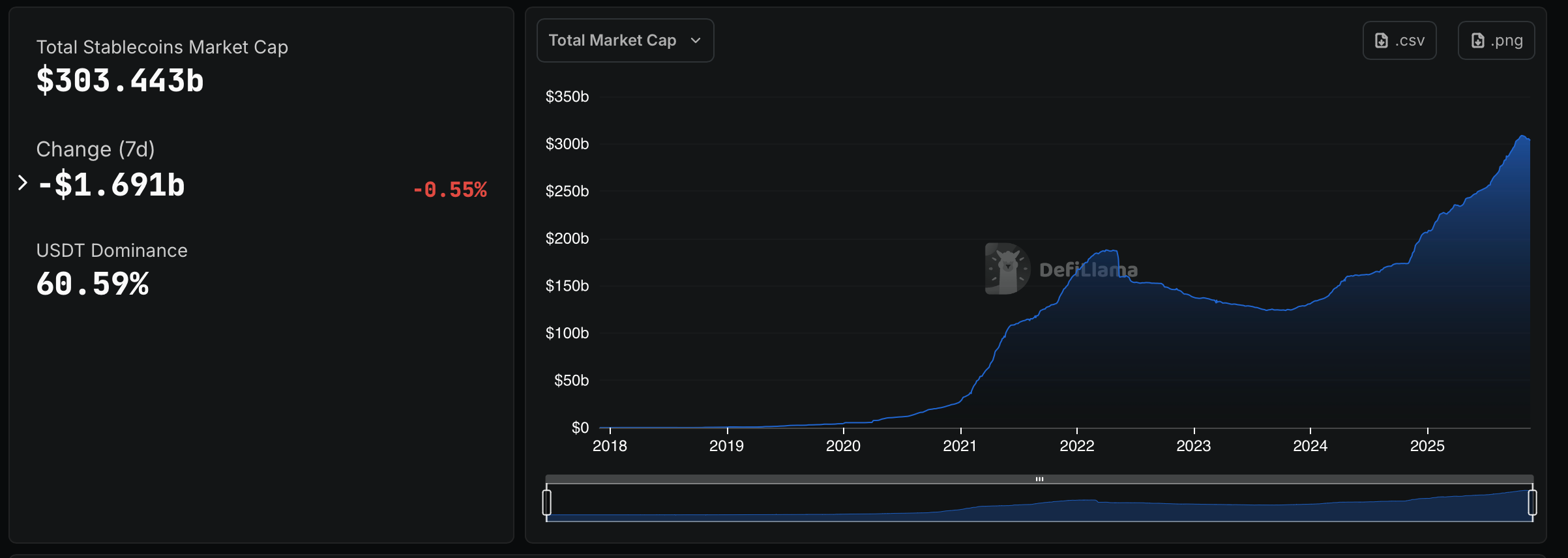

Рыночная капитализация стейблкоинов. Источник: Defillama

В октябре Western Union анонсировала планы по запуску USDPT, стейблкоина, привязанного к доллару США, эмитируемого Anchorage Digital Bank на блокчейне Solana (SOL). Токен предназначен для объединения цифровых и фиатных платежных систем компании и поддержки ее глобальных денежных переводов и казначейских операций.

В том же месяце JPYC, токийская финтех-компания, запустила первый в Японии стейблкоин с иеновым обеспечением — токен с привязкой 1:1 к иене, обеспечиваемый банковскими депозитами и государственными облигациями.

Также в октябре франко-германская банковская группа ODDO BHF запустила стейблкоин, привязанный к евро, в соответствии с регламентом Европейского союза «Рынки криптовалютных активов» (MiCA).

В сентябре европейский консорциум из девяти банков сообщил о планах запуска стейблкоина, привязанного к евро, для конкуренции с растущими стейблкоинами с долларовым обеспечением. Ожидается, что стейблкоин будет запущен во второй половине 2026 года.

Пов'язані матеріали

Valuation Rout of Old Titans: The Demise of a Generation's Asset Valuation Framework

"The Old Titans' Valuation Collapse: The Death of an Era's Valuation Framework" Between Alibaba's 2014 NYSE debut at $93.89 and its 2026 price of ~$95, twelve years have passed with zero price appreciation. This stagnation symbolizes a wholesale valuation reset for an entire generation of Chinese internet assets. Companies like Tencent, Pinduoduo, Meituan, Bilibili, and Kuaishou have seen catastrophic declines of 80-98% from their peaks. The core question arises: what framework now prices these companies, or has the framework itself expired? The valuation logic for Chinese internet stocks followed a clear "anchor-setting and anchor-removing" process. From 2014-2017, the dominant narrative was "US comparable discounting" – applying a growth premium and governance discount to US peers' multiples. This anchor loosened with the 2018 US-China trade war and the VIE structure risk, then was violently uprooted by the 2020-2021 regulatory crackdowns (Ant Group, Didi, anti-monopoly fines). The 2022 delisting panic and subsequent 2025-2026 geopolitical shocks (US military lists, AI espionage accusations) completed the demolition. The old "US对标打折" model is dead. However, this is not solely a China story. A structural mirror exists in US "old titan" stocks ("老登股"). In 2026, even Microsoft – with robust fundamentals – saw its PE compress from a 34x median to 22x, its worst performer status among the "Magnificent Seven" driven by a $190 billion annual AI capex crushing free cash flow. The core dilemma is universal: legacy platform giants, whether Alibaba or Microsoft, are spending colossal sums to chase an AI paradigm that may颠覆 their own high-margin, user/subscription-based business models. They have shifted from "companies defining the future" to "companies needing to prove they won't be淘汰ed by the future." This phenomenon of a dying valuation坐标系 has a historical precedent: post-1989 Japan. After its bubble burst, the "Japan premium" narrative ("most efficient manufacturing + perpetual growth") collapsed. A 25-year valuation vacuum ensued until Warren Buffett provided a new language in the 2010s: "low valuation + high dividend + governance reform." China's internet sector is now in a similar vacuum six years into its reset. While different from Japan's deflationary context, the parallel is clear: the old macro assumption of "deep integration with global capital" is falsified, but a new pricing framework is absent. Potential "new languages" for Chinese internet valuations are contradictory. AI transformation requires gutting profitable core businesses (e.g., Alibaba's ad-driven e-commerce) for an unproven consumption-based model, risking a Microsoft-like cash flow crunch. Alternatively, shareholder returns (buybacks/dividends) could build a floor, following Buffett's Japanese playbook, but current scales are insufficient to form a standalone anchor. The current state mirrors mid-1990s Japan: the old framework is dead, the new one unborn. The market waits in a vacuum for a重新定义ing force – a person, event, or proven business model shift – to answer "why buy." This may only be the middle phase of a prolonged re-rating.

marsbit2 хв тому

Valuation Rout of Old Titans: The Demise of a Generation's Asset Valuation Framework

marsbit2 хв тому

STRC Trading at Significant Discount, mNAV Falls Below Break-Even, Strategy's Valuation Logic Has Been Rewritten

Title: STRC Deeply Discounted, mNAV Falls Below Break-even, Strategy's Valuation Logic Redefined The recent volatility in MSTR and STRC highlights the need to reassess the core business model of Bitcoin reserve companies. These entities function more like leveraged, single-asset banks rather than software/tech firms. Consequently, they should be valued using banking metrics, not based on their total Bitcoin holdings. The key valuation metric is mNAV (market net asset value), akin to a price-to-book ratio. It compares the company's market capitalization to the equity value of its Bitcoin holdings after deducting all senior debt and preferred equity (like STRC). As of June 24, Strategy's mNAV was 1.10x. The focus should be on "net Bitcoin per share" (the Bitcoin claim per share after senior claims) and its growth rate, equivalent to a bank's book value and return on assets. Given STRC's 19% discount to its $100 par value (yielding 14.2%), issuing new MSTR equity at the current price to buy more Bitcoin is inefficient. It slightly dilutes the widely watched "total Bitcoin per share" metric while providing minimal improvement to the more critical "net Bitcoin per share." The article analyzes four potential uses for $1 billion in new equity: 1. **Buy Bitcoin:** Least effective. Improves net Bitcoin per share only marginally while diluting total Bitcoin per share. 2. **Repurchase STRC:** Most effective for balance sheet repair. The discount creates immediate value, increasing net Bitcoin per share by 1.0%, reducing debt burden, and lowering future dividend obligations. 3. **Boost Cash Reserves:** Dramatically improves the "cash coverage ratio" for STRC dividends from 9.8 months to 16.8 months, a crucial liquidity metric in a tightening funding environment. 4. **50/50 Split (STRC buyback & cash):** A balanced approach improving all key metrics. Strategy's own Q1 report indicates its internal break-even mNAV for profitable equity issuance to buy Bitcoin is 1.22x. With the current mNAV at 1.10x, such a move would be value-destructive. The core assumptions of its previous expansion model—issuing STRC at par and maintaining ample dividend coverage—have broken down. The recommended path is to use new capital to optimize core financial health: repurchasing discounted STRC and/or bolstering cash reserves. This would repair the balance sheet, signal liquidity strength, support STRC's price, lower its yield, and potentially reopen the par-value issuance channel. The current STRC discount represents a low-cost capital opportunity to restart this positive cycle. Bitcoin reserve companies must be evaluated as banks, focusing on book value, leverage, and liquidity resilience.

Foresight News3 хв тому

STRC Trading at Significant Discount, mNAV Falls Below Break-Even, Strategy's Valuation Logic Has Been Rewritten

Foresight News3 хв тому

South Korean Institutions' Crypto Race: Dual Explosion of Stablecoins and RWA

**Summary: South Korea's Institutional Crypto Race: Stablecoins and RWA Take Off** South Korea is undergoing a structural shift in its crypto ecosystem, moving beyond its historical role as a major retail trading hub. Major financial institutions and internet platforms are now building institutional-grade blockchain infrastructure, with stablecoins and Real-World Asset (RWA) tokenization as the primary drivers. The push for a regulated Korean won stablecoin market is a major policy and corporate focus. This is driven partly by an estimated $115 billion outflow into dollar stablecoins like USDC, threatening the domestic financial system. Banks (e.g., KB Financial, Hana), payment giants (e.g., Shinhan Card, BC Card), and internet super-apps (KakaoPay, NAVER Pay) are all conducting pilots. The goal is to anchor future digital finance to the Korean won and local regulations. In RWA, South Korea is advancing rapidly within regulatory sandboxes, focusing on unique domestic assets beyond typical global templates like US Treasuries. Projects involve tokenizing ships (with Hyundai Heavy Industries), defense supply chain assets, and K-pop intellectual property, alongside more conventional assets. A legal framework is set for 2027, and platforms like NXT are preparing for regulated trading. Key opportunities for crypto-native projects lie in providing the underlying technology these traditional institutions lack: global distribution channels for tokenized assets, cross-chain liquidity solutions, and enabling infrastructure tools (e.g., for asset packaging and management). Partnerships, such as Solana with Shinhan Card or LayerZero with the Korea Gold Exchange, exemplify this proactive approach. Crucially, user access is being shaped by consumer platforms. NAVER's planned acquisition of Upbit's operator Dunamu and Kakao's development of a unified wallet aim to seamlessly integrate crypto with everyday payments for tens of millions of users. The race is now about which protocols and projects will become the foundational standards as regulation solidifies and institutional adoption accelerates.

Foresight News1 год тому

South Korean Institutions' Crypto Race: Dual Explosion of Stablecoins and RWA

Foresight News1 год тому

Торгівля

Спот
活动图片