Grayscale Set To Debut First Spot Dogecoin ETF On Nov. 24: Bloomberg Expert

bitcoinistОпубліковано о 2025-11-18Востаннє оновлено о 2025-11-18

Анотація

Grayscale may launch the first US spot Dogecoin ETF as soon as November 24, according to Bloomberg Senior ETF analyst...

Trusted Editorial content, reviewed by leading industry experts and seasoned editors. Ad Disclosure

Grayscale may launch the first US spot Dogecoin ETF as soon as November 24, according to Bloomberg Senior ETF analyst Eric Balchunas, in what would mark the meme coin’s formal entry into the mainstream US ETF arena.

“Based on 20 day clock I believe Grayscale will be out with first Doge ETF in a week, 11/24,” Balchunas wrote on X, adding the caveat that “it won’t be 100% till exchange notice, but based on SEC guidance it looks good.” His comment refers to the 20-day period under Section 8(a) of the Securities Act, during which a registration statement can become automatically effective if the SEC does not step in and the issuer has removed the standard “delaying amendment” language.

First Dogecoin ETF Expected Within A Week

Grayscale is seeking to convert its existing Grayscale Dogecoin Trust into an exchange-traded fund that directly holds DOGE. The trust already exists as a single-asset vehicle with Dogecoin in custody; the ETF conversion would move it into the same structural category as spot Bitcoin and Ethereum ETFs, with daily creations and redemptions via authorized participants and shares listed on a national exchange. Once effective and listed, the vehicle would be rebranded as the Grayscale DOGE Trust ETF, providing brokerage and wealth-platform access to DOGE without requiring investors to handle wallets or exchanges.

Balchunas’ timing implies that Grayscale’s latest S-1 amendment started the 20-day clock in early November. If the SEC does not delay the filing and the listing exchange posts its notice in time, Grayscale could be first to market with a US spot Dogecoin ETF, even though a separate Dogecoin ETF, REX Osprey’s DOJE, has already begun trading in a different structure.

Grayscale is not alone. Bitwise and 21Shares are also in the queue with spot Dogecoin ETF filings that could follow relatively quickly if the SEC continues to tolerate automatic effectiveness.

Bitwise has filed the Bitwise Dogecoin ETF, a trust designed to hold DOGE as its sole asset and list on NYSE Arca. Bitwise, like Grayscale, has relied on the Section 8(a) mechanism by removing the delaying amendment, effectively starting its own 20-day window. Experts project a potential effective date only days after Grayscale’s, meaning Bitwise could launch a competing spot DOGE ETF in late November or shortly thereafter, assuming no SEC intervention.

21Shares, which already runs multiple crypto ETPs in Europe, has filed a US spot DOGE ETF as a commodity-based trust that tracks an index via physical holdings of DOGE. Its S-1 and associated exchange rule filing have been amended several times, and the product is structurally positioned to follow the Grayscale and Bitwise funds. However, its timeline is less tightly anchored to a specific 20-day window, so its launch is expected to trail the first movers rather than coincide with them.

All of these new products differ from the REX Osprey Dogecoin ETF (ticker DOJE), which has already debuted in the US. DOJE offers economic exposure to Dogecoin but does so via a 1940-Act fund structure that routes exposure through a subsidiary and includes allocations to another Dogecoin ETP rather than holding only spot DOGE in a straightforward commodity-trust format. That is why many analysts describe DOJE as “technically not a pure spot ETF,” and why the Grayscale, Bitwise and 21Shares vehicles are seen as the first true single-asset spot Dogecoin ETFs likely to define the institutional DOGE market once they go live.

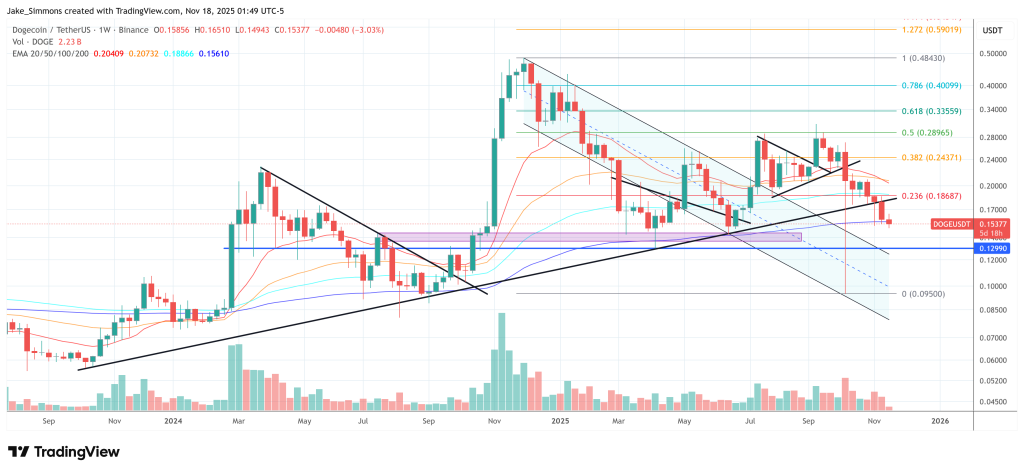
At press time, DOGE traded at $0.1537.
Dogecoin price
DOGE needs to hold above the 200-week EMA, 1-week chart | Source: DOGEUSDT on TradingView.com
Featured image created with DALL.E, chart from TradingView.com
Editorial Process for bitcoinist is centered on delivering thoroughly researched, accurate, and unbiased content. We uphold strict sourcing standards, and each page undergoes diligent review by our team of top technology experts and seasoned editors. This process ensures the integrity, relevance, and value of our content for our readers.

Jake Simmons has been a Bitcoin enthusiast since 2016. Ever since he heard about Bitcoin, he has been studying the topic every day and trying to share his knowledge with others. His goal is to contribute to Bitcoin's financial revolution, which will replace the fiat money system. Besides BTC and crypto, Jake studied Business Informatics at a university. After graduation in 2017, he has been working in the blockchain and crypto sector. You can follow Jake on Twitter at @realJakeSimmons.

Пов'язані матеріали

AI Bull Market Reprices Everything, Including the 'Male Valuation System' in the Marriage Market

The AI boom is redefining value across markets, including the male "valuation system" in the dating scene. A new hierarchy is emerging, based on company valuation, employee income, and industry status within the AI sector. At the top are NVIDIA and SK Hynix employees, dubbed the "T0 version." NVIDIA is the AI world's cash machine, while SK Hynix employees are seeing astronomical bonuses due to HBM demand, making them highly sought-after "AI concept stocks" in Korea's dating market. Next are OpenAI and Anthropic staff, representing the "new elite." Unlike the paper wealth of the past internet boom, these employees are actively realizing significant wealth through stock sales, though their status is considered more volatile. DeepSeek and ByteDance AI team members are rated as "top-tier." Their companies are engaged in fierce talent wars with massive investments, making these employees scarce, high-value players. Samsung and Tencent employees are seen as "NPCs" still searching for their AI "ticket." Samsung has been outpaced by SK Hynix in the memory race, while Tencent's more cautious AI investment contrasts with ByteDance's aggressive strategy, raising questions about their future position. Finally, traditional finance and crypto men are rated at the bottom ("pulled"). Their once-dominant wealth and status are being eclipsed by the new AI-driven economic order and its redistribution of value and opportunity.

Odaily星球日报9 хв тому

AI Bull Market Reprices Everything, Including the 'Male Valuation System' in the Marriage Market

Odaily星球日报9 хв тому

AI is Revaluing the Real World: Why Gold, Silver, and Copper are Becoming Important Again

AI is reassessing the value of the real world: why gold, silver, and copper are regaining importance. For over a decade, financial innovation centered on digitalization, from internet platforms to RWA tokenization. However, AI's rapid development highlights a deeper dependency: the physical infrastructure underpinning the AI era, not just code. Contrary to being "dematerialized," AI strengthens reliance on the real world. Every model training and deployment requires vast resources—data centers, energy grids, cooling systems, and critical industrial materials like copper, silver, and gold, which provide irreplaceable conductivity and durability. This shift is redefining the asset layer structure. A new "Asset Stack" is emerging: - Physical Layer: Metals, energy, and raw materials. - Financial Layer: Government bonds, ETFs, structured products. - Digital Layer: Tokenization infrastructure and programmable assets. The digital layer relies on the financial layer, which ultimately depends on the physical layer. While markets previously rewarded upper-layer assets like stocks and digital platforms, AI is redirecting attention to foundational real-world resources. S&P Global forecasts data center copper demand will surge from 1.1 million tons in 2025 to 2.5 million tons by 2040, amid a growing global supply deficit. This signals a long-term structural shift where energy, metals, and infrastructure form a critical "Physical Layer" that could limit AI's expansion. Tokenization alone doesn't create value; it connects markets to already-trusted assets. Successful tokenization requires mature demand, deep liquidity, and institutional consensus. Thus, the logical progression begins with sovereign debt (highest liquidity and trust), followed by gold (centuries of global consensus), then silver (blending reserve and industrial utility). Future expansion may include industrially critical materials like copper. Within gold, a key divergence is appearing. Gold ETFs solved "investability" but keep gold within traditional financial systems. Gold tokens, like Matrixdock's XAUm, explore making gold a functional part of the digital financial system—enabling instant settlement, cross-border collateral, and programmable utility without intermediaries. Looking ahead, industrial metals are evolving from commodities to strategic "functional assets." Silver faces a structural supply deficit, driven by demand from solar, EVs, and AI infrastructure. While gold represents a "Store of Value," metals like silver and copper are becoming "Stores of Function." Tokenizing them, as with Matrixdock's XAGm for silver, focuses not just on reserve value but on bridging physical commodity systems with digital infrastructure for efficient circulation. Ultimately, the asset layer is evolving to be more grounded in the strategic, physical realities of the economy. The most valuable assets for tokenization may not be the easiest to digitize, but those most essential for long-term economic and technological foundations.

链捕手2 год тому

AI is Revaluing the Real World: Why Gold, Silver, and Copper are Becoming Important Again

链捕手2 год тому

Торгівля

Спот
Ф'ючерси
活动图片