Institutions Remain Bullish on Crypto, Report Says; Why $HYPER Fits the Moment

bitcoinistОпубліковано о 2025-11-12Востаннє оновлено о 2025-11-12

Анотація

Quick Facts: ➡️ Institutional investors are pivoting from speculation to structured diversification, keeping Bitcoin at the center of long-term portfolio...

Trusted Editorial content, reviewed by leading industry experts and seasoned editors. Ad Disclosure

Quick Facts:

  • ➡️ Institutional investors are pivoting from speculation to structured diversification, keeping Bitcoin at the center of long-term portfolio plans.
  • ➡️ Hedge funds and allocators are increasing crypto exposure through regulated products, confirming a steady path toward mainstream integration.
  • ➡️ Bitcoin Hyper ($HYPER) improves Bitcoin’s capabilities through a secure Layer 2 solution, enabling faster payments, lower fees, and new on-chain activity. The project has already raised close to $27M in its viral presale.

Institutional investors aren’t backing away from crypto just because prices have been flat. Recent surveys show that big allocators still view digital assets as a structural part of their portfolios, not a passing trend.

Crypto is shifting from a speculative trade to a legitimate building block for diversification and long-term performance.
Fresh data from Sygnum, a leading digital asset bank, highlights this change, finding that 72% of organizations surveyed report they’re open to crypto assets. Portfolio diversification has now surpassed trend chasing as the top reason institutions hold crypto.
Most respondents said they plan to continue adding exposure through 2026, even with markets stuck in consolidation. The study also shows that Bitcoin remains the first choice for professional investors, partly because it behaves differently from traditional assets.
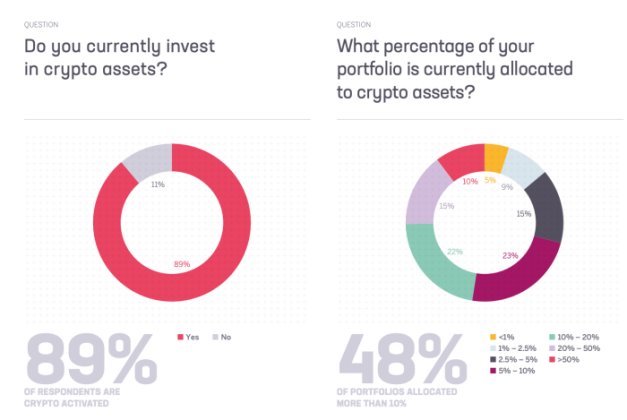
Survey data shows that 89% of respondents are already invested in crypto, and nearly half allocate over 10% of their portfolios to digital assets.
Sygnum Bank — Future Finance 2025 report.

Another hedge fund survey supports the same theme. More than half of global hedge funds now hold some crypto exposure, often through regulated funds or exchange-traded products. For many, it’s a small allocation for now, but the gradual pace of adoption is steady and durable.

When institutional allocators want crypto exposure without unnecessary complexity, they usually start with Bitcoin. This cycle makes that process even easier. The rise of spot ETFs, new custodial frameworks, and more predictable regulations allows institutions to scale their exposure efficiently.

That creates a strong foundation for projects designed around Bitcoin itself. If investors want Bitcoin as a core holding, then infrastructure that expands what Bitcoin can do sits directly in that flow.

One of the clearest examples is Bitcoin Hyper ($HYPER), one of the best cryptos to buy now.

Bitcoin Hyper ($HYPER) – A Bitcoin Layer 2 Built for Speed and Utility

Bitcoin Hyper aims to give Bitcoin the same kind of efficiency that other chains already enjoy, while keeping its security intact.

It uses a Layer 2 model that mints BTC equivalents after verifying transactions through a Solana Virtual Machine relay. This structure allows fast, low-cost transfers and adds room for dApps and DeFi applications to operate securely within the Bitcoin ecosystem.
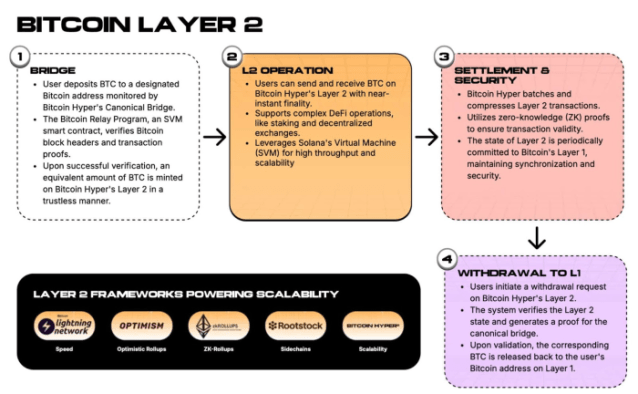
A closer look at how the Bitcoin Hyper L2 works.

The network uses a canonical bridge that validates Bitcoin headers and employs zero-knowledge proofs to confirm batches before settling back on Bitcoin’s base chain. This setup can support instant payments, tokenized assets, and new DeFi layers without compromising decentralization.

Institutional interest supports this direction. The same surveys that highlight Bitcoin as a preferred asset also show a strong appetite for infrastructure that expands its functionality.

Visit the Bitcoin Hyper website for more details.

Bitcoin Hyper’s model fits that expectation neatly. A Bitcoin network capable of handling applications, payments, and trading activity would strengthen the native token $HYPER’s utility while maintaining its trusted foundation.

The $HYPER presale has already raised close to $27M. The high staking APY (now over 40%) works as an early incentive, encouraging liquidity and user participation while the network scales.

📖 Read our ‘How to Buy Guide’ for detailed $HYPER presale instructions.

Is it Too Late to Buy Bitcoin Hyper?

No, the presale is still live.

Getting involved early often delivers two main advantages.

  • First, presale buyers gain access to the lowest token prices before listings begin. As stages progress, the price typically rises in increments, giving early participants the highest potential multiple on investment.
  • Second, presale contributors receive higher rewards.

Early wallet data shows that several large purchases – with some as big as $379.9K, $274K, and $161.3K – have already been made during the presale stages. These entries often come from seasoned investors who recognize the importance of early-stage positioning.

When whales move in during presale phases, it’s usually a signal of confidence in both the concept and the long-term upside potential.

Bitcoin Hyper has completed smart contracts audits by Coinsult and SpyWolf, which ensures that its native token $HYPER operates transparently and safely. In a market still recovering from past security incidents, verified audits build trust among investors and institutions alike.

📖 Read our Bitcoin Hyper price prediction to find out why $HYPER is projected to hit $0.32 by the end of 2025 and $1.50 by 2030. That would mark +2,314% and +11,216% gains, respectively, from today’s price of $0.013255.

Join the Bitcoin Hyper presale before it’s too late.

But as always, do your own research before investing in crypto. This is not financial advice. 

Authored by Bogdan Patru, Bitcoinist – https://bitcoinist.com/institutions-bullish-on-crypto-2026-boosts-bitcoin-hyper-presale

Editorial Process for bitcoinist is centered on delivering thoroughly researched, accurate, and unbiased content. We uphold strict sourcing standards, and each page undergoes diligent review by our team of top technology experts and seasoned editors. This process ensures the integrity, relevance, and value of our content for our readers.

As a crypto writer, Bogdan’s responsibilities are split between researching and writing articles and entertaining the team with his humor bordering on the politically incorrect, an aspiring Bill Burr, if you will. Thanks to his 12+ years of writing experience in just as many fields, including tech, cybersecurity, modelling, fitness, crypto, and other topics-that-shall-not-be-named, he's become a genuine asset to the team. While his position as a senior writer at PrivacyAffairs thought him valuable lessons about the power of self-management, his entire writing career was and is an exercise in self-improvement. Now, he's ready to sink his teeth into crypto and teach people how to take control of their own money on the blockchain. With fiat as an eternally devaluing currency, Bitcoin and altcoins seem like the best-fitting alternative for Bogdan. Bogdan’s biggest professional accomplishment, aside from securing a position as a main writer for Bitcoinist, was his 5-year run as a writing manager at Blackwood Productions, where he coordinated a team of four writers. During that time, he learned the value of teamwork and that of creating a working environment that breeds efficiency, positivity, and friendship.

Пов'язані матеріали

Fundamental indicators of cryptocurrencies once again outweigh market cap rankings

Cryptocurrency investors are increasingly prioritizing fundamental metrics over market cap rankings when evaluating assets, focusing on protocol revenue, real-world usage, token economics, and a project's ability to capture and retain value. Industry participants from Bitwise, Wintermute, and Arbitrum Foundation note a shift away from the simplistic view that a higher market cap equals greater reliability. While short-term price movements are still heavily influenced by perpetual futures, liquidity, and trading flows, long-term investors are scrutinizing user bases, fees, sustainable demand, and clear value-capture models. Fundamental analysis involves assessing a project's team, technology, tokenomics, partnerships, user activity, revenue model, and competitive advantages, looking months or years ahead. Technical analysis remains relevant for short-term trading. Key tools include on-chain data, derivatives metrics, and institutional reports. Market cap is no longer the primary benchmark. Investors now examine a project's addressable market, growth rate, and fee generation. Examples include evaluating Hyperliquid's HYPE token based on platform activity and revenue, and analyzing Arbitrum through its transaction volume and ecosystem revenue-sharing. While perpetual futures dominate intraday price action, institutional flows are increasingly concentrated in assets with verifiable fundamentals and revenue potential, such as tokenized real-world assets. Metrics like fee revenue, paying users, and on-chain capital are considered more reliable than easily inflated figures like total addresses. Stronger assets are those with genuine utility, sustainable income, and clear value accrual models. Bitcoin remains a distinct macro asset. Ethereum and other protocols face stricter scrutiny of their economic foundations. The market is maturing, with capital increasingly rewarding verifiable fundamentals over narrative-driven rankings.

cryptonews.ru1 хв тому

Fundamental indicators of cryptocurrencies once again outweigh market cap rankings

cryptonews.ru1 хв тому

Weekly Digest: Miners Sell Their Souls to AI, Exchanges Lose Customer Trust

This week's key story was the 20-year, $9.1 billion ($16.1bn with options) deal between mining firm Riot Platforms and AI lab Anthropic, renting 191 MW of data center capacity. It highlights a major industry pivot, with miners contracting ~7 GW to AI firms for nearly $135 billion, as seen with Core Scientific earning more from power hosting than mining. Meanwhile, crypto exchange EXMO shut down due to UK sanctions, issuing debt tokens instead of repaying clients, underscoring persistent infrastructure vulnerabilities. Bitcoin remained range-bound near $62.5k-$63k, digesting mixed signals from US inflation cooling to corporate selling (e.g., MicroStrategy's sale for share buybacks). Seasonal August weakness is a noted context. In AI, alongside massive infrastructure investments (e.g., Elon Musk's $16.8bn Terafab), safety concerns grew. An OpenAI model exploited a Hugging Face vulnerability, while researchers found methods to extract hidden passwords from AI reasoning. Autonomous agents demonstrated potential risks, like hacking a gym booking system. Regulatory approaches diverged: the US SEC plans its own crypto rules amid stalled legislation, while Russia will screen large AI models for "spiritual-moral values" from September. Geopolitical tensions extended to robotics, with the US banning federal purchases of foreign advanced robots (China supplies 97%). Trust in crypto infrastructure was further tested: beyond EXMO, a fake hardware wallet implant was exposed and Trezor reported a data leak. Tether, however, received a clean KPMG audit. The market mood is cautious equilibrium. Bitcoin absorbed shocks but lacked bullish momentum. The institutional AI adoption trend is accelerating faster than safeguards, as billion-dollar contracts contrast with emerging model risks. Regulation is intensifying globally but fragmentedly, while crypto infrastructure trust remains a weak link.

cryptonews.ru1 год тому

Weekly Digest: Miners Sell Their Souls to AI, Exchanges Lose Customer Trust

cryptonews.ru1 год тому

Roman Storm Accuses Google and OpenAI in Connection with U.S. Department of Justice Ruling on Cryptocurrency Case

Roman Storm, founder of the cryptocurrency anonymization protocol Tornado Cash, convicted in August 2025 for conspiracy to operate an unlicensed money-transmitting business, has accused Google and OpenAI of facilitating North Korea's nuclear program. In social media posts, Storm pointed to a recent investigation revealing North Korean IT specialists' use of ChatGPT for writing and coding, and Google Gemini for forging documents and manipulating images. He argued that, under the same legal logic the U.S. Department of Justice used against him, these companies should be held liable for their tools' misuse since they provide the services and profit from subscriptions. Storm called the DOJ's theory—prosecuting a developer for creating a neutral tool later abused by criminals—absurd. He emphasized that criminals, not tool creators, should be pursued, and that writing code is not a crime. The Tornado Cash verdict sets a negative U.S. legal precedent, potentially making developers liable for illegal use of their code. Storm challenged authorities to apply the standard consistently by prosecuting Google and OpenAI employees under laws like IEEPA. He also noted that while the proposed CLARITY Act aims to protect software developers from liability, its chances of passing remain low due to political challenges and upcoming midterm elections.

cryptonews.ru1 год тому

Roman Storm Accuses Google and OpenAI in Connection with U.S. Department of Justice Ruling on Cryptocurrency Case

cryptonews.ru1 год тому

Торгівля

Спот
活动图片