Cardano Founder Blasts Ghost Chain Critics: ‘Cavalry Is Coming’

bitcoinistОпубліковано о 2025-09-15Востаннє оновлено о 2025-09-15

Анотація

Broadcasting “from rough and rugged Wyoming” late on September 14, Cardano founder Charles Hoskinson delivered a forceful rebuttal to what...

Trusted Editorial content, reviewed by leading industry experts and seasoned editors. Ad Disclosure

Broadcasting “from rough and rugged Wyoming” late on September 14, Cardano founder Charles Hoskinson delivered a forceful rebuttal to what he called years of dismissive “ghost chain” narratives, arguing that the industry has “moved the goalposts” away from decentralization and toward VC-favored speed and token economics.

“It sucks to go to cryptocurrency Reddit and no matter what you say or do, you’re criticized and demeaned and attacked,” he said, after reading a community post lamenting the “overwhelming negative sentiment outside of our community.” Hoskinson’s message: Cardano will stick to its original brief—resilience, censorship resistance, and self-governance—and the payoff is near. “Keep the faith and don’t give up hope. The cavalry is coming. We are moving exactly as we need to,” he said.

Hoskinson Blasts Cardano Critics And ‘VC Chains’

The livestream’s central theme was a clash of first principles. Hoskinson traced early crypto’s mission to “disintermediation and decentralization,” saying the sector has since rewarded throughput and speculative manias—NFTs, GameFi, memecoins, and now RWAs—over credible neutrality. “The goalpost moved from disintermediation and decentralization to, well, let’s build high-performance systems and we don’t particularly care if those systems are resilient or decentralized,” he argued.

In his telling, Cardano’s refusal to compromise on those design goals explains both the network’s slower, research-driven cadence and its perceived under-appreciation in Web3 circles: “We’ve beat that drum and we’ve built protocol after protocol doing things the right way. Not the sexy way, not the VC-friendly way.”

Hoskinson framed the project’s past decade as an exercise in building durable primitives: the extended UTXO model for deterministic smart contracts; “liquid non-custodial staking”; the Ouroboros family of protocols; the Hard Fork Combinator for “telescoping” upgrades; end-to-end on-chain governance and treasury; and newer concepts such as isomorphic state channels, a partner-chains paradigm, and “Bitcoin DeFi” to align with what he called a principles-first ecosystem. “Every year, Cardano continues to get more decentralized, more resilient,” he said. “We’re able to take the best of all the ideas in the space, but never once have we compromised on who we are.”

On scalability, Hoskinson said Cardano is “on the dawn” of its next phase. He stated that “Leios is now in a SIP,” describing it as “the last stage before implementation” and “the foundation of a scalability agenda that is endless,” language he linked to a co-evolution with Hydra and advances in zero-knowledge cryptography. Taken together, he said, these efforts aim at “infinite scale just in time to absorb the needs of the economic, political and social systems abroad and at home.” He pointed to Hydra’s maturation—from a “toy” to demonstrations including a “vending machine” and tests he described as “a million transactions a second”—as a key pillar of the network’s L2 posture.

The founder set out a go-to-market plan that deliberately looks beyond crypto natives. “Less than 5% of the world is in the cryptocurrency space,” he said. “So why do we particularly care about a minority of a minority when there’s a big wide world out there?”

He urged “physicalizing Cardano,” citing Hydra-backed point-of-sale and ATM integrations, and stressed “rational privacy for all” through Midnight. He also cast Cardano as “the best place to launch a new blockchain,” linking that claim to the partner-chains initiative and what he called the “best AVS experience in the space.” Bitcoin remains the critical ally in this strategy, he said: “We have to partner with ecosystems that are principles first like Bitcoin… And we’re doing this with Bitcoin DeFi.”

Cavalry Coming?

Geographically, Hoskinson highlighted Argentina and Africa. He said Input Output maintains the “largest cryptocurrency office” in Buenos Aires and hosts biweekly events, adding that Cardano “continues to grow throughout Latin America.” In Africa, he said the long-trailed identity push is “almost ready to roll out,” with 2026 targeted to “turn on the ability to bring economic identity to the millions eventually billions who don’t have it.” Throughout, he contrasted these efforts with what he characterized as short-lived hype cycles: “To be truly a visionary, you have to accept that you have to go alone sometimes into the wilderness… And we’ve done that for 10 years.”

Governance milestones formed another through-line. Hoskinson declared the project’s “Voltaire” era “mission accomplished,” citing a community-elected constitutional committee, “hundreds of DReps,” a ratified on-chain constitution, and an annual budget. “We’re already talking about the next constitution and an incredible suite of governance tools,” he said, arguing that this collective machinery lets the ecosystem “speak with one voice,” ratify upgrades, and “converge to a budget” without compromising liveness or safety. “We are the only chain in the history of the cryptocurrency industry to do this,” he asserted.

The address included rare self-critique. Hoskinson said he wished Cardano had “moved faster in certain areas,” made “slightly different decisions about the ordering of the roadmap,” and staffed partnerships more aggressively. He nonetheless credited the privacy-focused Midnight initiative with “more than a hundred partnerships,” positioning it as a commercial bridge that “will bring hundreds more, if not thousands.”

He also revisited longstanding allegations from rival communities, saying he is “still inundated” with claims he “stole $600 million,” and added that a “128-page” forensic audit “gave complete exoneration,” a result he said received little attention from crypto media. “The asymmetries of information sting long, hard, and unfortunately take years or decades to undo,” he said.

Hoskinson closed by returning to community morale, urging Cardano’s governance participants to “forget the past and… look to the future,” redirecting energy toward entrepreneurs who can “bring in the countless millions to tens of millions to hundreds of millions of users.” The core bet, he said, is unchanged: that decentralization, credible governance, and research-led engineering will ultimately outlast every hype cycle.

“The next 24 to 36 months, Cardano will be in a position where it’s the fastest, most secure, and frankly speaking, best platform… to build anything at scale for anyone,” Hoskinson concluded, adding: “Cardano’s best days are ahead of it. I will always believe that. And that’s because Cardano has the best people.”

At press time, ADA traded at $0.89.
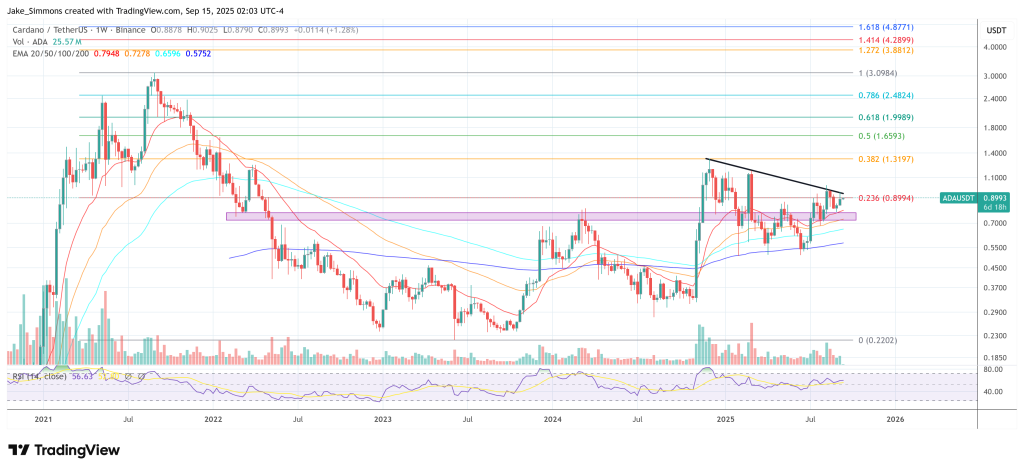
Cardano price
ADA bulls need to break the trendline, 1-week chart | Source: ADAUSDT on TradingView.com
Featured image created with DALL.E, chart from TradingView.com
Editorial Process for bitcoinist is centered on delivering thoroughly researched, accurate, and unbiased content. We uphold strict sourcing standards, and each page undergoes diligent review by our team of top technology experts and seasoned editors. This process ensures the integrity, relevance, and value of our content for our readers.

Jake Simmons has been a Bitcoin enthusiast since 2016. Ever since he heard about Bitcoin, he has been studying the topic every day and trying to share his knowledge with others. His goal is to contribute to Bitcoin's financial revolution, which will replace the fiat money system. Besides BTC and crypto, Jake studied Business Informatics at a university. After graduation in 2017, he has been working in the blockchain and crypto sector. You can follow Jake on Twitter at @realJakeSimmons.

Трендові криптовалюти

Пов'язані матеріали

How to Detect AI-Generated Videos? A Review of Dynamic, Traceable, and Explainable Detection Systems

**How to Detect AI-Generated Videos: A Survey on Dynamic, Traceable, and Explainable Detection Systems** With rapid advances in AI video generation (e.g., Sora, Veo), creating highly realistic, multi-minute videos is now possible, widening the gap with detection research. Current AI video detection, often limited to unreliable binary classifications, is insufficient. This survey, accepted at ACL 2026, reframes the goal as **"factual fidelity verification"**—checking if a video's content (who, when, where, what) aligns with the real world perceptually and cognitively. It categorizes AI-generated videos into three paradigms: **Local Manipulation Videos (LMV**, e.g., face swaps), **Audio-Visual Editing (AVE**, e.g., lip-syncing), and **Generative Video Synthesis (GVS**, fully synthetic videos like Sora's). Detection challenges evolve from visual artifacts in LMV to multi-modal inconsistencies in AVE and higher-level world knowledge violations in GVS. The core proposal is a **Vision-Language Dual-View framework** with four hierarchical layers: 1. **Layer 1 (Intrinsic Visual Cues):** Analyzes low-level signal statistics, noise patterns, and physiological signals. 2. **Layer 2 (Spatiotemporal Consistency):** Checks for temporal coherence in object motion and scene dynamics. 3. **Layer 3 (Cross-Modal Consistency):** Verifies alignment between video, audio, and text within the video. 4. **Layer 4 (Language-Guided World-Level Reasoning):** Uses external knowledge, facts, and physical laws to judge semantic plausibility and factual correctness. The survey traces a shift in detection focus from lower layers (1 & 2) toward higher, language-involved layers (3 & 4). It also reviews evolving evaluation metrics and datasets tailored for each video paradigm. The conclusion advocates for a **dynamic, evidence-first detection system** that moves beyond simple classification. Future trustworthy detection requires combining visual evidence (from CV) with semantic reasoning and explanation (from NLP & multimodal AI), ultimately creating traceable and explainable judgments about a video's adherence to real-world constraints.

marsbit28 хв тому

How to Detect AI-Generated Videos? A Review of Dynamic, Traceable, and Explainable Detection Systems

marsbit28 хв тому

It Turns Out the First Real-World Application of AI x Crypto is in Security Auditing

The article explores the surprising trend where AI's first major impact on crypto has been in security auditing, not in areas like trading or analytics. It details how AI-powered tools are dramatically lowering the barrier to finding smart contract vulnerabilities, enabling attackers to scan thousands of contracts and execute exploits within minutes. This has rendered traditional, manually-produced audit reports with their month-long validity periods increasingly obsolete, creating a critical "structural crack" in the old security model. Cases like Drift Protocol and KelpDAO show that even extensively audited protocols can be hacked through social engineering, operational flaws, or infrastructure misconfigurations beyond pure code review. Attackers are also using AI to find and exploit vulnerabilities in years-old, deployed contracts. Notably, OpenZeppelin's co-founder has expressed a grim view that "all DeFi is insecure" due to AI's asymmetric advantage. In response, the audit industry is undergoing a fundamental shift. While there's a short-term spike in defensive re-audits, the long-term business model is changing. Firms are developing AI-assisted systems and moving from one-time report deliveries towards embedded, continuous services like real-time monitoring and formal verification. Examples include AI tools uncovering critical, previously missed vulnerabilities in heavily audited protocols like Curve Finance and Zcash. The conclusion is that security must become a continuous investment, not a one-time checkbox, and audit firms must rapidly evolve their tools and service models to survive.

marsbit34 хв тому

It Turns Out the First Real-World Application of AI x Crypto is in Security Auditing

marsbit34 хв тому

Never expected that the first tangible application of AI x Crypto is in security auditing

Unexpectedly, the initial major application of AI in the Crypto sphere has turned out to be security auditing. In 2026, DeFi has faced significant security challenges, with 121 hacking incidents resulting in approximately $942 million in losses. While AI was expected to first impact areas like quantitative trading, its initial breakthrough has instead transformed security auditing by drastically lowering the cost and skill barrier for finding smart contract vulnerabilities. The traditional audit model is facing obsolescence. Advanced AI models, such as Claude Mythos, enable attackers to scan thousands of contracts and identify vulnerability patterns at scale, compressing the time from discovery to execution to mere minutes. This renders the month-long validity of traditional audit reports ineffective. Notably, attacks now frequently target well-audited, established protocols by exploiting business logic flaws, operational security weaknesses, and even years-old historical contracts, demonstrating that old audit reports offer zero protection. This pressure is forcing a fundamental shift in the industry. In the short term, a wave of defensive re-auditing is occurring, driven by projects seeking to meet new AI-era security standards and regulatory requirements. In the long run, audit firms' business models are diverging. The one-time report delivery model is declining in value, as evidenced by platforms like Code4rena shutting down. Leading firms are now pivoting towards AI-powered defense, integrating continuous monitoring, real-time on-chain risk detection, and embedding security directly into the development phase, as seen with tools like OpenZeppelin's Skills system. Ultimately, the era of "audit once, secure forever" is over. Security must become a continuous, embedded infrastructure investment for projects. For audit companies, survival depends on proactively transforming from traditional service providers into platforms offering AI-native, ongoing security solutions.

链捕手42 хв тому

Never expected that the first tangible application of AI x Crypto is in security auditing

链捕手42 хв тому

Торгівля

Спот

Популярні статті

Як купити ADA

Ласкаво просимо до HTX.com! Ми зробили покупку Cardano (ADA) простою та зручною. Дотримуйтесь нашої покрокової інструкції, щоб розпочати свою криптовалютну подорож.Крок 1: Створіть обліковий запис на HTXВикористовуйте свою електронну пошту або номер телефону, щоб зареєструвати обліковий запис на HTX безплатно. Пройдіть безпроблемну реєстрацію й отримайте доступ до всіх функцій.ЗареєструватисьКрок 2: Перейдіть до розділу Купити крипту і виберіть спосіб оплатиКредитна/дебетова картка: використовуйте вашу картку Visa або Mastercard, щоб миттєво купити Cardano (ADA).Баланс: використовуйте кошти з балансу вашого рахунку HTX для безперешкодної торгівлі.Треті особи: ми додали популярні способи оплати, такі як Google Pay та Apple Pay, щоб підвищити зручність.P2P: Торгуйте безпосередньо з іншими користувачами на HTX.Позабіржова торгівля (OTC): ми пропонуємо індивідуальні послуги та конкурентні обмінні курси для трейдерів.Крок 3: Зберігайте свої Cardano (ADA)Після придбання Cardano (ADA) збережіть його у своєму обліковому записі на HTX. Крім того, ви можете відправити його в інше місце за допомогою блокчейн-переказу або використовувати його для торгівлі іншими криптовалютами.Крок 4: Торгівля Cardano (ADA)Легко торгуйте Cardano (ADA) на спотовому ринку HTX. Просто увійдіть до свого облікового запису, виберіть торгову пару, укладайте угоди та спостерігайте за ними в режимі реального часу. Ми пропонуємо зручний досвід як для початківців, так і для досвідчених трейдерів.

1.0k переглядів усьогоОпубліковано 2024.12.10Оновлено 2026.06.02

Як купити ADA

Обговорення

Ласкаво просимо до спільноти HTX. Тут ви можете бути в курсі останніх подій розвитку платформи та отримати доступ до професійної ринкової інформації. Нижче представлені думки користувачів щодо ціни ADA (ADA).

活动图片