a16z's Latest Discovery: The Capital Winds Have Shifted, Blowing from 'Bits' to 'Atoms'

marsbitОпубліковано о 2026-08-24Востаннє оновлено о 2026-08-24

Анотація

In its "Charts of the Week," a16z highlights three structural shifts in the U.S. economy indicating capital and labor are moving from digital ("bits") to physical ("atoms"). First, ETF themes have rotated from clean energy and healthcare in 2020 to AI, nuclear energy, space, defense, and infrastructure by 2026. Second, data center construction is a major economic driver, creating high-wage blue-collar jobs with significant wage premiums (up to 50% for construction workers) and reshaping local economies. Third, ride-hailing prices are rising (Uber fares up ~20% since 2024), while the gig economy sees explosive growth in social commerce. Meanwhile, AI agents, though early-stage, are consuming nearly 5x more tokens than humans and beginning to displace traditional automation tools like Zapier.

Author: Moses Sternstein, a16z

Compiled by: Deep Tide TechFlow

Deep Tide Introduction: This week, a16z's 'Charts of the Week' outlines three forming structural forces in the U.S. economy. Firstly, the themes of ETFs have completely changed in just a few years—from clean energy, emerging market technology, and healthcare in 2020, to AI, nuclear power, space, defense, and infrastructure dominating by 2026. Secondly, data centers are not only behemoths of capital expenditure but are also quietly reshaping blue-collar employment and wages: offering construction workers an hourly wage approximately 50% higher than the market rate. Thirdly, ride-hailing prices are rising, with 'social commerce' emerging strongly in the gig economy. Meanwhile, AI Agents, though in their infancy, are consuming nearly 5 times more tokens than humans and beginning to encroach on traditional automation tools. These three scenarios point to the same conclusion: the winds of capital and labor are shifting from 'bits' back to 'atoms'.

The Wind of Thematic Rotation

ETFs have become an increasingly prominent presence in public markets, especially for retail investors. Beyond thematic ETFs, there are active and passive ETFs, index-tracking ETFs, credit ETFs—a wide variety, with varying degrees of leverage. The surge of ETFs owes much to low fees, low barriers to entry, easier distribution, and excellent marketing (and, of course, an overall increase in retail participation).

According to Citadel data, ETF net inflows are heading towards their strongest year on record, with July hitting an all-time high.
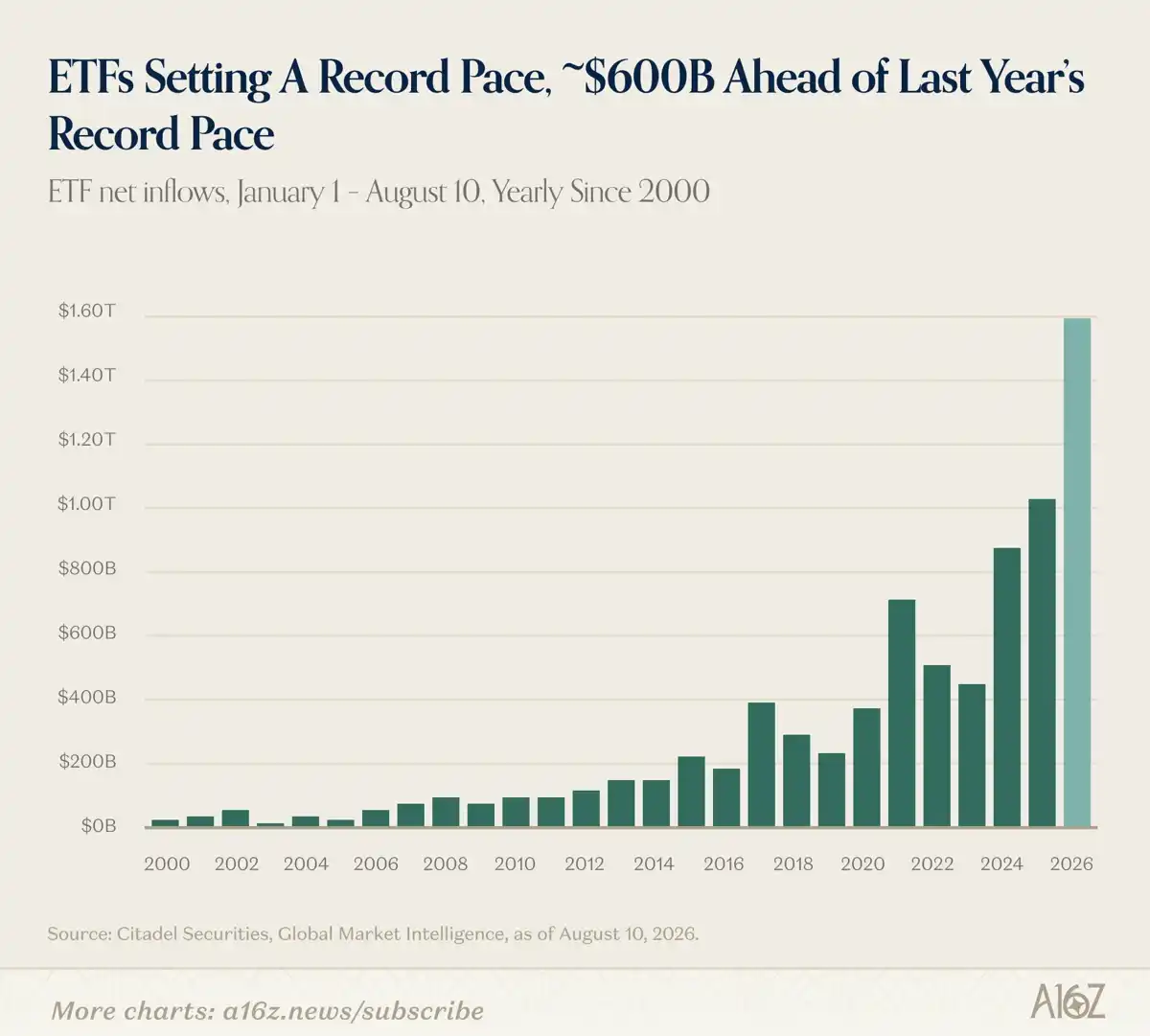
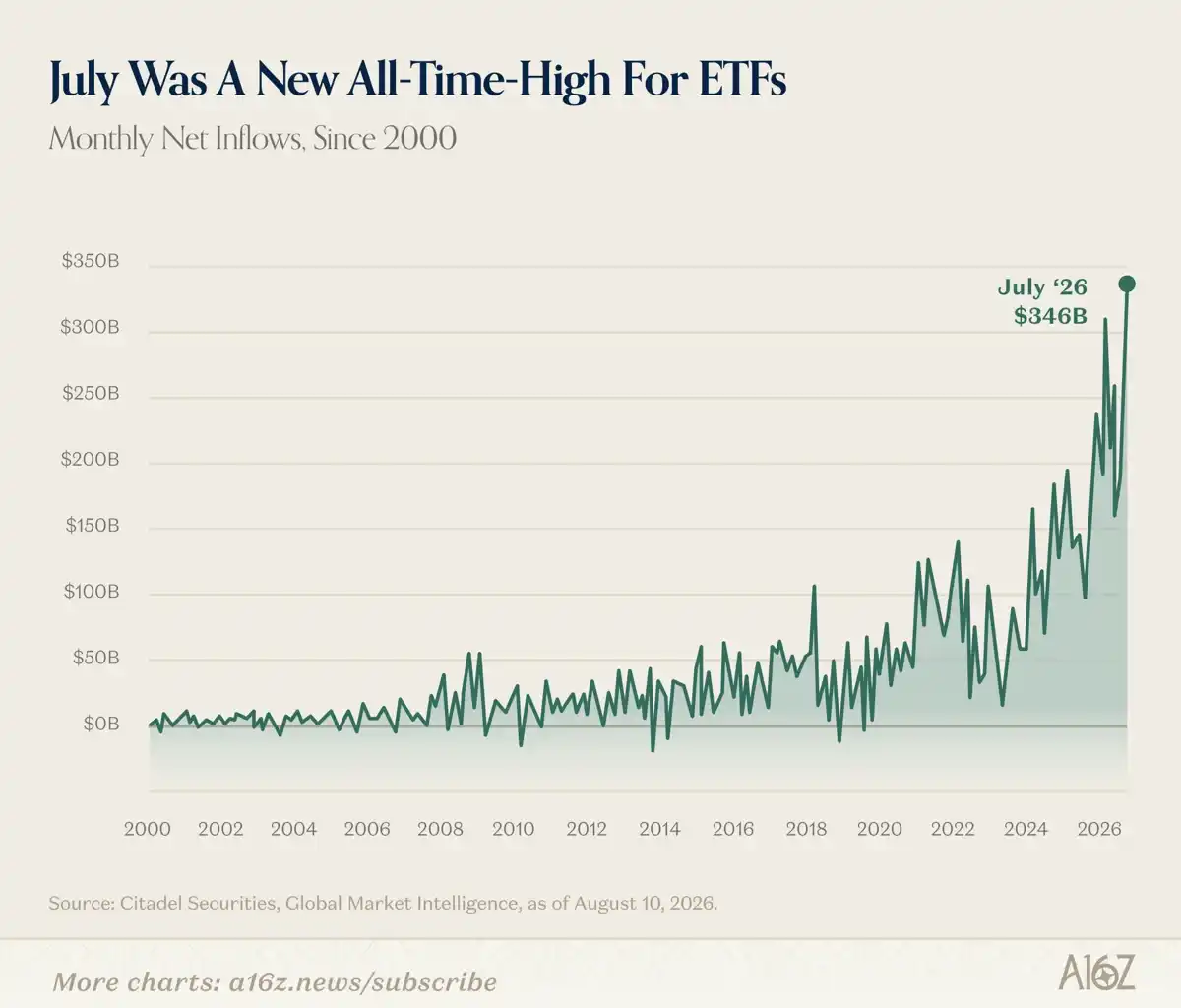
One thing ETFs excel at is latching onto any hot theme of the moment. "Oh, you think robotics is the next big opportunity? We have an ETF for that. Want to ride the memory chip rocket? You'll love the taste of DRAM. Looking for something spicier? Try our latest photonics product PHOX; it pairs nicely."

That statement is interesting in itself, but perhaps more intriguing is how dramatically the 'themes' of ETFs have rotated in a relatively short period—
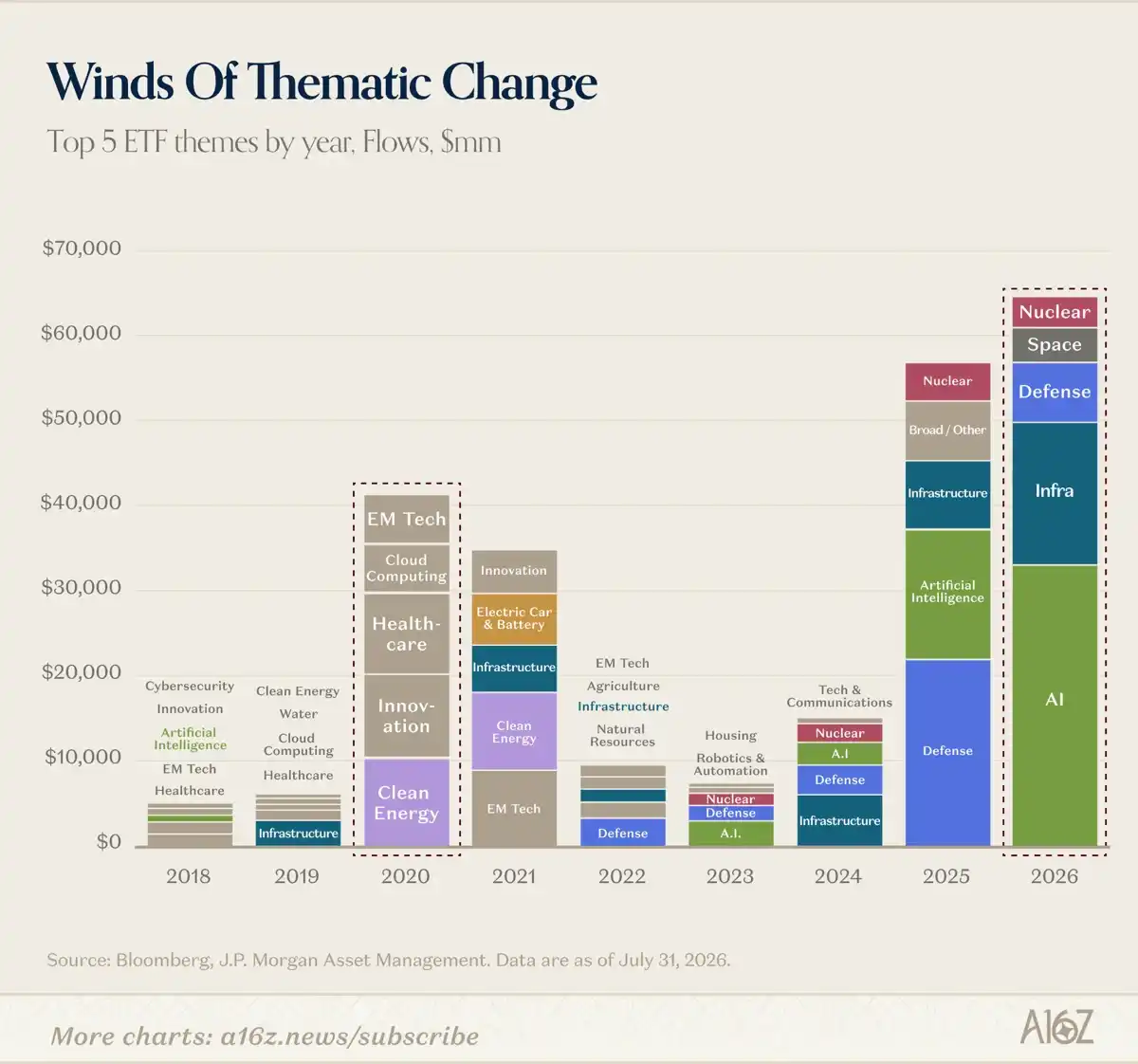
In 2020, the top five themes included clean energy, emerging market technology, and healthcare. By 2026, the thematic narrative has been completely rewritten: AI, nuclear power, space, defense, and infrastructure dominate the rankings.

For capital-intensive, ambitious businesses where 'atoms matter more than bits,' this amounts to an ETF blitz. As for the outcome, the charts cannot predict, but it must be said: 2026 is indeed far more interesting than before.

Data Centers Are a Boon for Blue-Collar Workers

People might love putting data centers into their ETFs, but somehow, they increasingly dislike seeing data centers near their homes.

I don't intend to jump into that debate prematurely (at least not yet). I'll just say this: whether you like it or not, data centers are economically significant, and in some cases, they are the most important thing locally.

For states that are actually building data centers, this construction represents a significant portion of all non-residential building expenditures:
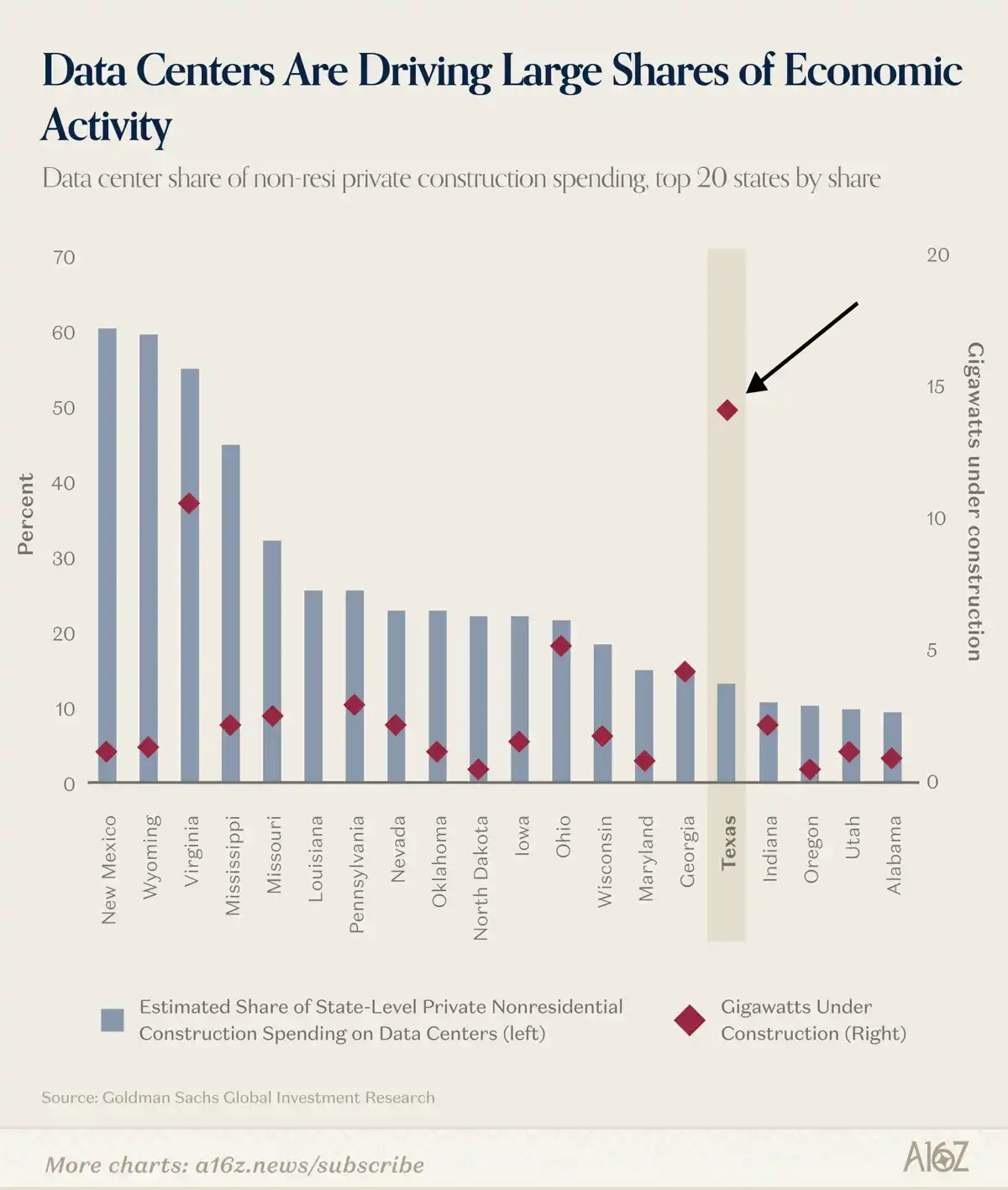
New Mexico and Wyoming aren't building much—under 3 gigawatts under construction—but because these states don't have much construction activity to begin with, data centers account for about 60%(!) of private non-residential building spending. Even in a much larger state like Pennsylvania, a mere ~3 GW of data centers approaches 30% of non-residential spending. In contrast, Texas, with much more capacity under construction, only accounts for 10% of total spending—still substantial but far less dramatic than 60%.

Regardless, no matter your view on data centers, one fact remains unchanged: they are one of the most important (if not *the* most important) economic pulses at present.

Wells Fargo attempted to parse the 'notable economic benefits' accompanying data centers (whether operational or under construction):
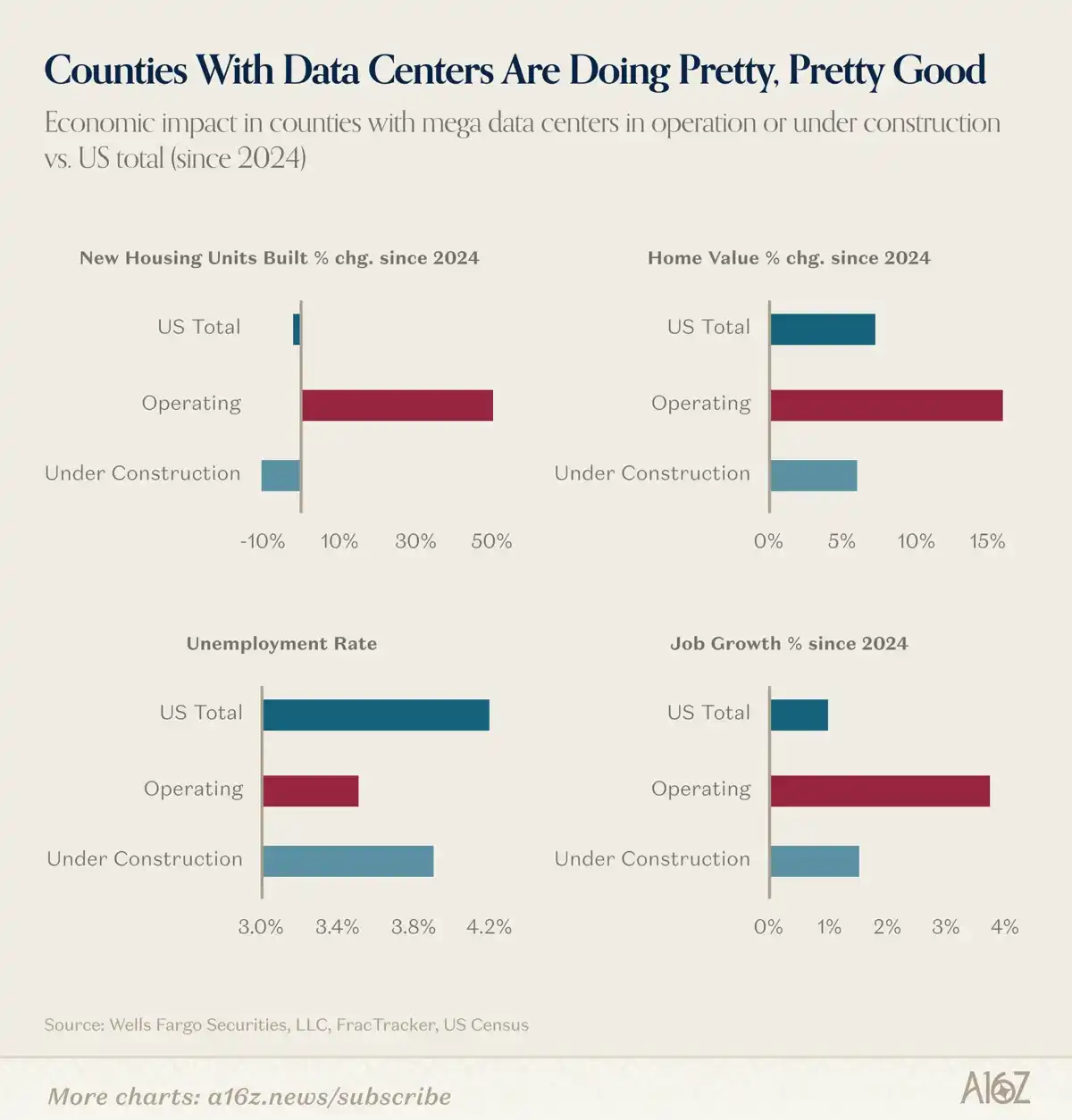
Since 2024, counties with operational data centers have uniformly better metrics: more housing, higher home prices, lower unemployment, faster employment growth. For counties building data centers, employment conditions are indeed better, but new housing construction has seen a more noticeable decline, and home price increases aren't as high.

To be fair, causality here isn't clear-cut. Many existing (and new) data centers are in Loudoun County, Virginia—one of the wealthiest counties in the U.S. Similarly, many new data centers are in Texas, which experienced historic residential construction (and home price increases) before 2024, so the housing decline starts from a much higher base.

But back to the point above: building a data center is almost certainly good for employment. Beyond the hundreds of hard-hat jobs being created, data centers offer significantly better pay than comparable employers:

According to Indeed data, data centers offer wage premiums as high as 64% (facility manager), and even the lowest-paid electrical engineers see a 10% premium.
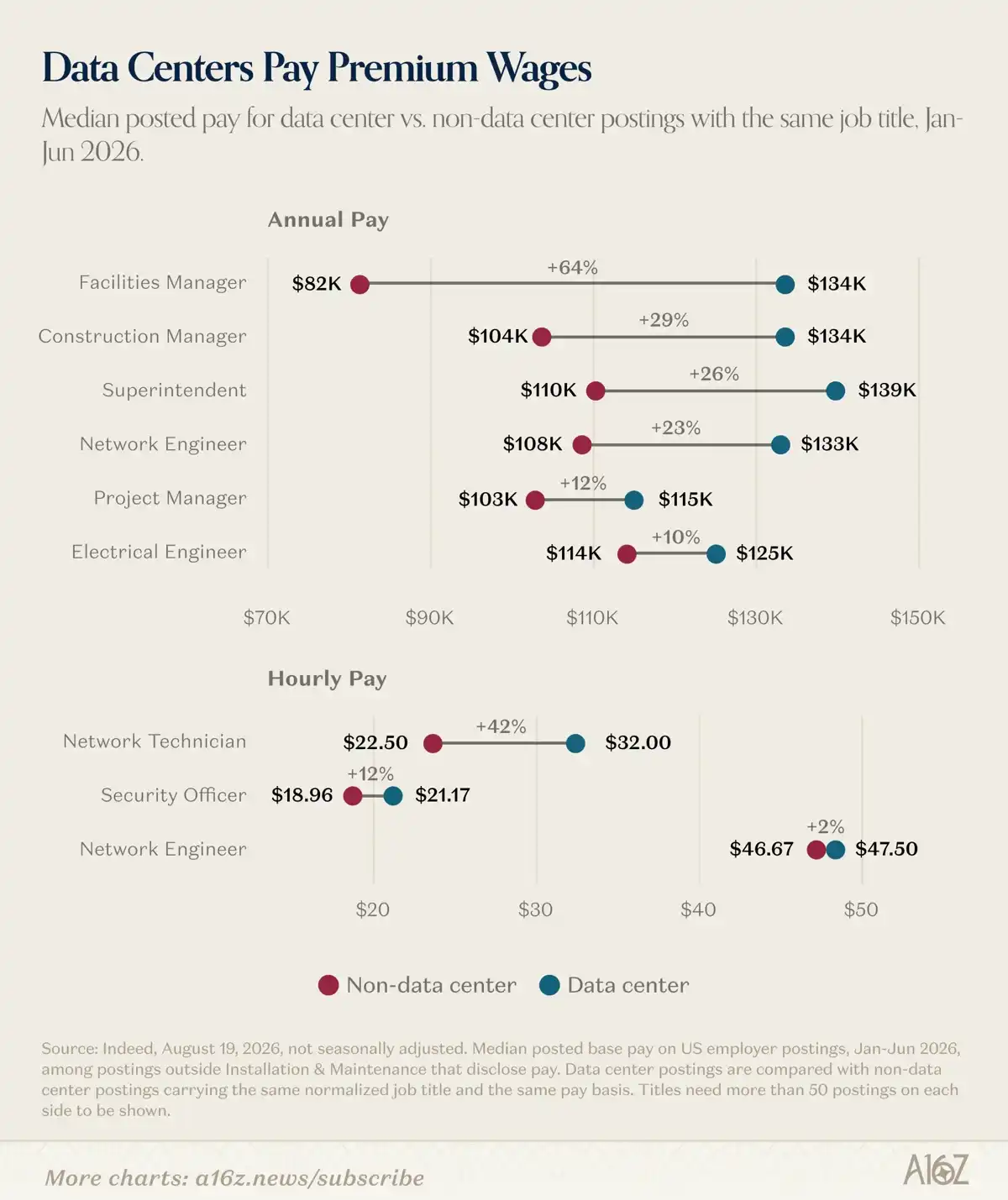
Data centers are making good times even brighter for skilled trades. A recent commentary from a Dallas Fed report hits the nail on the head:

A heavy industrial construction contractor stated: "We've been offering what we thought were competitive wages for skilled concrete workers, $28–$32 per hour. Data centers are offering $45 per hour, plus a $150 per day per diem."

For concrete workers on data centers, that's about a 50% wage premium—a life-changing raise.

ADP data tells a similar story. Looking at wage premiums for job switchers—a proxy for 'where demand is hot,' since a raise is needed to induce someone to change jobs—premiums for data-center-related categories are simply 'sizzling':
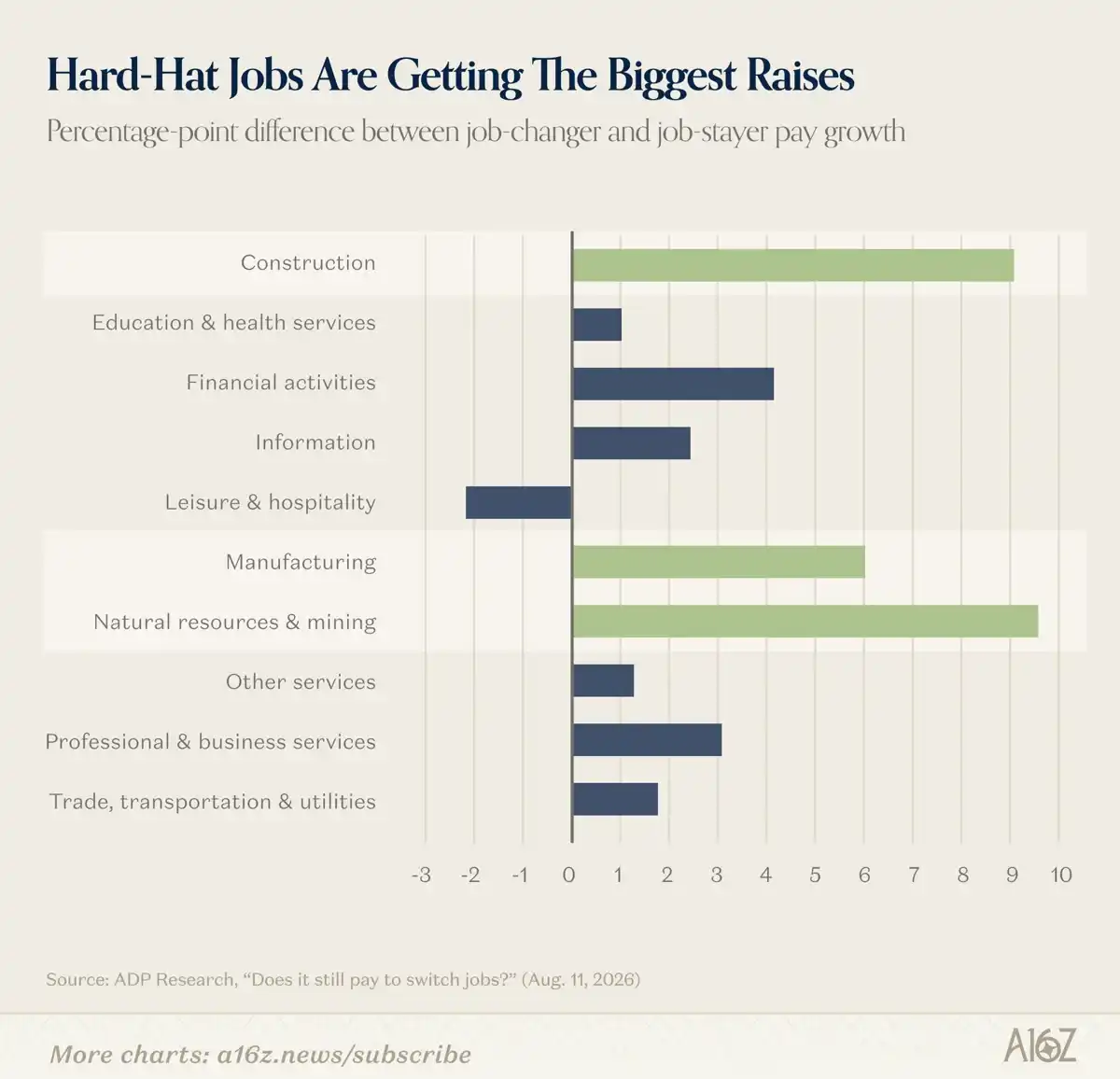
Wage growth for job switchers in construction, manufacturing, and natural resources/mining is 6–9.5 percentage points higher than for those who stay. This switching premium far exceeds that of any other industry.

Again, the point here is not to deliver a definitive defense of data centers. The point is to note: saying 'no' to data centers almost certainly means saying 'no' to higher wages for blue-collar workers (and the surrounding most substantial investment pulse).

Ride-Hailing Is Indeed More Expensive—It's Not Your Imagination

If you feel Uber rides have been more expensive lately, it's probably because—they are. At least, that's what Gridwise Analytics data suggests.

Since 2024, both the average and median Uber fares have increased by about 20% (and seem to keep climbing):
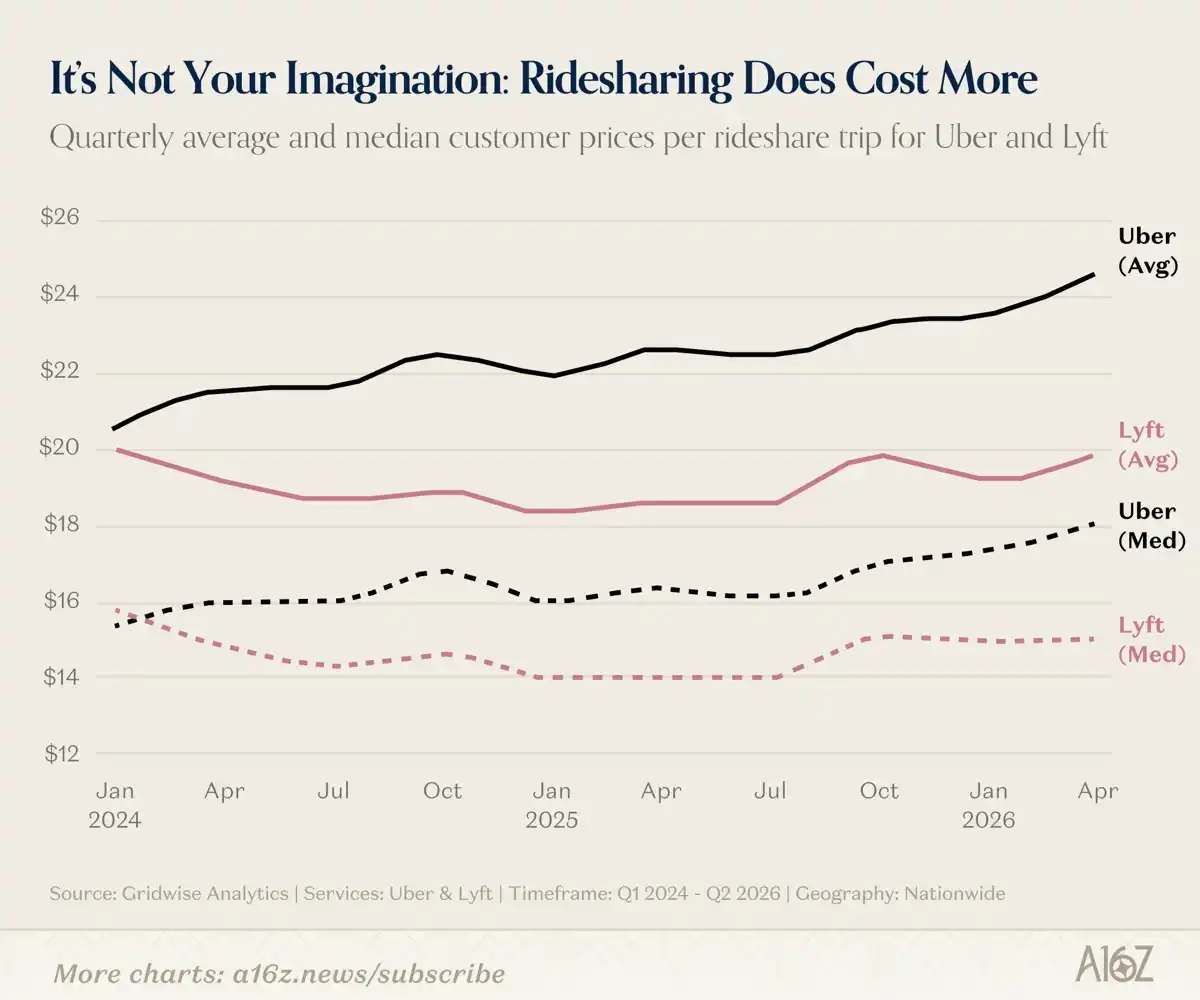
Notably, during this period, only Uber has increased prices—Lyft's median and average fares are actually slightly cheaper than at the start of 2024 (overall about 24% lower than Uber), although they have also risen recently.

A significant source of the price increase seems to be rising platform fees, especially for Uber:
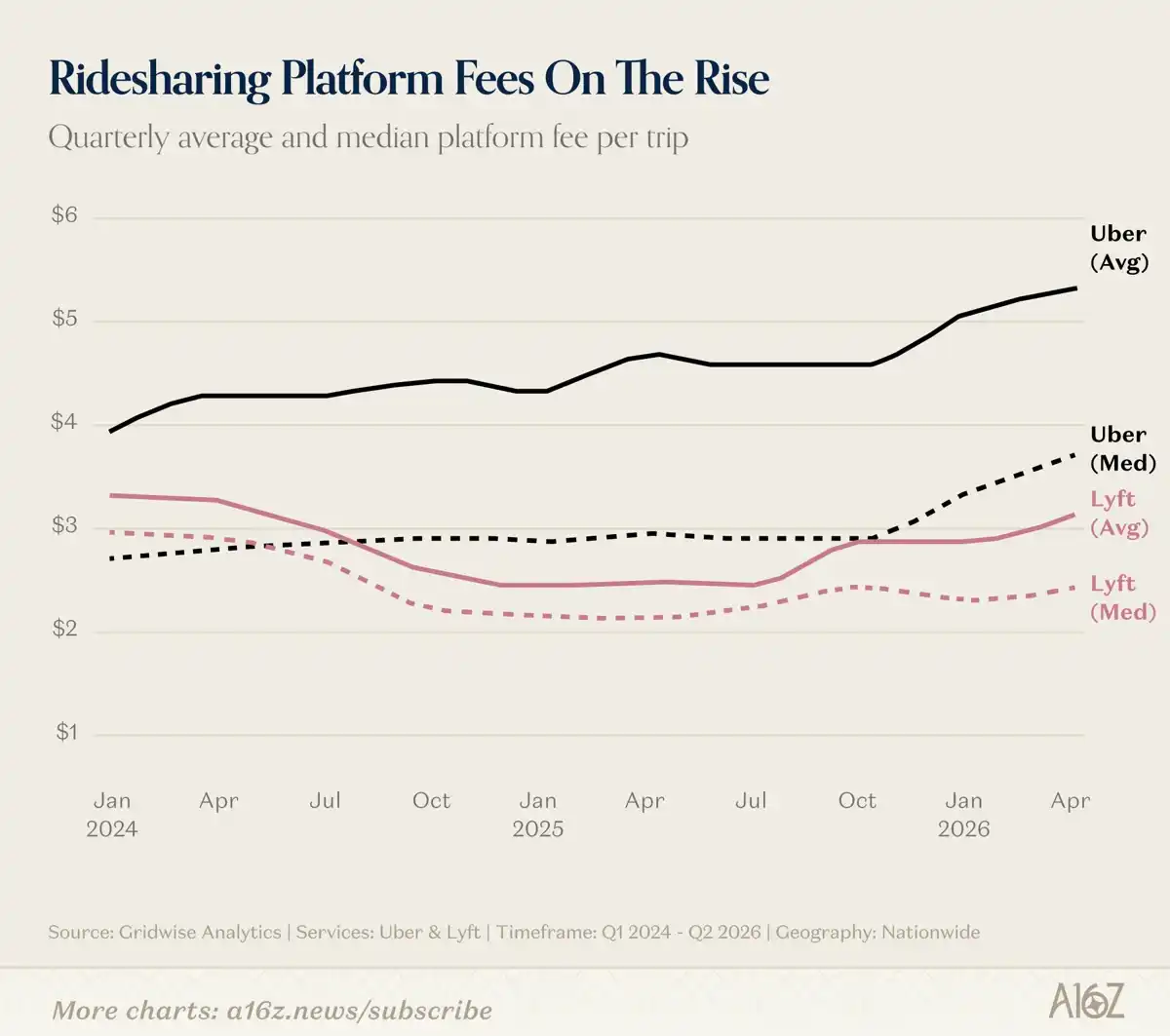
Uber's platform fees have been steadily rising over the past year (median fees jumped noticeably in October), while Lyft's platform fees, after a period of significant decline, have only just started to rise.

This is good for Uber and good for Lyft.

To be fair, it's not just the platforms benefiting—Uber/Lyft drivers are also getting a share:

Average gross driver earnings per trip have also been rising continuously since 2024, recently hitting an all-time high.

In the long term, whether higher ride-hailing prices will put downward pressure on demand remains to be seen; but for now, fares are getting more expensive, and the gains are flowing to both platforms and drivers.

Another interesting aside: despite the overall weak hiring market, besides more people starting their own businesses, more are also turning to 'gig' work—likely partly attracted by rising earnings.

However, while ride-hailing gigs are growing in popularity, they are far from the fastest-growing type of gig. The hottest new thing in the gig space is undoubtedly 'social commerce,' the QVC of the social media era:

In Bank of America's client accounts, all categories of gig work grew except vacation rentals, but social commerce surged over 30%, far outpacing any other category—despite a smaller base.

Exactly why social commerce is exploding is anyone's guess. Perhaps it's the shift of media consumption from TV to social, combined with the broader e-commerce boom; it's also likely that AI has lowered the cost of all other aspects of running a social-media version of QVC, making social commerce a more sustainable livelihood for more people. Or maybe Instagram's ad targeting is just too precise to resist. Or perhaps all of the above.

AI Agents Are Early, But Already Changing the Game (And Other Stories from the Frontier)

Charts previously observed: although overall AI demand is rising, growth is far from normally distributed. There's a massive divergence in usage between median and heavy users, and recent data from OpenAI (OAI) suggests this divergence is widening further.

Output tokens for the typical enterprise roughly doubled, but the top 10% are pulling further away:
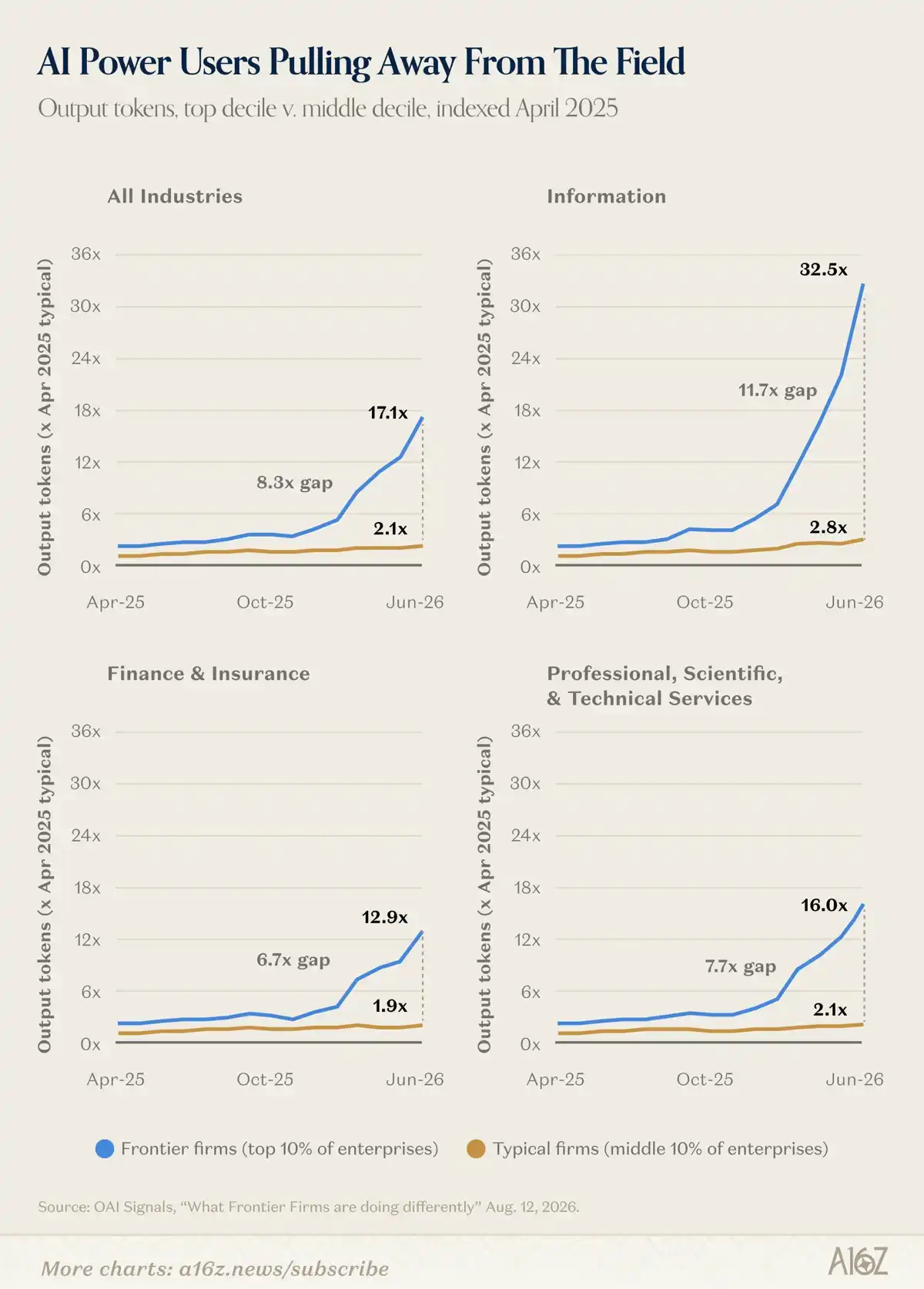
Across all industries, the token output gap between the typical enterprise and the top 10% is about 8x, with the latter's output growing over 17x since April 2025. In certain specific industries, the gap is larger—close to 12x in the Information (i.e., tech) sector, where the top 10%'s token output is 32.5x(!) higher than over a year ago.

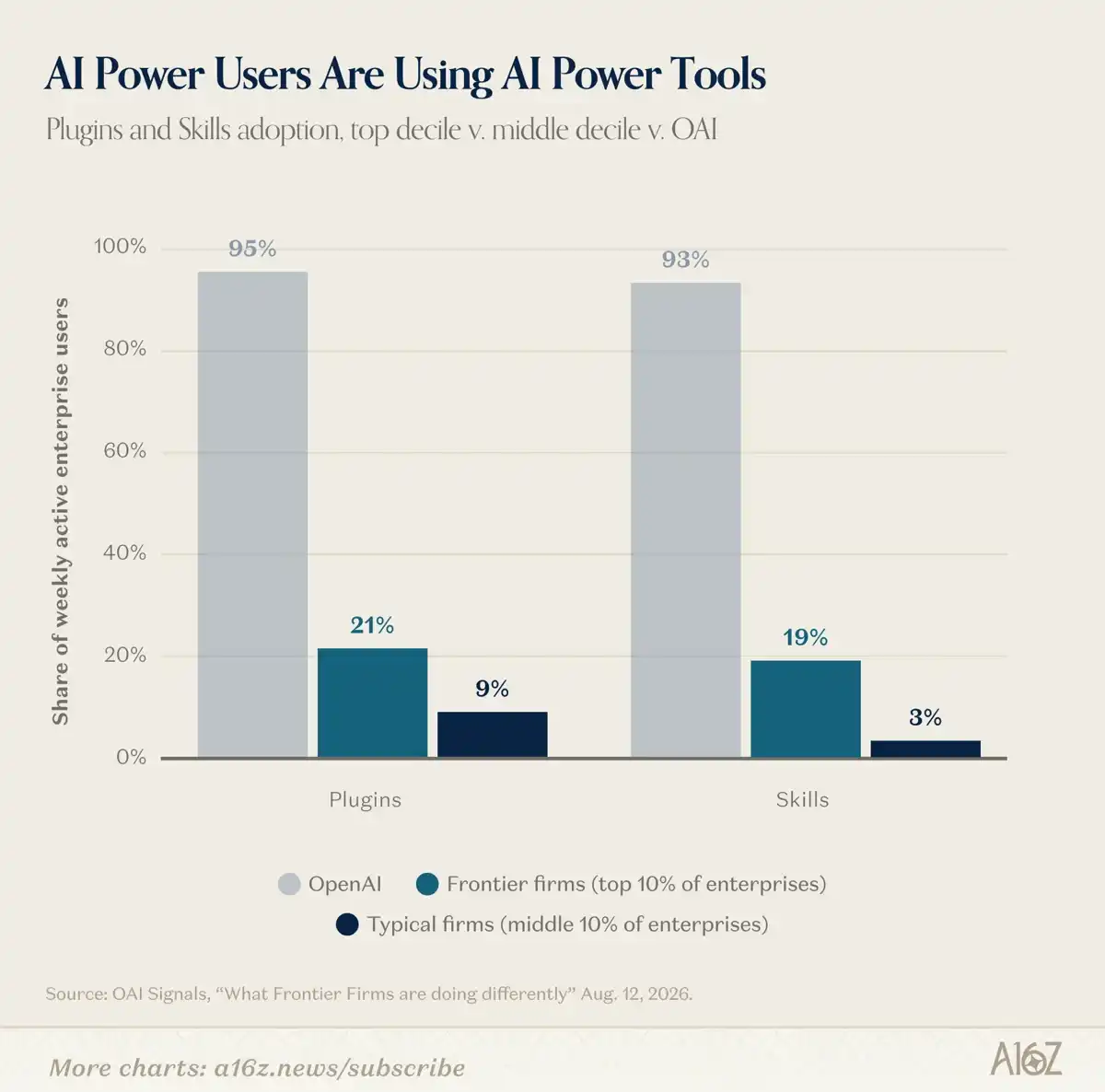
Unsurprisingly, heavy users aren't generating more tokens by chatting with AI companions. They have largely moved beyond chatting toward more advanced AI tools:

The adoption rate of plugins and Skills among the top 10% is about 2x and 6x that of the typical enterprise, respectively, although even heavy users have a long way to go compared to OAI's internal adoption levels.
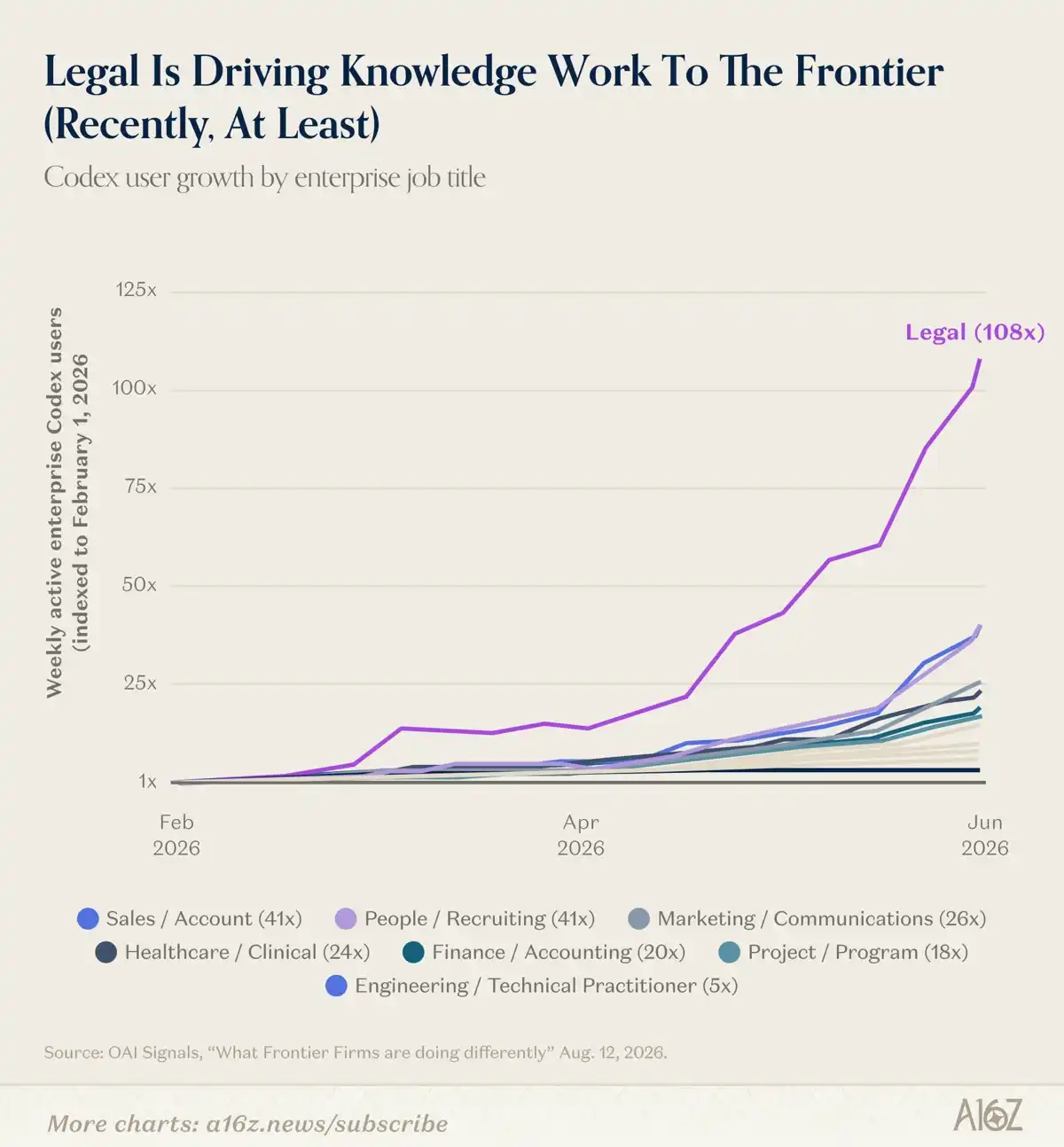
However, interestingly, tech is not the sector with the fastest recent growth in adopting more powerful tools. If Codex adoption is used as a measure of maturity, then overall knowledge worker maturity is increasing, but no group stands out more than legal professionals:

Codex adoption among legal practitioners has skyrocketed 108x since February 2026. How much of this is driven by broader Codex rollouts is debatable, but regardless, the legal field stands out.
Another implication of this shift towards more sophisticated AI adoption is that it is dramatically changing the growth and composition of token consumption.

Although only a tiny fraction of AI adopters have deployed full Agents, Agents contribute a massive share of tokens:

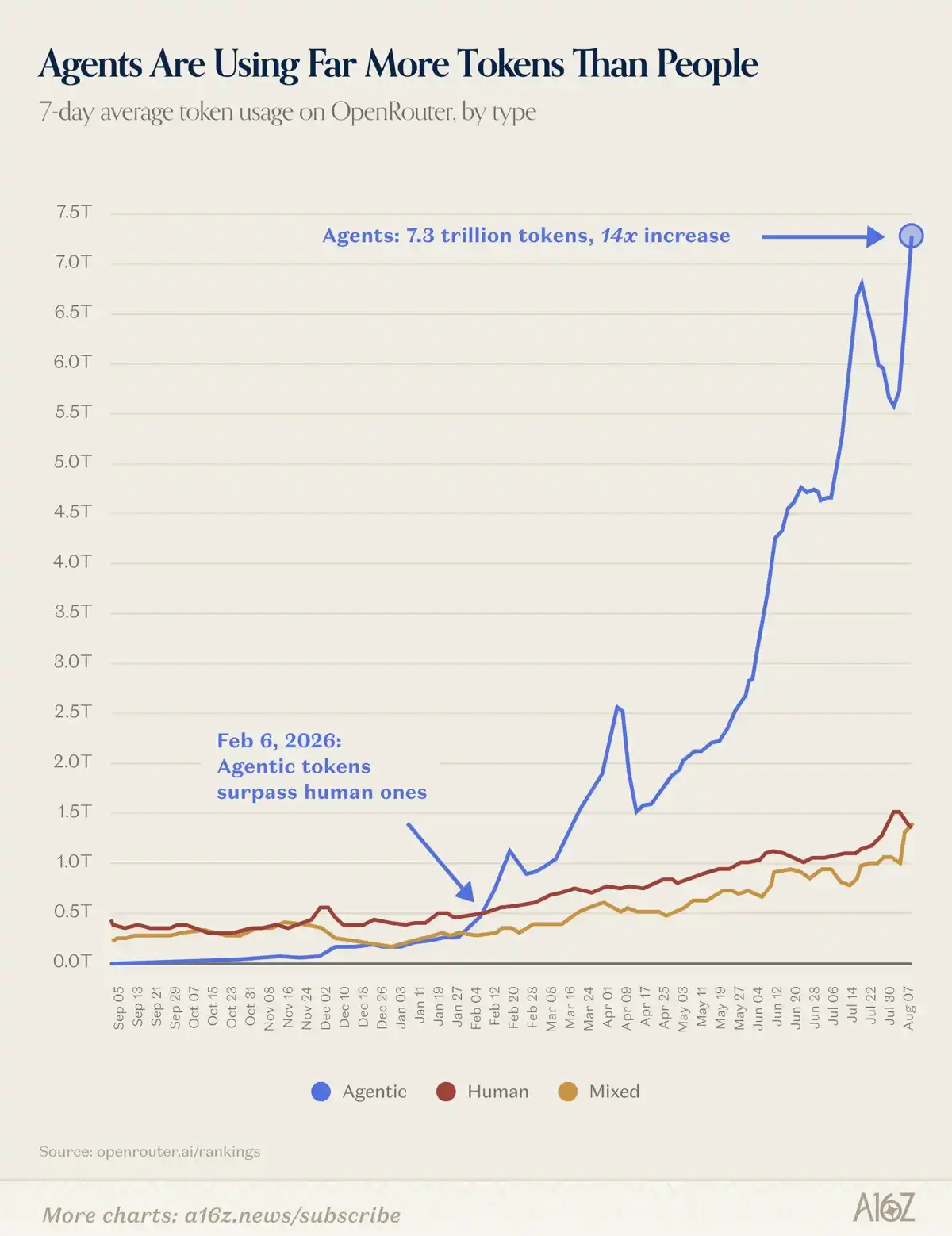
According to OpenRouter (and chart author Peter Walker), Agents use almost 5x more tokens than humans, and Agent usage has grown about 14x since February.
Agents not only use far more tokens than humans but also use them in a fundamentally different way. Agents do much more work with cached tokens than humans do:

Also according to OpenRouter, over 85% of Agent token consumption comes from cached prompts—and cached tokens constitute almost all of the relative growth in token usage.
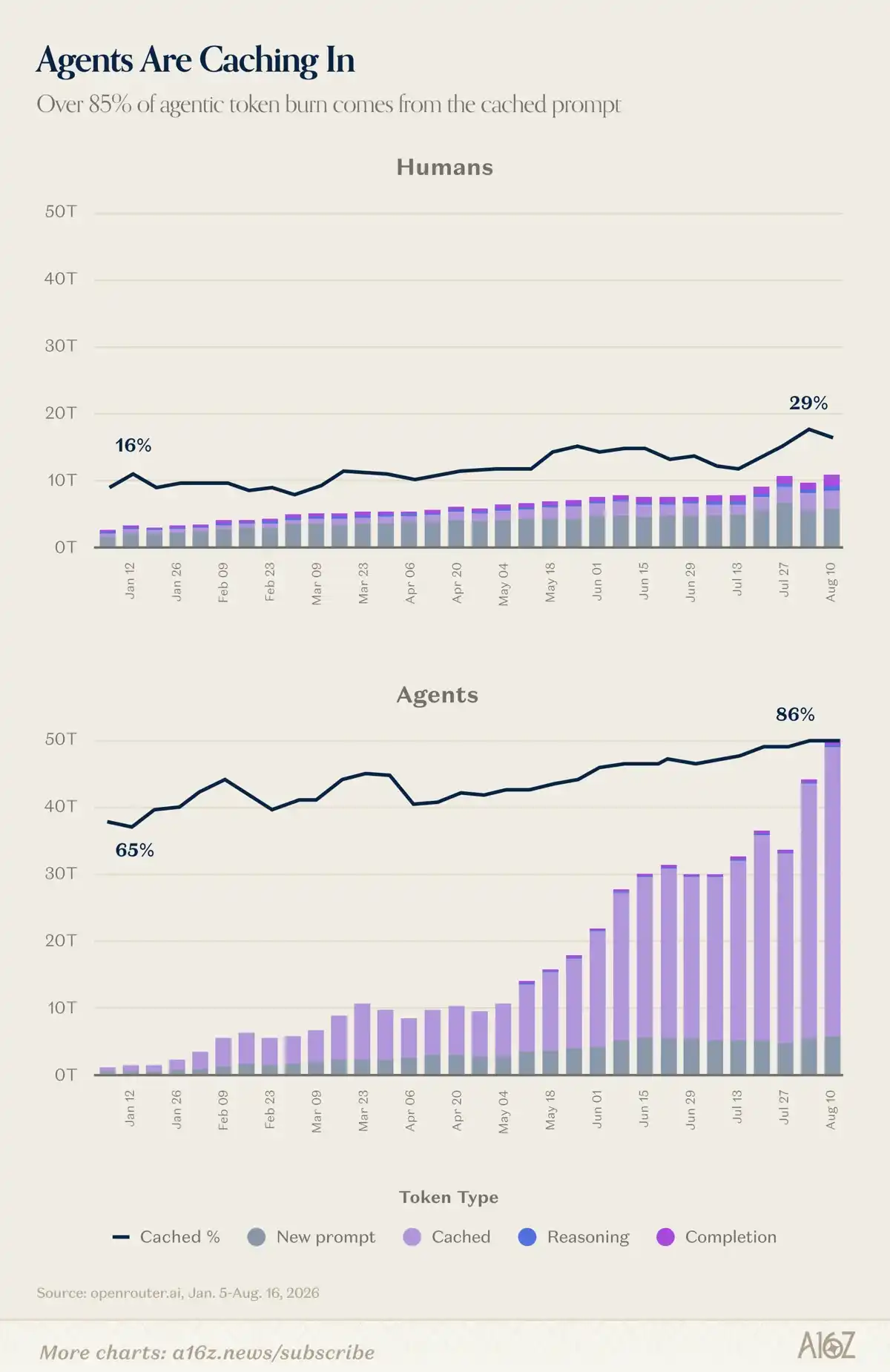
The reason is fairly straightforward: humans tend toward 'question-answer' dialogues, while Agents are designed to iterate repeatedly toward a goal. The initial prompt contains token-dense 'pre-fill' (i.e., core context around the goal, be it policy processes, code specifications, etc.), then the Agent incrementally reads and writes—progressively adding content to the cache as it moves toward a final result.

Cached tokens are far cheaper than pre-fill—this is good, making Agent economics increasingly viable—but (by definition) are also extremely memory-intensive. Now you understand why high-bandwidth memory is especially sought after—all those busy Agents (which don't need to start from scratch each cycle) need memory to 'fire.' And though overall development remains very early, Agents are proliferating rapidly.

Another notable potential second-order effect of Agents: they may be undermining demand for traditional automation and workflow tools.

According to Similarweb data, traffic to automation tool websites is consistently declining, except for Gumloop:

N8N, Zapier, and Make all predate LLMs, and although they dominate the entire automation segment (by visits), each has seen double-digit declines on a rolling 12-week basis. In contrast, Gumloop, launched in 2023 as an 'AI-native Agent builder,' is the only automation platform still gaining momentum (per Similarweb).

It's too early to pronounce death on the Zapiers—they have AI too—but Agents have just arrived and are already substantively changing the game.

To be continued.

Трендові криптовалюти

Пов'язані питання

QWhat is the main conclusion of the a16z report regarding capital and labor trends?

AThe main conclusion is that the direction of capital and labor is shifting from the digital ('bits') back towards the physical ('atoms'). This is evidenced by changes in ETF themes, significant investment in data centers impacting blue-collar jobs, and rising prices in services like ride-hailing.

QHow have the themes of top-performing ETFs changed from 2020 to 2026 according to the article?

AIn 2020, the top themes were clean energy, emerging market tech, and healthcare. By 2026, the leading themes have completely shifted to AI, nuclear energy, space, defense, and infrastructure, reflecting a move towards capital-intensive 'atoms'-focused industries.

QWhat economic impact do data centers have on local employment and wages?

AData centers create a significant number of construction jobs and offer substantial wage premiums. For example, concrete workers for data centers can earn about a 50% higher hourly wage compared to the market rate. Data center-related roles, such as facility managers, can command wage premiums as high as 64%, significantly boosting local blue-collar employment and income.

QWhat is the trend in Uber and Lyft pricing as described in the article?

ASince 2024, Uber's average and median fares have increased by about 20% and continue to rise, largely due to increasing platform fees. In contrast, Lyft's fares were slightly cheaper than at the start of 2024 and about 24% lower than Uber's on average, though they have recently started to increase as well. Drivers for both platforms have also seen their gross earnings per trip rise to record highs.

QWhat role do AI Agents play in the current AI landscape according to the report?

AAI Agents, though still in early stages, are consuming nearly 5 times more tokens than human users and are growing rapidly. They operate differently, heavily utilizing cached tokens for iterative tasks, which is more memory-intensive. Their rise is also potentially disrupting demand for traditional automation and workflow tools like Zapier, as seen with the growth of AI-native platforms like Gumloop.

Пов'язані матеріали

Fields Medalist Stumped, Claude Solves 78-Year Mystery, Possibly the Most Important AI Achievement in Mathematics

A 78-year-old mathematical problem—whether the six-dimensional sphere (S6) admits a complex structure—has been answered affirmatively in just three days by Harvard mathematician Levent Alpöge with the assistance of Claude, an AI system. The work constructs an explicit complex manifold X and rigorously proves it is diffeomorphic to S6, bypassing decades of inconclusive theoretical debate. Previous attempts by distinguished mathematicians, including Fields Medalist Michael Atiyah, had fallen short. The 108-page proof details a novel geometric construction: starting with a (3,4,∞) triangle group acting on the upper half-plane to form a base sphere with three singular points, then attaching a family of complex 2-tori over most points. The three singularities are filled using distinct classical techniques (Mumford's toric degeneration and Kodaira's logarithmic transformations with multiplicities 3 and 4). The resulting compact complex threefold X is shown to be simply connected with trivial fundamental group, matching the homology of S6. Applying established results by Smale, and Kervaire & Milnor, it is concluded that X is indeed the standard smooth 6-sphere. This achievement is part of a rapid series of breakthroughs by Alpöge using Claude, including a claimed counterexample to the 87-year-old Jacobian conjecture in July and significant progress on the Riemann zeta function in early August. Experts note that while prior AI contributions involved searching or combining existing results, this work represents the active *creation* of a new mathematical object. If verified, it stands as a landmark demonstration of AI's potential in fundamental research.

marsbit25 хв тому

Fields Medalist Stumped, Claude Solves 78-Year Mystery, Possibly the Most Important AI Achievement in Mathematics

marsbit25 хв тому

Торгівля

Спот

Популярні статті

Що таке $S$

Розуміння SPERO: Комплексний огляд Вступ до SPERO Оскільки ландшафт інновацій продовжує еволюціонувати, виникнення технологій web3 та криптовалютних проектів відіграє ключову роль у формуванні цифрового майбутнього. Один з проектів, який привернув увагу в цій динамічній сфері, — це SPERO, позначений як SPERO,$$s$. Ця стаття має на меті зібрати та представити детальну інформацію про SPERO, щоб допомогти ентузіастам та інвесторам зрозуміти його основи, цілі та інновації в рамках web3 та крипто-сектору. Що таке SPERO,$$s$? SPERO,$$s$ — це унікальний проект у криптопросторі, який прагне використати принципи децентралізації та технології блокчейн для створення екосистеми, що сприяє залученню, корисності та фінансовій інклюзії. Проект розроблений для полегшення взаємодії між користувачами новими способами, надаючи їм інноваційні фінансові рішення та послуги. У своїй основі SPERO,$$s$ прагне надати можливості індивідам, забезпечуючи інструменти та платформи, які покращують користувацький досвід у криптовалютному просторі. Це включає в себе можливість більш гнучких методів транзакцій, сприяння ініціативам, що підтримуються спільнотою, та створення шляхів для фінансових можливостей через децентралізовані додатки (dApps). Основна концепція SPERO,$$s$ обертається навколо інклюзивності, прагнучи зменшити розриви в традиційній фінансовій системі, використовуючи переваги технології блокчейн. Хто є творцем SPERO,$$s$? Особистість творця SPERO,$$s$ залишається дещо невідомою, оскільки є обмежені публічно доступні ресурси, що надають детальну інформацію про його засновників. Ця відсутність прозорості може бути наслідком зобов'язання проекту до децентралізації — етики, яку багато проектів web3 поділяють, ставлячи колективні внески вище за індивідуальне визнання. Зосереджуючи обговорення навколо спільноти та її колективних цілей, SPERO,$$s$ втілює суть наділення без виділення конкретних осіб. Таким чином, розуміння етики та місії SPERO є більш важливим, ніж ідентифікація єдиного творця. Хто є інвесторами SPERO,$$s$? SPERO,$$s$ підтримується різноманітними інвесторами, починаючи від венчурних капіталістів до ангельських інвесторів, які прагнуть сприяти інноваціям у крипто-секторі. Зосередження цих інвесторів зазвичай узгоджується з місією SPERO — пріоритет надається проектам, які обіцяють технологічний прогрес у суспільстві, фінансову інклюзію та децентралізоване управління. Ці інвесторські фонди зазвичай зацікавлені в проектах, які не лише пропонують інноваційні продукти, але й позитивно впливають на спільноту блокчейн та її екосистеми. Підтримка з боку цих інвесторів підкріплює SPERO,$$s$ як значного конкурента в швидко змінюваній сфері крипто-проектів. Як працює SPERO,$$s$? SPERO,$$s$ використовує багатогранну структуру, яка відрізняє його від традиційних криптовалютних проектів. Ось деякі ключові особливості, які підкреслюють його унікальність та інноваційність: Децентралізоване управління: SPERO,$$s$ інтегрує моделі децентралізованого управління, надаючи користувачам можливість активно брати участь у процесах прийняття рішень щодо майбутнього проекту. Цей підхід сприяє відчуттю власності та відповідальності серед членів спільноти. Корисність токена: SPERO,$$s$ використовує свій власний криптовалютний токен, розроблений для виконання різних функцій в екосистемі. Ці токени дозволяють здійснювати транзакції, отримувати винагороди та полегшувати послуги, що пропонуються на платформі, підвищуючи загальну залученість та корисність. Шарова архітектура: Технічна архітектура SPERO,$$s$ підтримує модульність та масштабованість, що дозволяє безперешкодно інтегрувати додаткові функції та додатки в міру розвитку проекту. Ця адаптивність є надзвичайно важливою для збереження актуальності в постійно змінюваному крипто-ландшафті. Залучення спільноти: Проект підкреслює ініціативи, що підтримуються спільнотою, використовуючи механізми, які стимулюють співпрацю та зворотний зв'язок. Підтримуючи сильну спільноту, SPERO,$$s$ може краще задовольняти потреби користувачів та адаптуватися до ринкових тенденцій. Фокус на інклюзію: Пропонуючи низькі комісії за транзакції та зручні інтерфейси, SPERO,$$s$ прагне залучити різноманітну базу користувачів, включаючи осіб, які раніше не брали участі в крипто-просторі. Це зобов'язання до інклюзії узгоджується з його загальною місією наділення через доступність. Хронологія SPERO,$$s$ Розуміння історії проекту надає важливі уявлення про його розвиток та етапи. Нижче наведено пропоновану хронологію, що відображає значні події в еволюції SPERO,$$s$: Етап концептуалізації та ідеації: Початкові ідеї, що стали основою SPERO,$$s$, були сформовані, тісно пов'язані з принципами децентралізації та фокусом на спільноті в індустрії блокчейн. Запуск білого паперу проекту: Після концептуального етапу був випущений комплексний білий папір, що детально описує бачення, цілі та технологічну інфраструктуру SPERO,$$s$, щоб залучити інтерес та зворотний зв'язок від спільноти. Створення спільноти та ранні залучення: Активні зусилля були спрямовані на створення спільноти ранніх прихильників та потенційних інвесторів, що полегшило обговорення цілей проекту та отримання підтримки. Подія генерації токенів: SPERO,$$s$ провів подію генерації токенів (TGE) для розподілу своїх рідних токенів серед ранніх прихильників та встановлення початкової ліквідності в екосистемі. Запуск початкового dApp: Перший децентралізований додаток (dApp), пов'язаний з SPERO,$$s$, став доступним, дозволяючи користувачам взаємодіяти з основними функціями платформи. Постійний розвиток та партнерства: Безперервні оновлення та вдосконалення пропозицій проекту, включаючи стратегічні партнерства з іншими учасниками блокчейн-простору, сформували SPERO,$$s$ у конкурентоспроможного та еволюціонуючого гравця на крипто-ринку. Висновок SPERO,$$s$ є свідченням потенціалу web3 та криптовалют для революціонізації фінансових систем та наділення індивідів. Завдяки зобов'язанню до децентралізованого управління, залучення спільноти та інноваційно спроектованих функцій, він прокладає шлях до більш інклюзивного фінансового ландшафту. Як і з будь-якими інвестиціями в швидко змінюваному крипто-просторі, потенційним інвесторам та користувачам рекомендується ретельно досліджувати та обдумано взаємодіяти з поточними подіями в SPERO,$$s$. Проект демонструє інноваційний дух крипто-індустрії, запрошуючи до подальшого дослідження його численних можливостей. Хоча подорож SPERO,$$s$ ще триває, його основні принципи можуть справді вплинути на майбутнє того, як ми взаємодіємо з технологією, фінансами та один з одним у взаємопов'язаних цифрових екосистемах.

379 переглядів усьогоОпубліковано 2024.12.17Оновлено 2024.12.17

Що таке $S$

Що таке AGENT S

Агент S: Майбутнє автономної взаємодії в Web3 Вступ У постійно змінюваному ландшафті Web3 та криптовалюти інновації постійно переосмислюють, як люди взаємодіють з цифровими платформами. Один з таких новаторських проектів, Агент S, обіцяє революціонізувати взаємодію людини з комп'ютером через свою відкриту агентну структуру. Прокладаючи шлях для автономних взаємодій, Агент S прагне спростити складні завдання, пропонуючи трансформаційні застосування в штучному інтелекті (ШІ). Це детальне дослідження заглиблюється в складності проекту, його унікальні особливості та наслідки для сфери криптовалюти. Що таке Агент S? Агент S є революційною відкритою агентною структурою, спеціально розробленою для вирішення трьох основних викликів в автоматизації комп'ютерних завдань: Набуття специфічних знань у галузі: Структура інтелектуально навчається з різних зовнішніх джерел знань та внутрішнього досвіду. Цей подвійний підхід дозволяє їй створити багатий репозиторій специфічних знань у галузі, покращуючи її продуктивність у виконанні завдань. Планування на довгих горизонтах завдань: Агент S використовує планування з підкріпленням досвіду, стратегічний підхід, який полегшує ефективний розподіл та виконання складних завдань. Ця функція значно підвищує її здатність ефективно та результативно управляти кількома підзавданнями. Обробка динамічних, неоднорідних інтерфейсів: Проект представляє Інтерфейс Агент-Комп'ютер (ACI), інноваційне рішення, яке покращує взаємодію між агентами та користувачами. Використовуючи багатомодальні великі мовні моделі (MLLMs), Агент S може безперешкодно орієнтуватися та маніпулювати різноманітними графічними інтерфейсами користувача. Завдяки цим новаторським функціям Агент S надає надійну структуру, яка вирішує складнощі, пов'язані з автоматизацією людської взаємодії з машинами, прокладаючи шлях для численних застосувань у ШІ та за його межами. Хто є творцем Агент S? Хоча концепція Агент S є фундаментально новаторською, конкретна інформація про його творця залишається невідомою. Творець наразі невідомий, що підкреслює або початкову стадію проекту, або стратегічний вибір зберегти засновників у таємниці. Незважаючи на анонімність, акцент залишається на можливостях та потенціалі структури. Хто є інвесторами Агент S? Оскільки Агент S є відносно новим у криптографічній екосистемі, детальна інформація про його інвесторів та фінансових спонсорів не задокументована. Відсутність публічно доступних відомостей про інвестиційні фонди або організації, що підтримують проект, викликає питання щодо його фінансової структури та дорожньої карти розвитку. Розуміння підтримки є критично важливим для оцінки стійкості проекту та потенційного впливу на ринок. Як працює Агент S? В основі Агент S лежить передова технологія, яка дозволяє йому ефективно функціонувати в різних умовах. Його операційна модель побудована навколо кількох ключових функцій: Взаємодія з комп'ютером, подібна до людської: Структура пропонує розширене планування ШІ, прагнучи зробити взаємодії з комп'ютерами більш інтуїтивними. Імітуючи людську поведінку при виконанні завдань, вона обіцяє підвищити досвід користувачів. Наративна пам'ять: Використовується для використання високорівневого досвіду, Агент S використовує наративну пам'ять для відстеження історій завдань, тим самим покращуючи свої процеси прийняття рішень. Епізодична пам'ять: Ця функція надає користувачам покрокові інструкції, дозволяючи структурі пропонувати контекстуальну підтримку в міру виконання завдань. Підтримка OpenACI: Завдяки можливості працювати локально, Агент S дозволяє користувачам зберігати контроль над своїми взаємодіями та робочими процесами, узгоджуючи з децентралізованою етикою Web3. Легка інтеграція з зовнішніми API: Його універсальність і сумісність з різними платформами ШІ забезпечують те, що Агент S може безперешкодно вписатися в існуючі технологічні екосистеми, роблячи його привабливим вибором для розробників та організацій. Ці функціональні можливості колективно сприяють унікальному положенню Агент S у крипто-просторі, оскільки він автоматизує складні, багатоступеневі завдання з мінімальним втручанням людини. У міру розвитку проекту його потенційні застосування в Web3 можуть переосмислити, як відбуваються цифрові взаємодії. Хронологія Агент S Розробка та етапи Агент S можуть бути узагальнені в хронології, яка підкреслює його значні події: 27 вересня 2024 року: Концепція Агент S була представлена в комплексній науковій статті під назвою “Відкрита агентна структура, яка використовує комп'ютери як людина”, що демонструє основи проекту. 10 жовтня 2024 року: Наукова стаття була опублікована на arXiv, пропонуючи детальне дослідження структури та її оцінки продуктивності на основі бенчмарку OSWorld. 12 жовтня 2024 року: Було випущено відеопрезентацію, що надає візуальне уявлення про можливості та особливості Агент S, ще більше залучаючи потенційних користувачів та інвесторів. Ці маркери в хронології не лише ілюструють прогрес Агент S, але й вказують на його прихильність до прозорості та залучення громади. Ключові моменти про Агент S У міру розвитку структури Агент S кілька ключових характеристик виділяються, підкреслюючи її новаторський характер та потенціал: Інноваційна структура: Розроблена для забезпечення інтуїтивного використання комп'ютерів, подібного до людської взаємодії, Агент S пропонує новий підхід до автоматизації завдань. Автономна взаємодія: Здатність автономно взаємодіяти з комп'ютерами через GUI означає стрибок до більш інтелектуальних та ефективних обчислювальних рішень. Автоматизація складних завдань: Завдяки своїй надійній методології він може автоматизувати складні, багатоступеневі завдання, роблячи процеси швидшими та менш схильними до помилок. Безперервне вдосконалення: Механізми навчання дозволяють Агенту S покращуватися на основі минулого досвіду, постійно підвищуючи свою продуктивність та ефективність. Універсальність: Його адаптивність до різних операційних середовищ, таких як OSWorld та WindowsAgentArena, забезпечує його здатність служити широкому спектру застосувань. Оскільки Агент S займає своє місце в ландшафті Web3 та криптовалюти, його потенціал покращити можливості взаємодії та автоматизувати процеси означає значний прогрес у технологіях ШІ. Завдяки своїй інноваційній структурі Агент S є прикладом майбутнього цифрових взаємодій, обіцяючи більш безперешкодний та ефективний досвід для користувачів у різних галузях. Висновок Агент S представляє собою сміливий крок вперед у поєднанні ШІ та Web3, з можливістю переосмислити, як ми взаємодіємо з технологією. Хоча проект все ще на ранніх стадіях, можливості для його застосування є величезними та переконливими. Завдяки своїй комплексній структурі, що вирішує критичні виклики, Агент S прагне вивести автономні взаємодії на передній план цифрового досвіду. У міру того, як ми заглиблюємося в сфери криптовалюти та децентралізації, проекти, подібні до Агент S, безсумнівно, відіграватимуть ключову роль у формуванні майбутнього технологій та співпраці людини з комп'ютером.

989 переглядів усьогоОпубліковано 2025.01.14Оновлено 2025.01.14

Що таке AGENT S

Як купити S

Ласкаво просимо до HTX.com! Ми зробили покупку Sonic (S) простою та зручною. Дотримуйтесь нашої покрокової інструкції, щоб розпочати свою криптовалютну подорож.Крок 1: Створіть обліковий запис на HTXВикористовуйте свою електронну пошту або номер телефону, щоб зареєструвати обліковий запис на HTX безплатно. Пройдіть безпроблемну реєстрацію й отримайте доступ до всіх функцій.ЗареєструватисьКрок 2: Перейдіть до розділу Купити крипту і виберіть спосіб оплатиКредитна/дебетова картка: використовуйте вашу картку Visa або Mastercard, щоб миттєво купити Sonic (S).Баланс: використовуйте кошти з балансу вашого рахунку HTX для безперешкодної торгівлі.Треті особи: ми додали популярні способи оплати, такі як Google Pay та Apple Pay, щоб підвищити зручність.P2P: Торгуйте безпосередньо з іншими користувачами на HTX.Позабіржова торгівля (OTC): ми пропонуємо індивідуальні послуги та конкурентні обмінні курси для трейдерів.Крок 3: Зберігайте свої Sonic (S)Після придбання Sonic (S) збережіть його у своєму обліковому записі на HTX. Крім того, ви можете відправити його в інше місце за допомогою блокчейн-переказу або використовувати його для торгівлі іншими криптовалютами.Крок 4: Торгівля Sonic (S)Легко торгуйте Sonic (S) на спотовому ринку HTX. Просто увійдіть до свого облікового запису, виберіть торгову пару, укладайте угоди та спостерігайте за ними в режимі реального часу. Ми пропонуємо зручний досвід як для початківців, так і для досвідчених трейдерів.

2.1k переглядів усьогоОпубліковано 2025.01.15Оновлено 2026.06.02

Як купити S

Обговорення

Ласкаво просимо до спільноти HTX. Тут ви можете бути в курсі останніх подій розвитку платформи та отримати доступ до професійної ринкової інформації. Нижче представлені думки користувачів щодо ціни S (S).

活动图片