Crypto Prices Dump as FTX Plans September Payout: $SNORT Is a Smart Buy Now

bitcoinistОпубліковано о 2025-07-24Востаннє оновлено о 2025-07-24

Анотація

The entire crypto market is on a down-drift after what seems to be a prolonged market correction, forcing Bitcoin down...

Trusted Editorial content, reviewed by leading industry experts and seasoned editors. Ad Disclosure

The entire crypto market is on a down-drift after what seems to be a prolonged market correction, forcing Bitcoin down to $118,148 after a 0.40% slip over the past 24 hours.

While there are multiple proposed reasons for the current market shift, one of them seems to connect to FTX’s payment plan set to come into effect in September.

The now-defunct exchange will release another court-approved payment round of at least $1.9B through the same third-party entities: Kraken, Payoneer, and BitGo.

This marks the third big payout in 2025 as part of FTX’s efforts to repay their creditors and redistribute $14.5B in damages.

FTX’s upcoming payment could explain, at least in part, the current market shift by digging up the doubt and fear linked to the disgraced exchange, following Sam Bankman-Fried’s scam.

Bitcoin’s $86M Outflows Force the Market Sentiment Down

An even bigger factor for the current market sentiment seems to be Bitcoin’s $86M in outflows, with BlackRock ($IBIT) and Fidelity ($FBTC) bearing most of the burden, with $142.48M and $227.24M respectively.

Trader T is the bearer of bad news, keeping track of Bitcoin’s performance and highlighting the three consecutive days of consistent outflows.

Trader T X postThe outflows aren’t bad on their own, but their impact on the market is. Entities like Fidelity, for instance, may be forced to liquidate their Bitcoin holdings to cover the withdrawals, which could increase the sell pressure, amplify price volatility, and push market sentiment even lower.

But what are the triggers behind this sudden market shift, given that FTX’s payment plan couldn’t account for it on its own?

Several factors may contribute to the current market shift:

  • The economic uncertainty linked to the persistent inflation, geopolitical tensions, and the US Federal Reserve increasing interest rates
  • Profit-taking behavior following the market’s recent rally, which saw Bitcoin pushing above $123K and triggering the sell mentality once it stabilized below $120K
  • Portfolio rotation, as investors flee the stagnant Bitcoin to more promising altcoins
  • Caution and uncertainty relating to the still-ambiguous legal framework for stablecoins, partially stemming from the SEC delaying several ETF approvals

However, while the market is on the back foot, it’s unlikely to backpedal for too long. The Fear and Greed Index is already telling half the story, with the community sentiment still borderline extremely greedy.
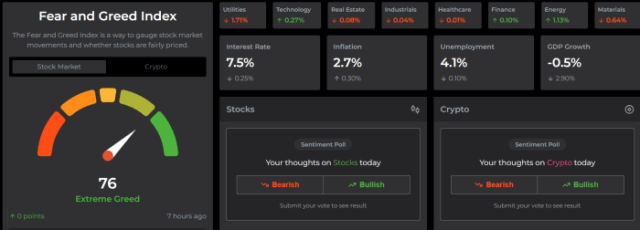
Fear and Greed IndexTrader Tardigrade seems to nourish similar sentiments, stating that, based on the market’s performance, crypto is set to become the largest asset in the world.

Another crypto analyst, Titan of Crypto, hints at a second Breakout coming, which would be the final hurdle before Altcoin Season 3.0.

With the market winding for a coming rally, some assets may experience higher gains than others, especially those with blockchain utility and massive long-term potential.

Snorter Token is one of them, introducing the Snorter Bot, the trading companion which snipes hot tokens milliseconds after liquidity appears.

How Snorter Token ($SNORT) Makes Coin Hunting Easy and Rewards

Snorter Token’s ($SNORT) Snorter Bot promises to become the most proficient coin hunter, thanks to its ease of use, integrated scam alerts, protecting against suspicious projects, and its appetite for hot and booming tokens.
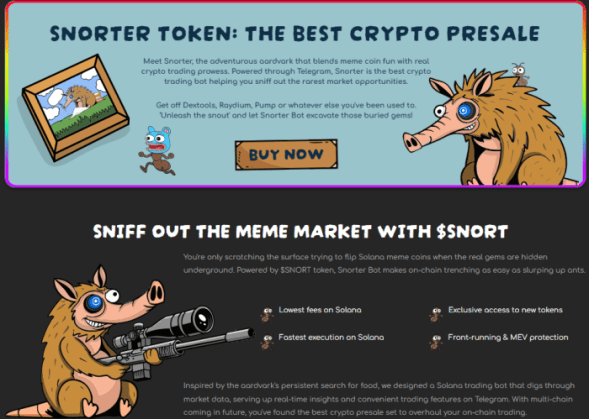
Snorter Token presale pageThe Aardvark sniper is the perfect solution to manual coin hunting, which demands high technical knowledge and subjects you to potential scams like honeypots and rug pulls.

The Bot operates in its Telegram chat-only, centralizing its activity in one place and rendering the need for multiple wallets, plug-ins, and browser extensions obsolete.

You only need to instruct the Bot accordingly and watch it claim its victims milliseconds after liquidity becomes available. This reaction time puts UIs like Raydium, Pump Fun, and Jupiter to shame.

Based on these facts, Snorter Token is set to become one of the best meme coins on the market, following successful implementation and witnessing widespread adoption.

The project is currently in presale, having accumulated over $2.3M with a token price of $0.0991.

Given Snorter Bot’s roadmap and efficiency, we expect the project to witness growing success post launch. In that context, $SNORT could easily push to $0.94 shortly after its public listing.

A 2030 price point of $3.25 or higher is also expected in a pro-crypto context and following mass adoption. Based on today’s price point of $0.0991, this translates into a 5-year ROI of 3,179%.

If you want to support the project and buy yourself some $SNORT, go to the presale page and place your order today.

Is the Crypto Market in Recession?

Despite the heavy Bitcoin outflows and the perceived market uncertainty, the bullish market sentiment seems to suggest that what we’re seeing is not recession, but rather market correction, following the recent generalized rally.

We expect Bitcoin to push again soon, once it clears the psychological threshold of $120K, at which point projects like Snorter Token ($SNORT) will also steam up.

Remember, this isn’t financial advice. Do your own research (DYOR) and invest wisely.

Editorial Process for bitcoinist is centered on delivering thoroughly researched, accurate, and unbiased content. We uphold strict sourcing standards, and each page undergoes diligent review by our team of top technology experts and seasoned editors. This process ensures the integrity, relevance, and value of our content for our readers.

As a crypto writer, Bogdan’s responsibilities are split between researching and writing articles and entertaining the team with his humor bordering on the politically incorrect, an aspiring Bill Burr, if you will. Thanks to his 12+ years of writing experience in just as many fields, including tech, cybersecurity, modelling, fitness, crypto, and other topics-that-shall-not-be-named, he's become a genuine asset to the team. While his position as a senior writer at PrivacyAffairs thought him valuable lessons about the power of self-management, his entire writing career was and is an exercise in self-improvement. Now, he's ready to sink his teeth into crypto and teach people how to take control of their own money on the blockchain. With fiat as an eternally devaluing currency, Bitcoin and altcoins seem like the best-fitting alternative for Bogdan. Bogdan’s biggest professional accomplishment, aside from securing a position as a main writer for Bitcoinist, was his 5-year run as a writing manager at Blackwood Productions, where he coordinated a team of four writers. During that time, he learned the value of teamwork and that of creating a working environment that breeds efficiency, positivity, and friendship.

Пов'язані матеріали

Li Fei-Fei's Latest Long-Form Article: When Video Generation, Robotics, and NVIDIA All Call Themselves World Models, We Need a Taxonomy

In a new article, Dr. Fei-Fei Li addresses the widespread and often inconsistent use of the term "world model" in AI. She proposes a clear, functional taxonomy rooted in the classic Partially Observable Markov Decision Process (POMDP) loop (agent → action → state → observation → agent). According to this framework, current systems called "world models" are different projections of this loop, categorized by their primary output: 1. **Renderers**: Output observations (pixels). Their goal is visual fidelity for human consumption (e.g., video generation models like Sora). They are the most commercially mature but are limited by a focus on appearance over physical accuracy. 2. **Simulators**: Output states (geometric, physical, dynamic representations). They provide a structurally accurate world for both human professionals (e.g., architects) and computational agents (e.g., robots for training). Li argues simulators are the crucial, underappreciated bridge, as they can underpin both rendering and planning. 3. **Planners**: Output actions. Given an observation and a goal, they decide what an agent should do next (e.g., robotic action models). This area is highly promising but remains the least mature for real-world deployment. Li highlights a key trend: the boundaries between these three categories are beginning to blur, as they all rely on a shared underlying understanding of geometry, physics, and dynamics. The logical endpoint is a unified world foundation model capable of switching between rendering, simulation, and planning based on downstream needs. This convergence, she concludes, is central to advancing spatial intelligence—enabling machines not just to talk about the world, but to truly understand, imagine, and interact with it.

marsbit50 хв тому

Li Fei-Fei's Latest Long-Form Article: When Video Generation, Robotics, and NVIDIA All Call Themselves World Models, We Need a Taxonomy

marsbit50 хв тому

Forbes Feature: Stablecoin Cross-Border Payments Are Faster, But Not Yet Cheaper

A Forbes feature delves into the state of stablecoin-based cross-border payments, noting rapid growth but a key shortfall: while faster and more accessible, they are not yet cheaper. At a recent industry conference in Mexico City, optimism about technology, regulation, and volume was tempered by discussions with practitioners. The core issue is liquidity. Traditional FX brokers charge 60-70 basis points, and stablecoins promise to slash this to 2-5 basis points. However, this theoretical cost advantage cannot be realized until deep liquidity pools are established at scale, requiring significant institutional capital inflow. A major adoption barrier is trust. Businesses often rely on long-standing relationships with traditional brokers, valuing reliability over marginal cost savings. This shift will be gradual. Furthermore, successful companies in the space are not positioning themselves as replacements for legacy systems like SWIFT, but as complements. They leverage stablecoins for speed while using traditional rails for their standardization and reliability in ensuring accurate payment details—a critical factor for supplier payments to avoid customs issues. Companies like Caliza, experiencing high monthly growth, exemplify this hybrid approach. The industry anticipates consolidation, as long-term viability will depend on securing the essential trifecta: proper licensing, robust fiat on/off-ramps, and deep liquidity. Without these, firms risk being mere intermediaries rather than building sustainable businesses.

marsbit51 хв тому

Forbes Feature: Stablecoin Cross-Border Payments Are Faster, But Not Yet Cheaper

marsbit51 хв тому

Li Feifei's Latest Article: When Video Generation, Robotics, and NVIDIA All Claim to Have 'World Models,' We Need a Taxonomy

"World Model" has become a widely used yet ambiguous term in AI. Drawing from the classic POMDP framework (agent → action → state → observation), this article proposes a functional taxonomy to clarify the concept. It identifies three distinct types, categorized by their output in the perception-action loop: 1. **Renderers**: Output visual observations (pixels). These models, like advanced video generators, prioritize visual fidelity but often lack underlying physical accuracy. 2. **Simulators**: Output the state of the world (geometry, physics, dynamics). They provide a structurally accurate representation for professionals (e.g., architects) and serve as training environments for robots and AI agents. 3. **Planners**: Output actions. Given an observation and a goal, they determine what an agent should do next, closing the perception-action loop (e.g., vision-language-action models). While renderers are currently the most commercially mature and planners are the most aspirational, the article argues that **simulators are the crucial, underappreciated hub**. By working at the level of geometry and physics, a simulator can project upwards to create visuals for humans and downwards to predict action consequences for agents. The future lies in the convergence of these three functions. Emerging research and products, like World Labs' Marble model which outputs both visual splats and physical collision meshes, are beginning to blur these boundaries. The logical endpoint is a unified world foundation model capable of rendering, simulating, and planning based on a shared understanding of spatial and temporal structures—ultimately enabling machines to understand, imagine, and interact with the physical world.

链捕手1 год тому

Li Feifei's Latest Article: When Video Generation, Robotics, and NVIDIA All Claim to Have 'World Models,' We Need a Taxonomy

链捕手1 год тому

Торгівля

Спот
活动图片