29 Million Impressions, Only $71 Earned: How to Make Money from Traffic on X Platform?

深潮Опубліковано о 2025-12-26Востаннє оновлено о 2025-12-26

Анотація

An experiment on X platform revealed that chasing high exposure metrics does not translate to significant earnings. After generating 28.9 million impressions and gaining 37.5k followers through aggressive commenting and engagement chasing under popular posts, the author earned only $71.49. The key insight is that exposure alone is a vanity metric. X’s monetization algorithm prioritizes quality interactions from paid verified users—not raw visibility. Comments and reposts from premium users carry the most weight, while likes and free-user engagements have little value. The author’s high-exposure strategy attracted bot traffic, diluted audience quality, and risked algorithmic demotion. The account was flagged as low-quality despite high impression numbers. The revised strategy focuses on nurturing a genuine community: removing fake followers, creating original content, and fostering meaningful interactions with verified users. Key metrics for success now include a 3-5% engagement rate, over 45% verified user ratio, and comment-driven interactions. The conclusion: X rewards content creators who build authentic communities, not those who exploit exposure loopholes.

Written by: MAD Vincent

Compiled by: Chopper, Foresight News

I did exactly what they said: frantically spammed comments, closely followed top accounts to ride on their traffic, jumped on every trending topic, and chased impressions like chips in a bull market.

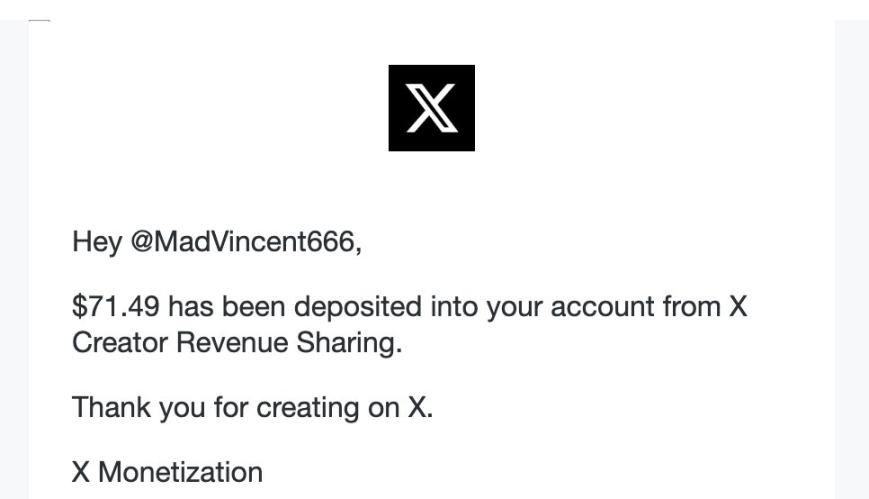
After 29 million impressions, the X platform paid me $71.49.

This is a warning. As of 2025, those still chasing impressions on the X platform are neither seizing the initiative nor working hard—they are just the bag holders of bot traffic.

The Lie Everyone Believes

At some point, the cryptocurrency community (CT) reached a consensus: "The higher the impressions, the more money you make." This was half-true in the past. But by 2025, it has become a complete fallacy.

Today, impressions are just a flashy vanity metric: they look glamorous and addictive but are utterly useless for actual earnings. They can make your data panel as beautiful as a bull market chart, but the corresponding bank deposit is pitifully small, akin to an abandoned small wallet.

I learned this lesson the hard way.
My Personal Experiment (A.K.A. How I Got Rekt)

In mid-December 2025, I launched this aggressive traffic experiment: posting over 200 comments daily, specifically targeting top accounts' posts to蹭热度 (ride on their popularity), without limiting myself to any vertical—a full-scale "indiscriminate bombardment."

Movies, gaming, politics, cryptocurrency, memes, sports... as long as it was a hot topic, I jumped in to comment.

Soon, my actions echoed on the platform: "Bro, I see you everywhere," "The algorithm must love you," "This data is explosive growth."

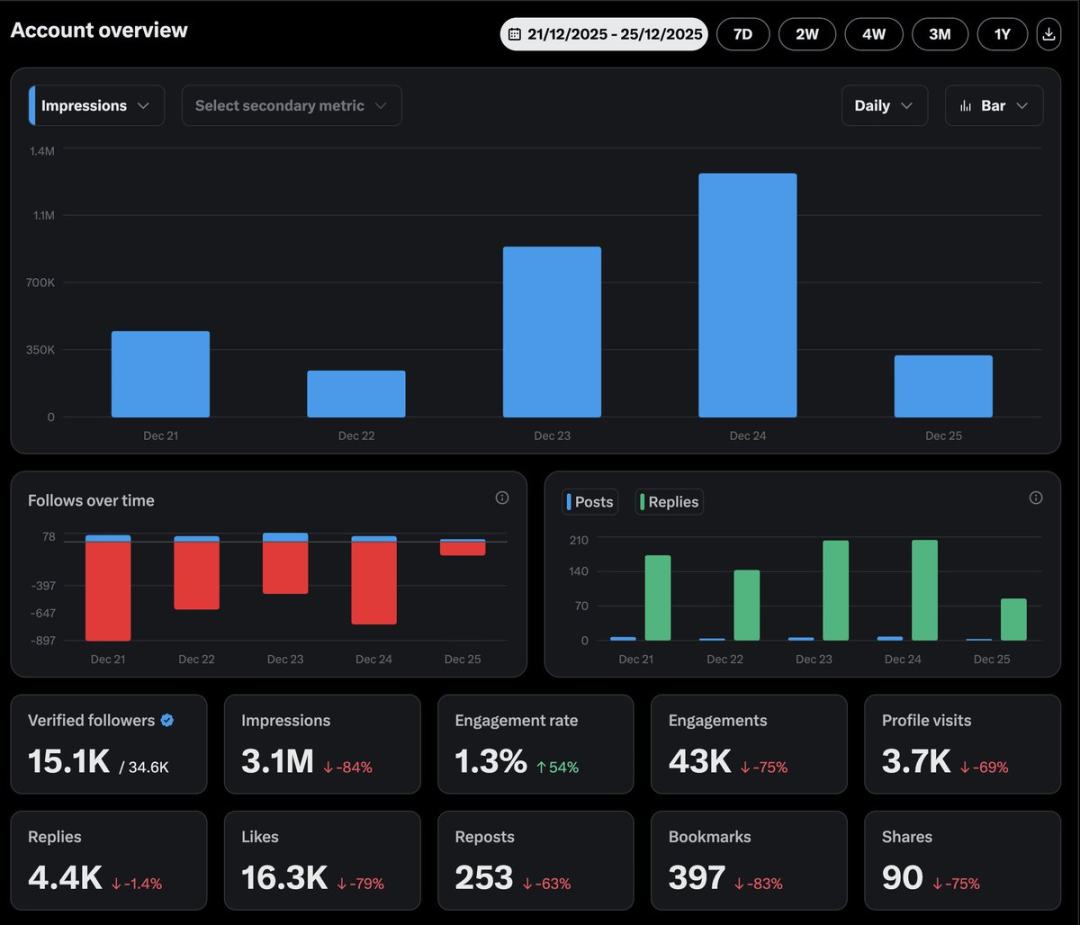
Now, let's look at the specific results: 28.9 million impressions, 267.7k engagements, 119.5k likes, 11.8k comments, 3.1k bookmarks, 20k profile visits, 37.5k followers, with verified users accounting for about 41%.

I only posted an average of 4 original pieces of content per day, with the rest of the traffic全靠 "comment section蹭热度" (relying entirely on comment section popularity chasing). Looking solely at the data panel, it was a crushing advantage. But when payday came, the deposit was only $71.49.

That's when it hit me: Impressions don't make money; high-quality paid user engagement is king.

The monetization logic of the X platform has long changed. It no longer rewards exposure but rather who engages with you.

If your engagement data doesn't come from paid verified users, it's no different from having no engagement at all.

The Real Monetization Rules of the X Platform in 2025

There's no mystery behind this; many just refuse to accept reality. The real monetization rules are as follows.

Only engagement types from paid verified users count towards monetization: comments, reposts, bookmarks, likes, and the engagement must occur within monetizable reply posts.

Some engagement types are无效 for monetization (ineffective for monetization): free user engagement, bot traffic, skyrocketing impressions without paid user participation, "fake viral hits" without paid user engagement.

One comment from a paid verified user might be worth far more than 100 bot likes.

Furthermore, engagement has varying weights; not all are equal. Comments and reposts carry the highest weight, followed by bookmarks, with likes being the lowest.

So, if your engagement data shows these characteristics: many likes, few comments, low percentage of verified users—then your account looks hot but has zero monetization value.

The Unmentioned Bot Traffic Trap

Chasing热度 (popularity) in the comment sections of top accounts seems like a shortcut to gaining followers, but it's actually a distribution engine for bot traffic.

Here's the real situation: Your comment gets pushed to a bot network → Impressions skyrocket → Engagement data looks healthy → Platform filters out all invalid traffic during settlement.

This is why the absurd result of "29 million impressions, only $71 earned" occurs. This isn't a system glitch; it's the precise execution of platform rules.

This Playstyle Is Ruining Your Account

This is not only an extremely low ROI practice but also causes irreversible damage to your account.

Bot Follower Pollution

In just a few days, my account gained over 2500 bot followers. These bots lower:

  • The percentage of verified users in your account

  • The platform's trust rating for you

  • Future settlement amounts

Audience Dilution

Your followers are no longer a targeted audience but become worthless "noise." The platform understands this, advertisers understand this, and ultimately, your earnings will reflect it directly.

Algorithmic Downgrade Penalty

Posting 200+ comments daily → Easily triggers rate limits. Content lacks vertical focus → Unable to send clear account labels to the algorithm. Eventually, your account gets flagged by the algorithm as a "suspected spam account."

Creator Burnout

You think you're dominating the platform's hot lists, but the bank deposit notification punches you in the gut. This is the moment most creators give up.

What I Did

I completely overturned my previous strategy: cleaned up 2500 bot followers, removed 5000 zombie followers, stopped the comment section热度 chasing operation, focused on building a genuine community of followers.

In the short term, account metrics did decline, but the long-term health of the account is recovering.

In the next settlement cycle, my account data showed new characteristics: lower impressions, higher quality engagement (check the engagement rate percentage), more precise follower growth, and significantly reduced creative pressure.
The Core Metrics Actually Worth Focusing On

If you want to make money on the X platform, aim for these targets:

  • 3%-5% engagement rate

  • High-engagement posts dominated by comments

  • 45%-50% verified user ratio

  • Consistent output of original content

It's okay to have fewer impressions; the key is high quality of engaging users. Achieve these, and you'll go from "Why are my earnings so terrible?" to "So this is how you achieve stable monetization."

The Final Truth

Impressions are like the song of the Sirens: they make you think you've seized the initiative, make you feel like you're the platform's focus, and give you an illusion of "importance."

But they don't bring a single cent of profit. What monetizes is the engagement from high-quality paid users. In 2025, the X platform will not reward "traffic speculators"; it will only reward "content builders."


Пов'язані питання

QWhat was the author's total earnings from 29 million impressions on X platform?

AThe author earned only $71.49 from 29 million impressions on the X platform.

QAccording to the author, what is the key to earning money on X platform in 2025?

AThe key is high-quality interactions from paid users, not just high impression counts.

QWhat types of user interactions are considered valuable for monetization on X platform?

AValuable interactions are those from paid, verified users, specifically comments, reposts, bookmarks, and likes. Interactions from free users or bots are filtered out and are worthless for monetization.

QWhat negative consequences did the author experience from chasing impressions by spamming comments?

AThe author gained over 2500 bot followers, diluted their audience with 'noise', risked algorithm downgrades for being flagged as spam, and experienced creator burnout.

QWhat are the core metrics the author suggests focusing on for successful monetization?

AThe core metrics are a 3%-5% engagement rate, high-quality interactions (especially comments), a 45%-50% verified user ratio among followers, and a focus on creating original content.

Пов'язані матеріали

As Consensus Accelerates, What Are Young Investors Betting On?

Title: As Consensus Forms Faster, What Are Young Investors Betting On? In the rapid evolution of tech investment, a new generation of young investors is navigating a landscape where AI, robotics, commercial aerospace, and quantum computing are advancing simultaneously. Traditional investment logic based on financial models is giving way to a need for deep technical understanding and the ability to act before industry consensus forms. An analysis of trends from the "WAIC FUTURE TECH" list of young investment leaders reveals key shifts in focus. The first major trend is the movement of AI from the digital screen into the physical world. Investment is shifting from large language models and chatbots towards embodied AI, robotics, AI hardware, and edge computing. While demonstrations generate excitement, the real challenge lies in achieving scalable, reliable, and cost-effective delivery in complex real-world environments like factories and logistics. Success depends not just on algorithms but on the integration of sensors, actuators, and control systems. Second, the competitive focus for large models is moving beyond raw capability toward building an "intelligence flywheel." The goal is to create self-reinforcing systems where user interaction generates data, improving the model, which in turn enhances the user experience and attracts more engagement. Companies that successfully embed AI into workflows to create these closed-loop systems can build lasting value that isn't easily erased by the next model upgrade. Third, facing a potential bottleneck in high-quality human-generated data, investors are looking at new underlying technologies. Reinforcement learning and self-play, as demonstrated by AlphaGo Zero, offer paths for AI to generate its own experience. Scientific foundation models, which aim to build general AI capabilities for fields like life sciences and materials discovery, represent a non-consensus direction that could unlock new frontiers of knowledge and data. Finally, in deep-tech areas like quantum computing, commercial aerospace, and space-based infrastructure, patient capital is essential. These fields have long, uncertain development and validation cycles involving complex engineering, supply chains, and regulations. Investment here requires a long-term view, focusing on foundational team capabilities and the eventual emergence of market demand, even if commercial returns are distant. Collectively, these trends illustrate how young investors are adapting to a new era. They are learning to make earlier, technically-informed judgments, balance hype with real-world viability, and provide the patient capital needed to build the deep-tech foundations of the future.

marsbit28 хв тому

As Consensus Accelerates, What Are Young Investors Betting On?

marsbit28 хв тому

Can Japan Buy Growth with AI? Will the Bond Market Believe It?

Japan's cabinet has introduced the 2026 Basic Policy on Economic and Fiscal Management and Reform, shifting its primary fiscal target. The new framework moves away from the traditional annual primary balance goal and instead prioritizes a stable reduction of the debt-to-GDP ratio. This change is tied to a strategy of increased "responsible proactive fiscal" spending, aiming to boost long-term growth through investments in strategic sectors like AI, semiconductors, energy, and robotics. The government estimates total public and private investment in 62 key technologies could exceed 370 trillion yen by 2040. The market reaction has been mixed and cautious. While equity markets may respond to policy signals, bond markets are focused on fiscal credibility. Concerns center on whether the weakening of the clear primary balance anchor could lead to looser fiscal discipline. If investors doubt that these strategic investments will generate sufficient productivity gains, tax revenue, and nominal growth to outpace rising interest costs, they may demand higher yields on Japanese Government Bonds (JGBs). Recent volatility in the yen and JGB yields, with the 10-year yield briefly reaching 2.9%, reflects this skepticism. The success of this new framework hinges on two factors: whether Japan can achieve a nominal growth rate consistently higher than its long-term interest rates, and whether future budgets demonstrate disciplined control over bond issuance. The government's narrative is that strategic investment is essential to break Japan's cycle of low growth, aging, and labor shortages. However, the bond market will continuously assess the credibility of this plan, pricing the risk that it may represent fiscal expansion rather than a viable growth strategy.

marsbit1 год тому

Can Japan Buy Growth with AI? Will the Bond Market Believe It?

marsbit1 год тому

Misjudged A-Shares: Resilience, Expectations, and Confidence

China's A-share market recently faced selling pressure, especially in tech sectors, initially triggered by a global tech sell-off that began in South Korea. However, the article argues this is a case of "mistaken injury" and highlights the market's underlying resilience. This resilience stems from three main pillars: **1) Tech Sector Fundamentals:** Unlike Korea's market dominated by a few memory chip stocks, China's tech sector is diversified across computing, communications, electronics, and semiconductors, supported by dual narratives of global AI supply chains and domestic substitution. Core areas like optical modules and fiber optics continue to show strong earnings growth. **2) "National Team" Support:** State-backed institutions and large corporations have made significant market purchases and announced buybacks, providing liquidity and signaling confidence. This is seen as a stabilizing policy signal, often associated with market bottoms. **3) Broader Market Pillars:** Other major sectors are showing endogenous recovery momentum. Consumer stocks benefit from stabilizing CPI and signs of sector recovery (e.g., liquor price hikes). Cyclical sectors like aluminum have high earnings, potential price increases due to tight supply, and low valuations. The financial sector offers stable dividends and low valuations. The conclusion is that the sell-off was driven by external contagion, not a collapse in fundamentals. With strong policy support and recovering momentum across key sectors, the A-share market possesses the toughness to regain stability.

marsbit1 год тому

Misjudged A-Shares: Resilience, Expectations, and Confidence

marsbit1 год тому

Торгівля

Спот
活动图片




