Аналитики Bubblemaps обвинили создателя мем-токенов знаменитостей в мошенничестве

cryptonews.ruОпубліковано о 2021-10-15Востаннє оновлено о 2024-08-15

Что произошло? Эксперты аналитической блокчейн-платформы Bubblemaps опубликовали расследование о мошеннической деятельности предпринимателя Сахила Ароры при запуске мем-токенов для знаменитостей, которая позволила ему заработать около 30 млн долларов в 2024 году. Курсы большинства монет, в запуске которых участвовал Арора, впоследствии обрушились до нуля.
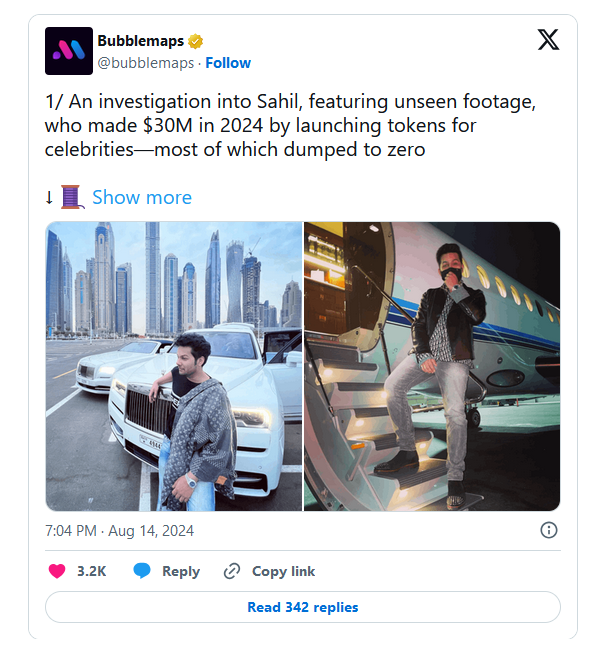
Источник: X.com

Что еще известно? Арора сотрудничал с такими знаменитостями, как Кейтлин Дженнер, Игги Азалия, Джейсон Деруло, Эмбер Роуз, Санни Леоне, Бобби Альтхофф, Trippie Redd и Lil Pump.

По словам исследователей, Арора ведет деятельность в криптопространстве по меньшей мере последние 7 лет. Еще в 2017 году, в возрасте 18 лет, он основал в родной Индии компанию Vuzelaa Group для установки биткоин-банкоматов по всему миру, а с 2020 по 2023 год запустил более десятка криптопроектов.

Среди них эксперты выделили дебетовую криптокарту ZelaaPayAE и маркетплейс невзаимозаменяемых токенов ZelaaNFT — несмотря на провал обоих проектов, Арора получил значительную прибыль.

Затем, как отметили в Bubblemaps, предприниматель обратил внимание на платформу Pump.fun на базе блокчейна Solana, где любой пользователь менее чем за $2 может запустить собственный токен.

«Имея большую аудиторию в Instagram и верифицированный аккаунт, Сахил понял, что жадные знаменитости согласятся практически на любую сделку. Все, о чем он их просил — опубликовать в X адрес контракта токена», — пишут в Bubblemaps.

Например, певцу Джейсону Деруло предпринимать за такой твит предложил $200 000.

Поскольку Сахил, как организатор выпуска, владел почти всем объемом предложения токенов, вскоре после публикации твитов он сбрасывал активы, используя фанатов селебрити в качестве выходной ликвидности, в результате чего последние оставались с обесцененными токенами на руках. Такой подход созвучен с мошеннической схемой накачки и сброса (Pump&Dump). При этом он даже не пытался скрываться из открыто делился информацией о полученной прибыли в общедоступном Telegram-канале.

Аналитики обнаружили более 40 адресов, связанных с Аророй. Для каждого токена он удерживал 25-40% предложения на одном или нескольких адресах, а на волне ажиотажа обменивал их на нативные токены Solana (SOL) и посылал на свой основной адрес. Эти средства он затем депонировал на централизованные биржи (CEX).

По словам аналитиков Bubblemaps, в какой-то момент он ежедневно запускал новые токены на Pump.fun, привлекая новых знаменитостей. Хотя в результате тысячи фанатов потеряли свои деньги, действия Сахила остаются в серой зоне, что затрудняет его преследование. В настоящий момент предприниматель проживает в Дубае, где функционирует Управление по регулированию виртуальных активов (VARA).

«Даже знаменитости не преследуют его, потому что они частично ответственны за это», — заключили эксперты.

При этом токен Игги Азалии Mother Iggy (MOTHER) по-прежнему входит в топ-5 монет экосистемы Pump.fun по рыночной капитализации с показателем свыше 40,3 млн долларов, согласно данным агрегатора CoinGecko. Однако за сутки он утратил 13,2%, а недельное падение составило 25,8%.

Анонимный исследователь блокчейна ZachXBT, известный своими публикациями о случаях мошенничества и взломов в криптопространстве, поспорил с Bubblemaps. Опираясь на данные о ликвидности созданных Аророй токенов, ZachXBT предположил, что тот заработал лишь около 2-3 млн долларов.
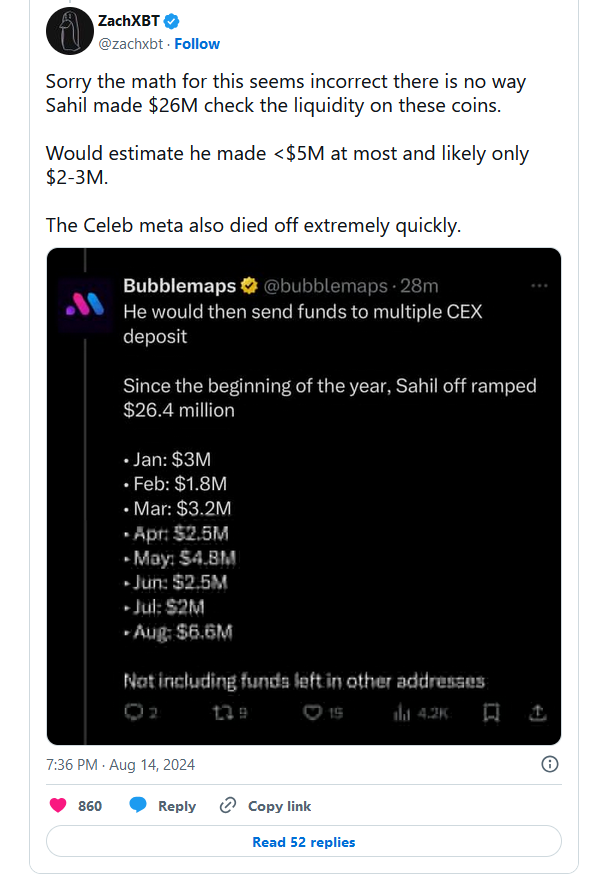
Источник: X.com

Ранее сооснователь блокчейна Ethereum Виталик Бутерин выступил с критикой селебрити-коинов, отметив, что они не несут пользы и направлены лишь на обогащение создателей и ранних инвесторов.

В августе создатели популярной тапалки Hamster Kombat для Telegram объявили, что отказались от всех предложений о венчурном финансировании для обеспечения долгосрочного развития проекта. Они пояснили, что венчурные инвесторы могут использовать реальных игроков в качестве выходной ликвидности, оставив последних с обесцененными монетами.


Пов'язані матеріали

The Hunter Becomes the Hunted: The Most Profitable MEV Bot Gets Hacked

A well-known and highly profitable Ethereum MEV Bot, Jaredfromsubway.eth, suffered a sophisticated on-chain attack this Saturday, losing over $7.5 million. Analysis by Blockaid and others reveals this was not a conventional phishing or smart contract exploit, but a targeted "counter-MEV honeypot attack." The attacker meticulously laid a trap over several weeks, deploying 66 fake token contracts and liquidity pools disguised as major assets like WETH and USDC. These pools created the illusion of arbitrage opportunities. The MEV Bot's automated system detected these signals, executed trades, and in the process, granted approval permissions to attacker-controlled contracts. These approvals were not revoked, creating a persistent vulnerability. The attacker then exploited this in a single transaction, draining the bot's ETH, USDC, and USDT holdings. Jaredfromsubway.eth is notorious as one of Ethereum's most active and profitable MEV Bots, primarily known for executing "sandwich attacks" to profit from transaction slippage. Estimates suggest it has earned tens of millions in MEV revenue. The incident highlights escalating crypto security threats, demonstrating that even top-tier automated "predators" are vulnerable to novel, logic-based attacks designed to exploit their own operational rules. Following the hack, an unverified X account impersonating Jaredfromsubway.eth emerged, falsely offering a bounty for the return of funds, prompting developer warnings for users to stay vigilant.

marsbit1 год тому

The Hunter Becomes the Hunted: The Most Profitable MEV Bot Gets Hacked

marsbit1 год тому

The Reality of Payments in Latin America Is Not What You Think

The payment landscape in Latin America is undergoing a fundamental shift, driven by on-the-ground realities that challenge common perceptions. Based on over 500 hours of field research across the region, key insights emerge. Firstly, QR code payments, like Brazil's Pix, are becoming the dominant payment method in most emerging markets, overtaking cards. However, these domestic instant payment systems lack international interoperability, creating a significant gap for cross-border users. Secondly, the narrative around crypto cards is often misunderstood; their primary volume comes from high-net-worth professionals using them for salary conversions (e.g., USDT to local currency via Pix), not retail micro-payments. Competition in payments is shifting from customer acquisition to controlling the settlement layer, leading fintechs to acquire banking licenses for efficiency. Thirdly, treating "Latin America" as a single market is a mistake. Countries like Argentina, Brazil, and Mexico have distinct economic realities, user segments, and regulatory approaches. Brazil alone has at least five distinct user segments with different financial flows. Overlooked markets like Guatemala, Honduras, and El Salvador (the "forgotten five") offer high remittance volumes with lower competitive density. Finally, regulation in Latin America is often ahead of the US, with clearer frameworks for digital assets and a pragmatic approach from regulators focused on safety rather than obstruction. The margin on stablecoin forex is rapidly compressing toward zero, meaning future winners will be those building value-added services on top of the infrastructure, not just the cheapest exchange.

marsbit1 год тому

The Reality of Payments in Latin America Is Not What You Think

marsbit1 год тому

Making Music in a Bear Market: The Survival Experiment of a Bitcoin Band

"Orange Pill Jam: A Bitcoin Band's Survival in the Bear Market" Orange Pill Jam is a musical group exploring themes of financial sovereignty and privacy, born from the Bitcoin community. Formed after singer Mermaid performed her song "Dollar Apocalypse" at a 2022 conference, the band creates music intended for both Bitcoin enthusiasts and general audiences. Their creative process involves Mermaid writing lyrics and melodies, which producer/multi-instrumentalist Michi then shapes with a precise, rhythm-focused approach, often demanding numerous retakes to achieve his unique standard of timing. Their songs, like "Cypherpunks' Manifesto" and "Fire of Freedom," tackle concepts of digital privacy, the pitfalls of "free" services, and personal sovereignty, influenced by experiences in places like El Salvador. Despite operating in a crypto bear market with a Copyleft model (offering music for free sharing/remixing and accepting optional Bitcoin donations), they face practical challenges. Their growth is slow on platforms like YouTube and Spotify, which aren't optimized for their niche content. The band also navigates the rise of AI-generated music. While acknowledging AI's efficiency for certain tasks, they believe human creativity occupies a unique space that algorithms cannot replicate—the ability to create new genres and capture intangible rhythmic feeling. For Orange Pill Jam, the core argument for both Bitcoin in a downturn and human artistry in the AI age lies in this irreplaceable, intentional, and imperfectly human creative process. Their project persists as an anti-algorithm experiment, valuing the unquantifiable impact of music over scalable metrics.

marsbit1 год тому

Making Music in a Bear Market: The Survival Experiment of a Bitcoin Band

marsbit1 год тому

Торгівля

Спот
Ф'ючерси
活动图片