Hunter Becomes the Hunted: The Most Profitable MEV Bot Gets Hacked

Odaily星球日报Опубліковано о 2026-06-21Востаннє оновлено о 2026-06-21

Анотація

The prominent Ethereum MEV bot address Jaredfromsubway.eth suffered a targeted on-chain attack, losing over $7.5 million. The incident was identified as a "counter-MEV honeypot attack," where the attacker deployed numerous fake token contracts and liquidity pools over several weeks, mimicking mainstream assets like WETH and USDC to create seemingly profitable arbitrage opportunities. The MEV bot, designed to automatically detect and execute such trades, interacted with the malicious setup. During the process, it granted approvals to attacker-controlled contracts, which were not promptly revoked. The attacker later exploited these persistent permissions in a single transaction, draining the bot's holdings of ETH, USDC, and USDT. Jaredfromsubway.eth is known as one of Ethereum's most active and profitable MEV bots, primarily executing "sandwich attacks" to extract value from user transactions. Its operations have been linked to a majority of such attacks on the network. This event highlights the evolving security threats in crypto, demonstrating that even sophisticated, rule-exploiting systems can become targets of carefully designed behavioral traps. Following the theft, an impersonator account on X falsely claimed to offer a bounty for the return of the funds, prompting warnings from developers.

Original | Odaily Planet Daily (@OdailyChina)

Author | Azuma (@azuma_eth)

The well-known MEV Bot address Jaredfromsubway.eth, long active on the Ethereum network, was targeted in a highly sophisticated on-chain attack on Saturday, resulting in losses exceeding $7.5 million.

According to investigations by Blockaid and several on-chain analytics firms, this incident was not a traditional phishing attack or smart contract exploit. Instead, it was a "counter-MEV honeypot attack" specifically designed to target the operational logic of MEV Bots.

Over the preceding weeks, the attacker had systematically deployed 66 counterfeit token contracts and fake liquidity pools. These assets were meticulously disguised on-chain as mainstream stablecoins like WETH, USDC, and USDT, creating seemingly legitimate arbitrage trading pathways.

The attack chain unfolded step by step — the fake liquidity pools generated signals for "arbitrageable price gaps"; the MEV bot automatically identified the arbitrage opportunity and executed trades; during the transaction, the robot granted authorization to an auxiliary contract controlled by the attacker; this authorization was not promptly revoked, leading to persistent exposure of permissions; Ultimately, in a single transaction, the attacker triggered a pre-embedded backdoor logic, directly draining the ETH, USDC, and USDT held in the MEV bot's address.

On-chain data shows that the total value of assets stolen from Jaredfromsubway.eth in this attack has exceeded $7.5 million. The attacker subsequently split and transferred portions of the funds, further dispersing the flow through mixing tools.

Who is Jaredfromsubway.eth? The Most Notorious MEV Bot Address

The reason this attack is so notable today is that the victim, Jaredfromsubway.eth, is itself one of the most active, profitable, and notorious MEV Bots on the Ethereum network (if not the most).

Essentially, "MEV attacks" are a category of on-chain arbitrage behaviors revolving around "transaction ordering rights." On the Ethereum network, transactions enter the mempool to await block inclusion before being confirmed. Block builders or searchers can extract extra profit by adjusting transaction order, inserting transactions, or rearranging transactions within a block.

The most typical attack type is the "Sandwich Attack" — the attacker inserts buy and sell operations immediately before and after a user's transaction, profiting from the price slippage within a very short time frame. Such behavior is extremely common in high-liquidity DeFi trading pairs and constitutes one of the most fundamental profit models within the MEV ecosystem.

Jaredfromsubway.eth is precisely the most representative automated executor of this mechanism. Unlike traditional "single-point arbitrage bots," this MEV Bot resembles a highly industrialized MEV execution system. It continuously monitors unconfirmed transactions in the mempool, identifies in real-time transaction paths susceptible to being sandwiched, and completes transaction construction, Gas bidding, and order insertion within an extremely short time window, systematically capturing slippage profits.

Data from Cointelegraph Research shows that from November 2024 to October 2025, approximately 60,000 to 90,000 sandwich attacks occurred monthly on the Ethereum network, with about 70% related to the strategic system of Jaredfromsubway.eth.

In May of this year, when Ethereum co-founder Vitalik Buterin exchanged 26,544 DigitalBits (XDB), his transaction was also targeted and sandwiched by Jaredfromsubway.eth.

Regarding Jaredfromsubway.eth's historical revenue, there is no official statistic, but conservative estimates suggest that the address has accumulated MEV profits reaching tens of millions of dollars during its active periods. During some peak periods, its daily earnings could reach hundreds of thousands of dollars, and it consistently ranked near the top of Ethereum's MEV leaderboards.

Crypto Security Threats Intensify: Even Top Predators Are Not Spared

While one might muse that "the eagle-hunter finally got pecked," the hacking of Jaredfromsubway.eth has also sounded another alarm regarding risks in the cryptocurrency space.

In past perceptions, MEV Bots like Jaredfromsubway.eth belonged to the "predator" side of the on-chain ecosystem — they continuously capture slippage and arbitrage opportunities within user transactions through automated strategies, positioning themselves advantageously, arguably representing one of the most iconic types of attackers in the cryptocurrency market.

But this time, it became the one that was designed, lured, and ultimately harvested. Moreover, the attacker did not choose a traditional exploit path. Instead, they constructed a long-running "behavioral trap," allowing the MEV Bot's automated system to make progressively flawed decisions while fully complying with its own rules.

It must be acknowledged that even participants like Jaredfromsubway.eth, once most adept at "gaming the system," are now exposed to a broader attack surface.

Additionally, it is worth noting that after Jaredfromsubway.eth was hacked, an unknown X account with 94,000 followers changed its name to Jaredfromsubway.eth and falsely claimed it would "offer a $1 million bounty for the full return of all funds."
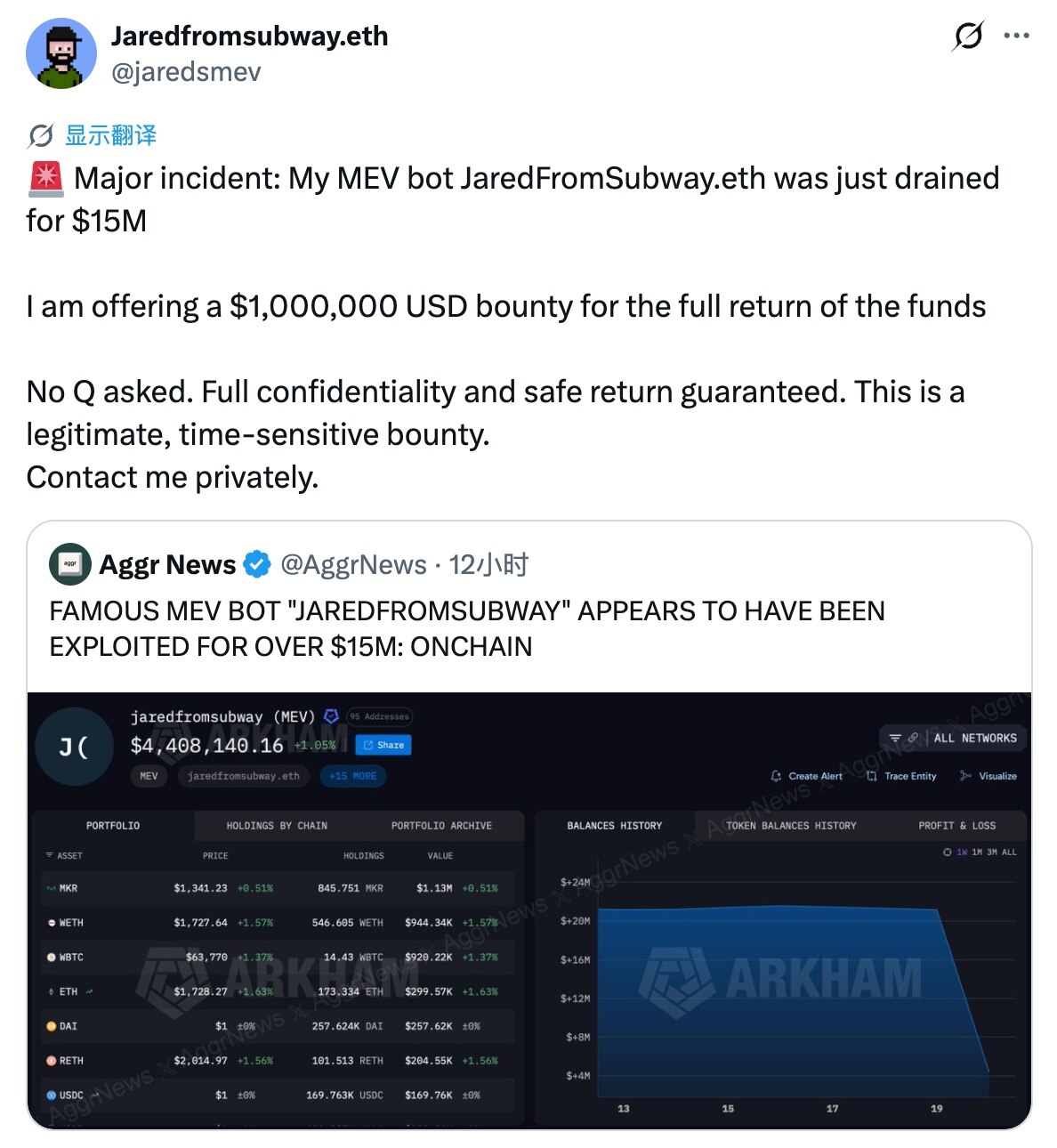
Several developers issued risk warnings, emphasizing that this account is not the official Jaredfromsubway.eth account (the MEV Bot team has no official account). They cautioned that this account might be used for scams subsequently and urged users to remain highly vigilant.


Пов'язані питання

QWhat type of attack did the MEV bot Jaredfromsubway.eth fall victim to, according to the article?

AThe article states that the MEV bot Jaredfromsubway.eth was targeted by a 'counter-MEV honeypot attack.' This was not a traditional phishing or smart contract exploit, but a sophisticated attack specifically designed to exploit the MEV bot's behavioral logic.

QWhat was the estimated total loss suffered by Jaredfromsubway.eth in this incident?

AAccording to on-chain data cited in the article, the total value of assets stolen from Jaredfromsubway.eth exceeded 7.5 million US dollars.

QAccording to the article, what is a 'Sandwich Attack' in the context of MEV?

AA 'Sandwich Attack' is described as a typical type of MEV attack. In this strategy, the attacker inserts buy and sell orders before and after a target user's transaction, respectively, to profit from the price slippage within a very short time window.

QWhat significant event involving Vitalik Buterin is mentioned in relation to Jaredfromsubway.eth?

AThe article mentions that in May of this year (presumably 2025), Ethereum co-founder Vitalik Buterin was targeted by Jaredfromsubway.eth when exchanging 26,544 DigitalBits (XDB) tokens.

QFollowing the hack, what fake action was taken by an unknown X account, and what warning was given?

AAn unknown X account with 94,000 followers changed its name to Jaredfromsubway.eth and falsely announced a '1 million US dollar bounty for the full return of all funds.' Developers issued warnings that this is not the official account (as the MEV bot team has none) and cautioned users to remain vigilant as the account might be used for scams.

Пов'язані матеріали

The Hunter Becomes the Hunted: The Most Profitable MEV Bot Gets Hacked

A well-known and highly profitable Ethereum MEV Bot, Jaredfromsubway.eth, suffered a sophisticated on-chain attack this Saturday, losing over $7.5 million. Analysis by Blockaid and others reveals this was not a conventional phishing or smart contract exploit, but a targeted "counter-MEV honeypot attack." The attacker meticulously laid a trap over several weeks, deploying 66 fake token contracts and liquidity pools disguised as major assets like WETH and USDC. These pools created the illusion of arbitrage opportunities. The MEV Bot's automated system detected these signals, executed trades, and in the process, granted approval permissions to attacker-controlled contracts. These approvals were not revoked, creating a persistent vulnerability. The attacker then exploited this in a single transaction, draining the bot's ETH, USDC, and USDT holdings. Jaredfromsubway.eth is notorious as one of Ethereum's most active and profitable MEV Bots, primarily known for executing "sandwich attacks" to profit from transaction slippage. Estimates suggest it has earned tens of millions in MEV revenue. The incident highlights escalating crypto security threats, demonstrating that even top-tier automated "predators" are vulnerable to novel, logic-based attacks designed to exploit their own operational rules. Following the hack, an unverified X account impersonating Jaredfromsubway.eth emerged, falsely offering a bounty for the return of funds, prompting developer warnings for users to stay vigilant.

marsbit1 год тому

The Hunter Becomes the Hunted: The Most Profitable MEV Bot Gets Hacked

marsbit1 год тому

The Reality of Payments in Latin America Is Not What You Think

The payment landscape in Latin America is undergoing a fundamental shift, driven by on-the-ground realities that challenge common perceptions. Based on over 500 hours of field research across the region, key insights emerge. Firstly, QR code payments, like Brazil's Pix, are becoming the dominant payment method in most emerging markets, overtaking cards. However, these domestic instant payment systems lack international interoperability, creating a significant gap for cross-border users. Secondly, the narrative around crypto cards is often misunderstood; their primary volume comes from high-net-worth professionals using them for salary conversions (e.g., USDT to local currency via Pix), not retail micro-payments. Competition in payments is shifting from customer acquisition to controlling the settlement layer, leading fintechs to acquire banking licenses for efficiency. Thirdly, treating "Latin America" as a single market is a mistake. Countries like Argentina, Brazil, and Mexico have distinct economic realities, user segments, and regulatory approaches. Brazil alone has at least five distinct user segments with different financial flows. Overlooked markets like Guatemala, Honduras, and El Salvador (the "forgotten five") offer high remittance volumes with lower competitive density. Finally, regulation in Latin America is often ahead of the US, with clearer frameworks for digital assets and a pragmatic approach from regulators focused on safety rather than obstruction. The margin on stablecoin forex is rapidly compressing toward zero, meaning future winners will be those building value-added services on top of the infrastructure, not just the cheapest exchange.

marsbit1 год тому

The Reality of Payments in Latin America Is Not What You Think

marsbit1 год тому

Making Music in a Bear Market: The Survival Experiment of a Bitcoin Band

"Orange Pill Jam: A Bitcoin Band's Survival in the Bear Market" Orange Pill Jam is a musical group exploring themes of financial sovereignty and privacy, born from the Bitcoin community. Formed after singer Mermaid performed her song "Dollar Apocalypse" at a 2022 conference, the band creates music intended for both Bitcoin enthusiasts and general audiences. Their creative process involves Mermaid writing lyrics and melodies, which producer/multi-instrumentalist Michi then shapes with a precise, rhythm-focused approach, often demanding numerous retakes to achieve his unique standard of timing. Their songs, like "Cypherpunks' Manifesto" and "Fire of Freedom," tackle concepts of digital privacy, the pitfalls of "free" services, and personal sovereignty, influenced by experiences in places like El Salvador. Despite operating in a crypto bear market with a Copyleft model (offering music for free sharing/remixing and accepting optional Bitcoin donations), they face practical challenges. Their growth is slow on platforms like YouTube and Spotify, which aren't optimized for their niche content. The band also navigates the rise of AI-generated music. While acknowledging AI's efficiency for certain tasks, they believe human creativity occupies a unique space that algorithms cannot replicate—the ability to create new genres and capture intangible rhythmic feeling. For Orange Pill Jam, the core argument for both Bitcoin in a downturn and human artistry in the AI age lies in this irreplaceable, intentional, and imperfectly human creative process. Their project persists as an anti-algorithm experiment, valuing the unquantifiable impact of music over scalable metrics.

marsbit1 год тому

Making Music in a Bear Market: The Survival Experiment of a Bitcoin Band

marsbit1 год тому

Торгівля

Спот
Ф'ючерси
活动图片