Blast首轮空投到来,一文速览代币分配详情与价格预判

Odaily星球日报Опубліковано о 2024-06-26Востаннє оновлено о 2024-06-26

Анотація

Blast积分、黄金积分各获得70亿枚代币,场外价格0.03美元/枚。

原创 | Odaily星球日报

作者 | 南枳

Blast首轮空投到来,一文速览代币分配详情与价格预判

昨夜,引领了积分制模式的 Blast 在历时 8 个月后,宣布将于今日晚上 10 点向社区空投 BLAST,来自 23 年的空投项目在此将落下帷幕。在人们对 Layer 2 代币预期越来越低的当下,Blast 能否带来惊喜?Odaily 将于本文解读代币分配数据与价格预期。

代币总量与划分

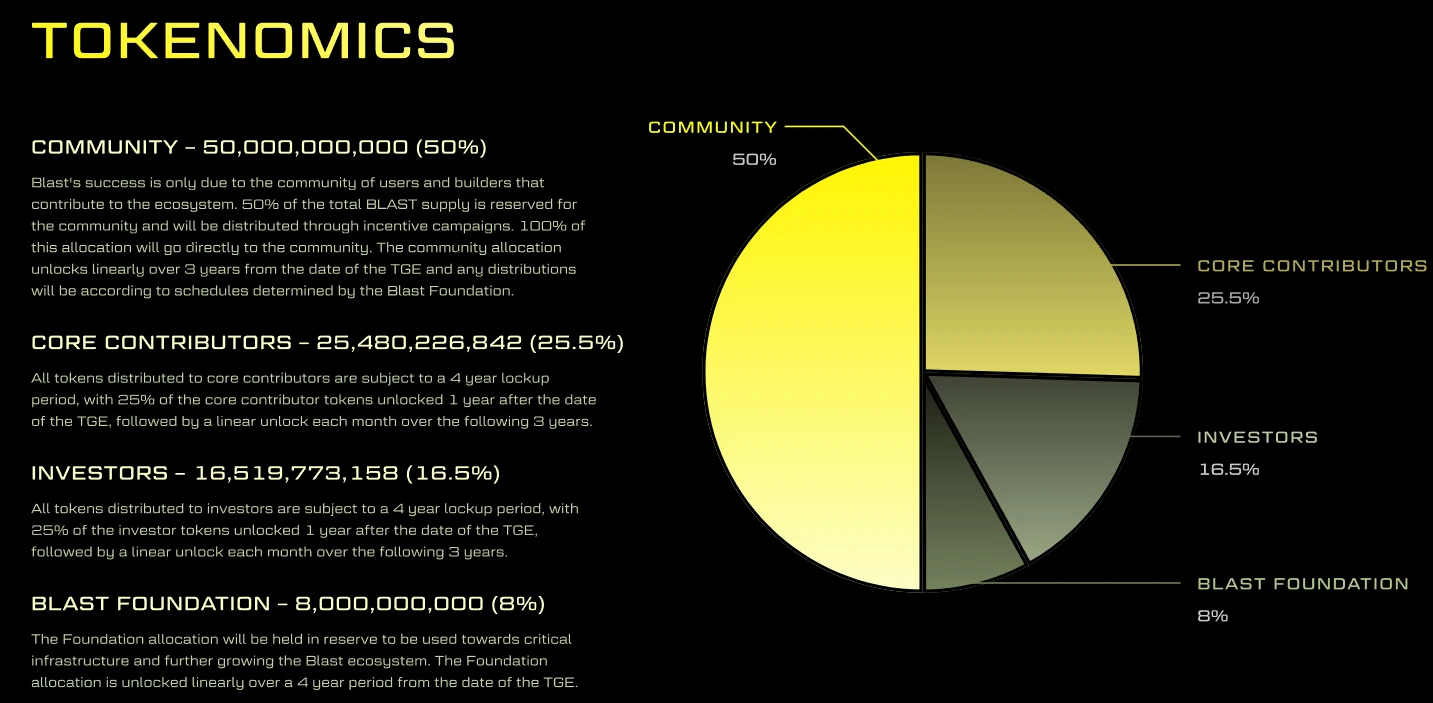
官方Q2报告,BLAST 总量为 1000 亿枚,总量的划分详情如下:

  • 社区 50% 代币(500 亿枚),所有代币将直接划拨给社区,并通过激励活动进行分配。社区分配将从 TGE 之日起三年线性分配,但需要根据 Blast 基金会所确定的时间表进行(unlocks linearly over 3 years from the date of the TGE and any distributions will be according to schedules determined by the Blast Foundation)。

  • 核心贡献者 25.5% 代币(254.8 亿枚),具有 4 年锁定期,其中 25% 的核心贡献者代币将在 TGE 发布之日起 1 年后解锁,在后续三年每月线性解锁;

  • 投资者 16.5% 代币(165.2 亿枚),具有 4 年锁定期,其中 25% 的投资者代币将在 TGE 日后 1 年解锁,在后续三年每月线性解锁;

  • Blast 基金会 8% (80 亿枚),作为储备金用于生态发展,从 TGE 日起,基金会拨款将在 4 年内线性解锁。
Blast首轮空投到来,一文速览代币分配详情与价格预判

首轮空投

在官方的Q2报告中,还披露了首轮空投的细节,这一轮空投将分配 BLAST 总量的 17% (170 亿枚)给用户, 17% 的组成为:Blast 积分 7% 、Blast 黄金积分 7% 、Blur 基金会 3% 。

其中 Blast 表示,对于排名前 0.1% 的用户(约 1000 个地址)的空投将在 6 个月内线性释放,并且这些用户的释放需达到每月积分阈值。更多细节将于 6 月 26 日公布。

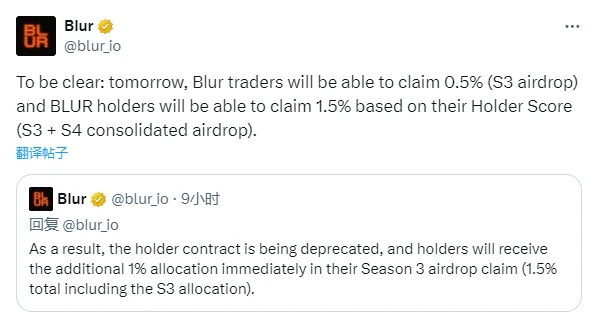
另一方面,Blur 基金会所分配的 3% 代币将用于分发给 Blur 社区,今日凌晨 Blur 发布了分配细节, 3% 的代币分配中:

  • 第三季交易者获得 0.5% ,BLUR 质押者获得 0.5% ;

  • 第四季交易者获得 0.5% ,BLUR 质押者获得 1% ;

  • 0.5% 为 Blur 项目方所预留。

Blast首轮空投到来,一文速览代币分配详情与价格预判

价格预测

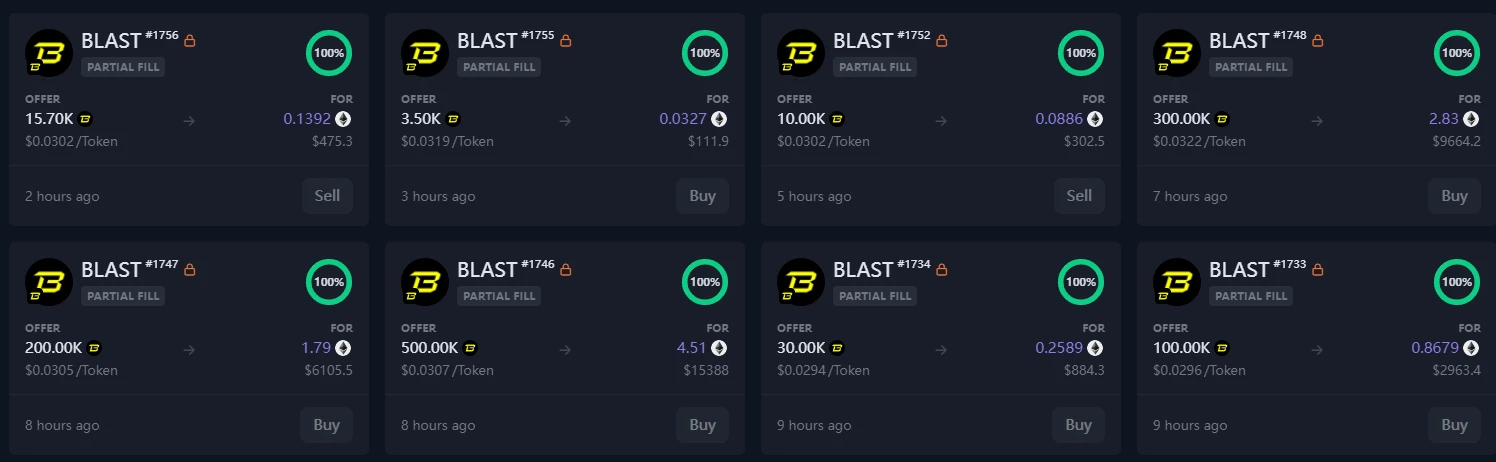
Whales Market 的盘前市场上,当前挂单最低价格为 0.0297 美元,而已成交的历史订单,最新价格也接近这一数值,因此盘前市场价格可认定为 0.03 美元。

基于 BLAST 1000 亿总量和 170 亿初始分配量,对应 FDV 为 30 亿美元,流通市值为 5.1 亿美元。

其他 Layer 2 流通市值参考数据如下:ARB 为 27 亿美元,OP 为 20 亿美元,STRK 为 9.5 亿美元,ZK 为 6.3 亿美元。

根据L2 BEAT 所提供数据,Blast 的 TVL 低于 Arbitrum 和 Optimism,高于 ZKsync 和 Starknet,价格略微低估。但考虑到市场对于 Layer 2 代币的认可程度越来越低,仍可认为当前的价格与流通市值属于合理估值范围。
Blast首轮空投到来,一文速览代币分配详情与价格预判

依据以上数据,黄金积分用户的收益也可进行初步预测,Blast 一共分发了五期黄金积分,第一期第二期第四期第五期各为 1000 万分,第三期为 1500 万分,按此计算总量为 5500 万分,所有黄金积分共分配 70 亿枚代币,意味着每个积分获得 127 枚代币,按照 0.03 美元的价格计算,约为 3.81 美元/分,读者也可按照预估的心理价位进行测算。

Трендові криптовалюти

Пов'язані матеріали

Jensen Huang: Prompts are Becoming Obsolete, Loops are the New Paradigm

Jensen Huang, alongside AI leaders like Peter Norvig, Boris Cherny, and Andrew Ng, is advocating for a shift from "prompt engineering" to "loop engineering" as the new paradigm for AI development. Instead of manually crafting individual prompts, the focus is now on designing autonomous loops—systems where AI agents execute tasks, self-validate results, and iterate until completion without constant human oversight. A loop is a management framework that enables agents to operate independently. Key implementations are seen in Claude Code (with features like /loop, /goal, and /schedule) and OpenAI Codex, which employ multiple agents working in parallel within isolated environments. A core principle is the separation of roles: one agent (or model) performs the task, while an independent agent (or a smaller, separate model) validates the output to ensure objectivity. The article outlines a practical roadmap for implementing loops, starting with a "four-condition test" to assess suitability, building a minimal viable loop, and emphasizing critical pitfalls to avoid, such as lacking hard stop conditions or allowing loops to handle tasks requiring human judgment. This evolution is framed as the fourth major shift in AI interaction: from Prompt Engineering (crafting instructions) to Context Engineering (providing background information), then to Harness Engineering (building tool-enabled environments), and finally to Loop Engineering (creating self-sustaining systems). This progression reflects a consistent trend of increasing abstraction, moving human involvement from direct instruction to system design and rule-setting. The concept has academic roots in frameworks like ReAct, which formalized the "reason-act-observe" cycle. While loop engineering promises greater automation, experts caution about managing token costs and warn against outsourcing understanding—AI can assist, but deep problem comprehension remains essential.

marsbit1 год тому

Jensen Huang: Prompts are Becoming Obsolete, Loops are the New Paradigm

marsbit1 год тому

GPT Designs GPT

OpenAI has unveiled its first custom AI chip, Jalapeño, a move signaling a strategic shift beyond being a mere model company. While many see it as a challenge to NVIDIA, its core aim is to control the entire intelligent production pipeline—from models and chips to data centers and energy. The key driver is the evolving competitive landscape: model advantages are shrinking, while the computational gap in areas like cost-per-token, system throughput, and energy efficiency is becoming the true long-term barrier. Jalapeño is primarily an inference chip, targeting the massive and growing "inference tax"—the daily operational cost of generating tokens for services like ChatGPT and APIs. By designing its own hardware optimized for its specific workloads and future product roadmaps (even using AI to aid the chip design process), OpenAI aims to drastically reduce token generation costs and improve system efficiency. This creates a potential flywheel: better models help design better chips, which lower costs for running next-generation models, supporting more users and products, which in turn provides more data to refine future chips. The strategy mirrors Apple’s integrated approach, building a closed loop where hardware, software, and applications are co-optimized. In the long term, OpenAI is not trying to become the next NVIDIA (a supplier of "shovels" to all AI companies) but to own and operate the entire "mine"—selling the end product of intelligence itself. This move marks OpenAI's ambition to evolve from creating the smartest models to controlling the foundational infrastructure of AI production.

marsbit1 год тому

GPT Designs GPT

marsbit1 год тому

Торгівля

Спот
Ф'ючерси

Популярні статті

Як купити BLAST

Ласкаво просимо до HTX.com! Ми зробили покупку Blast (BLAST) простою та зручною. Дотримуйтесь нашої покрокової інструкції, щоб розпочати свою криптовалютну подорож.Крок 1: Створіть обліковий запис на HTXВикористовуйте свою електронну пошту або номер телефону, щоб зареєструвати обліковий запис на HTX безплатно. Пройдіть безпроблемну реєстрацію й отримайте доступ до всіх функцій.ЗареєструватисьКрок 2: Перейдіть до розділу Купити крипту і виберіть спосіб оплатиКредитна/дебетова картка: використовуйте вашу картку Visa або Mastercard, щоб миттєво купити Blast (BLAST).Баланс: використовуйте кошти з балансу вашого рахунку HTX для безперешкодної торгівлі.Треті особи: ми додали популярні способи оплати, такі як Google Pay та Apple Pay, щоб підвищити зручність.P2P: Торгуйте безпосередньо з іншими користувачами на HTX.Позабіржова торгівля (OTC): ми пропонуємо індивідуальні послуги та конкурентні обмінні курси для трейдерів.Крок 3: Зберігайте свої Blast (BLAST)Після придбання Blast (BLAST) збережіть його у своєму обліковому записі на HTX. Крім того, ви можете відправити його в інше місце за допомогою блокчейн-переказу або використовувати його для торгівлі іншими криптовалютами.Крок 4: Торгівля Blast (BLAST)Легко торгуйте Blast (BLAST) на спотовому ринку HTX. Просто увійдіть до свого облікового запису, виберіть торгову пару, укладайте угоди та спостерігайте за ними в режимі реального часу. Ми пропонуємо зручний досвід як для початківців, так і для досвідчених трейдерів.

128 переглядів усьогоОпубліковано 2024.12.11Оновлено 2026.06.02

Як купити BLAST

Обговорення

Ласкаво просимо до спільноти HTX. Тут ви можете бути в курсі останніх подій розвитку платформи та отримати доступ до професійної ринкової інформації. Нижче представлені думки користувачів щодо ціни BLAST (BLAST).

活动图片