Zhou Hang: How Much Is SpaceX Really Worth?

链捕手2026-06-02 tarihinde yayınlandı2026-06-02 tarihinde güncellendi

Özet

**Zhou Hang: How Much is SpaceX Really Worth?** SpaceX, arguably one of the greatest industrial companies of the past 50 years, is reportedly targeting a staggering $1.75 trillion valuation in its potential IPO. However, the author argues this figure is inflated by approximately $1.25 trillion when assessed through standard financial metrics. The analysis begins by acknowledging SpaceX's undeniable success: drastically reducing launch costs, achieving near-monopoly in commercial launches, and building the strategic Starlink network. Its achievement surpasses even Tesla's, given it disrupted a state-monopolized industry. Despite this greatness, a $1.75 trillion valuation places SpaceX above the combined market cap of Boeing, Lockheed Martin, Northrop Grumman, RTX, and General Dynamics. Projecting optimistic 2030 revenues of $50-80 billion and applying generous tech-sector multiples yields a "reasonable" valuation range of $500 billion to $1.2 trillion. The $1.25 trillion gap is attributed to three non-financial premiums: 1. **Long-term vision premium** for future Starship-enabled markets (e.g., space-based computing). 2. **Sovereign asset/strategic premium**, as SpaceX is deeply integrated into U.S. national security. 3. **Retail narrative/Musk cult premium**, driven by a heroic story and personal following. Post-IPO, three scenarios are outlined: valuation solidifying (25% probability), sideways volatility as narrative outpaces reality (50%), or a re-rating down to $8...

Author: Zhou Hang

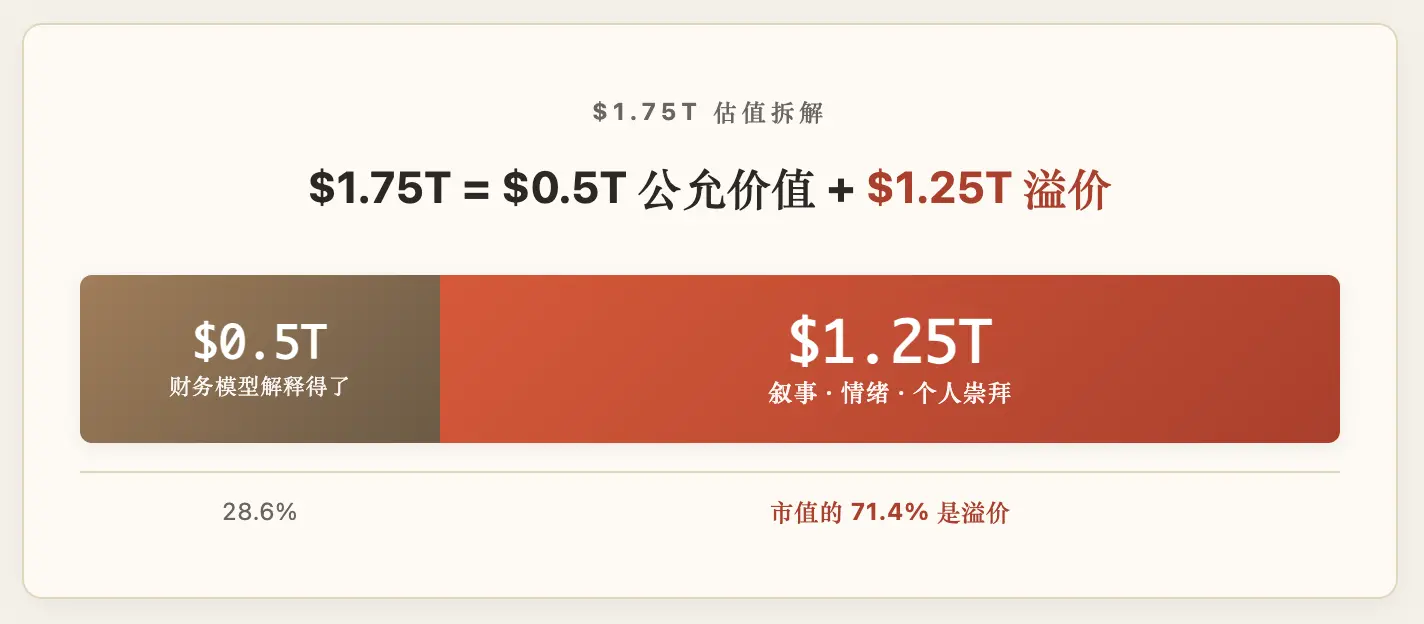
SpaceX may be overvalued by $1.25 trillion around its IPO.

This is not denying SpaceX's greatness. On the contrary, anyone seriously discussing SpaceX must first acknowledge: it might be one of the greatest industrial companies of the past 50 years.

But the greatness of a company and whether its stock is worth buying at any price are two completely different things.

SpaceX can simultaneously be the "greatest industrial entity of the 21st century" and a "seriously overvalued investment target." These two things are not contradictory.
First, Acknowledge Its True Greatness

Any honest discussion about SpaceX's valuation must start with one sentence: It is the most successful industrial company of the past 25 years, bar none—even more successful than Tesla. This is not mere praise; it's an economic and engineering fact.

Tesla disrupted a 150-year-old mature industry—automobiles. Its rivals are Mercedes, Ford, Toyota. These opponents are not weak, but they are commercial companies, without the backing of national interests or political barriers; the essence of the competition is product, brand, supply chain.

SpaceX disrupted a 60-year-old state-monopoly industry—space. Its opponents are NASA, Roscosmos, ESA, CNSA. This is an entirely different level of difficulty: higher engineering barriers, greater capital intensity, more complex regulation, deeper entanglement with national interests. In 2002 when Musk founded SpaceX, the entire space industry was essentially an extension of national missions; commercial companies were not believed capable of building rockets, let alone rockets cheaper than national ones.

More than 20 years later, SpaceX has slashed launch costs from $54,500/kg in the Space Shuttle era to $1,500/kg—a 36-fold decrease. It now launches 165 times a year, with one company exceeding the total launch count of all other countries and all commercial players combined. It built humanity's first truly reusable rocket, with a single Falcon 9 first stage flying 32 times and a success rate over 99%. It constructed the world's first global satellite internet—covering capacity for over 1 billion users, becoming a decisive strategic asset on the first day of the Ukraine war.

Tesla in 2025 still faces fierce competition from Chinese EVs; SpaceX's share in the global commercial launch market is approaching monopoly.

SpaceX is a great company, perhaps the greatest industrial company on Earth in the past 50 years. Any criticism about its valuation must first acknowledge this.

What Does $1.75 Trillion Even Mean?

Let's look at it through a set of comparisons:
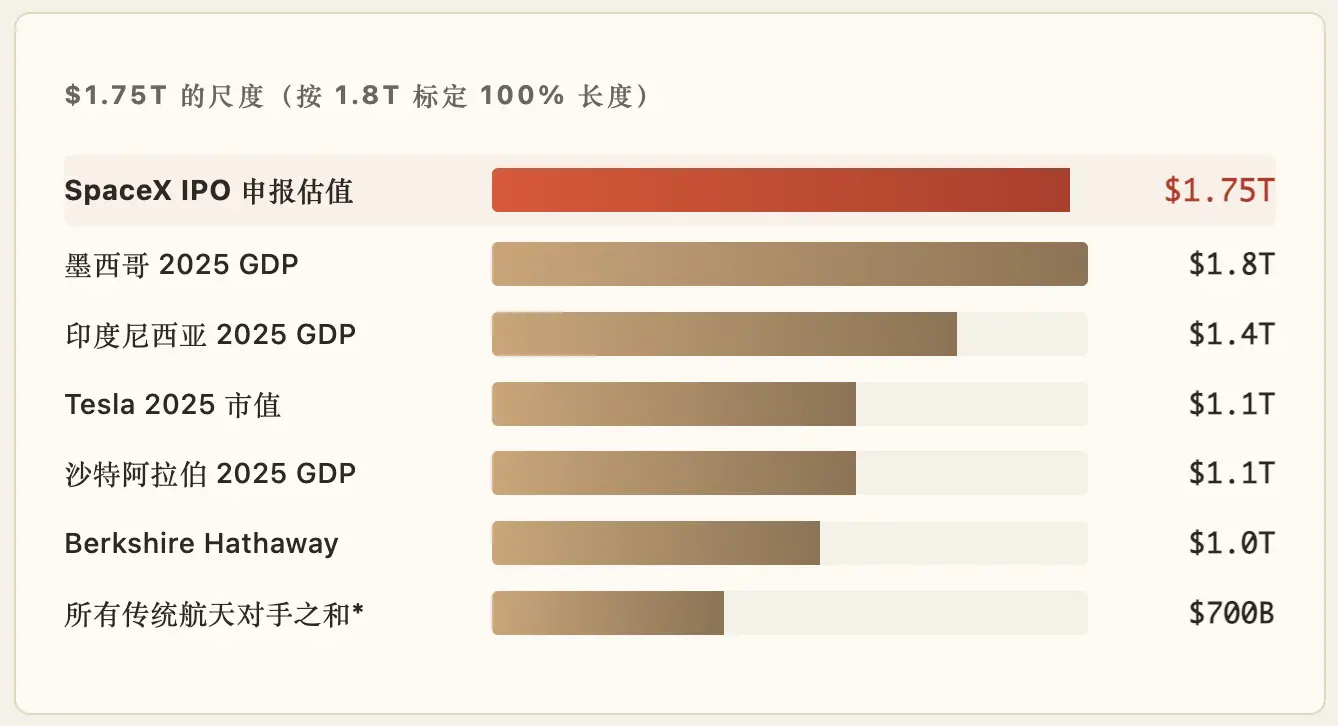
* Combined market cap of Boeing + Lockheed + Northrop + RTX + GD. SpaceX's valuation alone is 2.5 times their total.

In other words, the valuation of SpaceX alone would exceed Mexico's full-year GDP, surpass either Tesla or Berkshire, and be 2.5 times the total market cap of all its traditional space rivals.

This itself isn't the problem—great companies deserve great valuations. But that 2.5x ratio means the market is not pricing it as a "space company," nor as an "industrial company." The market is pricing it with a paradigm closer to some hybrid of "sovereign asset + AI-era infrastructure + narrative premium."

Is this pricing reasonable?

List all of SpaceX's current businesses and realistically calculate how much revenue they could generate by 2030, using a reasonable optimistic scenario for each line:
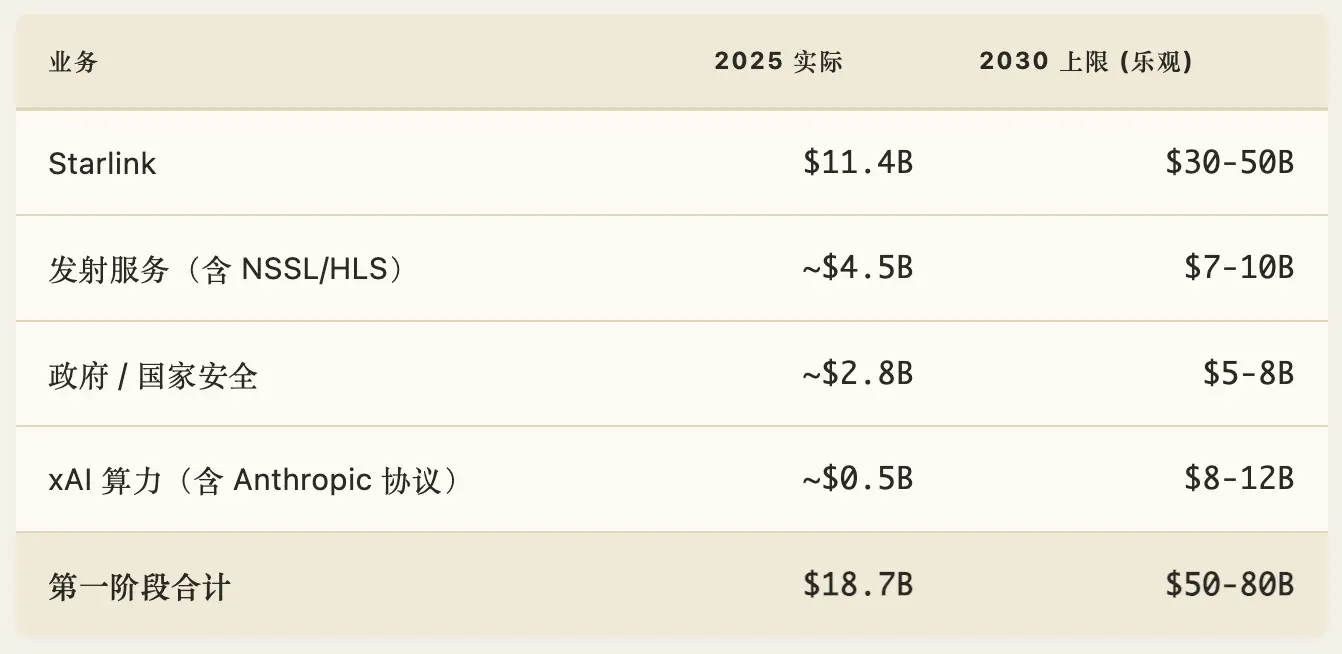
If SpaceX achieves $50-80B in revenue by 2030, corresponding EBITDA (Earnings Before Interest, Taxes, Depreciation, and Amortization, roughly understood as the operating cash profit from the company's main business) would be about $20-35B (using a 40% margin, already a very optimistic assumption).

Using the SaaS-diversified standard EV/EBITDA multiple of 25-35x—this is already a premium tech company valuation—SpaceX's "reasonable valuation" range in 2030 is from $500B to $1.2T.

Taking the conservative anchor of $500B (i.e., valuing all 2030 businesses at a reasonable, not wild, level), the market price is $1.75T.

Difference:$1.25T.

This difference cannot be explained by any standard financial model. It is not the result of DCF (Discounted Cash Flow), nor the result of pushing a P/S multiple, nor the result of comparable company benchmarking—none of these methods yield $1.75T.
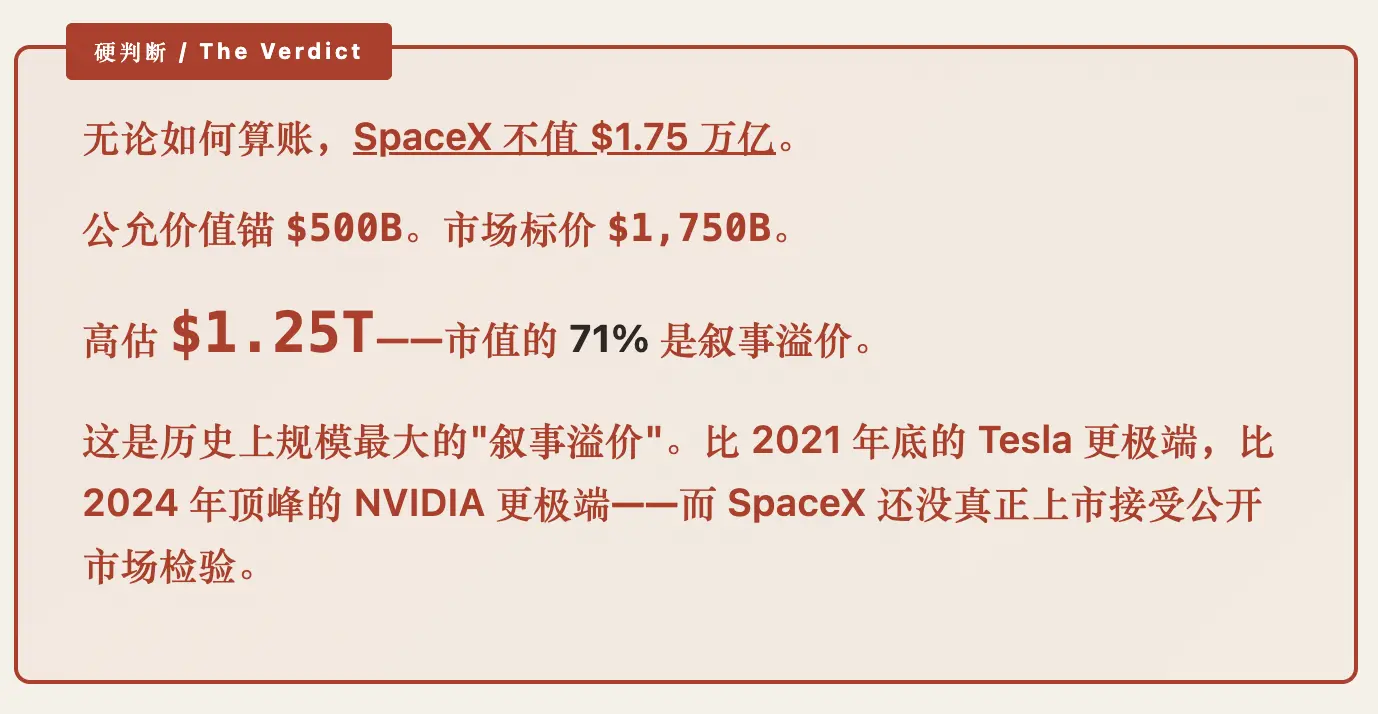
This difference doesn't appear out of thin air. It has three real sources:

First source: Long-term vision premium. If Starship becomes stable between 2027-2030, launch costs could drop to $200/kg or lower. That's a 30x increase in capacity—enough to support new businesses (orbital data centers, lunar commerce, deep-space robotics). Anthropic has publicly expressed interest in "paying for GW-level computing power in space." If this narrative materializes, SpaceX's total addressable market including new businesses by 2040 could reach $200-500B/year. This ceiling is indeed massive—so it's reasonable for the market to leave room for a "vision premium."

Second source: Sovereign asset + strategic positioning premium. SpaceX is no longer just a commercial company; it's a US national strategic asset. $22B in government contracts, HLS lunar lander, NRO's secret reconnaissance constellations, Golden Dome missile tracking—these bind SpaceX into the US national security apparatus. In today's rapidly fragmenting global communications order (Chinese sphere / American sphere / third parties), Starlink automatically gains "soft sovereignty" in all markets it can serve. The monetization of this position may take 10+ years to fully manifest, but the premium is real.

Third source: Retail investors' yearning for a heroic narrative + Musk's personal cult. This is the hardest to quantify, but anyone familiar with capital markets knows its power. Musk has 200 million followers on platform X; he himself is a valuation variable. The SpaceX story—a private company sending people to Mars, building a global internet, making humanity a multiplanetary species—is the most heroic commercial story of the past 50 years.

Retail investors aren't buying EBITDA; they're buying a ticket to participate in history.

The first two premiums are "real, but slow"; the third premium is "large, but fragile." The current $1.75T valuation bets that all three hold true and nothing goes wrong. This is a difficult combination to sustain.

What Happens After the IPO?

Assuming SpaceX completes its IPO in the second half of 2026, the next 3-5 years will likely look like this:

Scenario A: Valuation solidifies (Probability ~25%). Starship V3 successfully debuts in 2027, enters stable operation in 2028, and the first GW-level contract for space computing lands in 2028. Lunar commerce proceeds on NASA's schedule. Although Starlink growth slows, aviation + maritime + D2C segments make up for the deceleration in the residential market. In this scenario, $1.75T "starts to look cheap"—the market would revalue it to $2-3T.

Scenario B: Flat, volatile valuation (Probability ~50%). Starship progress is slower than expected—if the 2025 flight test success rate of 5/25 = 20% continues through 2026-2027, V3's true maturity may not arrive until 2029-2030. Starlink growth slows to +20%/year, the xAI-Anthropic agreement brings real cash flow but no second major contract follows. The market realizes "the narrative is ahead of reality," and the valuation oscillates between $1.2T - $1.8T for 3-5 years. This is the most probable scenario.

Scenario C: Revaluation (Probability ~25%). Persistent Starship delays, xAI lags significantly in AI competition, a Musk personal risk event (health, reputation, politics) triggers. The sentiment premium rapidly contracts. The market re-prices using financial models—valuation falls back to the $800B-$1.2T range, equivalent to "the reasonable valuation a great industrial company deserves." This scenario is actually good for long-term holders—but means a 30-50% paper loss for retail investors who buy after the IPO.
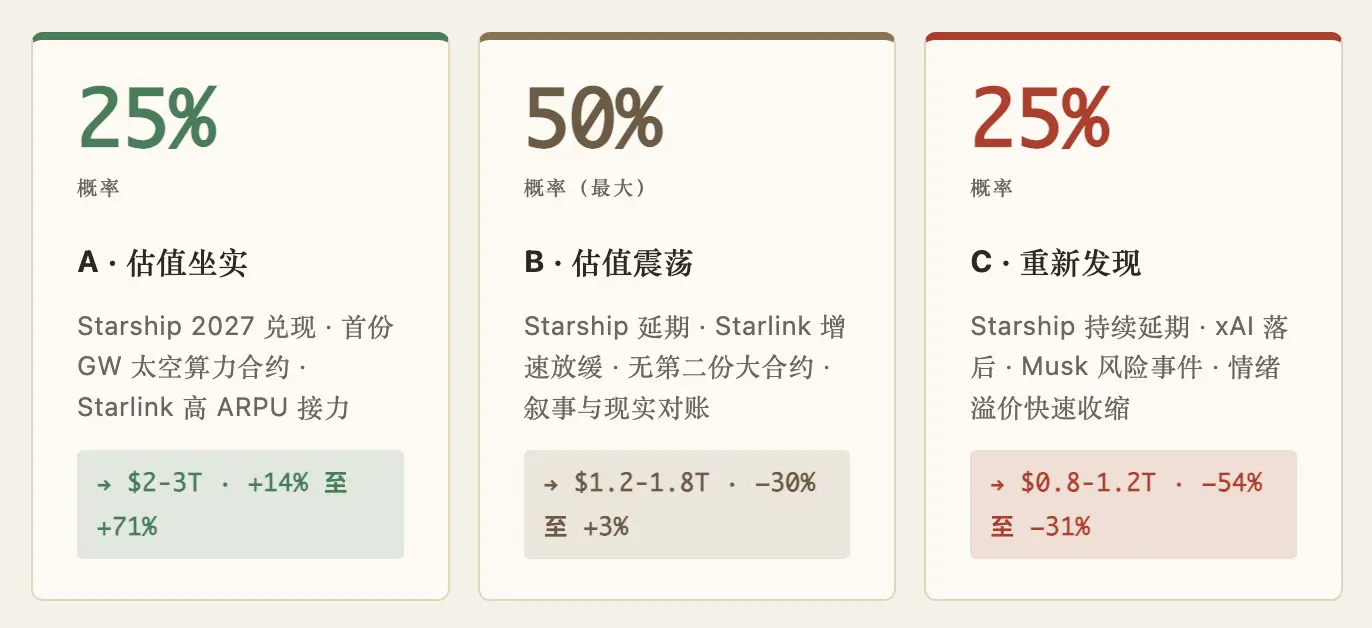
Probability-weighted = 0.25 × upside + 0.50 × volatility + 0.25 × downside ≈ expected value of $1.3-1.5T, lower than the IPO filing price of $1.75T.

Weighting the three probabilities, the expected central value for SpaceX's valuation over the next 3-5 years is around $1.3-1.5Tbelow the current IPO filing price.

In plain English: buying at $1.75T on IPO day results in a negative expected return over 5 years. This is the inevitable result after weighting the three scenarios by probability: you get no return in the most probable scenario; you lose 30-50% in the worst scenario; only in 1/4 of scenarios do you make money.

In the words of Charlie Munger: This is not an attractive bet.

For Those Planning to Buy on IPO Day

SpaceX is a great company, but a great company does not equal a stock that should be bought at any price. These two things must not be confused.

Tesla at the end of 2021 was also considered by many as "a buy at any price"—back then its market cap was $1.2T. Then over the next two years, Tesla fell 70%, from $1.2T to $400B. This wasn't because Tesla became a bad company—it remains an excellent EV company. It's because the price had run too far ahead of fundamentals.

SpaceX's current situation is highly similar to Tesla's at the end of 2021—possibly more dangerous, because SpaceX's "vision premium" accounts for a higher proportion, its story is grander, and retail participation could be deeper.

If you truly believe in SpaceX's long-term vision and are willing to hold for 10+ years without selling, then buying at the IPO price may be fine—in 10 years, this company will likely be worth more. But if you expect to "double your money within 1-3 years," the math is not on your side.

A more rational strategy:

  • Do not chase the price on IPO day
    The premium is usually highest on the first day of any mega-IPO
  • Wait for at least one of three things to happen
    Starship V3 stable operation, the first GW-level space computing contract, or the stock price falling below $1T
  • If you must buy now, limit your position
    Don't treat it as a "sure bet"—it's not. It's a "meaningful long-term +/- 30% uncertainty"

■ A Great Company, Can Also Be an Expensive Stock

A company's greatness is a fact; whether a stock's price is reasonable is math. Facts don't change, math changes every day. In SpaceX's current valuation structure, financial models can only explain half; the other half is market sentiment + sovereign status + personal cult—this part does exist, but it is fragile.

After the IPO, one thing will happen: retail investors will start measuring this company by its quarterly earnings. The first quarterly report, the second, the third—each will force the market to reconcile "story" with "reality." This reconciliation process is usually unfriendly to short-term valuation.

If you're buying the company—the great industrial entity, humanity's post-Starship infrastructure, the sovereign asset—then the IPO price is just a point in a 20-year marathon, no need to obsess.

If you're buying the story—participating in history, following a hero, for the sake of us becoming a multiplanetary species—then please acknowledge this is consumption, not investment. Consumption can be expensive, but you need to know what you're doing.

A company can be the world's best, and its stock can simultaneously be overvalued by $1.25 trillion. Both can be true, but they must be viewed separately. Distinguish whether you're buying the company, or the story.


Trend Kriptolar

İlgili Sorular

QAccording to Zhou Hang's analysis, what is the main argument regarding SpaceX's valuation ahead of its potential IPO?

AZhou Hang argues that SpaceX's potential IPO valuation of $1.75 trillion is significantly overvalued by approximately $1.25 trillion when analyzed through standard financial modeling of its projected 2030 business lines.

QWhat three sources of 'premium' does the article identify as inflating SpaceX's valuation beyond its fundamental financial value?

AThe article identifies three sources of premium: 1) Long-term vision premium (Starship enabling new markets like space-based computing), 2) Sovereign asset and strategic status premium (its role as a U.S. national security asset), and 3) Retail investor enthusiasm for the heroic narrative and Elon Musk's personal brand.

QHow does the article contrast the competitive challenges faced by Tesla and SpaceX?

AThe article states that Tesla disrupted the mature, commercially-driven automotive industry, facing rivals like Mercedes and Toyota. SpaceX, however, disrupted a 60-year state-monopolized space industry, competing against entities like NASA and Roscosmos, which involves much higher engineering barriers, capital intensity, and complex state interests.

QWhat are the three probable post-IPO scenarios for SpaceX's stock price, and what is their weighted expected outcome?

AThe three scenarios are: A) Valuation is validated (25% probability), B) Valuation trades sideways (50% probability), and C) Valuation is rediscovered downward (25% probability). The probability-weighted expected valuation range is $1.3 to $1.5 trillion, which is below the hypothetical $1.75 trillion IPO price.

QWhat investment advice does the article offer to those considering buying SpaceX stock on its IPO day?

AThe article advises against buying at the IPO day's likely peak premium. It suggests waiting for key milestones like Starship V3 stable operations or a major space-computing contract, or for the price to fall below $1 trillion. If one must buy immediately, it recommends limiting the position size, treating it as a long-term hold with significant uncertainty, not a sure bet.

İlgili Okumalar

From Gold to Bitcoin: Fixed Supply + Institutional Frenzy, Might It Repeat the 'Explosive' Price Trend?

"From Gold to Bitcoin: Fixed Supply and Institutional Frenzy May Lead to 'Explosive' Price Rally Analysts suggest Bitcoin's price action could mirror gold's over the past two decades, following the launch of spot Bitcoin ETFs. Gold ETFs, introduced in 2004, drove gold's price surge to a current market cap near $28 trillion. Both gold and Bitcoin are non-yielding stores of value, with prices driven purely by investor sentiment rather than cash flows or credit. Gold ETFs experienced dramatic cycles: explosive growth, painful drawdowns, and slow recoveries, with each cycle reaching higher peaks. Bitcoin ETFs, approved in early 2024, saw rapid institutional adoption but are now facing similar volatility. Recent warnings highlight the risk of significant ETF outflows disrupting the current rebound. BlackRock's IBIT, a leading Bitcoin ETF, has sold nearly 100,000 BTC to meet redemptions while still holding over 733,000. The core parallel is fixed supply: when demand surges, prices explode, but demand is often volatile and wave-like, not steady. Institutional interest, through ETFs and corporate adoption, remains a key support pillar, helping to cushion sell-offs. If Bitcoin captures even a fraction of gold's role as a store of value, its upside potential is immense, though the path will be marked by high volatility. For investors, focusing on long-term trends and managing risk is crucial as this 'price explosion' narrative unfolds."

Foresight News5 dk önce

From Gold to Bitcoin: Fixed Supply + Institutional Frenzy, Might It Repeat the 'Explosive' Price Trend?

Foresight News5 dk önce

Why Is AI Agent Shopping Hard to Popularize?

The article argues that the popular narrative of "AI agent shopping" – equipping AI with a wallet to autonomously handle purchases – is fundamentally flawed and oversimplifies the complexity of shopping. It deconstructs shopping into two core actions: **information retrieval** (standardized, easily automated) and **value judgment** (deeply subjective and human-centric). The narrative mistakenly assumes AI can fully handle both. Value judgment itself has two layers: **evaluation** (assessing options against criteria) and **demand definition** (setting the criteria, weights, and values). The latter is inherently human and dynamic, as preferences are not fixed but constructed during the decision-making process ("constructive preferences"). The real dividing line for automation is not product standardization, but whether the **act of choosing** itself holds experiential value. For mundane purchases (e.g., printer paper), full AI delegation works. For experiential goods (e.g., wine, furniture), the joy of selection is core to consumption, so AI should act as an assistant that narrows options, leaving the final choice to humans. The "AI wallet" concept confuses three separate elements: decision-making, execution, and fund custody. Current payment industry solutions (e.g., from Stripe, Mastercard, Google, Visa) show that limited, scoped payment authorization tokens are sufficient for most consumer scenarios, not full fund custody. The true use case for autonomous AI wallets is in **B2B procurement** and **machine-to-machine (M2M) settlements** for standardized, high-frequency, low-value transactions. The real bottlenecks for AI shopping are not payment technology, but **1) the lack of trusted data sources** (e.g., fake reviews, counterfeit goods) and **2) the impossibility of automating human demand definition**. The conclusion is that the focus should be on safely automating the assessment and filtering process while reserving for humans the rights to define their criteria and enjoy the final act of choice. For experiential goods, the platform's competitive advantage shifts to providing a superior selection experience.

Foresight News1 saat önce

Why Is AI Agent Shopping Hard to Popularize?

Foresight News1 saat önce

After Nine Months of Shorting, a Full Turn to Long: Renowned Trader Opens Bitcoin Positions Around 64K, Crypto Market Long-Short Divergence Intensifies

After nine months of being short, prominent crypto trader Doctor Profit has closed all his bearish positions and started buying Bitcoin near $64,000, signaling a complete bullish reversal. He argues that structural market changes—such as impending U.S. regulation (CLARITY Act) and institutional adoption via securities tokenization—are rewriting the traditional four-year cycle script, potentially bringing the market bottom forward from the widely expected September/October timeframe. This view finds some technical support from on-chain analyst gumsays, who notes a bullish divergence on Bitcoin's weekly chart has persisted for 147 days, nearing the 161-day duration seen before the 2022 cycle low. However, cycle researcher Jake Pahor presents a counter-argument based on historical data. Analyzing patterns since 2014, he identifies three common features of past bear market bottoms: a ~12-month duration from peak to trough, a sustained period of extreme fear (with a proprietary risk score below 20), and the price falling below Bitcoin's realized price (~$53,000 currently). The current cycle, only nine months from its October 2025 peak, meets none of these conditions. The debate highlights a market torn between "front-running" a potential early bottom driven by new fundamentals and waiting for confirmation through traditional on-chain and sentiment metrics. While Doctor Profit opts for aggressive buying, Pahor maintains a disciplined, tiered accumulation strategy, continuing weekly buys at current risk levels but reserving larger orders for if more extreme fear emerges.

marsbit1 saat önce

After Nine Months of Shorting, a Full Turn to Long: Renowned Trader Opens Bitcoin Positions Around 64K, Crypto Market Long-Short Divergence Intensifies

marsbit1 saat önce

Senior Trader's Confession: How to Trade Market's False Expectations?

Veteran trader's case study: trading the market's "wrong expectations". This trade centered on a textbook "expectation error" after a weak CPI report. While the market initially priced in broad monetary easing (sending Nasdaq to 30,060), the crucial 30-year real yield hit a 20-year high. This signaled a fractured transmission mechanism: short-term rates eased, but long-term funding costs (vital for tech valuations) refused to fall. The trader executed five short positions on the Nasdaq (NQ) as it fell from 30,060 to 28,768. The core methodology: don't just trade the data, but analyze the market's implied causal chain and identify where it breaks. In this case, the chain was: Weak CPI → Policy Easing → Lower Long-Term Funding Costs → NQ Valuation Expansion. The break occurred between policy easing and long-term rates. The "veto variable" – long-term real yields – refused to confirm the bullish narrative. Trades were structured around "fast variables" (price) temporarily repairing while "slow variables" (funding conditions) remained broken. The article outlines a repeatable framework: 1) Map the market's implied causal chain. 2) Identify the veto variable. 3) Observe if it rejects the narrative. 4) Enter when price still follows the old script. 5) Choose the cleanest asset expression (e.g., short NQ, not broad S&P). 6) Define both invalidation and fulfillment exit conditions. The key insight: Alpha often comes not from an information edge, but from a "reaction function edge" – recognizing when the market is applying an outdated causal logic to new data. The critical question: What causal chain is the market's first reaction relying on, and is that chain still valid today?

marsbit1 saat önce

Senior Trader's Confession: How to Trade Market's False Expectations?

marsbit1 saat önce

İşlemler

Spot

Popüler Makaleler

T Nasıl Satın Alınır

HTX.com’a hoş geldiniz! Threshold Network Token (T) satın alma işlemlerini basit ve kullanışlı bir hâle getirdik. Adım adım açıkladığımız rehberimizi takip ederek kripto yolculuğunuza başlayın. 1. Adım: HTX Hesabınızı OluşturunHTX'te ücretsiz bir hesap açmak için e-posta adresinizi veya telefon numaranızı kullanın. Sorunsuzca kaydolun ve tüm özelliklerin kilidini açın. Hesabımı Aç2. Adım: Kripto Satın Al Bölümüne Gidin ve Ödeme Yönteminizi SeçinKredi/Banka Kartı: Visa veya Mastercard'ınızı kullanarak anında Threshold Network Token (T) satın alın.Bakiye: Sorunsuz bir şekilde işlem yapmak için HTX hesap bakiyenizdeki fonları kullanın.Üçüncü Taraflar: Kullanımı kolaylaştırmak için Google Pay ve Apple Pay gibi popüler ödeme yöntemlerini ekledik.P2P: HTX'teki diğer kullanıcılarla doğrudan işlem yapın.Borsa Dışı (OTC): Yatırımcılar için kişiye özel hizmetler ve rekabetçi döviz kurları sunuyoruz.3. Adım: Threshold Network Token (T) Varlıklarınızı SaklayınThreshold Network Token (T) satın aldıktan sonra HTX hesabınızda saklayın. Alternatif olarak, blok zinciri transferi yoluyla başka bir yere gönderebilir veya diğer kripto para birimlerini takas etmek için kullanabilirsiniz.4. Adım: Threshold Network Token (T) Varlıklarınızla İşlem YapınHTX'in spot piyasasında Threshold Network Token (T) ile kolayca işlemler yapın.Hesabınıza erişin, işlem çiftinizi seçin, işlemlerinizi gerçekleştirin ve gerçek zamanlı olarak izleyin. Hem yeni başlayanlar hem de deneyimli yatırımcılar için kullanıcı dostu bir deneyim sunuyoruz.

630 Toplam GörüntülenmeYayınlanma 2024.12.10Güncellenme 2026.06.02

T Nasıl Satın Alınır

Tartışmalar

HTX Topluluğuna hoş geldiniz. Burada, en son platform gelişmeleri hakkında bilgi sahibi olabilir ve profesyonel piyasa görüşlerine erişebilirsiniz. Kullanıcıların T (T) fiyatı hakkındaki görüşleri aşağıda sunulmaktadır.

活动图片