Zcash surges 20% after breakout – ZEC traders, watch THIS for next move

ambcrypto2026-03-17 tarihinde yayınlandı2026-03-17 tarihinde güncellendi

Özet

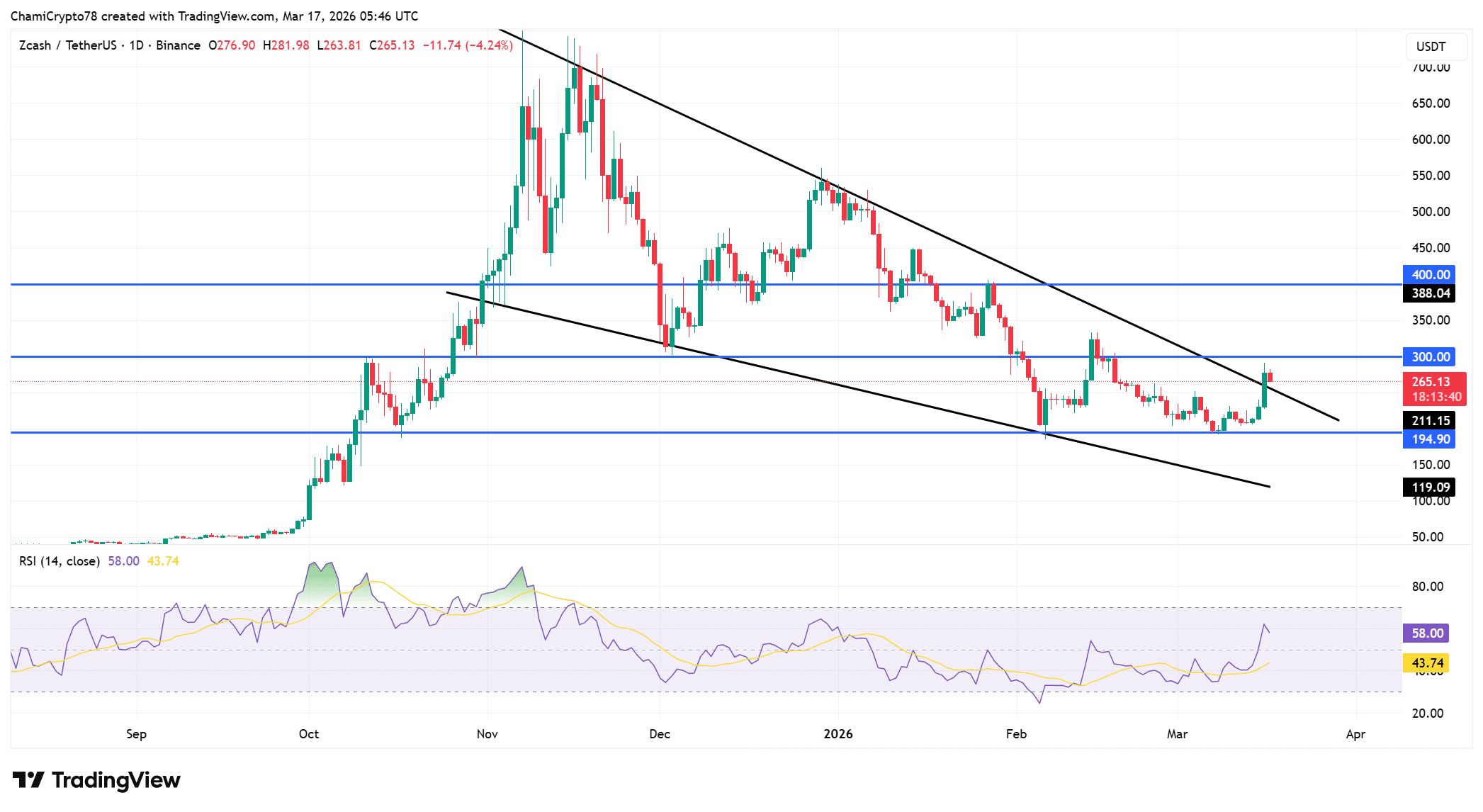
Zcash (ZEC) surged over 20% in 24 hours, breaking out of a descending wedge pattern and signaling a potential bullish shift. The price moved from the $194.90 support level toward the $300 resistance zone, with RSI strengthening to 58, indicating growing buying interest without overbought conditions. However, underlying metrics present mixed signals: Spot Taker CVD remains sell-dominant, suggesting persistent selling pressure, and the funding rate is negative (-0.032%), reflecting heavy short positioning. This sets the stage for potential short squeezes and increased volatility near key resistance. While the breakout shows strength, the sustainability of the rally depends on overcoming layered resistance and resolving conflicting market dynamics.

Zcash has surged over 20% in 24 hours as trading volume rises over 76%, reflecting a sharp increase in participation and aggressive positioning.

This expansion in activity signals renewed interest after a prolonged decline. Zcash [ZEC] has pushed upward from the $194.90 support zone, showing buyers stepping in with conviction.

However, underlying metrics still present mixed signals that require careful interpretation.

While price continues climbing, structural resistance remains nearby, which could influence short-term direction.

Breakout from wedge signals recovery push for Zcash

Zcash has broken out of a descending wedge, shifting its short-term structure toward bullish territory.

This breakout follows a sustained compression phase where price respected lower highs within the wedge formation.

After rebounding from $194.90, the price has advanced toward the $300 resistance zone, which now acts as the immediate barrier.

However, the broader trendline from previous highs still looms above, suggesting that upside continuation must overcome layered resistance.

The breakout itself indicates improving market strength, yet the proximity to resistance introduces friction.

As a result, price now tests a critical decision zone where continuation or rejection could define the next directional phase.

RSI has climbed toward 58, reflecting strengthening buyer activity without entering overbought territory.

This positioning suggests that buying pressure has increased steadily rather than accelerating into exhaustion.

Earlier, RSI remained suppressed during the downtrend, which aligned with weakening ZEC price action.

Now, the shift toward neutral-bullish levels highlights improving sentiment among participants.
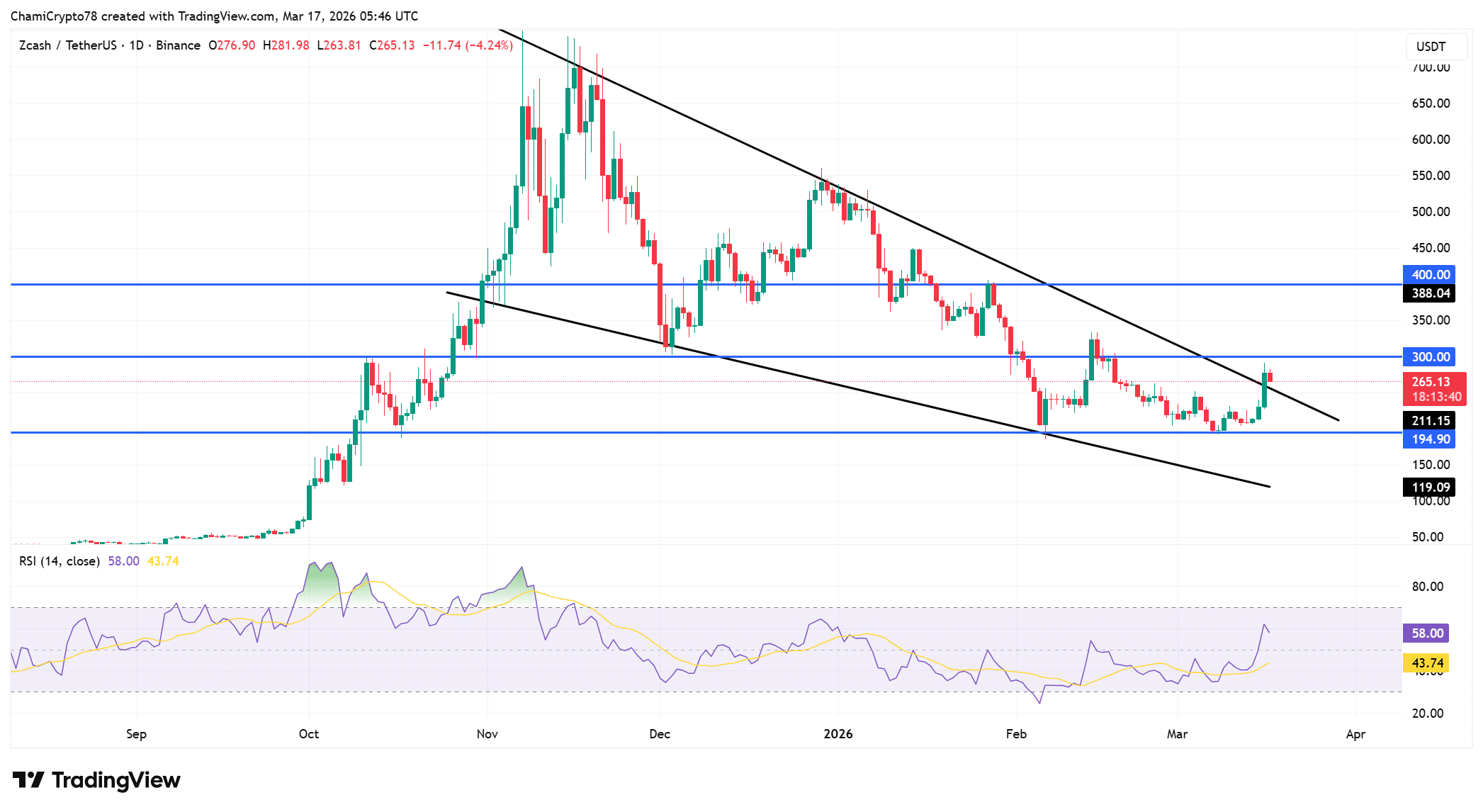
Source: TradingView

Sell-dominant CVD signals hidden pressure

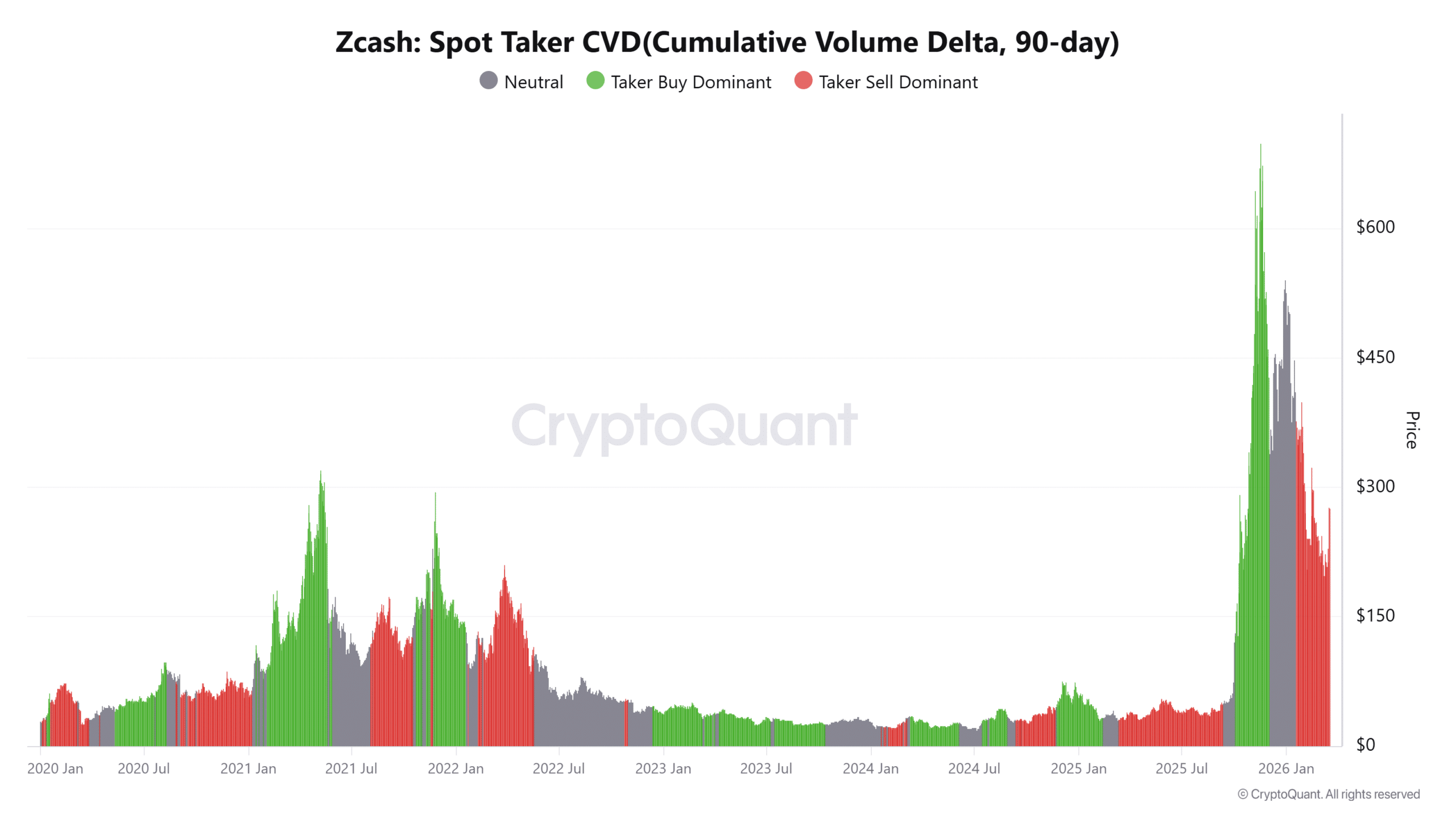
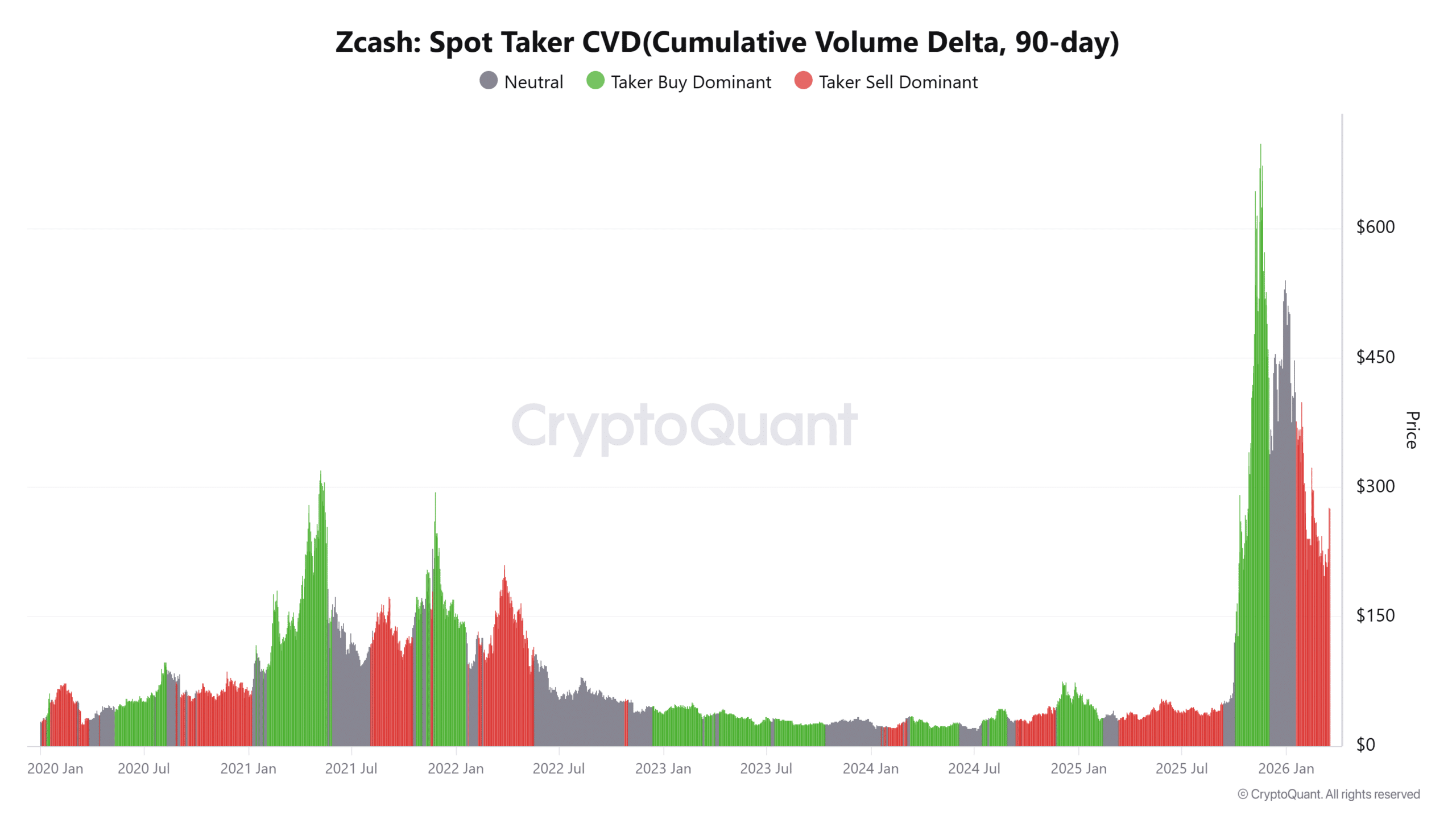
At the time of writing, Spot Taker CVD over the 90-day period remained sell-dominant, indicating that market sell orders have continued to outweigh buy orders despite the recent rally.

This divergence creates an important contrast between visible price strength and underlying order flow dynamics.

While price has moved upward, aggressive sellers have maintained influence in the broader structure.

However, such conditions can also reflect absorption, where buyers gradually take supply without immediate price collapse.

This dynamic suggests that the rally may not rely purely on organic demand.

Instead, it highlights a complex interaction between accumulation and distribution, which introduces uncertainty around the sustainability of the current move.
Negative funding reveals crowded short positioning on Zcash

OI-Weighted Funding Rate has dropped to approximately -0.032%, signaling that short positions dominate the Derivatives market.

This shift reflects growing bearish positioning even as price trends upward in the short term. When funding turns deeply negative, it often indicates that traders expect downside continuation.

However, this imbalance can create conditions for sharp upside moves if shorts begin to unwind. As the price approaches the $300 resistance zone, this positioning becomes increasingly relevant.

A continued upward push could force short liquidations, amplifying volatility. Therefore, the derivatives landscape currently supports heightened price sensitivity around key resistance levels.
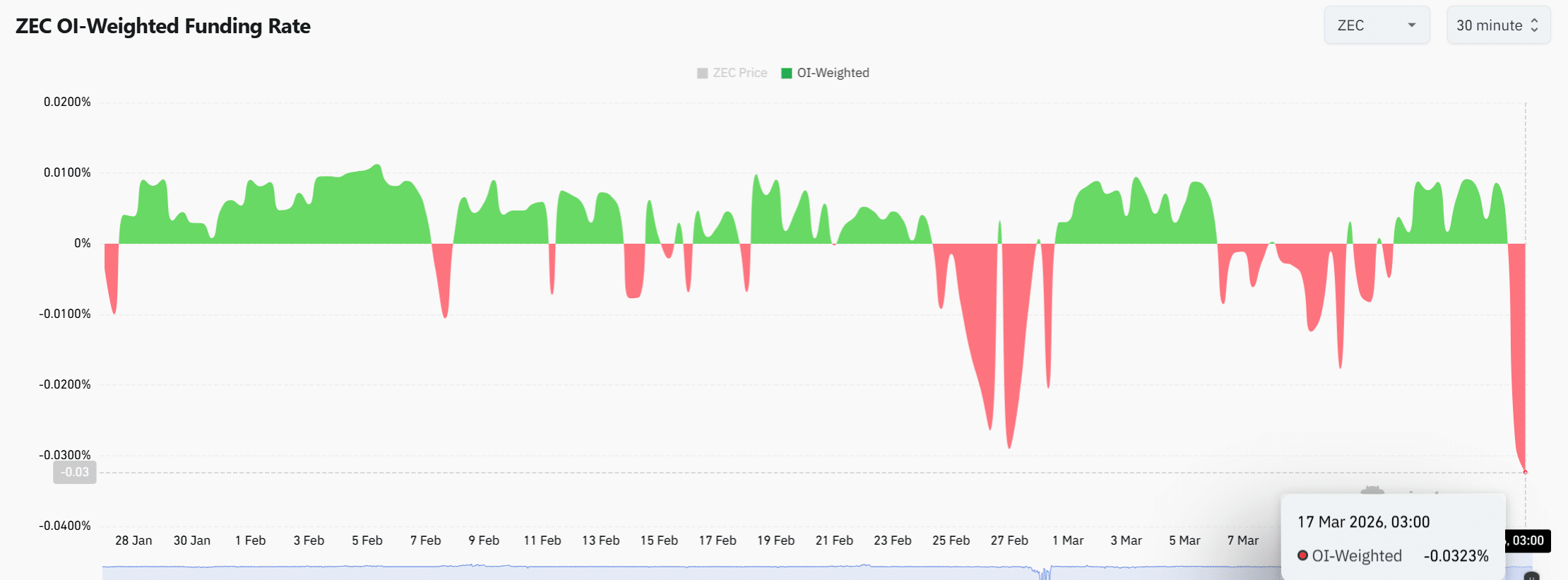
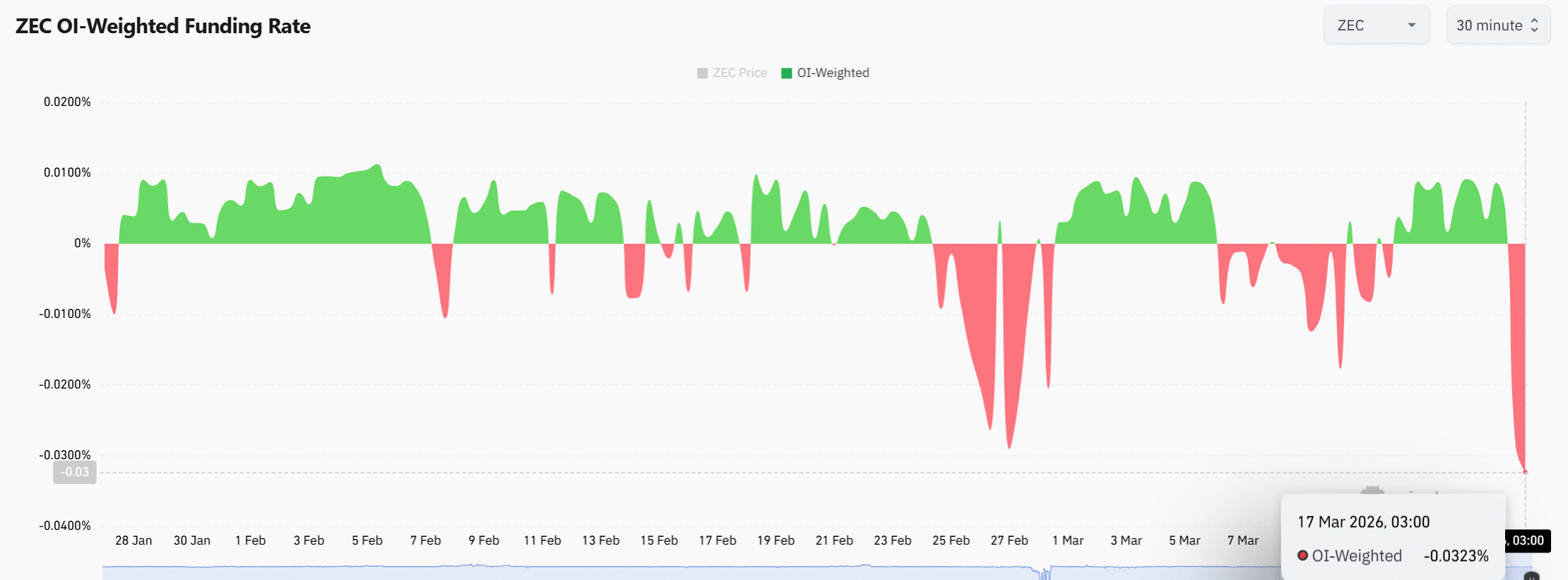
Source: CoinGlass

Zcash’s rally showed clear strength after breaking out of the descending wedge, supported by rising RSI and strong volume expansion.

However, persistent sell pressure in Spot Taker CVD and heavy short positioning introduces conflicting signals beneath the surface.

While short squeezes could extend upside moves, the $300 resistance remains a decisive barrier, meaning the rally would likely continue with volatility rather than a smooth trend.


Final Summary

  • Zcash showed an improving structure, but resistance pressure could still challenge continuation despite current breakout strength holding firm.
  • Short positioning imbalance may drive volatility higher, potentially extending gains while increasing risk of sharp reversals near resistance.


İlgili Sorular

QWhat was the percentage surge in Zcash's price and the increase in trading volume mentioned in the article?

AZcash surged over 20% in 24 hours, and its trading volume rose over 76%.

QFrom which key support level did ZEC price rebound, and what is the immediate resistance it is approaching?

AZEC rebounded from the $194.90 support level and is now approaching the $300 resistance zone.

QWhat does the negative OI-Weighted Funding Rate of approximately -0.032% indicate about market positioning?

AIt indicates that short positions dominate the derivatives market, reflecting growing bearish positioning among traders.

QWhat technical pattern did Zcash break out of, and what does this breakout signal?

AZcash broke out of a descending wedge pattern, which signals a shift in short-term structure toward bullish territory.

QAccording to the article, what two underlying metrics present mixed signals despite the price rally?

AThe Spot Taker CVD, which remains sell-dominant, and the negative funding rate, which indicates heavy short positioning, present mixed signals.

İlgili Okumalar

The King of Blind Date Attire in Korea: How SK Hynix Made a Comeback Against Samsung?

In South Korea's dating scene, SK Hynix employees are now highly sought after, a status shift fueled by the company's astronomical profits and employee bonuses, projected to reach up to 6.1 million RMB per person by 2027. This marks a dramatic reversal for the long-time second-place player in memory semiconductors, which has now surpassed its rival Samsung in annual operating profit. The turnaround story began in 2008 when a struggling Hynix, emerging from bankruptcy restructuring, took a risky bet by agreeing to develop High Bandwidth Memory (HBM) with AMD. At the time, HBM had no clear market beyond high-end graphics cards and was a costly, complex technology. Major players like Samsung, pursuing its own HMC technology, declined. For Hynix, with only memory as its core business, it was a gamble born of necessity. The pivotal moment came in 2012 when SK Group Chairman Chey Tae-won acquired Hynix. Defying industry downturns, he invested heavily in R&D and fabrication, sustaining the HBM project through over a decade of commercial uncertainty and internal challenges. A key break occurred around 2016-2017 when Samsung faced production issues supplying HBM2 for Google's TPU, allowing SK Hynix to gain a crucial foothold in the data center market. The AI explosion post-ChatGPT in 2022 was the catalyst, turning HBM into a critical bottleneck for AI accelerators like NVIDIA's GPUs. By 2025, SK Hynix captured 62% of the global HBM market, leaving Samsung at 17%. For the first time, its annual operating profit exceeded Samsung's. Analysts point to the "innovator's dilemma" to explain Samsung's miss: its vast, successful business portfolio made it risk-averse, preventing an all-in bet on the initially niche HBM technology. In contrast, SK Hynix, as a challenger with its back against the wall, had no choice but to commit fully. The story highlights how Korea's chaebol system allows for ultra-long-term bets beyond quarterly pressures. However, SK Hynix's lead isn't guaranteed. Samsung is aggressively catching up on HBM4, and challenges like customer concentration (heavy reliance on NVIDIA) and technical hurdles in advanced packaging remain. The narrative underscores a market truth: the greatest alpha often comes from betting on uncertain, long-term directions others dismiss, much like HBM in 2008.

marsbit13 dk önce

The King of Blind Date Attire in Korea: How SK Hynix Made a Comeback Against Samsung?

marsbit13 dk önce

Understanding Hash in One Article: The "Browser Miner" on Ethereum

Hash is an Ethereum-based ERC-20 token described as a "browser-minable post-quantum token." Its key features include enabling browser-based GPU mining without specialized hardware, a fixed supply cap of 21 million tokens, immutable and permissionless smart contracts with no team allocation or pre-mining, and an emphasis on post-quantum security using Keccak256 hashing. The mining mechanism is a simplified on-chain proof-of-work where miners solve unique challenges tied to their wallet address. Key design elements prevent answer theft, with epochs resetting every 100 blocks (~20 minutes) and a per-block minting limit. Emission follows a Bitcoin-like halving schedule every 100,000 mints, starting at 100 tokens per mint. Projections suggest all tokens could be mined within approximately 294 days if a target rate of one mint per minute is sustained. Hash emphasizes "post-quantum" security by leveraging hash-based primitives like Keccak256, which are considered more resistant to quantum attacks compared to elliptic-curve cryptography. While not a fully post-quantum asset, it aligns with Ethereum's broader post-quantum research narrative. The project completed its Genesis sale at $0.03 and began trading on Uniswap, with its price reaching around $0.19. The initial circulating supply is small, with 5% sold in Genesis and 5% allocated to liquidity. The majority (47.6% of total supply) is allocated to early-stage mining, leading to a front-loaded emission schedule. This structure, combined with low initial liquidity, makes Hash a high-volatility, high-risk project dependent on sustained miner participation and market demand to absorb new supply.

marsbit27 dk önce

Understanding Hash in One Article: The "Browser Miner" on Ethereum

marsbit27 dk önce

OpenAI's Largest Internal Wealth Creation: 600 People Cash Out a Total of $6.6 Billion, 75 Take Home the Maximum $30 Million Each

A Wall Street Journal report reveals OpenAI's unprecedented pre-IPO wealth creation. In a single employee stock sale last October, over 600 current and former employees sold shares, collectively cashing out approximately $6.6 billion. Due to high investor demand, the company tripled the individual sale cap to $30 million, with about 75 employees selling the maximum amount. This event represents the largest such transaction in tech industry history for a private company. OpenAI's valuation was $500 billion for this tender offer. Employees with over two years of tenure were eligible, allowing many post-ChatGPT hires their first liquidity event. The company's stock has reportedly grown over 100-fold in seven years. Following a restructuring, employees collectively hold about 26% of OpenAI. The scale of executive wealth is also staggering. In court testimony related to Elon Musk's lawsuit, President and co-founder Greg Brockman confirmed his OpenAI stake is worth around $30 billion. Analysis indicates about 165 current and former employees hold a combined ~$164.9 billion in equity, averaging nearly $1 billion per person in paper wealth. OpenAI's per-employee stock-based compensation is estimated to be 34 times the average of major tech firms before their IPOs. OpenAI continues its rapid ascent, closing a $122 billion funding round at an $852 billion valuation in March. With monthly revenue hitting $2 billion, over 900 million weekly ChatGPT users, and plans for a potential trillion-dollar IPO in late 2026, this wealth-creation engine shows no signs of stopping.

链捕手49 dk önce

OpenAI's Largest Internal Wealth Creation: 600 People Cash Out a Total of $6.6 Billion, 75 Take Home the Maximum $30 Million Each

链捕手49 dk önce

İşlemler

Spot
Futures

Popüler Makaleler

ZEC Nasıl Satın Alınır

HTX.com’a hoş geldiniz! Zcash (ZEC) satın alma işlemlerini basit ve kullanışlı bir hâle getirdik. Adım adım açıkladığımız rehberimizi takip ederek kripto yolculuğunuza başlayın. 1. Adım: HTX Hesabınızı OluşturunHTX'te ücretsiz bir hesap açmak için e-posta adresinizi veya telefon numaranızı kullanın. Sorunsuzca kaydolun ve tüm özelliklerin kilidini açın. Hesabımı Aç2. Adım: Kripto Satın Al Bölümüne Gidin ve Ödeme Yönteminizi SeçinKredi/Banka Kartı: Visa veya Mastercard'ınızı kullanarak anında Zcash (ZEC) satın alın.Bakiye: Sorunsuz bir şekilde işlem yapmak için HTX hesap bakiyenizdeki fonları kullanın.Üçüncü Taraflar: Kullanımı kolaylaştırmak için Google Pay ve Apple Pay gibi popüler ödeme yöntemlerini ekledik.P2P: HTX'teki diğer kullanıcılarla doğrudan işlem yapın.Borsa Dışı (OTC): Yatırımcılar için kişiye özel hizmetler ve rekabetçi döviz kurları sunuyoruz.3. Adım: Zcash (ZEC) Varlıklarınızı SaklayınZcash (ZEC) satın aldıktan sonra HTX hesabınızda saklayın. Alternatif olarak, blok zinciri transferi yoluyla başka bir yere gönderebilir veya diğer kripto para birimlerini takas etmek için kullanabilirsiniz.4. Adım: Zcash (ZEC) Varlıklarınızla İşlem YapınHTX'in spot piyasasında Zcash (ZEC) ile kolayca işlemler yapın.Hesabınıza erişin, işlem çiftinizi seçin, işlemlerinizi gerçekleştirin ve gerçek zamanlı olarak izleyin. Hem yeni başlayanlar hem de deneyimli yatırımcılar için kullanıcı dostu bir deneyim sunuyoruz.

517 Toplam GörüntülenmeYayınlanma 2024.12.12Güncellenme 2025.03.21

ZEC Nasıl Satın Alınır

Tartışmalar

HTX Topluluğuna hoş geldiniz. Burada, en son platform gelişmeleri hakkında bilgi sahibi olabilir ve profesyonel piyasa görüşlerine erişebilirsiniz. Kullanıcıların ZEC (ZEC) fiyatı hakkındaki görüşleri aşağıda sunulmaktadır.

活动图片