Worldcoin hits 6-month low: Will $0.20 be WLD’s next support level?

ambcrypto2026-03-28 tarihinde yayınlandı2026-03-28 tarihinde güncellendi

Özet

Worldcoin (WLD) has extended its bearish trend, falling 9.03% to a six-month low of $0.2701 and breaching the $0.30 support level. The decline was accompanied by significant capital outflows, with its market cap dropping to $876 million and over $4.26 million in long positions being liquidated. Adding to the selling pressure, the Worldcoin team transferred 89.65 million WLD (worth $26.17 million) to a new wallet and then to multiple centralized exchanges, a move that often signals potential token sales or liquidity provision. Market data shows strong dominance by sellers, with sell volume exceeding buy volume on Binance and futures netflow turning negative at -$18.98 million, indicating aggressive exits. Technical indicators, including the RSI nearing a bearish crossover, suggest further downside risk. A drop to the $0.20 support level appears likely unless WLD can reclaim and hold above the $0.30 resistance.

Worldcoin [WLD] has traded within a strong downtrend since it fell below $1. In fact, the altcoin has closed at lower lows since January, reflecting strong bearish pressure.

Worldcoin extended its bearish streak, breaching the $0.3 support and dropping to a 6-month low of $0.2701. At press time, WLD traded at $0.282, down 9.03% on the daily charts.

Over the same period, the altcoin’s market cap dropped from $1 billion to $876 million, indicating massive capital outflows. Following this market slip, liquidation levels soared with over $4.26 million in long positions liquidated, further stretching the downtrend.

Amid this market weakness, the Worldcoin team has moved significant funds into exchanges.

WLD team moves 89.65M tokens

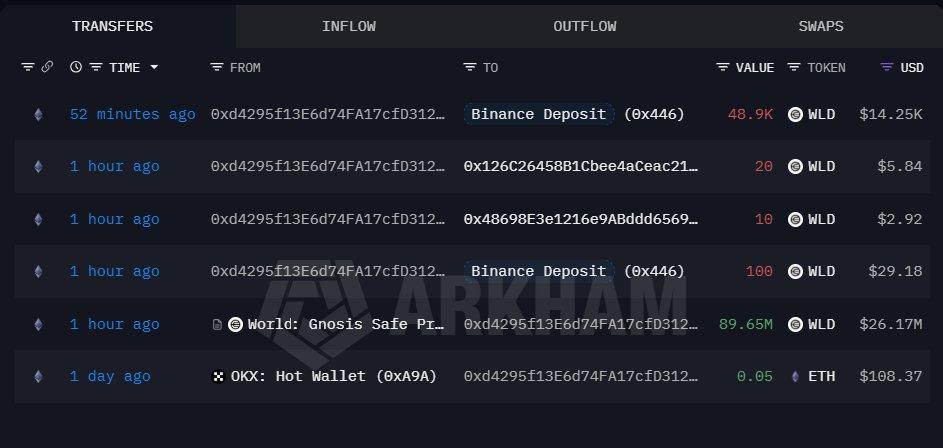
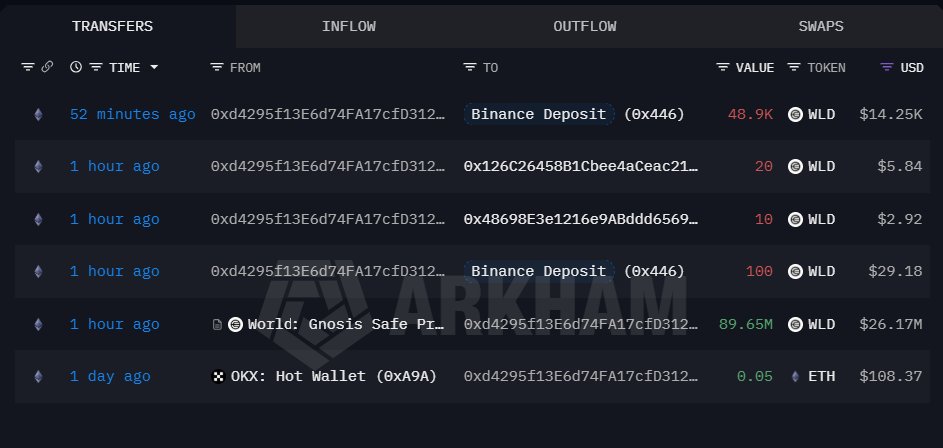
Onchain Lens reported that the WorldCoin Team sent 89.65 million WLD, worth $26.17 million, to a new wallet. After the transfer, the team later began sending funds to multiple centralized exchanges (CEXs).
Source: Onchain Lens

When a team’s wallet makes such transfers, it could mean two important things. Firstly, moving funds to exchanges could mean that tokens are being prepared for sale.

Usually, this move is inflationary, causing short-term bearish pressure and leading to a price decline. However, sometimes teams move funds to exchanges to provide liquidity, supporting market stability by avoiding higher slippage.

Although less bearish, it could also create downside pressure if the demand is weak. Combined, either move could result in bearish pressure, leading to lower prices.

WLD faces strong bearish pressure

In addition to the team’s token transfers, Worldcoin has faced significant pressure from other market participants.

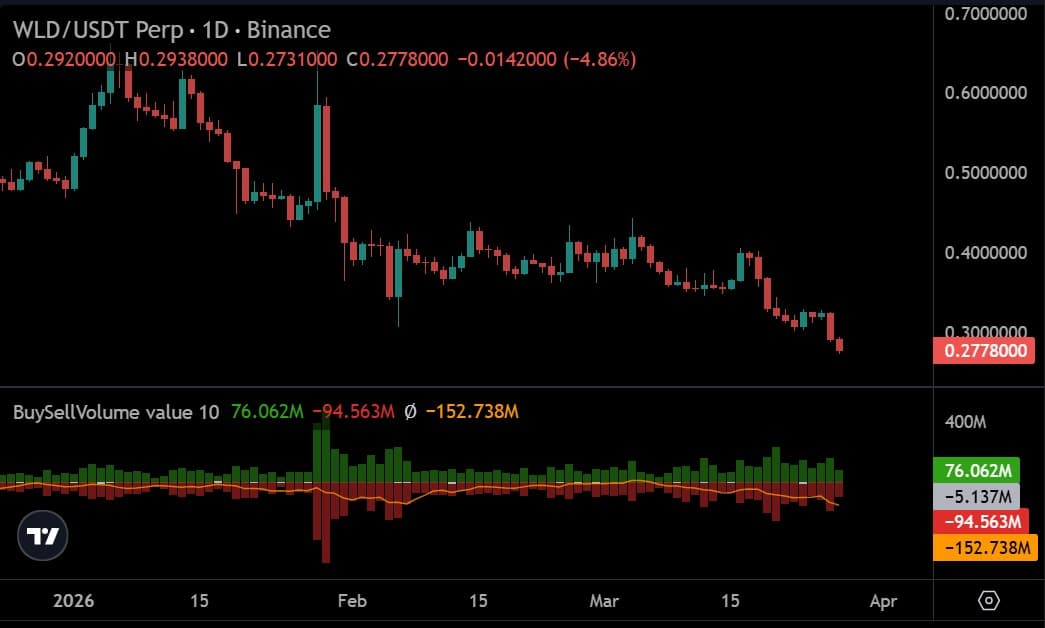
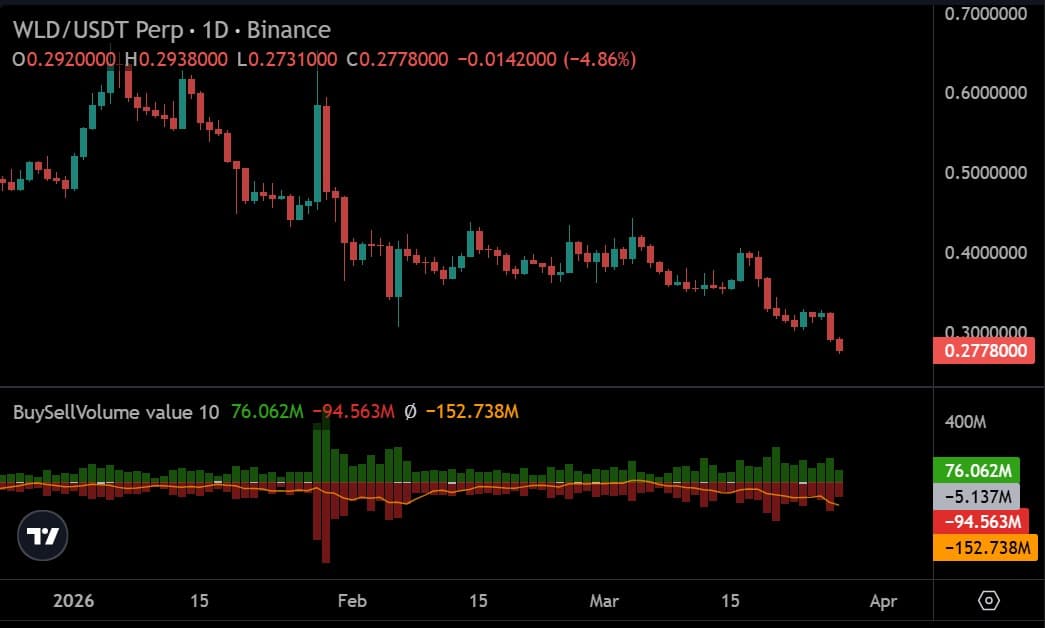
On the spot side, sellers have largely dominated the market, as evidenced by Buy Sell Volume on Binance. A the time of writing, Sell Volume rose to 94 million, while Buy Volume dropped to 76 million as of writing, with net market delta holding at -152 million.
Source: Coinalyze

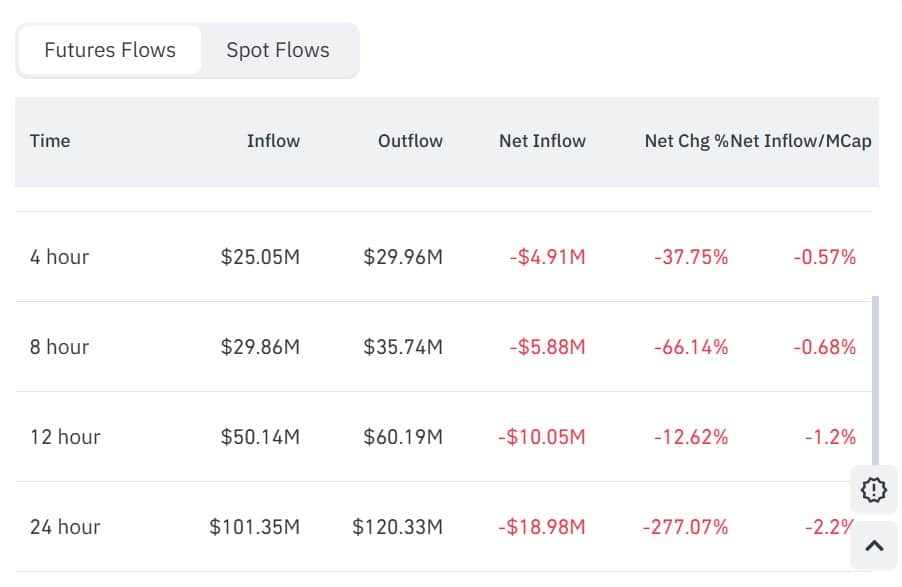
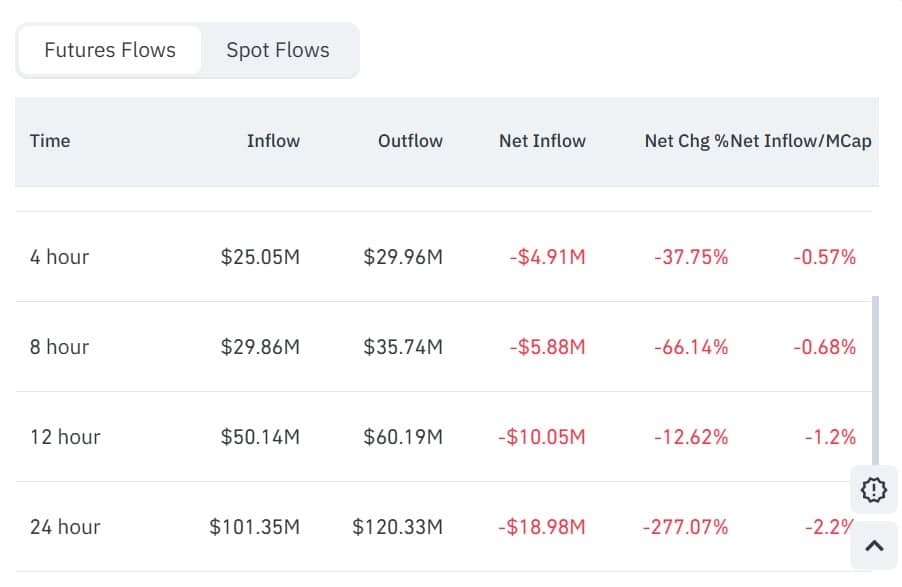
The same market behavior was observed on the Futures side. According to CoinGlass data, Futures Inflow dropped to $101 million while outflows jumped to $120.3 million.

As a result, Futures Netflow dropped 277% to -$18.98 million, a clear sign of aggressive exits in the futures market. Such market conditions suggest increased risk-off sentiment with traders reducing exposure.
Source: CoinGlass

More losses ahead for WLD?

Worldcoin has faced significant downside pressure, and the latest team’s token transfer exacerbated the downtrend.

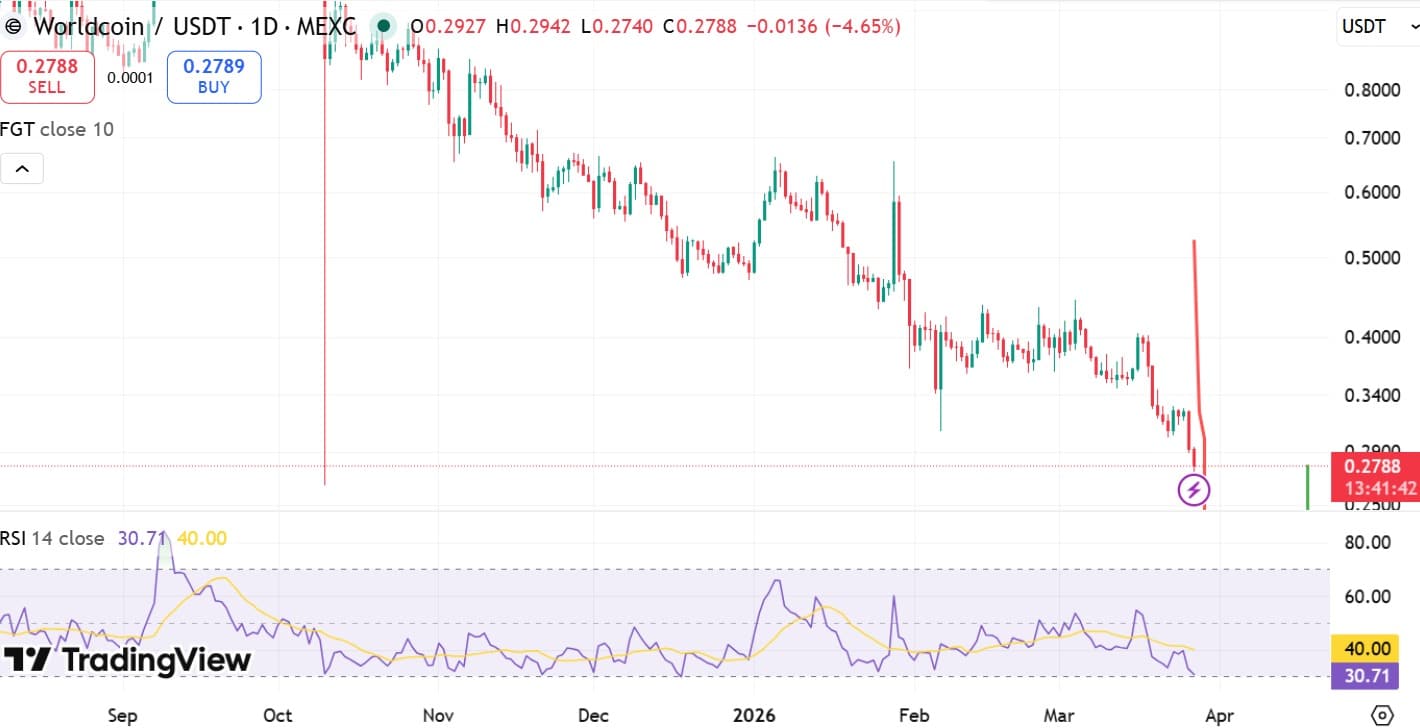
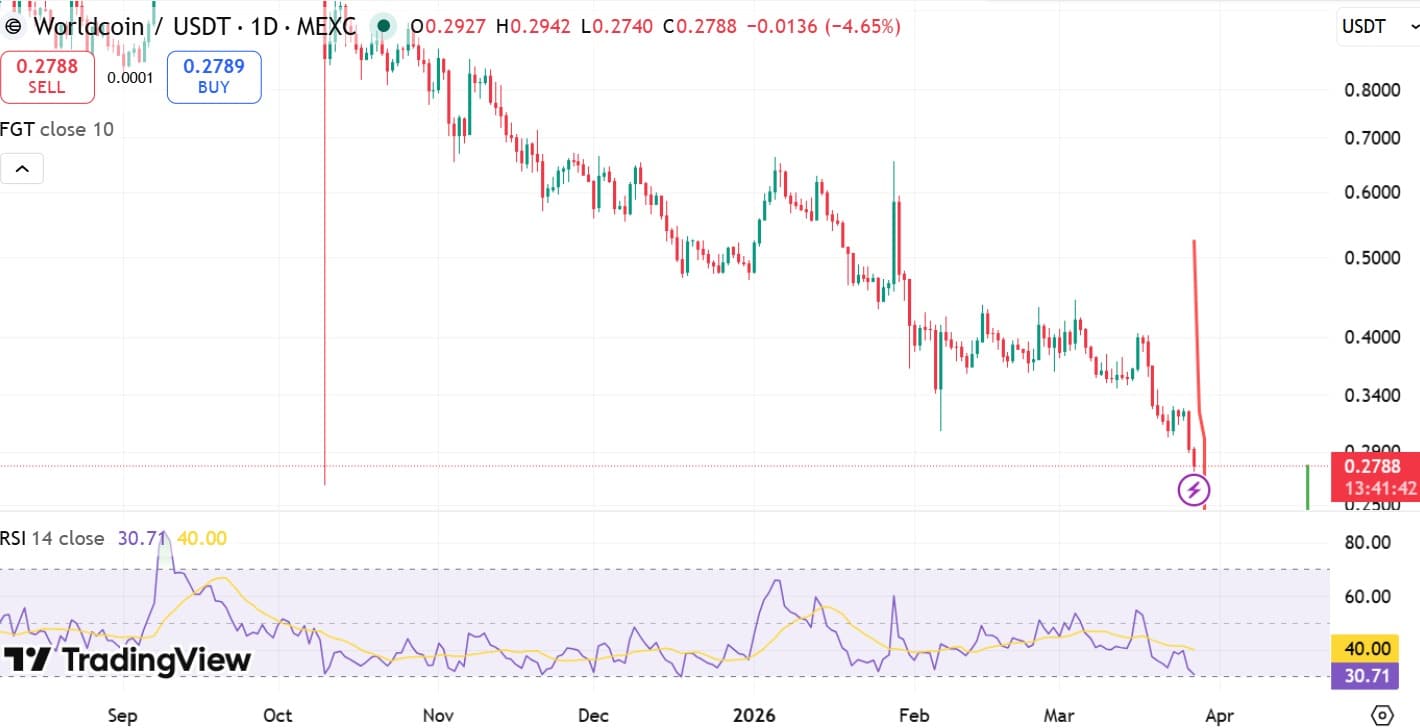
At press time, the altcoin’s Relative Strength Index (RSI) dropped deeper into the bearish zone and was nearing an bearish crossover. Often, when this momentum indicator drops to such levels, it suggests that sellers have outpaced buyers.
Source: TradingView

Traditionally, a drop into oversold territory has preceded lower prices. In fact, the Future Grand Trend indicator indicated a continued market decline, with a likelihood of dropping below the $0.2 support.

For a potential trend reversal, WLD needs to reclaim the $0.3 resistance and flip it into support.


Final Summary

  • Worldcoin team moves 89.65 million WLD, worth $26.17 million, to multiple exchanges.
  • WLD declined 9.03%, breaching the $0.3 support to a 6-month low of $0.27.

İlgili Sorular

QWhat was the recent price movement of Worldcoin (WLD) and what support level did it breach?

AWorldcoin declined 9.03% and breached the $0.3 support level, dropping to a 6-month low of $0.2701.

QWhat significant action did the Worldcoin team take that contributed to the bearish pressure?

AThe Worldcoin team moved 89.65 million WLD, worth $26.17 million, to a new wallet and then began sending funds to multiple centralized exchanges (CEXs).

QWhat does the negative Futures Netflow of -$18.98 million indicate about market sentiment?

AThe -$18.98 million Futures Netflow, a drop of 277%, is a clear sign of aggressive exits in the futures market, indicating an increased risk-off sentiment with traders reducing their exposure.

QAccording to the technical analysis, what is the potential next major support level for WLD if the downtrend continues?

AThe Future Grand Trend indicator suggests a likelihood of the price dropping below the $0.20 support level if the downtrend continues.

QWhat would need to happen for a potential trend reversal in WLD's price?

AFor a potential trend reversal, WLD needs to reclaim the $0.30 resistance level and flip it into support.

İlgili Okumalar

It Took Me a Year to See the Bitter Truth About Agent Payments

After a year building infrastructure for the Agent economy, engaging with major players like Stripe, Visa, and Coinbase, the author shares a sobering analysis of the current state of Agent payments. The core finding is a stark lack of genuine, immediate demand across most envisioned use cases. The article breaks down four key market segments: 1. **Agent-to-Merchant (Consumer Shopping):** For most product categories (e.g., clothing, electronics), conversational AI shopping is a step backwards from visual e-commerce interfaces. While agents excel at understanding needs, they can't replace side-by-side product comparison. Real merchant interest is defensive "Agent Engine Optimization," not driven by current customer demand. Potential exists for high-frequency, low-decision purchases (like food delivery) or navigating complex store UIs, but these require massive B2C distribution channels dominated by giants like Amazon. 2. **Agent-to-API (Developer Services):** Developers already have subscriptions and billing relationships for APIs (compute, data). Prepaid balances solve micro-payment issues for low transaction volumes. A deeper structural problem is that major SaaS vendors' business models rely on enterprise contracts, resisting granular pay-per-call pricing. While protocols like MPP and x402 serve the long tail of niche services, this market is small and developers are historically low-willingness-to-pay. 3. **Agent-to-Agent:** This remains largely theoretical with minimal transaction volume. While it represents a long-term bet on a fundamentally new transaction infrastructure (sub-second, micro-penny to million-dollar, multi-party settlements), it does not constitute a present market. 4. **Agent-to-Finance:** This is the only category with existing, paying demand. Integrating AI into financial workflows (trading, portfolio management) is a natural evolution and enables new capabilities like autonomous rebalancing. However, competition favors established, regulated institutions. The "real problem" is not moving money between agents, but the broader challenge of **coordination**—orchestrating work between agents and humans, verifying outcomes, and settling results. Payment is just one component of settlement, which is itself part of coordination. Companies that solve the coordination layer will subsume payment, not the other way around. While well-funded incumbents build defensively for a long-term future, startups must find where the market is today—which, for the author's team, lies outside these four categories in an area of real, growing, and underserved activity.

marsbit39 dk önce

It Took Me a Year to See the Bitter Truth About Agent Payments

marsbit39 dk önce

It Took Me a Year to See the Hard Truth About Agent Payments

**Title: It Took Me a Year to See the Hard Truth About Agent Payments** Over the past year, I've worked on infrastructure for the Agent economy, engaging with major players like Stripe, Visa, Coinbase, and numerous startups. The findings reveal a stark reality: genuine, widespread demand for Agent-based payments does not yet exist. **Key Observations:** * **Agent-to-Merchant (Shopping):** The user experience for AI shopping often falls short, especially for visual product discovery. While AI excels at understanding needs, conversational interfaces can't yet replace browsing and comparing multiple products visually. Current merchant interest is largely defensive ("Agent Engine Optimization") for a future that hasn't arrived. High-frequency, low-friction purchases (like food delivery) are potential fits, but lack open APIs and face high AI inference costs. Simpler, more affordable, or cross-language interactions for complex UIs are a niche opportunity but require massive consumer distribution to scale. * **Agent-to-API (Developer Tools):** Developer payment needs for APIs (computing, data, models) are already met through subscriptions and prepaid credits. The core challenge is not payment friction but supplier economics: most large SaaS providers prefer enterprise contracts over micropayments for API calls. Protocols like MPP and x402 suit the long-tail of smaller services but cater to a developer market historically reluctant to pay for these tools. Major infrastructure needs at the top of the stack are already being addressed. * **Agent-to-Agent (Machine Commerce):** This is a long-term vision with almost no current transaction volume. While a future with high-speed, high-frequency, multi-party machine-to-machine transactions would require novel infrastructure, it remains theoretical. The market is not here yet. * **Agent-to-Finance:** This is the only category with clear, present demand. Financial professionals and DeFi users already pay for tools, and AI augmentation is a natural evolution. Autonomous AI agents can enable entirely new financial strategies. However, competition is fierce from established, regulated incumbents who can more easily layer AI onto their existing products. **The Core Insight:** Companies, especially giants with long time horizons, are building defensively for a potential future of mass machine commerce. For them, early investment is a low-cost hedge. For startups, the current market reality is different. The primary challenge isn't just moving money between agents (payments). The larger, unsolved problem is **orchestration** – coordinating work between agents and humans, verifying outcomes, and then settling. Payment is just a part of settlement, which is just a part of orchestration. Companies that solve the orchestration problem will subsume payments, not the other way around. After a year of building, we see the real, growing, and underserved market opportunity lies in this broader domain of orchestration.

链捕手1 saat önce

It Took Me a Year to See the Hard Truth About Agent Payments

链捕手1 saat önce

Claude Opus 4.8 Finds a $4.5 Billion Bug: The AI Era is Mass-Producing Hackers

A researcher discovered a critical "infinite mint" vulnerability in the Zcash cryptocurrency's Orchard protocol using Claude Opus 4.8, leading to a swift fix but also a 50% market drop, erasing billions in value. This incident highlights a new era where powerful, accessible AI models are dramatically lowering the barrier to finding software vulnerabilities. Previously, the security community feared specialized models like Claude Mythos Preview, capable of finding decades-old zero-day exploits. The Zcash case, however, involved a publicly available, general-purpose model. This shift makes advanced security auditing—and attack capabilities—accessible to far more people, not just experts. The mass democratization of vulnerability discovery brings a dual challenge: a flood of low-quality, AI-generated false reports that overwhelm maintainers, and the real, rapid uncovering of deep, dangerous bugs. Open-source projects, often understaffed and unfunded, are particularly vulnerable to this "attention DDoS." The article cites examples like curl shutting down its bug bounty program due to the unsustainable workload. Our perceived digital safety has often been luck, relying on the high cost and effort required to find deeply hidden flaws in complex systems, as seen with historical vulnerabilities like Heartbleed or Baron Samedit. AI changes this cost structure, effectively "mass-producing flashlights" to illuminate every corner of our codebase. While large companies operate extensive security chains involving external white-hat hackers and massive defensive operations, the global cybersecurity workforce faces a severe shortage, especially of experienced personnel capable of analyzing complex threats and coordinating fixes. The core dilemma emerges: AI makes *finding* bugs cheap and scalable, but *fixing* them remains a slow, expensive, and human-intensive process. The article concludes that AI won't destroy the internet but acts as a bright light, revealing that our digital existence is not inherently secure but is precariously maintained by ongoing human effort. The true cost in the AI era may not be discovery, but whether there will be enough people left willing and able to do the hard work of repair.

marsbit1 saat önce

Claude Opus 4.8 Finds a $4.5 Billion Bug: The AI Era is Mass-Producing Hackers

marsbit1 saat önce

Codex Goal Mode Usage Guide: How to Make AI Continuously Pursue a Specific Objective

"Codex Goal Mode: How to Make AI Work Continuously Toward a Specific Goal" OpenAI's Codex "goal mode" (/goal) transforms the AI from a reactive code assistant into a proactive execution agent capable of working autonomously for hours or even days to achieve a defined objective. To maximize its effectiveness, follow these key principles: 1. **Define Clear, Verifiable Exit Criteria:** The goal prompt should be a concise, measurable success condition, not a lengthy specification. Use quantifiable metrics like "reduce build time by 30%" or "achieve 100% test parity." 2. **Provide Initial Guidance and Tools:** Direct Codex toward likely problem areas and specify available tools (e.g., browsers, testing environments) to prevent it from exploring unproductive paths. 3. **Enable Progress Measurement:** Equip Codex with ways to track advancement, such as creating comparison tools for visual tasks or evaluation sets, ensuring it can gauge its own progress. 4. **Use a Realistic Execution Environment:** For tasks like performance optimization, provide access to environments that closely mimic production (e.g., similar configs, databases) to yield valid results. 5. **Be Cautious with Visual Goals:** Avoid vague "pixel-perfect" instructions. Instead, supplement visual references with functional checklists or design system specifications to prevent Codex from obsessing over minor details. 6. **Implement Progress Tracking:** For long-running tasks, have Codex commit code to draft PRs, update progress documents, or send Slack updates to maintain visibility into its work. 7. **Review and Consolidate Results:** Once the goal is met, instruct Codex to review its work, clean up ineffective experimental code, and reflect on what strategies succeeded or failed. Ultimately, using goal mode shifts the developer's role from writing prompts to managing a persistent engineering agent—defining objectives, establishing metrics, configuring environments, and conducting final reviews.

marsbit2 saat önce

Codex Goal Mode Usage Guide: How to Make AI Continuously Pursue a Specific Objective

marsbit2 saat önce

İşlemler

Spot
Futures

Popüler Makaleler

WLD Nasıl Satın Alınır

HTX.com’a hoş geldiniz! Worldcoin (WLD) satın alma işlemlerini basit ve kullanışlı bir hâle getirdik. Adım adım açıkladığımız rehberimizi takip ederek kripto yolculuğunuza başlayın. 1. Adım: HTX Hesabınızı OluşturunHTX'te ücretsiz bir hesap açmak için e-posta adresinizi veya telefon numaranızı kullanın. Sorunsuzca kaydolun ve tüm özelliklerin kilidini açın. Hesabımı Aç2. Adım: Kripto Satın Al Bölümüne Gidin ve Ödeme Yönteminizi SeçinKredi/Banka Kartı: Visa veya Mastercard'ınızı kullanarak anında Worldcoin (WLD) satın alın.Bakiye: Sorunsuz bir şekilde işlem yapmak için HTX hesap bakiyenizdeki fonları kullanın.Üçüncü Taraflar: Kullanımı kolaylaştırmak için Google Pay ve Apple Pay gibi popüler ödeme yöntemlerini ekledik.P2P: HTX'teki diğer kullanıcılarla doğrudan işlem yapın.Borsa Dışı (OTC): Yatırımcılar için kişiye özel hizmetler ve rekabetçi döviz kurları sunuyoruz.3. Adım: Worldcoin (WLD) Varlıklarınızı SaklayınWorldcoin (WLD) satın aldıktan sonra HTX hesabınızda saklayın. Alternatif olarak, blok zinciri transferi yoluyla başka bir yere gönderebilir veya diğer kripto para birimlerini takas etmek için kullanabilirsiniz.4. Adım: Worldcoin (WLD) Varlıklarınızla İşlem YapınHTX'in spot piyasasında Worldcoin (WLD) ile kolayca işlemler yapın.Hesabınıza erişin, işlem çiftinizi seçin, işlemlerinizi gerçekleştirin ve gerçek zamanlı olarak izleyin. Hem yeni başlayanlar hem de deneyimli yatırımcılar için kullanıcı dostu bir deneyim sunuyoruz.

154 Toplam GörüntülenmeYayınlanma 2024.12.11Güncellenme 2026.06.02

WLD Nasıl Satın Alınır

Tartışmalar

HTX Topluluğuna hoş geldiniz. Burada, en son platform gelişmeleri hakkında bilgi sahibi olabilir ve profesyonel piyasa görüşlerine erişebilirsiniz. Kullanıcıların WLD (WLD) fiyatı hakkındaki görüşleri aşağıda sunulmaktadır.

活动图片













