Author: Zuoye Web3
A storm is about to break. Stripe is once again attempting to acquire PayPal. Fortune's wheel keeps turning. The last time was thirty years ago, when Peter Thiel's PayPal merged with Elon Musk's original X.com.
I don't understand why everyone is talking about PayPal's lackluster growth, as if this FinTech track spells doom for us. Twenty years ago, Peter Thiel embarked on his first entrepreneurial journey from payments, leading to the unification of the PayPal Mafia. Wherever Elon Musk went, people welcomed him sincerely. He truly enjoyed favorable conditions, a scene of vibrant vitality and fierce competition. Yet, just two decades later, has the payment industry really become our burial ground?
Growth is the Miracle, Stablecoins Are Not
Stripe not going public during the pandemic was a mistake in hindsight.
Stripe's various efforts are all for the distant dream of an IPO. Against the backdrop of pandemic-era monetary easing, Stripe first touched a $100B valuation.
However, it did not follow the IPO of Coinbase and others, leading to repeated valuation declines. Mistaking the era's opportunity for personal effort, Stripe has, after much reflection, embarked on the path of acquisition.
Stripe started with a developer-friendly model, one-click API integration, an undeniably strong allure for developers. This was the most unique approach in the payment industry, not focusing on rates and scenarios, but reaching the people actually doing the work behind them.
Stripe hopes to repeatedly reuse its experience: approaching the acquiring system from the B-side, stablecoins from the C-side, and even deploying protocols like ACP/MPP for the Agent-side, hoping to reshape the entire payment industry.
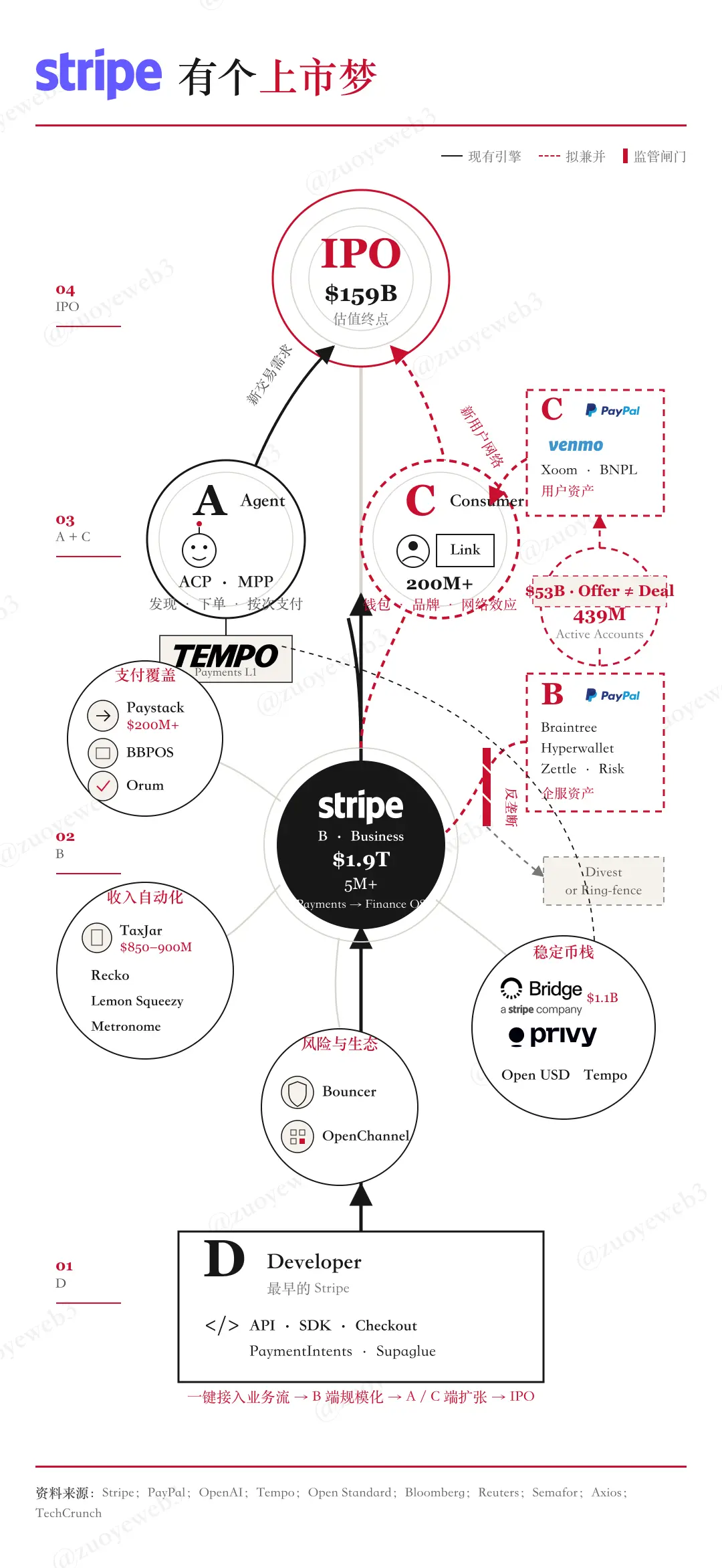
Image Description: Stripe's Bumpy Road to IPO
Image Source: @zuoyeweb3
Two characteristics of the payment industry have always hindered Stripe's continued advancement:
-
The payment industry remains highly fragmented. Securing a country, an industry, or even a few companies allows for continued survival, impossible to be directly eliminated by external forces. -
Payment is an appendage of the banking industry. Developers and B/C-side enterprises are ultimately externalizations of banking processes. Stablecoins will also eventually be incorporated into the banking system's orbit.
In particular, a series of acquisitions related to stablecoins, from the issuance at Bridge, to wallet entry via Privy, and even Tempo and OpenUSD, will struggle to replicate Stripe's past glory.
The current acquisition proposal for PayPal is actually a phased result of Stripe's failed attempt to use stablecoins to open up the C-side, trying to use PayPal's C-side business to supplement itself.
PayPal's problem isn't that it can't keep up with the times. From Venmo to PYUSD, nothing has saved PayPal from its downward trend.
In other words, PayPal is simply too old. The entire company suffers from structural dysfunction; launching new businesses alone cannot bring it back to life.
Stripe, which started slightly later, still wants to add more narrative possibilities before its IPO.
If Stripe has wrapped the backend to capture the developer market, the stablecoin market wraps the frontend—the story of the issuance network is likely over. Tempo and OpenUSD may impact Circle's stock price but cannot affect Tether at all.
If Stripe's ceiling is Coinbase or Circle, then an IPO is destined for an underwhelming fate. Compared to Adyen's market cap and Airwallex's valuation, Stripe's stablecoin narrative and Agent narrative are valuable.
Stablecoins are not yet part of the daily routine of the current payment system, but they are a visible trend.
Agents still need to find an entry point for themselves to enter the existing system.
On the positive side of the news, Agents are already buying computing power and tokens with stablecoins, but beyond suspicions of wash trading, Agents have not yet entered Web3 business, let alone the more conservative corporate and banking systems.
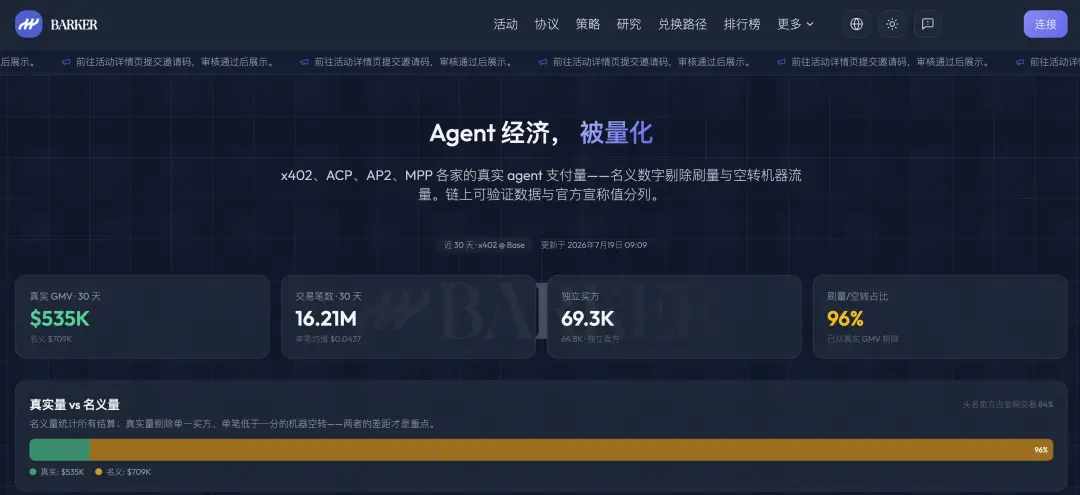
Image Description: Agents are currently mainly used for wash trading
Image Source: @BarkerMoneyX
A-side (future), B-side, C-side, D-side (foundational), but Stripe's valuation struggles to escape the reasonable ceiling of $50B for FinTech; $100B contains too much active imagination.
If it cannot briefly arrive in the future, then expanding scale and ecosystem is the only point where Stripe can exert force. You can understand Stripe as a kind of option product.
-
Agents will use OUSD stablecoins, running on Tempo, Stripe should be at Visa's scale; -
Agents will use stablecoins, but OUSD fails, Tempo captures part of the market, Stripe should have a $100B valuation + Tempo blockchain valuation; -
Agent economy is unlikely to materialize, Agentic Payment is overtaken by new concepts, then Stripe at least still has its own business.
Investment losses are certainly a mistake, but missing out is even more regrettable. Starting from the conundrum Stripe presents to the private market, how the entire payment industry will evolve is worth our further consideration.
Payment is Just the Entry, Value-Added Services Generate Profit
Agent is a visible future, provided one can survive until that day.
Standing in mid-2026 is a delicate point. The final time window for clear legislation to pass, stablecoin profits may be settled once and for all.
Simultaneously, the long-term future of the Agent economy is currently focused on replacement models for white-collar and blue-collar workers, as well as new wearable devices, AIOS phones, and other hardware fields.
The transformation of payments by Agents has not yet triggered widespread social attention. There is reason to believe this is a hidden opportunity for stablecoins, a beta opportunity sent by the times.
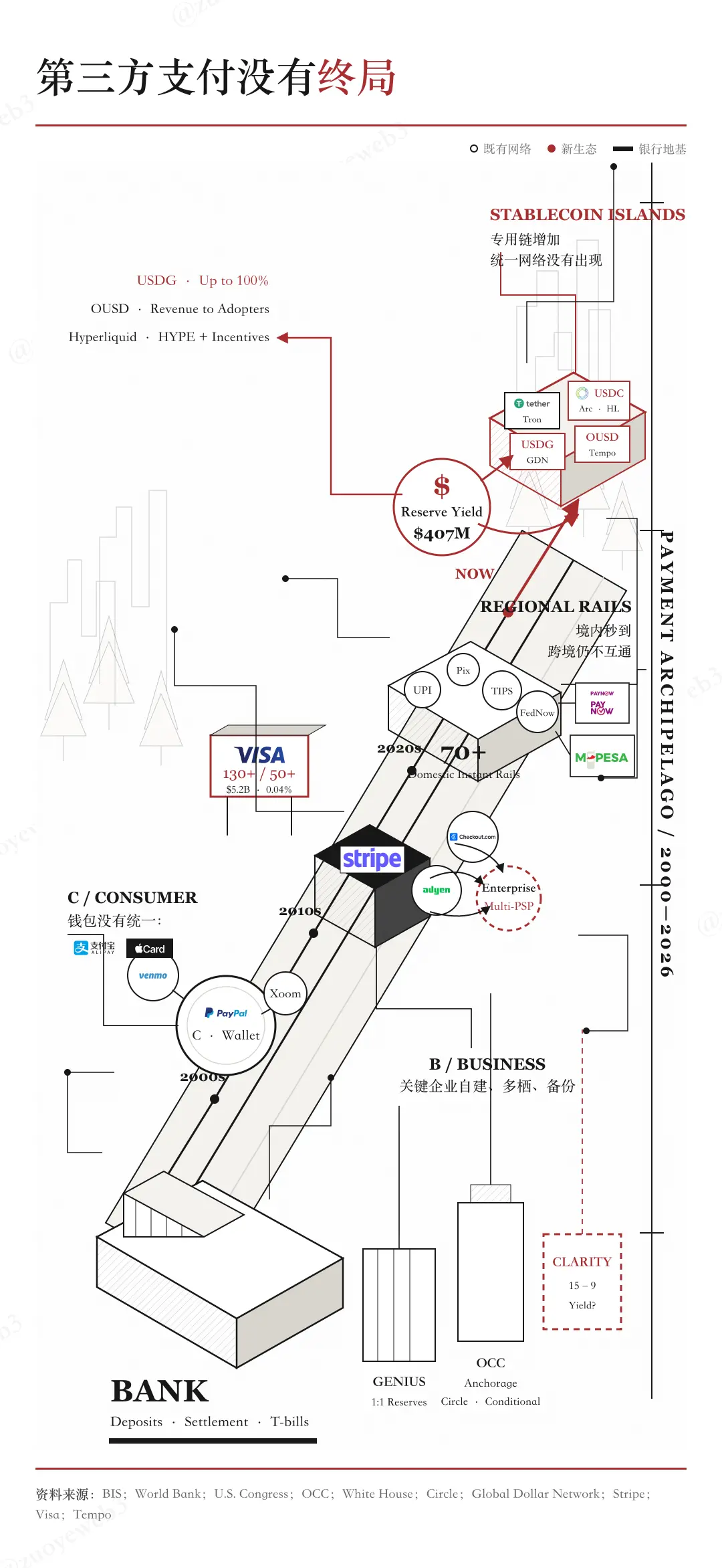
Image Description: The Ever-Moving Payment Industry
Image Source: @zuoyeweb3
However, the operational model built by the payment industry in the past on "licensing + localization" may face continuous impact from clearing networks.
Stablecoins still need entry points like on-ramps at the front end, and exit points for on-chain circulation and settlement at the back end, which is also the basis for banking compliance.
Over the past 30 years, the FinTech wave driven by the internet ultimately increased the banking industry's control over payments. Unlike publishing, retail, entertainment, or dining, which were directly transformed or even eliminated.
Under technological waves, banks have become increasingly transparent but always retain the terminal touchpoints of cash and branch networks. In a sense, the fragmentation of the payment industry can be attributed to the segmented, regional structure of banks, while licensing and sovereign boundaries are merely acknowledgments of this reality.
However, in the actions of Stripe and Circle lies another possibility for payments: acquiring customers with stablecoins at the front end, and profiting from clearing at the back end.
Stripe and Circle are actually quite similar, representing the intersecting future forms of FinTech and Crypto. Both are working on blockchains (Tempo vs Arc), stablecoins (OUSD vs USDC), and clearing networks.
The reason it's not about profit-sharing from stablecoin issuance is that Circle has already started subsidizing channel partners like Hyperliquid, and OUSD directly shares profits with partners. The two sides have already started competing intensely, which is certainly not the future.
But the clearing system, for the first time, allows their blockchains to earn revenue from payment and stablecoin network effects purely through capital efficiency, without forced subsidies to partners.
The clearing system is not complex. Traditional fiat clearing relies on card networks, SWIFT, central banks, and commercial banks, a cumbersome and overloaded structure.
Emerging stablecoin blockchains, however, have no historical baggage and can focus on improving clearing efficiency. As Circle and Stripe obtain OCC Special Purpose Bank Charters (conditionally approved), they will inevitably move towards clearing after stablecoin profit-sharing.
And clearing networks have the potential to partially detach from the commercial banking system, keeping profits within themselves.
Conclusion
Stripe missed the IPO window during the pandemic and entered the trench warfare of third-party payments. This battle is an eternal Verdun mode, where one can never crush small players in specific regions and industries by sheer scale.
A different way of living is necessary, using efficiency to face the banking industry. From PayPal to Stripe, from stablecoins to Agents, four generations of the payment industry coexist. Will this time bring victory?






