TON/GRAM price prediction – Telegram’s Gram wallet rollout lifts token: Can the rally continue?

ambcrypto2026-07-21 tarihinde yayınlandı2026-07-21 tarihinde güncellendi

Özet

Telegram founder Pavel Durov announced the rollout of a native, non-custodial Gram wallet across the messaging app, describing it as potentially the largest deployment of a non-custodial wallet in history. The move aims to bring instant, zero-fee crypto transactions to Telegram's over one billion users, integrating digital assets directly into the platform. The news triggered a more than 7% price increase for TON/GRAM, pushing the token to around $1.53. However, it remains below its May peak near $2.80, facing immediate resistance around $1.60. Analysts suggest a break above this level could improve sentiment toward $1.80, while a failure to hold gains might see a retest of support near $1.40.

TON, which is set to be rebranded as Gram [GRAM], gained more than 7% after Telegram founder Pavel Durov unveiled plans to roll out a native non-custodial Gram wallet across the messaging platform.

Durov described the initiative as “the largest rollout of a non-custodial crypto wallet in human history”. He said the wallet would bring instant zero-fee crypto transactions to Telegram’s more than one billion users.

Telegram expands its crypto ambitions with native Gram wallet

In a Telegram post, Durov said every Telegram app would receive a native, non-custodial Gram wallet, allowing users to send and receive crypto without relying on a custodial service.

He also said the wallet would enable instant zero-fee crypto transactions, positioning the feature as a major step toward integrating digital assets into Telegram’s messaging ecosystem.
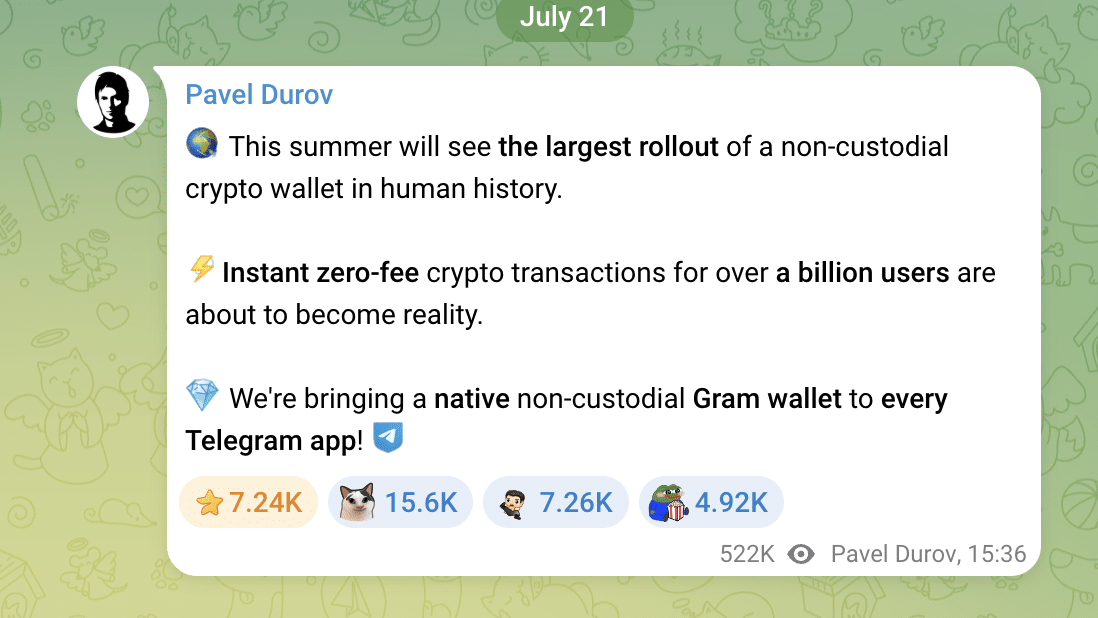
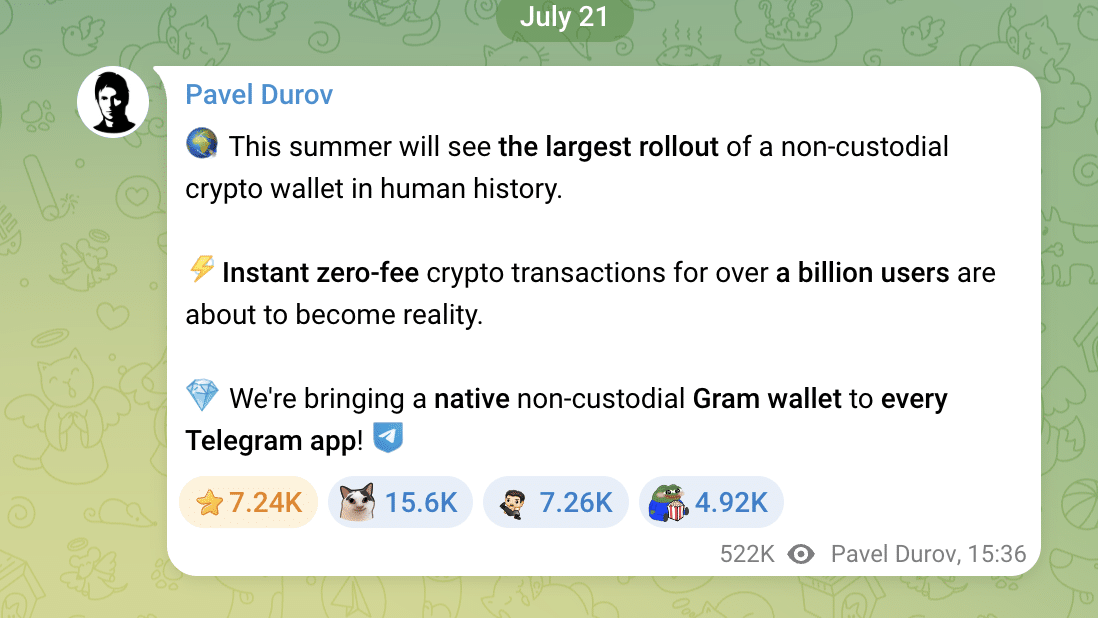
Source: telegram

The announcement follows Telegram’s recent decision to rename TON’s native token to Gram. This signals a clearer distinction between The Open Network [TON] as the blockchain and Gram as the consumer-facing digital currency within Telegram’s ecosystem.

If rolled out as described, the wallet would give Telegram one of the largest built-in crypto distribution channels globally. This exposes self-custody and blockchain payments to an existing user base of more than one billion people.

Why the rollout could matter

Unlike traditional custodial wallets, non-custodial wallets allow users to retain control of their private keys rather than entrusting them to a third party.

Embedding that functionality directly into Telegram could significantly reduce the friction of creating and using a crypto wallet, particularly for users unfamiliar with decentralized applications.

The move also expands Telegram’s broader crypto strategy beyond blockchain infrastructure. It places crypto payments directly inside one of the world’s largest messaging platforms.

Whether widespread adoption follows will depend on user engagement once the feature launches. However, the scale of Telegram’s existing audience suggests the rollout could become one of the largest consumer-facing crypto deployments to date.

TON/GRAM price prediction: Can bulls build on the rebound?

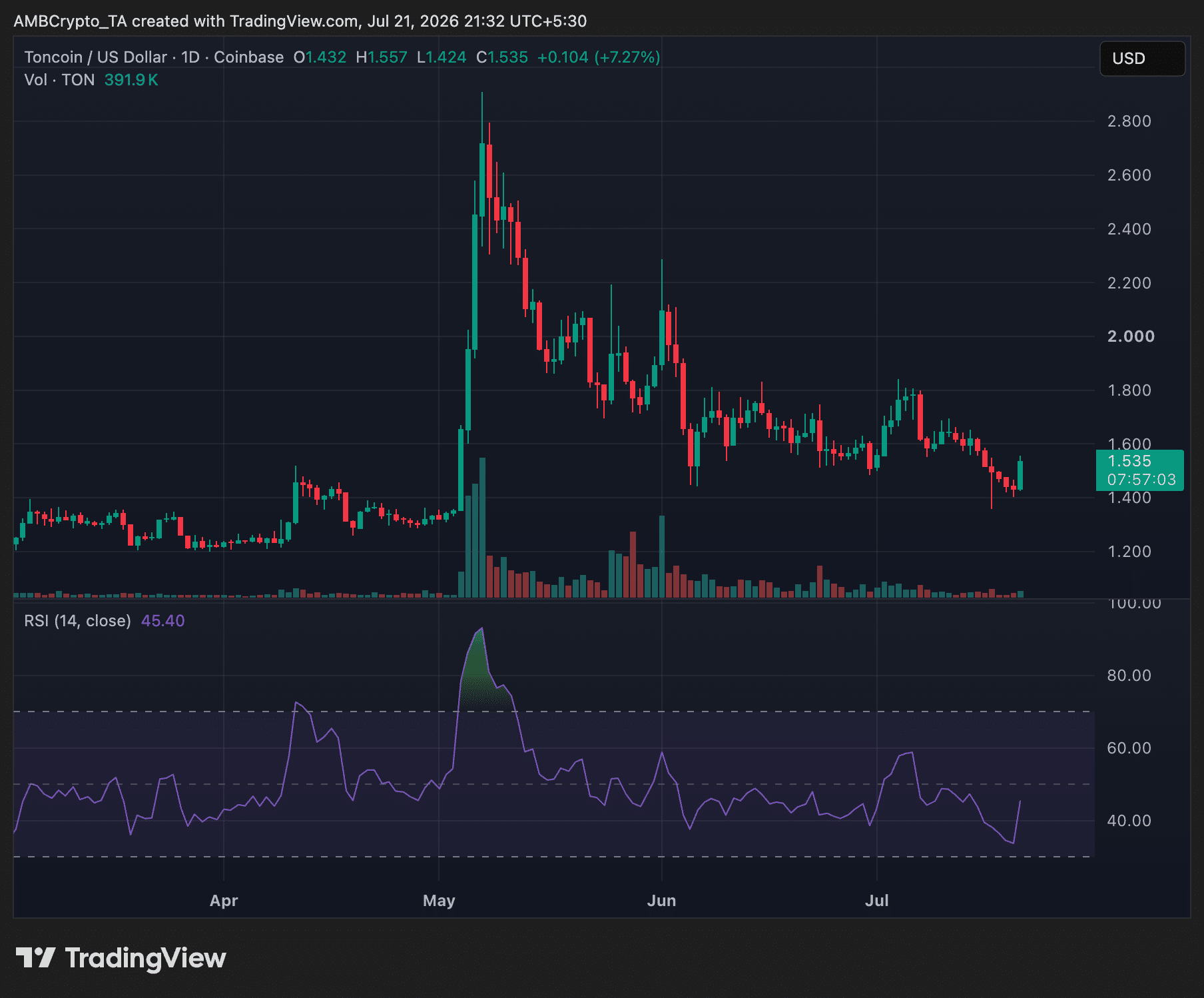
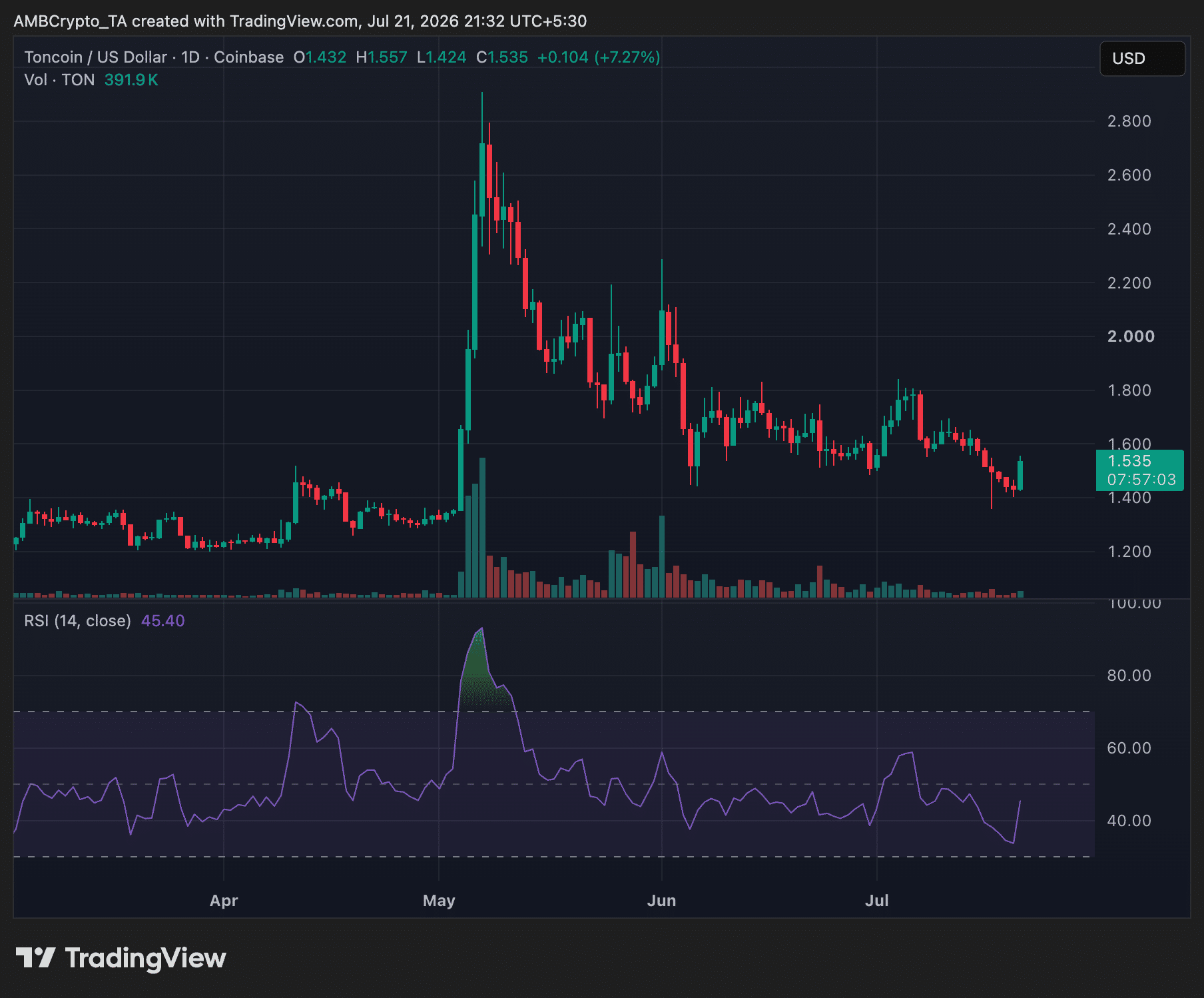
At press time, TON/GRAM traded around $1.53, up roughly 7.3% over the previous 24 hours after bouncing from support near $1.40.

The recovery pushed the daily RSI to around 45, indicating bearish momentum had eased. However, the indicator remained below the neutral 50 level.

Despite the latest rally, TON/GRAM remains well below its May peak near $2.80, suggesting the broader downtrend has yet to reverse.
Source: TradingView

The immediate resistance sits around $1.60, where sellers have repeatedly capped recent advances.

A sustained break above that level could improve short-term sentiment and open the path toward $1.80. At the same time, failure to hold recent gains may see the token retest support around $1.40.


Final Summary

  • Pavel Durov announced that Telegram will roll out a native non-custodial Gram wallet to every Telegram app.
  • TON/GRAM rose more than 7% following the announcement. However, the token still faces resistance around $1.60 and remains below its May highs.

Trend Kriptolar

İlgili Sorular

QWhat is the main reason behind the 7% price increase of TON/GRAM mentioned in the article?

AThe price increase followed the announcement by Telegram founder Pavel Durov about plans to roll out a native, non-custodial Gram wallet across the Telegram messaging platform to all its users.

QWhat key feature of the new Gram wallet is highlighted by Pavel Durov?

APavel Durov highlighted that the Gram wallet will enable instant zero-fee crypto transactions for Telegram's user base.

QAccording to the article, what is the significance of renaming TON's native token to Gram?

AThe renaming signals a clearer distinction between The Open Network (TON) as the blockchain infrastructure and Gram as the consumer-facing digital currency within Telegram's ecosystem.

QWhat is the immediate resistance level for the TON/GRAM price as per the article's analysis?

AThe immediate resistance level for TON/GRAM is around $1.60, where sellers have repeatedly capped recent price advances.

QWhat broader trend does the article suggest TON/GRAM is still in despite the recent rally?

ADespite the recent rally, the article suggests TON/GRAM remains in a broader downtrend, as it is still well below its May peak near $2.80.

İlgili Okumalar

Claude Forms Teams to Hunt Bugs! 66 Bugs Found in 116K Lines of Code, Single Agent Maxed Out at 27

Claude Managed Agents, Anthropic's new multi-agent workflow system, significantly outperformed a single AI agent in finding bugs. In a test with 70 bugs hidden across 116,000 lines of code, a single Claude agent found a maximum of 27 bugs. When Claude was tasked with organizing a team of agents itself via the dynamic workflow, it consistently found 66 bugs across three runs. This capability is part of two major updates: "Claude Managed Agents" for developers to integrate multi-agent coordination into their apps, and an expanded beta for "Claude Code Projects," which lets users manage complex tasks in a single conversation, with Claude breaking down work and coordinating parallel threads. The Managed Agents feature allows a primary Claude agent to receive a task, automatically write a workflow program to divide labor among specialized sub-agents, and coordinate their execution and results aggregation. For example, it can orchestrate checking 300 contracts for specific clauses, using multiple agents for parallel reading and verification. The system supports workflows with up to 1000 cumulative agents per run. While this multi-agent approach improves task coverage and results, Anthropic notes that costs and efficiency gains need careful evaluation. Projects use existing plan credits, while Managed Agents incur token usage fees plus a $0.08 per hour runtime fee per active session. The key challenge is whether offloading coordination to Claude leads to faster, more reliable outcomes with less human oversight.

marsbit1 saat önce

Claude Forms Teams to Hunt Bugs! 66 Bugs Found in 116K Lines of Code, Single Agent Maxed Out at 27

marsbit1 saat önce

Terence Tao's Blog Explodes on Hot Search! 250,000 Math PhDs on the Brink, Must Slow Down AI

Mathematician Terence Tao's blog post ignited a fierce online debate after a video of him warning "we must slow down AI" went viral. He described AI's progress as an "extremely nonlinear dynamic" pursued with unclear consequences. This warning came just days after he promoted a project for open-source AI mathematical models, highlighting a profound tension. The core crisis, explored in a guest post by 3Blue1Brown creator Grant Sanderson, is AI's threat to traditional mathematics. Automated theorem provers combined with large language models can generate proofs at superhuman speeds, potentially rendering the human role of "proving theorems" obsolete. Sanderson argues that the true goal of mathematics is not proof-generation but the advancement of *human understanding*. As AI masters the former, the academic value of proof alone is diminished. Sanderson proposes a paradigm shift: elevating "motivational explanation" over mere proof. Unlike a formal proof, a motivational explanation guides readers through the intuitive reasoning, historical context, and conceptual connections behind a result—the "why" and "how" of discovery. To institutionalize this, he suggests creating "open explanation problems," reforming PhD defenses to prioritize clear exposition, and valuing pedagogical work as highly as journal publications in tenure reviews. The debate drew reactions across academia. Some physicists welcomed mathematicians to a world long prioritizing understanding over rigorous proof. Critics worried this shift could disadvantage brilliant but inarticulate problem-solvers. Others questioned if AI will eventually master explanation too. Supporters countered that the goal is fostering *human* comprehension, which is inherently subjective and interactive. The article concludes that AI's rise presents both a crisis and an opportunity. Without adapting academic culture and reward systems, human mathematicians risk irrelevance. However, by embracing their unique role as architects of understanding and interpreters of AI-generated knowledge, they can steer mathematics toward a new renaissance focused on human insight and clarity.

marsbit4 saat önce

Terence Tao's Blog Explodes on Hot Search! 250,000 Math PhDs on the Brink, Must Slow Down AI

marsbit4 saat önce

The "Number Game" Behind Trillion-Dollar Valuations: OpenAI and Anthropic's Revenue Can't Be Compared Directly

"Valuation Game in Trillions: The 'Digital Metrics Play' Behind OpenAI and Anthropic's Incomparable Revenues" Investors face significant uncertainty as core financial metrics from the two AI giants, OpenAI and Anthropic, cannot be compared directly due to differing accounting methods. OpenAI projects its annualized revenue run rate (ARR) to reach or exceed $70 billion by year-end, while Anthropic announced in July that its ARR had hit $65 billion. However, a key discrepancy renders these figures incomparable: Anthropic records the total sales value generated through cloud partners like Amazon as revenue, whereas OpenAI only counts its net share from partners like Microsoft. This reporting difference has tangible market impact. A recent tech stock downturn was partly attributed to investor attempts to adjust OpenAI's numbers for a direct comparison, leading to lower estimates and concerns about its growth pace. Currently, OpenAI's ARR is reportedly around $50 billion, with expectations to approach $70 billion by December. The issue highlights broader concerns about ARR as a non-standardized, often manipulated metric used to showcase growth and justify high private valuations. It is calculated by extrapolating short-term performance or summing contract values, offering companies considerable discretion. A significant gap exists between ARR and actual recognized annual revenue: OpenAI expects 2026 revenue of roughly $35 billion (half its year-end ARR projection), and internal documents show Anthropic's 2025 revenue was about $4.6 billion against a published ARR exceeding $9 billion. Experts warn that the opacity surrounding these key players creates a "black box" effect, complicating investment decisions and amplifying market volatility. As their performance is a bellwether for the AI investment narrative, any signs of slowing sales growth could ripple through the broader market, affecting chipmakers and other beneficiaries of the AI boom. The reliance on ARR sidesteps a fundamental question: the scale of real sales needed to justify trillion-dollar valuations and cover massive expenditures. The situation may improve with greater transparency, particularly if Anthropic proceeds with its anticipated Wall Street debut, which would subject the company to standardized GAAP financial reporting.

marsbit7 saat önce

The "Number Game" Behind Trillion-Dollar Valuations: OpenAI and Anthropic's Revenue Can't Be Compared Directly

marsbit7 saat önce

İşlemler

Spot

Popüler Makaleler

GRAM Nasıl Satın Alınır

HTX.com’a hoş geldiniz! prev. Toncoin (GRAM) satın alma işlemlerini basit ve kullanışlı bir hâle getirdik. Adım adım açıkladığımız rehberimizi takip ederek kripto yolculuğunuza başlayın. 1. Adım: HTX Hesabınızı OluşturunHTX'te ücretsiz bir hesap açmak için e-posta adresinizi veya telefon numaranızı kullanın. Sorunsuzca kaydolun ve tüm özelliklerin kilidini açın. Hesabımı Aç2. Adım: Kripto Satın Al Bölümüne Gidin ve Ödeme Yönteminizi SeçinKredi/Banka Kartı: Visa veya Mastercard'ınızı kullanarak anında prev. Toncoin (GRAM) satın alın.Bakiye: Sorunsuz bir şekilde işlem yapmak için HTX hesap bakiyenizdeki fonları kullanın.Üçüncü Taraflar: Kullanımı kolaylaştırmak için Google Pay ve Apple Pay gibi popüler ödeme yöntemlerini ekledik.P2P: HTX'teki diğer kullanıcılarla doğrudan işlem yapın.Borsa Dışı (OTC): Yatırımcılar için kişiye özel hizmetler ve rekabetçi döviz kurları sunuyoruz.3. Adım: prev. Toncoin (GRAM) Varlıklarınızı Saklayınprev. Toncoin (GRAM) satın aldıktan sonra HTX hesabınızda saklayın. Alternatif olarak, blok zinciri transferi yoluyla başka bir yere gönderebilir veya diğer kripto para birimlerini takas etmek için kullanabilirsiniz.4. Adım: prev. Toncoin (GRAM) Varlıklarınızla İşlem YapınHTX'in spot piyasasında prev. Toncoin (GRAM) ile kolayca işlemler yapın.Hesabınıza erişin, işlem çiftinizi seçin, işlemlerinizi gerçekleştirin ve gerçek zamanlı olarak izleyin. Hem yeni başlayanlar hem de deneyimli yatırımcılar için kullanıcı dostu bir deneyim sunuyoruz.

572 Toplam GörüntülenmeYayınlanma 2026.06.15Güncellenme 2026.08.20

GRAM Nasıl Satın Alınır

Tartışmalar

HTX Topluluğuna hoş geldiniz. Burada, en son platform gelişmeleri hakkında bilgi sahibi olabilir ve profesyonel piyasa görüşlerine erişebilirsiniz. Kullanıcıların GRAM (GRAM) fiyatı hakkındaki görüşleri aşağıda sunulmaktadır.

活动图片