When Breakpoint Becomes a 'Festival': Why Solana Still Puts Builders Center Stage

marsbit2025-12-16 tarihinde yayınlandı2025-12-16 tarihinde güncellendi

Özet

Breakpoint 2025 in Abu Dhabi marked a significant evolution for the Solana ecosystem—from a developer-focused gathering into a global “festival” of builders, capital, and cultural energy. Authored by Abhitej, a long-time Solana builder, the piece reflects on whether the event has retained its builder-first ethos amid rapid scaling and institutional interest. Unlike traditional conferences, Breakpoint felt open, decentralized, and intentionally designed to reduce hierarchy. It balanced the presence of developers, founders, creators, and investors without letting any group dominate. The agenda emphasized short, high-signal talks and demos, giving more people visibility. Solana’s culture stands out for rejecting elitism—anyone building something meaningful, no matter how small, gets a platform. The ecosystem embraces what works, from DeFi and infrastructure innovation to memecoins, learning from both successes and failures. Despite market turbulence, Breakpoint 2025 felt grounded in product-building, with mature discussions on scalability, cost, and real-world use cases. The energy was optimistic yet pragmatic—a celebration of creation, not extraction. While some insular “Solana-only” attitudes persist, the overall vibe was collaborative and forward-moving. Abu Dhabi’s setting contributed to the event’s inclusive, international atmosphere. Breakpoint has outgrown the conference model—it’s now a cultural festival embodying the open, builder-centric spirit of the next internet...

In December 2025, after Solana Breakpoint 2025 concluded in Abu Dhabi, Abhitej, an entrepreneur long entrenched in the Solana ecosystem, wrote this article. As a co-founder of Filament Finance and now a core builder at Bento.fun, he reflects, based on firsthand experience from multiple Breakpoints, on whether builders are still truly placed at the center as the conference has scaled.

The title may seem sharp, but it is not a negation of the grand event; rather, it's a reminder from within the ecosystem: as Breakpoint evolved from an early developer-led gathering into a global spectacle sharing the city with the F1 Grand Prix and Bitcoin MENA, with institutions, capital, and grand narratives flooding in, are the true "heads-down coders" getting diluted in the mix.

Unlike macro judgments from an external perspective, Abhitej focuses on those hard-to-quantify factors that determine the ecosystem's direction—whether the culture remains open, whether the stage still belongs to the builders, whether participation remains low-barrier. The article does not attempt to provide a standard answer, but it reminds us: Solana's vitality has never been on the stage or in the narratives, but in the developers around the globe who are persistently, quietly, yet truly building products.

Below is the original text:

I attended the first Breakpoint in Lisbon, and four years later, came to Abu Dhabi for the latest edition. In between, industry giants have fallen, the price of SOL has completed roller-coaster rides more than once, and Memecoin mania has repeatedly tested the resilience of the entire ecosystem.

But as the Solana ecosystem began preparing for Breakpoint 2025, it had already established its position:

Leading in multiple core metrics such as transaction count, application revenue, and DEX trading volume

Possessing the most culturally perceptive, user-close ecosystem atmosphere

Being the strongest, or at least one of the strongest, builder ecosystems

@joeljohn's article "Most used chain based on what?" also well pointed out Solana's dominance in multiple recent dimensions.
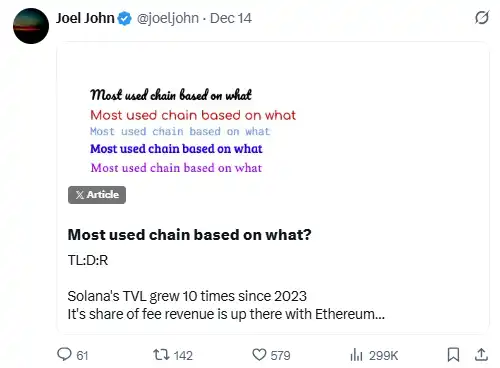
All of this has happened against the backdrop of an extremely brutal cycle for retail. Arbitrageurs have squeezed value to near its limits, altcoins have underperformed the market overall, and net developer inflow has dropped to a low. What this industry truly lacks is a spark of optimism, something that reminds people: the crypto world itself is still beautiful.

I believe Breakpoint lit that match.

When I walked into the Solana Breakpoint venue in Abu Dhabi, the first thing I felt wasn't excitement, but a movement in progress.

Not the kind of noisy, chaotic bustle. More like an undercurrent. A force in flow.

It didn't feel like entering a conference. There was no tension, no forced social pressure, no anxiety of "I must be in the right room at the right time." It felt more like a festival, a place where people weren't there to "extract value" from each other, but to genuinely celebrate "creation."

People were smiling, talking, moving around freely. Developers, creators, founders, institutions—everyone had their place, and overall, it wasn't unbalanced.

This sense of harmony was obvious from the start. No single group was overly amplified: institutions didn't dominate the narrative; creators weren't treated as mascots; founders weren't elevated to unreachable statuses. Everyone seemed approachable.

And that, in itself, is very rare.

The longer I stayed at Breakpoint, the more I felt that all this was not accidental, but deliberately designed.

The agenda wasn't like top-down information infusion: five-minute lightning talks, debates, product demos, conversations. Short, sharp, high information density. Letting more people be seen, rather than having a few repeatedly occupy the stage. You could clearly feel that this wasn't a one-time inspiration, but the result of long-term iteration.

Breakpoint wasn't achieved overnight, but gradually figured out "what really works" through years of practice.

A brief exchange I had with @paarugsethi from Superteam India was enough to make one realize how deeply the Solana ecosystem thinks about culture and the founder community.

Dissolving Elitism

But if there's one thing Solana does better than most ecosystems, it's this: it successfully dissolves elitism.

There's no invisible hierarchy here where "only a few voices matter." As long as you've genuinely built something valuable, even if it's small, you can get a platform to showcase it.

This openness changes everything: it reduces fear, invites more participation, and ultimately creates momentum. And momentum compounds.

After talking to more and more people, another characteristic became clear: within the Solana ecosystem, there is a shared sense of direction. Not a dogmatic consensus, but a state of "moving forward together." There are navigators, signal sources, and people who are seen as directional coordinates by others. Because of this, the ecosystem doesn't easily fragment.

In many ecosystems, people fight their own battles, narratives conflict, gaps keep widening, and everyone endlessly argues about "what should be," unwilling to accept "what is working."

Solana does it differently. If speculation works, it's accepted. If it fits the behavior of the new generation, it's studied, not shamed. There's no moral superiority, no whitewashing. Even memecoins, despite that phase being chaotic and predatory, were seen as an acceleration experiment, a stress test of internet capital markets.

The system crashed, some profited from it, and lessons were truly absorbed. Solana didn't pretend it never happened, but distilled the cognition as an "entire ecosystem." This acceptance, instead, made space for innovation, rather than accumulating resentment.

The most prominent feeling this year was Breakpoint's extreme builder-first nature. The market has cooled, prices are no longer狂热, the "100x overnight" crowd has noticeably decreased. But it's precisely at times like these that the real builders begin to shine.

DeFi appears more mature; infrastructure discussions return to reality: predictability of block space, latency optimization, how to make app execution cheaper and more reliable.

You can see this change in specific products: Kalshi choosing Solana as tokenization infrastructure; Phantom supporting consumer-facing interface experiences; Phoenix perps, Prop AMM, new market designs; experiments in AI, bots, privacy; hackathons, Superteam projects, those still rough but real early ideas. People come to listen to shares to learn, not to ask "how to pump this token."

This energy shift is extremely important. It makes the entire conference feel solid, honest, and product-centric.

If there's one discomfort, it's that some narrow-minded attitudes still exist in the ecosystem—"if it's not Solana-only, it's not worth attention."

This mindset isn't unique to Solana, but it shrinks the pie. The real opportunity isn't winning a public chain war, but reshaping the entire tech stack. And that can only be achieved through collaboration, not posturing.

The irony is: Solana doesn't need to proclaim loudly. Anyone walking into Breakpoint can feel it directly. This ecosystem doesn't need to mock each other online. The products, the culture, the builders, the momentum—they are loud enough.

A "Festival"

This brings me back to the initial conclusion: Solana has outgrown "holding conferences." Conferences are one-way, static, bounded. What Solana is doing now aligns more with the native form of the new generation: a festival, a celebration that exists for builders. A space where culture, capital, experimental spirit, and belief collide.

And these "festivals" will only continue to grow: more vibrant, more immersive, more diverse. Every corner adds new flavor to this internet that is taking shape.

Breakpoint 2025 is one of the best conferences I've ever attended, and it clearly shows where Solana is heading.

P.S.: In my view, choosing Abu Dhabi as the host city was an important reason why Breakpoint 2025 could be so special.


Trend Kriptolar

İlgili Sorular

QWhat is the main concern raised by Abhitej about the evolution of Solana Breakpoint?

AAbhitej is concerned about whether builders, the core developers who code and create, remain at the center of the event as Breakpoint has scaled up from an early developer-led gathering into a large global conference with significant institutional and capital presence.

QAccording to the article, what makes Solana's ecosystem culture different from others?

ASolana's ecosystem culture is described as open, non-elitist, and builder-first. It successfully消解 (dissolves) elitism, where anyone who builds something valuable, even on a small scale, can get a platform. It lacks a hidden hierarchy and moral superiority, accepting what works—like投机 (speculation) or memecoins—as part of its experimental nature.

QWhat key change in energy or focus was observed at Breakpoint 2025 compared to more狂热 (frenzied) market times?

AThe energy at Breakpoint 2025 was more builder-first and product-centered. With the cooling market and fewer people seeking 'overnight 100x' gains, discussions shifted to mature DeFi, realistic infrastructure improvements (like predictable block space and lower costs), and genuine learning, rather than questions about token pumps.

QHow does the author describe the overall atmosphere and structure of Breakpoint?

AThe author describes Breakpoint not as a traditional conference but more like a '节日' (festival or celebration)—a dynamic, immersive space that feels like a movement. It lacks the pressure of traditional networking, is intentionally designed to be inclusive with short, high-density talks, and allows different groups (developers, creators, founders, institutions) to coexist harmoniously without any one dominating.

QWhat is one potential weakness or狭隘 (narrow-minded) attitude the author points out within the Solana ecosystem?

AThe author points out a narrow-minded attitude where some in the ecosystem believe that 'if it's not Solana-only, it's not worth paying attention to.' This mentality can limit collaboration and the larger opportunity to reshape the entire tech stack, which requires working together rather than engaging in tribal '公链战争' (public chain wars).

İlgili Okumalar

STAR 50 Soars 10.73%, Why Did A-Shares Stage a "V-Shaped Reversal"?

After a prolonged decline, the Chinese A-share market staged a strong rally on July 21. The STAR 50 index surged 10.73%, its largest single-day gain in nearly a year, leading a broad-based "V-shaped" reversal. The Shanghai Composite Index rose 1.79%, the Shenzhen Component Index gained 4.81%, and the ChiNext Index jumped 7.05%. Total market turnover reached 2.97 trillion yuan, an increase of 256.1 billion yuan from the previous session, with over 3,100 stocks advancing. The semiconductor sector spearheaded the rebound, with related ETFs posting significant gains. Analysts attribute the surge to three converging factors. First, coordinated capital inflows from "national team" institutions, insurance funds, listed company buybacks, and fund house self-purchases have bolstered market liquidity and confidence. Second, supportive policy signals, including commitments from regulators to ensure stable market operations, provided a favorable backdrop. Third, a stabilization and recovery in overseas markets, notably South Korea, created a positive external environment. Institutions suggest the most severe panic selling phase for the tech sector has likely passed, following a significant digestion of crowded positions and leveraged funds. While short-term volatility may persist, the medium to long-term outlook remains underpinned by enduring trends like AI computing demand expansion and semiconductor localization. The market's focus now shifts to the sustainability of supportive fund flows, earnings reports, and upcoming catalysts from the global AI industry chain.

marsbit24 dk önce

STAR 50 Soars 10.73%, Why Did A-Shares Stage a "V-Shaped Reversal"?

marsbit24 dk önce

U.S. Tech Momentum Stocks Post Largest Single-Day Gain Ever, But Is the Plunge Over?

US tech momentum stocks staged a sharp rebound on Tuesday (July 21st). Morgan Stanley's TMT Momentum Factor surged over 12%, marking its largest single-day gain on record, exceeding even peaks from the 2000 dot-com bubble. Key momentum indices from Goldman Sachs also posted their strongest daily performances in years. The rally was led by semiconductors, with the Philadelphia Semiconductor Index jumping 4.6%. This rebound followed three consecutive down days and a cumulative 33% plunge in momentum stocks, one of the steepest drawdowns since the dot-com era. Analysts attribute the surge largely to a short squeeze. Heavy selling had pushed high-beta momentum stocks into deeply oversold territory, forcing many short sellers, particularly in Asia, to cover their positions, creating a self-reinforcing buying spiral. However, the rebound's internals appear weak. Trading volume was notably low, and advancing stocks still lagged decliners on the S&P 500, indicating a narrow, concentrated rally rather than broad market participation. Diverging views emerge on the outlook. BTIG warns the bounce has hit key resistance and recommends selling into strength, citing extreme volatility and historical parallels to past market tops. Conversely, Goldman Sachs and UBS believe the momentum unwind is nearing its end, suggesting it may be time to gradually add exposure, as positioning has been significantly reduced. They caution, however, that high volatility warrants a measured approach, potentially using defined-risk strategies. The upcoming earnings season, particularly reports from major tech firms like Alphabet, is seen as a critical test for the rally's sustainability. Simultaneously, bond markets flashed a warning, with yields rising partly due to spiking oil prices. Analysts note that if long-term Treasury yields break decisively higher, it could pose a significant headwind for equities, especially growth stocks.

marsbit31 dk önce

U.S. Tech Momentum Stocks Post Largest Single-Day Gain Ever, But Is the Plunge Over?

marsbit31 dk önce

U.S. Tech Momentum Stocks Record Largest Single-Day Gain Ever, but Has the Rout Ended?

U.S. tech momentum stocks staged a dramatic rebound on Tuesday, July 21st. Key momentum indices like the Morgan Stanley TMT Momentum Factor and Goldman Sachs' High Beta Momentum Long Index posted historic or near-historic single-day gains, fueled largely by semiconductor stocks. This sharp rally followed a severe three-day sell-off that saw momentum stocks plunge 33%, marking one of the steepest pullbacks since the dot-com bubble. Analysts attribute the bounce primarily to a short squeeze, as forced covering from over-leveraged traders, particularly in Asia, created a buying spiral. However, the rally's health is questioned due to weak market breadth—overall trading volume was low, and decliners outnumbered advancers in the S&P 500 despite the index's gain—suggesting a narrow, concentrated surge rather than broad recovery. Opinions on the sustainability diverge. BTIG strategists warn the rebound has hit key resistance levels, citing extreme volatility and historic stock dispersion as signs of an ongoing broader correction, and recommend selling into strength. Conversely, Goldman Sachs and UBS view the aggressive momentum unwinding as nearing its end, noting reduced positioning and a lack of new fundamental catalysts. They suggest the sell-off presents a selective opportunity to add exposure, albeit cautiously and gradually using defined-risk strategies. The immediate trajectory hinges on the ongoing earnings season, with market focus on Alphabet's capital expenditure guidance for AI investment clarity. Meanwhile, bond markets present a risk, with rising Treasury yields—potentially heading toward 5.5%—and widening credit spreads for mega-cap tech companies posing a threat to equity valuations. The combination of technical factors, earnings results, and macro conditions leaves the durability of the rebound in doubt.

链捕手34 dk önce

U.S. Tech Momentum Stocks Record Largest Single-Day Gain Ever, but Has the Rout Ended?

链捕手34 dk önce

Long-Divided Must Unite, Long-United Must Divide: When L1 Becomes Its Own Rollup, What Is Ethereum's Endgame?

"The Inevitable Cycle: When L1 Becomes Its Own Rollup – What is Ethereum's Endgame?" For years, the Ethereum community grappled with concerns that L2s were fragmenting the ecosystem and eroding L1's value. While L2s provided cheaper execution, they also splintered liquidity and the unified user experience of a single chain. This has prompted a fundamental reassessment of the relationship between L1 and L2. Ethereum's roadmap is evolving. The "Scale" initiative merges L1 and L2 expansion into a holistic framework. L1 itself is advancing with higher gas limits, statelessness, and zkEVM verification, no longer content to be just a low-throughput settlement layer. Consequently, the primary value proposition of L2s is shifting from merely providing cheap blockspace to offering L1 cannot easily provide: application-specific optimizations, privacy features, and flexible governance models. L2s are becoming a spectrum of execution environments with varying degrees of security inheritance from Ethereum. A critical challenge in this multi-chain future is interoperability. The vision is to make Ethereum "feel like one chain again." This relies on advancements in native account abstraction (like EIP-7702) and intent-based architectures (Open Intents Framework), where users declare desired outcomes, and solvers handle the complex cross-chain execution. Furthermore, shortening Ethereum's finality time from minutes to seconds is crucial, as it underpins trust between chains for bridges, stablecoins, and cross-chain applications. Perhaps the most provocative idea is that Ethereum L1 itself could become a form of "its own Rollup." As zkEVM and proof systems mature, high-performance nodes could execute transactions and generate validity proofs. Regular validators would then verify these proofs instead of re-executing all transactions. This blurs the traditional L1/L2 hierarchy, making "Rollup" more of a general execution-verification architecture. Native Rollup aims to integrate L2 validation more directly into the Ethereum protocol, allowing L2s to inherit L1's security more fully and move away from reliance on security councils. In the end, L2s are not destined to replace L1 or be made obsolete by it. The likely future is a unified system where diverse execution environments—each optimized for specific use cases like DeFi, gaming, or privacy—coexist. They will share a common foundation of security, liquidity, and verifiable state, seamlessly connected to restore a cohesive user experience. The next phase for Ethereum is not just about scaling through separation, but about intelligently reintegrating what was separated back into a coherent whole.

链捕手50 dk önce

Long-Divided Must Unite, Long-United Must Divide: When L1 Becomes Its Own Rollup, What Is Ethereum's Endgame?

链捕手50 dk önce

İşlemler

Spot

Popüler Makaleler

O Nasıl Satın Alınır

HTX.com’a hoş geldiniz! O1 exchange (O) satın alma işlemlerini basit ve kullanışlı bir hâle getirdik. Adım adım açıkladığımız rehberimizi takip ederek kripto yolculuğunuza başlayın. 1. Adım: HTX Hesabınızı OluşturunHTX'te ücretsiz bir hesap açmak için e-posta adresinizi veya telefon numaranızı kullanın. Sorunsuzca kaydolun ve tüm özelliklerin kilidini açın. Hesabımı Aç2. Adım: Kripto Satın Al Bölümüne Gidin ve Ödeme Yönteminizi SeçinKredi/Banka Kartı: Visa veya Mastercard'ınızı kullanarak anında O1 exchange (O) satın alın.Bakiye: Sorunsuz bir şekilde işlem yapmak için HTX hesap bakiyenizdeki fonları kullanın.Üçüncü Taraflar: Kullanımı kolaylaştırmak için Google Pay ve Apple Pay gibi popüler ödeme yöntemlerini ekledik.P2P: HTX'teki diğer kullanıcılarla doğrudan işlem yapın.Borsa Dışı (OTC): Yatırımcılar için kişiye özel hizmetler ve rekabetçi döviz kurları sunuyoruz.3. Adım: O1 exchange (O) Varlıklarınızı SaklayınO1 exchange (O) satın aldıktan sonra HTX hesabınızda saklayın. Alternatif olarak, blok zinciri transferi yoluyla başka bir yere gönderebilir veya diğer kripto para birimlerini takas etmek için kullanabilirsiniz.4. Adım: O1 exchange (O) Varlıklarınızla İşlem YapınHTX'in spot piyasasında O1 exchange (O) ile kolayca işlemler yapın.Hesabınıza erişin, işlem çiftinizi seçin, işlemlerinizi gerçekleştirin ve gerçek zamanlı olarak izleyin. Hem yeni başlayanlar hem de deneyimli yatırımcılar için kullanıcı dostu bir deneyim sunuyoruz.

177 Toplam GörüntülenmeYayınlanma 2026.06.19Güncellenme 2026.06.29

O Nasıl Satın Alınır

PROS Nasıl Satın Alınır

HTX.com’a hoş geldiniz! Pharos (PROS) satın alma işlemlerini basit ve kullanışlı bir hâle getirdik. Adım adım açıkladığımız rehberimizi takip ederek kripto yolculuğunuza başlayın. 1. Adım: HTX Hesabınızı OluşturunHTX'te ücretsiz bir hesap açmak için e-posta adresinizi veya telefon numaranızı kullanın. Sorunsuzca kaydolun ve tüm özelliklerin kilidini açın. Hesabımı Aç2. Adım: Kripto Satın Al Bölümüne Gidin ve Ödeme Yönteminizi SeçinKredi/Banka Kartı: Visa veya Mastercard'ınızı kullanarak anında Pharos (PROS) satın alın.Bakiye: Sorunsuz bir şekilde işlem yapmak için HTX hesap bakiyenizdeki fonları kullanın.Üçüncü Taraflar: Kullanımı kolaylaştırmak için Google Pay ve Apple Pay gibi popüler ödeme yöntemlerini ekledik.P2P: HTX'teki diğer kullanıcılarla doğrudan işlem yapın.Borsa Dışı (OTC): Yatırımcılar için kişiye özel hizmetler ve rekabetçi döviz kurları sunuyoruz.3. Adım: Pharos (PROS) Varlıklarınızı SaklayınPharos (PROS) satın aldıktan sonra HTX hesabınızda saklayın. Alternatif olarak, blok zinciri transferi yoluyla başka bir yere gönderebilir veya diğer kripto para birimlerini takas etmek için kullanabilirsiniz.4. Adım: Pharos (PROS) Varlıklarınızla İşlem YapınHTX'in spot piyasasında Pharos (PROS) ile kolayca işlemler yapın.Hesabınıza erişin, işlem çiftinizi seçin, işlemlerinizi gerçekleştirin ve gerçek zamanlı olarak izleyin. Hem yeni başlayanlar hem de deneyimli yatırımcılar için kullanıcı dostu bir deneyim sunuyoruz.

182 Toplam GörüntülenmeYayınlanma 2026.06.22Güncellenme 2026.06.29

PROS Nasıl Satın Alınır

VERONA Nedir

I. Proje Tanıtımı VERONA, zincir soyutlaması aracılığıyla herkes için, her yerde inşa edilmiş bir blok zinciridir. Genel Soyutlama katmanını kullanarak, VERONA, hesaplar, imzalar ve birlikte çalışabilirlik gibi karmaşık blok zinciri işlevlerini doğrudan protokol seviyesinde entegre ederek kendini ayırt eder. Bu yaklaşım, temel teknolojileri anlamaya gerek kalmadan blok zinciri uygulamalarıyla etkileşimde bulunmayı sağlar.1) Temel Bilgiler İsim: VERONA (VERONA)III. İlgili Bağlantılar Resmi web sitesi bağlantısı: https://xion.burnt.com/ Whitepaper: https://xion.burnt.com/whitepaper.pdf Keşif Araçları: https://explorer.burnt.com/ Sosyal Medya: https://x.com/burnt_xion Not: Proje tanıtımı, resmi proje ekibi tarafından yayımlanan veya sağlanan materyallerden alınmıştır, yalnızca referans içindir ve yatırım tavsiyesi teşkil etmez. HTX, ortaya çıkan doğrudan veya dolaylı kayıplardan sorumluluk kabul etmez.

174 Toplam GörüntülenmeYayınlanma 2026.06.22Güncellenme 2026.06.22

VERONA Nedir

Tartışmalar

HTX Topluluğuna hoş geldiniz. Burada, en son platform gelişmeleri hakkında bilgi sahibi olabilir ve profesyonel piyasa görüşlerine erişebilirsiniz. Kullanıcıların A (A) fiyatı hakkındaki görüşleri aşağıda sunulmaktadır.

活动图片













