STAR 50 Soars 10.73%, Why Did A-Shares Stage a "V-Shaped Reversal"?

marsbit2026-07-22 tarihinde yayınlandı2026-07-22 tarihinde güncellendi

Özet

After a prolonged decline, the Chinese A-share market staged a strong rally on July 21. The STAR 50 index surged 10.73%, its largest single-day gain in nearly a year, leading a broad-based "V-shaped" reversal. The Shanghai Composite Index rose 1.79%, the Shenzhen Component Index gained 4.81%, and the ChiNext Index jumped 7.05%. Total market turnover reached 2.97 trillion yuan, an increase of 256.1 billion yuan from the previous session, with over 3,100 stocks advancing. The semiconductor sector spearheaded the rebound, with related ETFs posting significant gains. Analysts attribute the surge to three converging factors. First, coordinated capital inflows from "national team" institutions, insurance funds, listed company buybacks, and fund house self-purchases have bolstered market liquidity and confidence. Second, supportive policy signals, including commitments from regulators to ensure stable market operations, provided a favorable backdrop. Third, a stabilization and recovery in overseas markets, notably South Korea, created a positive external environment. Institutions suggest the most severe panic selling phase for the tech sector has likely passed, following a significant digestion of crowded positions and leveraged funds. While short-term volatility may persist, the medium to long-term outlook remains underpinned by enduring trends like AI computing demand expansion and semiconductor localization. The market's focus now shifts to the sustainability of supportive fund...

After several consecutive days of declines, the market welcomed a strong rebound.

On the morning of July 21, A-shares staged a "V-shaped reversal," with multiple indices subsequently surging rapidly. At the close, the STAR 50 Index soared 10.73%, marking its highest single-day gain in nearly a year. The three major indices all closed in positive territory, with the Shanghai Composite Index rising 1.79%, the Shenzhen Component Index climbing 4.81%, and the ChiNext Index advancing 7.05%.

The combined trading volume for the three major exchanges was 2.97 trillion yuan, an increase of 256.1 billion yuan from the previous day. At the individual stock level, over 3,100 stocks rose, with more than a hundred hitting their daily upside limit. As the vanguard of the rebound, the semiconductor industry chain saw a full-scale surge, led by sectors such as equipment, memory, wafers, and HBM. Sectors like oil and gas, banking, coal, and motorcycles were among the decliners.

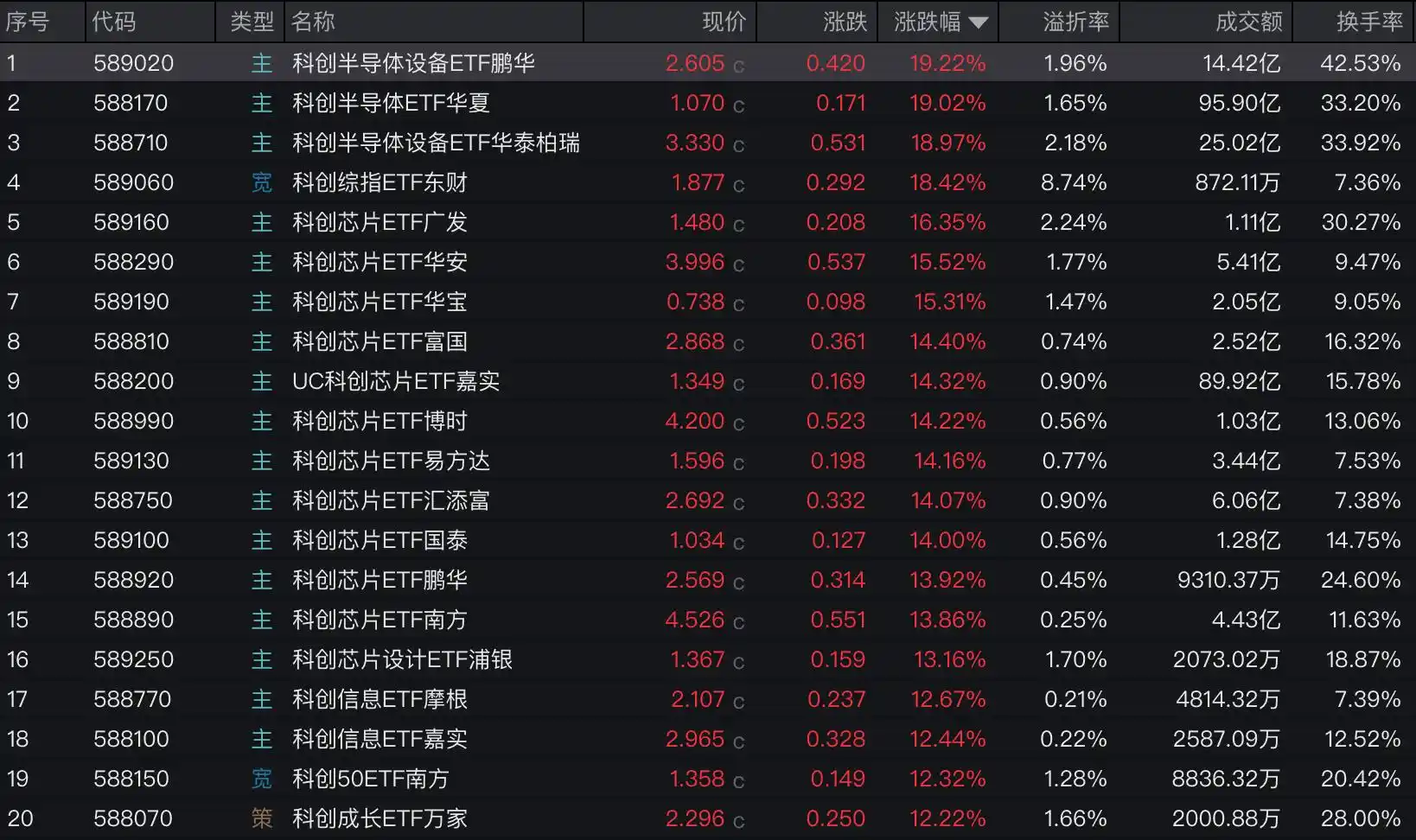
Boosted by the semiconductor rally, related thematic ETFs surged sharply, with as many as 73 products gaining over 10% intraday. Among them, Penghua STAR Semiconductor Equipment ETF, ChinaAMC STAR Semiconductor ETF, Huatai-PineBridge STAR Semiconductor Equipment ETF, and East Money STAR Composite Index ETF all rose over 18%. GF, Huaan, and Huabao's STAR Chip ETFs gained over 15%.
Triple Factors in Resonance

Today's powerful rebound in A-shares stemmed from the resonance of three factors.

First, multiple sources of funds announced market entry. Since July 19th, positive signals have emerged frequently from the capital side, ranging from "national team" and insurance capital increases in holdings to listed company buybacks and self-purchases by public and private funds.

Jinying Fund's analysis notes that the sustained entry of stabilizing funds has effectively boosted market confidence. "During the previous sustained and significant market decline, investors' risk-averse sentiment was concentratedly released, and A-share valuations gradually returned to a reasonable range. Meanwhile, major capital players seized the opportunity to enter the market, not only supporting market liquidity but also laying a solid foundation for market stabilization."

Wind data shows that over the last two trading days, multiple broad-based ETFs experienced significant volume expansion. On July 20th, broad-based ETFs saw a combined net inflow of 59.061 billion yuan. Among them, ChinaAMC STAR 50 ETF, Huatai-PineBridge CSI 300 ETF, and E Fund ChiNext ETF recorded net inflows of 13.7 billion yuan, 12.52 billion yuan, and 9.4 billion yuan, respectively. On July 21st, these three broad-based ETFs remained active, with trading volumes reaching 17.322 billion yuan, 15.266 billion yuan, and 12.895 billion yuan respectively.

Second, policy support. On July 20th, China Securities Regulatory Commission (CSRC) Chairman Wu Qing presided over an investor symposium, clearly stating the commitment to "fully maintain stable market operation." Bosera Fund believes that after the technology sector experienced a full adjustment earlier, releasing valuation pressure, coupled with the resonance of policy and capital factors, triggered today's concentrated rebound in the technology growth sector.

Third, the stabilization and rebound of overseas markets provided a favorable external environment for this round of A-share recovery. Jinying Fund points out that the global equity market previously underwent a rapid deleveraging and relatively full adjustment process, with indices in many regions experiencing deep valuation corrections, establishing an objective basis for stabilization and rebound.

Overseas markets, represented by the Korean stock market, took the lead in initiating a recovery. After falling over 30% from its historical peak, effectively clearing substantial risks, the Korea Composite Index (KOSPI) today saw a reversal from its decline, rebounding sharply by 3.56%, led by core Korean tech giants.

Jinying Fund states that alongside the collective warming of the global technology sector, it provided strong support for the synchronized rebound of A-share technology stocks.

The Most Panicked Stage Is Likely Over

Regarding whether the technology sector has emerged from the gloom, institutions provided analysis from short, medium, and long-term perspectives.

"After the rapid adjustment earlier, the crowdedness of the technology sector has been significantly digested," believes Bosera Fund. After consecutive days of decline in margin financing balances, the deleveraging process is nearing its end. Statements from central SOEs increasing holdings and insurance capital's commitment to add positions have released clear signals of long-term capital entering the market, supporting the valuation floor for the technology sector.

Jinying Fund indicates that the current market is still in the tail end of the deleveraging and sentiment-grinding stage. With the continuous inflow of allocation funds and significant clearance of panic-driven selling, follow-up attention can be paid to relatively good investment opportunities within the short-term oversold rebound.

"In the short term, the positive release of policy signals has to some extent alleviated the market's liquidity shock and panic sentiment. The concentrated deleveraging of margin financing has relatively eased, but the market still needs time to find its bottom. After the index's single-day overshoot, volatility in the technology sector remains high, and follow-up requires lowering market volatility." China Europe Fund suggests focusing on the sustainability of the 'national team' holdings increase, the pace of margin financing and quantitative fund replenishment, and performance verification during the intensive mid-year report disclosure period.

"After this round of oversold rebound, a new medium-term market cycle still awaits new heavyweight industrial catalysts. The Q2 earnings reports from overseas cloud providers in late July are a key node for verifying returns on capital expenditure." Jinying Fund analyzes that, from a medium-term perspective, subsequent differentiation clues within the AI industry chain depend on whether specific segments can maintain their rising share of demand and continued supply bottlenecks. For links where supply bottlenecks may loosen, valuation centers might face downward revisions. AI technology investment still needs to focus on core links with relatively tight supply and demand.

In the view of Bosera Fund, industrial trends such as the expansion of AI computing demand and semiconductor import substitution have not changed due to short-term adjustments. The growth resilience of technology leaders has been preliminarily verified in mid-year report performances. The short-term market may still experience fluctuations, but the most panicked stage for the technology sector is likely over. Subsequently, with the continuous landing of industrial catalysts, the technology growth direction still possesses medium- to long-term allocation value.

This article is from "*Caijing* New Media," author: Jiang Jinli, editor: Jiang Shizhou

İlgili Sorular

QWhy did the A-share market stage a 'V-shaped reversal' on July 21st according to the article?

AThe article states that the strong rebound in the A-share market stemmed from the resonance of three key factors: 1) Multiple sources of funds announcing entry into the market, including the 'national team,' insurance funds, company buybacks, and public and private fund self-purchases. 2) Policy support, highlighted by a speech from the CSRC chairman pledging to 'fully maintain stable market operations.' 3) The stabilization and rebound of overseas markets, such as the South Korean stock market, which provided a favorable external environment for A-shares' recovery.

QWhat was the single-day percentage gain for the STAR 50 Index on July 21st, and what is its significance?

AThe STAR 50 Index surged by 10.73% on July 21st. According to the article, this represents its highest single-day gain in nearly a year.

QWhich sector was the main driving force behind the market rebound, and how did related ETFs perform?

AThe semiconductor industry chain was the main driving force behind the rebound, with equipment, storage, wafers, HBM, and other segments leading the gains. Bolstered by this sector's performance, related thematic ETFs saw sharp increases. The article notes that 73 products saw intraday gains exceeding 10%, with several prominent ETFs, like those tracking STAR Board semiconductor equipment, gaining over 18%.

QWhat are the short- to medium-term outlooks provided by fund managers for the technology sector after this rebound?

AFund managers offered a tiered outlook. In the short term, institutions like Boshi Fund believe the most panic-driven stage for the tech sector has likely passed, though volatility may persist. Jin Ying Fund suggests the market is in the tail-end of deleveraging and sentiment bottoming, presenting opportunities from the short-term oversold bounce. For the medium term, they caution that a sustained new uptrend requires fresh, significant industry catalysts and advise focusing on AI supply chain segments with tight supply-demand dynamics, as others facing looser supply might see valuation corrections.

QHow did the trading volume and breadth of the market change on July 21st compared to the previous day?

AThe combined turnover for the three major exchanges reached 2.97 trillion yuan on July 21st, an increase of 256.1 billion yuan from the previous day. In terms of market breadth, over 3,100 stocks rose, with more than 100 hitting their daily price limit (涨停).

İlgili Okumalar

Tether CEO Ardoino Gives Clear Response to Blockchain Accusations: 'We Are Not Developing Our Own Network!'

Tether CEO Paolo Ardoino has issued a clear denial in response to market reports alleging that the company behind the USDT stablecoin is developing its own proprietary blockchain. An analytical report had suggested Tether was building a private blockchain, or "stablechain," to reduce its reliance on existing networks and gain greater control over its ecosystem. Ardoino firmly stated via social media that these claims are false, emphasizing that Tether is not developing any blockchain technology and has no such plans. He reiterated the company's strategy is to continue operating across multiple existing blockchain networks. USDT is currently available on several major blockchains, including Ethereum, Tron, Solana, Avalanche, and TON. This multi-chain approach allows users to choose networks based on transaction costs and speed requirements. While experts speculated that a proprietary blockchain could significantly impact the stablecoin sector, Ardoino's statement appears to have quelled these rumors for now. The article notes that Tether has also drawn attention for its investments in artificial intelligence, mining, and digital infrastructure. However, company leadership maintains that ensuring the smooth operation of USDT across various blockchains remains a top priority. The cryptocurrency market continues to watch Tether's strategic moves closely.

cryptonews.ru13 dk önce

Tether CEO Ardoino Gives Clear Response to Blockchain Accusations: 'We Are Not Developing Our Own Network!'

cryptonews.ru13 dk önce

Polymarket and Kalshi Give Signals But Do Not Guarantee a Predicted Outcome

Prediction markets like Polymarket and Kalshi are becoming a significant source of information for investors. Their main advantage is that participants stake their own money on specific outcomes, allowing contract prices to be interpreted as market-assessed probabilities. For instance, a YES contract priced at $0.65 on Kalshi suggests an approximately 65% likelihood of an event occurring. However, this is not a pure probability, as it is influenced by liquidity, spreads, fees, capital constraints, and informational differences among participants. A key question arises: does a high probability for an event on these platforms imply that the bitcoin or broader crypto market will follow suit? The answer is no. Prediction markets and crypto markets serve different purposes: the former assesses the likelihood of specific events, while the latter allocates capital and determines asset prices. Betting on an event is not the same as betting on an asset. For example, a signal forecasting a Federal Reserve interest rate cut is relevant, but it may already be priced into crypto markets through futures, options, or spot positions. The crypto price is shaped by existing capital commitments, leverage, liquidity, and the need to close trades, not just expectations. While prediction markets are useful for aggregating information and have shown accuracy in events like political elections, they should not be viewed as direct trading signals for assets like bitcoin. Research involving millions of trades indicates that the calibration of probabilities varies by event category, time horizon, trade size, and platform. Therefore, these markets offer valuable supplementary data but do not guarantee corresponding asset price movements.

cryptonews.ru16 dk önce

Polymarket and Kalshi Give Signals But Do Not Guarantee a Predicted Outcome

cryptonews.ru16 dk önce

Broadcom Plunges 20%, What is the Market Afraid Of?

Broadcom's stock price has fallen over 20% from its June high, driven by market fears over a massive off-balance-sheet liability linked to its "AI XPV Platform." This financing structure, established with Apollo and Blackstone, aims to lease AI hardware (featuring Broadcom's custom XPU chips) to clients like Anthropic. Broadcom provides a Residual Value Guarantee (RVG), agreeing to cover potential shortfalls if a client defaults and the resale value of the leased chips is insufficient to repay the SPV's senior debt. While the first deal involves a $290 billion RVG exposure, a Bank of America analysis projects this could balloon to $3.7 trillion in senior debt principal by mid-2029 if the platform scales to its 20GW target. In a worst-case scenario of 100% client defaults, Broadcom's theoretical maximum loss is estimated at $42 billion. This rapid growth of contingent liabilities far outpaces the company's revenue and cash flow, transforming Broadcom from a capital-light chip designer into a de facto financial guarantor for AI infrastructure financing. The core risk lies in the untested residual value of AI chips, which lack a mature secondary market and face rapid technological obsolescence. Credit rating agencies like S&P have flagged the arrangement as a "credit negative," and bond markets have already widened Broadcom's credit spreads, reflecting investor concern. The market's fear is not weak AI demand but rather the unpriced and systemic risks embedded in this new financing model where a semiconductor company's investment-grade credit backs an expanding chain of trillion-dollar AI debt.

marsbit18 dk önce

Broadcom Plunges 20%, What is the Market Afraid Of?

marsbit18 dk önce

Glassnode: Consumer Confidence Falls as AI-Related Stocks Rise, Bitcoin Lags Behind

According to Glassnode, consumer confidence remains at one of its lowest levels in a decade, despite two consecutive months of improvement. This has not stopped households from moving money out of cash, as they expect further cost-of-living increases and a broader economic slowdown. The key question is where this capital is flowing. US stocks hit a new all-time high in early August, primarily driven by trading in AI-related stocks rather than a broad market rally. Bitcoin, historically seen as a hedge against declining trust in traditional finance, has not participated in this movement. Spot Bitcoin ETFs saw outflows of $389.7 million in one week, coinciding with rising equity markets—a divergence that aligns with Glassnode's data on capital flows. Bitcoin is currently trading at roughly half its October 2025 peak, stuck in a narrow range. Meanwhile, AI-related trading continues to attract fresh capital from retail traders, hedge funds, and even crypto-native institutional investors, who are redirecting funds into AI stocks and tokens. The macroeconomic backdrop has not been hostile to Bitcoin, with core inflation at a moderate 2.5% in July. However, Bitcoin's muted response to favorable inflation data is seen as a concerning signal, given its supposed role as a hedge against currency debasement. Spot Bitcoin exchange trading volume has fallen to its lowest since 2019, and recent ETF inflows are only a "fraction of any prior accumulation wave," suggesting institutional buying may have paused. This trend extends beyond trading: some Bitcoin miners are repurposing their power contracts and data center capacity for AI workloads. This appears to be a structural shift that could pressure Bitcoin's status as the default destination for capital leaving cash. The fundamental arguments for Bitcoin as a hedge against inflation or scarcity are not invalidated, but their expected impact has not materialized within the timeline anticipated by crypto optimists this summer.

cryptonews.ru19 dk önce

Glassnode: Consumer Confidence Falls as AI-Related Stocks Rise, Bitcoin Lags Behind

cryptonews.ru19 dk önce

İşlemler

Spot
活动图片