U.S. Tech Momentum Stocks Record Largest Single-Day Gain Ever, but Has the Rout Ended?

链捕手2026-07-22 tarihinde yayınlandı2026-07-22 tarihinde güncellendi

Özet

U.S. tech momentum stocks staged a dramatic rebound on Tuesday, July 21st. Key momentum indices like the Morgan Stanley TMT Momentum Factor and Goldman Sachs' High Beta Momentum Long Index posted historic or near-historic single-day gains, fueled largely by semiconductor stocks. This sharp rally followed a severe three-day sell-off that saw momentum stocks plunge 33%, marking one of the steepest pullbacks since the dot-com bubble. Analysts attribute the bounce primarily to a short squeeze, as forced covering from over-leveraged traders, particularly in Asia, created a buying spiral. However, the rally's health is questioned due to weak market breadth—overall trading volume was low, and decliners outnumbered advancers in the S&P 500 despite the index's gain—suggesting a narrow, concentrated surge rather than broad recovery. Opinions on the sustainability diverge. BTIG strategists warn the rebound has hit key resistance levels, citing extreme volatility and historic stock dispersion as signs of an ongoing broader correction, and recommend selling into strength. Conversely, Goldman Sachs and UBS view the aggressive momentum unwinding as nearing its end, noting reduced positioning and a lack of new fundamental catalysts. They suggest the sell-off presents a selective opportunity to add exposure, albeit cautiously and gradually using defined-risk strategies. The immediate trajectory hinges on the ongoing earnings season, with market focus on Alphabet's capital expenditure guida...

Author: Long Yue

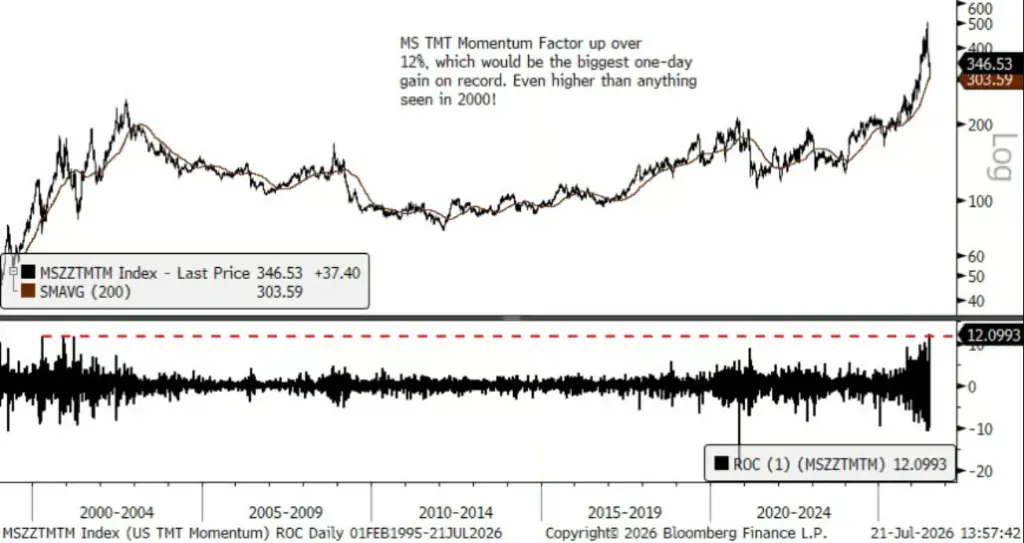
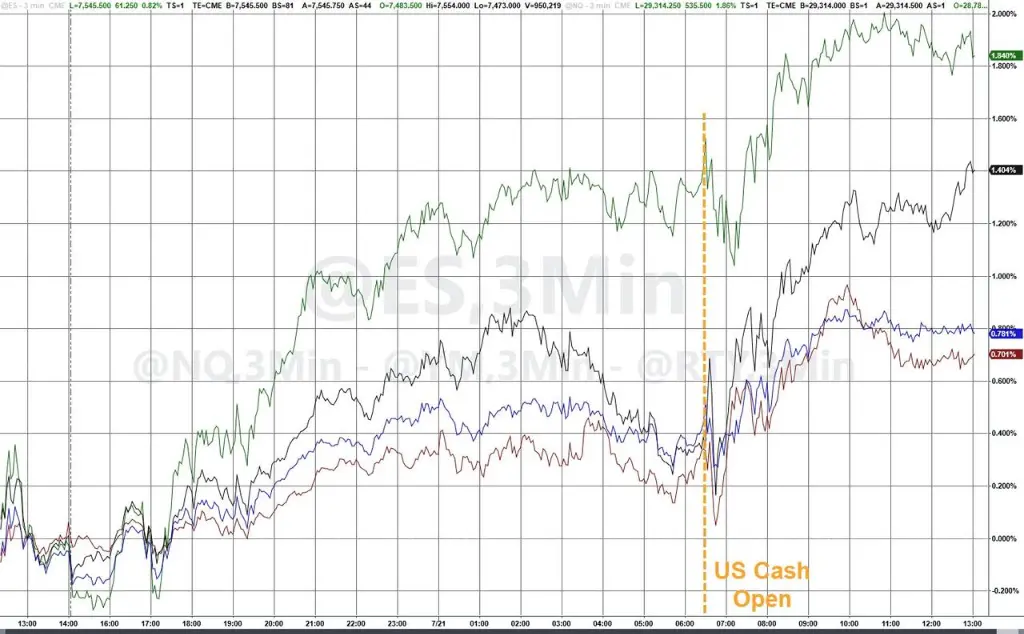
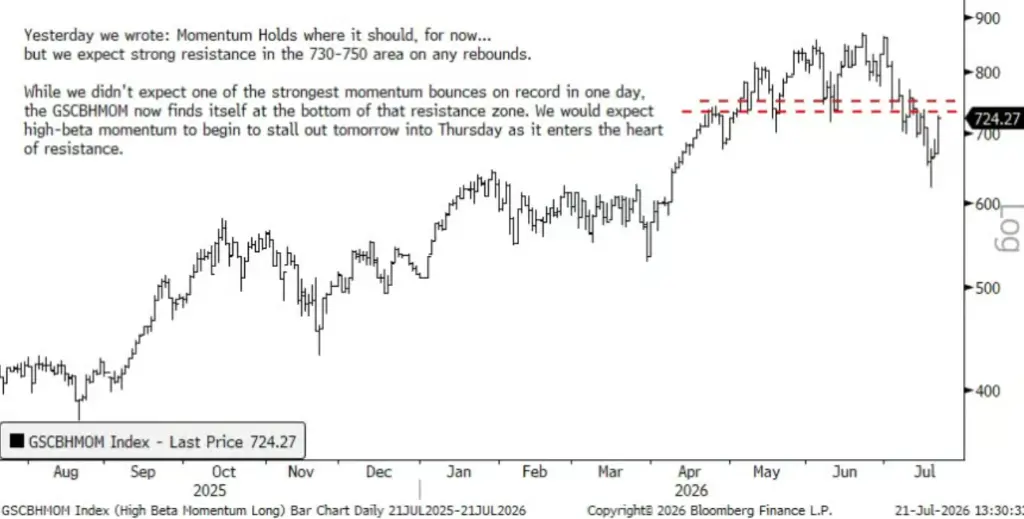
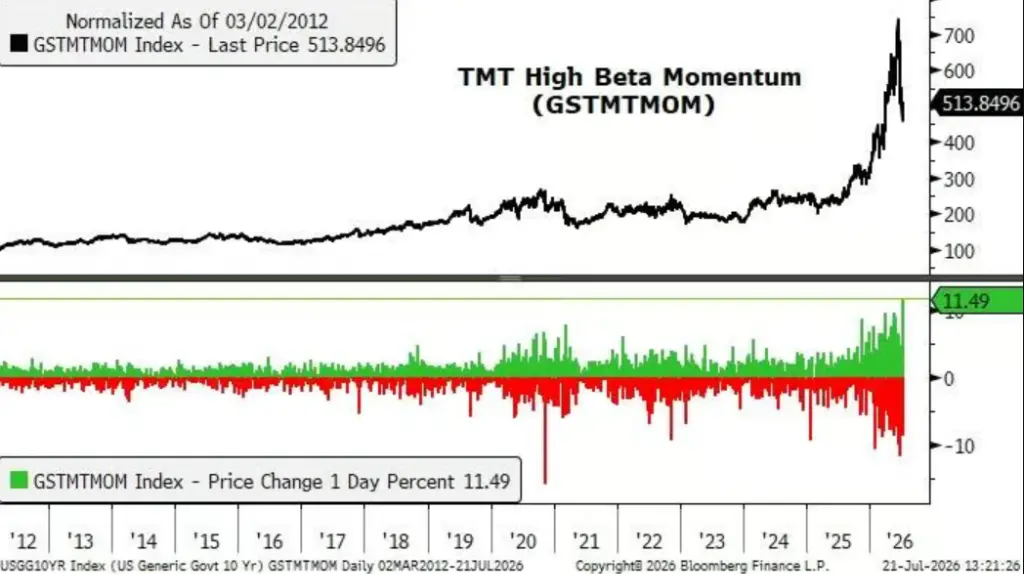
U.S. technology momentum stocks staged a sharp rebound on Tuesday (July 21).Morgan Stanley's TMT Momentum factor surged over 12%, marking its largest single-day gain on record, even surpassing any single-day performance during the 2000 dot-com bubble. The Goldman Sachs High Beta Momentum Long Index (GSCBHMOM) rose approximately 8.5%, its strongest single-day performance since April 2025; the High Beta Momentum Long/Short Index (GSPRHIMO) jumped 9.5%, its best since 2021, approaching historically high levels seen since 2003.

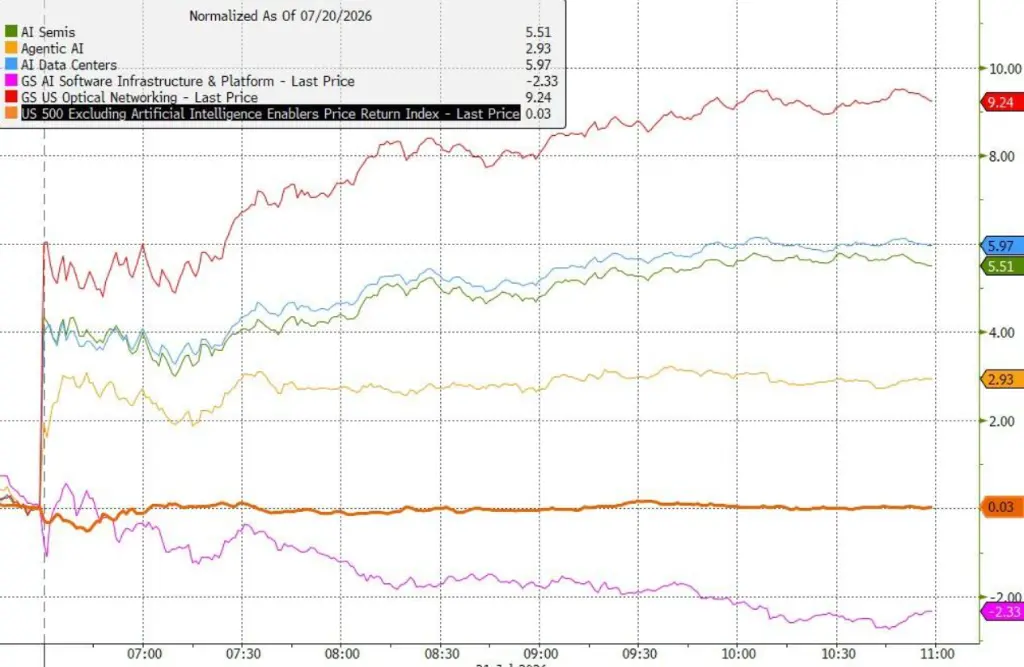
The Nasdaq Composite Index rose about 1.3% on the day, leading the three major indices.The semiconductor sector was the biggest driver – the Philadelphia Semiconductor Index soared 4.6%, and the VanEck Semiconductor ETF gained about 4.5%. Micron Technology surged over 10%, Intel rose about 8.6%, SanDisk climbed about 14%, Cerebras Systems jumped about 18%, and Cipher Mining soared over 11%.

This rally occurred after three consecutive days of declines and after momentum stocks had collectively plummeted 33%.
Why This Rebound? Short Sellers "Squeezed"

To understand this rebound, one must first grasp how deep the prior decline was.

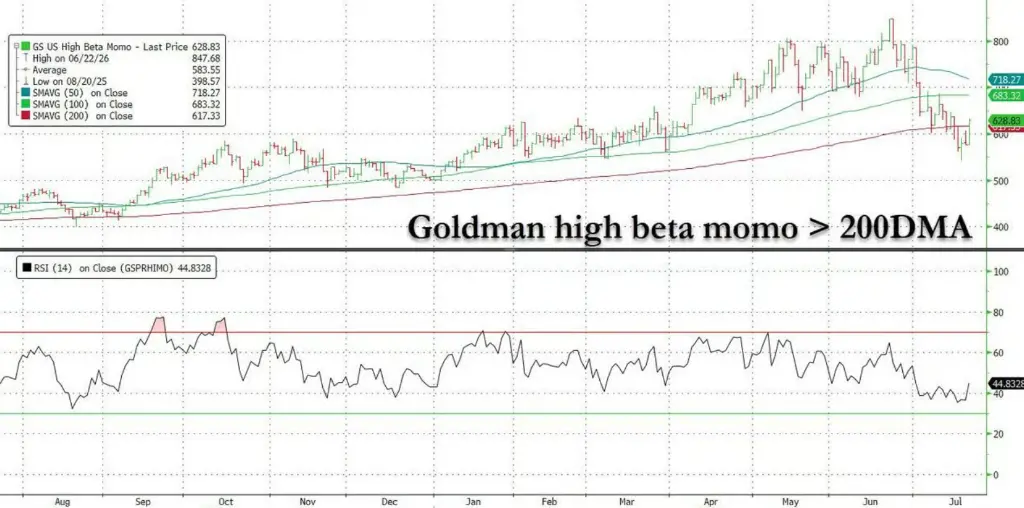
Goldman Sachs data shows that high-beta momentum stocks plunged 33% cumulatively over just a few trading days, one of the most severe drawdowns since the dot-com bust. The Goldman Sachs High Beta Momentum Index briefly fell below its 200-day moving average, hitting its lowest point since January of this year, with oversold conditions the worst since last August.
The deeper the fall, the greater the bounce – a basic market logic.

This rebound was largely a "short squeeze" event. Investors who had heavily shorted momentum stocks, particularly trend-following traders in South Korea and Japan, suffered heavy losses over the past two weeks – the South Korean market even saw large-scale margin call events, severely impacting local retail investors. When these shorts are forced to cover their positions, buying creates a self-reinforcing upward spiral.

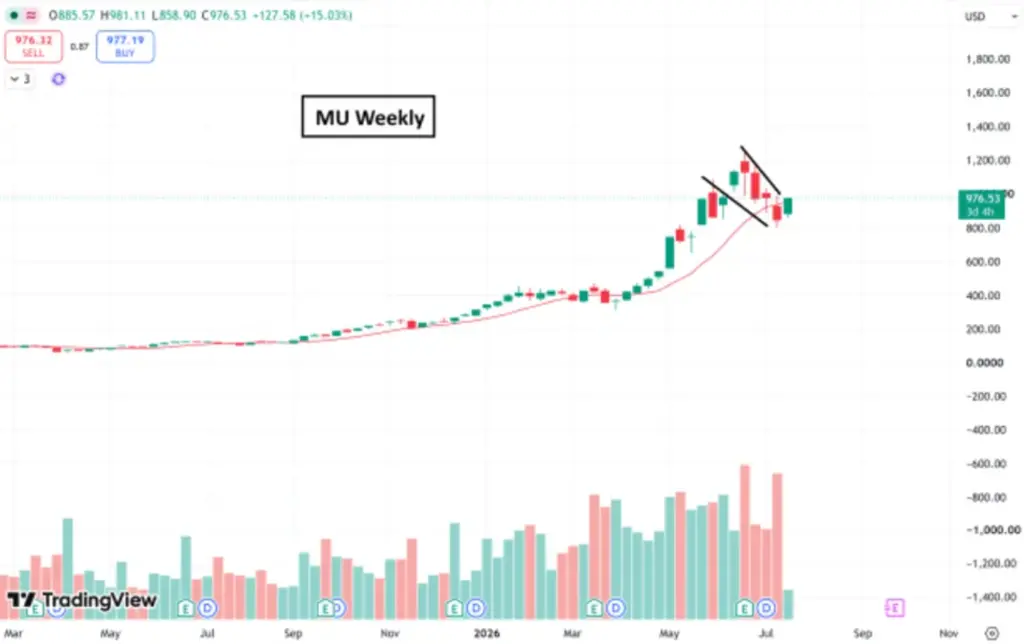
Zacks Investment Research analysis noted that Micron Technology had previously broken below the "head and shoulders" neckline on its daily chart, a bearish technical pattern. But Tuesday's price surge of over 10% reclaimed the neckline. "False breakdowns often trigger violent reversals because late shorts and sellers get trapped."
Market Breadth Remains Weak, Rebound Quality Questionable

The rebound numbers look impressive, but the internal structure is unhealthy.

BTIG strategist Jonathan Krinsky analyzed that overall trading volume on Tuesday was low, with SPY, QQQ, and S&P 500 cash volume all 20% to 30% below their 20-day averages. Meanwhile, the S&P 500 Index rose nearly 1% on the day, yet the number of declining stocks still exceeded advancing ones – this divergence between price and market breadth has occurred the most times this year, and Tuesday saw this phenomenon again.

Goldman Sachs trader data shows overall exchange volume was about 17% below the 20-day average, market maker book liquidity was only $6.83 million, and market activity scored just 3 out of 10.

In other words, this rebound looks more like a concentrated burst in a few heavily weighted stocks, rather than a broad-based recovery.

Bloomberg macro strategist Michael Ball analyzed, "It's too early to call the correction over." Demand for put options on semiconductor ETFs and former AI star stocks remains high, and negative Gamma exposure in the Nasdaq, semiconductor ETFs, and related individual stocks means market makers will chase trends rather than stabilize volatility – amplifying moves both up and down.
BTIG Warns: Rebound Has Hit Key Resistance, Suggests Selling on Strength

Not everyone is optimistic about this rebound.

BTIG's Jonathan Krinsky explicitly warned, recommending "fade the strength." He previously predicted momentum stock rebounds would encounter strong resistance in the 730 to 750 range, and Tuesday's rally precisely pushed GSCBHMOM to the lower end of that resistance zone.

Krinsky said: "Extreme volatility, coupled with historic stock divergence, signals the market is undergoing a full-blown correction." He expects high-beta momentum stocks to begin stalling as they enter the core of the resistance zone on Wednesday to Thursday.

Looking at historical data, since 1999, the High Beta Momentum Long Index has only posted single-day gains exceeding 7% above its 200-day moving average ten times. Three occurred this year, three in early 2021, and three in early 2000. Krinsky noted this data "both speaks to the rarity of this move and shows we continue to see statistical echoes of the 1999-2000 period."
Goldman Sachs, UBS: Momentum Selling Nearing End, Suggest Gradually Adding

Unlike BTIG's caution, both Goldman Sachs and UBS believe this momentum sell-off is entering its final stages and recommend investors seize the opportunity.

Goldman's Julia Mensch noted in a report that Goldman Sachs last week signaled momentum selling was "in the late innings." She wrote: "With positioning already significantly unwound (Goldman Prime data shows momentum exposure is at the 64th percentile over the past year and the 93rd percentile over the past five years), and given this sell-off lacks a new fundamental catalyst, we think momentum has room to revert to its longer-term trend, and this sell-off may be a good opportunity to add to momentum exposure or buy the dip in AI stocks."

UBS Head of Hedge Fund Equity Derivatives Sales Michael Romano expressed a similar view in a client note, seeing improving AI fundamentals as a buy signal. But he also advised investors to "add to positions gradually, rather than go all-in at once."

Romano wrote: "Momentum derisking is and remains a compelling call. Scaling in is prudent." He expects the momentum sell-off to bottom by the end of July (if it hasn't already), adding: "Once the tide turns, I expect liquidity to drive prices into overshoot territory."

However, Goldman also maintains some reservations – given recent extreme volatility and the dense earnings season ahead, Goldman advises investors to gain exposure via "limited-loss structures" rather than holding outright long positions.
Earnings Season is the Next Key Variable

The sustainability of this rebound largely depends on this week's earnings.

According to Reuters, 113 S&P 500 component companies (accounting for about 18% of the index's market cap) report earnings this week. Among them, Alphabet's (GOOGL) report is seen as "the most important data point of the week", with the market focusing on its full-year 2026 capital expenditure guidance – widely expected to be raised, providing a crucial clue about the direction of AI spending.

LPL Financial Chief Technical Strategist Adam Turnquist said: "The focus now is not just on total capital expenditures; the next focal point will be return on investment and spending quality, which we believe will become a core issue in the second half of the year."

He also noted: "We expect continued volatility in the semiconductor sector, as overbought conditions need to be digested, profit-taking pressure will emerge, and crowded positioning needs to be unwound. From a fundamental perspective, we don't believe anything has substantially changed."

According to Reuters, so far, 66 S&P 500 companies have reported earnings, with about 88% beating analyst profit estimates. 3M (MMM) surged over 9% on the day, and General Motors (GM) rose about 5%, both boosted by better-than-expected results.

Bonds & Macro: Another Hidden Risk

While stocks celebrate, the bond market is sounding a warning.

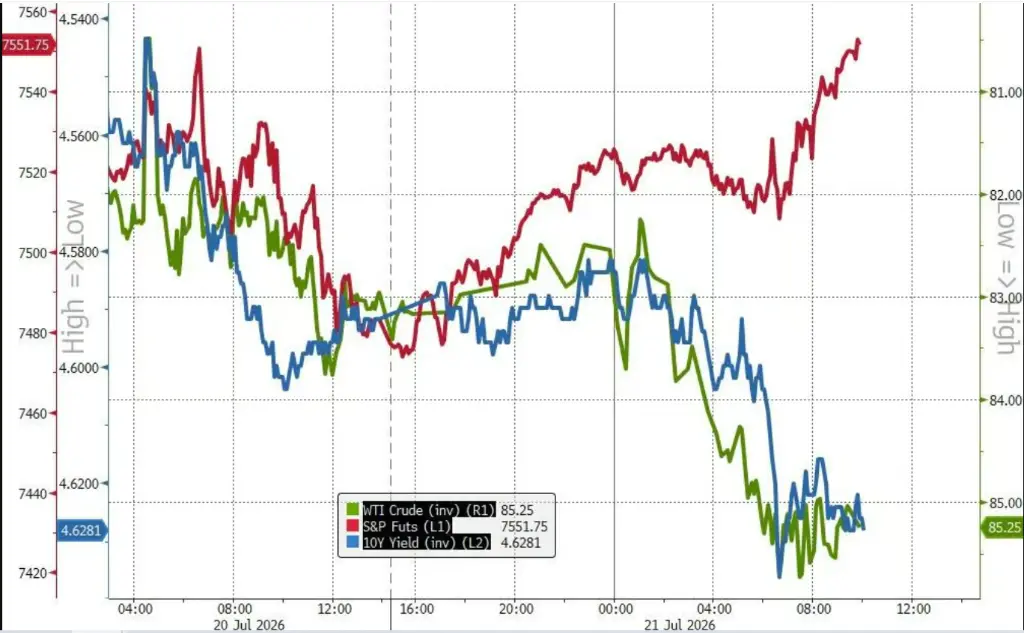
U.S. Treasury yields rose across the board, with the short-end 2-year yield up 5 basis points and the long-end 30-year yield up 2 basis points. Long-term yields hit two-month highs, erasing bond gains from last week's lower-than-expected inflation data.

Oil prices were one driver. Brent crude futures closed back above $90 per barrel for the first time since June 11. Middle East tensions continue to escalate – Yemen's Houthi forces announced a blockade of the southern Red Sea entrance, and two tankers carrying Saudi crude turned back in the Red Sea. Kpler's MarineTraffic data shows cargo loadings through the Bab el-Mandeb Strait had already fallen 34% over the past two weeks, even before the blockade announcement.

RBC Capital Markets rates strategist Izaac Brook said: "Today's market moves are primarily the result of continued strength in energy prices. The move in rates was amplified by breaks of closely watched technical levels – the 4.20% level for the 2-year and 4.60% for the 10-year – and the typically low-liquidity summer trading environment."

Bloomberg's Cameron Crise warned that long bond yields are at a critical point turning 5% from resistance to support, with the next obvious target at 5.5% – "which would hit stocks, especially if an upside surprise in the economy pushes yields higher and acts negatively on equities."

Goldman Sachs IG credit head Kevin Boova also warned that credit spreads for mega-cap tech companies have hit new highs, "the hyperscale cloud/AI/data center space is feeling a little fragile again."
İlgili Sorular

QWhat record-breaking performance did Morgan Stanley's TMT momentum factor achieve on July 21st, and what historical comparison was made?

AOn July 21st, Morgan Stanley's TMT momentum factor recorded a single-day gain of over 12%, marking its largest single-day gain on record. This performance even exceeded any single-day performance during the 2000 dot-com bubble period.

QAccording to the article, what is one major reason behind the sharp rebound in momentum stocks?

AThe rebound is largely attributed to a "short squeeze" scenario. Investors who had heavily shorted momentum stocks, particularly trend-following traders in South Korea and Japan, were forced to cover their positions due to heavy losses and margin calls, creating a self-reinforcing upward spiral of buying.

QWhy does BTIG strategist Jonathan Krinsky express caution about the rebound and what specific action does he recommend?

AJonathan Krinsky is cautious because the rebound has pushed the GSCBHMOM index into a key resistance zone (730-750 range) he identified. He warns that extreme volatility combined with historic stock divergence signals a broader market correction. He recommends "fading the rally," meaning investors should consider selling into strength or reducing positions on the bounce.

QIn contrast to BTIG's view, what is the stance of Goldman Sachs and UBS regarding the momentum sell-off, and what is their investment advice?

AGoldman Sachs and UBS believe the momentum sell-off is nearing its end. Goldman's Julia Mensch suggests the sell-off presents an opportunity to increase momentum exposure or buy AI stocks on the dip, as positioning has been significantly reduced. UBS's Michael Romano advises investors to start building positions gradually rather than going all-in at once.

QWhat is highlighted as the next key variable that will determine the sustainability of the rebound, and which specific company's report is deemed most critical?

AThe upcoming earnings season is highlighted as the next key variable. Specifically, Alphabet's (GOOGL) earnings report is considered "the most important data point of the week." The market will focus on its full-year 2026 capital expenditure guidance, which is expected to be raised and will provide crucial clues about the direction of AI spending.

İlgili Okumalar

The Clarity Act's Journey Through Congress: The Thorny Path of Bipartisan Compromise in the U.S.

The U.S. Congress is struggling to advance the crypto market structure bill known as the Clarity Act, with bipartisan compromise proving difficult. Key hurdles include unresolved disputes over "yield" products and, more critically, the inclusion of strong ethics provisions for elected officials—a non-negotiable demand for many Democrats. While a compromise on yield was reached in May, securing only limited Democratic support in committee, the separate Senate Agriculture Committee version later passed with no Democratic votes due to the ethics impasse. As Republicans push for a full Senate vote in July, demands for ethics rules have expanded, and other contentious issues like developer protections and concerns from law enforcement and large banks further complicate negotiations. Despite consensus on the need for legislation, the path forward is unclear. Recent discussions between senators and White House officials aim to find acceptable ethics language. Some lawmakers question whether a compromise text can garner enough bipartisan support, with one Democrat stating the current proposal lacks the strong ethics provisions required for their vote. Potential short-term goals for the crypto community include symbolic Senate action before the August recess, a longer-term aim for passage by 2026, or establishing a detailed framework that addresses ethics and other compromises. The process remains arduous, relying on the traditional, vote-by-vote effort to build bipartisan support.

marsbit11 dk önce

The Clarity Act's Journey Through Congress: The Thorny Path of Bipartisan Compromise in the U.S.

marsbit11 dk önce

Are Kalshi and Polymarket Founders at Odds? This Business Rivalry Is More Brutal Than You Think

"The Rivalry Between Kalshi and Polymarket Founders Turns Bitter and Litigious" The intense feud between Tarek Mansour, CEO of Kalshi, and Shayne Coplan, founder of Polymarket, has escalated far beyond typical business competition into personal animosity and regulatory battles. Both lead billion-dollar prediction market platforms, but their approaches differ sharply. Kalshi positions itself as the compliant operator, securing U.S. regulatory approval before launching. In contrast, Polymarket initially operated offshore, allowing U.S. users to access its platform via VPN, which drew regulatory scrutiny. The conflict reached a peak in November 2024 when FBI agents raided Coplan's New York apartment. While Coplan publicly blamed political motives, his team privately suspected Kalshi was involved. According to sources, Kalshi's lawyers had previously reported Polymarket's operations to federal prosecutors, highlighting its accessibility to U.S. users despite a ban. This incident fueled mutual accusations and underhanded tactics, including social media smear campaigns and attempts to sabotage each other's major business deals. Their rivalry also played out in Washington, influencing regulatory debates. Kalshi actively lobbied against Polymarket's practices, framing them as illegal and unethical. Polymarket, after facing a CFTC fine and investigation, later acquired a licensed U.S. firm to launch a domestic app, regaining a foothold. Despite the hostility, both companies have seen massive growth, with combined trading volumes soaring. However, increased regulatory scrutiny, particularly around insider trading on Polymarket's platform, continues to pose challenges. The founders' deep-seated mutual disdain ensures their battle for market dominance remains as much a personal vendetta as a commercial one.

marsbit19 dk önce

Are Kalshi and Polymarket Founders at Odds? This Business Rivalry Is More Brutal Than You Think

marsbit19 dk önce

Bank of America Quietly Positions: Could $6 Trillion in Bank Deposits Flow into Stablecoins?

Bank of America (BofA) is making strategic moves in digital assets, appointing senior leaders to advance a platform covering stablecoins, tokenized deposits, custody, and crypto settlement. This comes amid a broader discussion about the potential migration of trillions in bank deposits to stablecoins. A cited TBAC report estimated up to $6.6 trillion in transactional deposits could be at risk of moving to stablecoins long-term, a point BofA's CEO previously conditioned on stablecoins being allowed to pay interest. The regulatory landscape is evolving, with the GENIUS Act setting a final implementation deadline for January 2027. Major banks, however, are not waiting; JPMorgan, Citi, BofA, and others are already developing tokenized deposit networks and services. Industry observers note that while retail crypto trading is sluggish, institutional adoption of stablecoins for real-world use cases is driving growth. Despite the activity, some analysts remain cautious, noting banks have a long history of blockchain announcements and that true structural change is slow. The stablecoin market itself has seen a recent dip from its peak. Optimistic projections, however, foresee significant growth, with stablecoin settlement volume already reaching $33 trillion in 2025. The race is on for the post-January 2027 landscape, where regulatory clarity is expected to accelerate the fusion of traditional finance and crypto.

marsbit24 dk önce

Bank of America Quietly Positions: Could $6 Trillion in Bank Deposits Flow into Stablecoins?

marsbit24 dk önce

İşlemler

Spot
活动图片