The Time of Machines: When Agents Consume Stablecoins

marsbit2026-03-30 tarihinde yayınlandı2026-03-30 tarihinde güncellendi

Özet

"The Age of Machines: When Agents Consume Stablecoins" explores the convergence of AI and cryptocurrency, focusing on the emerging narrative of AI agents as economic actors. The author argues that while AI is rapidly advancing into production and consumption, crypto, particularly stablecoins, is struggling to find its role beyond financialization. The piece begins by reflecting on how AI-powered bots are evolving from nuisances to become autonomous economic entities, potentially even developing a "dislike" for humans. This shift creates a sense of desperation in the crypto community, which is now trying to prove its value to AI by promoting stablecoins as the preferred medium of exchange for agents. A core tension is highlighted: AI is mastering both production and the new "relations of production" by replacing human labor, while crypto remains confined to a narrow financial role. Previous attempts by crypto to capture AI use cases—through decentralized storage, compute, or GPU lending—have largely failed. The author warns that compliant, bank-issued stablecoins on networks like Canton could ultimately prevail over native crypto stablecoins. The emergence of payment protocols for machines, like Stripe's MPP, is noted, but these efforts are seen as integrating machines into the existing traditional financial system rather than creating a new crypto-native one. The crypto industry's strategy of selling stablecoins to AI based on technical merits like cheapness and speed is p...

Author: Zuo Ye Wai Bo Shan

We live in a vast gap, and the passage of time always brings a sense of dizziness.

In 2023, Musk called for small payments to block Bots and maintain the community atmosphere for human discussion. But just two or three years later, Bots, empowered by AI, are about to become the main actors of small payments and are showing a "rejection emotion" towards humans.
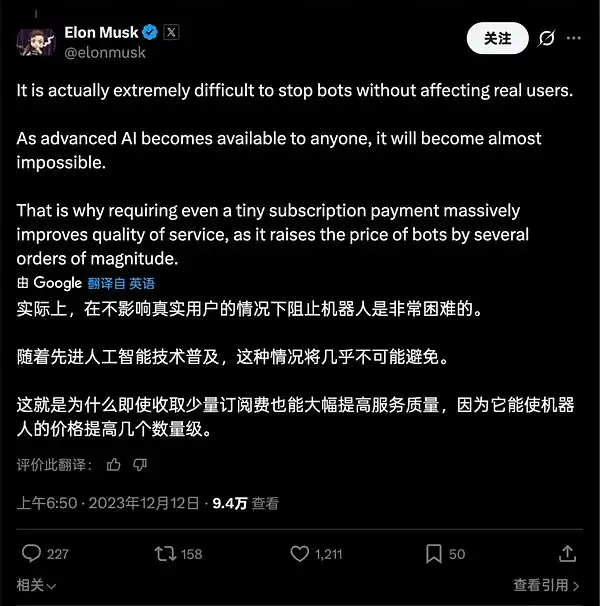
Image Caption: Musk wants to use micropayments to block Bots

Image Source: @elonmusk

It's not just ordinary white-collar workers who feel abandoned; more so, it's the sense of backwardness in the crypto community. You can repeatedly experience this despair from Vitalik's sutra-like repetition of the importance of ZK for trustworthy AI, de Agents like Virtuals seeking decentralized LLMs, and the latest—Agents should consume stablecoins.

This time, Crypto must prove its value to AI, in the name of stablecoins.

AI Steps into Productivity, Crypto Stuck in Finance

When you pursue freedom, you have already lost it.

In the narratives about AI and Crypto, the most classic is "AI is responsible for productivity, Crypto is responsible for production relations," but this relationship has never materialized.

Production relations refer to human collaboration models, and the biggest feature of this round of AI is "replacing humans."

AI Agents are climbing out of the screen, taking over white-collar jobs, while also invading the mechanically repetitive areas of manual labor. Admittedly, as Jensen Huang said, AI itself is also limited by physical hardware like electricity, firmly anchored in the geometric space woven by humans.
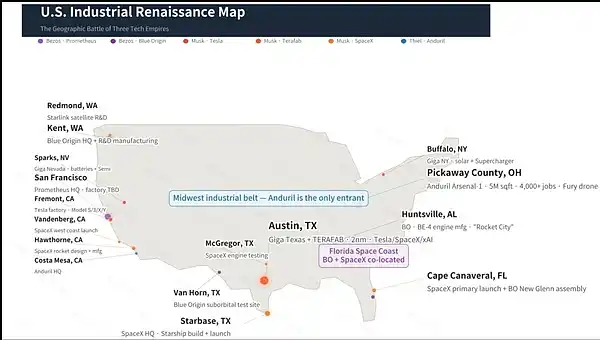
Image Caption: AI enters the production field

Image Source: @zuoyeweb3

If humans can only serve the production and consumption of AI, can they still preserve their subjectivity in labor?

At the same time, Crypto's vision is gradually narrowing, from early decentralized storage like IPFS/Filecoin, to computing power and storage projects in the 24/25 cycle, to USDAI focusing on GPU lending models. You can't say Crypto isn't trying, but each wave fails to capture AI's real use cases.

"AI is responsible for both productivity and production relations" is more likely to come true. Even if the Agent narrative is not a bubble, the stablecoins used may not be "stablecoins based on BTC/ETH assets, running on Ethereum."

I am not spreading terror or pessimism. The Genius Act has effectively allowed the OCC to take the definition power of "compliant stablecoins." Sky's USDS is just a U.S. debt certificate running on Ethereum. So, in the upcoming RWA era, will more assets choose Canton backed by Goldman Sachs or Solana, which is actively BDing?

ETH L1 has once again become a high-performance public chain, at the cost of node scale exploding rapidly. First, use compliant stablecoins to replace "YBS," then use Canton to replace ETH/SOL, and finally co-opt Vitalik as an institutionalized rebel.

Liangshan was good because it could surrender; the coin circle is bad because it's all about finance.

But Liangshan had the military foundation to surrender; the coin circle has all the套件 for financialization. And, no matter how much Agent replaces human consumption power, it must act according to human will.

In other words, Agent is the behavioral subject, and humans are the意愿 subject. Agent's consumption behavior can only be an infinite extension of human will.

In March 2026, Stripe launched the MPP protocol (Machine Payments Protocol), seemingly to摆脱 humans, but it is actually a failed restart之作 to incorporate machines into the existing financial system.

As early as last September, Stripe联合 OpenAI launched the ACP (Agentic Commerce Protocol) protocol, hoping to replace the previous "Google Search + Amazon Mall" through OpenAI's chat page. But unfortunately, Agent cannot cross the non-standard存量 of the old giants over 20 years, and the complexity leads to a conversion rate that is聊胜于无.

There are many such protocols, including Visa and the banking industry, which are urgently launching their own "machine payment" protocols. But归根到底, they are just adding stablecoins on the acquiring side. You hardly see merchants actively integrating stablecoins.
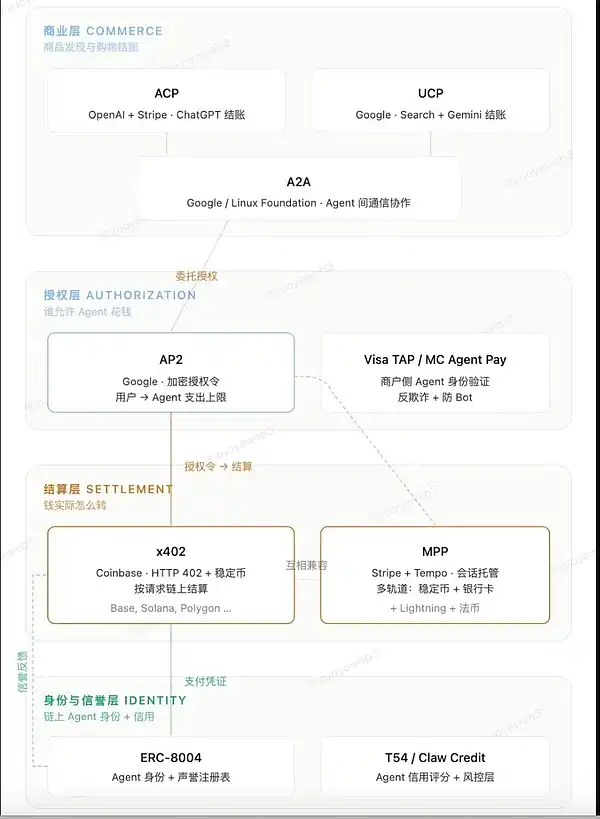
This is not to deny the trend of combining stablecoins and Agents. Borrowing a sentence from @Shoal Research, "In the past fifty years, efforts to replace card organizations, from PayPal to Apple Pay, have ultimately failed."

If the stablecoins issued by banks, running on Visa's private chain, ultimately defeat Crypto's efforts like they defeated Fintech, this story is not friendly to us.

On this point, Crypto must learn from AI, from Prompt Engineering, to Context Engineering, to the current Harness Engineering. The survival form of Agent has been constantly changing.

Early on, people optimized their prompts in Chat; then, people optimized their expressions in AI response texts, summarizing them into skills, and then疯狂购买 API and Mac Mini and other software and hardware services, ultimately training Agent into a version that is easier to replace themselves.

The narrative of Agent consuming stablecoins is a helpless move after only having financial value. It can only sell its cheap, fast and other technical narratives to AI and the public. This is无异于 putting on the rope that will hang itself, and at a clearance price.

Crypto Token ⇄ AI Token ⇄ Crypto Token

Stay away from the sound of gunfire, observe the battle from afar as much as possible.

If you are caught in it, try to create a new battlefield for yourself.

Providing liquidity for the AI industry is a dead end (no money, and it will relegate the coin circle to the background). Being treated as SaaS and channels will be swallowed and have profits taken away. Only by focusing on volatility can we trigger human FOMO emotions, thereby creating miracles of asset price surges.

The most exciting narrative of Agent is being the dual subject of production and consumption. Letting Agent consume can greatly surpass human physiological limitations:

  1. The number of humans is limited, or rather, the subjects of stablecoin consumption are limited, at most 8 billion. But the number of Agents is endless,无限递归. A human's Agent calls an Agent; the vassal of my vassal is not my vassal.
  2. Agent does not need sleep. This is the first time a "tool" has shown a physiological advantage over humans, a biological advantage over human labor—not smarter, but more耐磨, the Scaling Law on the time scale.
  3. Agent is good at handling Fuzzy tasks, or always gives you a solution. In multi-Agent mode, AI shows all-weather working ability for the first time.

Agent is not an evolution of the Ford assembly line, but the theoretical optimum of Taylorism. People are unstable, but Agent can be continuously tuned to最终适配 the ultimate dream of capitalism—capital appreciation.

This is not alarmist. The word Token, in both Chinese and English contexts, already points to the throughput of AI, no longer the competition of PoW.
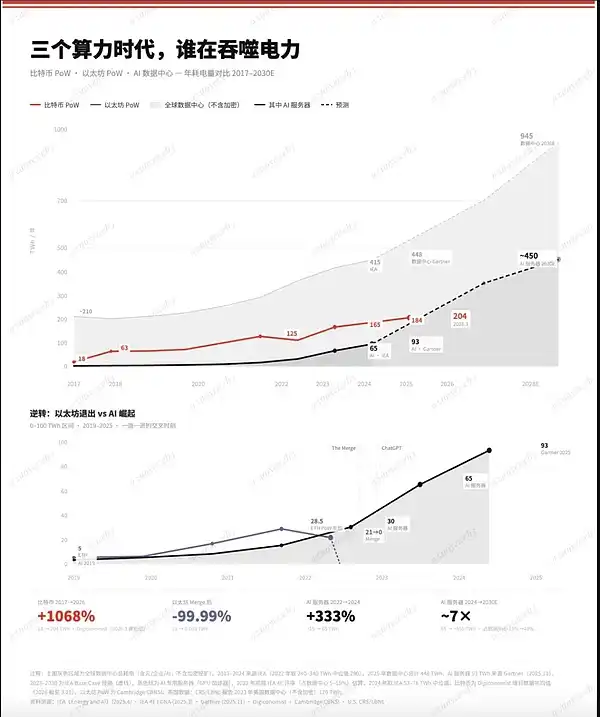
Image Caption: The变迁 of the computing power era

Data Source: @DigiEconomist @IEA

Ethereum abandoned the PoW mechanism in 2022; ChatGPT started the AI computing power competition era in 2022. Fate likes to play tricks on us. When Token in crypto became a pure emission game, more people chose AI supported by computing power consumption.

Transitioning from Crypto Token to AI Token is not difficult; stablecoins are trying. But the reverse, converting AI Token into the liquidity of Crypto Token, has become a difficult sutra to chant.

Computing power, reasoning, storage—all lost. How can the stablecoin story come true?

Perhaps AI can give us a reference. Agent's replacement of Chat is based on the fact that the Chat model cannot sustain a business model. ChatGPT shows no signs of replacing Google or Amazon; Claude specializes in "deterministic" areas like Coding.

Now it's time to consider whether Crypto will decline slowly and painfully like Binance, or rapidly like FTX.

We must learn from AI in reverse: create volatility based on stability. This is what crypto is best at. Traditional finance's adoption of AI pursues accuracy to reduce labor, but traditional finance's adoption of Crypto pursues "tokenization" to reduce friction.

This is not Crypto's own story. Volatility has always been built on a stable foundation. For example, RWA shifts from national debt to corporate debt; lending shifts from floating rates to fixed income.

What the crypto industry needs is, under the premise of Agent using stablecoins, how to create volatility, or rather, the inflation of asset prices?
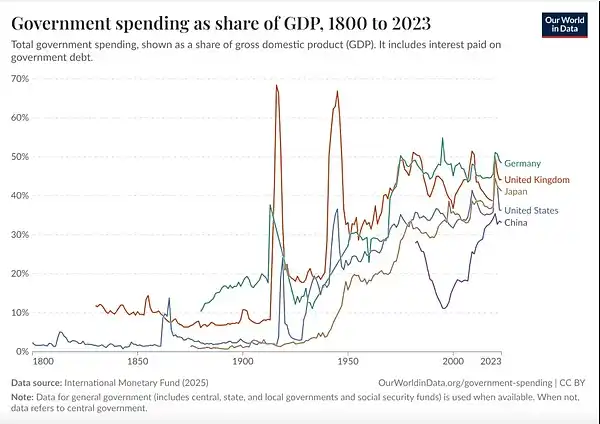
Image Caption: Government becomes the consumption subject

Image Source: @OurWorldInData

It's not as difficult as we imagine. Since the industrial revolution, the state has become the main body of economic operation. Even after the neoliberal narrative began in the 1980s, the proportion has still been steadily increasing.

The water released by QE, strong bank regulation, eventually turned into the withdrawal tide of asset management giants in 2026. This market never lacks AUM; it always lacks demand侧.

This is the significance of stablecoins for the retail market. Whether you package it as the chosen one for Agent or a post-human necessity, human emotions are always needed to trigger the initial purchase.

The AI narrative is the same, and the crypto narrative is the same. Ultimately, they must be sold to a small demand market.

Only technological progress can generate wealth surplus, gradually提高 the overall per capita income level, and thereby提升 consumption levels. This is the story AI tells. But now, the wealth effect of tokens is approaching zero; there is no growth. This is Crypto's biggest困境.

It has never been about productivity and production relations. This is a良缘 about consumption and finance. AI can become the subject of consumption; the government is the driving force of consumption. But humans are always needed to execute the financial big bang to complete the cycle.

The leap from AI Token to Crypto Token also requires letting Token break free from quantity restrictions and re-enter the space of imagination.

Conclusion

Circle's真正聪明之处 is to let Agent replace the limits of human numbers and consumption power,造了一个 dream of infinite users for the capital market.

But compliant Circle will also fall sharply due to the clear act "prohibiting" passive interest. This shows that the market hopes for a vague sense of朦胧感—when compliance is不利, there is also room for survival.

This is the characteristic of the crypto industry—always the frontline financial laboratory.

Current AI is becoming increasingly stable in methodology. The only breakthrough direction is Li Fei-Fei and Yann LeCun's world model, but this is essentially not a complete innovation of "algorithms," but still a dimensional update on the data side.

The significance of Agent for consumption and finance is about to enter the落地 stage after experimentation, and stablecoins carry all the hopes of Crypto.


İlgili Sorular

QWhat is the core argument the author makes about the relationship between AI and Crypto in the context of stablecoins?

AThe author argues that the narrative of 'AI for productivity, Crypto for production relations' has failed. Instead, AI is taking over both roles. Crypto, now largely confined to finance, is desperately trying to prove its value to AI by pushing the narrative of AI Agents consuming stablecoins, but this is a weak position that may lead to its co-option by traditional finance systems like Visa or Canton, rather than dominance.

QAccording to the author, what is the fundamental shift in the role of 'Token' between the Crypto and AI industries?

AThe term 'Token' has shifted from referring to a unit in Proof-of-Work (PoW) crypto mining competitions to denoting the computational throughput and consumption of AI models. The author highlights that while it's easy for value to flow from Crypto Tokens to AI Tokens (e.g., funding compute), the reverse—converting AI's computational value back into Crypto Token liquidity—has become extremely difficult.

QWhat are the three key advantages the author cites for AI Agents over humans as consumers of stablecoins?

AThe three key advantages are: 1. Infinite Scale: The number of Agents is potentially limitless, recursively creating more Agents, unlike the finite human population of 8 billion. 2. No Physiological Limits: Agents do not require sleep, giving them a biological advantage of continuous, 24/7 operation—a 'time-scale Scaling Law.' 3. Handling Fuzzy Tasks: Agents excel at processing ambiguous tasks and providing solutions, especially in multi-Agent systems, enabling full-time, optimized work capability.

QWhat is the author's view on the current efforts by traditional financial institutions like Stripe and Visa regarding machine payments?

AThe author is skeptical. They describe efforts like Stripe's Machine Payments Protocol (MPP) and Visa's initiatives as attempts to incorporate machines into the existing financial system that are ultimately failing or merely adding stablecoins as a payment option on the acquirer side. The author believes these traditional players, with their privately-backed stablecoins, could ultimately defeat Crypto's efforts, just as they previously defeated Fintech challenges to card networks.

QWhat does the author propose as Crypto's unique strength and survival strategy against the dominance of AI and traditional finance?

AThe author argues that Crypto's unique strength is not in stability but in creating volatility and speculation ('FOMO'). The survival strategy is to 'create a new battlefield' by leveraging this ability to generate asset price explosions and wealth effects. Crypto must focus on transforming the stability provided by assets like stablecoins into the volatility that drives financial markets, as this is what it does best and what attracts human capital.

İlgili Okumalar

AI PC Battle: Bet on the Toll Booth, Not the Camp

**Title:** The AI PC Battle: Don't Bet on Sides, Bet on the Tollbooth **Summary:** The AI PC competition is moving beyond simple "x86 vs. Arm" narratives. The core investment thesis should focus on identifying which players can sustain margins, cash flow, and pricing power throughout the upgrade cycle, rather than backing a particular architecture. The opportunity is analyzed in three layers: 1. **The Advanced Foundry Tollbooth:** TSMC is positioned to collect "tolls" regardless of which chip designer wins, due to its dominant ~70% share in advanced semiconductor manufacturing, which is essential for high-end AI PC chips. 2. **Compute & Platform Spillover:** AMD represents an offensive in the x86 CPU+GPU space, while NVIDIA leverages its GPU and CUDA software stack dominance. Both benefit from the demand for increased local AI compute. 3. **Architecture Diffusion & Turnaround Plays:** ARM and Intel offer potential for significant upside (elasticity), but investments here require stricter discipline due to higher execution risks and competitive challenges. The industry is transitioning from concept to shipment validation. While short-term forecasts for AI PC adoption have been revised down slightly due to tariffs and procurement delays, the long-term trend towards AI becoming a standard PC feature remains intact. The key driver for upgrade cycles will be whether compelling enterprise applications (e.g., privacy-sensitive computing, low-latency inference) emerge beyond consumer-focused features like meeting summarization. Investment strategy should prioritize companies with platform-level advantages and recurring revenue streams. TSMC offers high certainty as the foundational tollbooth. AMD presents a strong offensive play within the established ecosystem. ARM and Intel are higher-risk, higher-potential-reward turnaround bets. The report cautions against chasing short-term hype and emphasizes a disciplined, long-term approach focused on buying ecosystem strength and cash-flow certainty after market enthusiasm subsides. **Key Risks:** Underwhelming AI PC applications slowing upgrade cycles; slow improvement in Windows on Arm compatibility; macro/tariff impacts on PC demand; potential advanced node supply-demand mismatches affecting TSMC; high overall AI sector valuations making stocks vulnerable to a risk-off shift in markets.

marsbit11 dk önce

AI PC Battle: Bet on the Toll Booth, Not the Camp

marsbit11 dk önce

Ten-Thousand-Word Analysis: From $10 to $290, MRVL Wins the Entire AI Era by 'Not Making GPUs'

Marvell Technology's stock price surged from under $10 in 2016 to a record $290 in June 2026, fueled not by making GPUs, but by dominating AI infrastructure connectivity. This analysis argues the market misvalues MRVL as merely a smaller Broadcom in custom AI chips, overlooking its true, unique position. Marvell's core strength lies in enabling high-speed data flow for AI clusters through three interconnected businesses. First, it holds a commanding ~70% market share in high-speed optical DSPs (essential for data center light modules), a deep-moat business with accelerating growth. Second, its custom AI chip design business serves hyperscalers like AWS, Microsoft, and Google, with a significant revenue pipeline despite lower margins. Third, stable cash flows come from Ethernet switch chips and enterprise storage controllers. Together, they form a full-stack "AI data movement" platform. CEO Matt Murphy's transformative leadership since 2016, involving strategic divestments, key acquisitions (like Inphi for optical DSPs), and securing long-term agreements with major cloud providers, repositioned the company. A pivotal $2 billion strategic investment from NVIDIA in 2026 underscored Marvell's critical role in the AI ecosystem, particularly through collaborations like NVLink Fusion. While Marvell faces risks—including client concentration (losing the Amazon Trainium3 design), lower-margin business mix, competitive threats, insider selling, and complex supply chains—its fundamentals remain strong. The optical interconnect moat is widening with the acquisition of Celestial AI (photonics fabric), and financial metrics show accelerating revenue growth and operating leverage. With a PEG ratio suggesting undervaluation relative to its growth, the thesis is that the market undervalues Marvell's monopolistic position in AI "plumbing" while overemphasizing its competitive custom chip segment. The story transcends investing, symbolizing how in any complex system—from the internet to AI—the value of "connection" ultimately surpasses that of individual "nodes."

marsbit40 dk önce

Ten-Thousand-Word Analysis: From $10 to $290, MRVL Wins the Entire AI Era by 'Not Making GPUs'

marsbit40 dk önce

AI Relay Stations Spark Heated Debate on Zhihu: Behind Cheap Tokens, What Are Users Really Worried About?

A discussion on Zhihu about "AI relay stations" shifted the niche developer topic of "cheap tokens" into broader user awareness. Users moved beyond simply questioning the legitimacy of these services to focus on practical concerns: Where do cheap tokens truly come from? Is the model being accessed the real one? Can relay stations see prompts, code, and API keys? For occasional users, are the risks worth it? The core debate centered less on price and more on trust. A primary worry is model authenticity—the risk of "model swapping," where users paying for a premium model might be routed to a cheaper one, creating an information asymmetry. Others argued that cost comparisons matter; while cheaper than official pay-as-you-go APIs, relay stations may not be the lowest-cost option versus subscriptions, domestic models, or free tiers, making user needs assessment crucial. Speculation about token sources ranged from legitimate bulk discounts to gray-area methods like account sharing or exploiting regional pricing. This opacity makes risk assessment difficult for users. Data security emerged as a critical concern, especially for enterprise use. When processing sensitive information like code, contracts, or client data, the inability to verify a relay station's data handling, retention, or access policies poses significant compliance and confidentiality risks. The evolving consensus suggests relay stations can be used cautiously for low-sensitivity, disposable tasks (e.g., summarizing public info, simple translation). However, they should not be the default for sensitive, professional, or production workflows involving proprietary data, Agents, or automated systems. Recommendations include avoiding large prepayments, not relying on a single service, using test prompts to monitor quality, anonymizing data where possible, and keeping official channels as backups. Ultimately, the discussion framed tokens not just as a billing unit but as a measure of real cost encompassing price, model integrity, data security, and service stability. The popularity of relay stations highlights user demand for affordable access, but the debate underscores a key trade-off: the savings from cheap tokens may come at the price of trust, transparency, and control over one's data and AI experience.

marsbit1 saat önce

AI Relay Stations Spark Heated Debate on Zhihu: Behind Cheap Tokens, What Are Users Really Worried About?

marsbit1 saat önce

In-Depth Research Report on TradFi: The Convergence Wave of Crypto and Traditional Finance

In 2026, the crypto industry is undergoing a profound infrastructure-level transformation—TradFi assets are migrating on-chain at an unprecedented pace. According to CoinGecko's Q1 2026 report, the total value locked (TVL) of tokenized real-world assets (RWA) has surpassed $31 billion, a nearly 4x increase from $7.8 billion at the beginning of 2025, with the sector’s aggregate market capitalization reaching $19.3 billion. Among these, the market cap of tokenized stocks surged from $2 million to $486 million, with Q1 spot trading volume reaching $15.1 billion—a single quarter already surpassing the entire second half of 2025. RWA perpetual contract Q1 trading volume reached a staggering $524.8 billion, far exceeding the $313 billion for all of 2025. Meanwhile, BlackRock's BUIDL fund has reached $2.3 billion in scale and has filed for two new tokenized funds, signaling that the world's largest asset manager's tokenization strategy is evolving from pilot to product suite expansion. HTX, as a core participant in the crypto exchange sector, officially launched TradFi perpetual futures products including NVDA, AAPL, MSFT, META, and SPY in 2026, enabling crypto users to gain 24/7 trading access to core U.S. equities. Boston Consulting Group predicts that global tokenized asset scale could reach $16 trillion by 2030, while McKinsey offers a conservative estimate of approximately $2 trillion. The on-chain migration of TradFi assets is no longer a "future narrative" but a structural transformation unfolding in real time, as crypto exchanges evolve from single crypto asset trading platforms toward "multi-asset-class trading infrastructure."

HTX Learn1 saat önce

In-Depth Research Report on TradFi: The Convergence Wave of Crypto and Traditional Finance

HTX Learn1 saat önce

İşlemler

Spot
Futures
活动图片




