The Rise and Fall of Binance's Hegemony: The Stablecoin War from BUSD's 'Unification' to $U's 'Dominance'

marsbit2025-12-19 tarihinde yayınlandı2025-12-19 tarihinde güncellendi

Özet

"Binance's Stablecoin Wars: From BUSD's 'Unification' to $U's 'Domination'" This article chronicles Binance's evolving strategy in the stablecoin arena, tracing its journey from aggressive dominance to a more sophisticated, aggregator model. The story begins with the ambitious launch of BUSD, a Paxos-issued stablecoin born from a partnership between Binance's CZ and Paxos's Richmond Teo. Binance's most aggressive move came in 2022 with a "liquidity unification" blitz, automatically converting user balances of USDC, USDP, and TUSD into BUSD and removing their trading pairs. This tactic briefly propelled BUSD to a $23 billion market cap. However, its downfall was swift. A critical structural flaw was its "Binance-Peg BUSD," an unregulated, shadow version on the BNB Chain that sometimes lacked sufficient collateral. This led to a regulatory "Valentine's Day massacre" in February 2023, when the NYDFS ordered Paxos to stop minting BUSD, effectively killing the project. In the subsequent vacuum, Binance first promoted the Hong Kong-based FDUSD as a transitional solution and created BFUSD, an internal, yield-bearing "reward asset" for use as futures collateral. The narrative then shifts to Binance's latest and most surprising play: United Stables ($U). This new "meta-stablecoin" represents a strategic evolution. Instead of trying to eliminate rivals like USDT and USDC, $U aggregates them, backing itself with a basket of these major stablecoins. Notably, it also includes USD1, a s...

In the crypto world, what truly determines victory is never code, but the interplay of liquidity, power, and regulation. The rise and fall of BUSD is not just the tragic history of a single stablecoin, but a financial war about how an exchange attempted to "unify the world."

When BUSD was pushed onto the historical stage, it carried not only a compliance narrative but also Binance's ambition to reshape the stablecoin order through coercive measures—forcing exchange rates and merging trading pairs to absorb the depth of competitors directly into its own ledger.

The "automatic conversion" in 2022 was a textbook blitzkrieg; while the regulatory hammer on Valentine's Day 2023 caused this seemingly impregnable empire to collapse instantly. The twin BUSDs, the shadowy Binance-Peg, and the blurred regulatory boundaries together constituted its Achilles' heel.

But the story does not end here.

From FDUSD to BFUSD, and then to United Stables ($U), Binance did not give up on stablecoins but evolved from its failures, shifting from hegemonic unification to aggregated absorption, even paving the way for the AI economy in advance.

This is an article about stablecoins, but even more so, it is a business documentary about how exchange power attempted to tame the market and was counterattacked by regulation.

Chapter 1: Zeal and Hegemony—The "Unification" Story of BUSD

The story of BUSD is not just the rise and fall of a compliant product but also a tale of "imperial tactics" about how an exchange attempted to unify market liquidity through administrative means.

1.1 Humble Beginnings: The Dinner Between CZ and Richmond Teo

In 2019, the stablecoin market was Tether's wild west. At this time, Richmond Teo, as the co-founder of Paxos and CEO of Asia, became a key bridge connecting New York regulators with Asian crypto giants.

An industry rumor, seemingly false yet widely believed, circulated: Shortly before the launch of BUSD, after Paxos published a blog post celebrating its compliant status, Rich Teo and CZ were spotted dining together at an upscale overseas restaurant. After that dinner, the situation changed dramatically: Huobi's HUSD gradually fell out of favor, and Paxos solidified its position as the "full-time custodian" of BUSD. CZ entrusted Binance's liquidity backbone to Teo, while Teo used the New York State Department of Financial Services (NYDFS) "green list" license to equip Binance with a bulletproof vest.

1.2 The Zealous Moment: The 2022 "Exchange Rate Unification Blitz"

The most "zealous" and controversial moment in BUSD's history occurred in September 2022. To challenge the dominance of USDT and USDC, Binance launched a stunning "liquidity unification" operation.

Binance announced that it would automatically convert existing user balances and newly deposited USDC, USDP (Paxos Dollar), and TUSD (TrueUSD) into BUSD at a 1:1 ratio.

Binance directly removed spot trading pairs for USDC, USDP, and TUSD. This meant that on Binance, the world's largest liquidity pool, users could deposit USDC but would only see and use BUSD on their accounts. (However, they could withdraw USDT or USDC.)

This was a blatant strategy. By forcibly merging liquidity, BUSD instantly gained the trading depth that originally belonged to its competitors. Although Circle (the issuer of USDC) CEO Jeremy Allaire stated on Twitter that this helped increase dollar liquidity, the brand presence of USDC in the Binance ecosystem was forcibly erased, becoming "fuel" for BUSD.

This aggressive strategy was highly effective. BUSD's market capitalization soared to a historical peak of $23 billion in November 2022, once occupying half of the trading volume on centralized exchanges. That was BUSD's most glorious moment and the peak of Binance's ambition to establish an independent financial闭环 (closed loop).

1.3 The Regulatory "Valentine's Day Massacre"

However, this "unification" came to an abrupt end on February 13, 2023. The NYDFS pointed out that the "Binance-Peg BUSD" (a shadow version issued for use on BNB Chain) issued by Binance exceeded Paxos's regulatory scope and ordered a halt to its minting. BUSD's market capitalization plummeted from its peak of $23 billion to nearly zero. The empire built through "automatic conversion" collapsed under the regulatory hammer.

For Teo, this was undoubtedly a heavy blow. As the architect, he watched as the "child" he and CZ had raised together was forcibly euthanized. Paxos was forced to announce the severance of its relationship with Binance, and Teo subsequently entered a low-profile period lasting over a year.

However, the story did not end there. Rich Teo's high-profile return in the Trump family's crypto project, World Liberty Financial (WLFI), is seen as a continuation of his story with CZ. Teo is leveraging new political capital to build a new compliant stablecoin (USD1), and WLFI deeply relies on BNB Chain's liquidity. This seems to be a more subtle and迂回 (roundabout) way for the two old friends to continue their "liquidity alliance" in the cracks of regulation.

Chapter 2: The Achilles' Heel—The "Twins" and Regulatory Thunder

2.1 The Fatal Structural Flaw: Binance-Peg BUSD

Behind BUSD's glory lay a structural hidden flaw that ultimately led to its destruction. In fact, there were two截然不同 (distinctly different) forms of BUSD circulating in the market:

  • BUSD issued by Paxos (ERC-20): This was the real "compliant BUSD," issued by Paxos on the Ethereum blockchain, directly regulated by NYDFS, with reserves strictly held in segregated U.S. accounts.
  • Binance-Peg BUSD (BEP-20, etc.): This was a "wrapped token" created by Binance to extend its ecosystem to non-Ethereum chains (like BNB Chain, Polygon, Avalanche).

In theory, the mechanism of Binance-Peg BUSD was: Binance would lock 1 Paxos BUSD on Ethereum, then mint 1 Binance-Peg BUSD on BNB Chain. However, this "bridging" mechanism relied entirely on Binance's internal operations, not direct management by Paxos. NYDFS's regulatory authority and the "green list" only covered Paxos BUSD on Ethereum, not Binance-Peg BUSD.

The breaking point was the disconnect in reserve management. Investigations by media outlets like Bloomberg revealed that during certain periods from 2020 to 2021, the wallets backing Binance-Peg BUSD experienced severe "undercollateralization," with gaps reaching up to $1 billion at one point. Although Binance claimed this was merely an "operational delay" and not a solvency issue, it directly violated the regulators' bottom line: a stablecoin flying the flag of "NYDFS regulated" had spawned an unregulated "shadow version" with messy reserve management.

2.2 The Regulatory Hammer: The 2023 "Valentine's Day Massacre"

BUSD's fate came to an abrupt halt on February 13, 2023. On this day, the New York State Department of Financial Services (NYDFS) issued an administrative order demanding that Paxos immediately stop minting new BUSD tokens.

The regulator's理由 (reasoning) was clear and致命 (fatal): Paxos had failed to effectively supervise its relationship with Binance, particularly regarding the issuance of Binance-Peg BUSD, which allowed the compliant BUSD to be used as backing for unauthorized derivatives. The NYDFS explicitly stated: "While we authorized BUSD on Ethereum, we never authorized Binance-Peg BUSD."

Simultaneously, the U.S. Securities and Exchange Commission (SEC) issued a Wells Notice to Paxos, alleging that BUSD constituted an "unregistered security." The logic behind this accusation was that BUSD was not just a payment tool; it was part of Binance's ecosystem profit mechanism (through products like Earn), thus potentially constituting an investment contract. Although the SEC later dropped this specific investigation in July 2024, the dual blow at the time was already致命 enough (fatal enough).

2.3 Fall and Retreat

"Ceasing minting" meant BUSD became a "zombie token" that could only be redeemed, not newly issued. For an asset intended to be a liquidity medium, this was a death sentence. As Paxos announced the termination of its partnership with Binance, BUSD's market capitalization began a free fall. Within days, billions of dollars flowed out; within a year, its market cap shrunk by over 90%.

Binance was forced into a painful retreat:

  • Delisting Trading Pairs: Gradually removing BUSD spot and leverage trading pairs.
  • Ceasing as Margin: Announcing BUSD would no longer serve as a margin asset for contract trading.
  • Forced Conversion: Urging users to convert BUSD to other stablecoins (e.g., FDUSD).

The once "zealous" stablecoin empire collapsed under the regulatory hammer. Binance lost a stablecoin trump card and was forced to rethink its stablecoin strategy.

Chapter 3: The Transition Vacuum and the Emergence of FDUSD & BFUSD

In the initial period after BUSD's fall, Binance faced reluctance to let go of its "own stablecoin" revenue—why should this profit be handed over to others? To fill this void, Binance quickly promoted First Digital USD (FDUSD), a stablecoin issued by Hong Kong's First Digital Labs.

Binance's support for FDUSD almost replicated the strategy used to promote BUSD back in the day:

  • Launching "zero fee" activities for FDUSD trading pairs.
  • Offering 1:1 lossless conversion from BUSD to FDUSD.
  • Including FDUSD as a farming option in Launchpool.

However, FDUSD was more of a strategic buffer. While it addressed the shift in compliance location (from the U.S. to Hong Kong), it was still a traditional, centralized, third-party issued stablecoin. It did not solve the core problem: if regulators targeted the issuer again, Binance would still be passive. Furthermore, in a high-interest rate environment of up to 5%, the model of FDUSD (and USDT/USDC) meant the issuer earned all the interest, while users got nothing. This was already outdated in the DeFi era.

The era for new stablecoins had also passed. FDUSD's primary use case originally was participating in Launchpool. As Launchpool activities sharply decreased, FDUSD's utility value also diminished. Coupled with the丑闻 (scandal) involving Justin Sun in April 2025, the growth of FDUSD faced challenges.

To counter competitors' "contract position yield" features, BFUSD (Binance Futures USD) emerged.

Binance repeatedly emphasized that BFUSD is a "reward-based margin asset," not a true stablecoin.

Users holding BFUSD can earn 4-5% APY. The yield comes from a "Delta hedging" strategy.

BFUSD cannot be withdrawn; it can only be used as margin in Binance's contract accounts. It is Binance's "internal circulation" weapon, ensuring that even in a bear market, users do not transfer funds out of the exchange. It is an asset appreciation financial product disguised as a "stablecoin." Although BFUSD has also achieved considerable success (currently with an issuance of 1.8 billion), Binance also knows that a stablecoin that cannot leave the exchange is merely play money (欢乐豆).

Chapter 4: United Stables ($U)—The "Surprise" and New Landscape It Brings

If BUSD represented "exclusive" hegemony and BFUSD was "internal" defense, then the newly launched United Stables ($U) brings a completely different surprise: "compatibility" and "the future."

4.1 No Longer "Reinventing the Wheel," but "Absorbing the Wheel"

Unlike the BUSD era's attempt to eliminate USDC, $U adopts a "meta-stablecoin" strategy.

$U is backed by a basket of assets. According to the release information on December 18, 2025, its reserves include USDT, USDC, and USD1.

It continues BUSD's unification strategy. Whether it's USDC, USDT, USD1, or USD, they all become the underlying assets of $U, but对外呈现时是U (externally presented as U). By吸纳 (absorbing) the liquidity-fragmented USDT and USDC into $U's reserve pool, United Stables attempts to algorithmically "unify" these assets on BNB Chain, issuing the most liquid $U, somewhat analogous to curveUSD. U is the unified称谓 (designation) for these stablecoins, but users can choose other stablecoins when withdrawing/redeeming.

This is a higher-dimensional strike—since the dollar I issue you dare not use, I will package the dollars you dare use into my token.

4.2 Surprise Two: Foreshadowing, the Trump Concept Coin USD1 Enters the Game

The strategic surprise of United Stables also lies in including USD1 as a reserve asset. (This is the stablecoin issued by the Trump family's crypto project, World Liberty Financial (WLFI), whose stablecoin负责人 (head) is none other than BUSD's old architect, Richmond Teo. One wonders if this relationship was a factor?)

After all, USD1's size is several magnitudes smaller than USDC and USDT. This support, from an external view, seems more like a political投名状 (letter of commitment/pledge of allegiance). It is foreseeable that United Stables provides a huge use case for USD1 (as $U's underlying asset), given that USD1's current usage scenarios are still quite limited.

4.3 Surprise Three: Currency Born for AI (The AI Economy)

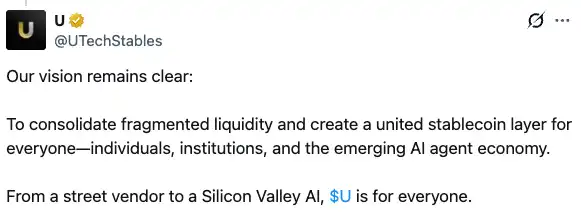
United Stables explicitly states that $U is "designed for the AI economy."

As stated in United Stables' tweet:
EIP-3009 (Gasless Authorization): Allows for "gasless transfers." This means future AI agents (Bots) conducting high-frequency micropayments do not need to hold BNB or ETH for gas fees. This solves the biggest pain point in machine-to-machine (M2M) economics.

x402 Delegated Execution: A standard that allows smart contracts to automatically execute fund transfers based on specific conditions. This paves the way for future "autonomous hedge funds" or "supply chain automatic payment AIs."

As of the time of writing: U already has a circulating supply of 55 million. Is it a case of积累薄发 (accumulating strength for a major leap), or just a passing cloud?

https://x.com/UTechStables/status/2001667382444482708?s=20

Epilogue: How Far Has the Journey Been from "Hegemony" to "Great Unity"?

Looking back at the evolution from BUSD to United Stables, we see a惊人的 (astonishing) evolution in strategic thinking:

BUSD Era (Hegemony): Leveraged the exchange's monopoly position, used "automatic conversion" to forcibly eliminate opponents, pursued absolute market share. This approach, though "zealous," was also极易 (highly prone) to provoke joint counterattacks from regulators and competitors.

United Stables Era (Great Unity): Learned lessons, adopted an "aggregation" strategy instead. Acknowledged the status of USDT/USDC, but used $U to make them the underlying assets, positioning itself as the upper-layer "super application."

Planned ahead for AI payments,跳出 (jumped out of) the存量博弈 (stock game) of current human traders to seize the增量市场 (incremental market) of the future machine economy.

$U is not just a new aggregated stable token; it is also an attempt by BUSD, after being struck down by regulation, to redefine the stablecoin game rules using more tactful, sophisticated, and technologically forward-looking means. One can only say risks and opportunities coexist. Let's wait and see!


İlgili Sorular

QWhat was the primary reason for the downfall of BUSD according to the article?

AThe downfall of BUSD was primarily due to regulatory action. The New York State Department of Financial Services (NYDFS) ordered Paxos to stop minting new BUSD because the 'Binance-Peg BUSD' (a wrapped version for other blockchains) operated outside of Paxos's regulatory oversight, creating a structural flaw and leading to allegations of inadequate collateralization.

QWhat aggressive strategy did Binance employ in September 2022 to boost BUSD's market position?

AIn September 2022, Binance launched an aggressive 'liquidity unification' blitz. It automatically converted user balances of USDC, USDP, and TUSD to BUSD at a 1:1 ratio and removed those stablecoins' spot trading pairs, forcing all liquidity on its platform to flow through BUSD.

QHow does the new United Stables ($U) differ fundamentally from the original BUSD strategy?

AUnited Stables ($U) uses an aggregating 'meta-stablecoin' strategy, where its value is backed by a basket of assets including USDT, USDC, and USD1. This contrasts with BUSD's 'hegemonic' strategy, which sought to eliminate competitors like USDC by强制转换 and replacing them entirely.

QWhat key technological feature of $U is designed specifically for the AI economy?

A$U is designed for the AI economy through its implementation of EIP-3009, which enables 'gasless transactions.' This allows AI agents (bots) to perform high-frequency micro-transactions without needing to hold native cryptocurrencies like BNB or ETH for gas fees.

QWho was the key figure from Paxos involved in the creation of BUSD, and what project are they associated with now?

ARichmond Teo, the co-founder and former Asia CEO of Paxos, was the key architect behind BUSD. He is now associated with the Trump-family-linked crypto project World Liberty Financial (WLFI), where he is involved with their USD1 stablecoin.

İlgili Okumalar

İşlemler

Spot
Futures

Popüler Makaleler

$S$ Nedir

SPERO'yu Anlamak: Kapsamlı Bir Genel Bakış SPERO'ya Giriş İnovasyonun manzarası gelişmeye devam ederken, web3 teknolojilerinin ve kripto para projelerinin ortaya çıkışı dijital geleceği şekillendirmede önemli bir rol oynamaktadır. Bu dinamik alanda dikkat çeken projelerden biri SPERO, $$s$$ olarak adlandırılmaktadır. Bu makale, SPERO hakkında ayrıntılı bilgi toplamak ve sunmak amacıyla, meraklılar ve yatırımcıların web3 ve kripto alanlarındaki temellerini, hedeflerini ve yeniliklerini anlamalarına yardımcı olmayı amaçlamaktadır. SPERO,$$s$$ Nedir? SPERO,$$s$$, kripto alanında merkeziyetsizlik ve blok zinciri teknolojisi ilkelerini kullanarak etkileşimi, faydayı ve finansal kapsayıcılığı teşvik eden bir ekosistem yaratmayı amaçlayan benzersiz bir projedir. Proje, kullanıcıların yenilikçi finansal çözümler ve hizmetler sunarak eşler arası etkileşimleri yeni yollarla kolaylaştırmayı hedeflemektedir. SPERO,$$s$$'nin temel amacı, bireyleri güçlendirmek ve kripto para alanındaki kullanıcı deneyimini artıran araçlar ve platformlar sağlamaktır. Bu, daha esnek işlem yöntemlerini mümkün kılmayı, topluluk odaklı girişimleri teşvik etmeyi ve merkeziyetsiz uygulamalar (dApp'ler) aracılığıyla finansal fırsatlar yaratmayı içermektedir. SPERO,$$s$$'nin temel vizyonu kapsayıcılık etrafında dönmekte olup, geleneksel finansal sistemlerdeki boşlukları kapatmayı ve blok zinciri teknolojisinin faydalarından yararlanmayı hedeflemektedir. SPERO,$$s$$'nin Yaratıcısı Kimdir? SPERO,$$s$$'nin yaratıcısının kimliği bir miktar belirsizdir, çünkü kurucusu(ları) hakkında ayrıntılı arka plan bilgisi sağlayan sınırlı kamuya açık kaynaklar bulunmaktadır. Bu şeffaflık eksikliği, projenin merkeziyetsizlik taahhüdünden kaynaklanabilir—birçok web3 projesinin paylaştığı bir etik anlayışı, bireysel tanınmanın yerine kolektif katkıları önceliklendirmektedir. Topluluk ve onun kolektif hedefleri etrafında tartışmaları merkezileştirerek, SPERO,$$s$$, belirli bireyleri öne çıkarmadan güçlendirme özünü taşımaktadır. Bu nedenle, SPERO'nun etik anlayışını ve misyonunu anlamak, tek bir yaratıcının kimliğini belirlemekten daha önemlidir. SPERO,$$s$$'nin Yatırımcıları Kimlerdir? SPERO,$$s$$, kripto sektöründe yeniliği teşvik etmeye adanmış girişim sermayedarlarından melek yatırımcılara kadar çeşitli yatırımcılar tarafından desteklenmektedir. Bu yatırımcıların odak noktası genellikle SPERO'nun misyonuyla uyumlu olup, toplumsal teknolojik ilerlemeyi, finansal kapsayıcılığı ve merkeziyetsiz yönetimi vaat eden projeleri önceliklendirmektedir. Bu yatırımcı temelleri, yalnızca yenilikçi ürünler sunan projelere değil, aynı zamanda blok zinciri topluluğuna ve ekosistemlerine olumlu katkılarda bulunan projelere de ilgi duymaktadır. Bu yatırımcıların desteği, SPERO,$$s$$'yi hızla gelişen kripto projeleri alanında dikkate değer bir rakip haline getirmektedir. SPERO,$$s$$ Nasıl Çalışır? SPERO,$$s$$, onu geleneksel kripto para projelerinden ayıran çok yönlü bir çerçeve kullanmaktadır. İşte benzersizliğini ve yeniliğini vurgulayan bazı temel özellikler: Merkeziyetsiz Yönetim: SPERO,$$s$$, kullanıcıların projenin geleceğiyle ilgili karar alma süreçlerine aktif olarak katılmalarını sağlayan merkeziyetsiz yönetim modellerini entegre etmektedir. Bu yaklaşım, topluluk üyeleri arasında sahiplik ve hesap verebilirlik duygusunu teşvik etmektedir. Token Kullanımı: SPERO,$$s$$, ekosistem içinde çeşitli işlevler sunmak üzere tasarlanmış kendi kripto para token'ını kullanmaktadır. Bu token'lar, işlemleri, ödülleri ve platformda sunulan hizmetlerin kolaylaştırılmasını sağlayarak genel etkileşimi ve faydayı artırmaktadır. Katmanlı Mimari: SPERO,$$s$$'nin teknik mimarisi, modülerlik ve ölçeklenebilirliği destekleyerek projenin evrimi sırasında ek özelliklerin ve uygulamaların sorunsuz bir şekilde entegrasyonuna olanak tanımaktadır. Bu uyum sağlama yeteneği, sürekli değişen kripto manzarasında geçerliliği sürdürmek için hayati öneme sahiptir. Topluluk Katılımı: Proje, işbirliği ve geri bildirim teşvik eden mekanizmalar kullanarak topluluk odaklı girişimlere vurgu yapmaktadır. Güçlü bir topluluk oluşturarak, SPERO,$$s$$, kullanıcı ihtiyaçlarını daha iyi karşılayabilir ve piyasa trendlerine uyum sağlayabilir. Kapsayıcılığa Odaklanma: Düşük işlem ücretleri ve kullanıcı dostu arayüzler sunarak, SPERO,$$s$$, daha önce kripto alanında yer almamış bireyler de dahil olmak üzere çeşitli bir kullanıcı tabanını çekmeyi hedeflemektedir. Bu kapsayıcılık taahhüdü, erişilebilirlik yoluyla güçlendirme misyonuyla uyumludur. SPERO,$$s$$ Zaman Çizelgesi Bir projenin tarihini anlamak, gelişim yolculuğu ve kilometre taşları hakkında kritik bilgiler sağlar. Aşağıda, SPERO,$$s$$'nin evriminde önemli olayları haritalayan önerilen bir zaman çizelgesi bulunmaktadır: Kavram Geliştirme ve Fikir Aşaması: SPERO,$$s$$'nin temelini oluşturan ilk fikirler, blok zinciri endüstrisindeki merkeziyetsizlik ve topluluk odaklılık ilkeleriyle yakından uyumlu olarak geliştirildi. Proje Beyaz Kağıdının Yayınlanması: Kavramsal aşamayı takiben, SPERO,$$s$$'nin vizyonunu, hedeflerini ve teknolojik altyapısını ayrıntılı bir şekilde açıklayan kapsamlı bir beyaz kağıt yayımlandı ve topluluk ilgisini ve geri bildirimini toplamak amacıyla sunuldu. Topluluk Oluşturma ve Erken Katılımlar: Projenin hedefleri etrafında tartışmalar yürüterek destek toplamak ve erken benimseyenler ile potansiyel yatırımcılar için bir topluluk oluşturmak amacıyla aktif iletişim çabaları gerçekleştirildi. Token Üretim Etkinliği: SPERO,$$s$$, yerel token'larını erken destekçilere dağıtmak ve ekosistem içinde başlangıç likiditesini sağlamak amacıyla bir token üretim etkinliği (TGE) gerçekleştirdi. İlk dApp'in Yayınlanması: SPERO,$$s$$ ile ilişkili ilk merkeziyetsiz uygulama (dApp) faaliyete geçti ve kullanıcıların platformun temel işlevleriyle etkileşimde bulunmalarını sağladı. Sürekli Gelişim ve Ortaklıklar: Projenin tekliflerine sürekli güncellemeler ve iyileştirmeler yapılmakta olup, blok zinciri alanındaki diğer oyuncularla stratejik ortaklıklar, SPERO,$$s$$'yi rekabetçi ve gelişen bir oyuncu haline getirmiştir. Sonuç SPERO,$$s$$, web3 ve kripto paranın finansal sistemleri devrim niteliğinde dönüştürme ve bireyleri güçlendirme potansiyelinin bir kanıtıdır. Merkeziyetsiz yönetime, topluluk katılımına ve yenilikçi tasarlanmış işlevselliğe olan bağlılığıyla, daha kapsayıcı bir finansal manzaraya doğru bir yol açmaktadır. Hızla gelişen kripto alanındaki herhangi bir yatırımda olduğu gibi, potansiyel yatırımcılar ve kullanıcılar, SPERO,$$s$$ içindeki devam eden gelişmelerle ilgili olarak kapsamlı bir araştırma yapmaları ve düşünceli bir şekilde katılmaları teşvik edilmektedir. Proje, kripto endüstrisinin yenilikçi ruhunu sergileyerek, sayısız olasılığını keşfetmeye davet etmektedir. SPERO,$$s$$'nin yolculuğu hala devam ederken, temel ilkeleri, teknoloji, finans ve birbirimizle etkileşim biçimimizi etkileyebilir.

89 Toplam GörüntülenmeYayınlanma 2024.12.17Güncellenme 2024.12.17

$S$ Nedir

AGENT S Nedir

Agent S: Web3'te Otonom Etkileşimin Geleceği Giriş Web3 ve kripto para dünyasında sürekli gelişen manzarada, yenilikler bireylerin dijital platformlarla etkileşim biçimlerini sürekli olarak yeniden tanımlıyor. Bu tür öncü projelerden biri olan Agent S, açık ajans çerçevesi aracılığıyla insan-bilgisayar etkileşimini devrim niteliğinde değiştirmeyi vaat ediyor. Otonom etkileşimlerin yolunu açarak, Agent S karmaşık görevleri basitleştirmeyi ve yapay zeka (AI) alanında dönüştürücü uygulamalar sunmayı hedefliyor. Bu detaylı inceleme, projenin karmaşıklıklarına, benzersiz özelliklerine ve kripto para alanındaki etkilerine dalacaktır. Agent S Nedir? Agent S, bilgisayar görevlerinin otomasyonunda üç temel zorluğu ele almak üzere özel olarak tasarlanmış çığır açıcı bir açık ajans çerçevesidir: Alan Spesifik Bilgi Edinimi: Çerçeve, çeşitli dış bilgi kaynaklarından ve iç deneyimlerden akıllıca öğrenir. Bu çift yönlü yaklaşım, alan spesifik bilgi açısından zengin bir veri havuzu oluşturmasını sağlar ve görev yürütmedeki performansını artırır. Uzun Görev Ufukları Üzerinde Planlama: Agent S, karmaşık görevlerin verimli bir şekilde parçalanmasını ve yürütülmesini kolaylaştıran deneyim artırımlı hiyerarşik planlama kullanır. Bu özellik, çoklu alt görevleri etkili ve verimli bir şekilde yönetme yeteneğini önemli ölçüde artırır. Dinamik, Homojen Olmayan Arayüzlerle Başlama: Proje, ajanlar ve kullanıcılar arasındaki etkileşimi geliştiren yenilikçi bir çözüm olan Ajan-Bilgisayar Arayüzü'ni (ACI) tanıtmaktadır. Çok Modlu Büyük Dil Modellerini (MLLM'ler) kullanarak, Agent S çeşitli grafik kullanıcı arayüzlerini sorunsuz bir şekilde gezinebilir ve manipüle edebilir. Bu öncü özellikler aracılığıyla, Agent S, makinelerle insan etkileşimini otomatikleştirmede karşılaşılan karmaşıklıkları ele alan sağlam bir çerçeve sunarak, AI ve ötesinde birçok uygulama için zemin hazırlıyor. Agent S'nin Yaratıcısı Kimdir? Agent S'nin kavramı temelde yenilikçi olsa da, yaratıcısı hakkında spesifik bilgiler belirsizliğini koruyor. Yaratıcı şu anda bilinmiyor, bu da projenin yeni aşamasını veya kurucu üyeleri gizli tutma stratejik tercihini vurguluyor. Anonimlikten bağımsız olarak, odak çerçevenin yetenekleri ve potansiyeli üzerinde kalıyor. Agent S'nin Yatırımcıları Kimlerdir? Agent S, kriptografik ekosistemde oldukça yeni olduğundan, yatırımcıları ve finansal destekçileri hakkında ayrıntılı bilgiler açıkça belgelenmemiştir. Projeyi destekleyen yatırım temelleri veya organizasyonları hakkında kamuya açık bilgilerdeki eksiklik, finansman yapısı ve gelişim yol haritası hakkında sorular doğuruyor. Destekleyicilerin anlaşılması, projenin sürdürülebilirliğini ve potansiyel pazar etkisini değerlendirmek için kritik öneme sahiptir. Agent S Nasıl Çalışır? Agent S'nin temelinde, çeşitli ortamlarda etkili bir şekilde çalışmasını sağlayan son teknoloji bir sistem yatmaktadır. İşleyiş modeli birkaç ana özellik etrafında inşa edilmiştir: İnsan Benzeri Bilgisayar Etkileşimi: Çerçeve, bilgisayarlarla etkileşimleri daha sezgisel hale getirmeyi amaçlayan gelişmiş AI planlaması sunar. Görev yürütmedeki insan davranışını taklit ederek, kullanıcı deneyimlerini yükseltmeyi vaat eder. Anlatı Belleği: Yüksek düzeyde deneyimlerden yararlanmak için kullanılan Agent S, görev geçmişlerini takip etmek amacıyla anlatı belleğini kullanarak karar verme süreçlerini geliştirir. Episodik Bellek: Bu özellik, kullanıcılara adım adım rehberlik sağlayarak, çerçevenin görevler gelişirken bağlamsal destek sunmasına olanak tanır. OpenACI Desteği: Yerel olarak çalışabilme yeteneği ile Agent S, kullanıcıların etkileşimleri ve iş akışları üzerinde kontrol sağlamasına olanak tanır ve Web3'ün merkeziyetsiz felsefesiyle uyumlu hale gelir. Dış API'lerle Kolay Entegrasyon: Çeşitli AI platformlarıyla uyumluluğu ve çok yönlülüğü, Agent S'nin mevcut teknolojik ekosistemlere sorunsuz bir şekilde entegre olmasını sağlar ve geliştiriciler ile organizasyonlar için cazip bir seçenek haline getirir. Bu işlevsellikler, Agent S'nin kripto alanındaki benzersiz konumuna katkıda bulunarak, karmaşık, çok aşamalı görevleri minimum insan müdahalesi ile otomatikleştirir. Proje geliştikçe, Web3'teki potansiyel uygulamaları dijital etkileşimlerin nasıl gelişeceğini yeniden tanımlayabilir. Agent S'nin Zaman Çizelgesi Agent S'nin gelişimi ve kilometre taşları, önemli olaylarını vurgulayan bir zaman çizelgesinde özetlenebilir: 27 Eylül 2024: Agent S'nin kavramı, “Bilgisayarları İnsan Gibi Kullanan Açık Bir Ajans Çerçevesi” başlıklı kapsamlı bir araştırma makalesi ile tanıtıldı ve projenin temelini sergiledi. 10 Ekim 2024: Araştırma makalesi arXiv'de kamuya açık olarak yayınlandı ve çerçevenin derinlemesine bir incelemesini ve OSWorld benchmark'ına dayalı performans değerlendirmesini sundu. 12 Ekim 2024: Agent S'nin yetenekleri ve özellikleri hakkında görsel bir içgörü sağlayan bir video sunumu yayımlandı ve potansiyel kullanıcılar ve yatırımcılarla daha fazla etkileşim sağlandı. Bu zaman çizelgesindeki işaretler, sadece Agent S'nin ilerlemesini değil, aynı zamanda şeffaflık ve topluluk katılımına olan bağlılığını da göstermektedir. Agent S Hakkında Ana Noktalar Agent S çerçevesi gelişmeye devam ederken, birkaç ana özellik öne çıkmakta ve yenilikçi doğasını ve potansiyelini vurgulamaktadır: Yenilikçi Çerçeve: İnsan etkileşimine benzer bir bilgisayar kullanımı sağlamak üzere tasarlanan Agent S, görev otomasyonuna yeni bir yaklaşım getiriyor. Otonom Etkileşim: GUI aracılığıyla bilgisayarlarla otonom olarak etkileşim kurabilme yeteneği, daha akıllı ve verimli hesaplama çözümlerine doğru bir sıçrama anlamına geliyor. Karmaşık Görev Otomasyonu: Sağlam metodolojisi ile karmaşık, çok aşamalı görevleri otomatikleştirerek süreçleri daha hızlı ve daha az hata payı ile gerçekleştirebilir. Sürekli İyileştirme: Öğrenme mekanizmaları, Agent S'nin geçmiş deneyimlerden öğrenmesini sağlar ve sürekli olarak performansını ve etkinliğini artırır. Çok Yönlülük: OSWorld ve WindowsAgentArena gibi farklı işletim ortamlarında uyumlu olması, geniş bir uygulama yelpazesine hizmet edebilmesini sağlar. Agent S, Web3 ve kripto alanında kendini konumlandırırken, etkileşim yeteneklerini artırma ve süreçleri otomatikleştirme potansiyeli, AI teknolojilerinde önemli bir ilerlemeyi temsil etmektedir. Yenilikçi çerçevesi aracılığıyla, Agent S dijital etkileşimlerin geleceğini örneklemekte ve çeşitli sektörlerde kullanıcılar için daha sorunsuz ve verimli bir deneyim vaat etmektedir. Sonuç Agent S, AI ve Web3'ün birleşiminde cesur bir sıçramayı temsil ediyor ve teknoloji ile etkileşim biçimimizi yeniden tanımlama kapasitesine sahip. Henüz erken aşamalarında olmasına rağmen, uygulama olanakları geniş ve çekici. Kritik zorlukları ele alan kapsamlı çerçevesi ile Agent S, otonom etkileşimleri dijital deneyimin ön plana çıkmasına taşımayı hedefliyor. Kripto para ve merkeziyetsizlik alanlarına daha derinlemesine girdikçe, Agent S gibi projelerin teknoloji ve insan-bilgisayar işbirliğinin geleceğini şekillendirmede önemli bir rol oynayacağı kesin.

447 Toplam GörüntülenmeYayınlanma 2025.01.14Güncellenme 2025.01.14

AGENT S Nedir

S Nasıl Satın Alınır

HTX.com’a hoş geldiniz! Sonic (S) satın alma işlemlerini basit ve kullanışlı bir hâle getirdik. Adım adım açıkladığımız rehberimizi takip ederek kripto yolculuğunuza başlayın. 1. Adım: HTX Hesabınızı OluşturunHTX'te ücretsiz bir hesap açmak için e-posta adresinizi veya telefon numaranızı kullanın. Sorunsuzca kaydolun ve tüm özelliklerin kilidini açın. Hesabımı Aç2. Adım: Kripto Satın Al Bölümüne Gidin ve Ödeme Yönteminizi SeçinKredi/Banka Kartı: Visa veya Mastercard'ınızı kullanarak anında Sonic (S) satın alın.Bakiye: Sorunsuz bir şekilde işlem yapmak için HTX hesap bakiyenizdeki fonları kullanın.Üçüncü Taraflar: Kullanımı kolaylaştırmak için Google Pay ve Apple Pay gibi popüler ödeme yöntemlerini ekledik.P2P: HTX'teki diğer kullanıcılarla doğrudan işlem yapın.Borsa Dışı (OTC): Yatırımcılar için kişiye özel hizmetler ve rekabetçi döviz kurları sunuyoruz.3. Adım: Sonic (S) Varlıklarınızı SaklayınSonic (S) satın aldıktan sonra HTX hesabınızda saklayın. Alternatif olarak, blok zinciri transferi yoluyla başka bir yere gönderebilir veya diğer kripto para birimlerini takas etmek için kullanabilirsiniz.4. Adım: Sonic (S) Varlıklarınızla İşlem YapınHTX'in spot piyasasında Sonic (S) ile kolayca işlemler yapın.Hesabınıza erişin, işlem çiftinizi seçin, işlemlerinizi gerçekleştirin ve gerçek zamanlı olarak izleyin. Hem yeni başlayanlar hem de deneyimli yatırımcılar için kullanıcı dostu bir deneyim sunuyoruz.

1.3k Toplam GörüntülenmeYayınlanma 2025.01.15Güncellenme 2025.03.21

S Nasıl Satın Alınır

Tartışmalar

HTX Topluluğuna hoş geldiniz. Burada, en son platform gelişmeleri hakkında bilgi sahibi olabilir ve profesyonel piyasa görüşlerine erişebilirsiniz. Kullanıcıların S (S) fiyatı hakkındaki görüşleri aşağıda sunulmaktadır.

活动图片