Written by:Thejaswini M A
Compiled by:Saoirse,Foresight News
A planned economy planner walks into a store, the shelves are empty. He says, "You see, there is no demand." This is an old joke circulated among economists to mock the Soviet Union.
Today, neobanks are stuck in the exact same vicious cycle. Hundreds of startups have launched checking account services, with a cumulative 1.4 billion people actually using them, but making a profit from this business is extremely difficult. 76% of neobanks are still in the red. On average, each neobank makes only $45 per user per year, while traditional banks can achieve $350.
The root cause lies in the type of product these businesses initially chose to build; this type of business itself has almost no profit margin.
To understand the choices made by early practitioners, one must first see clearly the flaws of the old system they wanted to escape.
Traditional banks continuously extract value from users, even charging fees at ATMs to withdraw one's own salary. The experience is even worse if you don't have much savings. When the first neobanks offered accounts with zero fees and no minimum deposit requirements, users naturally flocked to them.
Soon, hundreds of millions of users poured into these platforms. Today, Nubank's services cover over 60% of Brazil's adult population. Traditional local banks have always viewed ordinary customers as a hassle, which made the explosive growth of neobanks inevitable.
But these neobanks themselves struggled to sustain.
When you swipe your debit card at a coffee shop, the merchant pays a small processing fee. According to the Federal Reserve's Regulation II, for a $40 purchase, the fee cap is about 22 cents, which is divided among the card network, the bank, and the payment processor.
The share of profit that neobanks get is pitifully small. Millions of users treat their neobank accounts merely as daily spending wallets, keeping their mortgages and investments with other institutions. The meager fees accumulated are simply not enough to support a viable business.
The core profit driver for traditional banks has never been users' daily spending; the revenue from transactions is just a drop in the bucket.
The real profit pillar of banking is credit, specifically the interest generated from loans like mortgages and auto loans. Payments are just the daily entry point for banks to reach users; lending is the core means of extracting profit. This is also the fundamental reason why most neobanks continue to lose money: without a banking license, they cannot issue loans on a large scale and collect interest. In the early days, the vast majority of neobanks were merely tech platforms built on top of another bank's license, facing numerous legal restrictions on large-scale lending.
Nubank started in Brazil in 2013, gaining market traction with a free credit card. At the time, large local traditional banks had outrageously high interest rates, which gave Nubank a development opportunity. By 2026, it had amassed 131 million users.
Today, Nubank is valued at $60 billion. The free account is merely a lead-generation tool to attract users to download the app; real profits come entirely from lending.
Last year, the vast majority of its $15.8 billion in revenue came from interest on credit cards and personal loans. The personal loan business grew rapidly and has become the largest profit segment. What allowed Nubank to survive was not some disruptive new technology, but lending; the smooth app experience is just the bait to hook users.
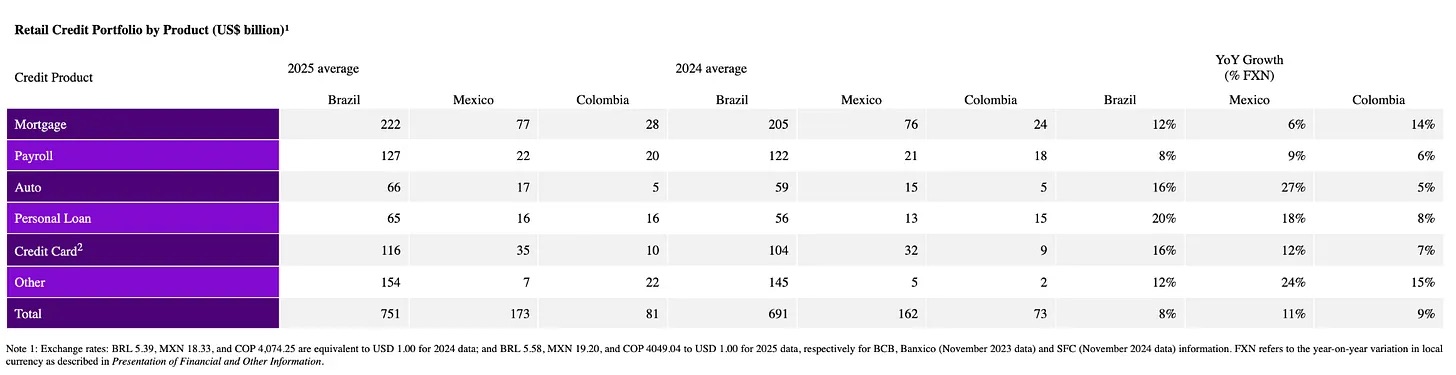
Source:@sec.gov
Revolut has taken another profitable path. In 2025, the company's net profit reached £1.3 billion, with revenue growing 46% year-on-year to £4.5 billion, achieving profitability for five consecutive years. Profits primarily come from foreign exchange fees, membership subscriptions, crypto assets, and its credit portfolio. Credit scale grew 120% year-on-year, reaching $2.9 billion. Early revenue from forex fees and subscriptions gave it ample time to steadily grow its lending business.
Chime took the longest to realize this truth. In its early years, it almost entirely survived on card swipe fees. Customer acquisition costs in the U.S. are extremely high, profit shares from card transactions are meager, and revenue is entirely dependent on users continuously spending. If users reduce their spending, revenue plummets directly.
In 2025, Chime's revenue surpassed $2 billion, but it still incurred a loss of one billion dollars, mainly from high stock-based compensation expenses related to its IPO. At its IPO, the company was valued at $11 billion, but its stock price fell sharply within months. It wasn't until Q1 2026 that it achieved its first-ever profit in 12 years since its founding, with a net profit of $53 million. The turning point was the explosion of its lending products: revenue from early wage access is expected to exceed $400 million, and instant small loan business volume surged.
In June 2026, a Nubank developer inadvertently triggered a push notification for a liquidation process during a routine system update. Numerous users received push notifications and emails stating that the central bank had liquidated the bank, instructing users on how to claim funds through the deposit insurance fund. Co-founder Cristina Junqueira had to publicly apologize on Instagram, calling it a bizarre operational error and assuring that the bank and user funds were safe. But within minutes, this erroneous notification led users to believe the platform was about to collapse.
To be fair, such technical glitches also frequently occur at large traditional banks, like transferring $1 billion by mistake due to a wrong digit. But venerable institutions like Citibank, founded in 1812, have solid foundations. Even when they malfunction, users see it as just a typical corporate error. However, if a startup digital bank spreads rumors of collapse, users immediately initiate a run. Old banks are just technologically backward, while new online platforms haven't yet learned how to operate as stably as real banks.
In April 2024, the middleware provider Synapse declared bankruptcy.
Neobanks are essentially software service providers. To offer checking accounts, they must connect an entire chain of partners behind the scenes. Synapse was the middleman, connecting hundreds of neobanks with traditional banks that actually hold the funds, responsible for account management, compliance checks, and asset ownership registration.
After Synapse's collapse, all business records were lost, freezing approximately $265 million in user funds. Partner banks couldn't distinguish which user each sum of money belonged to. Subsequent audits found $95 million missing, revealing a complete lack of accountability in the entire system. Users of popular digital bank apps like Yotta and Juno were unable to operate their accounts normally for months, with some even unable to pay their mortgages.
If a banking app's fund custody and middle-clearing processes all rely on third parties beyond its control, then this system is essentially a castle in the air, destined to collapse from the start.
Ultimately, the only safeguard against such systemic risks is a banking license. Yet, early on, all neobanks claimed they didn't need a license at all.
Last October, I wrote that digital banks in the crypto space had real development potential. At the time, regulatory frameworks were becoming clearer, many users held on-chain assets and hoped to use them directly for daily payments. That view still holds, but I severely underestimated one thing: the underlying infrastructure built on partner banks inherently carries all the potential risks of those partners.
The crypto industry's response is to stop pretending and face reality. From December 2025 to May 2026, the U.S. Office of the Comptroller of the Currency (OCC) conditionally approved about ten national trust charters for crypto and fintech firms, more than the total of the past decade combined. Paxos, BitGo, Fidelity Digital Assets, Ripple, Circle, Bridge (acquired by Stripe for $1.1 billion), and Crypto.com have all submitted applications for similar charters — precisely the qualifications that neobanks once scoffed at as unnecessary.
A national trust charter is the ultimate way out of the middleman trap. Holding a charter means obtaining direct federal backing. The company can custody user assets and handle payment clearing independently, operating across all fifty U.S. states under a unified set of regulations. There's no need to beg for survival from traditional partner banks anymore, nor will the entire company's lifeline be dependent on invisible middleware providers like Synapse.
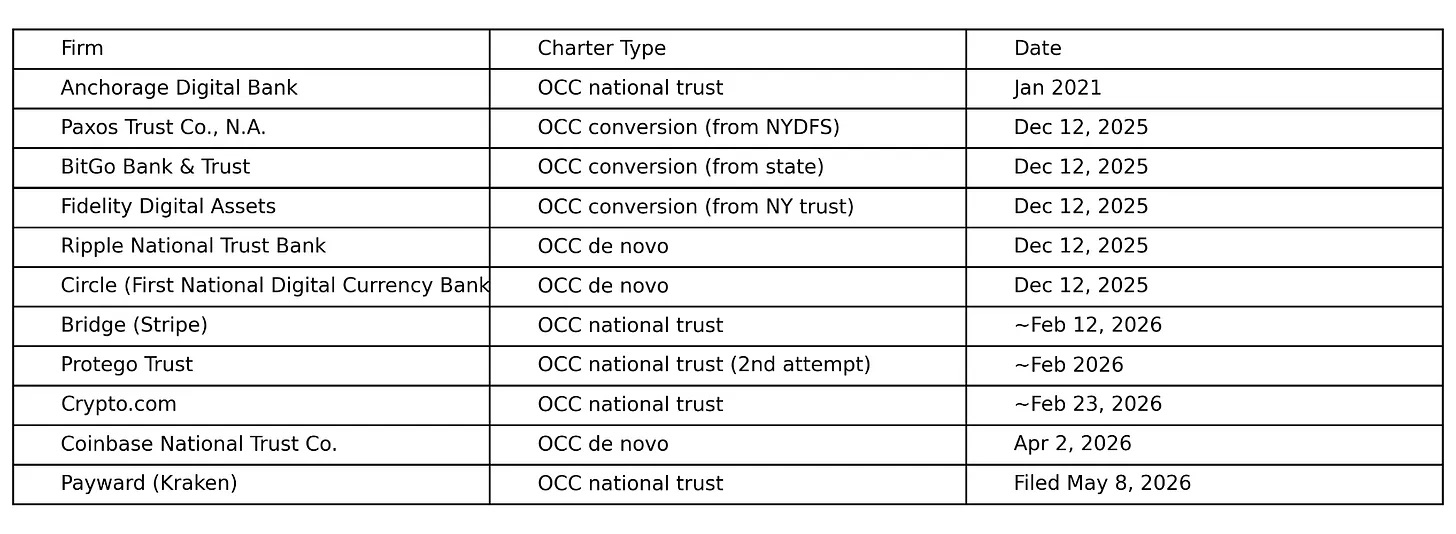
Crypto firms have finally understood: to move tens of billions in assets without being constrained at every turn by the legacy banking system's infrastructure, they must obtain formal entry credentials within the federal regulatory system.
Payward, Kraken's parent company, now holds three layers of regulatory credentials in the U.S.: a Wyoming financial license, a Federal Reserve master account approved in March 2026, and an OCC national trust charter application submitted in May 2026. SoFi acquired Golden Pacific Bancorp in 2022 to obtain an OCC charter. In December 2025, SoFi launched a USD-pegged stablecoin, the first issued by a U.S. national bank and built on a permissionless public blockchain. By May 2026, the platform's 14.7 million users could hold, spend, and exchange this stable币 within the app, with Mastercard as its clearing partner. Coinbase, leveraging the Base blockchain, conducts Bitcoin staking and lending business through the Morpho protocol. In early 2026, the amount of Bitcoin collateral exceeded $1.4 billion.
SoFi's development path is highly representative: student loan servicer → digital neobank → licensed formal bank → stablecoin issuer, having completed the entire evolutionary process of the industry.
Currently, the industry still has a major shortcoming: unsecured lending. The total scale of collateralized lending in CeFi and DeFi is $67.42 billion.
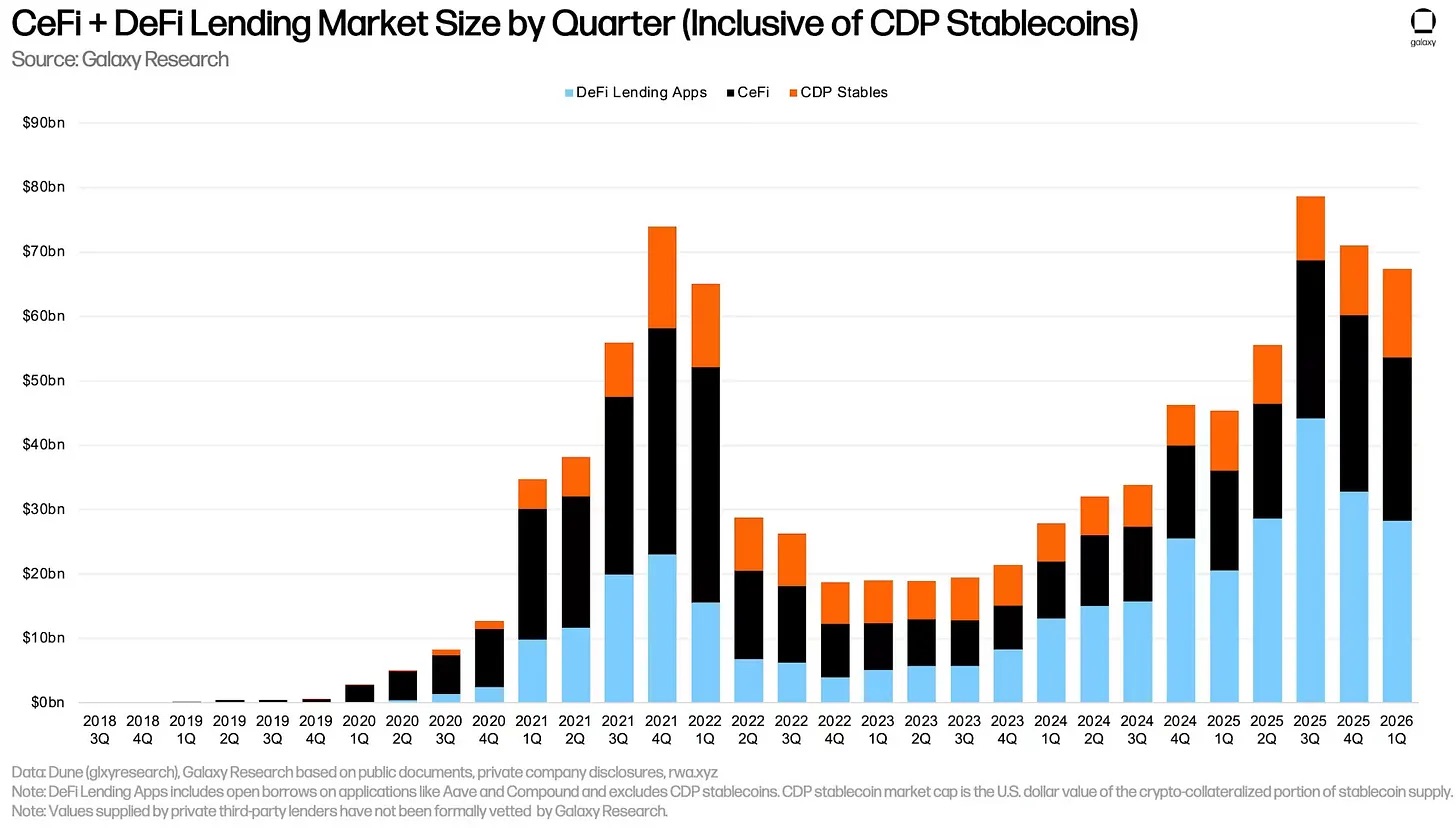
But the truly implemented scale of unsecured lending across the entire decentralized space is only $24 million. Protocols that once focused on unsecured lending (Goldfinch, early Maple, TrueFi) have either fully shifted to over-collateralized models or gradually shut down. Today, Maple, the largest DeFi lending protocol, has a collateralization rate as high as 160%.
Blockchain addresses have anonymity attributes, and unsecured lending lacks a viable mechanism for default recovery. In the real world, if a user defaults on a loan, banks can report to credit bureaus and file lawsuits. In the decentralized realm, there are no credit bureaus or asset collection channels. If a borrower runs away with unsecured assets, they just need to abandon the wallet address, and the funds become completely irrecoverable. Some DeFi protocols tried to rely on on-chain reputation data for risk control, but still experienced large-scale bad debts. Practitioners finally realized: without real-world legal constraints, anonymous users have almost no motivation to repay voluntarily.
Nubank issues loans to its 131 million users, many of whom have no traditional credit history. The platform uses users' transaction behavior for risk assessment and credit granting. This type of business has real commercial value, but operational costs are extremely high and implementation is difficult. If one wants to replicate similar credit products on a blockchain at scale, a company will almost certainly need to obtain a banking license. It is expected that more and more companies will submit charter applications to the OCC in the future.
Last October, I wrote that crypto digital banks are replaying the development patterns of the banking industry from a century ago. Technology keeps iterating, but the underlying logic of how humans use and manage money remains constant. When I wrote that line, I thought there was a certain beauty in its regularity. Looking back now, it presents another layer of reality.
The essence of banking has always been to profit from lending and collecting interest. The neobanks that survived initially promised to break this model, but the players that truly survived ultimately ended up walking the same path of lending — just with more user-friendly interest rates and smoother product interfaces, while the underlying business logic remained unchanged.
In the end, it boils down to one sentence: everything changes, yet the essence remains the same.