# Scalability İlgili Makaleler

HTX Haber Merkezi, kripto endüstrisindeki piyasa trendleri, proje güncellemeleri, teknoloji gelişmeleri ve düzenleyici politikaları kapsayan "Scalability" hakkında en son makaleleri ve derinlemesine analizleri sunmaktadır.

Ethereum Glamsterdam Upgrade: Largest-Scale Underlying Restructuring Yet, Mainnet Date Still Undecided

The upcoming Ethereum "Glamsterdam" upgrade is viewed by core developers as the most significant protocol-level refactoring since The Merge, fundamentally altering how the network processes transactions and manages its state to advance L1 scaling. Its core goals are: accelerating processing via parallelization, increasing capacity, and enhancing sustainability through adjusted fees that better reflect long-term data storage costs. The upgrade features two headline proposals. First, **ePBS (EIP-7732)** on the consensus layer aims to formalize proposer-builder separation directly within the protocol, eliminating reliance on off-chain relayers. This built-in mechanism is designed to provide a more secure and efficient block production pipeline, extending the critical validation window to allow the network to handle more data, particularly for Layer2s. Second, **BALs (EIP-7928)** on the execution layer introduces block-level access lists. These lists specify the data each transaction will access beforehand, allowing the network to identify and safely execute non-conflicting transactions in parallel, rather than strictly sequentially. This also speeds up new node synchronization. Glamsterdam also includes配套 proposals to reprice storage costs (aiming for a predictable ~120 GiB annual state growth) and the cost of data-reading operations to better align with modern hardware costs and prevent spam. Regarding the timeline, the initial schedule targeting a mainnet activation on September 16, 2026, has likely been delayed. Following the launch of a new dedicated testnet (Plataberget), the deployments on the Sepolia and Holesky testnets are now expected in September, with the mainnet launch potentially pushed to Q4 2026 or later, as developers prioritize correctness over a fixed date.

marsbitDün 08:11

Ethereum Glamsterdam Upgrade: Largest-Scale Underlying Restructuring Yet, Mainnet Date Still Undecided

marsbitDün 08:11

If Ethereum Had Never Switched from PoW to PoS: An Unrealized Game

"The Great Merge: What If Ethereum Had Stayed on PoW?" This article explores a counterfactual scenario: What if Ethereum had not transitioned from Proof-of-Work (PoW) to Proof-of-Stake (PoS) in 2022? It examines the potential trade-offs of this historical decision. The key argument for a continued PoW path is the missed opportunity in the AI era. Ethereum's GPU miners, unlike Bitcoin's specialized ASICs, could have formed a massive, globally distributed computing network. This infrastructure might have evolved into a decentralized AI cloud, giving Ethereum a strategic position in the AI compute market. Critics argue the switch to PoS prematurely ended this possibility. However, sticking with PoW would have carried significant costs. PoS drastically reduced ETH's daily issuance and miner sell pressure, aiding its "digital gold" narrative and attracting institutional capital. PoW's higher, continuous inflation could have hindered price stability. Furthermore, PoS provides greater design flexibility for scaling solutions (like Rollups and data blobs) and aligns better with environmental (ESG) and regulatory concerns for mainstream finance adoption. In conclusion, the shift from PoW to PoS represented a fundamental strategic choice between two distinct paths: one potentially leading to a smart-contract-enabled "digital commodity" network with vast compute resources, and the other aiming to become a global, efficient settlement layer for the digital economy. The rise of AI has only made the road not taken more intriguing to contemplate.

marsbit08/12 15:21

If Ethereum Had Never Switched from PoW to PoS: An Unrealized Game

marsbit08/12 15:21

Ethereum's 11th Year: Why Is This Year Particularly Crucial?

Ethereum's 11th year proved pivotal, marked by a dual evolution in its technical roadmap and organizational structure. The year saw the completion of the Fusaka upgrade, introducing PeerDAS to make data availability sampling more efficient and laying groundwork for future L2 scaling. This was followed by a significant reorganization of the Ethereum Foundation (EF). The EF downsized, redefining its core mandate around user sovereignty and CROPS principles, while spinning off key functions. Independent entities like Ethlabs (non-profit R&D), Ethereum Institutional (institutional onboarding), and EthSystems (institutional privacy solutions) now operate separately. Technologically, the community debated a bold, long-term vision outlined in Justin Drake's "Lean Ethereum" proposal and the collaborative "Strawmap." These point toward a "third major iteration" for Ethereum, targeting goals like faster finality (~1 second), gigagas-scale L1 throughput, teragas-scale L2 capacity, post-quantum cryptography, and protocol-level privacy. Data underscores Ethereum's dominant position: its L1 still holds roughly half of all stablecoin value, leads in tokenized Real-World Assets (RWA), and commands over 55% of total DeFi TVL. While L2s now handle over 10x more transactions than the mainnet, high-value assets remain concentrated on L1. The launch of Robinhood Chain, an EVM-compatible L2 for stock tokens, signals growing institutional adoption. The immediate roadmap includes the Glamsterdam upgrade (featuring ePBS for in-protocol proposer-builder separation and Block Access Lists for parallelism), potentially followed by Hegotá focusing on anti-censorship via FOCIL. In summary, Ethereum's 11th year was defined by setting ambitious technical foundations for its next decade and restructuring its core development ecosystem to be more modular and sustainable, all while maintaining its role as the leading settlement layer for decentralized finance and assets.

marsbit07/31 12:11

Ethereum's 11th Year: Why Is This Year Particularly Crucial?

marsbit07/31 12:11

Brale Claims New Protocol Can Eliminate a Major Obstacle to Scaling Custom Tokens

Stablecoin infrastructure firm Brale is launching a compatibility protocol, called ION, designed to solve a key bottleneck in the industry: moving the rapidly growing number of custom-branded stablecoins across different blockchains. The protocol allows participating stablecoins to move between blockchains by burning tokens on one network and minting an equivalent amount on another. Unlike most blockchain bridges, this model does not require pre-funded liquidity pools in each supported chain. While the $300 billion stablecoin market is dominated by Tether (USDT) and Circle’s USDC, a wave of new entrants—including banks, fintechs, crypto firms, and asset managers—are issuing their own tokens for payments, settlements, and tokenized assets. Over 350 such asset-pegged coins are already tracked, highlighting the need for infrastructure to connect this increasingly fragmented ecosystem. Brale, which supports over 100 stablecoin programs across more than 30 blockchains, argues that current interoperability models relying on liquidity pools or wrapped tokens are not scalable. These models require locking up capital in every supported network, creating an unsustainable capital requirement as the number of stablecoins and blockchains grows. Brale's founder and CEO, Ben Miln, stated that "liquidity between stablecoin programs is the No. 1 barrier to scaling individual stablecoins," noting there isn't enough capital in the world to solve the problem via liquidity pools. ION's burn-and-mint approach, similar to Circle's Cross-Chain Transfer Protocol (CCTP) but extended to any participating issuer, aims to provide a scalable alternative. The protocol will debut initially on testnet with partners including Monad, Rain, Coinflow, Turnkey, Etherfuse, Spark, and Canton.

cryptonews.ru07/30 11:16

Brale Claims New Protocol Can Eliminate a Major Obstacle to Scaling Custom Tokens

cryptonews.ru07/30 11:16

SharpLink's Helm: Buying Only, Never Selling, Making ETH Generate Profits Through the Cold Winter

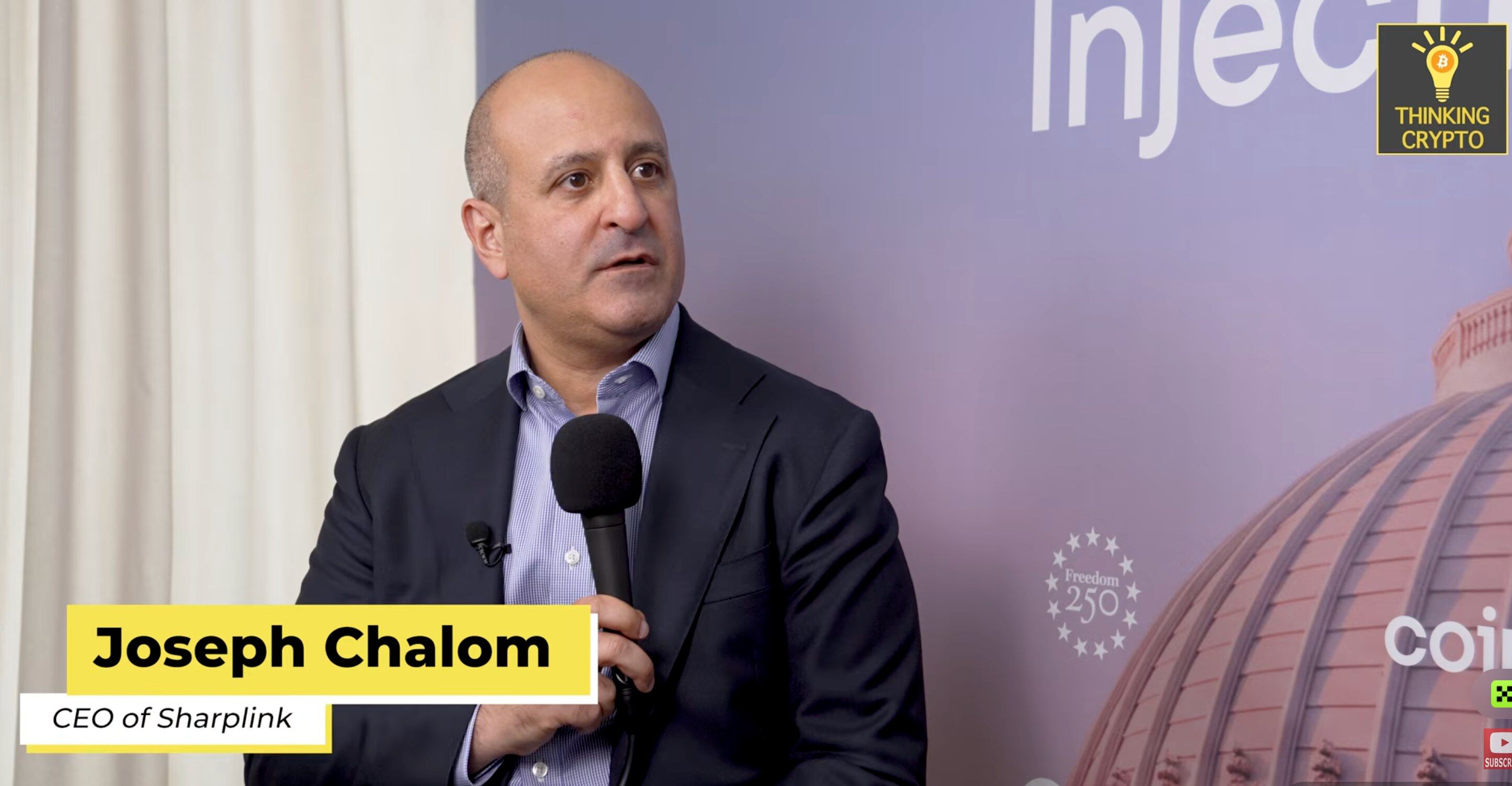
SharpLink co-CEO Joseph Chalom shares his bullish outlook on Ethereum during the recent "Injective Summit 2026." Despite prevailing negative market sentiment, Chalom argues that fundamentals and data tell a different story: Ethereum dominates with over 50% of stablecoin transaction volume, nearly 60% of tokenized real-world assets (RWA), and remains the uncontested leader in DeFi. He attributes the communication gap and lack of confidence partly to the Ethereum Foundation's restructuring. In response, SharpLink, alongside ConsenSys and Bitmain, is funding three key spin-off teams from the Foundation: ETH Labs (for institutional-scale scalability), Ethereum Institutional (for business development and marketing), and EthSystems (for next-gen privacy and compliance solutions). Chalom emphasizes these are critical for accelerating institutional adoption. Regarding SharpLink's strategy, Chalom details a conservative, yield-focused approach. The firm holds 886,725 ETH, acquired with zero leverage or debt. They generate revenue by staking ETH and strategically deploying capital into DeFi protocols via a dedicated fund, aiming for returns above the native staking yield. This contrasts with some Bitcoin-focused firms that have become net sellers. On the broader institutional adoption of tokenization, Chalom sees current progress as just the beginning. He breaks it down into layers: stablecoins as the currency/value layer, tokenized assets as the exposure layer, and DeFi as the execution layer. He predicts regulatory clarity, like the potential Clarity Act, will be a major catalyst. A key future inflection point will be when fiduciary managers prefer tokenized, 24/7 tradable digital assets over traditional "analog" versions due to their programmability and instant settlement. In conclusion, Chalom positions SharpLink not just as an ETH accumulator and yield generator, but as an active "ecosystem steward," funding essential development and marketing initiatives to support Ethereum's long-term growth, which he believes is directly aligned with shareholder interests.

Odaily星球日报07/29 07:46

SharpLink's Helm: Buying Only, Never Selling, Making ETH Generate Profits Through the Cold Winter

Odaily星球日报07/29 07:46

Ethereum's 2030 Blueprint: 200x Speed Increase, Quantum-Resistance, and Native Privacy

Ethereum's 2030 Roadmap: 200x Speed, Quantum-Resistant, Native Privacy Ethereum, now in its 11th year, is guided by the "Lean Ethereum" vision, a unified development blueprint aiming to streamline the network. This plan, outlined in the evolving "Strawmap" document, targets five core goals for 2030. **1. Fast L1:** Ethereum aims for near-instant finality and faster block times. By using Zero-Knowledge (ZK) proofs to aggregate validator votes, final confirmation could drop from ~15 minutes to seconds. Block times are slated to decrease from 12 seconds to 6 seconds (2027-28) and eventually 4 seconds (2029-30). The minimum staking requirement may also lower to 1 ETH, enhancing decentralization. **2. 1 Billion Gas L1:** To break the scalability-decentralization trade-off, L1 ZK-EVM will replace redundant transaction execution with ZK proofs. This allows nodes (even on phones) to verify blocks without re-running computations, paving the way to increase L1 throughput ~200x to 1 billion gas per second. **3. Trillion-Gas L2:** Ethereum will become a high-capacity settlement layer for Layer 2 networks (L2s). Planned upgrades, like PeerDAS and subsequent optimizations, target 1 GB per second of data bandwidth for L2s (Blobs), enabling a massive ecosystem of high-throughput rollups for specialized use cases. **4. Quantum-Resistant L1:** To counter future quantum computing threats, Ethereum plans to migrate its cryptographic signatures (ECDSA, BLS) to quantum-resistant, hash-based schemes. This multi-upgrade transition is targeted for completion by 2029, securing the network in the post-quantum era. **5. Privacy-Native L1:** For the first time, native transaction privacy is an official goal. Using ZK proofs, transactions could hide sender, receiver, and amount while proving compliance with rules. This infrastructure is tentatively planned, though details remain fluid and subject to regulatory landscapes. Driven by a broader ecosystem beyond the core Foundation, this ambitious roadmap seeks to make Ethereum faster, more scalable, quantum-secure, and private, while preserving its core tenets of neutrality and trustlessness. All plans remain subject to ongoing research, audits, and community consensus.

marsbit07/28 10:28
Ethereum's 2030 Blueprint: 200x Speed Increase, Quantum-Resistance, and Native Privacy

marsbit07/28 10:28

What Will Ethereum Look Like in 2030?

Ethereum, now in its 11th year, continues to evolve with a long-term vision centered around five "North Star" goals for 2030. First, a **Fast L1**: The consensus mechanism will be streamlined using zero-knowledge proofs to aggregate validator votes, aiming for single-slot finality. Block times are planned to decrease from 12 seconds to 4 seconds, making transactions irreversible within seconds. The staking minimum will also drop to 1 ETH, promoting greater decentralization. Second, a **1 Billion Gas L1**: Leveraging ZK proofs (L1 ZK-EVM), nodes will verify blocks without re-executing transactions, removing a key scalability bottleneck. This paves the way for the L1 to handle ~1 billion gas per second, a 200x increase, while allowing even light clients to fully verify the chain. Third, **Trillion-Gas L2s**: The roadmap focuses on massively scaling data capacity (blobs) for Layer 2 rollups, targeting 1 GB per second bandwidth. This creates a clear division: the L1 acts as a secure settlement layer, while high-throughput, application-specific L2s (like Robinhood Chain) handle execution. Fourth, a **Quantum-Resistant L1**: To counter future quantum computing threats, Ethereum plans to transition its signature schemes to hash-based cryptography, with the goal of a fully quantum-resistant L1 by 2029. Fifth, a **Privacy-Native L1**: Native privacy features, using ZK proofs to hide transaction details while proving validity, are officially on the roadmap, transforming Ethereum's transparent model. The development ecosystem is also shifting, with new organizations like Ethlabs emerging alongside a smaller Ethereum Foundation. While the "Strawmap" document outlining these goals remains a draft subject to change and delays, the core vision is clear: to make Ethereum faster, more scalable, quantum-safe, and privacy-enabled while preserving its foundational qualities of neutrality and trustlessness.

marsbit07/27 13:16

What Will Ethereum Look Like in 2030?

marsbit07/27 13:16

活动图片