SharpLink's Helm: Buying Only, Never Selling, Making ETH Generate Profits Through the Cold Winter

Odaily星球日报2026-07-29 tarihinde yayınlandı2026-07-29 tarihinde güncellendi

Özet

SharpLink co-CEO Joseph Chalom shares his bullish outlook on Ethereum during the recent "Injective Summit 2026." Despite prevailing negative market sentiment, Chalom argues that fundamentals and data tell a different story: Ethereum dominates with over 50% of stablecoin transaction volume, nearly 60% of tokenized real-world assets (RWA), and remains the uncontested leader in DeFi. He attributes the communication gap and lack of confidence partly to the Ethereum Foundation's restructuring. In response, SharpLink, alongside ConsenSys and Bitmain, is funding three key spin-off teams from the Foundation: ETH Labs (for institutional-scale scalability), Ethereum Institutional (for business development and marketing), and EthSystems (for next-gen privacy and compliance solutions). Chalom emphasizes these are critical for accelerating institutional adoption. Regarding SharpLink's strategy, Chalom details a conservative, yield-focused approach. The firm holds 886,725 ETH, acquired with zero leverage or debt. They generate revenue by staking ETH and strategically deploying capital into DeFi protocols via a dedicated fund, aiming for returns above the native staking yield. This contrasts with some Bitcoin-focused firms that have become net sellers. On the broader institutional adoption of tokenization, Chalom sees current progress as just the beginning. He breaks it down into layers: stablecoins as the currency/value layer, tokenized assets as the exposure layer, and DeFi as the exec...

Original article byTony Edward

Compiled by|Odaily Planet Daily Qin Xiaofeng(@QinXiaofeng 888 )
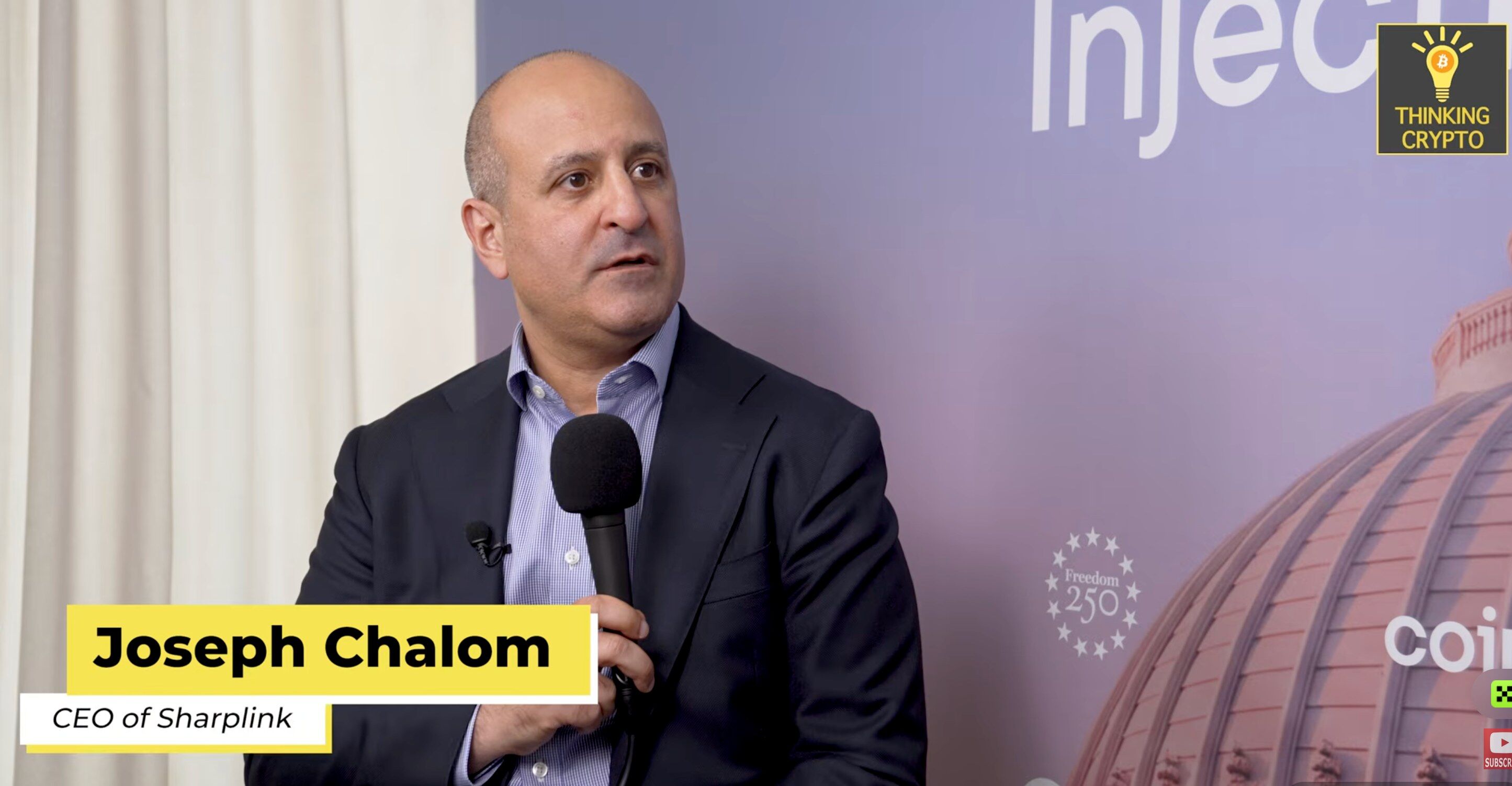
Editor's Note: At the recent "Injective Summit 2026" in Washington, D.C., SharpLink Co-CEO Joseph Chalom gave an exclusive interview.

He stated that while current market sentiment towards Ethereum is pessimistic, there is a divergence between reality and market sentiment. In reality, multiple data points from the Ethereum ecosystem indicate a bright future: stablecoin transaction volume accounts for over 50%, tokenized RWAs nearly 60%, and its DeFi dominance remains unchallenged. He said, "Ethereum is winning, but there's a communication problem." SharpLink has already joined forces with giants like ConsenSys, investing heavily to support three core teams spun off from the Ethereum Foundation, focusing on institutional-grade scaling, privacy/compliance, and market promotion. More crucially, they adopt zero leverage and no borrowing during the bear market, insisting on making ETH "productive" to generate revenue, and predict that tokenization and 24/7 trading will ignite the next wave of institutional adoption.

This week, ETH once surged close to $2000, and the ETH/BTC exchange rate also reached 0.03, hitting a nearly 3-month high, seemingly indicating that things are improving. Additionally, after roughly 8 months without large-scale new purchases, SharpLink bought another 10,000 ETH in June this year at an average cost of about $1611; after this purchase, their total ETH holdings reached 886,725 ETH.

The following is the original interview dialogue, Enjoy~

————————

Host (Tony Edward/Thinking Crypto): Everyone, we are recording at the Injective Policy Summit in Washington, D.C., and with me today is Joseph Chalom, CEO of SharpLink. Joseph, great to see you.

Joseph Chalom: Great to be back with you. First, a quick introduction: we are a digital asset capital management firm. We've raised billions of dollars to buy Ethereum (ETH) and make it highly efficient. The two most interesting things in the last month: first, we returned to the public markets for an equity raise and actually bought back ETH at a very good price and repurchased some stock. Second, together with Joe Lubin from ConsenSys and Tom Lee from Bitmine, we've started to support and invest in spin-out projects from the Ethereum ecosystem, which will be very positive for Ethereum's new narrative and new era.

Host: There's been a lot of negative sentiment around ETH lately, including some skepticism towards the Ethereum Foundation. Do you think this negativity is just a symptom of the bear market?

Joseph Chalom: Actually, I think for about the last year and a half, there's been a divergence between reality and market sentiment.

The reality is, let's start with the very positive side. The Ethereum ecosystem accounts for over 50% of all stablecoin transaction volume and nearly 60% of tokenized real-world assets, and the vast majority of DeFi is built on Ethereum. So if you look at the report card, they are winning. The sentiment is quite negative largely because of the industry malaise and because the Ethereum Foundation—though it has done a great job for the last decade or so—made the decision to streamline and have more ecosystem participants support the roadmap. And the way that communication happened led to a lack of clarity and confidence in the ecosystem, even though it is actually winning.

So some of us as ecosystem stewards and large holders of ETH have stood up, and we're putting our money where our mouth is, and I'm happy to share some of the things we are doing as an industry collective.

Host: Dive a little deeper into that. What are some specific actions?

Joseph Chalom: Start with the positive. Ethereum is the longest-running blockchain other than Bitcoin, never gone down, most secure, most trusted, most liquid. It also has a multi-year, very aggressive scaling roadmap.

Now, their ethos and approach now is to get back to its roots. The Ethereum Foundation will focus on privacy and censorship resistance and some core tenets to ensure Ethereum stays credibly neutral for decades to come. But what that means is that some of the most critical talent and functions inside the Foundation have been spun out. In the last three weeks or so, three teams have spun out of the Ethereum Foundation and have gotten the backing of Joe Lubin, myself, and Tom Lee from Bitmine. These are actually super critical for institutional adoption.

I'll tell you who they are. The first is ETH Labs, some of the most powerful developers in the Ethereum ecosystem, building the scaling capability that institutions need. The second is Ethereum Institutional, which is the go-to-market front-end, the business development activities, spun out of the Foundation with our support. And just earlier this week, the three of us also backed EthSystems, who are building next-gen privacy and compliance capabilities on Ethereum, an absolute necessity for the largest institutions to transact and ensure their data privacy. It might sound like three disparate nodes in the ecosystem, but these are the three most important things that will drive institutional adoption over the next year and beyond.

Host: That's interesting. I see a lot of institutions, when they're preparing to do tokenization and dive into DeFi and other areas, they start with Ethereum, and then they eventually expand to other chains.

Joseph Chalom: Exactly. As I said before, Ethereum has the characteristics that institutions need. I worked at BlackRock for 20 years, I know that before you want to move financial rails that have been around for 40, 50, 60 years, you want to move to a system that is trusted, never goes down, secure, and most liquid. Most importantly, people don't talk about decentralization enough.

Truly decentralized blockchain means that once you make a decision, the rules cannot be changed. So, having a fully distributed decentralized chain, not controlled by a single individual or a single treasury, is super important for institutions because they are doing a generational infrastructure migration.

Host: Absolutely agree. So during the bear market, how is SharpLink creating value for shareholders? Is it through staking, DeFi protocols to generate passive income?

Joseph Chalom: Of course. During the digital asset capital management craze last summer, about six or seven Ethereum digital asset capital management firms, and maybe five Solana capital management firms launched. Only a few of us were able to raise billions of dollars and achieve scale-out speed. You need scale when you compete in this industry.

What we do is, first, use all that capital to buy ETH, and then from day one make it productive, because ETH itself is a productive asset. You can stake it, get 2.5% to 3% yield. We've been doing that and making it more efficient than that benchmark. We also participate in DeFi. We announced a $125 million fund with another public company Galaxy, deploying our ETH into new protocols, helping them launch and get so-called TVL (Total Value Locked) or initial capital. So, we make ETH produce more than the native staking yield.

Finally, I'll say that when you start a business and 3 months later hit consolidation, winter, cycle, you really see who is running a public company in an institutional way. We didn't take on debt, didn't issue preferred stock, didn't borrow against our ETH. We decided to be conservative during the winter. A few of us survived, holding billions of dollars worth of ETH. That's how we protect our investors.

Honestly, going through winter is not fun, but treating investors with respect has always been what motivates us. You know, after winter comes spring and summer. When the market recovers, we are positioned very well. And we are starting to see the recovery in ETH. Just since these recent announcements, ETH is up about 20% from the lows. Short term is indeed challenging, but the long-term adoption story has never been more optimistic.

Host: That's really great to hear. I love that you didn't take on debt because I think that's risky and goes somewhat against the spirit of crypto.

Joseph Chalom: Yes. You know, I have respect for Michael Saylor; he basically invented a new asset exposure vehicle. You can own a public company and get exposure to Bitcoin.

The challenge in the Bitcoin space is that it's not inherently productive. The only way to have your Bitcoin compound and generate yield is to financialize your stock, issue convertible bonds, preferred stock. And then you might get into a pickle where you ultimately have to sell your reserve asset. That's been a challenge for the Bitcoin community because the digital asset capital management firms, including Michael Saylor's, have gone from being large net buyers of Bitcoin to now being sellers, which is very detrimental to short-term price action.

Host: Absolutely correct. Joseph, with your background at BlackRock and in TradFi, you have a wealth of experience. What's your outlook on institutional adoption of this technology? It seems everyone on Wall Street is looking into tokenization, getting involved with stablecoins, DeFi.

Joseph Chalom: Yes, I think the tokenization space, whether it's tokenizing the dollar into stablecoins or tokenizing treasuries or real-world assets, has been a phenomenon for about 8 or 9 years now.

Progress has actually been fairly slow so far, largely due to a lack of regulatory clarity. I want to describe to people in very simple terms how these things work together and how they layer on top of each other.

You can think of stablecoins as the dollar or value layer of future finance, you can think of tokenized assets as the asset exposure layer, and DeFi is the execution layer. If you have the money layer, exposure layer, and execution layer, you are off to the races. What you're starting to see is not just the tokenization of new funds but also the tokenization of existing multi-billion dollar funds and the tokenization of stocks. Getting one step more complicated, there's another layer, which is you have cash, assets, execution layer. Agentic will be the automation layer.

I think we are still in the bottom of the first inning. We are waiting for more regulatory clarity, but institutions have gone from a learning phase to an experimentation phase to now moving into production, and now it's a race not to be left behind.

Host: Do you feel that once something like the Clarity Act passes, it would serve as a catalyst or give confidence to institutions to innovate and invest more?

Joseph Chalom: 100%. I think the Clarity Act is super important in two ways. One, it clarifies that if you are a DeFi developer, you are a software provider, you are not responsible for the actions that happen on your software, but if you as a DeFi protocol hold client assets, then you are regulated and responsible for everything that happens. So the future of DeFi becomes brighter with the Clarity Act.

The second point, I think it also affects market sentiment and momentum. In crypto, even a little tailwind can lead to an outsized move.

The third point is, if you are at a large institution and your leadership is interested in digital assets, then with the "good housekeeping" seal of approval from the government, you have more room to do things faster that you might have done slowly. I think we'll see a lot of momentum this summer. And I think we'll get to a point where tokenization will be the norm, not the exception.

Host: Do you think there will be major challenges when some companies tokenize while traditional markets still exist? For example, you could have a tokenized version of Tesla stock, but there's still the traditional stock on the stock market. What differences or issues do you see arising?

Joseph Chalom: I think the biggest challenge is having disparate liquidity pools. For tokenization to succeed, we need to ensure the digital version of the stock or fund has similar trading volume and liquidity as the traditional version. But any time there is technological progress, there is analog and digital side-by-side. Like slow trains and fast trains running on parallel tracks, eventually they all become fast.

But I think the more important inflection point is this: Imagine a world where your government announces a war in the Middle East on a Friday night, and suppose you hold the analog version of a stock in your portfolio and you want to sell it. If you hold the digital version, you can trade 24/7 and express your view. You want to go long oil companies, you can. You want to sell consumer cyclical stocks, you can.

At some point, the fiduciaries deciding whether to buy the analog version or the digital on-chain version will almost certainly choose to buy and hold the on-chain version because it's 24/7 tradable, programmable, and instantly settles. So fiduciaries will get to a point and say to themselves: I can't hold the slow analog version because I can't express my view over the weekend. So at some point, there will be a tipping point, and I think that's still a few years away.

Host: That's a great point. As the market moves towards 24/7 trading, if you're still using the analog version, you're almost at a disadvantage. You have to move to the tokenized digital version.

Joseph Chalom: Yes. But you need the liquidity to tip in favor of the more liquid version because that's important too.

Host: I guess that's why stock exchanges, large institutions, banks are all moving towards 24/7 markets. That makes a lot of sense.

Joseph Chalom: Yes. Nasdaq, NYSE are transitioning to 23-hour-a-day, 7-day-a-week or 24/7 trading. Just this week, DTCC (Depository Trust & Clearing Corporation) – the clearing and settlement house that processes about 400 trillion transactions a year – just launched on-chain collateral tokenization. So, I find that super exciting. When you see announcements that have become so commonplace every day, whereas three or four years ago they would have rocked the market. That's when you know momentum is here.

Host: Exactly. It feels like the asset class is maturing. We are entering a new phase of adoption. It's pretty remarkable. Last item, could you share your roadmap?

Joseph Chalom: I think the most important thing SharpLink is doing right now, besides accumulating ETH and making it productive (we've consistently been the highest yield producer on our ETH among digital asset capital management firms), is stepping up to do something we never anticipated we'd need to do, which is become ecosystem stewards. Not just with words, but putting capital to work into new capabilities, into the spin-outs from the Ethereum Foundation, and basically helping Ethereum go to market.

I'm often asked: Whose interest does this serve? The answer is, it serves our shareholders' interest, it's completely aligned. So, helping Ethereum win, whether it's Layer 1 or Layer 2, and telling the story of why the ETH token will be the demanded settlement and trust commodity, actually serves our investors' interest. So, we're going to lean in with our ecosystem partners and try to be very good stewards. What we won't do is participate in core protocol, that's fully decentralized. We won't participate in Ethereum governance, but we will participate in funding talent and funding go-to-market capabilities, which serves the long-term interest of our investors.

(End)

Trend Kriptolar

İlgili Sorular

QAccording to Joseph Chalom, what is the main reason for the negative sentiment surrounding Ethereum despite its strong fundamentals?

AJoseph Chalom attributes the negative sentiment to a communication problem from the Ethereum Foundation, specifically its decision to downsize and let more ecosystem participants support the roadmap. This approach led to a lack of clarity and confidence in the ecosystem, even though Ethereum is performing well.

QWhat are the three key teams spun out from the Ethereum Foundation that SharpLink, ConsenSys, and Bitmine are supporting, and what do they focus on?

AThe three teams are: 1) ETH Labs, focusing on building scaling capabilities for institutions. 2) Ethereum Institutional, focusing on market-facing and business development activities. 3) EthSystems, focusing on building next-generation privacy and compliance capabilities on Ethereum.

QHow does SharpLink generate yield for its shareholders using its ETH holdings in a bear market?

ASharpLink generates yield by first staking its ETH to earn a base return of 2.5% to 3%. They further enhance this yield by deploying ETH into new DeFi protocols through partnerships, such as a $125 million fund with Galaxy, to help bootstrap these protocols and earn higher returns than native staking.

QWhat is the primary difference Joseph Chalom highlights between Bitcoin-focused asset management firms (like MicroStrategy) and his approach with ETH at SharpLink?

AThe key difference is that Bitcoin is not a productive asset, so firms focused on it often have to financialize their stock (issue debt, convertible notes) to generate yield or accumulate more, which can lead to them becoming net sellers of Bitcoin. In contrast, SharpLink treats ETH as a productive asset from day one, generates yield from it without leverage or debt, and therefore does not need to sell its core holdings.

QWhat future development does Joseph Chalom believe will be a major catalyst for the institutional adoption of tokenized assets?

AJoseph Chalom believes that the ability for 24/7 trading of tokenized digital versions of assets (like stocks or funds) will be a major catalyst. As traditional markets move towards 24/7 trading, fiduciaries will prefer the digital, on-chain versions because they allow for expressing investment views and trading at any time, unlike their slower 'analog' counterparts.

İlgili Okumalar

İşlemler

Spot

Popüler Makaleler

$S$ Nedir

SPERO'yu Anlamak: Kapsamlı Bir Genel Bakış SPERO'ya Giriş İnovasyonun manzarası gelişmeye devam ederken, web3 teknolojilerinin ve kripto para projelerinin ortaya çıkışı dijital geleceği şekillendirmede önemli bir rol oynamaktadır. Bu dinamik alanda dikkat çeken projelerden biri SPERO, $$s$$ olarak adlandırılmaktadır. Bu makale, SPERO hakkında ayrıntılı bilgi toplamak ve sunmak amacıyla, meraklılar ve yatırımcıların web3 ve kripto alanlarındaki temellerini, hedeflerini ve yeniliklerini anlamalarına yardımcı olmayı amaçlamaktadır. SPERO,$$s$$ Nedir? SPERO,$$s$$, kripto alanında merkeziyetsizlik ve blok zinciri teknolojisi ilkelerini kullanarak etkileşimi, faydayı ve finansal kapsayıcılığı teşvik eden bir ekosistem yaratmayı amaçlayan benzersiz bir projedir. Proje, kullanıcıların yenilikçi finansal çözümler ve hizmetler sunarak eşler arası etkileşimleri yeni yollarla kolaylaştırmayı hedeflemektedir. SPERO,$$s$$'nin temel amacı, bireyleri güçlendirmek ve kripto para alanındaki kullanıcı deneyimini artıran araçlar ve platformlar sağlamaktır. Bu, daha esnek işlem yöntemlerini mümkün kılmayı, topluluk odaklı girişimleri teşvik etmeyi ve merkeziyetsiz uygulamalar (dApp'ler) aracılığıyla finansal fırsatlar yaratmayı içermektedir. SPERO,$$s$$'nin temel vizyonu kapsayıcılık etrafında dönmekte olup, geleneksel finansal sistemlerdeki boşlukları kapatmayı ve blok zinciri teknolojisinin faydalarından yararlanmayı hedeflemektedir. SPERO,$$s$$'nin Yaratıcısı Kimdir? SPERO,$$s$$'nin yaratıcısının kimliği bir miktar belirsizdir, çünkü kurucusu(ları) hakkında ayrıntılı arka plan bilgisi sağlayan sınırlı kamuya açık kaynaklar bulunmaktadır. Bu şeffaflık eksikliği, projenin merkeziyetsizlik taahhüdünden kaynaklanabilir—birçok web3 projesinin paylaştığı bir etik anlayışı, bireysel tanınmanın yerine kolektif katkıları önceliklendirmektedir. Topluluk ve onun kolektif hedefleri etrafında tartışmaları merkezileştirerek, SPERO,$$s$$, belirli bireyleri öne çıkarmadan güçlendirme özünü taşımaktadır. Bu nedenle, SPERO'nun etik anlayışını ve misyonunu anlamak, tek bir yaratıcının kimliğini belirlemekten daha önemlidir. SPERO,$$s$$'nin Yatırımcıları Kimlerdir? SPERO,$$s$$, kripto sektöründe yeniliği teşvik etmeye adanmış girişim sermayedarlarından melek yatırımcılara kadar çeşitli yatırımcılar tarafından desteklenmektedir. Bu yatırımcıların odak noktası genellikle SPERO'nun misyonuyla uyumlu olup, toplumsal teknolojik ilerlemeyi, finansal kapsayıcılığı ve merkeziyetsiz yönetimi vaat eden projeleri önceliklendirmektedir. Bu yatırımcı temelleri, yalnızca yenilikçi ürünler sunan projelere değil, aynı zamanda blok zinciri topluluğuna ve ekosistemlerine olumlu katkılarda bulunan projelere de ilgi duymaktadır. Bu yatırımcıların desteği, SPERO,$$s$$'yi hızla gelişen kripto projeleri alanında dikkate değer bir rakip haline getirmektedir. SPERO,$$s$$ Nasıl Çalışır? SPERO,$$s$$, onu geleneksel kripto para projelerinden ayıran çok yönlü bir çerçeve kullanmaktadır. İşte benzersizliğini ve yeniliğini vurgulayan bazı temel özellikler: Merkeziyetsiz Yönetim: SPERO,$$s$$, kullanıcıların projenin geleceğiyle ilgili karar alma süreçlerine aktif olarak katılmalarını sağlayan merkeziyetsiz yönetim modellerini entegre etmektedir. Bu yaklaşım, topluluk üyeleri arasında sahiplik ve hesap verebilirlik duygusunu teşvik etmektedir. Token Kullanımı: SPERO,$$s$$, ekosistem içinde çeşitli işlevler sunmak üzere tasarlanmış kendi kripto para token'ını kullanmaktadır. Bu token'lar, işlemleri, ödülleri ve platformda sunulan hizmetlerin kolaylaştırılmasını sağlayarak genel etkileşimi ve faydayı artırmaktadır. Katmanlı Mimari: SPERO,$$s$$'nin teknik mimarisi, modülerlik ve ölçeklenebilirliği destekleyerek projenin evrimi sırasında ek özelliklerin ve uygulamaların sorunsuz bir şekilde entegrasyonuna olanak tanımaktadır. Bu uyum sağlama yeteneği, sürekli değişen kripto manzarasında geçerliliği sürdürmek için hayati öneme sahiptir. Topluluk Katılımı: Proje, işbirliği ve geri bildirim teşvik eden mekanizmalar kullanarak topluluk odaklı girişimlere vurgu yapmaktadır. Güçlü bir topluluk oluşturarak, SPERO,$$s$$, kullanıcı ihtiyaçlarını daha iyi karşılayabilir ve piyasa trendlerine uyum sağlayabilir. Kapsayıcılığa Odaklanma: Düşük işlem ücretleri ve kullanıcı dostu arayüzler sunarak, SPERO,$$s$$, daha önce kripto alanında yer almamış bireyler de dahil olmak üzere çeşitli bir kullanıcı tabanını çekmeyi hedeflemektedir. Bu kapsayıcılık taahhüdü, erişilebilirlik yoluyla güçlendirme misyonuyla uyumludur. SPERO,$$s$$ Zaman Çizelgesi Bir projenin tarihini anlamak, gelişim yolculuğu ve kilometre taşları hakkında kritik bilgiler sağlar. Aşağıda, SPERO,$$s$$'nin evriminde önemli olayları haritalayan önerilen bir zaman çizelgesi bulunmaktadır: Kavram Geliştirme ve Fikir Aşaması: SPERO,$$s$$'nin temelini oluşturan ilk fikirler, blok zinciri endüstrisindeki merkeziyetsizlik ve topluluk odaklılık ilkeleriyle yakından uyumlu olarak geliştirildi. Proje Beyaz Kağıdının Yayınlanması: Kavramsal aşamayı takiben, SPERO,$$s$$'nin vizyonunu, hedeflerini ve teknolojik altyapısını ayrıntılı bir şekilde açıklayan kapsamlı bir beyaz kağıt yayımlandı ve topluluk ilgisini ve geri bildirimini toplamak amacıyla sunuldu. Topluluk Oluşturma ve Erken Katılımlar: Projenin hedefleri etrafında tartışmalar yürüterek destek toplamak ve erken benimseyenler ile potansiyel yatırımcılar için bir topluluk oluşturmak amacıyla aktif iletişim çabaları gerçekleştirildi. Token Üretim Etkinliği: SPERO,$$s$$, yerel token'larını erken destekçilere dağıtmak ve ekosistem içinde başlangıç likiditesini sağlamak amacıyla bir token üretim etkinliği (TGE) gerçekleştirdi. İlk dApp'in Yayınlanması: SPERO,$$s$$ ile ilişkili ilk merkeziyetsiz uygulama (dApp) faaliyete geçti ve kullanıcıların platformun temel işlevleriyle etkileşimde bulunmalarını sağladı. Sürekli Gelişim ve Ortaklıklar: Projenin tekliflerine sürekli güncellemeler ve iyileştirmeler yapılmakta olup, blok zinciri alanındaki diğer oyuncularla stratejik ortaklıklar, SPERO,$$s$$'yi rekabetçi ve gelişen bir oyuncu haline getirmiştir. Sonuç SPERO,$$s$$, web3 ve kripto paranın finansal sistemleri devrim niteliğinde dönüştürme ve bireyleri güçlendirme potansiyelinin bir kanıtıdır. Merkeziyetsiz yönetime, topluluk katılımına ve yenilikçi tasarlanmış işlevselliğe olan bağlılığıyla, daha kapsayıcı bir finansal manzaraya doğru bir yol açmaktadır. Hızla gelişen kripto alanındaki herhangi bir yatırımda olduğu gibi, potansiyel yatırımcılar ve kullanıcılar, SPERO,$$s$$ içindeki devam eden gelişmelerle ilgili olarak kapsamlı bir araştırma yapmaları ve düşünceli bir şekilde katılmaları teşvik edilmektedir. Proje, kripto endüstrisinin yenilikçi ruhunu sergileyerek, sayısız olasılığını keşfetmeye davet etmektedir. SPERO,$$s$$'nin yolculuğu hala devam ederken, temel ilkeleri, teknoloji, finans ve birbirimizle etkileşim biçimimizi etkileyebilir.

228 Toplam GörüntülenmeYayınlanma 2024.12.17Güncellenme 2024.12.17

$S$ Nedir

AGENT S Nedir

Agent S: Web3'te Otonom Etkileşimin Geleceği Giriş Web3 ve kripto para dünyasında sürekli gelişen manzarada, yenilikler bireylerin dijital platformlarla etkileşim biçimlerini sürekli olarak yeniden tanımlıyor. Bu tür öncü projelerden biri olan Agent S, açık ajans çerçevesi aracılığıyla insan-bilgisayar etkileşimini devrim niteliğinde değiştirmeyi vaat ediyor. Otonom etkileşimlerin yolunu açarak, Agent S karmaşık görevleri basitleştirmeyi ve yapay zeka (AI) alanında dönüştürücü uygulamalar sunmayı hedefliyor. Bu detaylı inceleme, projenin karmaşıklıklarına, benzersiz özelliklerine ve kripto para alanındaki etkilerine dalacaktır. Agent S Nedir? Agent S, bilgisayar görevlerinin otomasyonunda üç temel zorluğu ele almak üzere özel olarak tasarlanmış çığır açıcı bir açık ajans çerçevesidir: Alan Spesifik Bilgi Edinimi: Çerçeve, çeşitli dış bilgi kaynaklarından ve iç deneyimlerden akıllıca öğrenir. Bu çift yönlü yaklaşım, alan spesifik bilgi açısından zengin bir veri havuzu oluşturmasını sağlar ve görev yürütmedeki performansını artırır. Uzun Görev Ufukları Üzerinde Planlama: Agent S, karmaşık görevlerin verimli bir şekilde parçalanmasını ve yürütülmesini kolaylaştıran deneyim artırımlı hiyerarşik planlama kullanır. Bu özellik, çoklu alt görevleri etkili ve verimli bir şekilde yönetme yeteneğini önemli ölçüde artırır. Dinamik, Homojen Olmayan Arayüzlerle Başlama: Proje, ajanlar ve kullanıcılar arasındaki etkileşimi geliştiren yenilikçi bir çözüm olan Ajan-Bilgisayar Arayüzü'ni (ACI) tanıtmaktadır. Çok Modlu Büyük Dil Modellerini (MLLM'ler) kullanarak, Agent S çeşitli grafik kullanıcı arayüzlerini sorunsuz bir şekilde gezinebilir ve manipüle edebilir. Bu öncü özellikler aracılığıyla, Agent S, makinelerle insan etkileşimini otomatikleştirmede karşılaşılan karmaşıklıkları ele alan sağlam bir çerçeve sunarak, AI ve ötesinde birçok uygulama için zemin hazırlıyor. Agent S'nin Yaratıcısı Kimdir? Agent S'nin kavramı temelde yenilikçi olsa da, yaratıcısı hakkında spesifik bilgiler belirsizliğini koruyor. Yaratıcı şu anda bilinmiyor, bu da projenin yeni aşamasını veya kurucu üyeleri gizli tutma stratejik tercihini vurguluyor. Anonimlikten bağımsız olarak, odak çerçevenin yetenekleri ve potansiyeli üzerinde kalıyor. Agent S'nin Yatırımcıları Kimlerdir? Agent S, kriptografik ekosistemde oldukça yeni olduğundan, yatırımcıları ve finansal destekçileri hakkında ayrıntılı bilgiler açıkça belgelenmemiştir. Projeyi destekleyen yatırım temelleri veya organizasyonları hakkında kamuya açık bilgilerdeki eksiklik, finansman yapısı ve gelişim yol haritası hakkında sorular doğuruyor. Destekleyicilerin anlaşılması, projenin sürdürülebilirliğini ve potansiyel pazar etkisini değerlendirmek için kritik öneme sahiptir. Agent S Nasıl Çalışır? Agent S'nin temelinde, çeşitli ortamlarda etkili bir şekilde çalışmasını sağlayan son teknoloji bir sistem yatmaktadır. İşleyiş modeli birkaç ana özellik etrafında inşa edilmiştir: İnsan Benzeri Bilgisayar Etkileşimi: Çerçeve, bilgisayarlarla etkileşimleri daha sezgisel hale getirmeyi amaçlayan gelişmiş AI planlaması sunar. Görev yürütmedeki insan davranışını taklit ederek, kullanıcı deneyimlerini yükseltmeyi vaat eder. Anlatı Belleği: Yüksek düzeyde deneyimlerden yararlanmak için kullanılan Agent S, görev geçmişlerini takip etmek amacıyla anlatı belleğini kullanarak karar verme süreçlerini geliştirir. Episodik Bellek: Bu özellik, kullanıcılara adım adım rehberlik sağlayarak, çerçevenin görevler gelişirken bağlamsal destek sunmasına olanak tanır. OpenACI Desteği: Yerel olarak çalışabilme yeteneği ile Agent S, kullanıcıların etkileşimleri ve iş akışları üzerinde kontrol sağlamasına olanak tanır ve Web3'ün merkeziyetsiz felsefesiyle uyumlu hale gelir. Dış API'lerle Kolay Entegrasyon: Çeşitli AI platformlarıyla uyumluluğu ve çok yönlülüğü, Agent S'nin mevcut teknolojik ekosistemlere sorunsuz bir şekilde entegre olmasını sağlar ve geliştiriciler ile organizasyonlar için cazip bir seçenek haline getirir. Bu işlevsellikler, Agent S'nin kripto alanındaki benzersiz konumuna katkıda bulunarak, karmaşık, çok aşamalı görevleri minimum insan müdahalesi ile otomatikleştirir. Proje geliştikçe, Web3'teki potansiyel uygulamaları dijital etkileşimlerin nasıl gelişeceğini yeniden tanımlayabilir. Agent S'nin Zaman Çizelgesi Agent S'nin gelişimi ve kilometre taşları, önemli olaylarını vurgulayan bir zaman çizelgesinde özetlenebilir: 27 Eylül 2024: Agent S'nin kavramı, “Bilgisayarları İnsan Gibi Kullanan Açık Bir Ajans Çerçevesi” başlıklı kapsamlı bir araştırma makalesi ile tanıtıldı ve projenin temelini sergiledi. 10 Ekim 2024: Araştırma makalesi arXiv'de kamuya açık olarak yayınlandı ve çerçevenin derinlemesine bir incelemesini ve OSWorld benchmark'ına dayalı performans değerlendirmesini sundu. 12 Ekim 2024: Agent S'nin yetenekleri ve özellikleri hakkında görsel bir içgörü sağlayan bir video sunumu yayımlandı ve potansiyel kullanıcılar ve yatırımcılarla daha fazla etkileşim sağlandı. Bu zaman çizelgesindeki işaretler, sadece Agent S'nin ilerlemesini değil, aynı zamanda şeffaflık ve topluluk katılımına olan bağlılığını da göstermektedir. Agent S Hakkında Ana Noktalar Agent S çerçevesi gelişmeye devam ederken, birkaç ana özellik öne çıkmakta ve yenilikçi doğasını ve potansiyelini vurgulamaktadır: Yenilikçi Çerçeve: İnsan etkileşimine benzer bir bilgisayar kullanımı sağlamak üzere tasarlanan Agent S, görev otomasyonuna yeni bir yaklaşım getiriyor. Otonom Etkileşim: GUI aracılığıyla bilgisayarlarla otonom olarak etkileşim kurabilme yeteneği, daha akıllı ve verimli hesaplama çözümlerine doğru bir sıçrama anlamına geliyor. Karmaşık Görev Otomasyonu: Sağlam metodolojisi ile karmaşık, çok aşamalı görevleri otomatikleştirerek süreçleri daha hızlı ve daha az hata payı ile gerçekleştirebilir. Sürekli İyileştirme: Öğrenme mekanizmaları, Agent S'nin geçmiş deneyimlerden öğrenmesini sağlar ve sürekli olarak performansını ve etkinliğini artırır. Çok Yönlülük: OSWorld ve WindowsAgentArena gibi farklı işletim ortamlarında uyumlu olması, geniş bir uygulama yelpazesine hizmet edebilmesini sağlar. Agent S, Web3 ve kripto alanında kendini konumlandırırken, etkileşim yeteneklerini artırma ve süreçleri otomatikleştirme potansiyeli, AI teknolojilerinde önemli bir ilerlemeyi temsil etmektedir. Yenilikçi çerçevesi aracılığıyla, Agent S dijital etkileşimlerin geleceğini örneklemekte ve çeşitli sektörlerde kullanıcılar için daha sorunsuz ve verimli bir deneyim vaat etmektedir. Sonuç Agent S, AI ve Web3'ün birleşiminde cesur bir sıçramayı temsil ediyor ve teknoloji ile etkileşim biçimimizi yeniden tanımlama kapasitesine sahip. Henüz erken aşamalarında olmasına rağmen, uygulama olanakları geniş ve çekici. Kritik zorlukları ele alan kapsamlı çerçevesi ile Agent S, otonom etkileşimleri dijital deneyimin ön plana çıkmasına taşımayı hedefliyor. Kripto para ve merkeziyetsizlik alanlarına daha derinlemesine girdikçe, Agent S gibi projelerin teknoloji ve insan-bilgisayar işbirliğinin geleceğini şekillendirmede önemli bir rol oynayacağı kesin.

700 Toplam GörüntülenmeYayınlanma 2025.01.14Güncellenme 2025.01.14

AGENT S Nedir

S Nasıl Satın Alınır

HTX.com’a hoş geldiniz! Sonic (S) satın alma işlemlerini basit ve kullanışlı bir hâle getirdik. Adım adım açıkladığımız rehberimizi takip ederek kripto yolculuğunuza başlayın. 1. Adım: HTX Hesabınızı OluşturunHTX'te ücretsiz bir hesap açmak için e-posta adresinizi veya telefon numaranızı kullanın. Sorunsuzca kaydolun ve tüm özelliklerin kilidini açın. Hesabımı Aç2. Adım: Kripto Satın Al Bölümüne Gidin ve Ödeme Yönteminizi SeçinKredi/Banka Kartı: Visa veya Mastercard'ınızı kullanarak anında Sonic (S) satın alın.Bakiye: Sorunsuz bir şekilde işlem yapmak için HTX hesap bakiyenizdeki fonları kullanın.Üçüncü Taraflar: Kullanımı kolaylaştırmak için Google Pay ve Apple Pay gibi popüler ödeme yöntemlerini ekledik.P2P: HTX'teki diğer kullanıcılarla doğrudan işlem yapın.Borsa Dışı (OTC): Yatırımcılar için kişiye özel hizmetler ve rekabetçi döviz kurları sunuyoruz.3. Adım: Sonic (S) Varlıklarınızı SaklayınSonic (S) satın aldıktan sonra HTX hesabınızda saklayın. Alternatif olarak, blok zinciri transferi yoluyla başka bir yere gönderebilir veya diğer kripto para birimlerini takas etmek için kullanabilirsiniz.4. Adım: Sonic (S) Varlıklarınızla İşlem YapınHTX'in spot piyasasında Sonic (S) ile kolayca işlemler yapın.Hesabınıza erişin, işlem çiftinizi seçin, işlemlerinizi gerçekleştirin ve gerçek zamanlı olarak izleyin. Hem yeni başlayanlar hem de deneyimli yatırımcılar için kullanıcı dostu bir deneyim sunuyoruz.

1.9k Toplam GörüntülenmeYayınlanma 2025.01.15Güncellenme 2026.06.02

S Nasıl Satın Alınır

Tartışmalar

HTX Topluluğuna hoş geldiniz. Burada, en son platform gelişmeleri hakkında bilgi sahibi olabilir ve profesyonel piyasa görüşlerine erişebilirsiniz. Kullanıcıların S (S) fiyatı hakkındaki görüşleri aşağıda sunulmaktadır.

活动图片