# PayPal İlgili Makaleler

HTX Haber Merkezi, kripto endüstrisindeki piyasa trendleri, proje güncellemeleri, teknoloji gelişmeleri ve düzenleyici politikaları kapsayan "PayPal" hakkında en son makaleleri ve derinlemesine analizleri sunmaktadır.
Stripe Rises, PayPal Falls: The New King of Payments Ascends the Throne

Stripe, the global payments infrastructure giant, surged to a $159 billion valuation in February 2026, marking a 74% increase from the previous year. It processed $1.9 trillion in annual transaction volume, accounting for 1.6% of global GDP. In contrast, PayPal, the legacy payments leader, faced stagnation with just 4.3% revenue growth in 2025, a sharp decline in core checkout growth, and flat active user numbers. Reports emerged that Stripe is considering acquiring PayPal. Stripe’s success is driven by strategic bets on next-generation technologies: it acquired stablecoin infrastructure firm Bridge and crypto wallet provider Privy, and co-developed the Tempo blockchain, capable of over 100,000 TPS. It also partnered with OpenAI to create the Agent Commerce Protocol, enabling AI agents to conduct micro-payments via stablecoins. These moves position Stripe at the center of AI and crypto-powered transaction growth. Meanwhile, PayPal struggled with innovation. Its stablecoin PYUSD held less than 0.5% market share, and its management acknowledged execution failures. While PayPal remains a cash-generating business with 439 million active accounts, it has been slow to adapt to shifting industry paradigms. The divergence highlights a fundamental strategic difference: Stripe is building the infrastructure for the future of payments—on-chain settlement, AI economies, and programmable money—while PayPal has been optimizing within an outdated framework. The industry is now racing toward stablecoin and blockchain-based payments, a transition Stripe began leading nearly two years ahead of competitors like Visa and Mastercard.

marsbit04/01 06:39

Stripe Rises, PayPal Falls: The New King of Payments Ascends the Throne

marsbit04/01 06:39

The Person Who 'Killed' PayPal Wants to Buy It

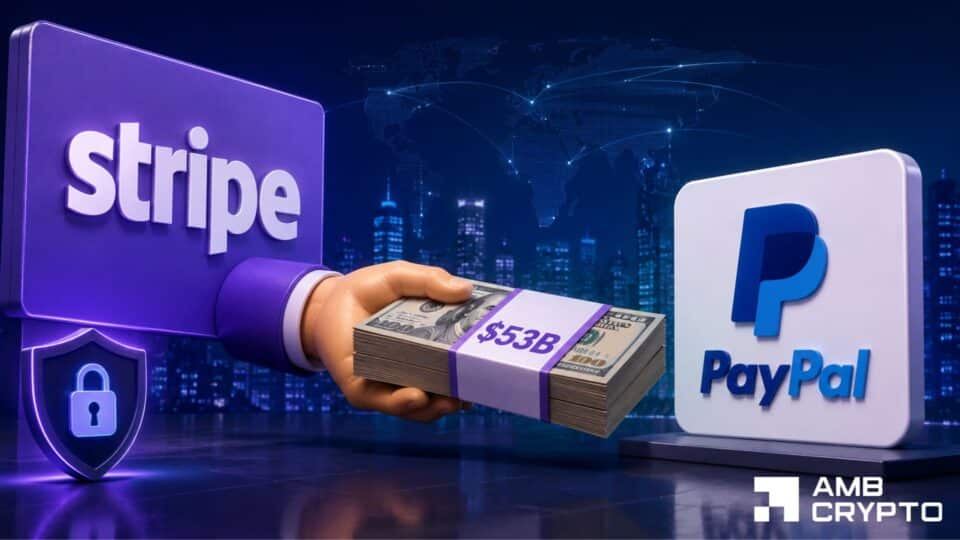
A potential acquisition that could reshape the global payments landscape is under discussion, as Stripe—valued at $159 billion—is reportedly considering acquiring all or parts of PayPal, which has a market cap of just $43 billion. The news drove PayPal’s stock up nearly 7%. PayPal has faced significant challenges: its stock fell 46% over the past year amid rising competition from Apple Pay, Google Pay, and agile rivals like Adyen and Stripe. Despite its vast user network of 438 million active accounts and strong presence in cross-border transactions, PayPal has struggled to keep pace with shifting user behaviors and the rise of embedded and social payments. However, PayPal retains valuable assets, including Braintree (processing around $700 billion annually), Venmo (with 100 million monthly active users), and a deeply entrenched global payments infrastructure. A key underlying motive for the deal is stablecoins. PayPal launched its own stablecoin, PYUSD, adopting a centralized approach to digital currency. In contrast, Stripe has pursued an infrastructure-focused strategy, acquiring stablecoin infrastructure firm Bridge and launching “Open Issuance”—a platform that enables businesses to issue their own stablecoins. Stripe is also developing Tempo, a Layer-1 blockchain aimed at challenging traditional settlement networks like SWIFT. A combined Stripe-PayPal entity could create a powerful Web3 payment ecosystem, integrating PYUSD with Tempo’s fast, low-cost transactions and leveraging Venmo’s user base. This could also support emerging use cases like AI Agent payments, where machines transact autonomously using crypto wallets. Regulatory and cultural hurdles remain significant, and the deal is still in early stages. But the talks signal a broader industry shift: future dominance in payments may belong to those who control next-generation infrastructure, not just scale.

比推02/24 23:42

The Person Who 'Killed' PayPal Wants to Buy It

比推02/24 23:42

The Payment Empire PayPal Might Be Bought Out

The once-dominant global payment giant PayPal is reportedly facing a potential acquisition, as its market value plummeted from a pandemic peak of $363 billion to a recent low of $38 billion—a nearly 90% drop over five years. Despite its pioneering role in enabling cross-border e-commerce, particularly for Chinese exporters in the mid-2000s, PayPal has struggled to keep pace with newer, more agile competitors like Stripe, Apple Pay, and various neobanks. Recent financial performance has been weak, with active user growth slowing to just 1% and transaction volume declining. The abrupt departure of its CEO and appointment of a new leader from HP—known for cost-cutting rather than product innovation—has fueled market skepticism. Critics, including former executive David Marcus, argue that PayPal lost its "mojo" by shifting from a product-driven to a finance-oriented culture, sacrificing long-term vision for short-term financial optimization. While subsidiary Venmo shows strong revenue growth and has become a verb among U.S. millennials, it faces challenges: user growth is stagnant, it remains confined to the U.S., and it lacks deeper integration like Stripe or the hardware-level ease of Apple Pay. PayPal’s bets on stablecoins (PYUSD) and AI-driven agentic payments are still unproven in highly competitive fields. Despite valuable assets—including Braintree’s infrastructure, a leading BNPL service, and 400 million active accounts—PayPal’s future as an independent company is uncertain. Market confidence now seems higher in a potential acquisition than in its standalone prospects, marking a dramatic fall for a former fintech disruptor.

marsbit02/24 11:44

The Payment Empire PayPal Might Be Bought Out

marsbit02/24 11:44

When AI Reshapes the Shopping Journey, How Much Time Does PayPal Have Left?

PayPal's recent $200 million acquisition of Cymbio signals a strategic pivot to remain relevant in the emerging era of "Agentic Commerce," where AI agents increasingly handle product discovery, decision-making, and purchasing on behalf of users. This move aims to transform PayPal from a Web2 payment button into an embedded infrastructure layer within AI-driven commercial workflows, covering discovery, checkout, and fulfillment. The competitive landscape is rapidly evolving: Google and Shopify are developing the Universal Commerce Protocol (UCP) to control the routing layer, while OpenAI and Stripe are advancing the Agentic Commerce Protocol (ACP) to enable AI agents to execute transactions. Stripe, in particular, is positioning itself as the default "action layer" for AI commerce, mirroring its success as the internet’s payment API. Major forecasts suggest Agentic Commerce could capture $1 trillion in U.S. retail sales by 2030, representing up to one-third of online retail. For PayPal, Stripe, and other fintech players, the challenge is to embed themselves into these new protocol-based ecosystems—or risk being sidelined. Banks retain advantages in clearing and compliance but must adapt quickly, while crypto remains largely absent from current frameworks, presenting both a risk and potential opportunity. PayPal’s acquisition is less an offensive move than a necessary bid to maintain its seat at the table.

marsbit02/18 12:38

When AI Reshapes the Shopping Journey, How Much Time Does PayPal Have Left?

marsbit02/18 12:38

活动图片