# Multi-Agent İlgili Makaleler

HTX Haber Merkezi, kripto endüstrisindeki piyasa trendleri, proje güncellemeleri, teknoloji gelişmeleri ve düzenleyici politikaları kapsayan "Multi-Agent" hakkında en son makaleleri ve derinlemesine analizleri sunmaktadır.

Japan's AI Dark Horse Emerges: How a 7B Small Model Challenges Fable and Mythos?

In June 2026, Sakana AI's new model Fugu caused a stir in the AI community. Its Fugu Ultra variant achieved scores of 73.7 on SWE-Bench Pro and 82.1 on TerminalBench 2.1, surpassing GPT-5.5 and Claude Opus 4.8, and was claimed to be comparable to export-restricted models like Fable 5 and Mythos Preview. Remarkably, the core of this high-performance system is not a massive model, but a small 7B-parameter RL Conductor model. Fugu operates as a multi-agent orchestrator: the 7B model acts as a "foreman," dynamically analyzing user tasks and delegating subtasks to a pool of top-tier global models (e.g., GPT-5, Gemini 3.1 Pro). It then synthesizes and verifies their outputs. This architecture represents a paradigm shift from monolithic models to an expert-team approach. It enhances performance in complex, multi-step engineering tasks like code review and security testing by enabling cross-validation from specialized models, improving long-session stability and token efficiency. However, Fugu's strengths come with trade-offs: it faces inherent latency due to multiple API calls, relies heavily on underlying US model APIs (creating dependency risks), and its benchmark comparisons with Fable/Mythos are based on reported scores, not head-to-head testing. For Japan's AI ecosystem, which lacks the massive compute and data resources of the US or China, Fugu exemplifies an "asymmetric breakthrough" strategy. Instead of competing directly in parameter scale, it focuses on intelligent orchestration of existing global models, offering a degree of AI sovereignty and resilience. While a significant system-level innovation, its ultimate capability is still bounded by the underlying models it coordinates.

marsbit06/22 11:17

Japan's AI Dark Horse Emerges: How a 7B Small Model Challenges Fable and Mythos?

marsbit06/22 11:17

Apple's Desired On-Device AI Sees a Dark Horse Emerge: The First Cognitive Model is Born, 4B Matches GPT-5.4

A Chinese company, Tomorrow's Journey (Nextie), has introduced what it is calling the industry's first "cognitive model" for edge devices. Named New Journey Alpha, this 4-billion-parameter model reportedly matches the performance of trillion-parameter giants like GPT-5.4 in group intelligence tasks such as debate and collective decision-making. The development follows Andrej Karpathy's vision of stripping vast factual knowledge from large language models to retain only a smaller "cognitive core" capable of reasoning, planning, and knowing its own limits. This approach directly addresses the soaring computational costs and token expenses hindering AI's widespread deployment, as highlighted by incidents like Amazon shutting down an internal AI tool due to prohibitive costs. Trained via reinforcement learning on a corpus of academic papers from 1800-2020 to enhance generalization, the model enables three key advancements: 1) Improved decision quality in multi-agent systems, 2) Drastically reduced compute costs, allowing for cost-effective cloud or on-device (e.g., MacBook) deployment, and 3) The feasibility of "proactive" AI agents that act autonomously without user prompts, unlocking new commercial possibilities beyond today's reactive models. Built by the former Microsoft Xiaoice team—known for creating a 3.6B model that outperformed a 65B Llama model—the company is now focusing on the multi-agent systems sector, a field gaining significant investor interest. The model's economic impact is profound; by achieving high-level performance with minimal parameters, it fundamentally alters the cost structure of AI services, challenging the prevailing model of ever-larger parameter counts.

marsbit06/09 12:04

Apple's Desired On-Device AI Sees a Dark Horse Emerge: The First Cognitive Model is Born, 4B Matches GPT-5.4

marsbit06/09 12:04

TaiJi Completes $3.5 Million Strategic Financing with Participation from Castrum Capital, Becker Ventures, and Coinvestor Ventures

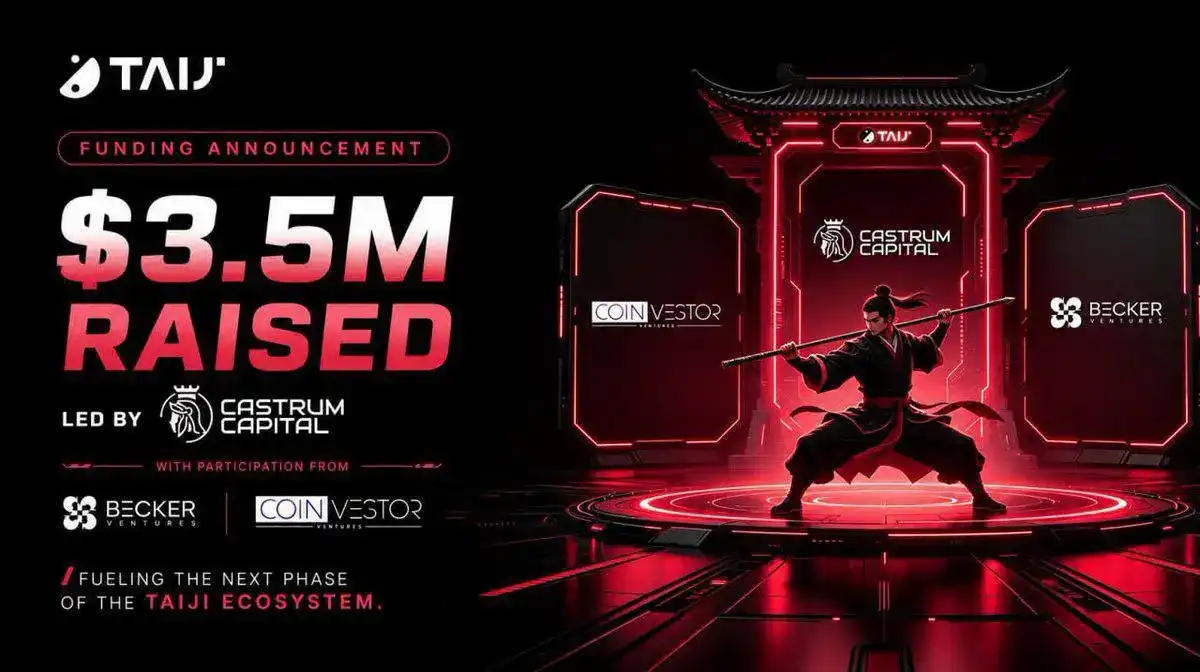
TaiJi, an AI-driven market intelligence platform for Web3, has completed a $3.5 million strategic funding round. The investment was led by Castrum Capital, Becker Ventures, and Coinvestor Ventures. The funds will be allocated to product R&D, upgrading its AI inference engine, building a multi-agent analysis system, improving market data infrastructure, expanding its global community, and advancing ecosystem partnerships, particularly within the BSC ecosystem. TaiJi aims to transform how users understand the Web3 market by moving beyond simple data display. It integrates market data, on-chain signals, liquidity changes, social sentiment, and news events into a unified AI system. This system generates structured event inferences, impact pathways, risk assessments, and follow-up indicators. The platform's core approach involves a multi-agent framework where specialized agents (Market, On-chain, Sentiment, Risk, Event) collaboratively analyze disparate signals to produce coherent market intelligence. Its initial product will feature modules including Market Intelligence, a Scenario Engine for AI-powered event analysis, an Impact Map, Risk Signals, and a personalized user dashboard called "My TaiJi." TaiJi emphasizes that it does not custody user assets, execute trades, provide investment advice, or promise returns. Following this funding round, the company plans to accelerate product development and testing, gradually rolling out its core features to the broader Web3 market.

marsbit06/02 09:47

TaiJi Completes $3.5 Million Strategic Financing with Participation from Castrum Capital, Becker Ventures, and Coinvestor Ventures

marsbit06/02 09:47

TaiJi Secures $3.5 Million Strategic Funding with Participation from Castrum Capital, Becker Ventures, and Coinvestor Ventures

TaiJi Secures $3.5 Million Strategic Funding TaiJi has announced the completion of a $3.5 million strategic funding round, with participation from Castrum Capital, Becker Ventures, and Coinvestor Ventures. The investment will support product development, upgrades to its AI inference engine, the construction of a multi-agent analysis system, improvements to market data infrastructure, global community expansion, and the advancement of ecosystem partnerships. Operating within the BSC ecosystem, TaiJi is building an AI-driven on-chain market intelligence network. The platform integrates market data, on-chain fund flows, liquidity changes, social media sentiment, news events, and project developments into a unified AI inference system. This approach aims to transform fragmented information into structured event inferences, impact pathways, risk assessments, and follow-up indicators, helping users navigate the increasingly complex and event-driven Web3 market. Unlike traditional market tools, TaiJi is constructing an intelligent analysis framework. It continuously aggregates real-time data to form a native market data network and builds a dataset of post-event market reactions for review. A core component is its multi-agent inference framework, where specialized agents—for markets, on-chain activity, sentiment, risk, and events—collaborate to analyze signals and generate insights. The first phase of TaiJi's product will focus on several key modules: Market Intelligence for real-time data aggregation; a Scenario Engine for AI-driven event inference; an Impact Map visualizing effects on assets and narratives; Risk Signals for identifying potential threats; and My TaiJi for personalized tracking and historical analysis. With this new funding, TaiJi plans to accelerate product development and testing, gradually rolling out its core features while expanding its presence within the BSC ecosystem and the broader global Web3 market.

链捕手06/02 09:26

TaiJi Secures $3.5 Million Strategic Funding with Participation from Castrum Capital, Becker Ventures, and Coinvestor Ventures

链捕手06/02 09:26

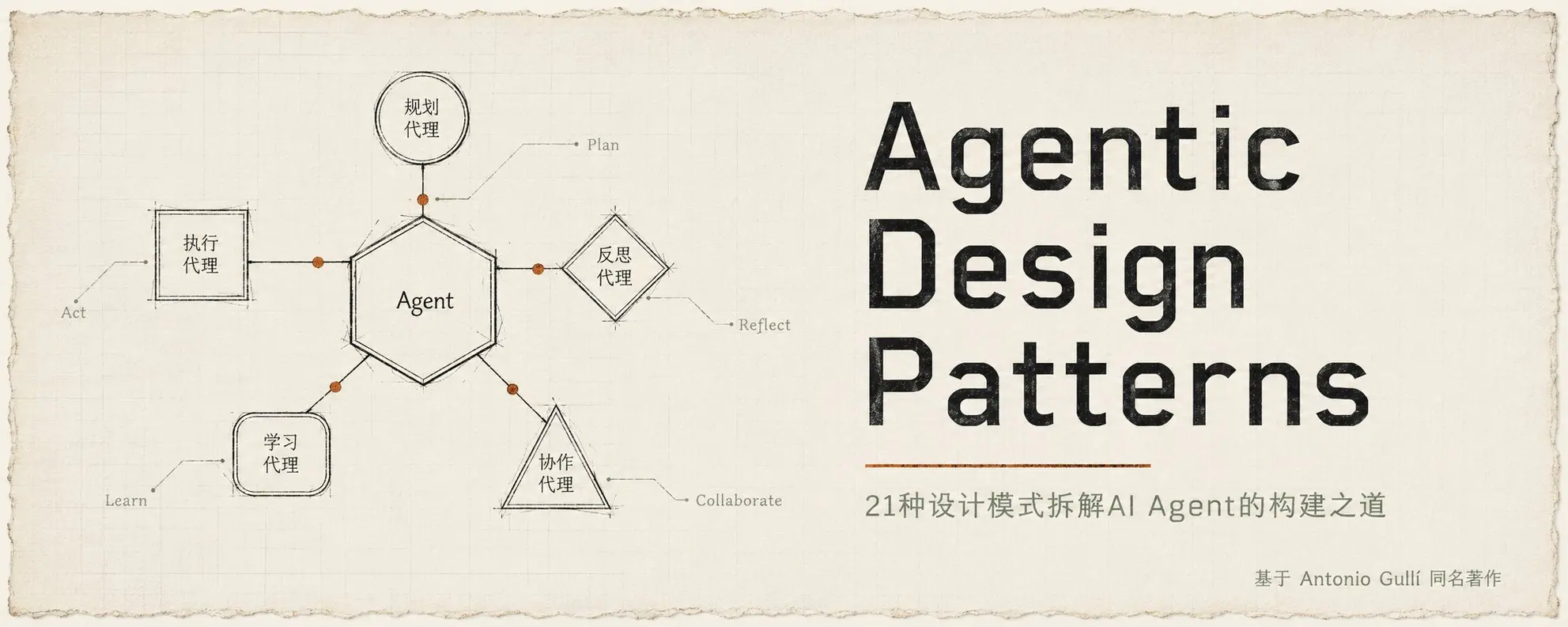
Agentic Design Patterns: A Book That Made Me Re-Understand "What Is an Agent, Really?"

"Agentic Design Patterns" is a 2025 book by Antonio Gullí, a Google engineering director, which offers a systematic framework for AI Agent development through 21 design patterns. A core contribution is the "Four Levels of Agency": Level 0 (bare LLMs) are not true agents. Level 1 agents actively decide when and how to use tools. Level 2 agents engage in strategic planning, context engineering (curating and filtering information), and self-reflection. Level 3 involves multi-agent collaboration with defined communication topologies. The book introduces **Context Engineering** as a superset of prompt engineering, managing four layers of information for the agent: system prompts, external data, implicit context (user history, environment), and feedback loops for automated optimization. A key pattern is **Reflection (Producer-Critic)**, where two distinct agents with different prompts collaborate iteratively—one produces output, the other critiques it—until quality is satisfactory or a max iteration limit is reached. For **Memory**, a three-layer model is proposed: Session (ephemeral conversation context), State (temporary task data), and Memory (persistent, long-term storage). Regarding **Multi-Agent Systems**, the book advises against unnecessary complexity, recommending simple topologies like Supervisor or Peer-to-Peer based on task needs. It emphasizes perfecting a single Level 2 agent before moving to multi-agent setups. The author concludes with three actionable takeaways: 1) Add a Critic agent to existing workflows, 2) Practice Context Engineering beyond simple prompts, and 3) Avoid premature multi-agent complexity; first master a robust single agent. The book provides a practical map, codifying common challenges like reflection, memory, and coordination into reusable patterns, saving developers from reinventing foundational solutions.

链捕手05/25 04:43

Agentic Design Patterns: A Book That Made Me Re-Understand "What Is an Agent, Really?"

链捕手05/25 04:43

Major AI Collaboration Breakthrough! Stanford and NVIDIA Jointly Eliminate AI Communication Overhead, Boosting Reasoning Speed by 2.4x

Title: AI Collaboration Breakthrough: Stanford & NVIDIA Eliminate Communication Overhead, Boost Reasoning Speed by 2.4x A new approach called RecursiveMAS, developed by UIUC, Stanford, NVIDIA, and MIT, tackles the major bottleneck in multi-agent AI systems: the "language tax." Currently, AI agents collaborate by generating and reading natural language text, a slow, costly, and information-lossy process akin to inefficient radio communication. RecursiveMAS bypasses this by enabling agents to communicate directly through their "thoughts"—latent space vector representations—instead of text. Inspired by recursive language models, it treats each agent like a reusable layer in a recursive loop. A special lightweight module called RecursiveLink passes these high-dimensional, semantic-rich internal states between agents. Only the final agent decodes the last latent representation into human-readable text. This process, described as "telepathic" communication, dramatically cuts the overhead of encoding and decoding text at each step. The system is highly efficient; the core AI model weights remain frozen, and only the small RecursiveLink modules are trained, requiring updates to just 0.31% of total parameters. This reduces training costs by over 50% compared to full fine-tuning. Comprehensive evaluations across math, science, coding, and QA benchmarks show significant improvements: - **Accuracy:** Average increase of 8.3%, with gains up to 18.1% on complex math problems (AIME2025). - **Speed:** End-to-end reasoning is 1.2x to 2.4x faster, with greater speedups as recursive depth increases. - **Cost:** Token usage is reduced by 34.6% to 75.6%. The research suggests a new scaling paradigm for multi-agent systems: deepening recursive collaboration depth rather than merely adding more agents. This could address key production barriers like compute cost, latency, and memory limits. However, challenges remain, including the need for independent verification, compatibility between different AI models (heterogeneous agents), reduced interpretability of the "black-box" latent communication, and adaptation to complex real-world workflows involving tools and human interaction. If validated, RecursiveMAS could fundamentally change how AI agents work together, moving beyond inefficient "textual handoffs" to more seamless and powerful collaborative reasoning.

marsbit05/21 00:10

Major AI Collaboration Breakthrough! Stanford and NVIDIA Jointly Eliminate AI Communication Overhead, Boosting Reasoning Speed by 2.4x

marsbit05/21 00:10

活动图片