# Culture İlgili Makaleler

HTX Haber Merkezi, kripto endüstrisindeki piyasa trendleri, proje güncellemeleri, teknoloji gelişmeleri ve düzenleyici politikaları kapsayan "Culture" hakkında en son makaleleri ve derinlemesine analizleri sunmaktadır.


SharpLink CEO: How to Understand Ethereum Developers Just Exceeded 1 Million?

SharpLink CEO reflects on the milestone of Ethereum surpassing 1 million historical developers, emphasizing that this figure represents the largest pool of technical talent ever assembled around an open, permissionless blockchain network. While approximately 232,000 developers remain active, the key question for the crypto industry is not which chain is fastest, but where the best builders choose to build long-term. Ethereum's advantage lies in a decade-long accumulation of infrastructure, standards, tools, liquidity, and a cohesive culture, making it the default operating system for programmable finance. This developer base is tackling complex challenges: the Glamsterdam upgrade aims to enhance scalability while preserving core principles; synchronous composability seeks to unify Rollup ecosystems; and significant efforts are underway for post-quantum security. Ethereum's deeper network effects stem from composability and shared standards (like the EVM and Solidity), creating a flywheel of more developers, tools, and liquidity. Three reinforcing strengths cement Ethereum's lead: credible neutrality (secured by ~900k validators), a modular architecture with interconnected Rollups, and a culture that attracts top researchers. The ecosystem is consolidating as the trusted coordination layer for internet-native finance, favored by large institutions valuing security and liquidity. The future of Ethereum is being built by this global community of founders and architects.

链捕手Dün 00:59

SharpLink CEO: How to Understand Ethereum Developers Just Exceeded 1 Million?

链捕手Dün 00:59

From Return to Resignation: Chen Hang's 437 Days at DingTalk

The 437-Day Return and Departure of Chen Hang at DingTalk This article chronicles the 437-day period from March 31, 2025, to June 11, 2026, when Chen Hang (also known as "No Move") returned as CEO of DingTalk, the enterprise communication platform he originally founded, only to later step down. Chen Hang, the creator of DingTalk in 2015, was brought back by Alibaba in 2025 after the company acquired his subsequent startup, HHO. His return was driven by Alibaba's renewed focus on AI and DingTalk's strategic role as its key to-B AI application. However, his aggressive management style, marked by strict work policies like mandatory clock-ins and extended hours, quickly caused internal friction and was criticized as being at odds with Alibaba's culture. Despite the internal turmoil, Chen Hang drove significant product launches. In August 2025, he unveiled "AI DingTalk 1.0," featuring new products like the AI-native entry point "DingTalk ONE." By March 2026, he announced "Wukong," touted as the world's first enterprise-grade AI-native work platform, representing a fundamental rebuild of DingTalk's architecture. The turning point came in early June 2026. A detailed internal post criticizing DingTalk's work culture went viral, followed by a public critique from a former executive. This prompted an unprecedented public rebuke from the Alibaba Partners Committee, which stated such management was not aligned with company values. One day later, on June 11, Alibaba announced Chen Hang's departure. He was succeeded by Chen Yusen, a 32-year-old technical expert known for founding cybersecurity firm Changting Technology. While Chen Hang's tenure laid the technical foundation for DingTalk's AI transformation with "Wukong," his leadership style ultimately led to his replacement as the company seeks a new direction under younger leadership.

marsbit06/11 10:23

From Return to Resignation: Chen Hang's 437 Days at DingTalk

marsbit06/11 10:23

Deconstructing Anthropic: The Best AI Company May Also Be an Organizational Invention

Anthropic has emerged as one of the most notable AI companies, distinguished by its strategic focus and unique organizational culture. Strategically, Anthropic demonstrated exceptional foresight by prioritizing coding early on, recognizing it as a critical path for model learning, commercial value, and accelerating AGI research. Unlike OpenAI's expansive, multi-front approach, Anthropic maintained rigorous focus on scaling language models and the coding vertical, avoiding distractions like multimodal development. This discipline stemmed partly from resource constraints but also from the conviction of its leadership, particularly co-founder Dario Amodei, who exhibits a strong, independent strategic vision. Organizationally, Anthropic’s culture is its “secret sauce.” It is characterized by a strong, mission-oriented focus on AI safety, high trust, low ego among employees, and a distinct humanistic ethos. This culture has resulted in remarkably low talent attrition and high retention rates. Key practices sustaining this culture include stringent cultural screening in hiring, high-context transparency and writing practices led by leadership, a founding structure of seven co-founders with equal equity to diffuse values, and a deliberate “one team” approach that minimizes internal silos and hierarchy. This culture is both a reaction to the political dynamics its founders experienced at previous companies and a functional necessity for the data-intensive, collaborative “dirty work” required to excel in coding and agentic AI. While OpenAI remains a formidable competitor with greater resources and exploration, Anthropic’s success illustrates how focus, cultural cohesion, and a steadfast mission can be powerful drivers in the AI race.

marsbit05/20 13:09

Deconstructing Anthropic: The Best AI Company May Also Be an Organizational Invention

marsbit05/20 13:09

Why is China's AI Developing So Fast? The Answer Lies Inside the Labs

A US researcher's visit to China's top AI labs reveals distinct cultural and organizational factors driving China's rapid AI development. While talent, data, and compute are similar to the West, Chinese labs excel through a pragmatic, execution-focused culture: less emphasis on individual stardom and conceptual debate, and more on teamwork, engineering optimization, and mastering the full tech stack. A key advantage is the integration of young students and researchers who approach model-building with fresh perspectives and low ego, prioritizing collective progress over personal credit. This contrasts with the US culture of self-promotion and "star scientist" narratives. Chinese labs also exhibit a strong "build, don't buy" mentality, preferring to develop core capabilities—like data pipelines and environments—in-house rather than relying on external services. The ecosystem feels more collaborative than tribal, with mutual respect among labs. While government support exists, its scale is unclear, and technical decisions appear driven by labs, not state mandates. Chinese companies across sectors, from platforms to consumer tech, are building their own foundational models to control their tech destiny, reflecting a broader cultural drive for technological sovereignty. Demand for AI is emerging, with spending patterns potentially mirroring cloud infrastructure more than traditional SaaS. Despite challenges like a less mature data industry and GPU shortages, Chinese labs are propelled by vast talent, rapid iteration, and deep integration with the open-source community. The competition is evolving beyond a pure model race into a contest of organizational execution, developer ecosystems, and industrial pragmatism.

marsbit05/10 08:09

Why is China's AI Developing So Fast? The Answer Lies Inside the Labs

marsbit05/10 08:09

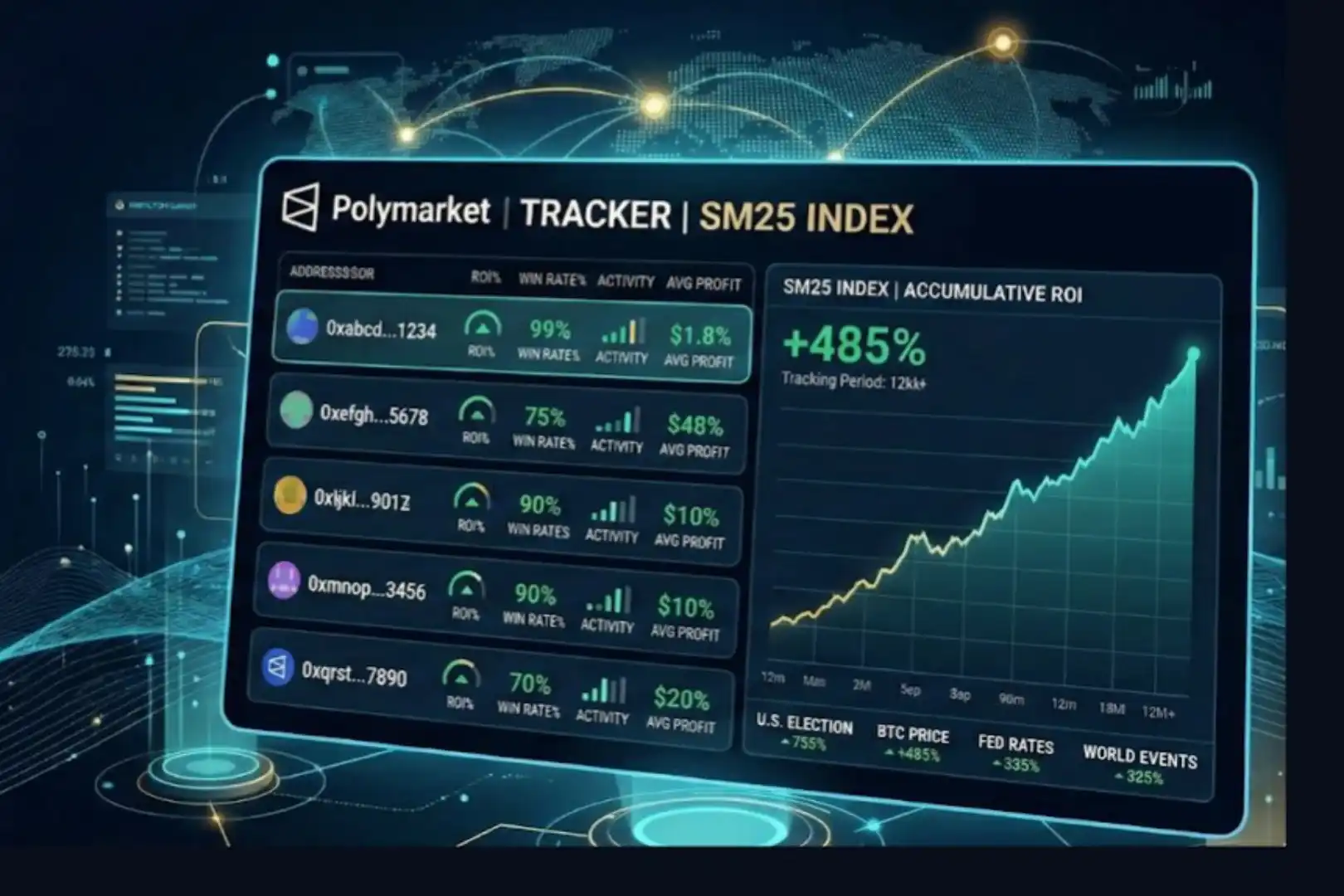
Polymarket Smart Money Panorama: 26 Long-Term Trackable Addresses (Categorized by Sector)

This article profiles 26 high-performing "smart money" addresses on Polymarket, categorized by their expertise in five distinct prediction market sectors. The selection criteria focused on proven Profit and Loss (PNL), a diversified winning structure (not reliant on a single bet), and high transaction volume to distinguish informed speculation from arbitrage. The addresses are broken down as follows: * **Politics & Geopolitics (5 addresses):** Experts in long-cycle macro events like Fed rates, US elections, and Middle Eastern geopolitics. They often bet against consensus (NO) in low-probability markets, achieving high ROI. * **Weather (6 addresses):** Specialists in temperature prediction markets for specific cities. Strategies range from high-frequency, small bets across thousands of markets to focused, high-conviction wagers. * **Tech (5 addresses):** Focused on Big Tech and AI product timelines (e.g., Google, OpenAI). They typically target high-probability outcomes or use a high-volume, low-cost approach on undervalued options. * **Culture (5 addresses):** Experts in movie box office results and Twitter-related markets. Strategies include betting on high-probability outcomes or taking contrarian, high-odds positions in low-probability markets. * **Sports (5 addresses):** Specialists in specific leagues like UFC, Soccer, and Tennis. They excel at identifying mispriced odds, often in medium-probability markets, and hold positions until settlement. A key warning is emphasized: a trader's success is often not transferable across sectors. An expert in sports may perform poorly in politics. The article advises followers to only mirror trades within a trader's proven area of expertise to avoid losses from their cross-sector ventures. All addresses are for reference only and not financial advice, as prediction markets carry significant risk of capital loss.

marsbit03/31 10:50

Polymarket Smart Money Panorama: 26 Long-Term Trackable Addresses (Categorized by Sector)

marsbit03/31 10:50

Cyber Chumaxian: Fake Taoists, AI Fortune-Telling, and the Forgotten Mysticism of Northeast China

"Cyber Shamans: Fake Taoists, AI Fortune-Telling, and the Untold Story of Northeast China’s Occultism" For millennia, the Chinese have developed complex metaphysical systems—from oracle bone divination to the I Ching and Four Pillars of Destiny—to seek security in an uncertain world. Despite modern technology’s attempt to replace superstition with rationality, AI has ironically become occultism’s latest tool. Recent crackdowns exposed fake Taoists using AI to answer existential queries, while apps like CeCe attract millions with free AI fortune-telling, later charging for live “spiritual” consultations. At the heart of this fusion is Northeast China, where Shamanic and “Chumaxian” traditions (based on animal spirits possessing humans) have evolved into a robust industry. Historically rooted in hardship—from the migration waves of “Chuang Guandong” to post-industrial unemployment—Northeastern metaphysics thrives on uncertainty. Today, it offers what many call “therapy tailored for the Chinese soul”: externalizing blame through cosmic narratives (e.g., bad luck years or evil spirits), unlike Western psychology’s inward focus. AI accelerates this shift. With algorithms now matching expert diviners in accuracy, low-end fortune tellers are being replaced. Meanwhile, prompt-savvy “metaphysical engineers” use AI to generate readings, focusing only on emotional delivery. Live-streamed “cyber shamans” combine folksy warmth with AI-generated scripts, offering cheap comfort in anxious times. This trend has even gone global. Startups like FateTell sell AI-translated Chinese astrology reports to overseas users, repackaging “feudal superstition” as Eastern philosophy for Silicon Valley elites. Yet behind the rise of AI mysticism lies a deeper human yearning—for certainty in an unstable world. As regulations tighten on AI divination, the core demand remains: whether through shamans or algorithms, people still seek comfort when facing the unknown.

marsbit03/30 02:08

Cyber Chumaxian: Fake Taoists, AI Fortune-Telling, and the Forgotten Mysticism of Northeast China

marsbit03/30 02:08

Wearing Slippers, Drinking Hot Water, Practicing Baduanjin: This Generation of Foreigners Collectively 'Diagnosed' as Chinese

An article from The New York Times Chinese website explores the viral TikTok trend where Western users humorously "diagnose" themselves as Chinese by adopting certain lifestyle habits. These include wearing slippers indoors, practicing the exercise Ba Duan Jin, using pillow covers, drinking hot water (often with apples, red dates, or goji berries), and embracing aunty-style floral cotton jackets. What began as a joke evolved into a popular meme, with users enthusiastically sharing their "very Chinese moments" and exploring details like whether to peel apples or switch to pears. While some Chinese-American influencers act as cultural arbiters, promoting practices like hotpot dinners or traditional medicine, others criticize the trend for oversimplifying and fetishizing Chinese culture. The phrase "diagnosed as Chinese" is particularly contentious, evoking racist stereotypes heightened during the COVID-19 pandemic. Despite this, the trend reflects a surprising shift towards admiration, with users praising China’s high-speed rail, electric vehicles, and affordable healthcare. The article notes that this fascination coexists with political tensions, such as the potential TikTok ban in the U.S., which drove users to Chinese app Xiaohongshu. Ultimately, the trend highlights both a romanticized vision of Chinese life and the complex dynamics of cultural exchange on social media.

比推03/20 19:18

Wearing Slippers, Drinking Hot Water, Practicing Baduanjin: This Generation of Foreigners Collectively 'Diagnosed' as Chinese

比推03/20 19:18

活动图片