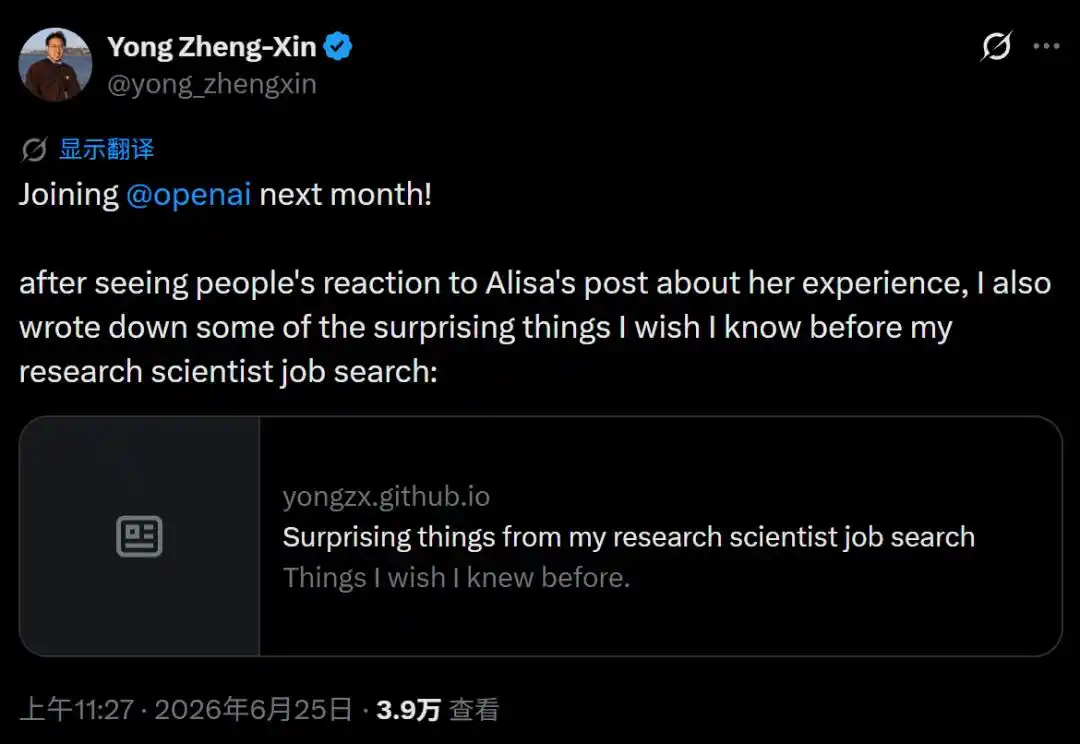
Yong Zheng-Xin, a PhD candidate at Brown University, announced today that he will officially join OpenAI next month as an Astra Fellow, focusing on AI Safety Research.
Yong Zheng-Xin’s PhD advisor at Brown University is Stephen Bach. His research areas include enhancing models' multilingual capabilities and cutting-edge AI safety and alignment. He currently focuses on risk prevention and preparedness for AGI/ASI (Artificial General Intelligence / Artificial Superintelligence). He has conducted in-depth research on scalable oversight, the generalization capabilities of model alignment, and the adversarial robustness and jailbreak vulnerabilities of large models when faced with complex prompts such as those in multiple languages.
Last week, another soon-to-graduate PhD candidate, Alisa Liu from the University of Washington, made headlines on X (formerly Twitter) with over a million views after announcing she would join OpenAI (see: "From 57 Interviews to an OpenAI Offer: An NLP PhD's Deep Dive into the Job Search at Top AI Companies Goes Viral").
Inspired by Alisa Liu's interview-sharing post, Yong Zheng-Xin also shared some of his experiences in seeking a research scientist position.
Compared to the more standardized interview preparation tips shared by Alisa, Zheng-Xin Yong's blog post "Surprising lessons from my research scientist job search" offers a different perspective.
As a candidate who switched from multilingual large models to AI safety research in the final year of his PhD, he summarized 6 interesting and surprising insights (Surprises) from his job search, which are very much worth reading:
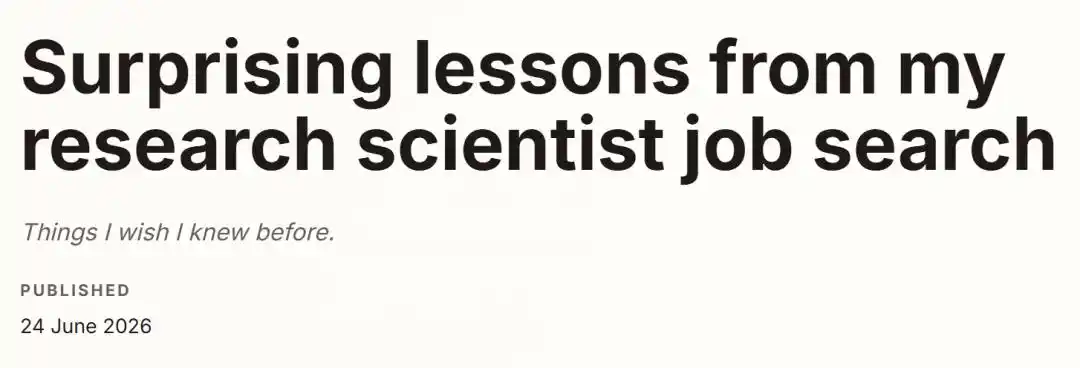
Link: https://yongzx.github.io/blog/2026/06/24/job-search/
Recently, computer science PhD candidates Alisa and Silvia each published blog posts detailing how they prepared and successfully joined leading-edge labs like OpenAI and Google DeepMind. I highly recommend both posts. Seeing the response on Twitter, I wanted to share a different angle: what unexpected things during my own research scientist job search surprised me.
This article is primarily aimed at two audiences:
- Computer Science (CS) PhD graduates who, like me, may have spent 5-6 years writing multiple research papers and are now striving to find opportunities in industry.
- Aspiring full-time AI safety researchers.
Disclaimer: No large language models were used in the writing of this article.
Personal Background
I am a fifth-year PhD student at Brown University. My job search was somewhat unusual because I changed my research direction in the final year of my PhD.
In the Fall of 2025, I applied for positions in both multilingual and AI safety research, but most of the opportunities I received were for Multilingual/Post-training Research Scientist roles. This was because my research portfolio contained relatively few core AI safety projects.
During the semester, I decided to fully commit to AI safety research, as I believe many critical aspects of this field need urgent attention with the advent of AGI/ASI. Therefore, when I received the Astra Fellowship, I decided to pause my job search for a few months to focus on delivering a strong fellowship project, aiming to become qualified for more impactful roles in AI safety. To do this, I declined some existing job offers and postponed my graduation to 2027.
As my research project neared its end, I resumed my job search, but things became messier than I had initially envisioned. I originally planned to finish the research project in June, write up the results into a paper, and then start interviewing (meaning I should have begun interviews in July). However, due to scheduling and concerns about running out of available positions, I started interviewing around mid-May and received several very satisfying offers before mid-June. In fact, I even withdrew from some ongoing interviews without fully exploring other options.
In summary, I'm grateful things worked out in the end. I no longer have to worry about funding (since I postponed graduation) or the anxiety of an ongoing job search (at least in the short term). Words cannot express my gratitude to everyone who supported me throughout this process.
Surprise #1: During the job search, really only one or two papers matter
From Alisa's post and the reactions, perhaps many already know that the interviews (e.g., LeetCode) might have little to do with the research you've done.
I might even say that during the job search, what truly matters might just be one or two papers. Sometimes, you might not even need a single paper; my evaluation could entirely depend on my ability to solve a team's problem on the spot.
Based on my experience, your papers serve two main purposes:
Getting the interview. I've done projects the target team liked, or my papers demonstrated some specific expertise the team was looking for, so I got into their interview pipeline. In other words, I just crossed the qualification bar and am now officially a candidate.
Deep dive. This usually happens during a research presentation or research discussion, where I elaborate in detail on the motivation and specifics of a piece of research. Sometimes, such a presentation might be as short as 20 minutes.
Therefore, to some extent, the sheer number of published papers doesn't matter much, beyond establishing credibility. In my case, I have far more multilingual research papers than AI safety papers — but given my shift to AI safety research, these papers, including my best paper award-winning work, were irrelevant to my interview outcomes. (Note: Yong Zheng-Xin's work won the NeurIPS 2023 SoLaR Best Paper Award.)
This is actually liberating because it means you can pivot at any time to a new field you find impactful, and as long as you demonstrate sufficient expertise in that area and a team needs you, you can still land your dream job. On the other hand, it also means you need to continuously learn and stay on top of industry trends, as past successes have less bearing on securing new job opportunities.
Surprise #2: The interview loops are incredibly varied
When I first started interviewing, I expected the format to be similar to that for new graduate software engineers (e.g., Leetcode-style problems and behavioral interviews), plus some technical interviews on LLMs / deep learning.
There seemed to be a somewhat standardized pattern for interview loops — I think the blogs by Alisa and Silvia gave that impression.
To my surprise, during my job search, I was asked about system design and parallel programming (e.g., how to use asyncio for parallel computation to achieve concurrency). I also learned that some interview loops would test your ability to use AI agents. In short, you should always be prepared for a wide variety of unexpected questions and interview rounds.
Surprise #3: Work trials
This was a completely new experience for me. I was also surprised reading Alisa's post because I thought work trials were only common for AI safety positions. It seems that work trials are becoming increasingly common at AI startups.
A work trial is completely different from an on-site interview — you don't fly to the company for multiple on-site rounds; instead, you collaborate with the team on a task. Sometimes, this task can be open-ended.
These work trials are usually compensated, but what surprised me was that some on-site work trials can last up to a week.
For me, participating in a work trial made it very difficult to prepare for other companies' interviews because I had to focus all my energy on the current task, leaving no time to prepare for others. You should consider this when scheduling interviews, especially when juggling multiple companies under tight deadlines.
Surprise #4: Timing is incredibly important
In the current job market, timing plays a crucial role.
For example, last fall, positions related to AI safety were very scarce compared to those related to reinforcement learning. But now, there are more startups offering opportunities related to AI safety (e.g., Lila and Mechanize).
There are a few points worth discussing about how timing affects your search for a full-time role:
Your work goes viral quickly, and many organizations are interested in it and want to recruit you. You might be caught off guard by the timing, and your best move now is to seize the opportunity and actively interview.
Your research area is becoming increasingly hot. This relates to the AI safety case I mentioned above. You can infer that related opportunities are also increasing. Application windows can be as short as less than a month or as long as several months, as companies are trying to expand.
Position demand. If you plan to postpone interviews or strategize about juggling multiple companies, you should ask recruiters about this.
Offers come pouring in. If you find yourself in this situation, you can ask other companies to expedite their interview processes. Don't be surprised if you have to do three consecutive interviews in a single day with less than a day to prepare.
It's reasonable to ask to delay the start of interviews (e.g., by a month or two), but usually, once the interview process starts, the gaps between rounds are very short. Also, note that some positions expect you to start within the next month or two, although the start date is negotiable.
Surprise #5: Return offers are rare
Compared to software engineering positions (which often provide return offers), research positions are more case-by-case.
For example, during my internship at Meta in 2024, return offers for full-time positions were scarce and highly dependent on team headcount. Many of my friends didn't receive return offers. As for the OpenAI Astra Fellowship I applied for, I still needed to go through the entire interview loop like any other applicant to ultimately join OpenAI.
I've heard that some institutions have expedited processes; for example, if there's a team match, you only need to go through one or two more rounds.
Surprise #6: Many interviews are unrelated to your topic
This surprised me because I was transitioning from capability research (multilingual) to safety research, and I thought safety-related interviews would constitute a large portion of the interview loop. My impression was reinforced by the extensive internal discussions on AI safety within Constellation during my Astra Fellowship.
That wasn't the case.
In fact, I encountered many rounds completely unrelated to AI safety, let alone my specific research direction. I believe my experience is similar to Alisa's and Silvia's (despite their different research areas within AI).
In a few places, I felt the interviewer was still assessing my overall competency as an AI researcher. I think there's some justification for this (e.g., the AI field moves fast, so solid fundamentals are important, etc.), but I had expected more AI safety-related questions because, in my view, it's a research area in urgent need of solutions, and it's still a relatively niche field. Perhaps for more senior roles, my interview experience would be different.
For safety researchers: If this helps, I co-authored a LessWrong article (https://www.lesswrong.com/posts/dvsFfGuXXyHYkyifp/tips-for-cracking-the-ai-safety-technical-interview-1) on safety-related rounds, but expect a lot of diversity in the questions asked.
Here are more reading resources:
1. Nathan Lambert — Thoughts on the job market in the age of LLMs: https://www.interconnects.ai/p/thoughts-on-the-hiring-market-in
2. Alisa Liu — Notes on the Industry Job Search: https://alisawuffles.github.io/blog/job-search/
3. Silvia Sapora — ML Job Interviews: The Ultimate Guide: https://silviasapora.github.io/blog/ml-interviews.html
This article is from the WeChat public account "Jiqizhixin" (Machine Heart)