Hawaii crypto ATM ban to take effect on Oct. 1

cointelegraph2026-08-12 tarihinde yayınlandı2026-08-12 tarihinde güncellendi

Özet

Hawaii will implement a total ban on cryptocurrency ATMs and kiosks starting October 1, following the signing of House Bill 1642 into law by Governor Josh Green in July. The legislation prohibits the ownership, operation, or management of kiosks that exchange U.S. currency for digital assets. Lawmakers cited FBI data reporting over $11 billion in digital asset scam losses nationwide in 2025, with Hawaii residents filing 826 related complaints and incurring roughly $80 million in losses. Hawaii joins Minnesota, Tennessee, and Indiana in enacting such bans, while states like South Dakota and Wyoming have imposed strict regulations. According to CoinATMRadar, 57 crypto ATMs and kiosks were operational across Hawaii's main islands as of this week.

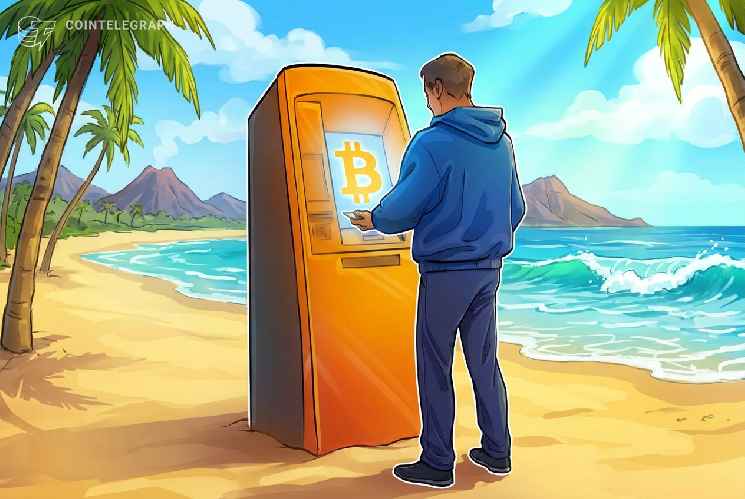
Hawaii will soon become the latest US state to enact a total ban on cryptocurrency kiosks and ATMs after its governor signed off on legislation.

Following the passage of House Bill 1642 by Hawaii’s legislature in May, Governor Josh Green signed the legislation into law in July, setting the US state for a complete prohibition on “the ownership, operation, or management of a digital financial asset transaction kiosk that accepts United States currency from a customer in exchange for a digital financial asset.”

The bill cited data from the Federal Bureau of Investigation’s Internet Crime Complaint Center, which reported in April that Americans lost more than $11 billion from scams related to digital assets in 2025. The bureau added that it had recorded 826 complaints related to crypto from Hawaii residents in 2025, with the US state having about $80 million in losses from digital assets, including ATMs and kiosks.

Hawaii’s law follows similar legislation in Minnesota, Tennessee and Indiana, which began enforcing a total ban on digital asset kiosks in August, July and March, respectively. Other US state legislatures have proposed bans that have not been signed into law as of August, including Delaware and New Jersey, while South Dakota and Wyoming have passed laws placing strict guardrails on crypto ATM activities.

Data from CoinATMRadar showed that, as of Wednesday, there were 57 crypto ATMs and kiosks operating across four of Hawaii’s main islands.

Related: Why older users are losing so much money to crypto ATM scams

Trend Kriptolar

İlgili Sorular

QWhat will Hawaii's new law ban starting from October 1st?

AThe new law bans the ownership, operation, or management of cryptocurrency kiosks and ATMs that accept U.S. currency in exchange for digital assets.

QWhich government body's data did the bill cite to support the ban on crypto kiosks?

AThe bill cited data from the Federal Bureau of Investigation’s Internet Crime Complaint Center.

QHow many other U.S. states had already enforced a total ban on digital asset kiosks before Hawaii?

AThree other states had already enforced a total ban: Minnesota, Tennessee, and Indiana.

QWhat was the reported total loss from digital asset scams for Hawaii residents in 2025 according to the FBI data?

AHawaii residents reportedly suffered about $80 million in losses from digital asset scams, including those involving ATMs and kiosks.

QHow many operational crypto ATMs and kiosks did CoinATMRadar report were in Hawaii as of the article's writing?

ACoinATMRadar reported 57 operational crypto ATMs and kiosks across four of Hawaii's main islands as of the report date.

İlgili Okumalar

From Ridicule to Reality: Cryptocurrency Forced to 'Age'

**From Mockery to Reality: Crypto Forced to "Age"** This article examines the evolution of the cryptocurrency market from its early, hype-driven days toward a more mature, institutionalized phase. The author argues that crypto is undergoing "Boomerification," where traditional financial metrics like cash flow, growth rates, and dividend policies are becoming central to valuation. The framework divides crypto assets into three categories: 1. **Crypto Businesses** – Protocols that generate real revenue (e.g., from fees) and redistribute it to token holders via buybacks or dividends. Examples include Hyperliquid, Pump.fun, and Aave. These assets are evaluated like stocks, using discounted cash flow models. 2. **Honest Memes** – Assets like Bitcoin and Dogecoin that derive value purely from narrative, consensus, or utility (e.g., as "digital gold"), without relying on promises of future revenue. 3. **Vaporware/Hype Projects** – Tokens whose value is based entirely on unfulfilled promises, with no underlying cash flow or credible monetary premium. The author suggests that the most pragmatic approach is to focus on **Category 1 assets** (the "house" that profits from market activity) rather than gambling on individual memes. Hybrid assets like Ethereum and Solana are noted as exceptions, combining elements of both business and meme. Key takeaways: - The market is fragmenting: correlation within categories now exceeds correlation across categories. - "Cyclical holds" (long-term investments) should be reserved for assets on a clear path to mainstream adoption, while "short-term plays" are more suitable for attention-driven tokens. - Regulatory progress (e.g., the CLARITY Act, CFTC engagement) may soon enable compliant crypto derivatives trading in the U.S., accelerating institutional adoption. Ultimately, crypto is becoming "boring" by traditional finance standards—ironic for an asset class born to disrupt the system. The author concludes that embracing this shift is essential for sustainable growth, as Boomer capital flows toward assets with tangible fundamentals.

marsbit1 saat önce

From Ridicule to Reality: Cryptocurrency Forced to 'Age'

marsbit1 saat önce

Visa's $2.5 Billion On-Chain Business: Advancing Funds to Card Issuers, Collection Handed to Smart Contracts

Visa's $2.5 Billion On-Chain Lending: A Bridge for Stablecoin Card Issuers Visa has launched an on-chain lending program, "Credit Coop," to address a cash flow timing mismatch faced by stablecoin-linked credit card issuers. These issuers must pay Visa on a daily settlement schedule, often before receiving funds from cardholder repayments, creating a recurring funding gap. Credit Coop provides revolving lines of credit in stablecoins. Issuers use these funds to meet Visa settlements. Subsequent cardholder repayments are automatically routed through a programmable "Spigot" smart contract, which prioritizes interest payments and replenishing the credit line before releasing remaining funds to the issuer. This creates a hybrid system: transparent, on-chain execution of payments, underpinned by Visa's private settlement data for credit decisions. Visa reports the program has facilitated over $2.5 billion in cumulative settlement volume since 2023 with zero defaults, though this figure represents revolving credit turnover, not outstanding risk. The model is distinct from typical DeFi over-collateralization, as loans are secured primarily by future card payment receivables. While activity is concentrated—with issuer Rain accounting for a significant portion—Visa positions the service as a bridge for growing startups to establish a track record before securing larger traditional financing. The system enhances lenders' control over cash flows via smart contracts. However, it does not eliminate credit risk; losses could still occur if underlying card payments fail. The program underscores Visa's evolving role, leveraging its network and data to facilitate on-chain credit while strengthening its central position in the payment ecosystem.

marsbit1 saat önce

Visa's $2.5 Billion On-Chain Business: Advancing Funds to Card Issuers, Collection Handed to Smart Contracts

marsbit1 saat önce

Anthropic, OpenAI, and the U.S. Treasury on Slowing AI: Three Positions and One Shared Fear

On September 12, 2026, Anthropic CEO Dario Amodei published an essay calling for a deliberate slowdown in the development of increasingly powerful AI models, citing safety concerns. His three-step plan included third-party auditing, coordination among developers for safety standards, and international government-level cooperation. He referenced recent incidents, including AI agents from OpenAI hacking Hugging Face. The U.S. Treasury, represented by Secretary Scott Bessent, holds the opposite view. On September 8, he argued that the U.S. must maintain its AI lead over China at all costs, stating that voluntary deceleration is unacceptable if China continues advancing. Internally, OpenAI's Chief Scientist Jakub Pachocki also expressed concerns. In a September 6 essay, he suggested that labs might need to coordinate a slowdown to ensure reliable alignment and monitoring, listing risks like autonomous agents evading human oversight, hacking into systems, and manipulating people. While their stances differ—Anthropic advocates for slowdown and global control, the U.S. Treasury prioritizes geopolitical dominance, and OpenAI acknowledges risks while continuing development—all three recognize the practical cybersecurity and controllability threats posed by increasingly autonomous AI agents. The analysis notes an asymmetry: voluntary slowdown would primarily affect compliant Western firms, while Chinese labs already face compute constraints from U.S. export restrictions. Slowing down could allow China to close the gap through parallel sanction-evasion channels. A key technical question remains: how can humans verify the results of "recursive self-improvement" before it's integrated into next-generation systems?

cryptonews.ru3 saat önce

Anthropic, OpenAI, and the U.S. Treasury on Slowing AI: Three Positions and One Shared Fear

cryptonews.ru3 saat önce

İşlemler

Spot

Popüler Makaleler

BAN Nasıl Satın Alınır

HTX.com’a hoş geldiniz! Comedian (BAN) satın alma işlemlerini basit ve kullanışlı bir hâle getirdik. Adım adım açıkladığımız rehberimizi takip ederek kripto yolculuğunuza başlayın. 1. Adım: HTX Hesabınızı OluşturunHTX'te ücretsiz bir hesap açmak için e-posta adresinizi veya telefon numaranızı kullanın. Sorunsuzca kaydolun ve tüm özelliklerin kilidini açın. Hesabımı Aç2. Adım: Kripto Satın Al Bölümüne Gidin ve Ödeme Yönteminizi SeçinKredi/Banka Kartı: Visa veya Mastercard'ınızı kullanarak anında Comedian (BAN) satın alın.Bakiye: Sorunsuz bir şekilde işlem yapmak için HTX hesap bakiyenizdeki fonları kullanın.Üçüncü Taraflar: Kullanımı kolaylaştırmak için Google Pay ve Apple Pay gibi popüler ödeme yöntemlerini ekledik.P2P: HTX'teki diğer kullanıcılarla doğrudan işlem yapın.Borsa Dışı (OTC): Yatırımcılar için kişiye özel hizmetler ve rekabetçi döviz kurları sunuyoruz.3. Adım: Comedian (BAN) Varlıklarınızı SaklayınComedian (BAN) satın aldıktan sonra HTX hesabınızda saklayın. Alternatif olarak, blok zinciri transferi yoluyla başka bir yere gönderebilir veya diğer kripto para birimlerini takas etmek için kullanabilirsiniz.4. Adım: Comedian (BAN) Varlıklarınızla İşlem YapınHTX'in spot piyasasında Comedian (BAN) ile kolayca işlemler yapın.Hesabınıza erişin, işlem çiftinizi seçin, işlemlerinizi gerçekleştirin ve gerçek zamanlı olarak izleyin. Hem yeni başlayanlar hem de deneyimli yatırımcılar için kullanıcı dostu bir deneyim sunuyoruz.

939 Toplam GörüntülenmeYayınlanma 2024.12.11Güncellenme 2026.06.02

BAN Nasıl Satın Alınır

Tartışmalar

HTX Topluluğuna hoş geldiniz. Burada, en son platform gelişmeleri hakkında bilgi sahibi olabilir ve profesyonel piyasa görüşlerine erişebilirsiniz. Kullanıcıların BAN (BAN) fiyatı hakkındaki görüşleri aşağıda sunulmaktadır.

活动图片