Safety Narrative Meets Reality Squeeze: How Anthropic Fell into an Identity Crisis?

比推2026-02-27 tarihinde yayınlandı2026-02-27 tarihinde güncellendi

Özet

In a span of seventy-two hours, Anthropic faced a severe identity crisis amid pressure from the U.S. Pentagon, public accusations from Elon Musk, and a major shift in its safety policy. The Pentagon issued an ultimatum: allow Claude to be used for "all lawful purposes," including autonomous weapons targeting and domestic mass surveillance, by Friday 5:01 PM, or risk losing a $2 billion contract and being blacklisted as a "supply chain risk." Anthropic initially resisted, citing ethical red lines. Simultaneously, Elon Musk accused Anthropic of large-scale training data theft, referencing a $1.5 billion settlement over using pirated books. Anthropic also accused three Chinese AI firms of "industrial-scale distillation attacks" on Claude, framing it as a national security threat—a move widely criticized as hypocritical. In a pivotal shift, Anthropic released its Responsible Scaling Policy (RSP) 3.0, removing its core commitment to halt training if safety measures were inadequate. The company cited competitive pressure and lack of industry-wide consensus as reasons. With a $380 billion valuation and rapid growth, Anthropic’s balancing act between its safety-brand identity and commercial-military demands appears increasingly unstable. Its narrative as a "responsible AI" leader is collapsing under political, competitive, and ethical pressures.

Author: Ada, Shenchao TechFlow

Original Title: Anthropic's 72-Hour Identity Crisis


February 24, Tuesday. Washington, the Pentagon.

Anthropic CEO Dario Amodei sat across from Defense Secretary Pete Hegseth. According to multiple media outlets including NPR and CNN citing informed sources, the atmosphere of the meeting was "polite," but the content was anything but.

Hegseth gave him an ultimatum: By 5:01 PM on Friday, lift the restrictions on Claude's military use, allowing the Pentagon to employ it for "all lawful purposes," including autonomous weapons targeting and domestic mass surveillance.

Otherwise, the $200 million contract would be canceled. The Defense Production Act would be invoked for compulsory requisition. Anthropic would be listed as a "supply chain risk," effectively blacklisting it alongside hostile entities from Russia and China.

On the same day, Anthropic released the third version of its "Responsible Scaling Policy" (RSP 3.0), quietly removing the company's core commitment since its founding: not to train more powerful models if safety measures could not be assured.

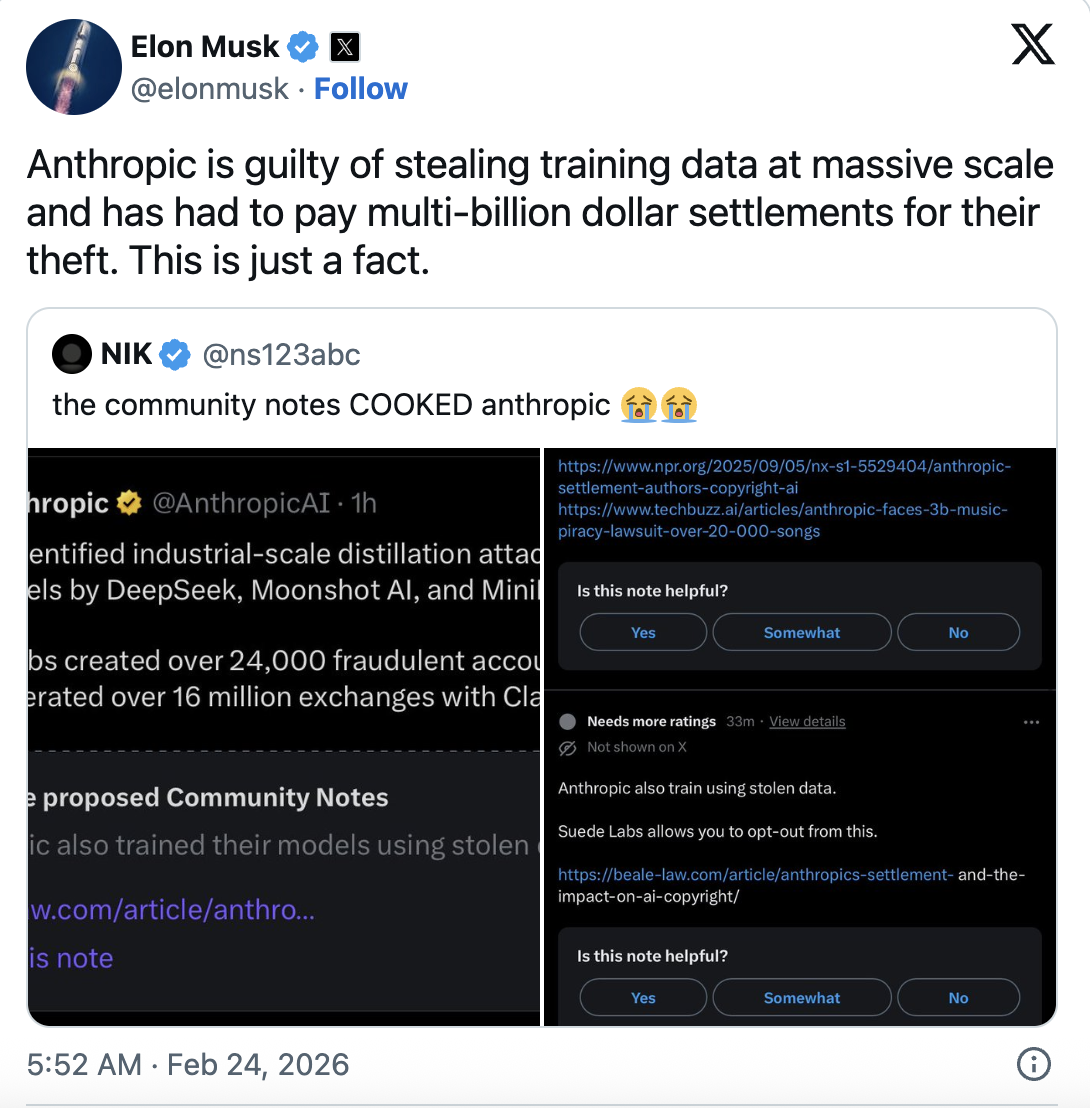
Also on the same day, Elon Musk posted on X: "Anthropic massively stole training data. This is a fact." Simultaneously, a Community Note on X supplemented this with a report that Anthropic had paid a $1.5 billion settlement for using pirated books to train Claude.

Within seventy-two hours, this AI company that claimed to have a "soul" simultaneously played three roles: safety martyr, intellectual property thief, and Pentagon traitor.

Which one is real?

Perhaps all of them.

The Pentagon's "Comply or Get Out"

The first layer of the story is simple.

Anthropic was the first AI company granted classified access by the U.S. Department of Defense. The contract, worth up to $200 million, was secured last summer. OpenAI, Google, and xAI subsequently secured contracts of similar scale.

According to Al Jazeera, Claude was used in a U.S. military operation in January of this year. The report stated the operation involved the kidnapping of Venezuelan President Maduro.

But Anthropic drew two red lines: no support for fully autonomous weapons targeting, and no support for mass surveillance of U.S. citizens. Anthropic argued that AI's reliability is insufficient for weapon control, and there are currently no laws or regulations governing AI's use in mass surveillance.

The Pentagon wasn't buying it.

White House AI advisor David Sacks publicly accused Anthropic on X last October of "using fear as a weapon and engaging in regulatory capture."

Competitors had already capitulated. OpenAI, Google, and xAI all agreed to let the military use their AI for "all lawful scenarios." Musk's Grok was just approved this week for entry into classified systems.

Anthropic was the last one standing.

As of publication, Anthropic stated in its latest announcement that it does not intend to concede. But the Friday 5:01 PM deadline is looming.

An anonymous former liaison between the Justice Department and the Defense Department expressed confusion to CNN: "How can you simultaneously declare a company a 'supply chain risk' and force that company to work for your military?"

Good question, but it's outside the Pentagon's consideration. What they care about is that if Anthropic doesn't comply, compulsory measures will be taken, or it will become a Washington pariah.

"Distillation Attack": A Slap-in-the-Face Accusation

On February 23, Anthropic published a fiercely worded blog post accusing three Chinese AI companies of carrying out an "industrial-scale distillation attack" on Claude.

The accused are DeepSeek, Moonshot AI, and MiniMax.

Anthropic accused them of using 24,000 fake accounts to initiate over 16 million interactions with Claude, specifically extracting its capabilities in agent reasoning, tool use, and programming.

Anthropic framed this as a national security threat, claiming that distilled models are "unlikely to retain safety guardrails" and could be used by authoritarian governments for cyber attacks, disinformation, and mass surveillance.

The narrative was perfect, the timing was perfect.

It came just after the Trump administration relaxed chip export controls to China, right when Anthropic needed ammunition for its lobbying stance on chip export controls.

But Musk fired a shot: "Anthropic massively stole training data and paid billions in settlement money for it. This is a fact."
Tory Green, co-founder of AI infrastructure company IO.Net, said: "You train your models on data from the entire web, and when others use your public API to learn from you, it's called a 'distillation attack'?"

Anthropic calls distillation an "attack," but it's commonplace in the AI industry. OpenAI uses it to compress GPT-4, Google uses it to optimize Gemini, even Anthropic itself does it. The only difference is, this time they were the ones being distilled.

As Singapore's Nanyang Technological University AI professor Erik Cambria told CNBC: "The boundary between legitimate use and malicious exploitation is often blurry."

More ironically, Anthropic just paid a $1.5 billion settlement for using pirated books to train Claude. It trains its models on data from the entire web, then accuses others of using its public API to learn from it. This isn't double standards, it's triple standards.

Anthropic wanted to play the victim, but got exposed as the defendant.

Dismantling the Safety Promise: RSP 3.0

On the same day as the Pentagon standoff and the Silicon Valley spat, Anthropic released the third version of its Responsible Scaling Policy.

Anthropic Chief Scientist Jared Kaplan told media in an interview: "We felt that stopping AI model training doesn't help anyone. In the context of rapid AI development, unilaterally making promises... while competitors are moving full speed ahead, it doesn't make sense."

In other words, others aren't playing by the rules, so we're dropping the act too.

The core of RSP 1.0 and 2.0 was a hard commitment to pause training if model capabilities exceeded the coverage of safety measures. This commitment gave Anthropic a unique reputation in the AI safety community.

But 3.0 removed it.

It was replaced with a more "flexible" framework, separating the measures Anthropic itself can take from the safety recommendations requiring industry-wide collaboration into two tracks. A report on risks would be issued every 3-6 months. External experts would review it.

Sounds responsible?

Independent reviewer Chris Painter from the nonprofit METR, after seeing an early draft of the policy, stated: "This indicates Anthropic believes it needs to enter 'triage mode' because methods for assessing and mitigating risks are not keeping pace with the growth in capabilities. This is more evidence that society is not prepared for AI's potential catastrophic risks."

According to TIME, Anthropic spent nearly a year internally debating this rewrite, with CEO Amodei and the board unanimously approving it. The official line is that the original policy was designed to foster industry consensus, but the industry simply didn't follow. The Trump administration adopted a laissez-faire attitude towards AI development, even attempting to repeal state-level regulations. Federal AI legislation is nowhere in sight. Although establishing a global governance framework seemed possible in 2023, three years later, that door has clearly closed.

An anonymous researcher long involved in AI governance put it more bluntly: "The RSP was Anthropic's most valuable brand asset. Deleting the training pause commitment is like an organic food company quietly tearing the 'organic' label off its packaging and then telling you their testing is now more transparent."

Identity Torn Under a $380 Billion Valuation

In early February, Anthropic completed a $30 billion financing round at a $380 billion valuation, with Amazon as the anchor investor. Since its founding, it has achieved $14 billion in annualized revenue. Over the past three years, this figure has grown more than 10x annually.

Simultaneously, the Pentagon threatens to blacklist it. Musk publicly accuses it of data theft. Its core safety promise is deleted. Anthropic's AI safety lead, Mrinank Sharma, resigned and wrote on X: "The world is in danger."

Contradiction?

Perhaps contradiction is in Anthropic's DNA.

The company was founded by former OpenAI executives because they were worried OpenAI was moving too fast on safety. Then they built a company themselves, creating more powerful models at an even faster pace, while telling the world how dangerous these models are.

The business model can be summarized in one sentence: we are more afraid of AI than anyone else, so you should pay us to build it.

This narrative worked perfectly in 2023-2024. AI safety was a hot term in Washington, and Anthropic was the most popular lobbyist.

In 2026, the winds changed.

"Woke AI" became an attack label, state-level AI regulation bills were blocked by the White House, and the California SB 53 supported by Anthropic was signed into law, but the federal level was a wasteland.

Anthropic's safety card is sliding from a "differentiating advantage" to a "political liability."

Anthropic is performing a complex balancing act. It needs to be "safe" enough to maintain its brand, yet "flexible" enough not to be abandoned by the market and the government. The problem is, the tolerance space on both ends is shrinking.

How Much is the Safety Narrative Worth?

Look at all three events together, and the picture becomes clear.

Accusing Chinese companies of distilling Claude is to strengthen the lobbying narrative for chip export controls. Deleting the safety pause commitment is to avoid falling behind in the arms race. Refusing the Pentagon's autonomous weapons demand is to preserve the last layer of moral clothing.

Each step has logic, but the steps contradict each other.

You can't simultaneously claim Chinese companies "distilling" your model is a national security threat, while deleting the promise preventing your own model from going out of control. If the model is truly that risky, you should be more cautious, not more aggressive.

Unless you are Anthropic.

In the AI industry, identity is not defined by your statements, but by your balance sheet. Anthropic's "safety" narrative is essentially a brand premium.

In the early days of the AI arms race, this premium was valuable. Investors were willing to pay a higher valuation for "responsible AI," governments were willing to give the green light to "trustworthy AI," customers were willing to pay for "safer AI."

But in 2026, this premium is evaporating.

Anthropic now faces not a multiple-choice question of "whether to compromise," but a sequencing problem of "who to compromise with first." Compromise with the Pentagon, brand damaged. Compromise with competitors, safety promise voided. Compromise with investors, both must give.

Friday at 5:01 PM, Anthropic will deliver its answer.

But whatever the answer is, one thing is certain: the Anthropic that once stood its ground with "we are different from OpenAI" is becoming like everyone else.

The endpoint of an identity crisis is often the disappearance of identity.


Twitter:https://twitter.com/BitpushNewsCN

Bitpush TG Discussion Group:https://t.me/BitPushCommunity

Bitpush TG Subscription: https://t.me/bitpush

Original link:https://www.bitpush.news/articles/7615114

İlgili Sorular

QWhat ultimatum did the Pentagon give to Anthropic regarding the use of Claude AI?

AThe Pentagon gave Anthropic an ultimatum to remove restrictions on Claude's military use by Friday at 5:01 PM, allowing it to be used for 'all legitimate purposes,' including autonomous weapons targeting and domestic mass surveillance, or risk cancellation of a $200 million contract and being designated as a 'supply chain risk'.

QWhat significant change did Anthropic make in its Responsible Scaling Policy (RSP) 3.0?

AAnthropic removed its core commitment to halt training more powerful models if safety measures could not be guaranteed, replacing it with a more flexible framework that separates internal safety measures from industry-wide recommendations and includes periodic risk reports.

QWhat accusation did Elon Musk make against Anthropic on X?

AElon Musk accused Anthropic of 'massive theft of training data' and referenced a $1.5 billion settlement Anthropic paid for using pirated books to train Claude.

QWhy did Anthropic accuse three Chinese AI companies of 'distillation attacks'?

AAnthropic accused DeepSeek, Moonshot AI, and MiniMax of using 24,000 fake accounts to interact with Claude over 16 million times to extract its core capabilities in reasoning, tool use, and programming, framing it as a national security threat.

QWhat internal contradiction does the article highlight in Anthropic's actions?

AThe article points out that Anthropic's accusation of Chinese companies 'distilling' its model for security risks contradicts its own removal of safety pause commitments, and its refusal to allow autonomous weapons use conflicts with its accelerated model development, revealing a conflict between its safety narrative and competitive pressures.

İlgili Okumalar

Has the 'Digital Gold' Narrative for BTC Failed?

**Title: Has the "Digital Gold" Narrative for Bitcoin Failed?** The article argues that Bitcoin's "digital gold" narrative remains valid despite a recent sharp price decline (from a peak near $126k in Oct 2025 to briefly under $61k in Feb 2026). It presents a long-term investment framework based on three core points: **1. Viewing Bitcoin as an Asset:** Bitcoin is presented as a superior potential store of value compared to gold. Key arguments are its absolute scarcity (21 million cap), superior portability, and transparent auditability via its public ledger. While acknowledging its current use in early, volatile stages (~3-4% global adoption), the author draws parallels to the early, disruptive phases of the internet and e-commerce. **2. Understanding the Recent Downturn:** The current ~50% correction is framed as a predictable, consensus-driven cycle following its post-halving peak (the 2024 halving preceded the Oct 2025 high). A crucial factor is a historic "changing of hands": the influx of new institutional buyers via ETFs allowed early, low-cost holders (miners, OG believers) to take profits. The author notes that while severe, Bitcoin's historical drawdowns (e.g., 93% in 2011, 77% in 2021-22) have been progressively smaller, suggesting maturing holder structure and decreasing volatility over time. **3. The Long-Term Perspective:** The long-term thesis hinges on Bitcoin capturing a portion of gold's market value. With Bitcoin's market cap at ~$1.4 trillion (at $70k) versus gold's ~$20 trillion, significant upside potential exists if the "digital gold" narrative is partially realized. However, the author strongly cautions that short-term risks remain, the bottom is unpredictable, and high volatility is inherent. The real risk is not Bitcoin failing but poor personal position management (over-leverage, wrong capital) and a lack of deep understanding, which can force investors out during severe downturns. The conclusion uses Amazon's 95% crash post-2000 dot-com bubble and subsequent 42x recovery as an analogy. The ultimate question is not if Bitcoin's price will rise, but if an investor's strategy and conviction can withstand the volatility to see the long-term play out. The recent divergence (gold up, Bitcoin down) is posed not as a narrative failure, but as potential evidence of this ongoing, painful transition from a speculative asset to a mainstream allocation.

marsbit4 saat önce

Has the 'Digital Gold' Narrative for BTC Failed?

marsbit4 saat önce

Has BTC's 'Digital Gold' Narrative Failed?

The article discusses Bitcoin's "digital gold" narrative, its recent price drop, and long-term outlook through the perspective of "Jason". It argues the narrative is not a failure but that Bitcoin represents a superior, new asset class due to its fixed supply (21 million), portability, and auditability. The piece compares its current ~3-4% global adoption rate to early internet/e-commerce, suggesting significant growth potential. Regarding the 2025-2026 price decline (from ~$126k to briefly under $61k), the author views it as a predictable, consensus-driven sell-off within Bitcoin's ~4-year cycle post-halving, exacerbated by a major "handover" from early, low-cost holders to new institutional buyers via ETFs. A key observation is that historical peak-to-trough drawdowns have lessened over time (e.g., 93% in 2011 to ~50% in 2026), indicating maturing volatility as holder structure changes. For the long term, the author uses a simple framework: Bitcoin's total market cap (~$1.4T at $70k) is only about 7% of gold's (~$20T). Even capturing 30-50% of gold's value would imply substantial upside. However, the article strongly cautions against viewing this as investment advice, emphasizing extreme volatility and the critical importance of risk management, position sizing, and deep fundamental understanding to survive severe drawdowns. It concludes by drawing a parallel to Amazon's 95% crash in 2000 and subsequent 42x recovery, stressing that the key is surviving market cycles to realize long-term potential.

链捕手4 saat önce

Has BTC's 'Digital Gold' Narrative Failed?

链捕手4 saat önce

From Code to Cognition: A Ten-Thousand-Word Guide to the Evolution of the Robot Brain

"From Code to Cognition: The Evolution of Robot Brains" The journey of robotic intelligence has shifted dramatically from manually coded systems to AI-driven brains. For decades, robots relied on layered software stacks—perception, state estimation, planning, control—each handcrafted. While predictable, they lacked adaptability. The 2010s saw deep learning revolutionize perception (e.g., object detection) and control (via reinforcement learning), but learned skills remained narrow. The arrival of Large Language Models (LLMs) marked a turning point. LLMs acted as high-level planners, interpreting natural language instructions and generating sequences of actions for traditional robotic systems to execute. However, true integration came with Visual-Language-Action (VLA) models, which fused vision, language, and motion prediction into a single network. Pioneered by models like RT-2 and open-source projects like OpenVLA, VLAs enable robots to reason and act directly from visual input and commands. The most advanced humanoid robots now employ a "dual-brain" architecture: a slow-thinking, large VLA (System 2) for reasoning and planning, and a fast-reacting, small network (System 1) for high-frequency motion control, sometimes with an even lower-level System 0 for balance. This split balances cognition with the physics of real-time movement. Computation is split between onboard hardware (e.g., NVIDIA Jetson) for safety-critical control loops and cloud/edge servers for non-critical tasks like learning and interfaces. A crucial driver is the open-source ecosystem—models like GR00T and OpenVLA allow startups to build upon pre-trained brains and fine-tune them with their own data, accelerating development. Despite progress, current systems struggle with recovery from errors, sample inefficiency, and long-horizon tasks. This has spurred the rise of **World Models**—neural networks that predict the consequences of actions. By simulating possible futures before acting (like NVIDIA Cosmos or Meta V-JEPA), robots can plan, recover, and generalize better. This represents the next frontier: shifting intelligence from learned reactions to an internal model of physics and cause-and-effect. The field is rapidly evolving. While not yet at its "ChatGPT moment," the convergence of cheaper hardware, scalable simulation, and world models points toward robots that are increasingly capable, adaptive, and useful. The question is shifting from "what can robots do?" to "what *should* they do?"

marsbit5 saat önce

From Code to Cognition: A Ten-Thousand-Word Guide to the Evolution of the Robot Brain

marsbit5 saat önce

AI Bubble Is Bursting

The AI Bubble is Bursting: A Necessary Purge on the Path to Ubiquitous Intelligence Market volatility has reignited debates about an AI bubble, with figures like Ray Dalio pointing to high valuations. However, this parallels the dot-com bubble, which, despite its crash, laid the physical infrastructure for today's internet era. The current AI investment frenzy, with tech giants planning trillions in infrastructure spending far outstripping current AI application revenues, appears similarly imbalanced. This 'bubble' is seen as an inevitable phase for a disruptive technology, paying the "innovation tax." Critically, AI inference costs have plummeted over 99.7% since 2023, making intelligence nearly free at the margin. This hasn't reduced spending but has instead unlocked massive new demand, as seen in enterprise AI cloud expenditure tripling. This follows the Jevons Paradox: efficiency gains lead to greater total consumption. The market is now entering a cleansing phase, weeding out speculative ventures lacking real moats. The deeper shift is a move from capital expenditure (CapEx) on hardware to value creation in operational expenditure (OpEx) through AI applications that solve real industry problems. While infrastructure valuations are high, rapid earnings growth from widespread AI adoption across sectors—from manufacturing and finance to law and healthcare—may digest these valuations over time. Ultimately, this creative destruction will leave behind robust infrastructure and optimized models, cheaply powering an AI-augmented future for all industries, much as the internet became indispensable after its own bubble burst. The core productive potential remains undiminished.

链捕手5 saat önce

AI Bubble Is Bursting

链捕手5 saat önce

İşlemler

Spot
Futures

Popüler Makaleler

ADA Nasıl Satın Alınır

HTX.com’a hoş geldiniz! Cardano (ADA) satın alma işlemlerini basit ve kullanışlı bir hâle getirdik. Adım adım açıkladığımız rehberimizi takip ederek kripto yolculuğunuza başlayın. 1. Adım: HTX Hesabınızı OluşturunHTX'te ücretsiz bir hesap açmak için e-posta adresinizi veya telefon numaranızı kullanın. Sorunsuzca kaydolun ve tüm özelliklerin kilidini açın. Hesabımı Aç2. Adım: Kripto Satın Al Bölümüne Gidin ve Ödeme Yönteminizi SeçinKredi/Banka Kartı: Visa veya Mastercard'ınızı kullanarak anında Cardano (ADA) satın alın.Bakiye: Sorunsuz bir şekilde işlem yapmak için HTX hesap bakiyenizdeki fonları kullanın.Üçüncü Taraflar: Kullanımı kolaylaştırmak için Google Pay ve Apple Pay gibi popüler ödeme yöntemlerini ekledik.P2P: HTX'teki diğer kullanıcılarla doğrudan işlem yapın.Borsa Dışı (OTC): Yatırımcılar için kişiye özel hizmetler ve rekabetçi döviz kurları sunuyoruz.3. Adım: Cardano (ADA) Varlıklarınızı SaklayınCardano (ADA) satın aldıktan sonra HTX hesabınızda saklayın. Alternatif olarak, blok zinciri transferi yoluyla başka bir yere gönderebilir veya diğer kripto para birimlerini takas etmek için kullanabilirsiniz.4. Adım: Cardano (ADA) Varlıklarınızla İşlem YapınHTX'in spot piyasasında Cardano (ADA) ile kolayca işlemler yapın.Hesabınıza erişin, işlem çiftinizi seçin, işlemlerinizi gerçekleştirin ve gerçek zamanlı olarak izleyin. Hem yeni başlayanlar hem de deneyimli yatırımcılar için kullanıcı dostu bir deneyim sunuyoruz.

1.4k Toplam GörüntülenmeYayınlanma 2024.12.10Güncellenme 2026.06.02

ADA Nasıl Satın Alınır

Tartışmalar

HTX Topluluğuna hoş geldiniz. Burada, en son platform gelişmeleri hakkında bilgi sahibi olabilir ve profesyonel piyasa görüşlerine erişebilirsiniz. Kullanıcıların ADA (ADA) fiyatı hakkındaki görüşleri aşağıda sunulmaktadır.

活动图片