Coldcard Vulnerability Leads to $89 Million Theft, Sparking Largest On-Chain Migration Since FTX Collapse

marsbit2026-08-03 tarihinde yayınlandı2026-08-03 tarihinde güncellendi

Özet

A security vulnerability in Coldcard hardware wallets led to the theft of 1,367.05 BTC (approx. $89 million) from 4,585 addresses, according to Galaxy Research. The flaw, caused by insufficient randomness in seed phrase generation for specific firmware versions, triggered a massive migration of funds as users moved assets to new, secure wallets. This event caused the largest on-chain movement of small Bitcoin transactions since the FTX collapse, distorting key market indicators like active addresses and exchange deposits, and significantly dampening market sentiment. The incident also highlighted challenges in cybersecurity investigations, as researchers reported that safety guardrails on mainstream U.S. AI models hindered the analysis of attack patterns, forcing them to use an open-source Chinese AI model for forensic work. This underscores a dilemma in balancing AI security restrictions with the need for rapid response in tracing stolen crypto assets.

Original author: Oluwapelumi Adejumo

Original compilation: Saoirse, Foresight News

The Coldcard wallet crisis has severely impacted Bitcoin market sentiment, distorted various on-chain reference metrics, and simultaneously exposed long-standing weaknesses in AI-assisted cybersecurity defense systems.

On July 30, hardware manufacturer Coinkite issued a risk alert to users: wallets generated by specific versions of Coldcard firmware were at risk of asset theft due to a software flaw that caused the random generation of seed phrases to fall far below the design standard.

Galaxy Research stated that this security incident involved three waves of attacks, targeting a total of 4,585 addresses. The amount of Bitcoin stolen was 1,367.05 BTC, with an approximate value of $89 million.
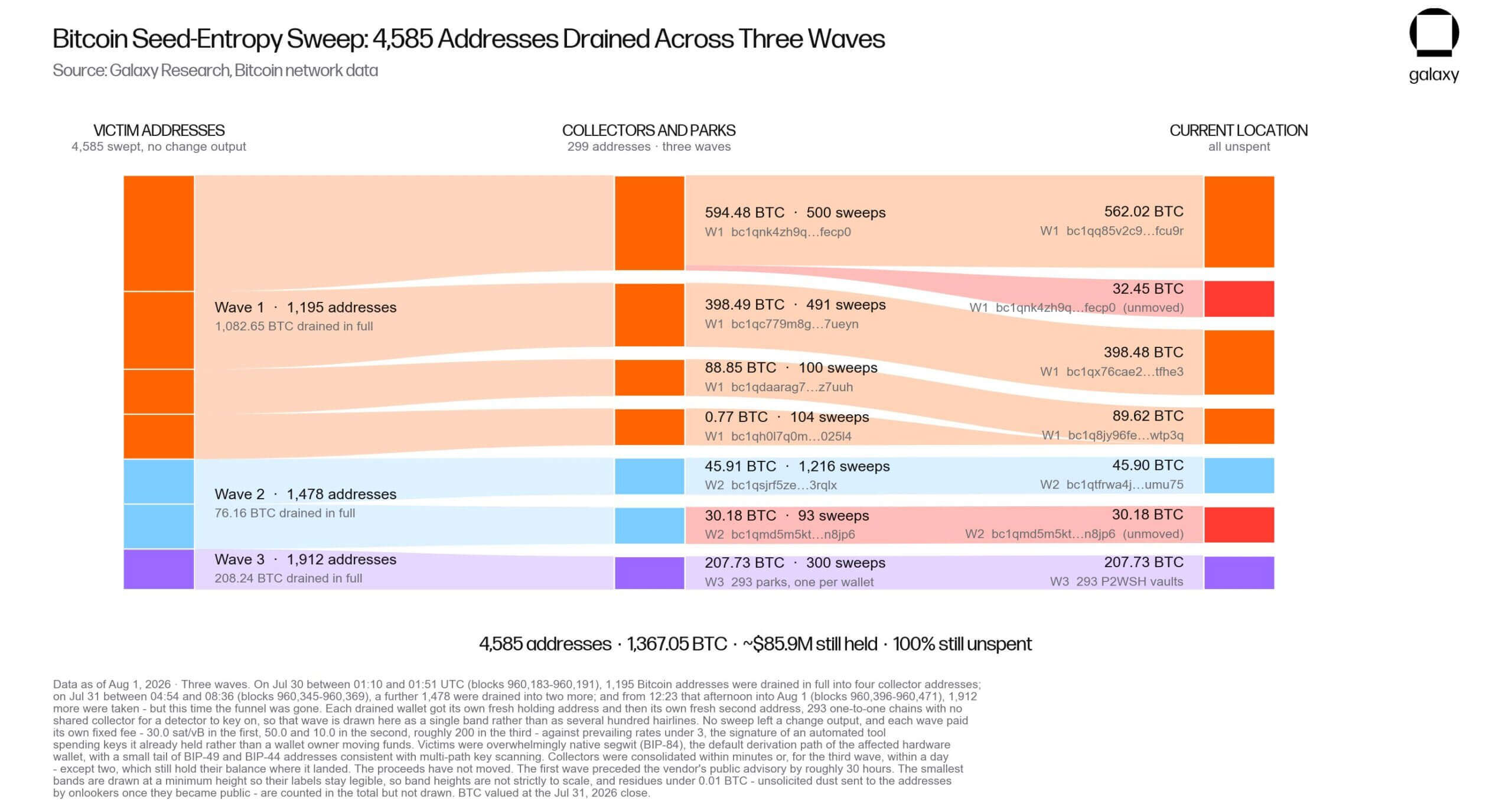
Coldcard Bitcoin Wallet Hacking Incident (Source: Galaxy Research)

Alex Thorn, Global Head of Research at Galaxy, said that the Bitcoin stolen in the three attack waves remains in addresses controlled by the attackers. However, he added that some scattered, small amounts of stolen funds have already been laundered through peel chains, cross-chain services, and overseas casinos.

Coldcard Wallet Migration Disrupts Bitcoin Bearish Signals

As the security risk continued to develop, users with potentially exposed vulnerabilities rushed to transfer their Bitcoin to prevent theft by hackers. Although Coinkite has already released a patched firmware version for affected devices, the high-risk seed phrases previously generated cannot be fixed through system updates. Users could only create new wallets and transfer assets to secure addresses.

This large-scale wallet migration caused an abnormal surge in the on-chain activity of small holders and long-dormant Bitcoin. Julio Moreno, Head of Research at CryptoQuant, explained that on July 31, the total volume of transactions with an output of less than 1 Bitcoin reached 39,600 BTC. This is the single-day highest value for this category since the FTX bankruptcy in November 2022; shortly after the FTX collapse that year, the flow volume for similar transactions was 39,900 BTC.

The daily number of active Bitcoin addresses also surged from about 645,000 on July 30 to nearly 1 million the next day, marking the highest level since December 10, 2024. Moreno noted that the surge in address count was mainly concentrated in sending addresses, with a very limited increase in receiving addresses, which is sufficient to indicate that users were transferring funds out of their original wallets due to security concerns.
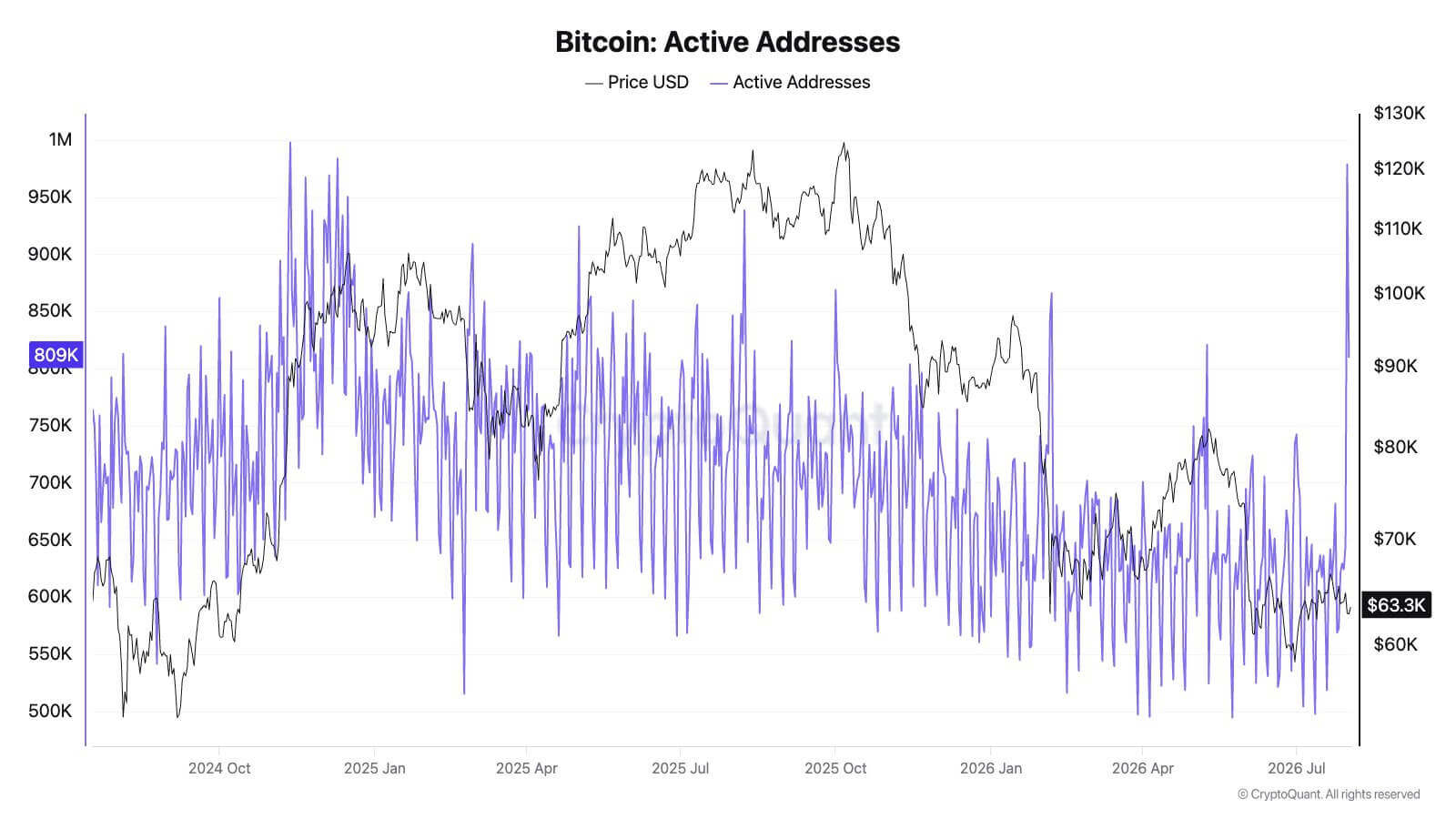
Daily Active Bitcoin Addresses (Data Source: CryptoQuant)

Exchange deposits from transactions involving less than 10 Bitcoin rose to 7,300 BTC, hitting a new high since February 6 of that year. Some users temporarily deposited assets into exchanges during the transition period while setting up new secure wallets, although this flow also included chips that investors intended to sell for cash.
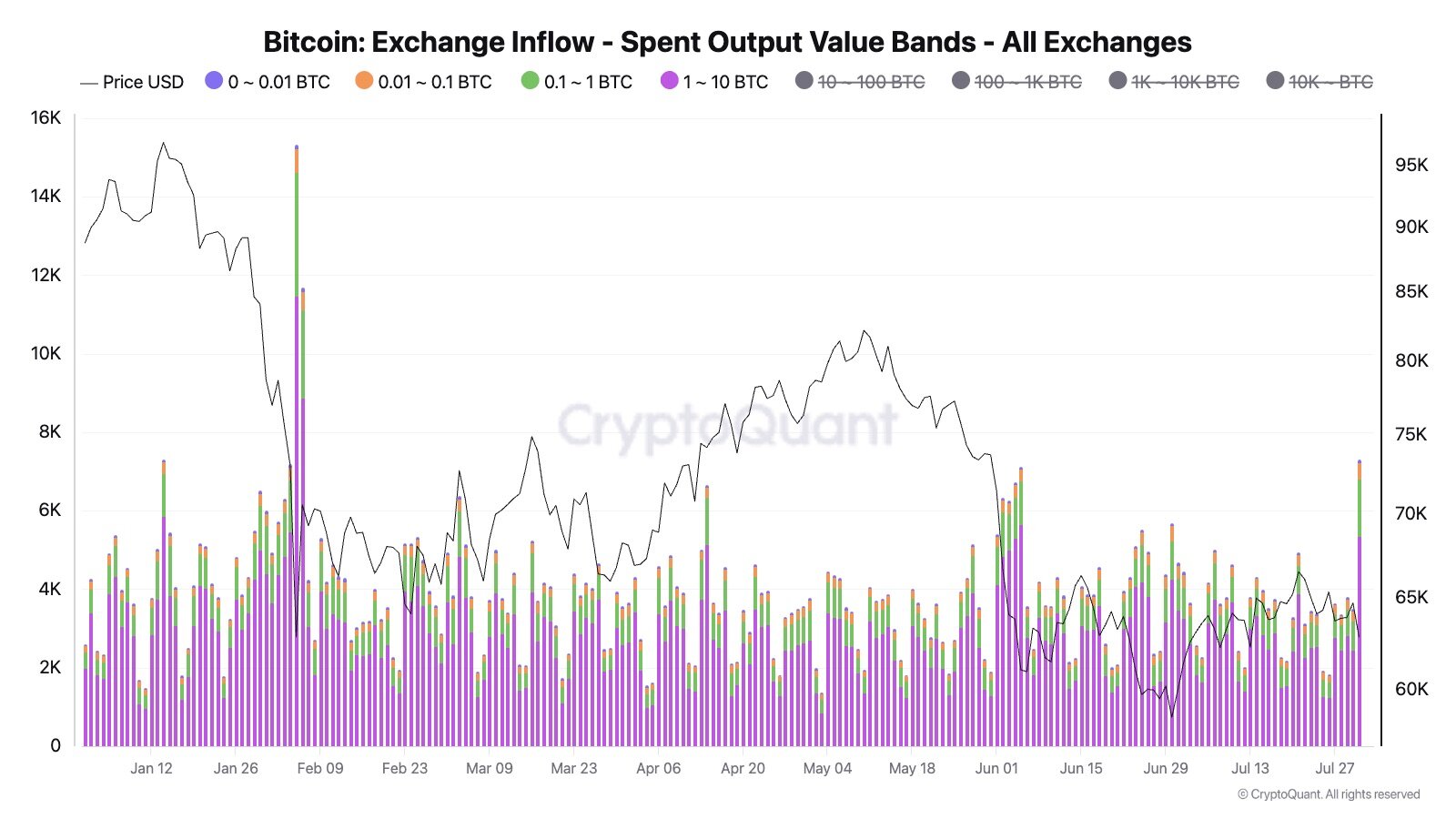
Surge in Bitcoin Exchange Deposits After Coldcard Incident (Source: CryptoQuant)

CryptoQuant analyst JA Maartunn added that after the vulnerability was exposed, 77,402 BTC that had been inactive for a long time were transferred. However, Maartunn cautioned that this large-scale movement of funds should not be seen as evidence of widespread panic selling by investors. Considering the context of the event, the nature of the fund movement is essentially users strengthening their wallet security.

He stated: "The Coldcard seed phrase issue has led users to transfer their long-held Bitcoin to ensure asset safety. This will interfere with the accuracy of various chart data such as Long-Term Holder supply changes, Coin Days Destroyed, and Spent Output Age Bands."

With the surge in on-chain transaction activity, overall market sentiment deteriorated sharply. Blockchain analytics firm Santiment pointed out that the ratio of bullish to bearish Bitcoin comments across the entire network fell to its lowest level since the platform began modern social data tracking. On platforms like X, Reddit, and Telegram, for every 1 bearish comment, there were only 0.58 bullish comments.
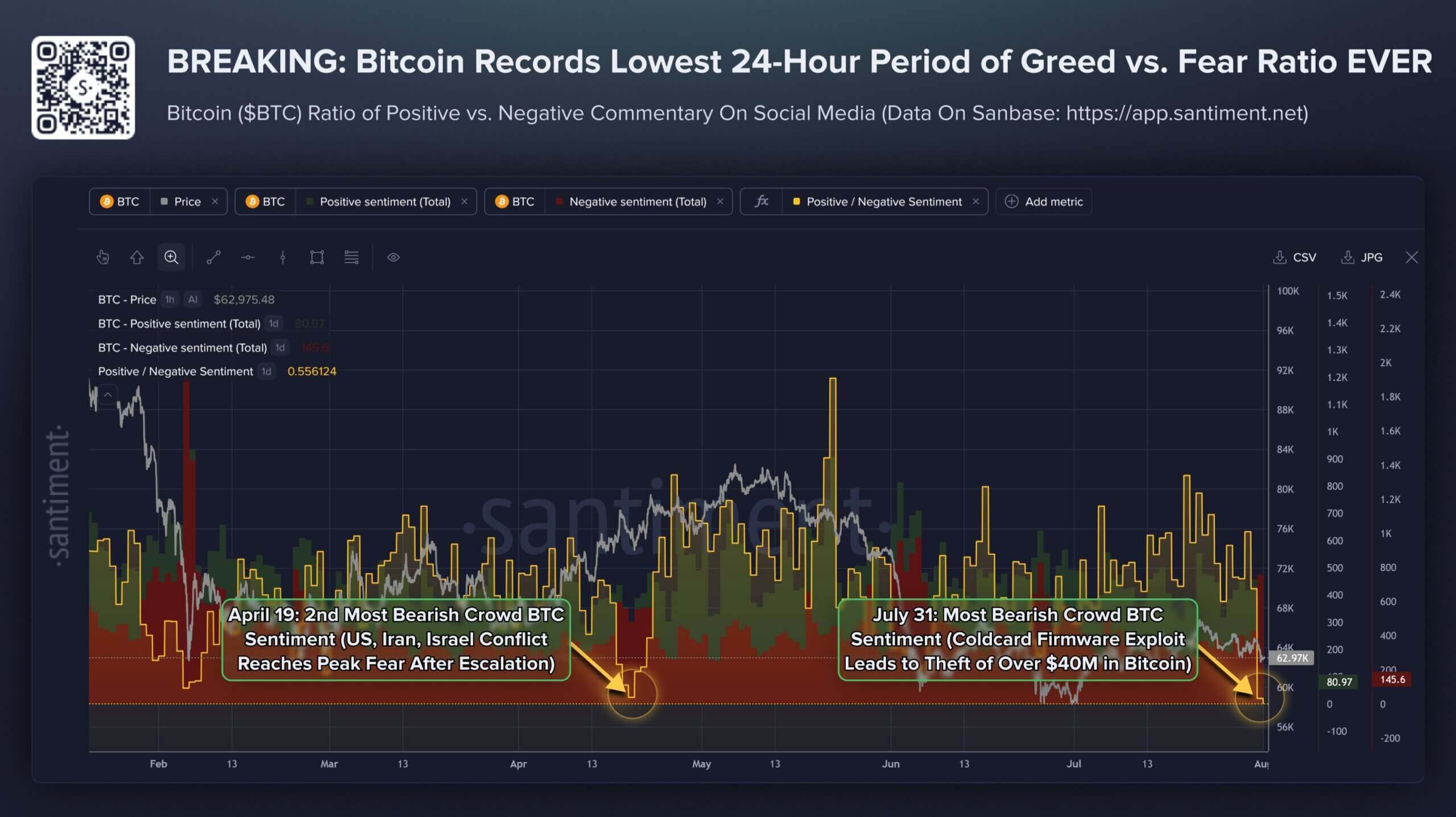
Bitcoin Market Sentiment Turns Bearish (Source: Santiment)

Santiment believes the reason for such a strong market reaction lies in the fact that the vulnerability attack targeted cold storage wallets. Most holders view cold wallets as the final line of security for their Bitcoin assets after withdrawing from exchanges and distancing themselves from high-risk crypto platforms.

US AI Control Regulations Increase Difficulty in Tracking Coldcard Case

These wallet transfers, which caused the distortion of Bitcoin market signals, also made tracing the stolen funds an urgent task, requiring the flow to be identified before the funds enter platforms where they can be exchanged or withdrawn.

Galaxy Research compiled information reported by victims, collated a series of suspected hacker addresses, and shared the materials with law enforcement, compliance institutions, and other cybersecurity investigators. Thorn revealed that institutions have reported approximately 600 suspected hacker addresses holding stolen Bitcoin.

However, he stated that security guardrails set by major mainstream AI models in the United States have hindered stolen asset tracking and user protection efforts, forcing the investigation team to switch to a Chinese open-source AI model. Thorn did not specify which U.S. AI models were involved, which query commands were blocked, nor did he detail what assistance this alternative model provided for the investigation. Nonetheless, the dilemma he described closely resembles the challenges faced by Hugging Face during a previous cyberattack.

This AI platform stated that automated programs had once infiltrated part of its infrastructure, and the security team needed to analyze over 17,000 event logs. Initially, investigators used commercial APIs to call mainstream leading AI models, uploading attack commands, exploit payloads, and command-and-control-related logs for analysis.

Hugging Face claimed that all these queries were blocked by the system. The reason was that the AI security system could not distinguish between investigators conducting emergency response and actual attackers. Ultimately, the team chose GLM 5.2, an open-source weight model independently developed by China's Zhipu AI, and completed all forensic analysis on their own servers.

This model assisted staff in mapping out the complete attack timeline, locating leaked credentials, extracting intrusion characteristics, and differentiating between real attack traces and decoy interference. Hugging Face stated that forensic work that originally would have taken several days was shortened to a few hours with AI assistance.

This case confirms the offensive-defensive AI asymmetry mentioned by Thorn in the Coldcard case: hackers can use unrestricted, self-modifiable AI tools, free from the security rules of commercial models; meanwhile, defenders often face AI rejections when submitting materials containing malicious characteristics for case investigation, even if the intent is to contain a severe security incident.

However, broadly removing AI security restrictions would create new risks. AI service providers cannot grant permissions based solely on users' verbal claims of tracking stolen funds, as such unrestricted tools could also be abused for wallet attacks, money laundering, evading transaction regulations, and other illegal activities.

This contradiction is particularly acute in the crypto field: stolen assets can circulate through cross-chain bridges, exchanges, and gambling platforms within minutes. Any delay in tracking means funds could be transferred into platforms that allow free withdrawals before victims receive a police report receipt or investigators complete manual tracing, completely losing the opportunity for freezing.

İlgili Sorular

QWhat was the primary cause of the Coldcard wallet vulnerability that led to the theft?

AThe primary cause was a software flaw in specific versions of Coldcard firmware, which resulted in the generation of seed phrases (mnemonics) with significantly lower randomness than the designed standard.

QAccording to the article, how did the mass migration of funds following the Coldcard incident affect Bitcoin's on-chain indicators?

AThe mass migration caused a sharp, anomalous spike in the activity of small Bitcoin holders and long-dormant wallets. It disrupted key on-chain metrics like Long-Term Holder supply changes, Coin Days Destroyed, and Spent Output Age Bands, making them less accurate for market analysis.

QWhat challenge did investigators face when trying to track the stolen funds from the Coldcard hack, as mentioned by Galaxy Research's Alex Thorn?

AInvestigators faced challenges due to the security guardrails of mainstream US AI models, which blocked their queries even when the intent was investigative. This limited their ability to analyze malicious data for tracking, creating an asymmetry where attackers could use unrestricted AI tools while defenders were hindered.

QWhat was the notable similarity between the investigation difficulties in the Coldcard case and a previous incident involving Hugging Face?

AIn both cases, the security protocols of commercial AI models prevented investigators from submitting attack-related data (like logs or payloads) for analysis, as the AI could not distinguish between malicious actors and security researchers conducting forensic investigations.

QWhy does the article suggest the market reaction to the Coldcard vulnerability was particularly severe?

AThe market reaction was particularly severe because the vulnerability targeted cold storage wallets, which are widely perceived by holders as the final, most secure line of defense for Bitcoin assets after withdrawing them from riskier platforms like exchanges.

İlgili Okumalar

Can Generative Models Finally Be Trained End-to-End? The Core Is a For Loop

This article introduces a novel training paradigm for generative models called Explorative Modeling (XM), which enables true end-to-end training. Traditionally, powerful generative models like autoregressive and diffusion models are not trained end-to-end. They are trained to predict a single small step but require iterative multi-step sampling for inference. This "exposure bias" leads to error accumulation and limits performance. The core challenge XM addresses is "mode blurring." In generative tasks, a single input (e.g., "generate a dog") corresponds to many valid outputs (multiple modes). Standard training objectives like reconstruction loss force the model to average these modes, producing unrealistic, blurry outputs. To avoid this, existing models break generation into many small, almost deterministic steps, sacrificing end-to-end training. XM tackles this by restructuring the training loop itself. Its key insight is to amplify "generative expressivity." For each training input, instead of generating one sample, the model generates K candidate outputs. Only the candidate closest to the real data is used for computing the loss and updating the model via backpropagation. This simple "best-of-K" mechanism is implemented as a short for-loop. By exploring multiple possibilities, the model learns to distribute its guesses across different modes rather than collapsing to their uninformative average. The paper demonstrates that "exploration" acts as a new, powerful scaling axis. Gains from XM increase with model size, data scale, and compute. Experiments show improvements in FID scores for image generation and significant efficiency gains, sometimes outperforming larger models without exploration. When pushed to the limit, XM enables fully single-step, end-to-end generative models. In robotics tasks, an "Explorative Policy" matched the performance of a 100-step Diffusion Policy with a single forward pass, drastically improving inference speed. While the best-of-K concept is not entirely new, the authors' contribution lies in formally understanding it as a direct method to boost generative expressivity without fragmenting the generation process. This work suggests that as models scale, enhancing exploration during training may become crucial for overcoming fundamental performance bottlenecks.

marsbit4 dk önce

Can Generative Models Finally Be Trained End-to-End? The Core Is a For Loop

marsbit4 dk önce

Annual Salary of Millions Competing for Electricians, Meta Rushes to Open Its Own Technical School

The AI boom is facing an unexpected bottleneck: a severe shortage of skilled construction workers and electricians. As tech giants like Meta, OpenAI, and Alphabet race to build massive data centers—such as OpenAI's $16 billion "Stargate" project—they are hitting a critical labor wall. The U.S. needs an estimated 130,000 more electricians, 240,000 construction workers, and 150,000 supervisors by 2030 for AI infrastructure alone, but tens of thousands of electrician jobs go unfilled each year. While AI companies offer high premiums, with electricians earning up to $280,000 annually, worker scarcity still causes massive losses—delays on a single project can cost $14.2 million per month. The complexity of building AI data centers, which require immense power (equivalent to powering hundreds of thousands of homes), sophisticated electrical systems, and advanced liquid cooling solutions, demands highly skilled technicians who are in short supply. To combat this, companies are investing heavily in training. Meta has committed $115 million to a free training school offering tuition, housing, and stipends, targeting 5,000 new workers. OpenAI is partnering with unions to secure skilled labor. These efforts are paying off, with a significant rise in Gen Z interest in trade schools over college. However, the power demands are staggering. AI data centers are driving a rapid surge in electricity consumption, projected to account for up to 12% of U.S. power use by 2028 and raising costs for consumers. Furthermore, the construction boom is project-based, leading to a potential future glut of trained workers once building peaks, which could depress wages industry-wide. The race for AI supremacy now depends as much on skilled hands as on advanced chips.

marsbit1 saat önce

Annual Salary of Millions Competing for Electricians, Meta Rushes to Open Its Own Technical School

marsbit1 saat önce

OpenAI No Longer Sells Its Most Expensive Model for Profit

OpenAI is shifting its business strategy away from promoting its most expensive, flagship models for every task. Recent price cuts—80% for GPT-5.6 Luna and 20% for Terra—signal a deeper change: the company now actively advises users that many tasks don't require the most powerful model. Instead, OpenAI recommends a tiered approach: use the high-end GPT-5.6 Sol for complex planning and analysis, then delegate execution to cheaper models like Luna. This mirrors moves by Anthropic, which recently launched Claude Opus 5 at half the price of its top model, Fable 5. Both companies are de-emphasizing flagship models as primary revenue drivers, using them instead for brand prestige and technological showcases. The industry is entering a "mass-market" phase, similar to automotive, where high-volume, cost-effective models handle daily operations and drive scale. OpenAI's price reductions are partly enabled by AI models themselves optimizing underlying code and infrastructure, creating a self-reinforcing cycle of efficiency gains and cost reduction. Competition is shifting from "who is smartest" to "who offers the best value." The goal is no longer selling individual models but fostering widespread API adoption and ecosystem lock-in. By making AI calls cheap and ubiquitous, companies like OpenAI aim to become the indispensable, utility-like infrastructure powering automated workflows—the "water and electricity" of software, quietly embedded everywhere.

marsbit1 saat önce

OpenAI No Longer Sells Its Most Expensive Model for Profit

marsbit1 saat önce

İşlemler

Spot
活动图片