Rare Annualized Rate of 400%: Is TradeXYZ Handing Out Money to Oil Bulls?

marsbit2026-04-10 tarihinde yayınlandı2026-04-10 tarihinde güncellendi

Özet

Amidst volatile oil markets due to geopolitical tensions, Trade.xyz’s WTIOIL-USDC perpetual contract exhibited an unusually negative annualized funding rate of -300% to -400%. This meant long positions received approximately 1% of their position value daily from shorts. The anomaly stemmed from the structure of WTI futures curves in extreme backwardation, where near-month (May) contracts traded at a significant premium to far-month (June) contracts. Trade.xyz’s oracle gradually shifts price weighting from near-month to far-month over five trading days during rollover. Anticipating this decline, traders heavily shorted the perpetual, driving the funding rate deeply negative. Three strategies were discussed: 1. Shorting Trade.xyz’s contract while going long on CME’s far-month futures—initially profitable but later eroded by high funding costs. 2. Shorting far-month futures and longing Trade.xyz’s near-month contract before rollover, which gained traction as arbitrage opportunities emerged. 3. Betting against funding rates via Boros, a rate-trading platform, though limited by low leverage and high slippage. The situation highlights how DeFi traders are adapting to traditional futures mechanics and advanced instruments like rate markets, reflecting the evolving infrastructure of crypto-native trading platforms.

Amid the uncertain situation of the Iran war, the crude oil market is experiencing significant volatility.

At the same time, a rare phenomenon has appeared on Trade.xyz's WTIOIL-USDC crude oil perpetual contract: the annualized funding rate has stabilized between -300% and -400%. This means that any trader willing to go long at this moment can receive profits equivalent to 1% of their principal daily from the shorts.

The market doesn't give away money for no reason. To understand this反常的 negative funding rate, we need to start with the basics of futures trading.

Rollover

Crude oil futures are a series of contracts arranged by delivery month. Contracts for May delivery, June delivery, July delivery, each with its own price. When the front month is about to expire, the market must switch from the old contract to the new contract; this action is called rollover.

Under normal circumstances, back-month contracts imply that oil merchants will store the oil for several additional months, incurring extra storage costs. Therefore, the delivery price should logically be higher. The market phenomenon where future contracts are more expensive than the near month is called Contango. Conversely, the situation where the near month is more expensive than the far month is called backwardation. This usually occurs when there is a current shortage, and everyone wants to get the oil immediately.
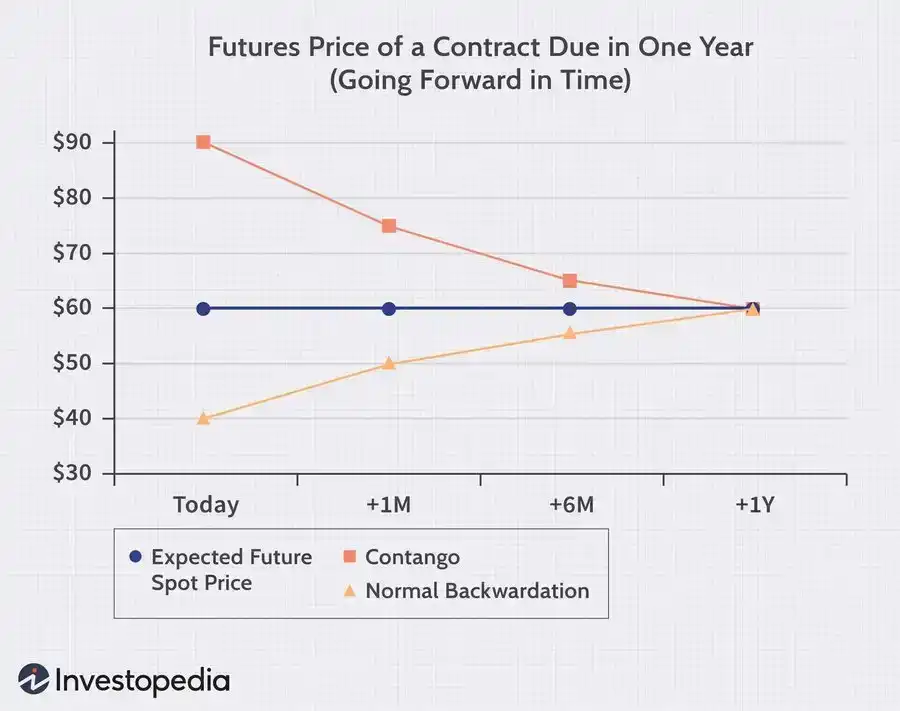
During this rollover period for Trade.xyz's crude oil, the crude oil futures market was in this near-high, far-low structure.
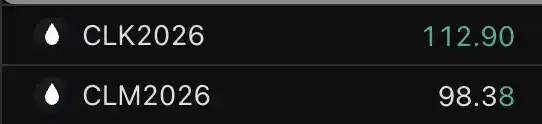
From late March to early April 2026, the WTI crude oil curve was in an extreme state of backwardation. As shown in the chart above, the price of the May contract (front month) remained consistently higher than the June contract (back month), with the spread widening to over $14 at one point.

The WTIOIL-USDC perpetual contract on Trade.xyz has its oracle pegged to this front-month May contract.

But we won't be trading this May contract forever. It must be rolled over to the next June contract. So how is the rollover accomplished?

According to the Tradexyz documentation, the oracle will take 5 trading days to gradually shift the price weighting from 100% front-month contract to 100% back-month contract.
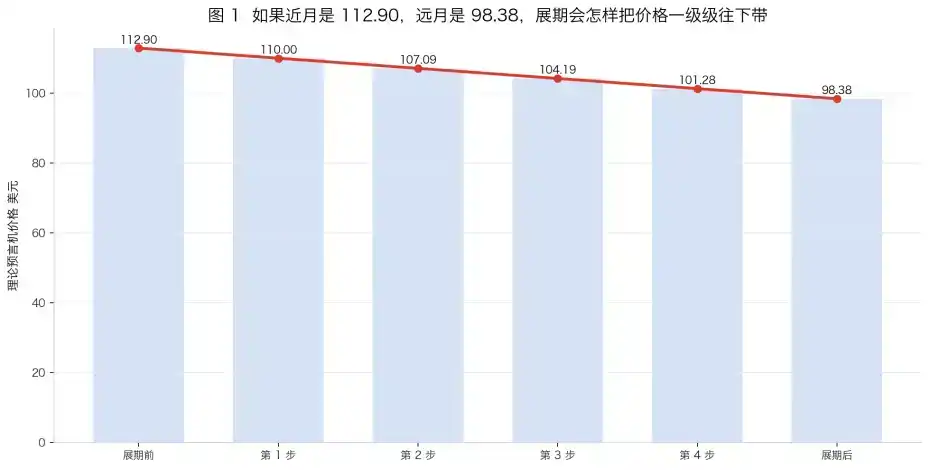
Against the backdrop of "backwardation," this means the oracle price on Tradexyz will drop from the front-month price to the back-month price over 5 trading days.
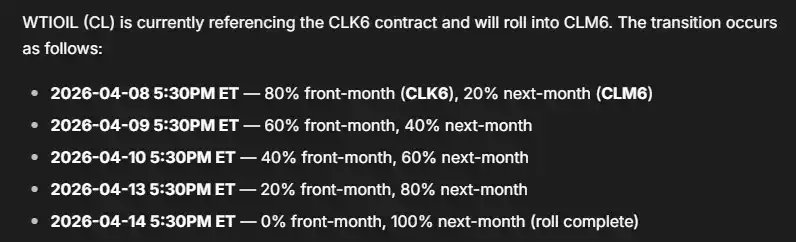
Market participants familiar with this mechanism have a clear expectation of the contract price after the rollover. Everyone knows it will fall, so they naturally rush to short. Shorts accumulate, the funding rate turns negative, and shorts start paying longs.
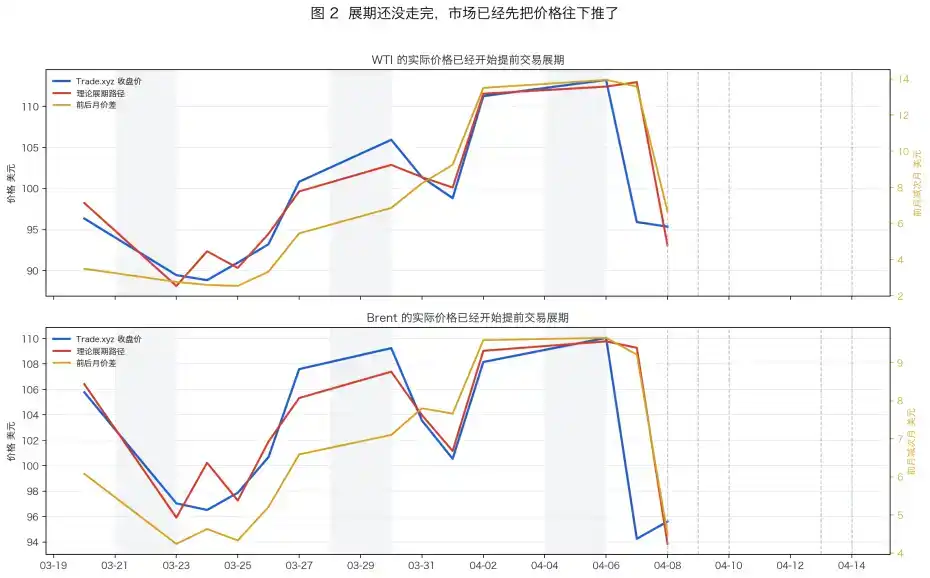
From an arbitrage-free principle perspective, this is normal. The spread between the front and back month gives short sellers a profit. The funding rate will reduce this profit. The larger the spread, the higher the negative funding rate the market charges.

Once the negative funding rate reaches a certain level, this seemingly obvious arbitrage opportunity will be eroded. The cost for short sellers will completely cover the profit.

Strategies

How to make money in such a market context? Here are three common strategies.

1. Short the crude oil contract on Tradexyz at the current price, while simultaneously going long the back-month contract on CME.

This seems like a risk-neutral strategy to stably earn the spread, but it fails to consider several factors.

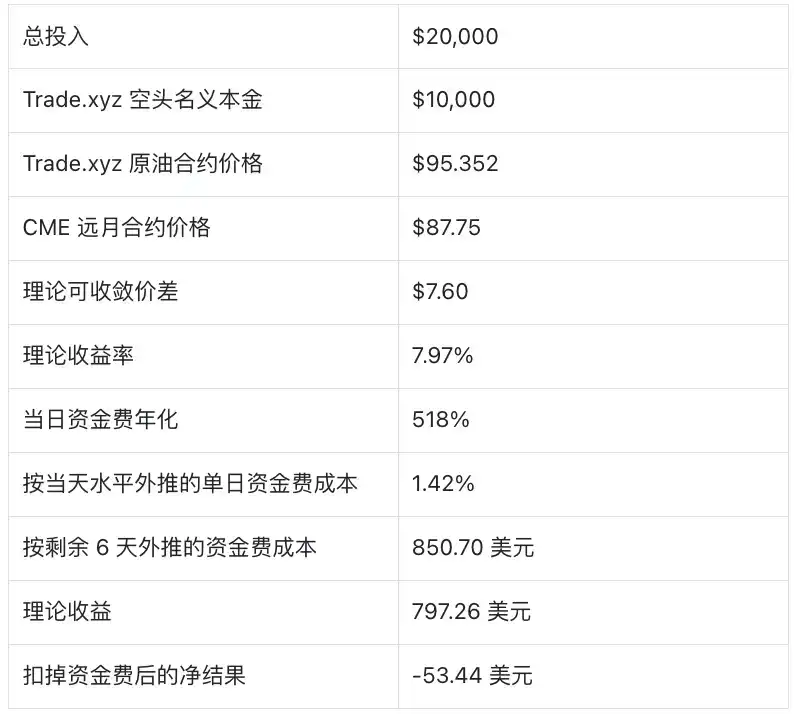
Suppose you short Trade.xyz's WTI contract at $95.352 on April 8th, while going long the June futures contract at $87.75, each with a notional principal of $10,000. If both sides eventually converge, you could theoretically get a spread of $7.60, about $797 in profit. But on April 8th, the daily funding rate for the short position was already 1.42%. Based on the remaining 6 days until rollover completion, the funding fee would cost $851. At this point, the net profit is only -$53. This doesn't even include transaction fees and slippage.
Abraxas capital implemented this strategy starting on March 19th, after the last rollover was completed. Their Brent crude oil position on tradexyz accounted for 20% of the open interest in that market and yielded huge profits early on when the funding rate remained relatively neutral. However, as more arbitrageurs flooded in, the funding fee has devoured 80% of their arbitrage profits.

The massive position also means they find it difficult to exit and are forced to pay passively.

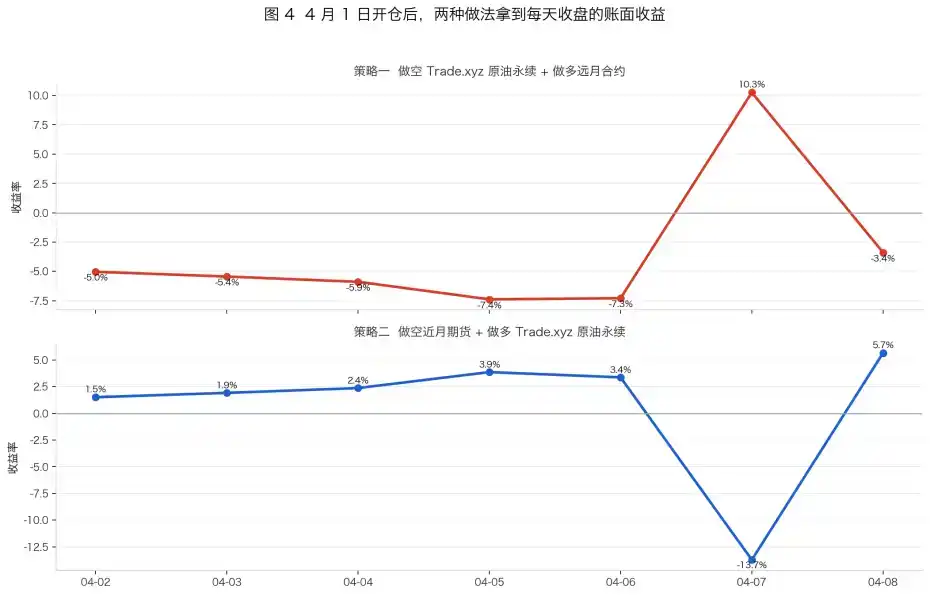
2. Short the back-month futures contract, go long the xyz front-month contract, and close the position before the rollover begins.

This trade is almost the counterparty to Strategy 1, betting that the market is over-arbitraged. After April 1st, this strategy could indeed yield profits.
3. Short the funding rate for the xyz contract on Boros before the rollover begins.

Boros is a market developed by the Pendle team specifically for trading rates (funding rates). In Boros's crude oil contract market, what is traded is the market's expectation of the funding rate for Trade.xyz's crude oil contract over the coming period. If users believe the negative funding rate will deepen further, they can short the market's funding rate contract.
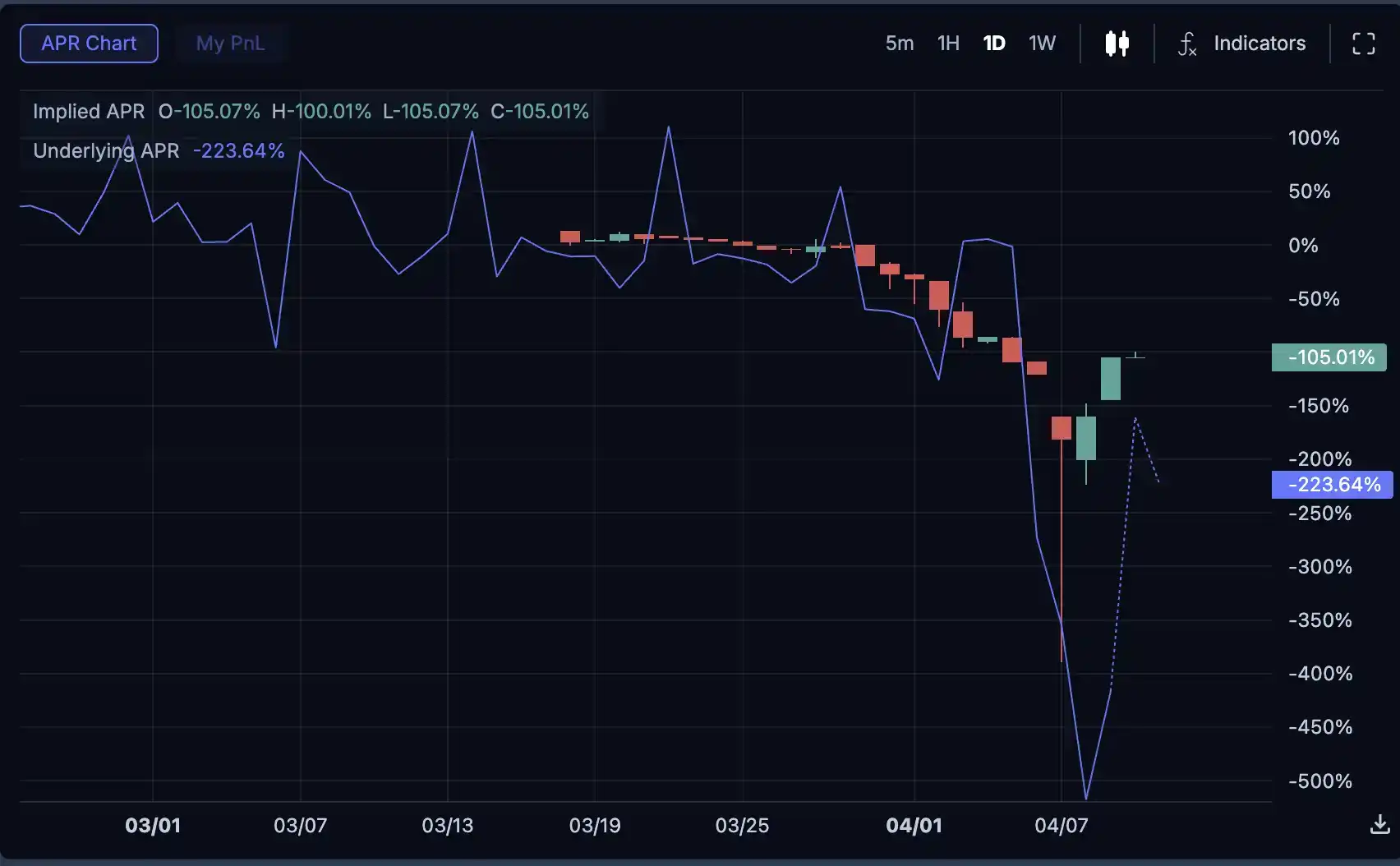
However, limited by slippage costs, position limits, transaction fees, and extremely low capital efficiency (only supporting 0.2x leverage), this trade also struggles to achieve the ideal high returns.

Conclusion

The rise of RWA trading platforms like Trade.xyz is forcing a group of "crypto traders" to become "futures traders." DeFi players are also starting to learn the CME rollover calendar, calculate front-back month spreads, and make decisions based on the funding rate curve on Boros.

Trading platforms are continuously iterating, and market participants are also adapting to new infrastructure.


İlgili Sorular

QWhat is the annualized funding rate for the WTIOIL-USDC perpetual contract on Trade.xyz, and what does it imply for traders?

AThe annualized funding rate for the WTIOIL-USDC perpetual contract on Trade.xyz is between -300% and -400%. This means that traders who take a long position at this time can receive a profit equivalent to approximately 1% of their principal daily, paid by the short sellers.

QWhat market structure is causing the extreme negative funding rate on Trade.xyz's crude oil perpetual contract?

AThe extreme negative funding rate is caused by a market structure called backwardation, where the near-month futures contract (May) is trading at a higher price than the far-month contract (June). This creates an expectation that the price will drop during the rollover period, leading to a surge in short positions and negative funding rates.

QHow does the rollover mechanism work for the WTIOIL-USDC perpetual contract on Trade.xyz?

AAccording to Trade.xyz's documentation, the oracle takes five trading days to gradually shift the price weighting from 100% of the near-month contract to 100% of the far-month contract. During this rollover period in a backwardated market, the oracle price is expected to drop from the higher near-month price to the lower far-month price.

QWhat was one of the strategies mentioned for profiting in this market, and what was its drawback?

AOne strategy was to short the crude oil contract on Trade.xyz while simultaneously going long on the far-month futures contract on CME. The drawback is that the high negative funding rate can consume most of the potential profits from the price difference. For example, a calculation showed that funding fees could cost $851 over six days, nearly erasing the $797 theoretical gain from the price spread, not including transaction costs and slippage.

QWhat is Boros, and how can it be used to trade in this context?

ABoros is a market developed by the Pendle team专门 for trading rates (funding rates). On Boros's crude oil contract market, traders can speculate on the expected funding rate for Trade.xyz's crude oil contract. If a trader believes the negative funding rate will deepen, they can short the funding rate合约 on Boros. However, this strategy is limited by slippage, position caps, trading fees, and low capital efficiency (only supporting 0.2x leverage).

İlgili Okumalar

Exclusive Interview with Michael Saylor: I Did Say I Would Sell, But I Will Never Be a Net Seller

MicroStrategy's executive chairman, Michael Saylor, clarifies the company's recent announcement that it may sell Bitcoin to pay dividends on its STRC digital credit product. He emphasizes this does not make MicroStrategy a net seller of Bitcoin. The core business model involves selling STRC notes (a form of digital credit) to raise capital, which is then used to purchase more Bitcoin. Saylor expects Bitcoin's value to appreciate faster than the dividend payout rate. Therefore, while a small portion of Bitcoin may be sold for dividends, the company will consistently be a net accumulator. For example, in April, the company raised $3.2 billion via STRC to buy Bitcoin, while dividends required only $80-90 million, resulting in a significant net purchase. Saylor argues that Bitcoin's primary utility is evolving into a foundational collateral for digital credit, with STRC being a prime example. He notes that STRC now constitutes a majority of the U.S. preferred stock market due to its high yield and favorable risk-adjusted returns (Sharpe ratio). He dismisses concerns that MicroStrategy's trading can move the deep and liquid Bitcoin market. Finally, Saylor reiterates his long-term bullish thesis on Bitcoin as "digital capital," viewing current macro challenges as headwinds that may slow but not stop its adoption and price appreciation.

Odaily星球日报4 dk önce

Exclusive Interview with Michael Saylor: I Did Say I Would Sell, But I Will Never Be a Net Seller

Odaily星球日报4 dk önce

Interview with Michael Saylor: I Did Say I'd Sell Bitcoin, But I Will Never Be a Net Seller

**Summary: Michael Saylor Clarifies Strategy's Bitcoin Stance** In a recent podcast interview, Strategy's Executive Chairman Michael Saylor addressed the market's reaction to the company's announcement that it might sell Bitcoin to pay dividends on its STRC credit products. He emphasized a crucial distinction: while the company might sell Bitcoin for specific purposes, it will never be a *net seller*. Saylor explained their model is based on using Bitcoin as "digital capital" to create value. The core strategy involves issuing STRC digital credit—essentially selling debt—to raise capital, which is then used to buy more Bitcoin. He estimates Bitcoin appreciates at roughly 40% annually. A small portion of these capital gains (e.g., ~2.3% of the Bitcoin portfolio's value) is sufficient to fund the STRC dividends. Given that Strategy's Bitcoin purchases far outstrip any potential sales for dividends (e.g., buying $3.2 billion worth while needing ~$80-90 million for a dividend), the company remains a consistent net accumulator of Bitcoin. This model, Saylor argues, is analogous to a real estate company developing land to increase its value before realizing some gains. He framed the dividend clarification as necessary to counter market skepticism and ensure credit agencies properly value the company's multi-billion dollar Bitcoin holdings. Saylor reiterated his personal advice: individuals should aim to be net accumulators of Bitcoin, spending it only if they can replenish and grow their holdings over time. Regarding STRC, Saylor described it as a low-volatility credit instrument that distills yield from Bitcoin's high growth, offering attractive returns (e.g., ~11-12% yield) for risk-averse investors. He noted that Strategy's STRC issuance now constitutes about 60% of the U.S. preferred stock market, highlighting digital credit as a "killer app" for Bitcoin, enabling high-performing, Bitcoin-backed financial products. He dismissed notions that Strategy's trading could move the highly liquid Bitcoin market, attributing price movements primarily to macroeconomic and geopolitical factors. Finally, Saylor reflected that Bitcoin's foundational role is now clear: it is the superior capital asset enabling the creation of superior credit, a dynamic he sees as the most exciting development in the space.

marsbit11 dk önce

Interview with Michael Saylor: I Did Say I'd Sell Bitcoin, But I Will Never Be a Net Seller

marsbit11 dk önce

380,000 Apps Exposed, 2,000+ Apps Leaked Secrets: AI Programming Turns 'Intranet' into Public Internet

Israeli cybersecurity firm RedAccess uncovered a severe data exposure trend linked to "vibe coding" or AI-powered software development tools. Their research found approximately 38,000 publicly accessible web applications built with platforms like Lovable, Base44, Netlify, and Replit. Of these, an estimated 2,000 apps exposed sensitive corporate and personal data, including medical records, financial information, internal strategic documents, and customer chat logs. In some cases, access even granted administrative privileges. The core issue stems from default privacy settings that make applications public by default, combined with a lack of built-in security controls (like authentication) in the AI-generated code. This allows employees without security expertise—"citizen developers"—to easily create and deploy applications that bypass standard corporate security reviews. The exposed apps, often indexed by search engines, are trivially discoverable. While some platform providers (Replit, Lovable, Wix/Base44) argue that security configuration is the user's responsibility and question the validity of some findings, security researchers confirm the widespread reality of such exposures. This pattern, also noted in prior studies, highlights a critical security gap as AI democratizes app creation, potentially leading to massive, unintentional data leaks.

marsbit1 saat önce

380,000 Apps Exposed, 2,000+ Apps Leaked Secrets: AI Programming Turns 'Intranet' into Public Internet

marsbit1 saat önce

Attracting Global Capital, Asia's New 'Super Cycle' Is Unfolding

Investors are turning to Asia as the next frontier for global equity growth, with a new "super cycle" unfolding across the region. Driven by the AI revolution, Asian markets, particularly South Korea, have seen significant rallies. According to Morgan Stanley analysis, the underlying drivers of Asia's industrial cycle are shifting from traditional sectors like real estate and manufacturing to massive investments in AI infrastructure, energy security and transition, and supply chain resilience. Fixed asset investment in Asia is projected to grow from around $11 trillion in 2025 to $16 trillion by 2030, with a 7% annual growth rate from 2026-2030. The AI wave is a primary catalyst, driving immense capital expenditure for chips, servers, data centers, and power systems. Asia is central to this hardware supply chain. In China, AI investment is focused on building a full-system domestic capability, with the local AI chip market potentially reaching $86 billion by 2030. Beyond AI, China's export story is expanding from EVs and batteries to robotics. The country already captures about half of new global industrial robot demand and over 90% of humanoid robot shipments. This growth phase mirrors the early stages of China's EV export boom. Simultaneously, energy security investments, spurred by AI's massive power needs, are rising, with China benefiting from its leadership in solar, batteries, and EVs. Regional defense spending is also increasing structurally, supporting demand for advanced manufacturing. The main beneficiaries are China, South Korea, and Japan, positioned in core supply chain areas. However, risks remain, including potential overcapacity, profit margin pressures from competition, persistent technological restrictions, geopolitical friction, and workforce displacement due to AI-driven automation. Market volatility is also expected to increase as investor expectations diverge on the realization of these capital investment and export themes.

marsbit1 saat önce

Attracting Global Capital, Asia's New 'Super Cycle' Is Unfolding

marsbit1 saat önce

İşlemler

Spot
Futures

Popüler Makaleler

WAR Nasıl Satın Alınır

HTX.com’a hoş geldiniz! WAR (WAR) satın alma işlemlerini basit ve kullanışlı bir hâle getirdik. Adım adım açıkladığımız rehberimizi takip ederek kripto yolculuğunuza başlayın. 1. Adım: HTX Hesabınızı OluşturunHTX'te ücretsiz bir hesap açmak için e-posta adresinizi veya telefon numaranızı kullanın. Sorunsuzca kaydolun ve tüm özelliklerin kilidini açın. Hesabımı Aç2. Adım: Kripto Satın Al Bölümüne Gidin ve Ödeme Yönteminizi SeçinKredi/Banka Kartı: Visa veya Mastercard'ınızı kullanarak anında WAR (WAR) satın alın.Bakiye: Sorunsuz bir şekilde işlem yapmak için HTX hesap bakiyenizdeki fonları kullanın.Üçüncü Taraflar: Kullanımı kolaylaştırmak için Google Pay ve Apple Pay gibi popüler ödeme yöntemlerini ekledik.P2P: HTX'teki diğer kullanıcılarla doğrudan işlem yapın.Borsa Dışı (OTC): Yatırımcılar için kişiye özel hizmetler ve rekabetçi döviz kurları sunuyoruz.3. Adım: WAR (WAR) Varlıklarınızı SaklayınWAR (WAR) satın aldıktan sonra HTX hesabınızda saklayın. Alternatif olarak, blok zinciri transferi yoluyla başka bir yere gönderebilir veya diğer kripto para birimlerini takas etmek için kullanabilirsiniz.4. Adım: WAR (WAR) Varlıklarınızla İşlem YapınHTX'in spot piyasasında WAR (WAR) ile kolayca işlemler yapın.Hesabınıza erişin, işlem çiftinizi seçin, işlemlerinizi gerçekleştirin ve gerçek zamanlı olarak izleyin. Hem yeni başlayanlar hem de deneyimli yatırımcılar için kullanıcı dostu bir deneyim sunuyoruz.

156 Toplam GörüntülenmeYayınlanma 2024.12.11Güncellenme 2026.04.28

WAR Nasıl Satın Alınır

Tartışmalar

HTX Topluluğuna hoş geldiniz. Burada, en son platform gelişmeleri hakkında bilgi sahibi olabilir ve profesyonel piyasa görüşlerine erişebilirsiniz. Kullanıcıların WAR (WAR) fiyatı hakkındaki görüşleri aşağıda sunulmaktadır.

活动图片












