Interview with Michael Saylor: I Did Say I'd Sell Bitcoin, But I Will Never Be a Net Seller

marsbit2026-05-11 tarihinde yayınlandı2026-05-11 tarihinde güncellendi

Özet

**Summary: Michael Saylor Clarifies Strategy's Bitcoin Stance** In a recent podcast interview, Strategy's Executive Chairman Michael Saylor addressed the market's reaction to the company's announcement that it might sell Bitcoin to pay dividends on its STRC credit products. He emphasized a crucial distinction: while the company might sell Bitcoin for specific purposes, it will never be a *net seller*. Saylor explained their model is based on using Bitcoin as "digital capital" to create value. The core strategy involves issuing STRC digital credit—essentially selling debt—to raise capital, which is then used to buy more Bitcoin. He estimates Bitcoin appreciates at roughly 40% annually. A small portion of these capital gains (e.g., ~2.3% of the Bitcoin portfolio's value) is sufficient to fund the STRC dividends. Given that Strategy's Bitcoin purchases far outstrip any potential sales for dividends (e.g., buying $3.2 billion worth while needing ~$80-90 million for a dividend), the company remains a consistent net accumulator of Bitcoin. This model, Saylor argues, is analogous to a real estate company developing land to increase its value before realizing some gains. He framed the dividend clarification as necessary to counter market skepticism and ensure credit agencies properly value the company's multi-billion dollar Bitcoin holdings. Saylor reiterated his personal advice: individuals should aim to be net accumulators of Bitcoin, spending it only if they can replenish and g...

Article Source: David Lin

Compiled by | Odaily Planet Daily (@OdailyChina); Translator | Azuma(@azuma_eth)
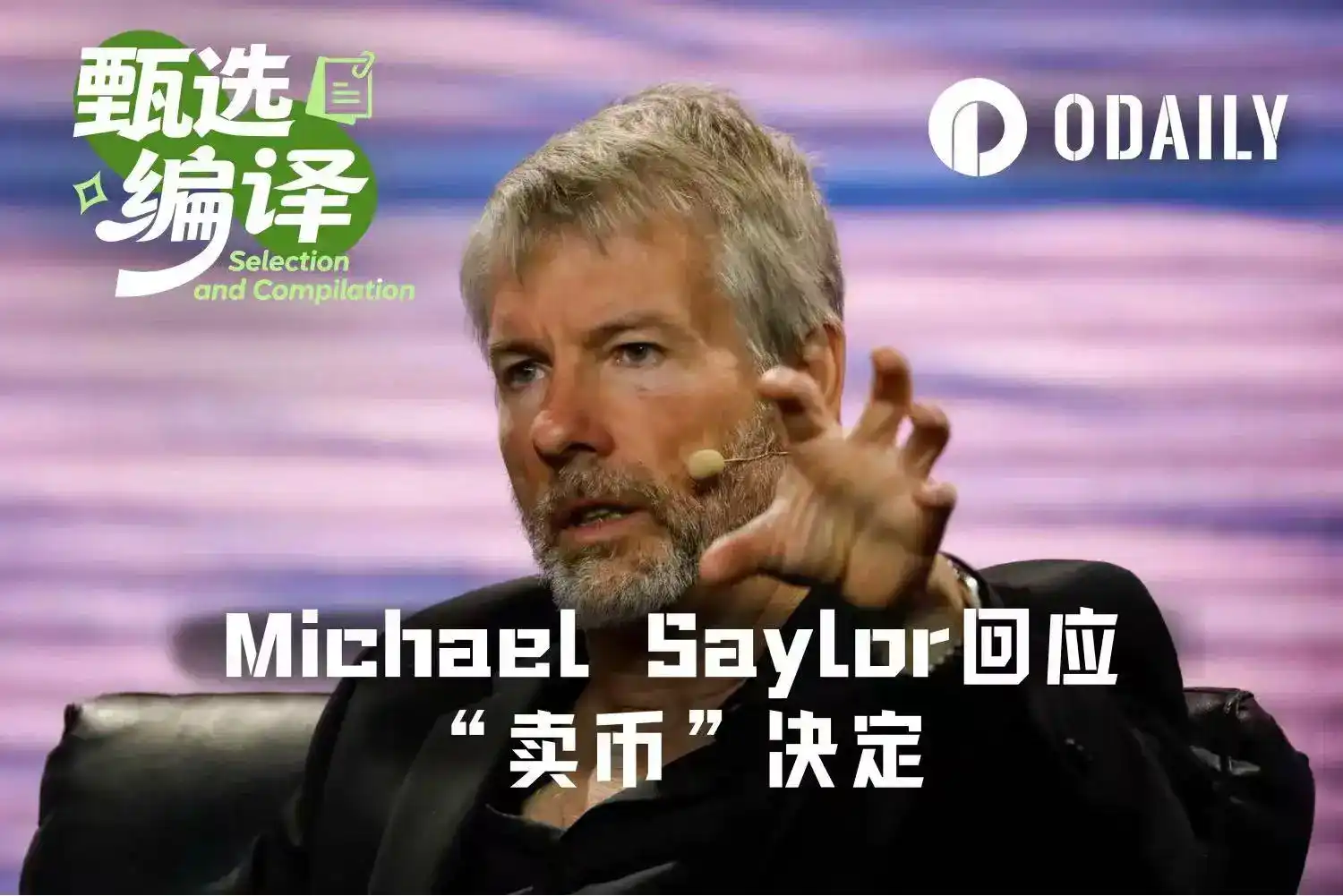
Editor's Note: During last Monday's earnings call, MicroStrategy first mentioned being "prepared to sell Bitcoin if necessary to pay dividends," a statement that immediately sparked intense market debate about its "abandonment of faith."

In response, MicroStrategy Executive Chairman Michael Saylor recently provided an in-depth analysis of the underlying logic behind this decision while appearing on David Lin's podcast, emphasizing that he only said "will sell," not "will be a net seller." Saylor also mentioned that MicroStrategy is leveraging Bitcoin's exceptional appreciation property as "digital capital" to achieve arbitrage by issuing digital credit instruments (like STRC), thereby ensuring the continuous net growth of its holdings. Below is the full content (edited) of the podcast, compiled by Odaily Planet Daily.

Podcast Interview

David Lin (Host A): It is my great honor to co-host this exciting interview with MicroStrategy Executive Chairman Michael Saylor, and my co-host is Bonnie Chang. We'll start with MicroStrategy's recent announcement and Michael Saylor's posts on social media. Bonnie, let's begin.

Bonnie Chang (Host B): Last week you announced something that shocked the entire world.

Michael Saylor: Uh, you're probably referring to our statement on the earnings call — we are prepared to sell Bitcoin if necessary to pay STRC dividends.

Bonnie Chang: I believe that was a carefully considered decision. What was the thinking behind it?

Michael Saylor: The most important point is that we want the market to understand that Bitcoin's capital gains can be used to fund credit dividends. When we sell $1 million worth of STRC credit products, we turn around and buy $1 million worth of Bitcoin. Our expectation for Bitcoin is about 30% annual appreciation, and in reality, it's closer to 40% per year. We can strip out roughly the initial 11% of those capital gains and pay that out as dividends.

The market was confused about what we would use to pay dividends. For most of history, we paid dividends by selling common stock (MSTR equity). MSTR equity is a derivative of Bitcoin and typically trades at a premium to Bitcoin. So, we were selling a Bitcoin derivative, but some people worried we might not be able to sell equity in the future.

Then there were bearish arguments saying we would have to sell equity; others said the company would never sell its Bitcoin. These arguments devolved into — 'Well, if they don't intend to sell Bitcoin, then Bitcoin must have no value, they can never sell it. And if they can't sell it, then we can't count Bitcoin as an asset on the balance sheet.'

If you own something worth $65 billion and people want to value it at zero, that's not great, right? We don't want credit rating agencies to think the company's assets are zero. We want them to think we have $65 billion in assets. Also, online there were these 'haters' constantly complaining it's a Ponzi scheme because we funded the preferred stock dividends by selling equity.

What we want to do is reinforce this business model — selling credit to invest in Bitcoin; over time, that investment appreciates faster than the dividends accumulate; then we realize those capital gains and pay the dividends.

We thought the best way to clarify this was to state clearly that 'the company will never need to sell common stock,' we can just sell Bitcoin, which has appreciated significantly, to pay dividends. That is essentially using capital gains to pay credit dividends.

I think it's like a real estate development company that raises money by issuing credit instruments, buys land at $10,000 an acre, develops it, making it worth $100,000 an acre, then realizes that capital appreciation. You could sell the land at $100,000 an acre, lease it after full development, or refinance it. No one questions a real estate development company that makes capital investments with credit proceeds, and we are doing the same thing with Bitcoin. We need to ensure the market understands this.

I became famous for saying 'never sell your Bitcoin,' which is why the internet exploded when they heard we might sell. But if I were more precise, it should be 'never be a net seller of Bitcoin.' It's just that 'never be a net seller' isn't as catchy or easy to spread.

I think in these times, even if we were to sell 1 Bitcoin, we would buy 10 to 20 more. So, you're talking about a situation of 'buy 10, sell 1, net buy 9.' Once people understand, it shouldn't be an issue anymore, but for now, it's a controversial topic.

Bonnie Chang: Can you explain how you can sell 1 Bitcoin while buying 10?

Michael Saylor: Yes. MicroStrategy's primary Bitcoin accumulation engine is STRC. We sold $3.2 billion worth of STRC in April, so we bought $3.2 billion worth of Bitcoin. The dividend is around $80 to $90 million. So, in this month where we raised $3 billion, we only need $80 or $90 million to pay the dividend — essentially, you're buying 30 Bitcoin while selling 1.

Our 'break-even rate' is roughly 2.3%. This means that if the credit debt we issue equals 2.3% of our Bitcoin holdings, then even if we sell Bitcoin to pay dividends, we will always be a net buyer of Bitcoin. Another point is, if Bitcoin appreciates 2.3% annually, we can pay dividends permanently and continuously create value, all without selling any common stock.

In the first four months of this year, we've already sold about $5 billion worth of STRC. At that rate, the issuance rate for the year will be 15% to 20%. As long as the company is growing, it will buy more Bitcoin than it sells. I anticipate that in every month and quarter going forward, we will be a net buyer of Bitcoin.

Bonnie Chang: I have another question. Many investors adhere almost religiously to the advice 'never sell Bitcoin.' Do you think they should still follow that advice?

Michael Saylor: Yes, I think you should be a 'net accumulator' of Bitcoin. When I said 'never sell your Bitcoin,' I meant if you're going to spend it on something, make sure you replenish it after spending.

Many crypto or Bitcoin believers say they want to buy things with Bitcoin. I'd say, fill the gap after spending. Don't be a net seller of Bitcoin because Bitcoin is capital. At the end of every year, you should have more Bitcoin than you started with.

To draw an analogy, if Google spends $1 billion building a data center and makes $10 billion from it, they net $9 billion. That doesn't crash the dollar market, right? No one gasps 'Google sold dollars to buy a data center.' The dollar will be fine; it doesn't undermine Google's business model. They spent $1 billion investing in the business — that's normal, it's rational. Sometimes you spend money to make more money.

So, if you spend 1 Bitcoin to make 10 Bitcoin, I think that's good for Bitcoin and good for the company... When equity capital markets are less liquid than the Bitcoin market, we want to be able to utilize that market.

Whenever a company takes options off the table, saying 'we will never ever do something,' whatever it is, regret is often the result. For example, if we said we 'absolutely will never repurchase our own stock, we will only sell stock,' then short sellers would hammer our stock down to $1. When the stock price is at a huge discount to net asset value (NAV), if we can buy it back, those short sellers would lose a lot. By exploiting their irrationality, we can make a lot of money.

So, what we were really saying on the earnings call is — we'll trade STRC for MSTR, we'll trade BTC for MSTR, we'll use BTC or MSTR to pay dividends, we'll do whatever is in the company's best interest. But over time, we expect to be a net accumulator of Bitcoin. This doesn't change how we trade assets day-to-day. Whether we sell credit debt, sell equity, or sell Bitcoin capital will depend on market conditions and mispricing.

The other thing we said yesterday is that we are prepared to repurchase our bonds. Currently, our corporate debt is trading cheap, undervalued, so it makes sense to buy it back, not to sell it. We won't sell undervalued assets; we will buy undervalued assets and arbitrage any opaque inefficiencies. If the market knows we will do this, the market will assign a fair value to all these assets. That benefits investors in all these instruments and, ultimately, that's our fiduciary duty.

David Lin: One of your biggest critics, Peter Schiff, wrote this morning: 'Yesterday, Saylor admitted MSTR (MicroStrategy) would sell Bitcoin if needed to pay STRC dividends. I think that pledge is meant to keep the so-called Ponzi scheme going a bit longer. But I'm guessing when push comes to shove, he'll opt to suspend the dividend and let STRC collapse rather than let Bitcoin collapse.' What is your response to that?

Michael Saylor: Peter thinks Bitcoin is a Ponzi scheme. Peter doesn't really like anything in this space. Bitcoin is 'digital capital,' and we've created a digital finance company by selling equity and credit instruments to buy that capital. I think Bitcoin will persist because it represents tokenized global economic wealth with full property rights.

We built a credit instrument, STRC, on top of it, which simply strips out volatility, reduces risk, and extracts or 'distills' yield from the digital capital. If you don't acknowledge Bitcoin as legitimate, you'll never acknowledge any derivative on it as legitimate. But for those who believe Bitcoin can store economic wealth in tokenized form, what we're doing is very straightforward.

STRC employs an overcollateralization model: for every $5 of Bitcoin, sell $1 of credit debt, and that $1 of credit debt has a clear yield. There are many people who believe Bitcoin is a legitimate asset but just can't stomach its volatility. They don't want to put money for their child's fall tuition into Bitcoin because they have to pay in 12 weeks. So, for them, digital credit makes a lot of sense because the principal is protected, more stable. Plus, they can get 3 to 4 times the yield of money markets through STRC, which is a trait of Bitcoin being superior to other capital assets, allowing us to pay this high dividend yield.

David Lin: Here's a theory I'd like to ask you about, then I'll hand it back to Bonnie. Some traders have noticed that whenever STRC pays a dividend, the ex-dividend price trades below par for a period (maybe a day or two). Once it reaches par, that's when MicroStrategy goes to buy Bitcoin. So, they've started 'front-running' by buying Bitcoin before STRC reaches par, betting that you and MicroStrategy will buy Bitcoin at par. Can you comment on that?

Michael Saylor: What happens near the dividend date is that demand for STRC is huge because there's about a 90-cent dividend after the record date. So, there are billions, tens of billions of dollars of STRC traded before the record date, and the day after the record date, it trades down 60 or 70 cents, then gradually recovers to par over the next week or two.

So that's normal. Those people are arbitrageurs. Their idea is that by tying up capital for about 12 days a year, they can capture roughly a 42% annualized yield. They have their own calculations. That's fine; it's good for us too because it creates liquidity and engagement, and it will continue.

As for the second idea, can you front-run the Bitcoin market? The Bitcoin derivatives market has $50 billion in daily volume. So, I don't think anyone has enough capital to move that market.

My view is that Bitcoin is a bit like 'the square of tech capital.' The factors driving the Bitcoin market are trade wars, hot wars, foreign policy, national situations, the Iranian situation in the Strait of Hormuz, then currency wars — like whether we expect SOFR to drop to 200 basis points or if the yield curve is being twisted. You can see that right now we are in a fairly tight monetary environment, so these macro factors are the main drivers of Bitcoin.

I can tell you as a fact, we have bought $100 million worth of Bitcoin in an hour, and it didn't move the price; we've bought $200 million in an hour, and it didn't move the price; we've bought $200 or $300 million in an hour and stopped, and the price actually went up.

So, no one has enough power to move the price of Bitcoin... Well, if you're going to throw $30 billion at the market in an afternoon, maybe. But I've spent a lot of money; we've bought more Bitcoin than anyone I know, we've probably bought $62 billion worth. I believe it's a global market with its own momentum.

So, statements about us being able to influence the price are flattering, but I don't think so.

Bonnie Chang: Why do you say the price doesn't budge when you buy so much Bitcoin?

Michael Saylor: Because the market liquidity is extremely deep. Suppose I were to buy $1 billion today; even that is only 1/50th of a $50 billion volume.

If you ask traders, they'll say spot market daily volume is sometimes $20 billion, and derivatives sometimes hit $80 billion. In a market with such deep liquidity, what is $100 million? That's the beauty of it. On the weekend, if you want to put on a $1 billion position with 20x leverage, you can do it in the Bitcoin market; if you want a $1 billion credit line within an hour, you can get it in the Bitcoin market.

I do think macro factors drive Bitcoin, and sometimes Bitcoin has a life of its own. Micro factors also drive it — I mean industry factors, like the formation of digital credit, the formation of bank credit, and investor sentiment towards Bitcoin assets. But I think Bitcoin is more powerful than all of us, and that's why we have confidence in it — because no single participant can prop it up or hold it back.

David Lin: If the Strait of Hormuz remains closed for the foreseeable future, several forces will intertwine. First, some say inflationary pressures will persist; second, the Fed may eventually need to cut rates because they are trapped by high inflation. So, what ultimately happens to liquidity? What happens to Bitcoin if the Fed remains trapped?

Michael Saylor: I think when you're facing tight monetary policy, high global trade tensions, and high geopolitical tensions due to foreign policy or war (whether in Ukraine or Iran), all of these are somewhat constraining; they are headwinds. I think when these reverse, they become tailwinds.

But regardless, Bitcoin will grind up. This is because the organic supply from miners is only about $10 to $12 billion per year, only 450 Bitcoin per day. Do the math yourself. Then, whenever we raise another $10 billion in capital, we've bought up the entire year's supply. So, if a bank creates $10 billion in credit, that's 'one turn of the axle'; if we sell $10 billion in STRC digital credit, that's 'a second turn of the axle'; when $10 billion flows into IBIT (BlackRock's Bitcoin spot ETF), that's 'a third turn of the axle.'

So, capital flows, digital credit, digital capital wrapper tools, and bank credit — all of these are driving the market's fundamentals, and they are all positive. Regardless of macro factors, you'll see continued adoption. The role of macro winds is just that, when we should grind up 30%, tailwinds make us surge to 50%, while headwinds somewhat slow us down.

David Lin: Has your logic for Bitcoin changed?

Michael Saylor: No change. But I would say it's now clear that Bitcoin is 'digital capital,' and over the past 12 months, one thing has become very clear — one of Bitcoin's killer applications is digital credit.

Many people have wondered, what is the killer app for a $1.5 trillion asset class with hundreds of billions in daily trading volume? The answer is: collateral for credit. Since digital capital is the best-performing capital asset (and it is), outperforming the S&P 500 by two to three times, then it follows that we can create the best-performing credit assets on top of this capital asset.

What we've seen over the past year is that STRC is the most liquid credit instrument; it's the most liquid preferred stock in the entire market and the largest preferred stock in the market. It has the highest Sharpe ratio. We've successfully created an instrument with a Sharpe ratio of 3 and a dividend yield of 11% to 12%.

The highest Sharpe ratio in stocks is Nvidia, around 1.7; the S&P 500 is about 0.9... nothing exceeds 1. Even the top hedge funds you can find can't exceed a Sharpe ratio of 2.2.

So, digital credit actually has better risk-adjusted returns than all other financial strategies and all publicly traded instruments in the public capital markets. I couldn't have told you this 12 months ago. But now the logic works — if Bitcoin is the best-performing capital, then convertible bonds backed by Bitcoin become the best-performing convertibles, and credit instruments like STRCh, become the best-performing preferred stock.

By the way, do you know what percentage of the preferred stock market we accounted for this year?

Bonnie Chang: I'd guess over 70%?

Michael Saylor: 60% of all preferred stock issued in the United States this year was issued by us. Last year and this year, we are the largest credit issuer in the US. We revived the preferred stock market; STRC has grown explosively.

So, I think what's novel is the idea of 'digital capital drives digital credit.' As you see on the show, digital credit is a stepping stone to digital currency. Because now there's a whole host of stable yield coins/tokens pegged to the dollar paying 8% or 9% yields. Apex created one, growing from 0 to $300 million in 8 weeks; Saturn created another, growing from 0 to $110 million in 6 weeks.

There's been an explosion of innovation in digital assets, crypto, and traditional finance driven by digital credit. And Bitcoin is the foundational rock that makes digital credit possible. That might be the most exciting thing this year.

Bonnie Chang: One last question. Did 'Have Space Suit—Will Travel' inspire you to go to MIT? Let's go back before MIT, before this book and Bitcoin. Say something to your younger self.

Michael Saylor: You know, when I was in first grade, my parents wanted to motivate me; they told me they'd give me 10 cents for every book I read. I was addicted to comic books at the time, and I remember comic books cost 25 cents each. So the calculation was, I had to read two and a half 'real books' to get one comic book. I was highly motivated.

That summer I read about 100 books. I'd go to the library and check out 10 at a time. Then I discovered science fiction, discovered Heinlein, Clark, and Asimov. I read 'The Moon is a Harsh Mistress' and 'Have Space Suit—Will Travel' before third grade. By third or fourth grade, I had devoured them all.

I'd say reading those science fiction books drove my intellectual development. Grade school boys are very impressionable. I remember in 'Have Space Suit—Will Travel,' the protagonist is an alpha male. He fixes a space suit, gets picked up by a ship, travels the universe, and saves humanity from 'bug-eyed monsters.' What's the reward for saving humanity? He gets a full scholarship to MIT. I thought, if MIT is good enough for the hero who saved humanity, it's probably good enough for me. So, come hell or high water, I was going there.

David Lin: If Elon Musk invited you to Mars, would you accept?

Michael Saylor: That would depend on what kind of vehicle he offers to take me there.

Trend Kriptolar

İlgili Sorular

QWhat is the key distinction Michael Saylor makes between selling Bitcoin and being a 'net seller' of Bitcoin for MicroStrategy?

AMichael Saylor clarifies that while MicroStrategy may sell some Bitcoin to pay dividends on its STRC credit product, the company will remain a 'net accumulator' or 'net buyer' of Bitcoin. This means for every Bitcoin sold, the company will buy back many more, ensuring its overall Bitcoin holdings increase over time. He uses the example of selling $1 in Bitcoin for dividends after buying $10 to $20 worth, resulting in a net gain.

QAccording to Saylor, what is the 'break-even rate' for MicroStrategy's STRC issuance, and what does it signify?

AThe 'break-even rate' is approximately 2.3%. It signifies that if MicroStrategy issues credit debt (like STRC) equal to 2.3% of its total Bitcoin holdings, the yield from that debt issuance will be sufficient to cover the dividend payments. Therefore, even if the company sells Bitcoin to pay those dividends, it can still be a perpetual net buyer of Bitcoin without needing to sell any equity, as long as Bitcoin appreciates at least 2.3% annually.

QHow does Michael Saylor characterize Bitcoin's primary 'killer app' that has become clear in the last 12 months?

ASaylor states that Bitcoin's primary 'killer app' is serving as collateral for 'Digital Credit.' He explains that as the best-performing capital asset, Bitcoin enables the creation of superior credit instruments. MicroStrategy's STRC, a digital credit tool, exemplifies this by offering high yields (11-12%) with a high Sharpe ratio, making it one of the top-performing preferred shares in the market.

QWhy does Michael Saylor believe individual or institutional buying pressure does not significantly move the Bitcoin market price?

ASaylor attributes this to the Bitcoin market's immense depth and liquidity. He cites daily trading volumes of hundreds of billions of dollars across spot and derivatives markets. Even large purchases by MicroStrategy (e.g., hundreds of millions in an hour) are a small fraction of the total daily volume. Therefore, he argues that macro factors like geopolitics and monetary policy, not individual actors, are the primary drivers of Bitcoin's price.

QWhat was the childhood inspiration that motivated Michael Saylor to attend MIT?

ASaylor was inspired by the science fiction book 'Have Space Suit—Will Travel' by Robert A. Heinlein. In the story, the protagonist saves humanity and is rewarded with a full scholarship to MIT. As a young boy, Saylor reasoned that if MIT was good enough for a fictional hero, it was good enough for him, which solidified his determination to attend the university.

İlgili Okumalar

Just now, DeepSeek V4 updates with DSpark, improving inference speed by 80%

DeepSeek has updated its DeepSeek V4 model with the DSpark speculative decoding framework, achieving a significant 60-85% speedup in generation for Flash models and 57-78% for Pro models while maintaining the same overall throughput. This engineering-focused update, rather than a core architectural change, introduces DSpark to address latency and throughput bottlenecks in high-concurrency production environments. DSpark combines high-throughput parallel generation with adaptive load-aware verification. Its key innovations include a semi-autoregressive generation architecture to model dependencies within token blocks and a hardware-aware confidence-scheduled verification system. This system uses a confidence head to predict token acceptance probabilities, allowing it to dynamically optimize verification length per request and allocate compute only to tokens with the highest expected payoff. The asynchronous scheduler is designed for real-world deployment, ensuring zero-overhead scheduling and continuous CUDA graph replay while preserving the target model's output distribution. In tests across mathematical reasoning, code generation, and daily dialogue, DSpark outperformed state-of-the-art models like Eagle3 and DFlash, increasing average acceptance length by 26.7%-30.9% and 16.3%-18.4% respectively on Qwen3 target models. DeepSeek also open-sourced DeepSpec, a full-stack codebase for training and evaluating speculative decoding draft models, providing a standardized toolkit that includes data preparation tools, model implementations, training code, and evaluation scripts.

marsbit2 saat önce

Just now, DeepSeek V4 updates with DSpark, improving inference speed by 80%

marsbit2 saat önce

BIT Research: The 2028 Halving Is Not the End, the Real Shake-Up of the Bitcoin Mining Industry Is Just Beginning

The Bitcoin mining industry is undergoing its most complex structural adjustment since inception. Despite Bitcoin's price holding near $61,000 and the network hash rate approaching a record 1 ZH/s, miner profitability is deteriorating. The industry is operating close to its breakeven point, with the 2028 halving expected to accelerate consolidation. The challenges extend beyond the halving's subsidy reduction; the industry's revenue model has yet to successfully transition towards a fee-driven structure. Increasingly, mining companies are evolving from simple Bitcoin producers into infrastructure and energy operators, including providers of AI/HPC computing power. Competition is shifting from pure hash rate expansion to business model upgrades. Economic pressure is evident. The theoretical daily mining revenue at current prices is around $78 million, yet the actual figure is only about $33 million—a 136% gap. Transaction fees remain low at roughly $220k daily, far below historical implied levels. With a current estimated industry-wide breakeven price near $65,000, mining alone is struggling to generate ideal profits. The 2028 halving is projected to push the fundamental production cost floor to approximately $93,289. This will likely accelerate a shift towards consolidation among larger, well-capitalized miners with diversified revenue streams. Competitive advantage will belong to institutionalized players with access to low-cost energy, AI/HPC hosting operations, and stronger balance sheets. In essence, Bitcoin mining is transitioning from a "mining business" to an "infrastructure business." Future profitability and resilience will depend less on block rewards and more on diversified income sources like energy management and computational infrastructure services. For investors, the key question is not the halving itself, but which miners can successfully navigate this business model transformation.

marsbit4 saat önce

BIT Research: The 2028 Halving Is Not the End, the Real Shake-Up of the Bitcoin Mining Industry Is Just Beginning

marsbit4 saat önce

This is How God Karpathy Uses Claude?

Andrej Karpathy, a prominent figure in AI, has reportedly joined Anthropic, leading to a noticeable decrease in his open-source contributions and social media activity. A document claiming to be his personal "CLAUDE.md" file—a set of instructions for the Claude AI to follow within a specific codebase—has been circulating online. While its authenticity is unverified, the content aligns closely with Karpathy's publicly shared principles on effective AI-assisted programming. The document outlines key rules for AI coding assistants, emphasizing the importance of reading existing code thoroughly before writing new code to maintain consistency. It advises against over-engineering, advocating for simple, surgical modifications that match the project's existing style. Other guidelines include clarifying assumptions upfront, writing meaningful tests, thoughtful debugging, and carefully considering dependencies. The core message is that these principles help prevent common AI coding failures, such as introducing unnecessary abstractions, style drift, or making invisible architectural decisions. The community has noted that even experts like Karpathy require detailed instructions to guide AI effectively, akin to managing a junior developer. A related GitHub repository, "andrej-karpathy-skills," which encapsulates these ideas, is reported to significantly reduce Claude's code error rate. Ultimately, the advice stresses that the best CLAUDE.md is tailored to one's own tech stack and coding practices.

marsbit4 saat önce

This is How God Karpathy Uses Claude?

marsbit4 saat önce

İşlemler

Spot

Popüler Makaleler

BITCOIN Nedir

HarryPotterObamaSonic10Inu (ERC-20)'yu ve Kripto Alanındaki Yerini Anlamak Son yıllarda, kripto para piyasası, hem ticaret yapanların hem de topluluk etkileşimi ve eğlence değeri arayanların ilgisini çeken meme coin'lerin popülaritesinde bir artış gördü. Bu benzersiz token'lar arasında, kripto para dokusuna kültürel referansları harmanlayan ilginç bir proje olan HarryPotterObamaSonic10Inu (ERC-20) bulunmaktadır. Bu makale, HarryPotterObamaSonic10Inu'nun temel yönlerini, mekanizmalarını, topluluk odaklı ethosunu ve daha geniş kripto manzarasıyla etkileşimini incelemektedir. HarryPotterObamaSonic10Inu (ERC-20) Nedir? Adından da anlaşılacağı gibi, HarryPotterObamaSonic10Inu, Ethereum blok zinciri üzerinde inşa edilen bir meme coin'dir ve ERC-20 standardı altında sınıflandırılmaktadır. Geleneksel kripto paraların pratik kullanılabilirlik veya yatırım potansiyeline odaklandığı durumların aksine, bu token eğlence değeri ve topluluğunun gücü üzerine kuruludur. Proje, bağlı kullanıcıların bir araya gelebileceği, fikirlerini paylaşabileceği ve çeşitli kültürel fenomenlerden ilham alan etkinliklere katılabileceği bir ortam yaratmayı hedeflemektedir. HarryPotterObamaSonic10Inu'nun dikkate değer özelliklerinden biri işlemlerde sıfır vergi olmasıdır. Bu çekici unsur, küçük ölçekli yatırımcıları caydırabilecek ek ücretlerden yoksun olarak ticareti ve topluluk katılımını teşvik etmeyi amaçlamaktadır. Coin'in toplam arzı bir milyar token olarak belirlenmiştir; bu, topluluk içinde önemli bir dolaşım sağlama niyetini göstermektedir. HarryPotterObamaSonic10Inu (ERC-20) Yaratıcısı HarryPotterObamaSonic10Inu'nun kökenleri bir miktar gizemlidir; yaratıcısı hakkında spesifik bilgilerin ne olduğu bilinmemektedir. Bu token'ın geliştirilmesi, belirli bir ekip veya açık bir plan eksikliği ile gerçekleşmiştir; bu durum, meme coin sektöründe oldukça yaygındır. Proje, topluluğunun heyecanı ve katılımına dayalı olarak organik bir şekilde ortaya çıkmıştır. HarryPotterObamaSonic10Inu (ERC-20) Yatırımcıları Dış yatırımlar ve destekler söz konusu olduğunda, HarryPotterObamaSonic10Inu da belirsiz kalmaktadır. Token, bilinen herhangi bir yatırım fonunu veya önemli bir kurumsal desteği listelememektedir. Bunun yerine, projenin can damarı, kolektif eylem ve kripto alanındaki katılım yoluyla büyüme ve sürdürülebilirlik sağlayan temel topluluğudur. HarryPotterObamaSonic10Inu (ERC-20) Nasıl Çalışır? Bir meme coin olarak, HarryPotterObamaSonic10Inu, genellikle varlık değerini yöneten geleneksel çerçevelerin dışında çalışmaktadır. Projenin nasıl çalıştığını tanımlayan birkaç özelliği vardır: Sıfır Vergi İşlemleri: İşlemlerde vergi ücreti olmadan, kullanıcılar gizli maliyet endişesi olmadan token'ı serbestçe alıp satabilirler. Topluluk Etkileşimi: Proje, topluluk etkileşimi üzerine kuruludur ve sosyal medya platformlarını kullanarak heyecan yaratarak katılımı kolaylaştırır. Tartışmalar, içerik paylaşımı ve katılım, projenin erişimini genişletmeye ve destekleyiciler arasında sadakat oluşturmaya yardımcı olan kritik unsurlardır. Pratik Kullanılabilirlik Yok: HarryPotterObamaSonic10Inu'nun mali ekosistem içinde somut bir kullanılabilirlik sunmadığı belirtilmelidir. Daha ziyade, eğlence ve topluluk etkinlikleri için bir token olarak sınıflandırılmaktadır. Kültürel Referans: Token, popüler kültürden unsurları zekice harmanlayarak ilgi çekmektedir ve hem meme meraklıları hem de kripto takipçileriyle bağlantı kurmaktadır. HarryPotterObamaSonic10Inu, meme coin'lerin, daha geleneksel kripto para projelerinden nasıl farklı çalıştığını örneklendirmektedir; bu projeler, utilitarist varlıklar yerine yenilikçi sosyal yapıların bir parçası olarak piyasaya girmektedir. HarryPotterObamaSonic10Inu (ERC-20) Zaman Çizelgesi HarryPotterObamaSonic10Inu'nun tarihi, birkaç dikkate değer kilometre taşı ile işaretlenmiştir: Oluşum: Token, birçok kripto meraklısının hayal gücünü yakalayan bir viral meme'den ortaya çıkmıştır. Spesifik yaratım tarihleri mevcut değildir ve bu onun organik yükselişini vurgulamaktadır. Borsa Listelemeleri: HarryPotterObamaSonic10Inu, topluluğun daha kolay erişim ve ticaret yapabilmesini sağlamak için çeşitli borsalarda yer bulmuştur. Topluluk Katılım İnisiyatifleri: Yarışmalar, sosyal medya kampanyaları ve hayranlar ile destekçilerden içerik üretimini içeren topluluk etkileşimini artırmayı amaçlayan devam eden etkinlikler. Gelecek Genişleme Planları: Projenin yol haritası, kültürel temalarına ilişkin bir NFT koleksiyonu, ticari ürünler ve bir e-ticaret sitesi başlatılmasını içermektedir; bu da topluluğun daha fazla katılımını sağlamayı ve ekosistemine daha fazla boyut kazandırmayı hedeflemektedir. HarryPotterObamaSonic10Inu (ERC-20) Hakkında Kilit Noktalar Topluluk Odaklı Doğası: Proje, kullanıcı katılımını geliştirme önceliği taşır ve böylece kullanıcıların sürecin en önünde yer almasını sağlar. Meme Coin Sınıflandırması: Eğlenceye dayalı kripto paranın doruk noktasıdır ve geleneksel yatırım araçlarından ayrılmaktadır. Bitcoin ile Doğrudan İlişki Yok: Ticker ismindeki benzeliğe rağmen, HarryPotterObamaSonic10Inu ayırt edicidir ve Bitcoin veya diğer yerleşik kripto paralarla herhangi bir ilişkisi yoktur. İşbirliğine Odaklanma: HarryPotterObamaSonic10Inu, sahipleri arasında işbirliği ve hikaye paylaşımı için bir alan oluşturmak üzere tasarlanmıştır ve bu da yaratıcılık ve topluluk bağlarını sağlamaktadır. Gelecek Beklentileri: Başlangıçta belirlendiği temalardan NFTs ve ticari ürünlere genişleme arzusu, projenin dijital kültürde daha ana akıma girebilmesi için bir yol haritası çizmektedir. Meme coin'ler, kripto para topluluğunun hayal gücünü çalmaya devam ederken, HarryPotterObamaSonic10Inu (ERC-20), kültürel bağları ve topluluk merkezli yaklaşımıyla öne çıkmaktadır. Geleneksel bir hizmet odaklı token modeliyle uyumlu olmasa da, özünde destekçileri arasında sağlanan neşe ve dostluğu vurgulayarak, giderek dijitalleşen bir çağda kripto paraların evrilen doğasını göstermektedir. Proje gelişmeye devam ettikçe, topluluk dinamiklerinin blockchain teknolojisi dünyasındaki seyrini nasıl etkilediğini izlemek önemli olacaktır.

2.0k Toplam GörüntülenmeYayınlanma 2024.04.01Güncellenme 2024.12.03

BITCOIN Nedir

BTC Nasıl Satın Alınır

HTX.com’a hoş geldiniz! Bitcoin (BTC) satın alma işlemlerini basit ve kullanışlı bir hâle getirdik. Adım adım açıkladığımız rehberimizi takip ederek kripto yolculuğunuza başlayın. 1. Adım: HTX Hesabınızı OluşturunHTX'te ücretsiz bir hesap açmak için e-posta adresinizi veya telefon numaranızı kullanın. Sorunsuzca kaydolun ve tüm özelliklerin kilidini açın. Hesabımı Aç2. Adım: Kripto Satın Al Bölümüne Gidin ve Ödeme Yönteminizi SeçinKredi/Banka Kartı: Visa veya Mastercard'ınızı kullanarak anında Bitcoin (BTC) satın alın.Bakiye: Sorunsuz bir şekilde işlem yapmak için HTX hesap bakiyenizdeki fonları kullanın.Üçüncü Taraflar: Kullanımı kolaylaştırmak için Google Pay ve Apple Pay gibi popüler ödeme yöntemlerini ekledik.P2P: HTX'teki diğer kullanıcılarla doğrudan işlem yapın.Borsa Dışı (OTC): Yatırımcılar için kişiye özel hizmetler ve rekabetçi döviz kurları sunuyoruz.3. Adım: Bitcoin (BTC) Varlıklarınızı SaklayınBitcoin (BTC) satın aldıktan sonra HTX hesabınızda saklayın. Alternatif olarak, blok zinciri transferi yoluyla başka bir yere gönderebilir veya diğer kripto para birimlerini takas etmek için kullanabilirsiniz.4. Adım: Bitcoin (BTC) Varlıklarınızla İşlem YapınHTX'in spot piyasasında Bitcoin (BTC) ile kolayca işlemler yapın.Hesabınıza erişin, işlem çiftinizi seçin, işlemlerinizi gerçekleştirin ve gerçek zamanlı olarak izleyin. Hem yeni başlayanlar hem de deneyimli yatırımcılar için kullanıcı dostu bir deneyim sunuyoruz.

8.0k Toplam GörüntülenmeYayınlanma 2024.12.12Güncellenme 2026.06.02

BTC Nasıl Satın Alınır

$BITCOIN Nedir

DİJİTAL ALTIN ($BITCOIN): Kapsamlı Bir Analiz DİJİTAL ALTIN ($BITCOIN) Tanıtımı DİJİTAL ALTIN ($BITCOIN), geleneksel değerli metallerin özelliklerini merkeziyetsiz teknolojilerin yeniliği ile birleştirmeyi amaçlayan Solana ağı üzerinde çalışan blockchain tabanlı bir projedir. Bitcoin ile aynı isme sahip olmasına rağmen, genellikle bir değer saklama aracı olarak algılandığı için “dijital altın” olarak anılmaktadır; DİJİTAL ALTIN, Web3 ortamında benzersiz bir ekosistem yaratmak için tasarlanmış ayrı bir tokendir. Hedefi, uygulanabilir bir alternatif dijital varlık olarak kendini konumlandırmaktır, ancak uygulamaları ve işlevleri ile ilgili ayrıntılar hala gelişmektedir. DİJİTAL ALTIN ($BITCOIN) Nedir? DİJİTAL ALTIN ($BITCOIN), Solana blockchain'inde kullanılmak üzere açıkça tasarlanmış bir kripto para tokenidir. Bitcoin'in yaygın olarak tanınan bir değer saklama rolü sağlamasının aksine, bu token daha geniş uygulamalara ve özelliklere odaklanıyor gibi görünmektedir. Dikkate değer yönler şunlardır: Blockchain Altyapısı: Token, yüksek hızlı ve düşük maliyetli işlemleri yönetme kapasitesi ile bilinen Solana blockchain'inde inşa edilmiştir. Arz Dinamikleri: DİJİTAL ALTIN'ın maksimum arzı 100 katrilyon token (100P $BITCOIN) ile sınırlıdır, ancak dolaşımdaki arzı ile ilgili ayrıntılar şu anda açıklanmamıştır. Kullanım Alanı: Kesin işlevler açıkça belirtilmemiş olsa da, token'ın merkeziyetsiz uygulamalar (dApps) veya varlık tokenizasyon stratejileri ile ilgili çeşitli uygulamalar için kullanılabileceğine dair işaretler bulunmaktadır. DİJİTAL ALTIN ($BITCOIN) Yaratıcısı Kimdir? Şu anda, DİJİTAL ALTIN ($BITCOIN) arkasındaki yaratıcıların ve geliştirme ekibinin kimliği bilinmemektedir. Bu durum, merkeziyetsiz finans ve meme coin fenomenleriyle uyumlu olan birçok yenilikçi proje arasında yaygındır. Böyle bir anonimlik, topluluk odaklı bir kültürü teşvik edebilirken, yönetişim ve hesap verebilirlik konusundaki endişeleri artırmaktadır. DİJİTAL ALTIN ($BITCOIN) Yatırımcıları Kimlerdir? Mevcut bilgiler, DİJİTAL ALTIN ($BITCOIN) için bilinen herhangi bir kurumsal destekçi veya önde gelen risk sermayesi yatırımı olmadığını göstermektedir. Proje, geleneksel finansman yolları yerine topluluk desteği ve benimsemeye odaklanan bir eşler arası modelde çalışıyor gibi görünmektedir. Faaliyetleri ve likiditesi esas olarak PumpSwap gibi merkeziyetsiz borsalarda (DEX'ler) yer almakta olup, bu da onun taban hareketine vurgu yapmaktadır. DİJİTAL ALTIN ($BITCOIN) Nasıl Çalışır DİJİTAL ALTIN ($BITCOIN) 'ın operasyonel mekanikleri, blockchain tasarımı ve ağ özellikleri temelinde açıklanabilir: Konsensüs Mekanizması: Solana'nın benzersiz tarih kanıtı (PoH) ile bir hisse kanıtı (PoS) modelini birleştirerek, proje ağın yüksek performansına katkıda bulunan verimli işlem doğrulamasını sağlar. Tokenomik: Belirli deflasyonist mekanizmalar kapsamlı bir şekilde detaylandırılmamış olsa da, geniş maksimum token arzı, henüz tanımlanmamış mikro işlemler veya niş kullanım durumlarına hitap edebileceğini ima etmektedir. Etkileşim: Solana'nın daha geniş ekosistemi ile entegrasyon potansiyeli bulunmaktadır; bu, çeşitli merkeziyetsiz finans (DeFi) platformlarını içermektedir. Ancak, belirli entegrasyonlarla ilgili ayrıntılar belirtilmemiştir. Önemli Olayların Zaman Çizelgesi DİJİTAL ALTIN ($BITCOIN) ile ilgili önemli kilometre taşlarını vurgulayan bir zaman çizelgesi: 2023: Token'ın Solana blockchain'inde ilk dağıtımı, sözleşme adresi ile işaretlenmiştir. 2024: DİJİTAL ALTIN, PumpSwap gibi merkeziyetsiz borsalarda işlem görmeye başladıkça görünürlük kazanır ve kullanıcıların bunu SOL karşısında ticaret yapmasına olanak tanır. 2025: Proje, topluluk odaklı etkileşimlere yönelik potansiyel ilgi ve ara sıra ticaret faaliyetleri görür, ancak şu ana kadar dikkate değer ortaklıklar veya teknik ilerlemeler belgelenmemiştir. Kritik Analiz Güçlü Yönler Ölçeklenebilirlik: Temel Solana altyapısı, yüksek işlem hacimlerini destekleyerek $BITCOIN'in çeşitli işlem senaryolarındaki faydasını artırabilir. Erişilebilirlik: Token başına potansiyel düşük ticaret fiyatı, perakende yatırımcıları çekebilir ve parçalı mülkiyet fırsatları sayesinde daha geniş katılımı kolaylaştırabilir. Riskler Şeffaflık Eksikliği: Kamuya açık olarak bilinen destekçilerin, geliştiricilerin veya bir denetim sürecinin olmaması, projenin sürdürülebilirliği ve güvenilirliği konusunda şüpheler doğurabilir. Piyasa Volatilitesi: Ticaret faaliyeti büyük ölçüde spekülatif davranışa dayanmakta olup, bu da yatırımcılar için önemli fiyat dalgalanmalarına ve belirsizliklere yol açabilir. Sonuç DİJİTAL ALTIN ($BITCOIN), hızla gelişen Solana ekosisteminde ilginç ama belirsiz bir proje olarak ortaya çıkmaktadır. “Dijital altın” anlatısını kullanmaya çalışırken, Bitcoin'in değer saklama rolünden ayrılması, amaçlanan faydasının ve yönetişim yapısının daha net bir şekilde tanımlanması gerekliliğini vurgulamaktadır. Gelecekteki kabul ve benimseme, mevcut belirsizliklerin giderilmesine ve operasyonel ile ekonomik stratejilerinin daha açık bir şekilde tanımlanmasına bağlı olacaktır. Not: Bu rapor, Ekim 2023 itibarıyla mevcut olan sentezlenmiş bilgileri kapsamaktadır ve araştırma döneminin ötesinde gelişmeler yaşanmış olabilir.

139 Toplam GörüntülenmeYayınlanma 2025.05.13Güncellenme 2025.05.13

$BITCOIN Nedir

Tartışmalar

HTX Topluluğuna hoş geldiniz. Burada, en son platform gelişmeleri hakkında bilgi sahibi olabilir ve profesyonel piyasa görüşlerine erişebilirsiniz. Kullanıcıların BTC (BTC) fiyatı hakkındaki görüşleri aşağıda sunulmaktadır.

活动图片