OpenAI's Largest Internal Wealth Creation: 600 Individuals Cash Out $6.6 Billion Combined, 75 Take the Full $30 Million Cap

marsbit2026-05-11 tarihinde yayınlandı2026-05-11 tarihinde güncellendi

Özet

OpenAI conducted its largest-ever internal stock sale in October, allowing over 600 current and former employees to collectively cash out approximately $6.6 billion. About 75 individuals sold the maximum allowed amount of $30 million per person, a limit tripled from $10 million due to high investor demand. The tender offer was based on a $500 billion company valuation. President Greg Brockman confirmed in court that his OpenAI stake is worth around $30 billion. Employees collectively own about 26% of the company, with average paper wealth per employee around $1 billion, far exceeding pre-IPO norms at other major tech firms. Following a recent funding round at an $852 billion valuation and with monthly revenue reaching $2 billion, OpenAI is reportedly preparing for a potential trillion-dollar IPO in late 2026.

Author: Claude, Shenchao TechFlow

Synopsis: The Wall Street Journal revealed the scale of wealth creation within OpenAI. In a staff stock sale last October, the company raised the personal cash-out limit from $10 million to $30 million. Over 600 current and former employees participated, cashing out a combined $6.6 billion, with approximately 75 individuals taking the full maximum amount. President Brockman confirmed in court this week that his stake is worth about $30 billion. Silicon Valley has never seen such a concentration of millionaires created by a private company before its IPO.

Image source: Wall Street Journal

In the past Silicon Valley, the typical path for ordinary employees to strike it rich was one: wait for the company to go public. OpenAI is rewriting that rule.

According to The Wall Street Journal, in an internal stock transaction completed last October, OpenAI allowed employees to sell up to $30 million in shares each. Over 600 current and former employees participated, cashing out approximately $6.6 billion in total. Informed sources revealed that about 75 of them took the full $30 million cap. This is the largest single employee stock sale event in the tech industry to date.

Cash-Out Cap Tripled, Driven by External Investor Demand

OpenAI originally set a single cash-out limit of $10 million for employees. However, due to external investor demand far exceeding expectations, the company tripled the cap to $30 million last fall.

The transaction was completed at a $500 billion valuation, with investors including Thrive Capital, SoftBank, Dragoneer Investment Group, Abu Dhabi's MGX, and T. Rowe Price. As previously reported by CNBC, OpenAI initially planned a sale of about $6 billion, later expanded to $10.3 billion, but the actual transaction ended up being around $6.6 billion. Internally, the lower participation rate was interpreted as a vote of confidence in the long-term prospects by employees.

According to OpenAI's rules, employees can sell shares after two years of service. This means many employees who joined after ChatGPT's launch at the end of 2022 had their first opportunity to cash in options in this transaction. The value of OpenAI's stock has increased over 100-fold in the past seven years.
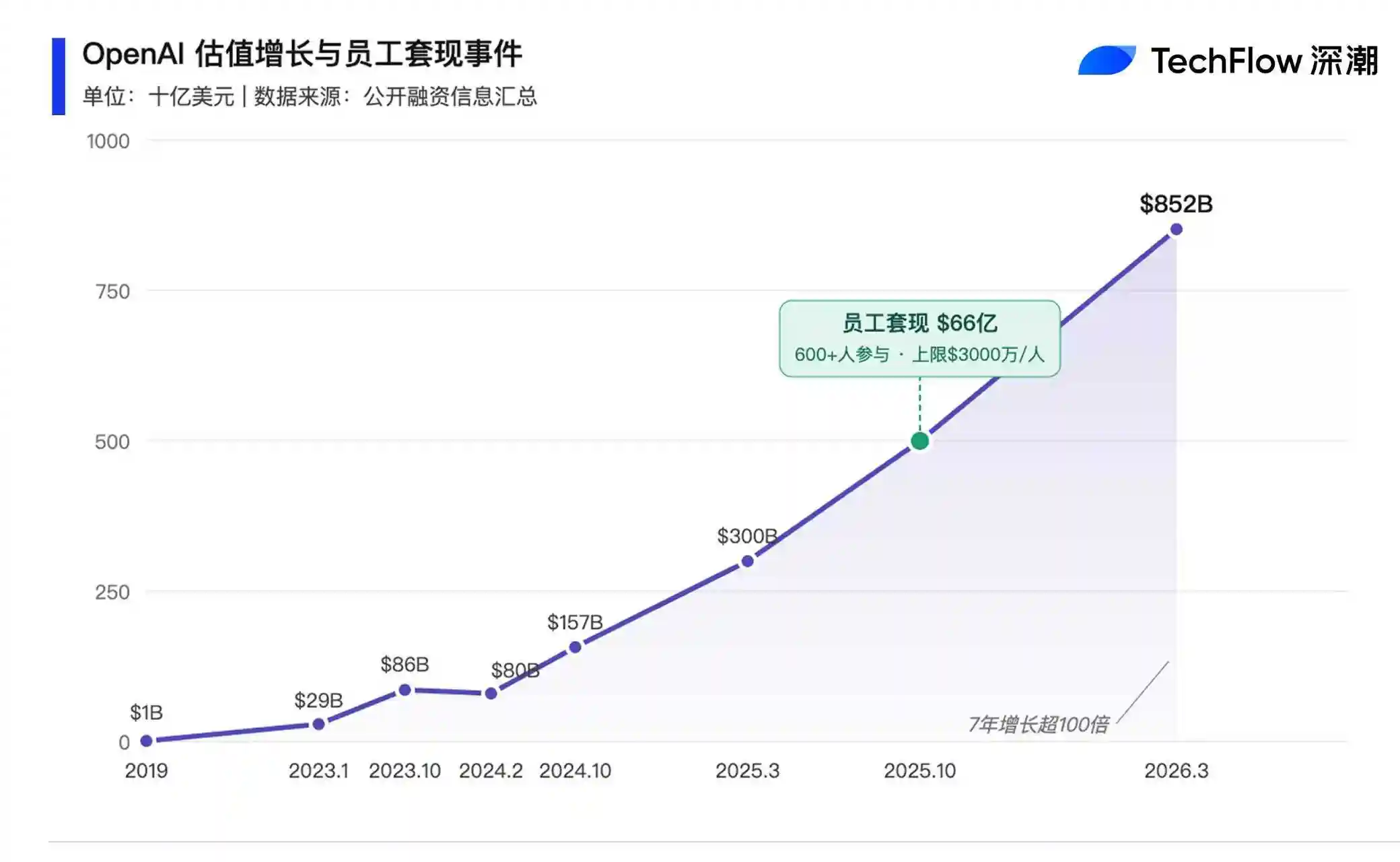
Brockman Confirms $30 Billion Stake in Court, Musk's Lawyer Presses Relentlessly

The scale of wealth held by executives is even more staggering. According to NBC, OpenAI President and Co-founder Greg Brockman confirmed during testimony on May 4th that his current OpenAI equity is worth approximately $30 billion.

This figure was disclosed on the fourth day of the trial in Elon Musk's lawsuit against OpenAI. Musk's lawyer, Steven Molo, repeatedly referenced this number during over two hours of questioning, pressing Brockman on why he hadn't fulfilled a promised $100,000 donation while amassing a $30 billion fortune. According to CNBC, Brockman admitted, "It is true I ultimately did not make the donation."

As reported by Fortune, Musk's legal team also revealed multi-layered financial ties between Brockman and CEO Sam Altman: Altman provided Brockman with about $10 million in equity from his family office as early as 2017; Brockman also holds stakes in AI chip startup Cerebras and nuclear fusion company Helion Energy. OpenAI had previously discussed acquiring Cerebras, and Altman has invested hundreds of millions in Helion. Musk's side argues these cross-holdings compromised Brockman's independence as a fiduciary.

Employees Hold 26% Stake, Average Paper Wealth Exceeds Returns of Most VC Funds

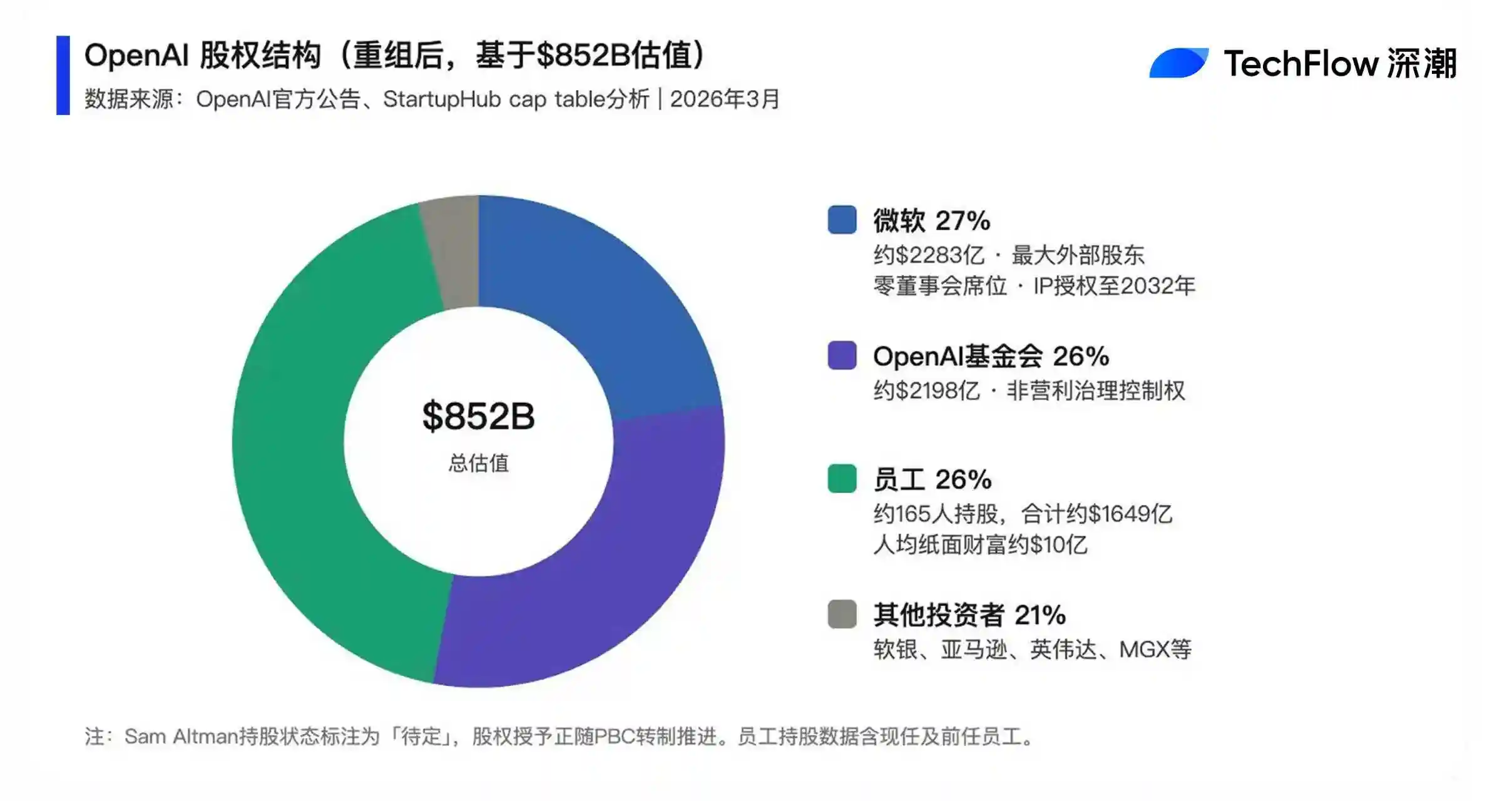
Following the company restructuring completed last October, OpenAI employees collectively hold about 26% of the company's equity.

According to an analysis by StartupHub, approximately 165 current and former employees collectively hold equity worth about $164.9 billion, averaging nearly $1 billion in paper wealth per person. This exceeds the total lifetime returns of most venture capital funds.

According to an analysis by The Wall Street Journal and data firm Equilar, OpenAI's per capita stock-based compensation in 2025 is about $1.5 million. This is over 7 times the figure for Google before its 2004 IPO, and 34 times the average for 18 large tech companies in the year before their IPOs over the past 25 years.

The company's equity-based compensation expense constitutes nearly half of its projected revenue, far surpassing peers like Palantir, Meta, and Salesforce.

$852 Billion Valuation, Trillion-Dollar IPO on Horizon, Wealth Creation Far From Over

OpenAI completed a $122 billion financing round on March 31st this year at an $852 billion valuation, setting a new record for the largest single private funding round in Silicon Valley history. Amazon led the investment with $50 billion, while Nvidia and SoftBank each invested $30 billion. The company's current monthly revenue is $2 billion, with over 900 million weekly active ChatGPT users and more than 50 million paid subscribers.
According to multiple media reports, OpenAI is preparing for an IPO in the fourth quarter of 2026, with a target valuation potentially reaching $1 trillion. If successful, this would become one of the largest tech IPOs in history. CFO Sarah Friar previously stated at Davos that the company plans to allocate a portion of the IPO shares to retail investors.

İlgili Sorular

QAccording to the article, how many OpenAI employees participated in the internal stock sale and what was the total amount cashed out?

AOver 600 current and former employees participated, cashing out a total of approximately $6.6 billion.

QWhat was the new individual cash-out limit set for the October stock sale, and how did it compare to the previous limit?

AThe new individual cash-out limit was set at $30 million. It was a threefold increase from the previous limit of $10 million.

QWhat did OpenAI president Greg Brockman reportedly confirm about his stake in the company during the Musk vs. OpenAI trial?

AHe confirmed that his current OpenAI equity is worth approximately $30 billion.

QWhat percentage of OpenAI is owned by employees, and what is the approximate average paper wealth per employee as cited by StartupHub?

AEmployees collectively own about 26% of OpenAI. According to StartupHub, around 165 employees hold a total of approximately $164.9 billion in equity, averaging about $1 billion in paper wealth per person.

QWhat is OpenAI's reported monthly revenue, and when is its IPO potentially scheduled to launch according to the article?

AOpenAI's monthly revenue is reported to be $2 billion. Its IPO is potentially scheduled to launch in the fourth quarter of 2026.

İlgili Okumalar

380,000 Apps Exposed, 2,000+ Apps Leaked Secrets: AI Programming Turns 'Intranet' into Public Internet

Israeli cybersecurity firm RedAccess uncovered a severe data exposure trend linked to "vibe coding" or AI-powered software development tools. Their research found approximately 38,000 publicly accessible web applications built with platforms like Lovable, Base44, Netlify, and Replit. Of these, an estimated 2,000 apps exposed sensitive corporate and personal data, including medical records, financial information, internal strategic documents, and customer chat logs. In some cases, access even granted administrative privileges. The core issue stems from default privacy settings that make applications public by default, combined with a lack of built-in security controls (like authentication) in the AI-generated code. This allows employees without security expertise—"citizen developers"—to easily create and deploy applications that bypass standard corporate security reviews. The exposed apps, often indexed by search engines, are trivially discoverable. While some platform providers (Replit, Lovable, Wix/Base44) argue that security configuration is the user's responsibility and question the validity of some findings, security researchers confirm the widespread reality of such exposures. This pattern, also noted in prior studies, highlights a critical security gap as AI democratizes app creation, potentially leading to massive, unintentional data leaks.

marsbit38 dk önce

380,000 Apps Exposed, 2,000+ Apps Leaked Secrets: AI Programming Turns 'Intranet' into Public Internet

marsbit38 dk önce

Attracting Global Capital, Asia's New 'Super Cycle' Is Unfolding

Investors are turning to Asia as the next frontier for global equity growth, with a new "super cycle" unfolding across the region. Driven by the AI revolution, Asian markets, particularly South Korea, have seen significant rallies. According to Morgan Stanley analysis, the underlying drivers of Asia's industrial cycle are shifting from traditional sectors like real estate and manufacturing to massive investments in AI infrastructure, energy security and transition, and supply chain resilience. Fixed asset investment in Asia is projected to grow from around $11 trillion in 2025 to $16 trillion by 2030, with a 7% annual growth rate from 2026-2030. The AI wave is a primary catalyst, driving immense capital expenditure for chips, servers, data centers, and power systems. Asia is central to this hardware supply chain. In China, AI investment is focused on building a full-system domestic capability, with the local AI chip market potentially reaching $86 billion by 2030. Beyond AI, China's export story is expanding from EVs and batteries to robotics. The country already captures about half of new global industrial robot demand and over 90% of humanoid robot shipments. This growth phase mirrors the early stages of China's EV export boom. Simultaneously, energy security investments, spurred by AI's massive power needs, are rising, with China benefiting from its leadership in solar, batteries, and EVs. Regional defense spending is also increasing structurally, supporting demand for advanced manufacturing. The main beneficiaries are China, South Korea, and Japan, positioned in core supply chain areas. However, risks remain, including potential overcapacity, profit margin pressures from competition, persistent technological restrictions, geopolitical friction, and workforce displacement due to AI-driven automation. Market volatility is also expected to increase as investor expectations diverge on the realization of these capital investment and export themes.

marsbit38 dk önce

Attracting Global Capital, Asia's New 'Super Cycle' Is Unfolding

marsbit38 dk önce

Funding Weekly Report | 14 Public Funding Events, Kalshi Completes $10B New Funding Round at $220B Valuation Led by Coatue Management

Weekly Funding Roundup: 14 Deals and $10.49B+ in Total Funding, Led by Kalshi's $1B Round Last week (5.4-5.10) saw 14 notable funding events in the global blockchain ecosystem, raising over $10.49 billion in total. Key highlights include Kalshi, a prediction market platform, securing a $1 billion round led by Coatue Management, reaching a $22 billion valuation. The platform now boasts ~2 million MAUs and $178B in annualized trading volume. In DeFi, regulated on-chain reinsurer OnRe raised $5 million in Series A funding, and Bitcoin-backed credit protocol Saturn Credit completed a $2 million seed round. For Infrastructure & Tools, OpenTrade raised $17 million to expand its stablecoin yield infrastructure, and RWA platform Balcony secured $12.7 million to deploy its property settlement service in the US. Centralized Finance saw one deal: AI-driven trading platform Stockcoin.ai completed a seed round led by Amber Group. In the prediction market sector alongside Kalshi, AI-powered platform Elastics raised $2 million. Other notable deals include SC Ventures' strategic investment in crypto market maker GSR and Centrifuge securing a "seven-figure" investment from Coinbase to become a core RWA partner for Base. On the investor side, Haun Ventures raised a new $1 billion fund targeting crypto and AI, and Multi Investment raised ~$616 million to focus on blockchain and Web3 investments.

marsbit1 saat önce

Funding Weekly Report | 14 Public Funding Events, Kalshi Completes $10B New Funding Round at $220B Valuation Led by Coatue Management

marsbit1 saat önce

İşlemler

Spot
Futures
活动图片