Rare Annualized Rate of 400%: Is TradeXYZ Handing Out Money to Oil Bulls?

marsbit2026-04-10 tarihinde yayınlandı2026-04-10 tarihinde güncellendi

Özet

Amidst volatile oil markets due to geopolitical tensions, Trade.xyz’s WTIOIL-USDC perpetual contract exhibited an unusually negative annualized funding rate of -300% to -400%. This meant long positions received approximately 1% of their position value daily from shorts. The anomaly stemmed from the structure of WTI futures curves in extreme backwardation, where near-month (May) contracts traded at a significant premium to far-month (June) contracts. Trade.xyz’s oracle gradually shifts price weighting from near-month to far-month over five trading days during rollover. Anticipating this decline, traders heavily shorted the perpetual, driving the funding rate deeply negative. Three strategies were discussed: 1. Shorting Trade.xyz’s contract while going long on CME’s far-month futures—initially profitable but later eroded by high funding costs. 2. Shorting far-month futures and longing Trade.xyz’s near-month contract before rollover, which gained traction as arbitrage opportunities emerged. 3. Betting against funding rates via Boros, a rate-trading platform, though limited by low leverage and high slippage. The situation highlights how DeFi traders are adapting to traditional futures mechanics and advanced instruments like rate markets, reflecting the evolving infrastructure of crypto-native trading platforms.

Amid the uncertain situation of the Iran war, the crude oil market is experiencing significant volatility.

At the same time, a rare phenomenon has appeared on Trade.xyz's WTIOIL-USDC crude oil perpetual contract: the annualized funding rate has stabilized between -300% and -400%. This means that any trader willing to go long at this moment can receive profits equivalent to 1% of their principal daily from the shorts.

The market doesn't give away money for no reason. To understand this反常的 negative funding rate, we need to start with the basics of futures trading.

Rollover

Crude oil futures are a series of contracts arranged by delivery month. Contracts for May delivery, June delivery, July delivery, each with its own price. When the front month is about to expire, the market must switch from the old contract to the new contract; this action is called rollover.

Under normal circumstances, back-month contracts imply that oil merchants will store the oil for several additional months, incurring extra storage costs. Therefore, the delivery price should logically be higher. The market phenomenon where future contracts are more expensive than the near month is called Contango. Conversely, the situation where the near month is more expensive than the far month is called backwardation. This usually occurs when there is a current shortage, and everyone wants to get the oil immediately.
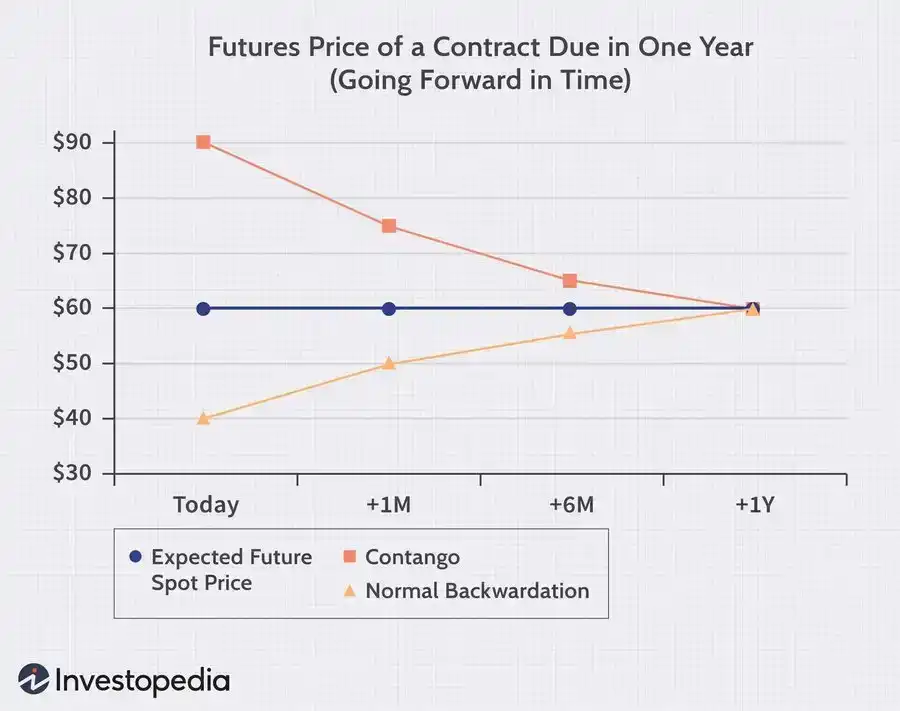
During this rollover period for Trade.xyz's crude oil, the crude oil futures market was in this near-high, far-low structure.
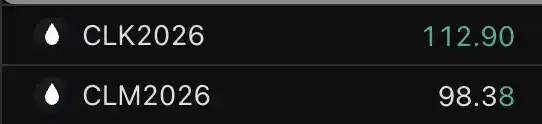
From late March to early April 2026, the WTI crude oil curve was in an extreme state of backwardation. As shown in the chart above, the price of the May contract (front month) remained consistently higher than the June contract (back month), with the spread widening to over $14 at one point.

The WTIOIL-USDC perpetual contract on Trade.xyz has its oracle pegged to this front-month May contract.

But we won't be trading this May contract forever. It must be rolled over to the next June contract. So how is the rollover accomplished?

According to the Tradexyz documentation, the oracle will take 5 trading days to gradually shift the price weighting from 100% front-month contract to 100% back-month contract.
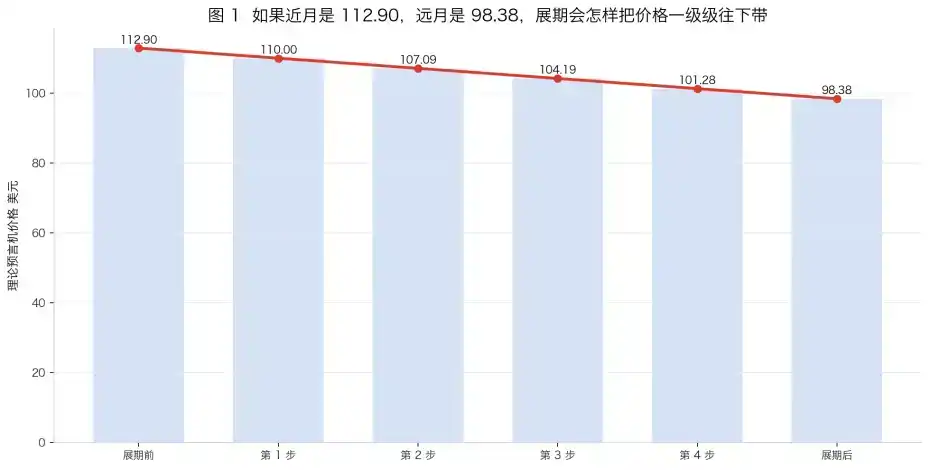
Against the backdrop of "backwardation," this means the oracle price on Tradexyz will drop from the front-month price to the back-month price over 5 trading days.
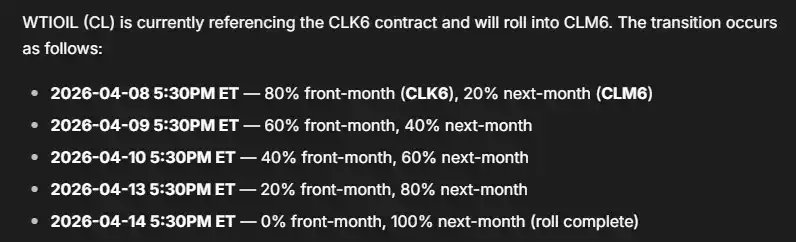
Market participants familiar with this mechanism have a clear expectation of the contract price after the rollover. Everyone knows it will fall, so they naturally rush to short. Shorts accumulate, the funding rate turns negative, and shorts start paying longs.
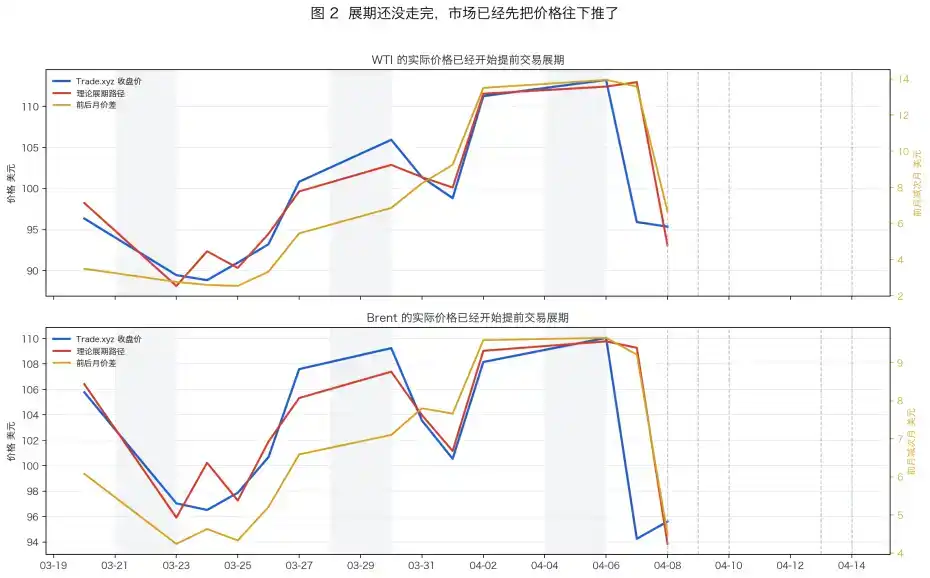
From an arbitrage-free principle perspective, this is normal. The spread between the front and back month gives short sellers a profit. The funding rate will reduce this profit. The larger the spread, the higher the negative funding rate the market charges.

Once the negative funding rate reaches a certain level, this seemingly obvious arbitrage opportunity will be eroded. The cost for short sellers will completely cover the profit.

Strategies

How to make money in such a market context? Here are three common strategies.

1. Short the crude oil contract on Tradexyz at the current price, while simultaneously going long the back-month contract on CME.

This seems like a risk-neutral strategy to stably earn the spread, but it fails to consider several factors.

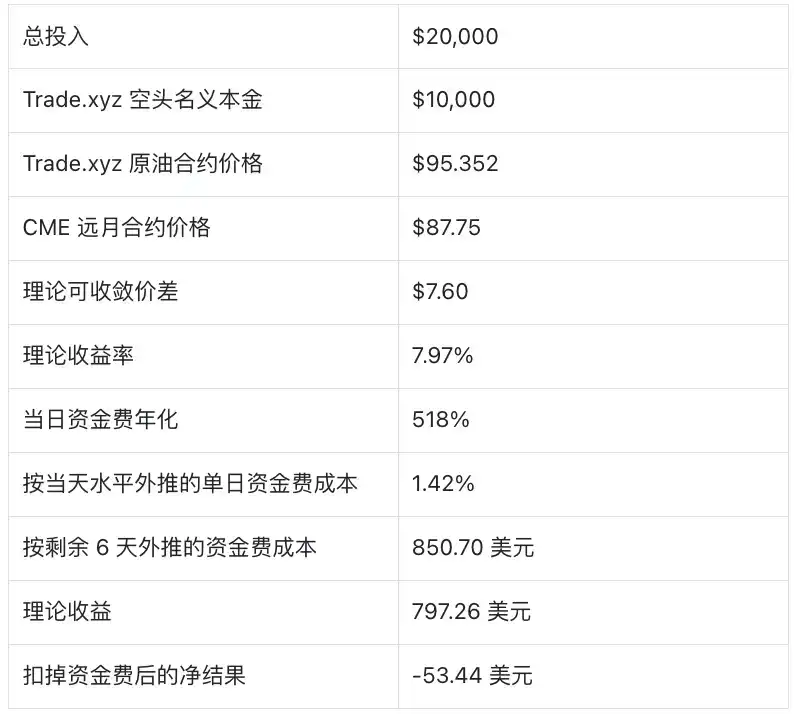
Suppose you short Trade.xyz's WTI contract at $95.352 on April 8th, while going long the June futures contract at $87.75, each with a notional principal of $10,000. If both sides eventually converge, you could theoretically get a spread of $7.60, about $797 in profit. But on April 8th, the daily funding rate for the short position was already 1.42%. Based on the remaining 6 days until rollover completion, the funding fee would cost $851. At this point, the net profit is only -$53. This doesn't even include transaction fees and slippage.
Abraxas capital implemented this strategy starting on March 19th, after the last rollover was completed. Their Brent crude oil position on tradexyz accounted for 20% of the open interest in that market and yielded huge profits early on when the funding rate remained relatively neutral. However, as more arbitrageurs flooded in, the funding fee has devoured 80% of their arbitrage profits.

The massive position also means they find it difficult to exit and are forced to pay passively.

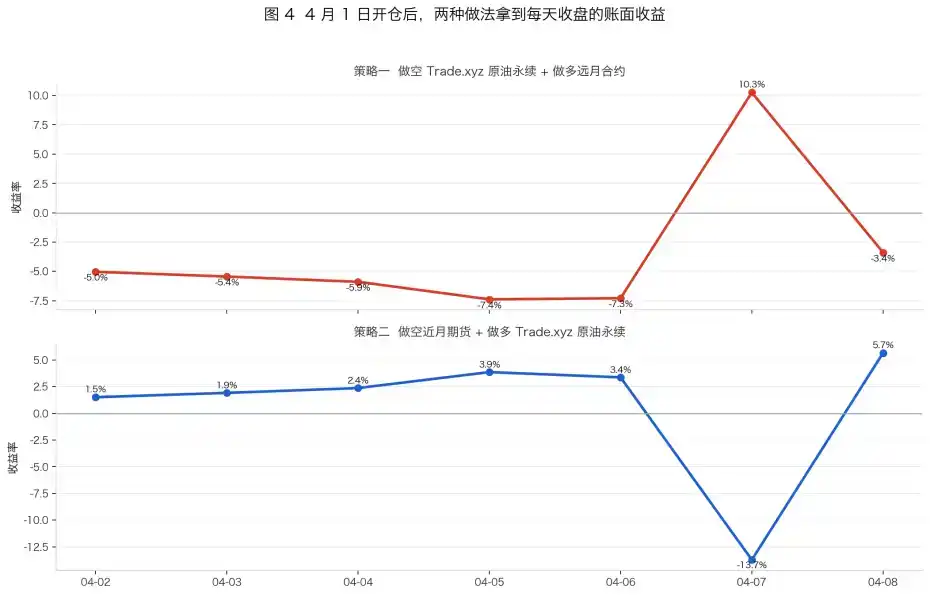
2. Short the back-month futures contract, go long the xyz front-month contract, and close the position before the rollover begins.

This trade is almost the counterparty to Strategy 1, betting that the market is over-arbitraged. After April 1st, this strategy could indeed yield profits.
3. Short the funding rate for the xyz contract on Boros before the rollover begins.

Boros is a market developed by the Pendle team specifically for trading rates (funding rates). In Boros's crude oil contract market, what is traded is the market's expectation of the funding rate for Trade.xyz's crude oil contract over the coming period. If users believe the negative funding rate will deepen further, they can short the market's funding rate contract.
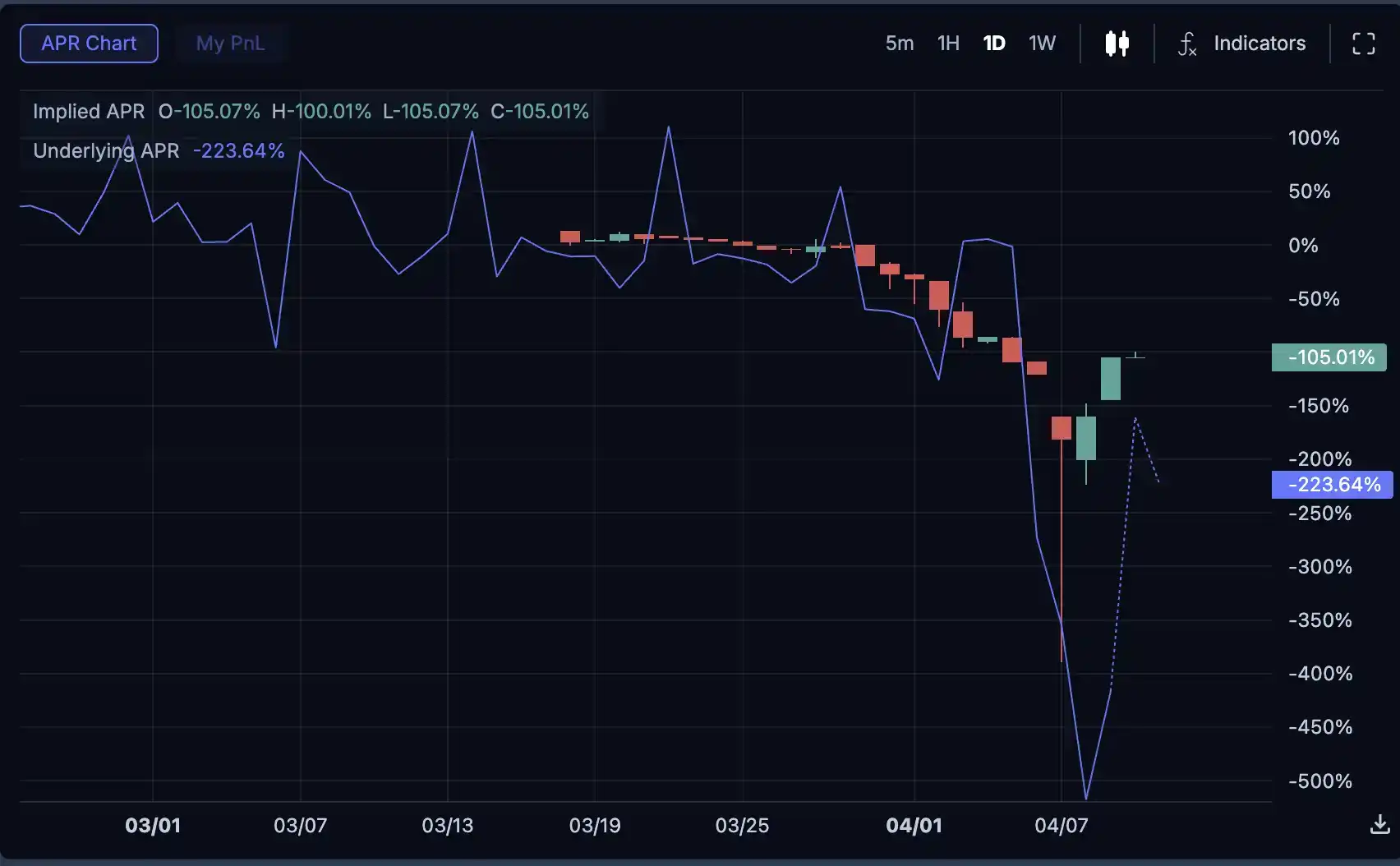
However, limited by slippage costs, position limits, transaction fees, and extremely low capital efficiency (only supporting 0.2x leverage), this trade also struggles to achieve the ideal high returns.

Conclusion

The rise of RWA trading platforms like Trade.xyz is forcing a group of "crypto traders" to become "futures traders." DeFi players are also starting to learn the CME rollover calendar, calculate front-back month spreads, and make decisions based on the funding rate curve on Boros.

Trading platforms are continuously iterating, and market participants are also adapting to new infrastructure.


İlgili Sorular

QWhat is the annualized funding rate for the WTIOIL-USDC perpetual contract on Trade.xyz, and what does it imply for traders?

AThe annualized funding rate for the WTIOIL-USDC perpetual contract on Trade.xyz is between -300% and -400%. This means that traders who take a long position at this time can receive a profit equivalent to approximately 1% of their principal daily, paid by the short sellers.

QWhat market structure is causing the extreme negative funding rate on Trade.xyz's crude oil perpetual contract?

AThe extreme negative funding rate is caused by a market structure called backwardation, where the near-month futures contract (May) is trading at a higher price than the far-month contract (June). This creates an expectation that the price will drop during the rollover period, leading to a surge in short positions and negative funding rates.

QHow does the rollover mechanism work for the WTIOIL-USDC perpetual contract on Trade.xyz?

AAccording to Trade.xyz's documentation, the oracle takes five trading days to gradually shift the price weighting from 100% of the near-month contract to 100% of the far-month contract. During this rollover period in a backwardated market, the oracle price is expected to drop from the higher near-month price to the lower far-month price.

QWhat was one of the strategies mentioned for profiting in this market, and what was its drawback?

AOne strategy was to short the crude oil contract on Trade.xyz while simultaneously going long on the far-month futures contract on CME. The drawback is that the high negative funding rate can consume most of the potential profits from the price difference. For example, a calculation showed that funding fees could cost $851 over six days, nearly erasing the $797 theoretical gain from the price spread, not including transaction costs and slippage.

QWhat is Boros, and how can it be used to trade in this context?

ABoros is a market developed by the Pendle team专门 for trading rates (funding rates). On Boros's crude oil contract market, traders can speculate on the expected funding rate for Trade.xyz's crude oil contract. If a trader believes the negative funding rate will deepen, they can short the funding rate合约 on Boros. However, this strategy is limited by slippage, position caps, trading fees, and low capital efficiency (only supporting 0.2x leverage).

İlgili Okumalar

Who Will Define the Rules of the AI Era? Anthropic Discusses the 2028 US-China AI Landscape

This article, based on Anthropic's analysis, outlines the intensifying systemic competition between the U.S./allies and China for AI leadership by 2028. It argues that access to advanced computing power ("compute") is the critical bottleneck, where the U.S. currently holds a significant advantage through chip export controls and allied innovation. However, China's AI labs remain competitive by exploiting policy loopholes—via chip smuggling, overseas data center access, and "model distillation" attacks to copy U.S. model capabilities—keeping them close to the frontier. The piece presents two contrasting scenarios for 2028. In the first, decisive U.S. action to tighten compute controls and curb distillation locks in a 12-24 month AI capability lead, cementing democratic influence over global AI norms, security, and economic infrastructure. In the second, policy inaction allows China to achieve near-parity through continued access to U.S. technology, enabling Beijing to promote its AI stack globally and integrate advanced AI into its military and governance systems, altering the strategic balance. Anthropic contends that maintaining a decisive U.S. lead is essential for shaping safe AI development and governance. The core recommendation is for U.S. policymakers to urgently close compute and model access loopholes while promoting global adoption of the U.S. AI technology stack to secure a lasting strategic advantage.

marsbit1 saat önce

Who Will Define the Rules of the AI Era? Anthropic Discusses the 2028 US-China AI Landscape

marsbit1 saat önce

“Why Didn’t You Buy 2x Long SK Hynix?”

The article discusses the immense popularity of the "2x Long SK Hynix ETF" (07709.HK) in Hong Kong, which became the world's largest single-stock leveraged ETF by May 2026. Launched in October 2025, the ETF's net value soared over 1000% in seven months, significantly outperforming the 324% gain of SK Hynix's underlying stock, driven by the AI boom and a critical shift in industry demand from computing power to memory. It highlights the mechanics and risks of daily-rebalanced leveraged ETFs. In a smooth bullish market, they generate amplified returns, but during volatile periods—exemplified by market swings during geopolitical tensions in the Strait of Hormuz in March-April 2026—they suffer severe "volatility decay," where choppy price action can cause losses far exceeding twice the drop of the underlying asset. The piece frames SK Hynix, as NVIDIA's primary HBM supplier, within the classic cycle of the memory chip industry—a commoditized sector prone to boom-and-bust cycles of shortage, price hikes, overcapacity, and crashes. While current AI-driven demand and high margins (Q1 2026毛利率~79%) create a "super cycle," the article questions its sustainability. It warns that extreme profits will inevitably tempt competitors like Samsung and Micron to ramp up HBM production, potentially eroding scarcity. Furthermore, the entire narrative remains tethered to the massive AI capital expenditure of tech giants. In conclusion, the ETF's trajectory symbolizes the accelerated, all-in nature of the current AI revolution, where timeframes are compressed and market moves are extreme. However, it also underscores that while industry trends define ultimate returns, macro-geopolitical risks dictate the volatile and uncertain path to get there.

marsbit1 saat önce

“Why Didn’t You Buy 2x Long SK Hynix?”

marsbit1 saat önce

a16z Crypto: A Guide to the CLARITY Act for Crypto Entrepreneurs

The CLARITY Act, a bipartisan crypto market structure bill, has advanced through the Senate Banking Committee, marking a potential historic shift in U.S. digital asset regulation. For years, a lack of clear rules has stifled innovation, pushed development overseas, and exposed consumers to risk. This bill aims to establish a comprehensive framework, providing long-needed regulatory clarity for blockchain networks and digital assets. It builds upon previous legislative efforts like FIT21 and the House version of CLARITY, which gained strong bipartisan support. CLARITY is crucial because it recognizes that blockchain networks are fundamentally different from traditional companies. Networks operate through decentralized, shared rules rather than centralized control. Applying corporate legal frameworks to networks forces them into a centralized model, concentrating power and value. In contrast, decentralized blockchain networks can function as user-owned public infrastructure, distributing value more equitably among participants. The bill seeks to enable the safe launch of networks in the U.S., clarify regulatory jurisdiction between the SEC and CFTC, oversee crypto exchanges, and enhance consumer protections. Its passage would align U.S. law with the nature of decentralized technology, allowing builders to operate transparently and fund projects domestically without structural compromises due to regulatory uncertainty. Similar to the positive impact seen after the stablecoin-focused GENIUS Act, CLARITY could unlock a new wave of innovation, helping the U.S. reclaim leadership in the crypto space while combating fraud and abuse.

链捕手1 saat önce

a16z Crypto: A Guide to the CLARITY Act for Crypto Entrepreneurs

链捕手1 saat önce

İşlemler

Spot
Futures

Popüler Makaleler

WAR Nasıl Satın Alınır

HTX.com’a hoş geldiniz! WAR (WAR) satın alma işlemlerini basit ve kullanışlı bir hâle getirdik. Adım adım açıkladığımız rehberimizi takip ederek kripto yolculuğunuza başlayın. 1. Adım: HTX Hesabınızı OluşturunHTX'te ücretsiz bir hesap açmak için e-posta adresinizi veya telefon numaranızı kullanın. Sorunsuzca kaydolun ve tüm özelliklerin kilidini açın. Hesabımı Aç2. Adım: Kripto Satın Al Bölümüne Gidin ve Ödeme Yönteminizi SeçinKredi/Banka Kartı: Visa veya Mastercard'ınızı kullanarak anında WAR (WAR) satın alın.Bakiye: Sorunsuz bir şekilde işlem yapmak için HTX hesap bakiyenizdeki fonları kullanın.Üçüncü Taraflar: Kullanımı kolaylaştırmak için Google Pay ve Apple Pay gibi popüler ödeme yöntemlerini ekledik.P2P: HTX'teki diğer kullanıcılarla doğrudan işlem yapın.Borsa Dışı (OTC): Yatırımcılar için kişiye özel hizmetler ve rekabetçi döviz kurları sunuyoruz.3. Adım: WAR (WAR) Varlıklarınızı SaklayınWAR (WAR) satın aldıktan sonra HTX hesabınızda saklayın. Alternatif olarak, blok zinciri transferi yoluyla başka bir yere gönderebilir veya diğer kripto para birimlerini takas etmek için kullanabilirsiniz.4. Adım: WAR (WAR) Varlıklarınızla İşlem YapınHTX'in spot piyasasında WAR (WAR) ile kolayca işlemler yapın.Hesabınıza erişin, işlem çiftinizi seçin, işlemlerinizi gerçekleştirin ve gerçek zamanlı olarak izleyin. Hem yeni başlayanlar hem de deneyimli yatırımcılar için kullanıcı dostu bir deneyim sunuyoruz.

157 Toplam GörüntülenmeYayınlanma 2024.12.11Güncellenme 2026.04.28

WAR Nasıl Satın Alınır

Tartışmalar

HTX Topluluğuna hoş geldiniz. Burada, en son platform gelişmeleri hakkında bilgi sahibi olabilir ve profesyonel piyasa görüşlerine erişebilirsiniz. Kullanıcıların WAR (WAR) fiyatı hakkındaki görüşleri aşağıda sunulmaktadır.

活动图片












