Promised Year of Crypto IPOs? Only One Went Public in Six Months, Down 70%

marsbit2026-06-11 tarihinde yayınlandı2026-06-11 tarihinde güncellendi

Özet

The much-anticipated wave of crypto IPOs in 2026 has failed to materialize, with market conditions worsening dramatically. While SpaceX prepares for the largest IPO in history, raising $75 billion at a $1.75 trillion valuation, the crypto sector faces a frozen pipeline. The sole crypto IPO success this year, BitGo, serves as a cautionary tale. After launching on the NYSE in January at $18, its stock has plummeted approximately 70%. Other major contenders have stalled or delayed. Kraken, which secretly filed in late 2025, has put its plans on ice, seeing its valuation drop 33% to $13.3 billion. Consensys has postponed its filing until autumn at the earliest, and Bitpanda is poised to miss its self-imposed H1 deadline for a Frankfurt listing. This widespread retreat is driven by a severe liquidity crunch. Bitcoin has fallen below $60,000, with capital being diverted to AI stocks and the massive SpaceX offering. The poor performance of earlier crypto listings like Gemini and the stagnant price of Coinbase further dampen investor appetite. A key underlying pressure is the impending US midterm elections in November, which could alter the currently favorable regulatory landscape. Companies had hoped to go public during this window of policy certainty, but challenging market dynamics have overridden those plans. The transparency that comes with being a public company is now seen as a potential liability rather than a benefit in a down market. The industry's fate now hinges on a ...

Author: Claude, Deep Tide TechFlow

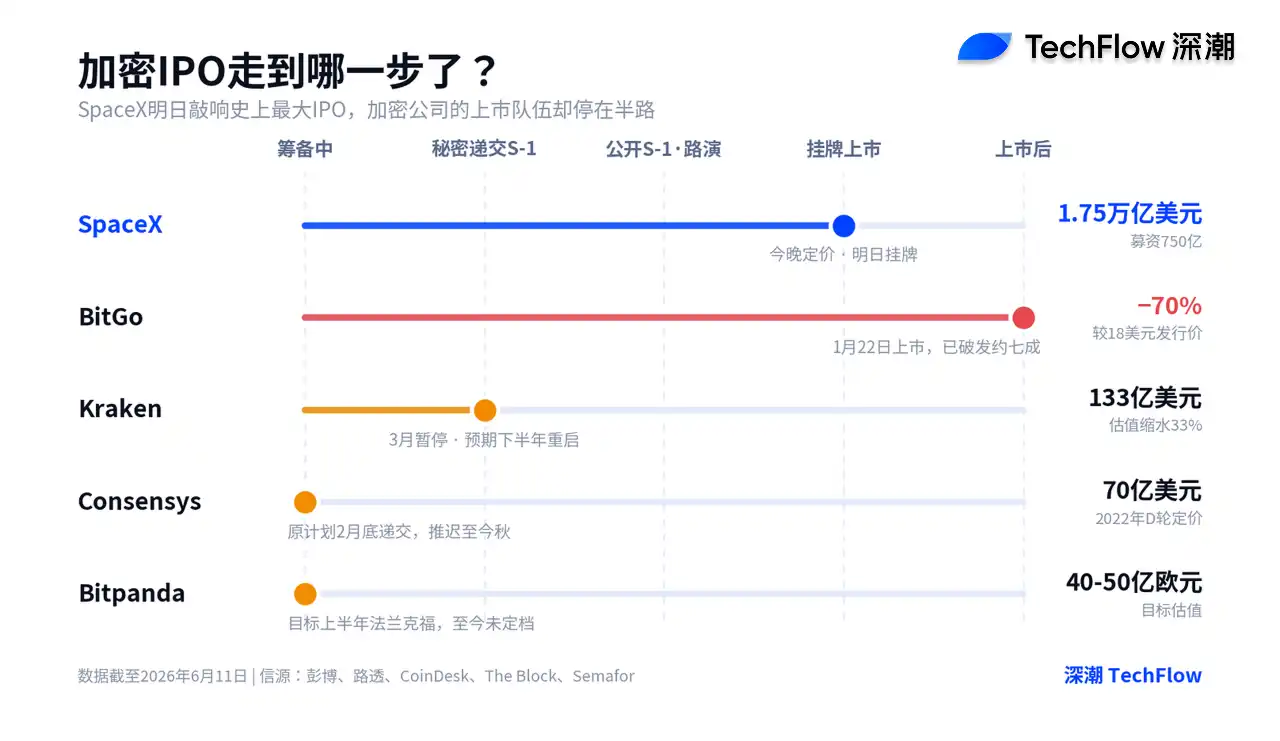
Deep Tide Introduction: SpaceX will price its offering tonight and list on Nasdaq tomorrow, aiming to raise $75 billion with a valuation of $1.75 trillion, marking the largest IPO ever. Meanwhile, the crypto IPO pipeline has frozen solid: the only company to list this year, BitGo, is down about 70% from its issue price; Kraken's valuation has shrunk 33% in five months; Consensys has been pushed back to autumn; Bitpanda is on the verge of missing its deadline. With just five months left until the midterm elections in November, the window for crypto companies to go public is narrowing.

After the U.S. stock market closes tonight, SpaceX will finalize its issue price. Tomorrow, the ticker SPCX will debut on Nasdaq. According to Reuters, the company plans to issue approximately 557 million shares at $135 per share, raising $75 billion at a valuation of $1.75 trillion. This will be the largest IPO in history by both fundraising size and valuation, with the fundraising amount more than double that of the previous record holder, Saudi Aramco.

Outside this grand feast, the queue of crypto companies waiting to go public is falling apart.
SpaceX Siphons Liquidity, Bitcoin Falls Below $60k Concurrently

SpaceX's listing pace is unusually fast. It confidentially filed its registration on April 1, publicly released its S-1 prospectus on May 20, and kicked off its roadshow on June 4, several days ahead of schedule due to an unexpectedly swift SEC review process. It took just over two months from confidential filing to bell-ringing.

The crypto market trended in the exact opposite direction during the same window. According to CoinDesk data, Bitcoin traded around $61,500 on June 10, down about 17% for the week and briefly falling below $60,000 for the first time in 2024. The Fear and Greed Index registered a reading of 9, indicating "Extreme Fear." The total crypto market cap shrank to around $2.21 trillion. The explanation for the capital flows isn't complicated: continuous outflows from Bitcoin ETFs, coupled with funds rotating towards the AI sector and SpaceX's subscription, have seen risk appetite sucked dry by this $1.75 trillion behemoth.

For any company wanting to go public, liquidity is oxygen. $75 billion in subscription demand is locked up by SpaceX alone. Filing a prospectus at this point is like flying a kite in a typhoon.

BitGo: The Year's Only Listing Sample, Stock Down About 70%

The crypto industry hasn't been without attempts. BitGo listed on the NYSE on January 22 with an issue price of $18, above the indicated range of $15 to $17, raising $213 million. It was the first and, so far, only crypto-native company to complete an IPO in 2026.

The start didn't look bad. It opened at $22.43 on its first day, up 24.6% from the issue price, and briefly surged to $24.5 intraday. But those gains were wiped out by the close, ending the day with just a 2.7% gain, followed by a steady decline. According to Benzinga data, BTGO closed at $5.61 on June 3, down about 69% from its issue price. Goldman Sachs cut its price target from $10.5 to $9 on June 4, and even this slashed target is 60% higher than the current price.

BitGo was once hoped to be the bellwether for 2026 crypto IPOs. Now it indeed serves as a bellwether, just pointing in the opposite direction. When Kraken paused its listing plans in March this year, multiple media reports cited BitGo's post-listing slump as a cautionary tale for management. If an infrastructure company with over $100 billion in assets under custody and a defensive business model fares this poorly, what valuation would a pure exchange story receive in the secondary market? The companies in line are well aware.

Kraken: Valuation Evaporates 33% in Five Months, Deutsche Börse Seizes Opportunity

Kraken is the company that progressed the furthest in the queue. On November 19, 2025, its parent company Payward confidentially submitted a draft S-1 to the SEC, shortly after completing an $800 million funding round with investors including Jane Street and Citadel Securities, valuing the company at $20 billion. Reuters reported at the time that its target was to go public in Q1 2026.

Then the market soured. In March this year, multiple media reports stated Kraken had frozen its listing plans. On April 14, co-CEO Arjun Sethi confirmed at the Semafor World Economy Summit in Washington that the confidential filing remained active but declined to provide a timeline, offering size, or valuation range. According to Semafor, Kraken was valued at $13.3 billion in a funding round in April, a 33% contraction from its peak last November.

This funding round contains a noteworthy subplot: Deutsche Börse Group invested $200 million for approximately 1.5% of Kraken's fully diluted shares, with the transaction expected to close in Q2. The operator of the Frankfurt Stock Exchange is buying in at a time when a U.S. exchange's valuation is at its lowest ebb. Considering Bitpanda's choice discussed below, the Germans' intent to snatch business as the U.S. window tightens is quite evident.

Media consensus currently expects Kraken's listing restart to wait until the second half of the year.

Consensys Pushed to Autumn, Bitpanda on the Verge of Missing Deadline

Consensys, the parent company of MetaMask, has a more straightforward script. According to a CoinDesk report on May 13, the company led by Ethereum co-founder Joe Lubin originally planned to confidentially file its S-1 with the SEC by the end of February, with JPMorgan and Goldman Sachs leading the underwriting. However, due to persistently weak market conditions, the IPO has been postponed until at least this autumn. Consensys' last valuation was from its Series D in 2022, a $450 million funding round at a $7 billion valuation. How much of this number can be preserved in the current market environment will only be known when the prospectus is unveiled.

Bitpanda's problem is the calendar. According to a Bloomberg report in January, this Vienna-based company, backed by Peter Thiel, plans to list in Frankfurt with a target valuation of €4-5 billion, with Goldman Sachs, Citigroup, and Deutsche Bank acting as underwriters. The schedule was set for the first half of the year, potentially Q1. Today is June 11, with less than three weeks left in H1, and the company has yet to officially announce a date. Unless it launches suddenly in the coming days, missing its own deadline is almost certain.

Looking at the four together: one listed but is down 70%, one filed but paused, one pushed to autumn, and one on the verge of missing its self-imposed deadline. The original Reddit post described these four as "sprinting to go public within 12 months." The wording isn't wrong, but the sense of direction is. This team isn't sprinting; they're each looking for an exit ramp.

Five Months Until the Midterm Elections

The clustering of crypto companies targeting 2026 for listings has a common, invisible deadline.

This year's regulatory climate has been relatively favorable for the crypto industry, but the U.S. midterm elections in early November could rewrite the congressional power balance. Many companies' timelines were originally compressed before the election, betting on five months of policy certainty.

Precedents aren't encouraging. Among the crypto companies that went public in 2025, Gemini's stock price had fallen over 60% from its issue price (data as of end-January), Bullish hovered around its issue price, and Coinbase, which listed in 2021, remains below its opening price from that year. Circle is a rare exception that has significantly outperformed its issue price. The pricing given by the secondary market with real money is more honest than any roadshow PowerPoint.

Returning to that Reddit post, the poster actually had a valid point: once an exchange goes public, its financials are no longer a black box. Quarterly audited reports will reveal whether revenue truly comes from trading fees, custody fees, or idle fund interest. Retail investors get their first chance to judge an exchange by numbers rather than "withdrawal smoothness."
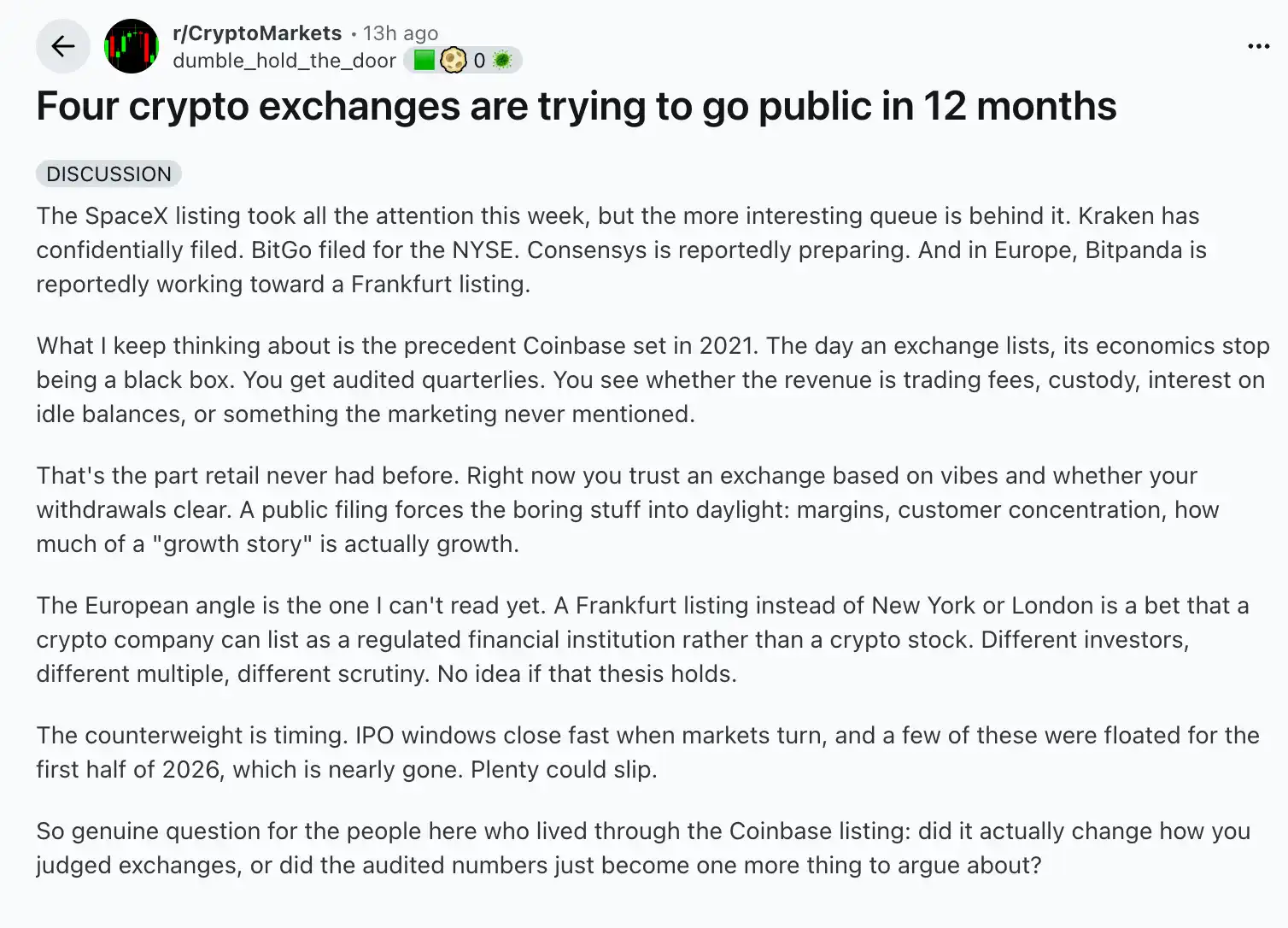
The problem is the sequence. Transparency is a consequence of going public, not the motivation for it. In a market with Bitcoin at $61,500 and the only listing sample down 70%, no company is in a hurry to lay its cards on the table.

Over the next five months, three specific milestones are worth watching: whether Kraken restarts in H2, whether Consensys actually files its S-1 in autumn, and when Bitpanda officially admits to missing its deadline.

There's another variable to be revealed tomorrow. If funds absorbed by SpaceX's listing flow back and market liquidity recovers, this window might crack open again. If even the largest IPO in history performs tepidly, this year's crypto listing wave will likely have to wait until after the elections.


Trend Kriptolar

İlgili Sorular

QWhat major event is described as diverting liquidity from the crypto market, coinciding with Bitcoin's price drop?

AThe article describes the upcoming IPO of SpaceX as the major event. SpaceX's planned $75 billion offering, with a $1.75 trillion valuation, was reportedly locking up significant investor capital and risk appetite, creating a 'liquidity drain' that contributed to Bitcoin falling below $60,000.

QAccording to the article, which crypto company is the only one to have completed an IPO in 2026, and how has its stock performed?

AThe only crypto-native company to have completed an IPO in 2026 is BitGo (ticker: BTGO). Its stock has performed poorly, falling approximately 70% from its initial offering price of $18 to around $5.61 by early June.

QWhy did the article suggest several crypto companies originally aimed to go public before November 2026?

AThe article suggests these companies aimed for a pre-November 2026 timeline due to the U.S. midterm elections. They were betting on the current, relatively friendly regulatory environment for crypto, which could change depending on the election outcome, making the five months before the election a window of perceived policy certainty.

QWhat evidence does the article provide that the public listing pipeline for crypto companies is effectively frozen?

AThe article provides several pieces of evidence: BitGo's poor post-IPO performance (-70%), Kraken's paused plans and 33% valuation drop, Consensys's delay to autumn, and Bitpanda's likely missed self-imposed deadline for a first-half listing. It describes the situation as companies 'finding their own excuses' rather than sprinting to go public.

QWhat is one potential positive outcome for crypto companies if SpaceX's IPO goes well, according to the article's conclusion?

AThe article concludes that if SpaceX's IPO performs well and the massive capital it absorbed begins to flow back into the market, improving overall liquidity, the window for crypto IPOs might 'reopen a crack.' However, if even the largest IPO ever performs poorly, any significant crypto listing wave would likely be postponed until after the midterm elections.

İlgili Okumalar

STAR 50 Soars 10.73%, Why Did A-Shares Stage a "V-Shaped Reversal"?

After a prolonged decline, the Chinese A-share market staged a strong rally on July 21. The STAR 50 index surged 10.73%, its largest single-day gain in nearly a year, leading a broad-based "V-shaped" reversal. The Shanghai Composite Index rose 1.79%, the Shenzhen Component Index gained 4.81%, and the ChiNext Index jumped 7.05%. Total market turnover reached 2.97 trillion yuan, an increase of 256.1 billion yuan from the previous session, with over 3,100 stocks advancing. The semiconductor sector spearheaded the rebound, with related ETFs posting significant gains. Analysts attribute the surge to three converging factors. First, coordinated capital inflows from "national team" institutions, insurance funds, listed company buybacks, and fund house self-purchases have bolstered market liquidity and confidence. Second, supportive policy signals, including commitments from regulators to ensure stable market operations, provided a favorable backdrop. Third, a stabilization and recovery in overseas markets, notably South Korea, created a positive external environment. Institutions suggest the most severe panic selling phase for the tech sector has likely passed, following a significant digestion of crowded positions and leveraged funds. While short-term volatility may persist, the medium to long-term outlook remains underpinned by enduring trends like AI computing demand expansion and semiconductor localization. The market's focus now shifts to the sustainability of supportive fund flows, earnings reports, and upcoming catalysts from the global AI industry chain.

marsbit19 dk önce

STAR 50 Soars 10.73%, Why Did A-Shares Stage a "V-Shaped Reversal"?

marsbit19 dk önce

U.S. Tech Momentum Stocks Post Largest Single-Day Gain Ever, But Is the Plunge Over?

US tech momentum stocks staged a sharp rebound on Tuesday (July 21st). Morgan Stanley's TMT Momentum Factor surged over 12%, marking its largest single-day gain on record, exceeding even peaks from the 2000 dot-com bubble. Key momentum indices from Goldman Sachs also posted their strongest daily performances in years. The rally was led by semiconductors, with the Philadelphia Semiconductor Index jumping 4.6%. This rebound followed three consecutive down days and a cumulative 33% plunge in momentum stocks, one of the steepest drawdowns since the dot-com era. Analysts attribute the surge largely to a short squeeze. Heavy selling had pushed high-beta momentum stocks into deeply oversold territory, forcing many short sellers, particularly in Asia, to cover their positions, creating a self-reinforcing buying spiral. However, the rebound's internals appear weak. Trading volume was notably low, and advancing stocks still lagged decliners on the S&P 500, indicating a narrow, concentrated rally rather than broad market participation. Diverging views emerge on the outlook. BTIG warns the bounce has hit key resistance and recommends selling into strength, citing extreme volatility and historical parallels to past market tops. Conversely, Goldman Sachs and UBS believe the momentum unwind is nearing its end, suggesting it may be time to gradually add exposure, as positioning has been significantly reduced. They caution, however, that high volatility warrants a measured approach, potentially using defined-risk strategies. The upcoming earnings season, particularly reports from major tech firms like Alphabet, is seen as a critical test for the rally's sustainability. Simultaneously, bond markets flashed a warning, with yields rising partly due to spiking oil prices. Analysts note that if long-term Treasury yields break decisively higher, it could pose a significant headwind for equities, especially growth stocks.

marsbit26 dk önce

U.S. Tech Momentum Stocks Post Largest Single-Day Gain Ever, But Is the Plunge Over?

marsbit26 dk önce

U.S. Tech Momentum Stocks Record Largest Single-Day Gain Ever, but Has the Rout Ended?

U.S. tech momentum stocks staged a dramatic rebound on Tuesday, July 21st. Key momentum indices like the Morgan Stanley TMT Momentum Factor and Goldman Sachs' High Beta Momentum Long Index posted historic or near-historic single-day gains, fueled largely by semiconductor stocks. This sharp rally followed a severe three-day sell-off that saw momentum stocks plunge 33%, marking one of the steepest pullbacks since the dot-com bubble. Analysts attribute the bounce primarily to a short squeeze, as forced covering from over-leveraged traders, particularly in Asia, created a buying spiral. However, the rally's health is questioned due to weak market breadth—overall trading volume was low, and decliners outnumbered advancers in the S&P 500 despite the index's gain—suggesting a narrow, concentrated surge rather than broad recovery. Opinions on the sustainability diverge. BTIG strategists warn the rebound has hit key resistance levels, citing extreme volatility and historic stock dispersion as signs of an ongoing broader correction, and recommend selling into strength. Conversely, Goldman Sachs and UBS view the aggressive momentum unwinding as nearing its end, noting reduced positioning and a lack of new fundamental catalysts. They suggest the sell-off presents a selective opportunity to add exposure, albeit cautiously and gradually using defined-risk strategies. The immediate trajectory hinges on the ongoing earnings season, with market focus on Alphabet's capital expenditure guidance for AI investment clarity. Meanwhile, bond markets present a risk, with rising Treasury yields—potentially heading toward 5.5%—and widening credit spreads for mega-cap tech companies posing a threat to equity valuations. The combination of technical factors, earnings results, and macro conditions leaves the durability of the rebound in doubt.

链捕手29 dk önce

U.S. Tech Momentum Stocks Record Largest Single-Day Gain Ever, but Has the Rout Ended?

链捕手29 dk önce

Long-Divided Must Unite, Long-United Must Divide: When L1 Becomes Its Own Rollup, What Is Ethereum's Endgame?

"The Inevitable Cycle: When L1 Becomes Its Own Rollup – What is Ethereum's Endgame?" For years, the Ethereum community grappled with concerns that L2s were fragmenting the ecosystem and eroding L1's value. While L2s provided cheaper execution, they also splintered liquidity and the unified user experience of a single chain. This has prompted a fundamental reassessment of the relationship between L1 and L2. Ethereum's roadmap is evolving. The "Scale" initiative merges L1 and L2 expansion into a holistic framework. L1 itself is advancing with higher gas limits, statelessness, and zkEVM verification, no longer content to be just a low-throughput settlement layer. Consequently, the primary value proposition of L2s is shifting from merely providing cheap blockspace to offering L1 cannot easily provide: application-specific optimizations, privacy features, and flexible governance models. L2s are becoming a spectrum of execution environments with varying degrees of security inheritance from Ethereum. A critical challenge in this multi-chain future is interoperability. The vision is to make Ethereum "feel like one chain again." This relies on advancements in native account abstraction (like EIP-7702) and intent-based architectures (Open Intents Framework), where users declare desired outcomes, and solvers handle the complex cross-chain execution. Furthermore, shortening Ethereum's finality time from minutes to seconds is crucial, as it underpins trust between chains for bridges, stablecoins, and cross-chain applications. Perhaps the most provocative idea is that Ethereum L1 itself could become a form of "its own Rollup." As zkEVM and proof systems mature, high-performance nodes could execute transactions and generate validity proofs. Regular validators would then verify these proofs instead of re-executing all transactions. This blurs the traditional L1/L2 hierarchy, making "Rollup" more of a general execution-verification architecture. Native Rollup aims to integrate L2 validation more directly into the Ethereum protocol, allowing L2s to inherit L1's security more fully and move away from reliance on security councils. In the end, L2s are not destined to replace L1 or be made obsolete by it. The likely future is a unified system where diverse execution environments—each optimized for specific use cases like DeFi, gaming, or privacy—coexist. They will share a common foundation of security, liquidity, and verifiable state, seamlessly connected to restore a cohesive user experience. The next phase for Ethereum is not just about scaling through separation, but about intelligently reintegrating what was separated back into a coherent whole.

链捕手45 dk önce

Long-Divided Must Unite, Long-United Must Divide: When L1 Becomes Its Own Rollup, What Is Ethereum's Endgame?

链捕手45 dk önce

İşlemler

Spot

Popüler Makaleler

ONE Nasıl Satın Alınır

HTX.com’a hoş geldiniz! Harmony (ONE) satın alma işlemlerini basit ve kullanışlı bir hâle getirdik. Adım adım açıkladığımız rehberimizi takip ederek kripto yolculuğunuza başlayın. 1. Adım: HTX Hesabınızı OluşturunHTX'te ücretsiz bir hesap açmak için e-posta adresinizi veya telefon numaranızı kullanın. Sorunsuzca kaydolun ve tüm özelliklerin kilidini açın. Hesabımı Aç2. Adım: Kripto Satın Al Bölümüne Gidin ve Ödeme Yönteminizi SeçinKredi/Banka Kartı: Visa veya Mastercard'ınızı kullanarak anında Harmony (ONE) satın alın.Bakiye: Sorunsuz bir şekilde işlem yapmak için HTX hesap bakiyenizdeki fonları kullanın.Üçüncü Taraflar: Kullanımı kolaylaştırmak için Google Pay ve Apple Pay gibi popüler ödeme yöntemlerini ekledik.P2P: HTX'teki diğer kullanıcılarla doğrudan işlem yapın.Borsa Dışı (OTC): Yatırımcılar için kişiye özel hizmetler ve rekabetçi döviz kurları sunuyoruz.3. Adım: Harmony (ONE) Varlıklarınızı SaklayınHarmony (ONE) satın aldıktan sonra HTX hesabınızda saklayın. Alternatif olarak, blok zinciri transferi yoluyla başka bir yere gönderebilir veya diğer kripto para birimlerini takas etmek için kullanabilirsiniz.4. Adım: Harmony (ONE) Varlıklarınızla İşlem YapınHTX'in spot piyasasında Harmony (ONE) ile kolayca işlemler yapın.Hesabınıza erişin, işlem çiftinizi seçin, işlemlerinizi gerçekleştirin ve gerçek zamanlı olarak izleyin. Hem yeni başlayanlar hem de deneyimli yatırımcılar için kullanıcı dostu bir deneyim sunuyoruz.

558 Toplam GörüntülenmeYayınlanma 2024.12.12Güncellenme 2026.06.02

ONE Nasıl Satın Alınır

Tartışmalar

HTX Topluluğuna hoş geldiniz. Burada, en son platform gelişmeleri hakkında bilgi sahibi olabilir ve profesyonel piyasa görüşlerine erişebilirsiniz. Kullanıcıların ONE (ONE) fiyatı hakkındaki görüşleri aşağıda sunulmaktadır.

活动图片












