Post-Mortem of the Venus THE Attack: How to Profit in a Fleeting Window?

marsbit2026-03-16 tarihinde yayınlandı2026-03-16 tarihinde güncellendi

Özet

Approximately two hours ago, Venus Protocol's THE token was exploited using a classic Mango Markets-style price manipulation attack. The attacker targeted THE, a low-liquidity collateral asset, by depositing it, borrowing other assets, and using those to buy more THE, artificially inflating its price. Once the time-weighted average oracle updated, the inflated price allowed further leveraged borrowing. To bypass THE's borrowing cap, the attacker performed a "donation attack" by transferring THE directly to the vTHE contract, increasing the recognized collateral value. After the first manipulation phase, THE's price stabilized around $0.50. The attacker attempted to further amplify gains by continuing to buy THE, but mounting sell pressure limited price increases and pushed their health factor near 1.0, risking liquidation. The collateral, nominally valued around $30M, had extremely low liquidity, making large-scale liquidation at inflated prices impossible. Recognizing the situation, the writer opened a short position on THE with high leverage, anticipating a price collapse due to overvaluation, illiquidity, and forced selling. After liquidation, THE price plummeted to ~$0.24, below its pre-attack level, resulting in a ~$15K profit for the writer. Venus Protocol was left with ~$2M in bad debt. The attacker likely gained little or lost funds, though may have profited from off-chain positions. The event highlights that nominal collateral value in DeFi does not equal realizabl...

Two hours ago, VenuV's THE token was hit with a classic Mango Markets-style price manipulation attack.

The attacker targeted the low-liquidity collateral THE:

· First, collateralized THE

· Borrowed other assets

· Used the borrowed assets to buy more THE

· Pushed THE price higher

· Waited for the time-weighted average oracle price to update, then obtained higher collateral value and continued the cycle of borrowing.
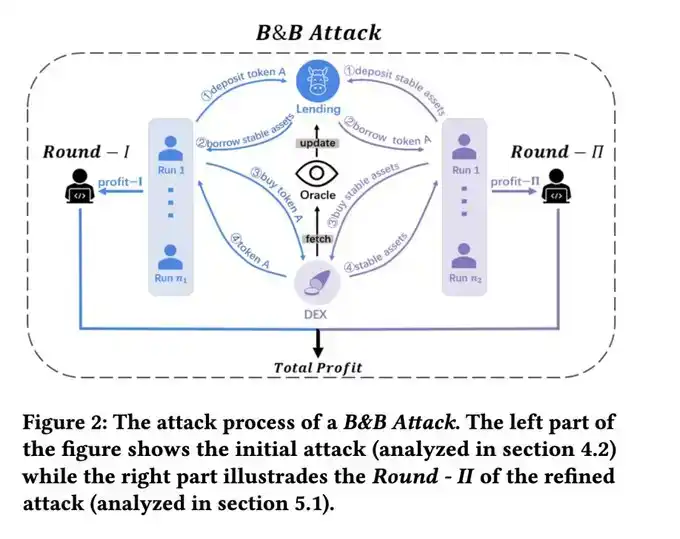
Due to THE's extremely poor on-chain liquidity, its price was driven from $0.27 to nearly $5. The oracle price subsequently updated to around $0.5 (time-weighted average), giving the attacker room to further amplify leverage.

More critically, THE itself has a supply cap.


Normally, this would limit the attacker's ability to expand their position. But they used a classic old trick to bypass it: the Compound fork donation attack. After depositing a large amount of THE, they directly transferred THE to the vTHE contract, "donating" to further inflate the collateral value recognized by the system and break through the cap.

Attack transaction: 0x4f477e941c12bbf32a58dc12db7bb0cb4d31d41ff25b2457e6af3c15d7f5663f
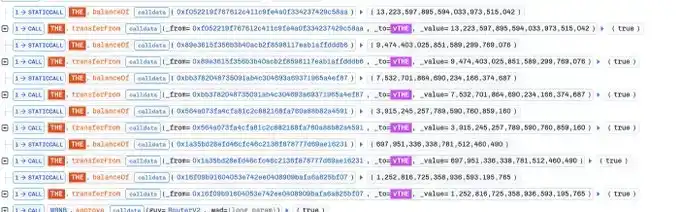
After the first wave of the attack, THE's price stabilized around $0.5.

At this point, the attacker could have walked away with the borrowed assets. But they clearly wanted to maximize profits, so they continued to use the borrowed assets to buy THE, attempting another pump.

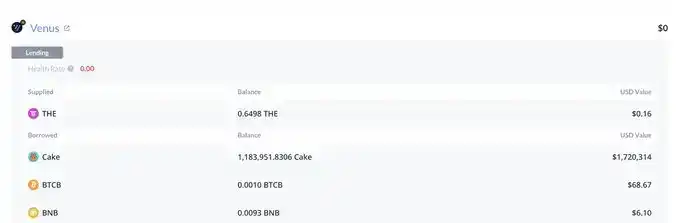
The problem arose: Although the price was abnormally high, selling pressure from the market became extremely intense. The attacker kept buying but could barely push the price higher. Eventually, they almost exhausted their borrowing capacity, and their position's health factor dropped close to 1, nearing liquidation.
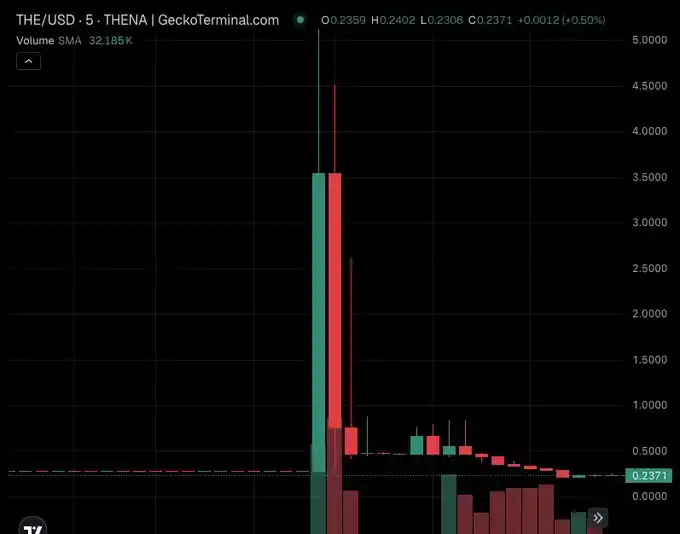
By then, the situation was very clear: The attacker's collateral, including their pre-prepared assets and THE bought during the attack, had a nominal value of about 30M. But the core issue with this collateral was—there was simply not enough liquidity to absorb it. Once liquidation began, this THE would be dumped onto the market. And no one in the market could possibly absorb such a large volume at these inflated prices.

So what did I do?

When liquidation started, I directly opened a short position on THE. And this was a position where relatively higher leverage could be applied.

The reason was simple: High valuation, low liquidity, massive passive selling pressure, no buyers.

The outcome was unsurprising: After the liquidation ended, THE's price fell all the way back to around $0.24, even lower than the pre-attack price, because original holders also sold during the process.

I closed my short position here, profiting about 15K.
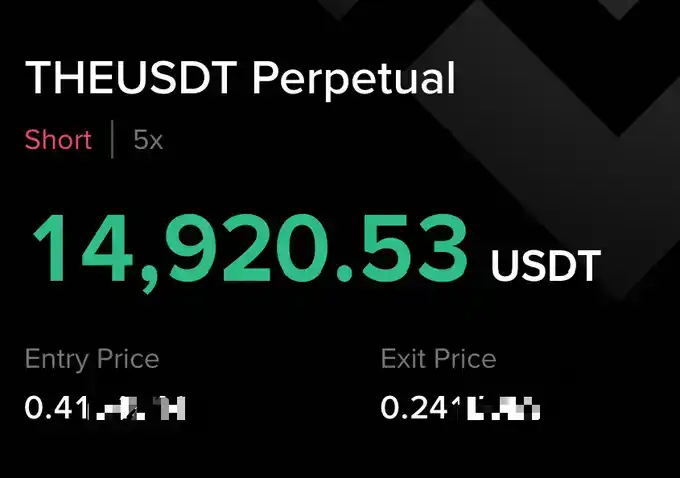
In the end, Venus was left with about 2M in bad debt.

As for how much the attacker actually profited, I haven't done a complete analysis; but judging from the operations of some addresses, they likely made little to no profit, or even blew themselves up. However, the attacker might still have profited from off-chain perp positions (just like our operation).

Venus's ~2M bad debt address: https://debank.com/profile/0x1a35bd28efd46cfc46c2136f878777d69ae16231
This incident once again demonstrates:


In DeFi, "nominal collateral value" does not equal "liquidation value". When the collateral itself lacks liquidity, the system sees 30M, but the market might only be able to realize a fraction of that.

In 2023, I published a paper titled 'Unmasking Role-Play Attack Strategies in Exploiting Decentralized Finance (DeFi) Systems' which provides a detailed mathematical model of this type of attack. Interested readers can refer to: https://dl.acm.org/doi/10.1145/3605768.3623545


İlgili Sorular

QWhat was the core strategy used by the attacker in the Venus THE exploit?

AThe attacker used a price manipulation strategy similar to the Mango Markets attack. They deposited the low-liquidity collateral THE, borrowed other assets, used those assets to buy more THE to drive its price up, waited for the time-weighted average oracle price to update to reflect the inflated value, and then repeated the cycle to gain higher borrowing power.

QHow did the attacker bypass the supply cap limitation on THE?

AThe attacker used a 'donation attack' by directly transferring THE tokens to the vTHE contract after a large deposit. This 'donation' artificially increased the total supply recognized by the system, allowing them to further inflate the collateral value and bypass the supply cap.

QWhy did the author of the article decide to open a short position on THE?

AThe author opened a short position because the attacker's collateral (THE tokens) had an extremely high nominal value but very low liquidity. They anticipated that once liquidation began, the massive sell pressure from the forced selling of these tokens would cause the price to crash dramatically, as there would be no market to absorb such a large volume at the inflated price.

QWhat was the final outcome for the attacker and the Venus protocol?

AThe attacker likely made little to no profit and may have even lost money from their on-chain maneuvers, though they might have profited from off-chain perpetual positions. The Venus protocol was left with approximately $2 million in bad debt.

QWhat key DeFi concept does this event highlight according to the article?

AThe event highlights that 'nominal collateral value' is not the same as 'liquidation value.' When collateral itself lacks sufficient liquidity, the value the system calculates can be vastly higher than the amount the market can actually realize during a liquidation event.

İlgili Okumalar

The "Impossible Triad" Is Fundamentally a Pseudo-Problem

The article argues that blockchain's fundamental limitation is not the scalability trilemma (decentralization, scalability, security), which has been largely solved, but the lack of **privacy** and, until recently, clear **legitimacy**. Blockchain is described as a slow, expensive, globally shared computer whose core value is censorship resistance and verifiability. While ideal for native digital assets like money (e.g., stablecoins), its default transparency acts as a **tax**, exposing all transactions and enabling MEV extraction, which deters serious institutional capital. Simultaneously, its permissionless nature created regulatory ambiguity. The piece contends that **privacy** is the missing critical feature. It rejects the false choice between total transparency and complete anonymity. Modern cryptography (like zero-knowledge proofs) enables **compliant privacy**: users can prove facts (solvency, KYC status, compliance) without revealing the underlying sensitive data (specific holdings, identities). This preserves auditability for regulators and eliminates the leak of financial information. With recent regulatory progress (e.g., the GENIUS Act) addressing legitimacy, adding default, provably compliant privacy becomes a pure upgrade. It transforms blockchain from a costly, public ledger into a confidential settlement layer, finally bridging the gap to mainstream institutional and individual adoption of on-chain finance.

链捕手10 saat önce

The "Impossible Triad" Is Fundamentally a Pseudo-Problem

链捕手10 saat önce

Optical Chips: Collective Capacity Expansion

The global optical chip industry is experiencing a massive wave of expansion driven by surging AI data center demand. Major players across the US, Japan, Europe, and China are aggressively investing to ramp up production capacity. In the US, Coherent is expanding its 6-inch Indium Phosphide (InP) semiconductor fab in Texas, supported by CHIPS Act funding and a $2 billion strategic investment from NVIDIA. Lumentum is building a new factory for InP optical devices, and Nokia is scaling its advanced photonic chip packaging and testing capabilities. NVIDIA's investments aim to secure future supply of critical lasers and optical interconnect products for AI infrastructure. Japan's JX Advanced Metals, a leading InP substrate supplier, plans a multi-billion yen investment to increase its capacity 7-10 times, strengthening its grip on the crucial upstream materials market. In Europe, IQE and Tower Semiconductor settled a patent dispute and signed a multi-year InP epitaxial wafer supply agreement, highlighting that next-generation silicon photonics platforms will integrate high-performance InP components. STMicroelectronics and Sivers Semiconductors are also expanding silicon photonics production and partnerships. China is rapidly building out its domestic supply chain. Dongshan Precision's subsidiary, Source Photonics, announced a $12 billion project to expand optical chip and module production. Companies like Sanan Optoelectronics and Yunnan Germanium are scaling up InP chip manufacturing and substrate production, moving towards vertical integration from materials to modules. While debate continues around the exact future architecture—whether CPO (Co-Packaged Optics), NPO, or pluggables will dominate—analysts like Morgan Stanley argue the underlying driver is unchangeable: the explosive growth in bandwidth demand. This will inevitably increase the volume of optical engines, lasers, and related content per GPU, regardless of the final technical path. The competition for "more light" in the AI era has intensified into a global, full-chain capacity race.

marsbit12 saat önce

Optical Chips: Collective Capacity Expansion

marsbit12 saat önce

Stablecoins Finally Find Real Yield: An In-Depth Look at On-Chain Reinsurance Re | A Conversation with Re Founder Karan Saroya

Stablecoin Real Yield Found: A Deep Dive into On-Chain Reinsurance with Re's Karan Saroya As stablecoin supply exceeds $170 billion, the search for sustainable, non-speculative yield intensifies. Re, an on-chain reinsurance platform, provides an answer: connecting stablecoin capital to the trillion-dollar traditional reinsurance market. Re operates as a regulated reinsurer, accepting stablecoin deposits as collateral to back US insurance companies. These insurers pay premiums, generating yield that flows back to on-chain depositors. Currently supporting 35 insurers and underwriting $500 million, Re projects scaling to over $1 billion soon. Key insights from a Bankless podcast with founder Karan Saroya and investor Avichal of Electric Capital: 1. **Uncorrelated, Real-World Yield:** Re offers stablecoin holders access to reinsurance returns (targeting 12-14%+), an asset class entirely separate from crypto or equity markets. 2. **Operational Efficiency via Smart Contracts:** Re replaces traditional, labor-intensive capital fundraising with smart contracts, allowing a ~12-person team to compete with industry giants. 3. **Regulatory Leverage:** For every $1 of collateral, regulations allow backing $5-7 in written premiums. This leverage amplifies returns from the underlying risk-free rate. 4. **DeFi Integration:** Depositors receive receipt tokens, which can be used in protocols like Morpho for "looping," potentially pushing yields to 18-20%+. 5. **The "DeFi Mullet" Model:** A compliant front-end (regulated reinsurer) paired with a decentralized back-end (smart contracts, DeFi capital markets). 6. **RE Governance Token:** Modeled on Lloyd's of London, the token governs the central capital pool's allocation, counterparty acceptance, and parameters. 7. **Real Economic Impact:** Capital funds real-world productivity (factories, clinics, businesses) via insurance, moving beyond crypto's internal loops. The discussion highlights a pivotal moment: DeFi's supply-side infrastructure is now met by real demand for productive yield, potentially kickstarting a flywheel where vast on-chain stablecoin capital seeks these real-world returns.

链捕手14 saat önce

Stablecoins Finally Find Real Yield: An In-Depth Look at On-Chain Reinsurance Re | A Conversation with Re Founder Karan Saroya

链捕手14 saat önce

İşlemler

Spot
Futures
活动图片