On L1 Value Capture from Two Solana Proposals

marsbit2026-08-05 tarihinde yayınlandı2026-08-05 tarihinde güncellendi

Özet

The article, "Discussing L1 Value Capture Through Two Solana Proposals," by Max Resnick, explores how Layer 1 (L1) blockchain tokens derive their fundamental value, drawing parallels to traditional asset pricing theory. Resnick argues that L1 token value, like stock value, stems from claims on future income streams for holders, not merely from network activity or technological promise. This value is captured when fees are either burned (economically akin to a buyback) or distributed to stakers (akin to dividends). Inflationary staking rewards, by contrast, redistribute value among holders rather than creating it. The core challenge is the quality and defensibility of fee-based revenue. High-quality fees come from sustainable, recurring demand for the network's economic utility (e.g., long-term financial activity), not from transient speculation (e.g., meme coins, airdrops). The strength of a blockchain's network effects—liquidity, applications, users—can make its revenue more defensible and grant it greater pricing power than often assumed. The article proposes a foundational valuation framework for L1s, separating revenue (fees captured for token holders), costs, and total token supply. A key accounting principle is that inflationary rewards should not be counted as a cost unless the newly minted tokens are symmetrically counted as a value input; otherwise, it misrepresents profitability. Finally, Resnick discusses the economics of increasing protocol fees to boost reven...

Author: Max Resnick, Chief Economist at Anza

Compiled by: Jiahuan, ChainCatcher

I am publishing this article as SIMD 550 (doubling the rate of inflation reduction) and SIMD 553 (resource costs) are about to enter the voting stage. This piece is not a specific commentary on these two proposals; I have already left my comments on the respective GitHub proposals. Here, I primarily discuss how the problems these proposals aim to address relate to the valuation of L1s.

Part 1: The Establishment of Asset Pricing Theory

Before asset pricing theory was formally established, investors were not short of methods to value companies. Some focused on hard assets and liquidation value, others emphasized profits, dividends, growth, management quality, or market psychology. There were many metrics available; what was truly missing was a rigorous framework to explain exactly which metrics determine value and how these metrics should be weighed against each other.

By the late 1920s, on the eve of the Great Depression, this ambiguity had become dangerous. Investors could cite facts like profit growth, market expansion, new technologies, and improved corporate governance, but these facts were often used to justify market prices rather than to derive asset value.

Graham and Dodd (1934) later described that era as one where analysis gave way to "potential and prophecy." Even when data was presented, it became "pseudo-analysis to support the illusions of the moment."

Anyone who frequently indulges in Crypto Twitter should find this scene familiar. Today's discussions around L1 tokens are similarly filled with the potential, prophecy, and pseudo-analysis that characterized the stock market of the late 1920s.

The number of people participating in blockchain development is at a record high. Transaction activity is at an all-time peak. Tokens will become currency, collateral, digital oil, or a call option betting on the future financial system.

Some of these claims may be true and could even imply upside for the underlying network. But if they cannot explain how these factors translate into token holder surplus, they do not constitute a coherent valuation framework.

John Burr Williams was the first to push asset pricing towards rigor. In "The Theory of Investment Value," Williams (1938) argued that value is "the present worth of future dividends, or of future coupons and principal in the case of a bond."

Gordon (1959) later expressed the same idea more succinctly: "A stock, like any other asset, is worth to a buyer only the benefits he expects to receive from it in the future."

Equity has value not because a company is impressive, active, important, or technologically irreplaceable. It has value because equity grants shareholders a claim on future income.

For L1 tokens, value can accrue in two ways. The first is fee burning, which economically resembles a buyback. The second is distributing fees to stakers, which economically resembles a dividend.

Staking rewards funded by issuance are different. They are neither income created by the network nor a cost borne by the network. The protocol creates new tokens and distributes them to stakers while diluting the holdings of non-stakers.

This mechanism may be necessary to secure the network and may determine who gradually comes to own the network over time. But from the perspective of all token holders, it neither creates nor destroys value.

A blockchain can process millions of transactions while creating almost no value for token holders because the surplus may be captured by users, applications, validators, or other intermediaries. Conversely, a chain with less activity may be more valuable if it converts a larger proportion of economic activity into token holder value.

But not all fees are created equal. The 'R' in ARR stands for recurring, meaning sustainable and repeatable income. Dichev, Graham, Harvey, and Rajgopal (2013) noted that high-quality earnings should be "sustainable and repeatable." The same standard applies to L1 fees.

One dollar of fees generated by long-term financial activity is not the same as one dollar generated by airdrops, meme coin mania, cascading liquidations, or temporary network congestion.

Some fees come from users' ongoing demand for scarce block space. Others are merely exhaust from speculative cycles. Once incentives disappear, volatility subsides, or users run out of money, these activities also vanish.

Fee quality depends on persistence and defensibility.

Are users paying because the chain provides long-term economic utility, or because a short-term activity happens to be on this chain? Can the protocol continue to charge these fees without driving users, applications, or order flow elsewhere? Can the token continue to capture these profits, or will this value eventually be competed away by validators, applications, searchers, block builders, users, or other chains?

Historically, crypto investors have often made two opposite errors regarding earnings quality simultaneously.

On one hand, they overestimated earnings quality because much crypto activity is speculative, reflexive, and episodic.

On the other hand, they underestimated earnings quality because they did not fully appreciate the strength of L1 network effects. Liquidity, applications, wallets, infrastructure, users, developers, assets, and order flow reinforce each other.

These network effects may make certain fees harder for competitors to capture than they initially appear. They also suggest that dominant blockchains like Solana and Ethereum may have stronger pricing power than the market generally believes, potentially benefiting from raising fees.

Part 2: Accounting Standards for Revenue, Inflation, and Total Supply

The next step is to specify a minimal fundamental model for L1s that can lead to valuation multiples.

It may be premature to call it the "standard model" now. There is currently no universally accepted standard model for L1 valuation. But the categorization below is the form I believe a standard model should take. It intentionally mirrors the methods stock analysts use to value companies.

The reason this needs to be explicitly written down is that there isn't even consensus on the most basic accounting objects.

I've discussed this framework with some of the smartest people I know, and they often disagree on fundamental questions. Are validator rewards funded by inflation considered a cost? Should foundation expenditures be treated as operating expenses? Should the unspent portion of foundation tokens be included in the token supply? Should MEV paid to validators count as protocol revenue, validator revenue, or neither?

Some of the confusion may stem from the fact that there can be more than one correct way to write a valuation model. Accounting classifications are not unique. As long as the corresponding offsetting items are also adjusted, you can move an item from one side of the ledger to the other while keeping the model correct.

But this flexibility is also dangerous. Many models are internally consistent, but many are not. Having multiple correct methods does not mean there are fewer incorrect ones.

Inflation rewards are the simplest example.

Staking rewards funded by issuance are essentially rewards paid by token holders to stakers via dilution. From the perspective of all token holders combined, the two offset each other. The protocol does not earn revenue when it mints new tokens, nor does it incur a real external cost when distributing these tokens to stakers.
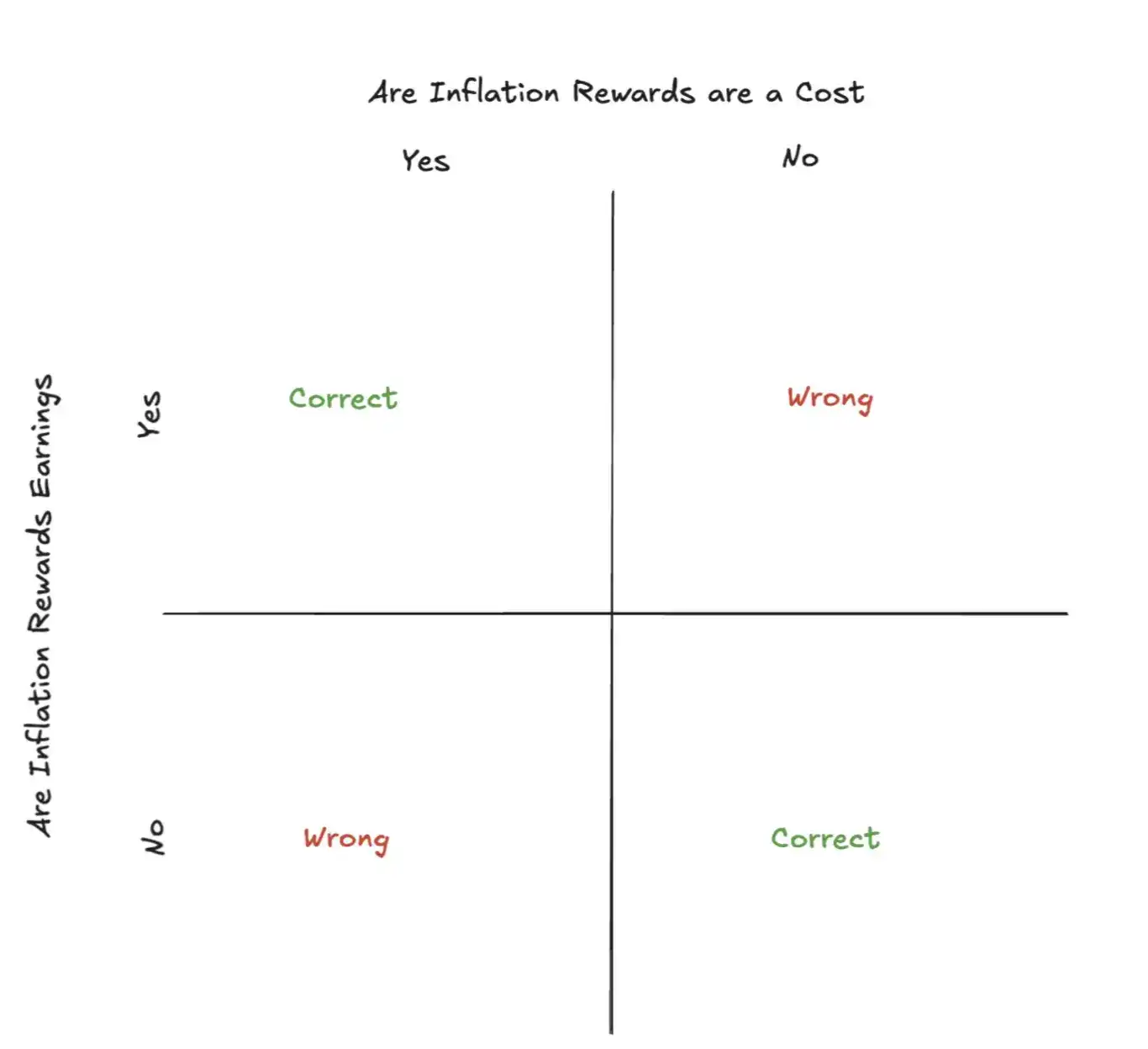
You can create a correct model that treats inflation rewards as a cost, but only if you simultaneously count newly issued tokens as a source of value to offset that cost. Otherwise, the model leads to absurd conclusions, such as Solana being unprofitable because it pays large staking rewards.

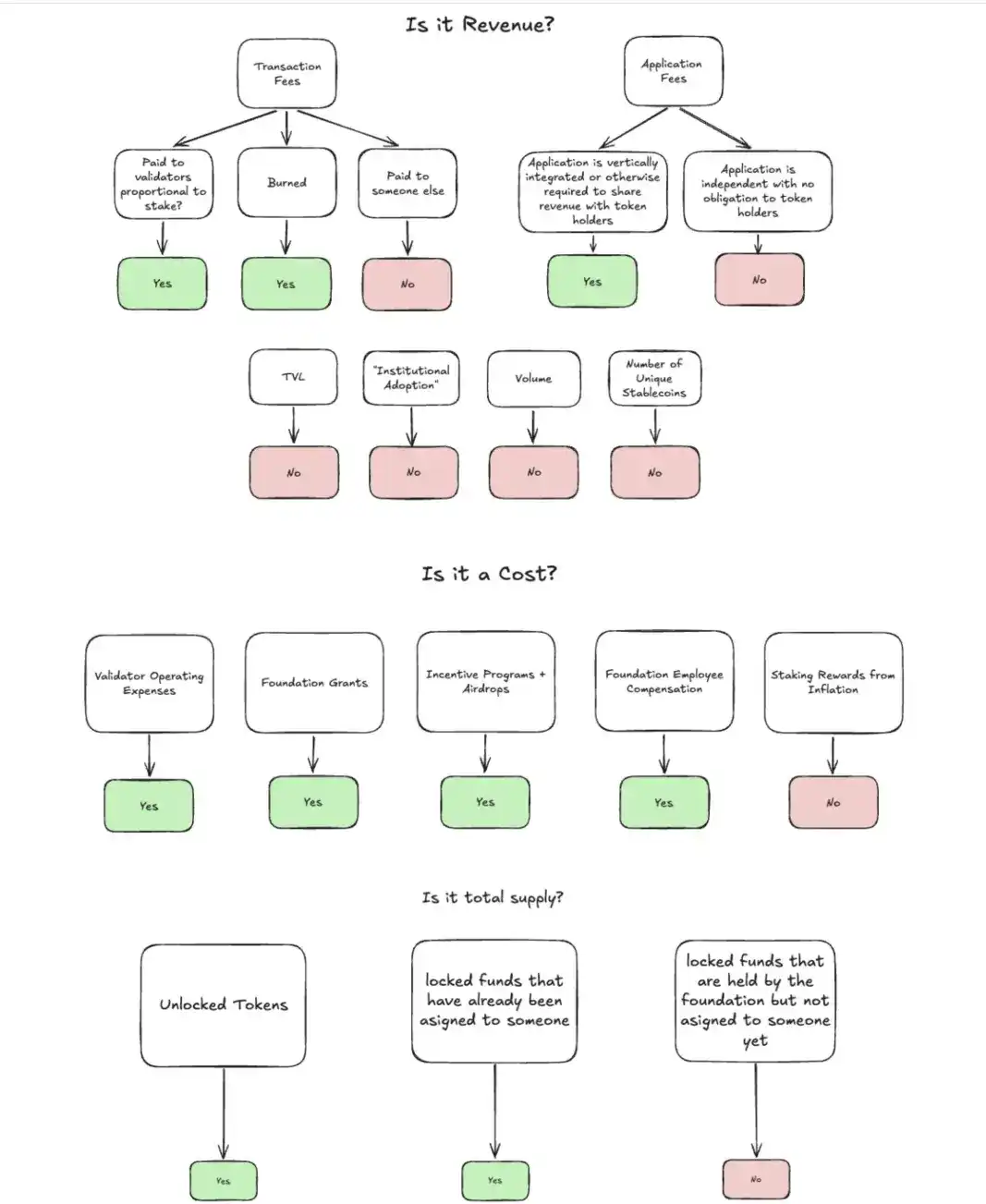
The categorization below is my proposed baseline. It separates three objects: revenue, costs, and total supply.

I believe these definitions most closely resemble the models stock analysts are already familiar with, making them easier to understand and reason about.

Other classifications may be correct, but deviations from this one must have clear justification. Proprietary models come with two costs.

First, they are harder for others to understand. Second, it is easy to miss dependencies between items.

For example, if foundation expenditures are classified as a cost, then the unspent portion of foundation tokens cannot also be included in the total supply, or it would be double-counted. If inflation rewards are classified as a cost, newly issued tokens must be treated symmetrically.
Part 3: Supply, Demand, and Price

Recently, several blockchains have explicitly raised fees with the goal of increasing revenue. However, revenue equals price multiplied by quantity.

Raising fees increases the revenue contributed by transactions that remain, but it also causes some transactions to disappear. Therefore, the net effect of a fee increase on revenue is uncertain; it hinges on the price elasticity of demand for transactions.

To understand the reasoning behind these adjustments, I spoke with some of the decision-makers involved. They believed the fees on these chains were originally too low, so demand was relatively inelastic within that price range.

This argument might apply to specific cases but is not universally true.

I have done some past research utilizing randomness in EIP-1559 pricing. The analysis showed that the price elasticity of gas demand is roughly between 0.6 and 0.8. That is, a 10% price increase leads to a 6% to 8% decrease in quantity demanded.

Moreover, this data only reflects short-term price fluctuations and does not capture the aggregate effects of applications migrating off-chain or optimizing their programs.
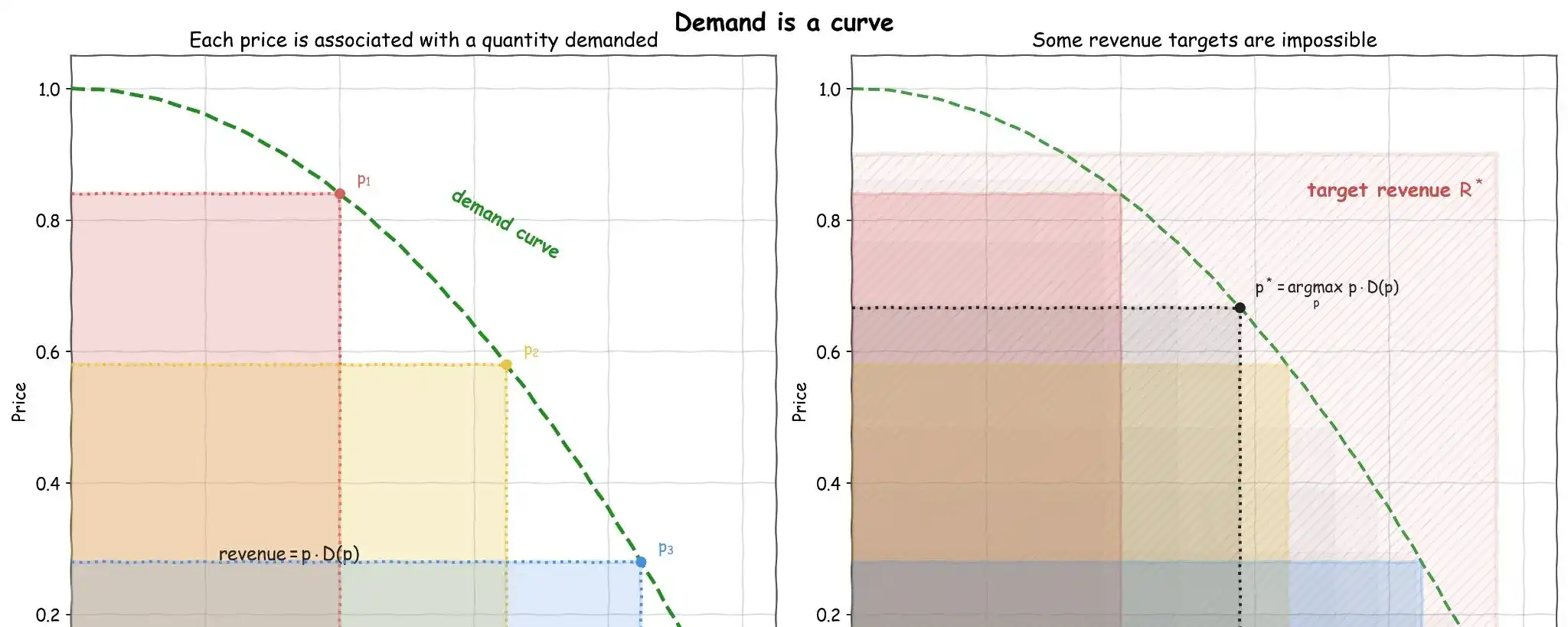
Therefore, a flat fee is a rather blunt instrument for generating revenue. Different types of on-chain transactions have different willingness to pay.

A small wallet transfer, a large stablecoin transfer, and a liquidation may consume the same block space, but they generate different total surplus and have different willingness to pay.
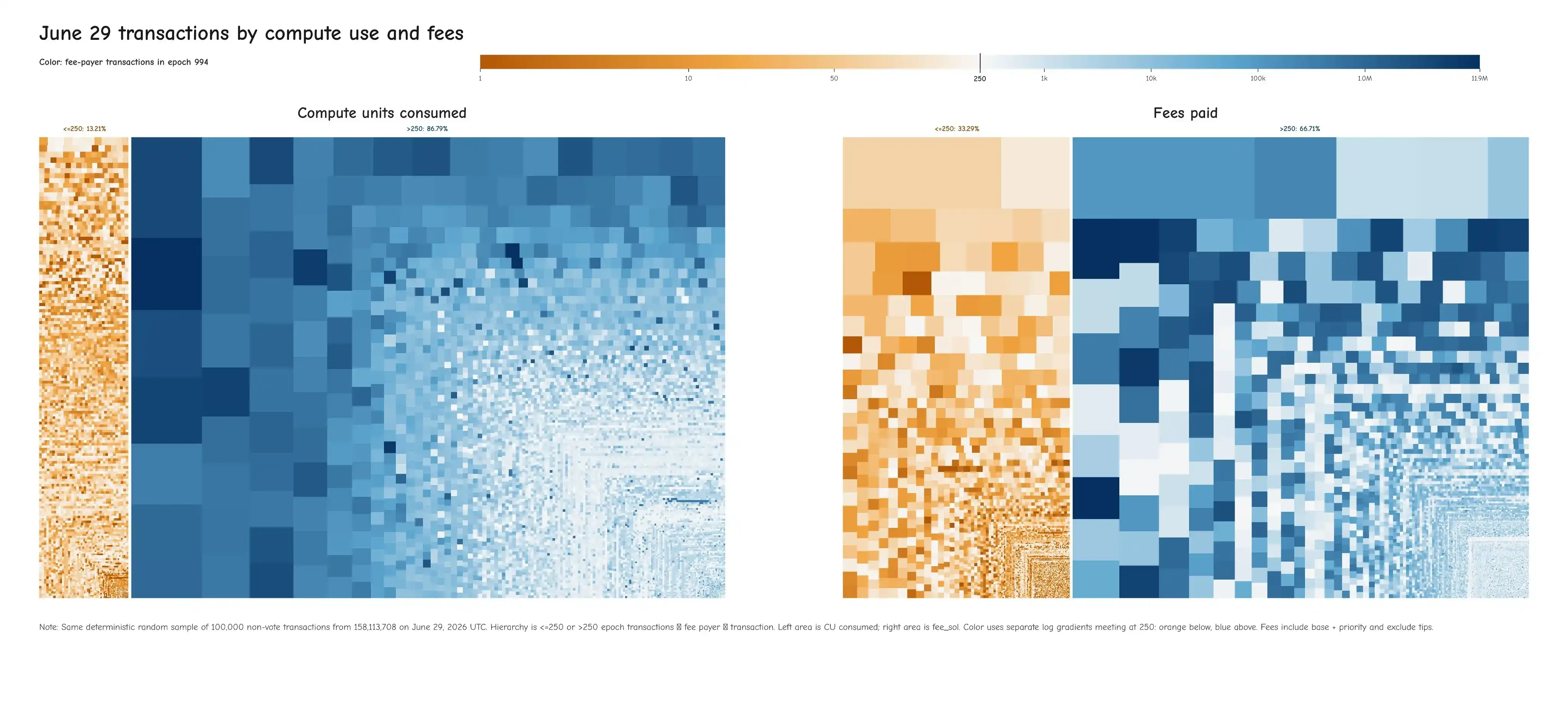
Note: Blue dots represent fee payers who initiated more than 250 transactions in the period, suggesting they are more likely to be bots and thus have higher price elasticity. Bots typically have thin profit margins, so they tend to reduce resource consumption significantly when prices rise.

Protocols want to charge higher fees for transactions with a higher willingness to pay. Computation-based fees are a step in this direction but not thorough enough.

For financial activity, the nominal transaction amount is often a better indicator of willingness to pay than computational load. This is why exchanges typically charge fees based on basis points.

Token programs can provide a way to charge fees proportional to transaction value. By modifying token programs, a small percentage-based fee can be levied on token transfers. This way, even if a high-value transfer uses similar computational resources as a low-value one, the high-value transfer still pays more.


Trend Kriptolar

İlgili Sorular

QAccording to the article, what are the two primary ways that value can be aggregated to L1 token holders, and how do they differ economically from staking rewards funded by inflation?

AAccording to the article, value can be aggregated to L1 token holders in two primary ways: 1) Burning fees, which is economically equivalent to a share buyback, and 2) Distributing fees to stakers, which is economically equivalent to paying a dividend. These differ from staking rewards funded by inflation, which are neither network income nor a real external cost. They represent a redistribution from non-stakers to stakers through dilution, not the creation of value for token holders as a whole.

QWhat is the key difference between 'high-quality' fees and lower-quality fees for an L1 blockchain, as discussed in the article?

AThe key difference lies in the sustainability and defensibility of the fees. High-quality fees are recurring and repeatable, stemming from persistent demand for scarce block space due to long-term economic utility. Lower-quality fees are temporary and non-recurring, often generated by speculative activities like airdrop farming, memecoin frenzies, liquidations, or temporary network congestion that can disappear when incentives fade or volatility subsides.

QIn the author's proposed 'standard model' for L1 accounting, how should inflationary staking rewards and new token issuance be treated, and why?

AIn the author's proposed standard model, inflationary staking rewards should not be treated as a network cost, and newly issued tokens should not be treated as network income. This is because, from the perspective of all token holders, they are offsetting internal transfers—the dilution from new issuance is the 'cost' paid by holders to fund the staking rewards. Treating them as a cost without a corresponding income entry would incorrectly suggest the network is unprofitable.

QWhat caution does the article offer regarding the strategy of increasing protocol fees to raise revenue, and what economic concept is central to this caution?

AThe article cautions that increasing protocol fees does not automatically lead to higher revenue because revenue equals price multiplied by quantity. Raising fees can reduce the quantity of transactions. The central economic concept is the price elasticity of demand. If demand is elastic, a fee increase will lead to a proportionally larger drop in transactions, reducing total revenue. The article cites research suggesting Ethereum gas demand has a price elasticity between 0.6 and 0.8, meaning it is somewhat elastic.

QWhat is the proposed alternative to a uniform fee structure that the author suggests could better capture value from high-willingness-to-pay transactions?

AThe author suggests that a more effective alternative to a uniform fee structure would be to implement fees based on the nominal transaction value, similar to how exchanges charge basis points. This could be done by modifying token programs to levy a small proportional fee on token transfers. This way, a high-value transfer pays more than a low-value transfer even if they consume similar computational resources, better capturing value from transactions with a higher willingness to pay.

İlgili Okumalar

Meme Coin with $60 Million Market Cap Plunges 65% in One Minute, FOMO Faces Renewed Scrutiny

A Solana-based meme token, $CATE, which had surged from a $20M+ to over $80M market cap in about a week, experienced a dramatic 65% crash within one minute. This flash crash has intensified scrutiny on the trading app 'fomo' and highlighted the speculative nature of the current meme coin market. The crash coincided with two events: the token's X account being suspended and the fomo app experiencing downtime, preventing users from trading. While the X suspension was straightforward, the fomo outage raised significant questions. $CATE's primary narrative driver was the open endorsement by Poorgoat, a top-ranked trader on fomo with over 200,000 followers, who had turned a ~$45,000 investment into over $2M at the peak. The token itself had no novel fundamentals, being a "cat sister" to Doge, a concept already existing on Ethereum without success. The crash, triggered by less than $1.5M in selling volume despite over 60,000 holder addresses, exposed a harsh reality: purely "organic" community-driven meme tokens (excluding past successes like $SPX) may now have a market cap ceiling around $17M, as exemplified by the long-term chart of $neet. This incident has fueled existing controversies surrounding fomo. Critics have grown skeptical of the app, alleging that rankings dominated by KOLs who receive lucrative token airdrops could be manipulated to create "pump-and-dump" schemes, luring in retail users before a rug pull. The timing of the crash during fomo's outage—preventing many of its users (who represent over 60% of $CATE holders) from reacting—was viewed as highly suspicious. Further controversy arose when another popular fomo trader publicly sold near the peak, and concerns were raised about the security of accessing private keys during the app's downtime. Fomo's official explanation of server overload due to surging user traffic was met with skepticism, given its substantial funding. The event serves as a stark reminder of the risks in meme coin speculation and the potential vulnerabilities of relying on a single trading platform during market volatility.

marsbit1 saat önce

Meme Coin with $60 Million Market Cap Plunges 65% in One Minute, FOMO Faces Renewed Scrutiny

marsbit1 saat önce

İşlemler

Spot

Popüler Makaleler

SOLANA Nedir

HarryPotterWifHatMyroWynn10Inu,$solana: Trendy Meme Coin Projesine Bir Giriş Giriş Kripto para birimlerinin sürekli gelişen dünyasında, yenilikçi projeler sürekli olarak ortaya çıkmakta ve yatırımcıların ve meraklıların hayal gücünü yakalamaktadır. Bu projelerden biri, kripto topluluğunda kendine bir yer edinmeye başlayan bir meme coin olan HarryPotterWifHatMyroWynn10Inu,$solana'dır. Bu makale, projenin amacını, mimarisini, yaratıcısını, yatırımcılarını ve yolculuğu boyunca kaydedilen dikkate değer kilometre taşlarını kapsamlı bir şekilde sunmayı hedeflemektedir. HarryPotterWifHatMyroWynn10Inu,$solana nedir? Genel Bakış HarryPotterWifHatMyroWynn10Inu,$solana, ölçeklenebilirliği ve hızı ile tanınan Solana blok zinciri üzerinde yapılandırılmış bir meme coin projesidir. Kripto alanına neşe ve yaratıcılık getirmeyi amaçlayan bu proje, sadece bir ticaret token’ı olarak değil, aynı zamanda meme içeriğinin üretilmesi ve paylaşılması için bir katalizör olarak da hizmet etmektedir. Temelindeki topluluk, aktif olarak katılım göstermeye teşvik edilmekte ve yaratıcılığın ve iş birliğinin geliştiği dinamik bir ekosistem sunulmaktadır. Hedefler ve Amaçlar Projenin özünde, meme meraklılarının bir araya gelip, paylaşabileceği ve yeni meme içerikleri oluşturabileceği bir ortam geliştirmek hedeflenmektedir. Bu anlatı odaklı yaklaşım, topluluk içerisinde heyecan yaratmakta, katılımı teşvik etmekte ve aynı zamanda Solana blok zincirinin yerel sağlam işlevselliğini öne çıkarmaktadır. HarryPotterWifHatMyroWynn10Inu,$solana, topluluk odaklı bir proje oluşturarak dijital para birimlerinin ifade biçimi olarak sosyal etkisini keşfetmeyi de amaçlamaktadır. HarryPotterWifHatMyroWynn10Inu,$solana'nın yaratıcısı kimdir? HarryPotterWifHatMyroWynn10Inu,$solana'nın arkasındaki yaratıcının kimliği gizemini korumaktadır. Proje, mülkiyetin feragat edildiği şekilde yapılandırılmıştır; bu nedenle, topluluk liderliğindeki bir girişim olarak gelişmektedir. Bu merkeziyetsizlik, tüm paydaşlar arasında şeffaflığı ve demokratik katılımı teşvik etmektedir. Topluluk katılımının en üst düzeyde olduğu meme coin dünyasında bu tür bir yaklaşım giderek daha popüler hale gelmektedir. HarryPotterWifHatMyroWynn10Inu,$solana'nın yatırımcıları kimlerdir? Şu anda, HarryPotterWifHatMyroWynn10Inu,$solana'yı destekleyen belirli yatırımcılar veya fonlar hakkında kamuya açık bilgi bulunmamaktadır. Tanınmış yatırımcıların yokluğu, projenin topluluk odaklı etik anlayışını daha da pekiştirerek geleneksel finansal çerçevelerden bağımsız olarak durmasına olanak tanımaktadır. Bu bağımsızlık, projenin, kullanıcı tabanından gelen toplu ilgiye dayanarak dış baskılardan bağımsız bir kimlik geliştirmesine olanak tanımaktadır. HarryPotterWifHatMyroWynn10Inu,$solana nasıl çalışır? Ekonomik Model Proje, işlevselliğini ve kullanıcı katılımını destekleyen benzersiz bir ekonomik model kullanmaktadır. HarryPotterWifHatMyroWynn10Inu,$solana içindeki işlemler, tüm taraflar için faydalı olacak şekilde tasarlanmıştır. Her ticaret, ücret almakta ve bu ücret mevcut token sahipleri arasında yeniden dağıtılmakta, aynı zamanda likidite havuzunu artırmaktadır. Bu modelin temel bileşenleri şunlardır: Yansıtma Mekanizması: İşlem ücretlerinin bir kısmı sahiplerine geri verilmektedir, bu da token'a uzun vadeli yatırım yapmayı teşvik etmektedir. Likidite Havuzu Edinimi: Likiditeyi artırmak için fonlar tahsis edilmektedir, böylece alım satım işlemleri sorunsuz bir şekilde gerçekleştirilebilmektedir. Yanma Mekanizmaları: Token'ların bir kısmı, talep arttıkça değeri potansiyel olarak artırmak için yanılabilir. Bu tasarım, topluluk etkileşimleri ve yatırımlar üzerinde gelişen kendine yeten bir ekosistemi teşvik etmektedir. Topluluk Katılımı HarryPotterWifHatMyroWynn10Inu,$solana'nın kalbinde, topluluk katılımına atfedilen değer yatmaktadır. Kullanıcıların, meme oluşturma ve tanıtımlar gibi çeşitli etkinlikler aracılığıyla projenin gelişimine katılmalarına olanak tanıyarak, yaratıcılığın gelişebileceği canlı bir ekosistem oluşturmaktadır. HarryPotterWifHatMyroWynn10Inu,$solana'nın Zaman Çizelgesi HarryPotterWifHatMyroWynn10Inu,$solana'nın yolculuğu, kripto topluluğundaki mevcut durumunu şekillendiren birkaç önemli olayı içermektedir: Yaratılış: Yaratılışın belirli tarihi açıklanmamış olmakla birlikte, projenin başlangıcı, dijital çağın içine işleyen meme kültüründe kök salmaktadır. Topluluk Devralması: Yaratıcının mülkiyetten feragat etmesinin ardından, proje topluluk liderliğine geçerek tüm katılımcılara başarısında bir pay vermiştir. Denetim ve NFT Koleksiyonu: Güvenilirliği artırmak için proje kapsamlı bir denetim gerçekleştirirken, aynı zamanda meme merkezli etik anlayışını yansıtacak bir NFT koleksiyonu başlatmıştır. Ortaklıklar ve Gelişim: Proje, mevcut durumda diğer token'larla potansiyel ortaklıklar keşfetmekte ve efsanevi meme'lerine dayanarak benzersiz bir web sitesi ve ürün seçeneklerinin geliştirilmesini organize etmektedir. Önemli Noktalar Özetle, HarryPotterWifHatMyroWynn10Inu,$solana, kripto para birimi meme coin sektörü içinde dikkate değer bir oyuncu durumundadır. İşte anahtar çıkarımlar: Topluluk Liderliğindeki Girişim: Proje, mülkiyet taleplerinden bağımsız olarak topluluk üyelerinin aktif katkılarını teşvik ederek iş birliği çabası içinde gelişmektedir. Yenilikçi Ekonomik Model: Yansıtma, likidite edinimi ve yanma mekanizmalarını kullanarak, kullanıcılar için sağlam ve ilgi çekici bir finansal ortam yaratmaktadır. NFT ve Ürün Etkileşimi: NFT koleksiyonunun lansmanı ile proje, topluluğu ile etkileşimi derinleştirmeyi hedeflemekte, meme kültürü ile dijital para birimi arasındaki bağı pekiştirmektedir. Ortaklıkların Keşfi: Girişim duraksamıyor – sürdürülebilir büyüme hedefleyen devam eden gelişmeler ve potansiyel ortaklıklar, ileri görüşlü bir yaklaşım olduğunu göstermektedir. Sonuç HarryPotterWifHatMyroWynn10Inu,$solana, kripto para birimi alanında itibar kazandıkça, topluluk katılımı, yenilikçi ekonomik yapılar ve meme kültürünün entegrasyonu ile potansiyel yolunu çizmektedir. Kökenleri ve yatırımcı bağlantıları etrafında gizem olmasına rağmen, proje merkeziyetçi inovasyonun özünü yansıtan ilginç bir hikaye sunmaktadır. Kripto para birimleri genellikle tamamen finansal bir bakış açısıyla değerlendirildiği bir dünyada, HarryPotterWifHatMyroWynn10Inu,$solana, kripto hareketinin yaratıcılığı, topluluğu ve iş birliğini içerebildiğini göstermektedir. İster deneyimli bir yatırımcı olsun, ister yeni bir katılımcı, bu meme coin projesinin gelişen yolculuğu kesinlikle dikkat etmeyi gerektiren ilgi çekici bir vaka çalışmasıdır.

586 Toplam GörüntülenmeYayınlanma 2024.04.04Güncellenme 2024.12.03

SOLANA Nedir

SOLANA 2.0 Nedir

BarbieCrashBandicootRFK777Inu, $SOLANA 2.0: Kripto Manzarasında Yeni Bir Oyuncu BarbieCrashBandicootRFK777Inu, $SOLANA 2.0'a Giriş Kripto para birimlerinin sürekli evrilen manzarasında, yeni girişimler sürekli olarak yatırımcıların ve meraklıların dikkatini çekiyor. Bu yeni projeler arasında, kripto para simgesi $SOLANA 2.0 ile temsil edilen BarbieCrashBandicootRFK777Inu bulunmaktadır. Bu benzersiz girişim, gizem, macera ve meme kültürü unsurlarını birleştirerek, son derece rekabetçi bir arenada beklentileri aşmayı hedefliyor. Büyüme ve yenilik arzularıyla, bu proje, yerleşik devlerle savaşa hazırlanan bir alt yapının ruhunu yakalıyor. BarbieCrashBandicootRFK777Inu, $SOLANA 2.0 Nedir? BarbieCrashBandicootRFK777Inu, temelinde çeşitli ikonik kültürel referanslardan ilham alan bir kripto para projesidir. Barbie ile ilişkilendirilen zarafet ve çekicilik, Crash Bandicoot'ın dinamik enerjisi ve RFK'nın temsil ettiği amansız azim ile harmanlanan bu proje, kripto para dünyasında çok yönlü bir deneyim sunmayı amaçlamaktadır. BarbieCrashBandicootRFK777Inu projesinin ana hedefi, bu farklı unsurları geniş bir izleyici kitlesine hitap eden uyumlu bir ekosisteme birleştirmektir. Meme kültürünün eğlenceli yanlarını kucaklarken, merkeziyetsizlik ve finansal güçlendirme ilkeleriyle köklü bir bağ kurarak, proje kendisini hem deneyimli yatırımcılar hem de kripto dünyasına yeni katılanlar için cazip bir seçenek olarak konumlandırmıştır. BarbieCrashBandicootRFK777Inu, $SOLANA 2.0'nın Yaratıcısı Kimdir? BarbieCrashBandicootRFK777Inu'ya olan ilginin artmasına rağmen, yaratıcısı hakkında bilgiler büyük ölçüde bilinmemektedir. Kurucusunun veya geliştirme ekibinin anonimliği, projenin yapısı ve yönetişimi hakkında soru işaretleri oluşturuyor. Kripto para dünyasında, projelerin kamuya açık bir şekilde yaratıcıları olmadan faaliyet göstermesi sık rastlanan bir durumdur. Bu bilgi eksikliği bazı potansiyel yatırımcıları caydırabilirken, diğerleri bunu birçok kripto para girişimini destekleyen merkeziyetsizlik ruhunu benimseme fırsatı olarak görebilir. BarbieCrashBandicootRFK777Inu, $SOLANA 2.0'in Yatırımcıları Kimlerdir? Şu anda, BarbieCrashBandicootRFK777Inu'yu destekleyen yatırım temelleri veya kuruluşları hakkında sınırlı bilgi bulunmaktadır. Projenin detaylı bir yatırım desteğinden yoksun olması, birçok kripto paranın bağımsız doğasını vurguluyor. Bu durumda, projenin finansmanının yerel topluluk desteğinden mi yoksa daha büyük finansal varlıkların desteğinden mi geleceği henüz belirsizliğini koruyor. BarbieCrashBandicootRFK777Inu, $SOLANA 2.0 Nasıl Çalışıyor? BarbieCrashBandicootRFK777Inu, kalabalık kripto alanında kendine özgü olmasına katkıda bulunan birçok özellikle tasarlanmıştır. Belirli teknik detaylar gizli tutulsa da, proje kullanıcı etkileşimini artırmayı ve topluluk büyümesini teşvik etmeyi amaçlayan işlevsellikler içermesi beklenmektedir. Modadan maceraya ve oyun dünyasına kadar çeşitli etkilerin birleşimi, farklı ilgi alanlarına hitap eden kapsayıcı bir atmosferi teşvik ediyor. Ek olarak, projenin $SOLANA 2.0 ekosistemi ile olan bağı, potansiyel teknolojik avantajları önermektedir. Bu, yenilikçi işlem hızlarını, ölçeklenebilirliği ve maliyet etkinliğini içerebilir ve bu da Solana blok zincirinin teknik kapasitesiyle uyumlu hale getirmektedir. Projenin kurucuları, kalıcı bir topluluk deneyimi ve önemli bir ürün sunumu oluşturmak için bu teknolojik temeli benimseyecek gibi gözüküyor. BarbieCrashBandicootRFK777Inu, $SOLANA 2.0'ın Zaman Çizelgesi BarbieCrashBandicootRFK777Inu'nun yolculuğu, projenin şimdiye kadarki gelişimini aydınlatan birkaç önemli dönüm noktası içermektedir: Proje Kavramsallaştırması: Gizem, macera ve meme kültürünün birleştirilmesine dair ilk fikirler ortaya çıktı ve projenin benzersiz konsepti için bir çerçeve sağladı. Token Oluşturma: Projenin beklentilerini temsil etmek ve potansiyel yatırımcıların ilgisini çekmek üzere tasarlanmış sembolik $SOLANA 2.0 tokeni oluşturuldu. Proje Gelişimi: Şu anda, proje daha fazla geliştirme aşamasındadır ve kripto alanındaki yerleşik oyunculara meydan okumaya ve yenilikçi tekliflerde bulunmaya odaklanmaktadır. Bu dönüm noktaları, projenin büyüme eğilimini yansıtırken, öncü bir kripto para deneyimi geliştirme konusundaki kararlığını da vurgulamaktadır. BarbieCrashBandicootRFK777Inu, $SOLANA 2.0 Hakkında Ana Noktalar Benzersiz Konsept: BarbieCrashBandicootRFK777Inu, gizem, macera ve meme kültürünü birleştirerek tek bir kripto para projesi olarak öne çıkmaktadır. Alt Yapı Ruhu: Proje, yerleşik kripto para projelerine meydan okumak ve sektörde bir niş oluşturma amacı taşıyan bir alt yapı kişiliğini benimsemektedir. Gelişim Aşaması: Aktif geliştirme çabaları devam etmektedir ve topluluğun ve yatırımcıların beklentileriyle uyumlu yenilikçi teklifler sunma niyeti bulunmaktadır. Sonuç $SOLANA 2.0 sembolü ile temsil edilen BarbieCrashBandicootRFK777Inu, kripto para piyasasında ilginç bir yeni girişimdir. Kültürel referansların benzersiz karışımı ve iddialı vizyonu, kripto manzarasında alternatif proje değerleri arayanlarla yankı bulabilir. Yaratıcısının ve yatırımcılarının bilinmeyen durumu bazılarına tuhaf gelebilir, ancak projenin çekicilik ve maceraya olan vurgusu, kripto paraların neyi temsil edebileceğinin sınırlarını genişleten etkileyici bir anlatı sunuyor. Proje geliştikçe, daha geniş kripto dünyasında nasıl evrileceğini ve rakipleri arasında nasıl bir yer edineceğini gözlemlemek ilginç olacaktır. BarbieCrashBandicootRFK777Inu, dijital varlıklarla etkileşimi yeniden tanımlayacak sürpriz deneyimlerin kapısını aralayabilir. Şu anda, proje ilerledikçe, yolculuğu kripto alanında yeniliğin sınır tanımadığını, heyecan ve eğlenceden finansal güçlendirme potansiyeline kadar her şeyi sunduğunu hatırlatıyor.

246 Toplam GörüntülenmeYayınlanma 2024.04.05Güncellenme 2024.12.03

SOLANA 2.0 Nedir

SOL Nasıl Satın Alınır

HTX.com’a hoş geldiniz! Solana (SOL) satın alma işlemlerini basit ve kullanışlı bir hâle getirdik. Adım adım açıkladığımız rehberimizi takip ederek kripto yolculuğunuza başlayın. 1. Adım: HTX Hesabınızı OluşturunHTX'te ücretsiz bir hesap açmak için e-posta adresinizi veya telefon numaranızı kullanın. Sorunsuzca kaydolun ve tüm özelliklerin kilidini açın. Hesabımı Aç2. Adım: Kripto Satın Al Bölümüne Gidin ve Ödeme Yönteminizi SeçinKredi/Banka Kartı: Visa veya Mastercard'ınızı kullanarak anında Solana (SOL) satın alın.Bakiye: Sorunsuz bir şekilde işlem yapmak için HTX hesap bakiyenizdeki fonları kullanın.Üçüncü Taraflar: Kullanımı kolaylaştırmak için Google Pay ve Apple Pay gibi popüler ödeme yöntemlerini ekledik.P2P: HTX'teki diğer kullanıcılarla doğrudan işlem yapın.Borsa Dışı (OTC): Yatırımcılar için kişiye özel hizmetler ve rekabetçi döviz kurları sunuyoruz.3. Adım: Solana (SOL) Varlıklarınızı SaklayınSolana (SOL) satın aldıktan sonra HTX hesabınızda saklayın. Alternatif olarak, blok zinciri transferi yoluyla başka bir yere gönderebilir veya diğer kripto para birimlerini takas etmek için kullanabilirsiniz.4. Adım: Solana (SOL) Varlıklarınızla İşlem YapınHTX'in spot piyasasında Solana (SOL) ile kolayca işlemler yapın.Hesabınıza erişin, işlem çiftinizi seçin, işlemlerinizi gerçekleştirin ve gerçek zamanlı olarak izleyin. Hem yeni başlayanlar hem de deneyimli yatırımcılar için kullanıcı dostu bir deneyim sunuyoruz.

2.0k Toplam GörüntülenmeYayınlanma 2024.12.12Güncellenme 2026.06.02

SOL Nasıl Satın Alınır

Tartışmalar

HTX Topluluğuna hoş geldiniz. Burada, en son platform gelişmeleri hakkında bilgi sahibi olabilir ve profesyonel piyasa görüşlerine erişebilirsiniz. Kullanıcıların SOL (SOL) fiyatı hakkındaki görüşleri aşağıda sunulmaktadır.

活动图片