Pharos Establishes RealFi Alliance to Promote Institutional-Grade On-Chain Execution Standardization for RWA

marsbit2026-02-23 tarihinde yayınlandı2026-02-23 tarihinde güncellendi

Özet

Pharos Network has launched the RealFi Alliance, a strategic ecosystem initiative aimed at unifying institutional asset issuers, financial infrastructure providers, and on-chain builders. The alliance seeks to standardize and scale the execution framework for real-world assets (RWA), moving beyond isolated pilots. Founding members include Chainlink, Asseto Finance, Ember, Faroo, LayerZero, R25, Re7 Labs, TopNod, and Centrifuge. The alliance addresses systemic issues like fragmented liquidity, inconsistent infrastructure standards, and regulatory disconnects by creating a unified operational layer where RWAs remain active, composable, and capable of supporting institutional workflows. It operates on four core pillars: Asset Enablement (bringing real-world value on-chain securely), Infrastructure & Compliance (leveraging Pharos’s parallel execution and built-in compliance modules), Liquidity & Utility (designing clear functional use cases like staking and yield mechanisms), and Market Transparency (establishing trust through clear risk and return benchmarks). Pharos CEO Wish Wu emphasized that the goal is to create a unified environment for assets to operate at scale with institutional reliability. The upcoming Pharos mainnet will launch as a ready-to-use financial environment with integrated liquidity and compliance standards. The alliance plans to expand in structured batches, selecting new members based on asset quality, technical maturity, and ecosystem synergy. Pharos i...

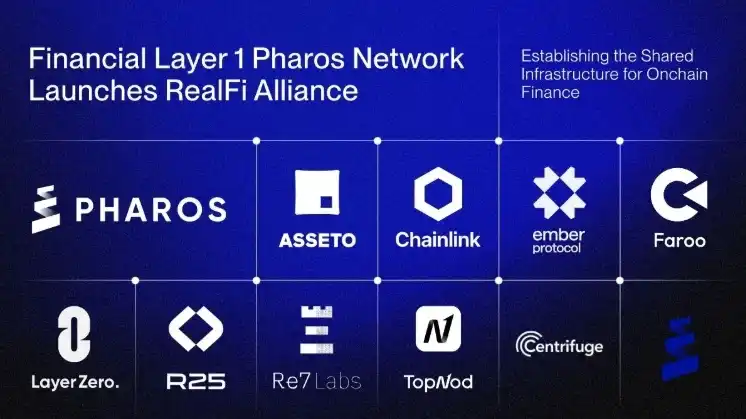
Pharos Network, a financial-grade Layer 1 public chain, today announced the establishment of the RealFi Alliance, a strategic ecosystem initiative aimed at uniting institutional-grade asset issuers, financial infrastructure providers, and on-chain builders. The alliance's goal is to advance the real-world asset (RWA) market from isolated pilot phases to a standardized, scalable, and executable operational framework. The inaugural members of the RealFi Alliance include: Chainlink, Asseto Finance, Ember, Faroo, LayerZero, R25, Re7 Labs, TopNod, and Centrifuge.

The RealFi Alliance aims to address systemic friction issues such as liquidity fragmentation, inconsistent infrastructure standards, and regulatory disconnects by coordinating assets and capital under a unified framework. Rather than viewing real-world assets (RWA) as static tokens, the alliance sees RealFi as a foundational financial infrastructure layer that keeps assets active, composable on-chain, and capable of supporting institutional-grade business processes at any time. The inaugural members form the core foundation of RealFi on Pharos, ensuring that the network has real-world partners building and implementing on it from the moment it enters the market.

The alliance operates under a framework of four core pillars designed to ensure long-term adoption and systemic robustness. Central to this initiative is Asset Enablement, focusing on bringing real-world value on-chain in a secure and composable form and optimizing its capacity for continuous participation. This foundation is further strengthened by rigorous infrastructure and compliance alignment, leveraging Pharos's deep parallel execution architecture and built-in compliance modules to meet the highest institutional security standards. To bridge the gap between asset issuance and practical use, the alliance prioritizes liquidity and utility design, creating clear functional pathways for assets through mechanisms like staking, yield, and application integration. The collaboration between Ember and Re7 Labs exemplifies this philosophy—embedding institutional-grade risk management and vault curation capabilities directly into the asset lifecycle. Finally, by establishing market transparency and clear benchmarks for risk and return sources, the alliance builds the necessary foundation of trust for sophisticated capital allocators to participate at scale within the ecosystem.

Wish Wu, Co-founder and CEO of Pharos Network, stated: "The core challenge in today's on-chain finance is not a lack of assets, but the absence of a unified environment where these assets can operate at scale. The RealFi Alliance is our commitment to building that environment. By aligning with industry-standard oracle platforms like Chainlink and specialized asset operators, we ensure that real value can flow on-chain with institutional-grade reliability."

This strategic synergy ensures that the upcoming Pharos mainnet will launch as a 'ready-to-use' financial environment with integrated liquidity and compliance standards. Moving forward, the RealFi Alliance will expand in structured batches, with new members selected based on asset quality, technical maturity, and ecosystem synergy. This long-term development path ensures that as the Pharos ecosystem matures, the quality and utility of its underlying assets remain industry-leading.

About Pharos Network

Pharos is an inclusive financial Layer 1 for RealFi, where real value and institutional-grade assets circulate on-chain and can be composably integrated with decentralized assets, serving as the next generation of financial-grade infrastructure for global finance. Pharos combines a modular architecture, deep parallel execution mechanism, and built-in compliance modules to power an asset-native ecosystem. The project is built by a team of management and engineering veterans from Ant Group and is backed by global investment firms such as Hack VC and Faction VC.


Trend Kriptolar

İlgili Sorular

QWhat is the main goal of the RealFi Alliance announced by Pharos Network?

AThe main goal of the RealFi Alliance is to advance the real-world asset (RWA) market from isolated pilot phases to a standardized, scalable, and executable operational framework by uniting institutional-grade asset issuers, financial infrastructure providers, and on-chain builders.

QWhich companies are among the founding members of the RealFi Alliance?

AThe founding members of the RealFi Alliance include Chainlink, Asseto Finance, Ember, Faroo, LayerZero, R25, Re7 Labs, TopNod, and Centrifuge.

QWhat are the four core pillars that the RealFi Alliance operates on?

AThe four core pillars are: Asset Enablement (bringing real-world assets on-chain), Infrastructure & Compliance Alignment (leveraging Pharos's architecture for institutional security), Liquidity & Utility Design (creating functional pathways for assets), and Market Transparency & Trust (building a foundation for mature capital allocators).

QAccording to Wish Wu, what is the core challenge facing on-chain finance today?

AWish Wu stated that the core challenge is not a lack of assets, but the absence of a unified environment that allows these assets to operate at scale.

QWhat is the background of the team behind Pharos Network, and which investors support it?

AThe project is built by a team of management and engineers from Ant Group and is backed by global investment firms such as Hack VC and Faction VC.

İlgili Okumalar

Global Stock Market's Storm Center: South Korea's Stock Market De-leveraging Is Largely Complete

Storm's Eye: South Korean Market De-leveraging Nears Completion The recent sharp correction in South Korean equities, with the KOSPI index dropping 32% from its June high, has been a key trigger for global tech stock volatility. The core driver was not a fundamental shift but a forced de-leveraging process within the market's unique structure, which is now largely complete. Two main leverage channels amplified the sell-off: 1. **Leveraged ETFs:** Their size, proportionally four times larger than in the U.S., peaked near $50 billion. Their mandatory daily rebalancing mechanism created a vicious cycle of "price drop → forced selling → further drop." Approximately 75% of this excess has been unwound, shrinking to $26 billion, with regulatory curbs now blocking new inflows. 2. **Hedge Fund Leverage:** Using swaps to magnify exposure, hedge funds saw their net long positioning fall by over 50% from peak levels. The most intense phase of this institutional de-leveraging is over. In contrast, **retail margin debt** poses minimal systemic risk. At 0.5% of market cap, it is far lower than in the U.S. or China, lacks automatic triggers, and is concentrated in smaller stocks. The conclusion: the high-leverage structures most prone to "chain-reaction selling" have been substantially cleared. The market is transitioning from a liquidity-driven crash to one priced more on fundamentals. The article argues that the AI trend—centered on Korean memory chips—remains intact. This episode represents a painful but necessary clearing of crowded trades, not the end of the AI revolution. For investors, the key question is conviction in the long-term AI direction; if the trend is real, current volatility is a cost of entry, not a terminal risk.

链捕手1 saat önce

Global Stock Market's Storm Center: South Korea's Stock Market De-leveraging Is Largely Complete

链捕手1 saat önce

The Eternal Fragments of Money: Third-Party Payment Has No First Principle

"The Enduring Fragments of Money: Third-Party Payments Lack a First Principle" Stripe is reportedly attempting to acquire PayPal, marking a significant shift reminiscent of PayPal's merger with the original X.com 30 years ago. The article analyzes Stripe's strategic challenges and the broader payments industry landscape. Despite its initial success with a developer-friendly API model, Stripe missed its optimal IPO window during the pandemic and has since seen its valuation decline. Its attempts to expand through acquisitions and new ventures, particularly in stablecoins (like its OUSD project) and Agent-focused payments (ACP/MPP protocols), have faced headwinds. The author argues that the payment industry remains highly fragmented and is ultimately an adjunct to the traditional banking system. This structure limits the potential for any single player, including Stripe, to achieve complete dominance. While stablecoins and the future rise of autonomous Agent economies present potential growth avenues, they are not yet mainstream and still require integration with the existing financial system. For now, Agent-based transactions are largely used for speculative "volume boosting" rather than substantive business applications. Stripe's current move to acquire PayPal is seen as an attempt to bolster its weak consumer-facing (C-side) business after its stablecoin-focused strategies faltered. Meanwhile, PayPal is described as structurally outdated, unable to revive itself through new products like Venmo or PYUSD. The future of payments may lie not in payments themselves but in value-added services like more efficient settlement networks. The author suggests that companies like Stripe and Circle, which are building their own blockchains (Tempo, Arc) and stablecoins, are positioning themselves to eventually profit from high-efficiency settlement systems. These new networks could potentially bypass some traditional banking layers. In conclusion, the article posits that third-party payment is a perpetually fragmented battlefield where scale alone cannot ensure victory. Players must find new models, focusing on efficiency to compete with the entrenched banking system. Stripe's acquisition of PayPal represents a bet on this uncertain future.

链捕手1 saat önce

The Eternal Fragments of Money: Third-Party Payment Has No First Principle

链捕手1 saat önce

İşlemler

Spot

Popüler Makaleler

LAYER Nasıl Satın Alınır

HTX.com’a hoş geldiniz! Solayer (LAYER) satın alma işlemlerini basit ve kullanışlı bir hâle getirdik. Adım adım açıkladığımız rehberimizi takip ederek kripto yolculuğunuza başlayın. 1. Adım: HTX Hesabınızı OluşturunHTX'te ücretsiz bir hesap açmak için e-posta adresinizi veya telefon numaranızı kullanın. Sorunsuzca kaydolun ve tüm özelliklerin kilidini açın. Hesabımı Aç2. Adım: Kripto Satın Al Bölümüne Gidin ve Ödeme Yönteminizi SeçinKredi/Banka Kartı: Visa veya Mastercard'ınızı kullanarak anında Solayer (LAYER) satın alın.Bakiye: Sorunsuz bir şekilde işlem yapmak için HTX hesap bakiyenizdeki fonları kullanın.Üçüncü Taraflar: Kullanımı kolaylaştırmak için Google Pay ve Apple Pay gibi popüler ödeme yöntemlerini ekledik.P2P: HTX'teki diğer kullanıcılarla doğrudan işlem yapın.Borsa Dışı (OTC): Yatırımcılar için kişiye özel hizmetler ve rekabetçi döviz kurları sunuyoruz.3. Adım: Solayer (LAYER) Varlıklarınızı SaklayınSolayer (LAYER) satın aldıktan sonra HTX hesabınızda saklayın. Alternatif olarak, blok zinciri transferi yoluyla başka bir yere gönderebilir veya diğer kripto para birimlerini takas etmek için kullanabilirsiniz.4. Adım: Solayer (LAYER) Varlıklarınızla İşlem YapınHTX'in spot piyasasında Solayer (LAYER) ile kolayca işlemler yapın.Hesabınıza erişin, işlem çiftinizi seçin, işlemlerinizi gerçekleştirin ve gerçek zamanlı olarak izleyin. Hem yeni başlayanlar hem de deneyimli yatırımcılar için kullanıcı dostu bir deneyim sunuyoruz.

420 Toplam GörüntülenmeYayınlanma 2025.02.11Güncellenme 2026.06.02

LAYER Nasıl Satın Alınır

Tartışmalar

HTX Topluluğuna hoş geldiniz. Burada, en son platform gelişmeleri hakkında bilgi sahibi olabilir ve profesyonel piyasa görüşlerine erişebilirsiniz. Kullanıcıların LAYER (LAYER) fiyatı hakkındaki görüşleri aşağıda sunulmaktadır.

活动图片