Only 3 Points for the Public Chain Moat? Alliance DAO Founder's Remarks Ignite Crypto Community Debate

Odaily星球日报2025-12-11 tarihinde yayınlandı2025-12-11 tarihinde güncellendi

Özet

In a recent debate sparked by Alliance DAO founder qw (@QwQiao), the crypto community is divided over the "moat" of blockchain technology. Qw controversially rated the moat of L1 public chains at just 3/10, arguing that their defensibility is limited compared to traditional tech and financial giants like Microsoft (10/10), Apple (10/10), or Visa (10/10). He suggested that even top crypto projects only score around 5/10, with Bitcoin being an exception at 9/10 due to its unique founding narrative and Lindy effect. The discussion originated from a Paradigm researcher’s critique that "liquidity is not a moat," which drew mixed reactions. Some, like Dragonfly Capital’s Haseeb, strongly disagreed with qw, pointing to Ethereum’s decade-long dominance despite numerous challengers as proof of a significant moat. Others argued that network effects, trust, and ecosystem maturity are critical moats in crypto. The article explores seven potential components of a public chain’s moat: technical vision, founder influence, developer/user networks, application ecosystems, token market cap, external connectivity, and long-term roadmaps. It concludes that the crypto industry is still too small and nascent to focus heavily on moat analysis—instead, it should prioritize scaling users, capital, and real-world utility.

Original / Odaily Planet Daily (@OdailyChina)

Author / Wenser(@wenser2010)
Recently, Alliance DAO founder qw(@QwQiao) dropped a bombshell opinion: "Blockchain moats are limited," rating the moat of L1 public chains at a mere 3/10.

This statement quickly ignited the overseas crypto circle, sparking heated discussions among crypto VCs, public chain builders, and KOLs. Dragonfly partner Haseeb angrily retorted that rating the "blockchain moat at 3/10" was utterly ridiculous, noting that even Aave founder Santi, who dislikes the industry's gambling tendencies, never believed blockchain "has no moat."

Debates about the meaning, value, and business models of blockchain & cryptocurrency consistently resurface throughout market cycles. The crypto industry constantly oscillates between idealism and reality: people nostalgically yearn for the original decentralized ideals while simultaneously craving the status and recognition of the traditional financial industry, all while being deeply mired in self-doubt about whether it's "just a repackaged casino." The root of all these contradictions perhaps lies in scale—the total market capitalization of the crypto industry has hovered around $3-4 trillion, still appearing minuscule compared to traditional financial giants often worth hundreds of billions or even trillions of dollars.

As practitioners in the industry, everyone harbors a contradictory psychology of both arrogance and inferiority—arrogant about blockchain's birth embodying Satoshi Nakamoto's ideal of de-monetization and decentralized spirit, and about the crypto industry indeed becoming an emerging financial sector that is gradually gaining attention, acceptance, and participation from mainstream forces; the point of inferiority, however, is probably like a poor kid always feeling that what they are doing isn't quite honorable, filled with blood, tears, bitterness, and pain from a zero-sum game where people prey on each other. In short, the limitations of the industry's scale have bred this cyclical identity anxiety, self-doubt, and self-denial.

Today, let's use the topic of "moat business ratings" raised by qw to discuss the existing chronic problems and core advantages of the crypto industry.

Origin of the Debate: Is Liquidity the Moat of the Crypto Industry?

This major industry discussion about "whether the crypto industry has a moat" originally stemmed from a statement by Paradigm team researcher frankie—"The greatest trick the devil ever pulled was convincing crypto people that liquidity is a moat."(Odaily Planet Daily Note: Original quote: the greatest trick the devil ever pulled was convincing crypto people that liquidity is a moat.)

It's clear that frankie, a "purebred" VC, somewhat scoffs at the current industry trend of highly推崇 "liquidity is everything." After all, for an investment manager or research expert who holds advantages in capital and information, they often hope their managed funds are spent on projects and businesses with real operational support, capable of generating genuine cash flow and continuously providing financial returns.

This view also gained agreement from many in the comments:

  • Multicoin partner Kyle Samani directly said "+1";
  • Ethereum Foundation member binji believed that "trust is the real moat; even if trust might flow opportunistically in the short term, liquidity will always reside where trust is placed."
  • Chris Reis from Circle's Arc blockchain team also pointed out: "TVL always seems to be the wrong North Star metric (business guiding goal)."
  • Justin Alick from the Aura foundation remarked somewhat jokingly: "Liquidity is like a fickle woman; she might leave you at any time."
  • DeFi researcher Defi peniel stated bluntly: "Relying solely on liquidity is not a moat; hype can disappear overnight."

Of course, many also refuted this—

  • DFDV COO & CIO Parker commented: "What are you talking about? USDT is the worst stablecoin but holds absolute dominance. Bitcoin is the (performance/experience) worst blockchain but holds dominant地位 absolutely."
  • Former Sequoia investor, now Folius Ventures investor KD, simply asked: "Isn't it?"
  • Fabric VC investor Thomas Crow pointed out: "In exchanges, liquidity *is* a moat—the deeper the liquidity, the better the user experience; this is the most important characteristic in this vertical industry, without exception. This is why major innovations in crypto asset trading focus on solving insufficient liquidity (which leads to worse user experience). Examples include Uniswap acquiring liquidity for long-tail assets through LPs, and Pump.Fun attracting pre-token launch liquidity through standardized contracts and bonding curves."
  • Pantera investor Mason Nystrom retweeted and commented: "Liquidity is absolutely a moat." He then provided various examples: Among public chains, Ethereum leads today because of DeFi liquidity (and developers); among CEXs, Binance, Coinbase, etc.; among lending platforms, Aave, MakerDAO; among stablecoins, USDT; among DEXs, Uniswap, Pancakeswap.

Then came the "moat rating" tweet from Alliance DAO founder qw:
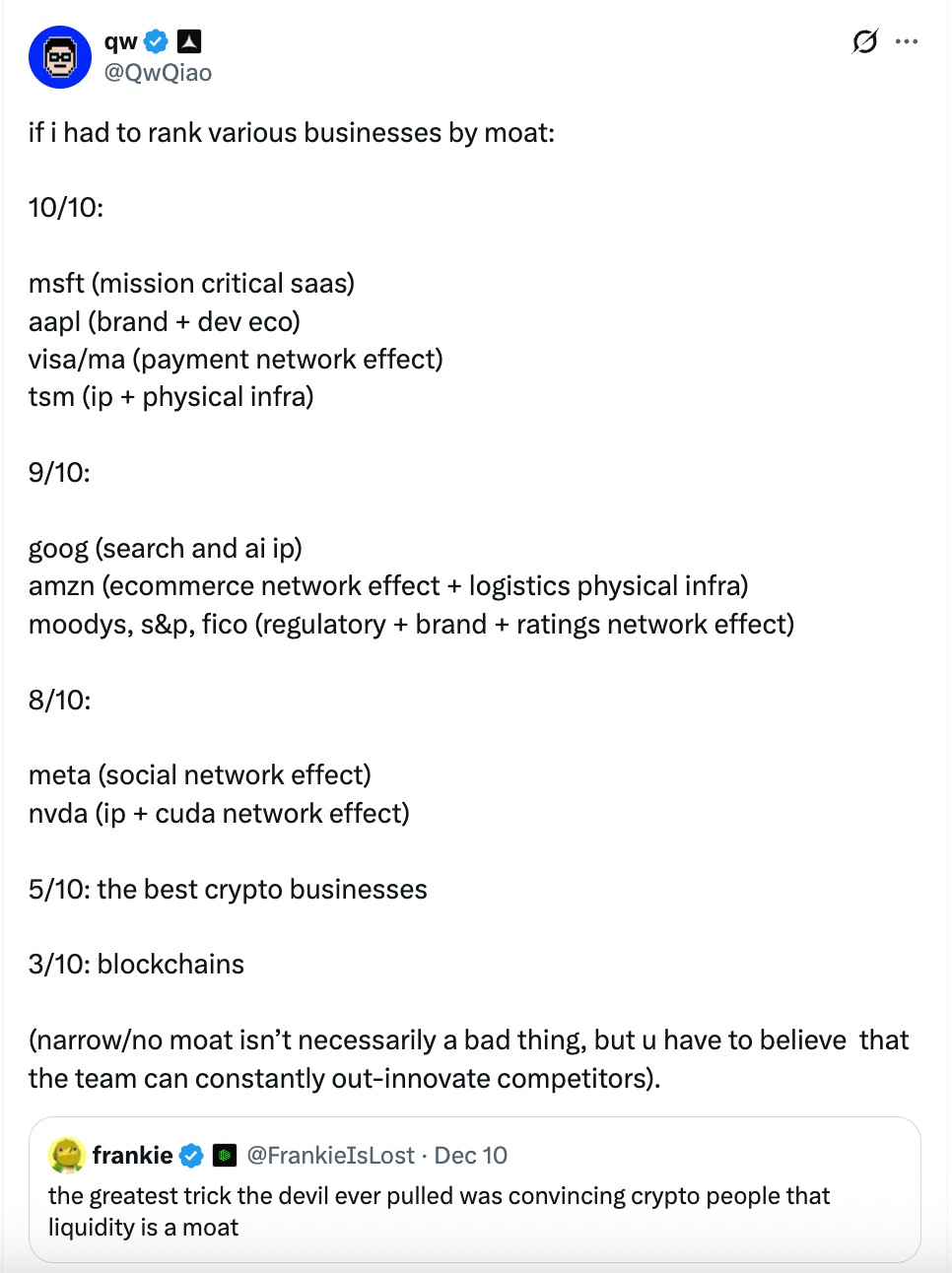
In his view, the moat of the blockchain (public chain) itself is very limited, rated only 3/10.

  • He believes Microsoft (key SaaS), Apple (brand + developer ecosystem), Visa/Mastercard (payment network effects), TSMC (IP + physical infrastructure) can score 10/10 (strongest moat);
  • Google (search and AI IP), Amazon (e-commerce network effects + logistics infrastructure), rating agencies like Moody's, S&P, FICO (regulation-driven + brand + rating network effects), large-scale cloud computing (AWS/Azure/GCP etc.) can score 9/10;
  • Meta (social network effects), NVIDIA (IP + CUDA network effects) score 8/10;
  • The best crypto businesses in the crypto industry score 5/10;
  • Public chains (blockchains) score only 3/10 (narrow moat).

qw further stated that a low moat score isn't necessarily bad, but it means teams must continuously lead innovation, otherwise they will be quickly replaced. Later, perhaps feeling the initial rating was too hasty, he added some supplementary ratings in the comments:

  • The 3 major cloud service infrastructure providers score 9/10;
  • BTC's moat scores 9/10 (Odaily Planet Daily Note: qw pointed out that no one can replicate BTC's founding story and the "Lindy Effect," but deducted 1 point because it's unclear if it can handle security budget and quantum threats);
  • Tesla 7/10 (Odaily Planet Daily Note: qw believes automated IP like self-driving is insane, but the car industry is commoditized, and humanoid robots might be similar)
  • Lithography machine manufacturer ASML 10/10.
  • AAVE's moat score might be higher than 5/10, qw's reason: "As a user, you must trust their smart contract security testing is thorough enough not to lose your funds".

Of course, seeing qw so grandly play the "sharp critic," besides debates about the "moat system," some in the comments made unrelated sarcastic remarks, even mentioning: "What about those terrible launch platforms you invested in?" (Odaily Planet Daily Note: After investing in pump.fun, Alliance DAO's subsequent investments in one-click token issuance platforms (like Believe) performed poorly, even he himself didn't want to rate them)

With such a火药味十足 (fireworks-filled) focal topic, Dragonfly partner Haseeb's subsequent angry retort followed.

Dragonfly Partner's Inner OS: Nonsense, I've Never Seen Someone So Shameless

Responding to qw's "moat rating system," Dragonfly partner Haseeb posted angrily: "What? 'Blockchain moat: 3/10'? That's kinda absurd. Even Santi doesn't think public chains 'have no moat'.

Ethereum has held a dominant position for *10 consecutive years*, hundreds of challengers have raised over $10 billion trying to grab market share. After a decade of competitors trying to defeat it, Ethereum has successfully defended its throne every time. If that doesn't indicate Ethereum has a moat, I don't know what a moat is!"

In the comments of this tweet, qw gave his perspective: "You're talking about looking back ('the past ten years') and it's factually incorrect (on multiple metrics Ethereum no longer holds the throne)."

Subsequently, the two exchanged several rounds on "what exactly is a moat?" and "does Ethereum really have a moat", with qw even pulling out a post he made in November, pointing out that the "moat" in his mind is actually revenue/profit. But Haseeb immediately counterargued with examples—once-popular crypto projects like OpenSea, Axie, BitMEX, although they had high revenues, actually had no moat; the real moat should focus on—"can it be replaced by competitors".

Abra Global management director Marissa also joined the discussion: "Agree (with Haseeb). qw's statement is a bit strange—switching costs and network effects can be strong moats—Solana and Ethereum both have these, I think they will be stronger than other public chains over time. They both have strong brands and developer ecosystems, clearly also part of the moat. Maybe he's referring to other public chains that don't have the above advantages."

Haseeb continued, full of sarcasm: "qw is just splitting hairs, asking for trouble."

Based on the above discussion, perhaps we should break down the "real moat" of public chains in the cryptocurrency industry and what aspects it comprises.

The 7 Components of a Public Chain Moat: From People to Business, From Origin to Network

In my opinion, the main reasons why qw's "moat rating system" seems somewhat unable to justify itself are:

First, its rating标准 only looks at current industry status and revenue while ignoring multi-dimensional evaluation. Whether it's infrastructure like Microsoft, Apple, Amazon Web Services, or payment giants like Visa, Mastercard, the main reason qw gives high scores is their strong revenue models, which obviously oversimplifies and superficializes the business moat of a giant company. Moreover, Apple's global market share is not dominant, and payment giants like Visa also face challenges like market shrinkage and regional business decline.

Second, it overlooks the complexity and uniqueness of public chains and crypto projects区别于 (differentiating them from) traditional internet businesses. As challengers to the fiat system, cryptocurrency, blockchain technology, and subsequent public chains and crypto projects立足点 (base themselves) on the inherent "anonymity," "nodality" of decentralized networks, which is often something traditional revenue-driven businesses cannot achieve.

Based on this, I believe the moat of public chain businesses mainly lies in the following 7 aspects, including:

1. Technical Philosophy. This is also the biggest advantage and differentiating feature of the Bitcoin network, Ethereum network, Solana network, and countless public chain projects. As long as humanity remains wary of centralized systems, authoritarian governments, and the fiat system, and accepts the concepts of sovereign individuals and related viewpoints, the real demand for decentralized networks will always exist;

2. Founder Charisma. Satoshi Nakamoto disappeared after inventing Bitcoin and ensuring the Bitcoin network ran smoothly, sitting on tens of billions of dollars in assets but unmoved; from a World of Warcraft enthusiast abused by the game company to Ethereum co-founder, Vitalik resolutely embarked on his decentralized spiritual journey; Solana founder Toly and others were originally elite engineers at US big tech companies but were unwilling to stop there, thus starting their own "capital internet" construction journey, not to mention the various public chains built inheriting the ambition of Meta's Libra network with the Move language. The personal charm and appeal of founders are particularly important in the crypto industry. This is also why countless crypto projects receive VC favor, community追捧 (praise), and capital influx because of their founders, but also fade into obscurity due to founder resignation or accidents. A good founder is the true soul of a public chain乃至 (and even) a crypto project;

3. Developer and User Network. On this point,正如 (just as) the Metcalfe effect and Lindy effect emphasize, the stronger the network effect of something and the longer it exists, the more likely it is to persist. The developer and user network is the cornerstone of public chains and many crypto projects, because developers can be said to be the first and most enduring users of a crypto public chain or project;

4. Application Ecosystem. A tree with roots but no branches and leaves can hardly survive, and the same goes for crypto projects. Therefore, a rich application ecosystem capable of self-closure and synergistic effects is crucial. The reason why public chains like Ethereum and Solana can survive the winter and still exist is inseparable from the various application projects that are always building. Furthermore, the richer the application ecosystem, the more it can continuously generate造血 (blood-making), feeding back to the public chain;

5. Token Market Cap. If the aforementioned are the inner part and foundation of a "moat," then the token market cap is the external form and brand image of a public chain and a crypto project. Only when you "look expensive" will more people believe you "have a lot of money," that you are a "gold mining ground." This is true for individuals, and likewise for projects;

6. Openness to the Outside. Besides building their own internal循环 (circulation) ecosystems, public chains and other crypto projects also need to maintain openness and operability and exchange value with the external environment. Therefore, openness to the outside is also crucial. Taking public chains like Ethereum and Solana as examples, this refers to the convenience and scale of their bridging with traditional finance, user fund inflows/outflows, and various industries through windows like payments and lending;

7. Long-Term Roadmap. A truly solid moat must not only provide support in the short term but also constantly update, iterate, and innovate, maintaining its own vitality and longevity in the long term. For public chains, the long-term roadmap is both a North Star metric and a powerful抓手 (lever) to激励 (incentivize) continuous development and innovation inside and outside the ecosystem. Ethereum's success is closely related to the planning of its long-term roadmap.

Based on the above elements, a public chain can grow from zero to one, from nothing to something, gradually moving through the野蛮生长 (wild growth) period into the mature iteration period. Corresponding liquidity and user stickiness will naturally follow.

Conclusion: The Crypto Industry Has Not Yet Reached the Stage of "Competing on Talent"

Recently, Moore Threads, known as the "Chinese version of NVIDIA," successfully listed on the Hong Kong stock market, achieving a milestone of 300 billion CNY on its first day of trading; then, within just a few days, its stock price soared all the way, reaching another astonishing breakthrough with a market cap exceeding 400 billion CNY today.

Compared to Ethereum, which took 10 years of operation to finally reach a $300 billion market cap, Moore Threads covered 1/7 of that journey in just a few days. And compared to US stock giants often worth trillions, the crypto industry is even more insignificant.

This makes us sigh again that today, with the scale of capital and user involvement far smaller than the financial and internet industries, we are far from the stage of "competing on talent." The only pain point of the crypto industry today is that we don't have enough people, we don't attract enough capital, and the industries involved are not broad enough. Rather than worrying about those grand, all-encompassing "moats," perhaps what we should think about is how cryptocurrency can更快 (faster), lower cost, and more conveniently meet the real needs of more market users.


İlgili Sorular

QWhat controversial rating did Alliance DAO founder qw assign to L1 public blockchains' moat, and why did it spark debate?

Aqw assigned a moat rating of only 3/10 to L1 public blockchains, arguing their moat is very limited. This sparked intense debate because many industry leaders, such as Dragonfly's Haseeb, found it absurd, citing Ethereum's decade-long dominance despite numerous well-funded challengers.

QAccording to the article, what did Paradigm researcher frankie criticize as a false belief in crypto, and how did the community respond?

Afrankie criticized the belief that 'liquidity is a moat' as a deceptive notion. The community was divided: some agreed, like Multicoin's Kyle Samani and others emphasizing trust or better metrics, while defenders like DFDV's Parker argued liquidity is crucial, citing examples like USDT and Bitcoin's dominance.

QHow did Dragonfly partner Haseeb counter qw's low moat rating for blockchains?

AHaseeb strongly countered by pointing to Ethereum's sustained dominance for over a decade despite hundreds of competitors raising over $10 billion to challenge it. He argued that if this doesn't constitute a moat, nothing does, emphasizing that a true moat is about being hard to replace.

QWhat are the seven components of a public blockchain's moat as outlined in the article?

AThe seven components are: 1. Technical philosophy, 2. Founder charisma, 3. Developer and user network, 4. Application ecosystem, 5. Token market capitalization, 6. Openness to the outside world, and 7. Long-term roadmap.

QWhat does the article conclude is the crypto industry's main challenge regarding its 'moat' and future growth?

AThe article concludes that the crypto industry's main challenge is its relatively small scale in terms of user adoption and capital compared to traditional finance and internet giants. It argues the focus should be on attracting more users and capital by meeting real market needs quickly, cheaply, and conveniently, rather than worrying about abstract moats.

İlgili Okumalar

Warsh Hearing Concludes: What Are the Notable Signals for the Crypto Industry?

The Senate Banking Committee held a confirmation hearing for Judy Shelton, a Federal Reserve nominee, who faced intense questioning regarding her ability to maintain the central bank's independence amid pressure from President Trump to lower interest rates. Shelton denied any pre-arranged commitments on rate cuts and emphasized her independence, though Democrats remained skeptical, citing contradictions with Trump's public statements. Shelton characterized post-pandemic inflation as a major policy failure and called for a "regime change" in the Fed’s approach, including reforms to inflation measurement and communication strategies. She criticized the current practice of Fed officials frequently signaling future rate moves and did not commit to maintaining post-meeting press conferences, suggesting potential reductions in transparency. Regarding crypto markets, Shelton’s extensive investments in digital asset companies—including Solana, DeFi, and blockchain infrastructure—were noted, though she has pledged to divest these holdings due to ethics rules. Her familiarity with the crypto industry and deregulatory leanings may signal a more open, though cautious, stance toward digital assets. However, concerns were raised about potential conflicts of interest, especially given Trump family involvement in crypto-financial ventures. The timing of her confirmation remains uncertain, pending a Justice Department investigation into current Chair Powell. Shelton’s potential leadership could lead to a more hawkish, productivity-focused Fed with tighter policy communication—factors that may significantly influence liquidity conditions and macro narratives for crypto markets.

marsbit4 saat önce

Warsh Hearing Concludes: What Are the Notable Signals for the Crypto Industry?

marsbit4 saat önce

İşlemler

Spot
Futures

Popüler Makaleler

$S$ Nedir

SPERO'yu Anlamak: Kapsamlı Bir Genel Bakış SPERO'ya Giriş İnovasyonun manzarası gelişmeye devam ederken, web3 teknolojilerinin ve kripto para projelerinin ortaya çıkışı dijital geleceği şekillendirmede önemli bir rol oynamaktadır. Bu dinamik alanda dikkat çeken projelerden biri SPERO, $$s$$ olarak adlandırılmaktadır. Bu makale, SPERO hakkında ayrıntılı bilgi toplamak ve sunmak amacıyla, meraklılar ve yatırımcıların web3 ve kripto alanlarındaki temellerini, hedeflerini ve yeniliklerini anlamalarına yardımcı olmayı amaçlamaktadır. SPERO,$$s$$ Nedir? SPERO,$$s$$, kripto alanında merkeziyetsizlik ve blok zinciri teknolojisi ilkelerini kullanarak etkileşimi, faydayı ve finansal kapsayıcılığı teşvik eden bir ekosistem yaratmayı amaçlayan benzersiz bir projedir. Proje, kullanıcıların yenilikçi finansal çözümler ve hizmetler sunarak eşler arası etkileşimleri yeni yollarla kolaylaştırmayı hedeflemektedir. SPERO,$$s$$'nin temel amacı, bireyleri güçlendirmek ve kripto para alanındaki kullanıcı deneyimini artıran araçlar ve platformlar sağlamaktır. Bu, daha esnek işlem yöntemlerini mümkün kılmayı, topluluk odaklı girişimleri teşvik etmeyi ve merkeziyetsiz uygulamalar (dApp'ler) aracılığıyla finansal fırsatlar yaratmayı içermektedir. SPERO,$$s$$'nin temel vizyonu kapsayıcılık etrafında dönmekte olup, geleneksel finansal sistemlerdeki boşlukları kapatmayı ve blok zinciri teknolojisinin faydalarından yararlanmayı hedeflemektedir. SPERO,$$s$$'nin Yaratıcısı Kimdir? SPERO,$$s$$'nin yaratıcısının kimliği bir miktar belirsizdir, çünkü kurucusu(ları) hakkında ayrıntılı arka plan bilgisi sağlayan sınırlı kamuya açık kaynaklar bulunmaktadır. Bu şeffaflık eksikliği, projenin merkeziyetsizlik taahhüdünden kaynaklanabilir—birçok web3 projesinin paylaştığı bir etik anlayışı, bireysel tanınmanın yerine kolektif katkıları önceliklendirmektedir. Topluluk ve onun kolektif hedefleri etrafında tartışmaları merkezileştirerek, SPERO,$$s$$, belirli bireyleri öne çıkarmadan güçlendirme özünü taşımaktadır. Bu nedenle, SPERO'nun etik anlayışını ve misyonunu anlamak, tek bir yaratıcının kimliğini belirlemekten daha önemlidir. SPERO,$$s$$'nin Yatırımcıları Kimlerdir? SPERO,$$s$$, kripto sektöründe yeniliği teşvik etmeye adanmış girişim sermayedarlarından melek yatırımcılara kadar çeşitli yatırımcılar tarafından desteklenmektedir. Bu yatırımcıların odak noktası genellikle SPERO'nun misyonuyla uyumlu olup, toplumsal teknolojik ilerlemeyi, finansal kapsayıcılığı ve merkeziyetsiz yönetimi vaat eden projeleri önceliklendirmektedir. Bu yatırımcı temelleri, yalnızca yenilikçi ürünler sunan projelere değil, aynı zamanda blok zinciri topluluğuna ve ekosistemlerine olumlu katkılarda bulunan projelere de ilgi duymaktadır. Bu yatırımcıların desteği, SPERO,$$s$$'yi hızla gelişen kripto projeleri alanında dikkate değer bir rakip haline getirmektedir. SPERO,$$s$$ Nasıl Çalışır? SPERO,$$s$$, onu geleneksel kripto para projelerinden ayıran çok yönlü bir çerçeve kullanmaktadır. İşte benzersizliğini ve yeniliğini vurgulayan bazı temel özellikler: Merkeziyetsiz Yönetim: SPERO,$$s$$, kullanıcıların projenin geleceğiyle ilgili karar alma süreçlerine aktif olarak katılmalarını sağlayan merkeziyetsiz yönetim modellerini entegre etmektedir. Bu yaklaşım, topluluk üyeleri arasında sahiplik ve hesap verebilirlik duygusunu teşvik etmektedir. Token Kullanımı: SPERO,$$s$$, ekosistem içinde çeşitli işlevler sunmak üzere tasarlanmış kendi kripto para token'ını kullanmaktadır. Bu token'lar, işlemleri, ödülleri ve platformda sunulan hizmetlerin kolaylaştırılmasını sağlayarak genel etkileşimi ve faydayı artırmaktadır. Katmanlı Mimari: SPERO,$$s$$'nin teknik mimarisi, modülerlik ve ölçeklenebilirliği destekleyerek projenin evrimi sırasında ek özelliklerin ve uygulamaların sorunsuz bir şekilde entegrasyonuna olanak tanımaktadır. Bu uyum sağlama yeteneği, sürekli değişen kripto manzarasında geçerliliği sürdürmek için hayati öneme sahiptir. Topluluk Katılımı: Proje, işbirliği ve geri bildirim teşvik eden mekanizmalar kullanarak topluluk odaklı girişimlere vurgu yapmaktadır. Güçlü bir topluluk oluşturarak, SPERO,$$s$$, kullanıcı ihtiyaçlarını daha iyi karşılayabilir ve piyasa trendlerine uyum sağlayabilir. Kapsayıcılığa Odaklanma: Düşük işlem ücretleri ve kullanıcı dostu arayüzler sunarak, SPERO,$$s$$, daha önce kripto alanında yer almamış bireyler de dahil olmak üzere çeşitli bir kullanıcı tabanını çekmeyi hedeflemektedir. Bu kapsayıcılık taahhüdü, erişilebilirlik yoluyla güçlendirme misyonuyla uyumludur. SPERO,$$s$$ Zaman Çizelgesi Bir projenin tarihini anlamak, gelişim yolculuğu ve kilometre taşları hakkında kritik bilgiler sağlar. Aşağıda, SPERO,$$s$$'nin evriminde önemli olayları haritalayan önerilen bir zaman çizelgesi bulunmaktadır: Kavram Geliştirme ve Fikir Aşaması: SPERO,$$s$$'nin temelini oluşturan ilk fikirler, blok zinciri endüstrisindeki merkeziyetsizlik ve topluluk odaklılık ilkeleriyle yakından uyumlu olarak geliştirildi. Proje Beyaz Kağıdının Yayınlanması: Kavramsal aşamayı takiben, SPERO,$$s$$'nin vizyonunu, hedeflerini ve teknolojik altyapısını ayrıntılı bir şekilde açıklayan kapsamlı bir beyaz kağıt yayımlandı ve topluluk ilgisini ve geri bildirimini toplamak amacıyla sunuldu. Topluluk Oluşturma ve Erken Katılımlar: Projenin hedefleri etrafında tartışmalar yürüterek destek toplamak ve erken benimseyenler ile potansiyel yatırımcılar için bir topluluk oluşturmak amacıyla aktif iletişim çabaları gerçekleştirildi. Token Üretim Etkinliği: SPERO,$$s$$, yerel token'larını erken destekçilere dağıtmak ve ekosistem içinde başlangıç likiditesini sağlamak amacıyla bir token üretim etkinliği (TGE) gerçekleştirdi. İlk dApp'in Yayınlanması: SPERO,$$s$$ ile ilişkili ilk merkeziyetsiz uygulama (dApp) faaliyete geçti ve kullanıcıların platformun temel işlevleriyle etkileşimde bulunmalarını sağladı. Sürekli Gelişim ve Ortaklıklar: Projenin tekliflerine sürekli güncellemeler ve iyileştirmeler yapılmakta olup, blok zinciri alanındaki diğer oyuncularla stratejik ortaklıklar, SPERO,$$s$$'yi rekabetçi ve gelişen bir oyuncu haline getirmiştir. Sonuç SPERO,$$s$$, web3 ve kripto paranın finansal sistemleri devrim niteliğinde dönüştürme ve bireyleri güçlendirme potansiyelinin bir kanıtıdır. Merkeziyetsiz yönetime, topluluk katılımına ve yenilikçi tasarlanmış işlevselliğe olan bağlılığıyla, daha kapsayıcı bir finansal manzaraya doğru bir yol açmaktadır. Hızla gelişen kripto alanındaki herhangi bir yatırımda olduğu gibi, potansiyel yatırımcılar ve kullanıcılar, SPERO,$$s$$ içindeki devam eden gelişmelerle ilgili olarak kapsamlı bir araştırma yapmaları ve düşünceli bir şekilde katılmaları teşvik edilmektedir. Proje, kripto endüstrisinin yenilikçi ruhunu sergileyerek, sayısız olasılığını keşfetmeye davet etmektedir. SPERO,$$s$$'nin yolculuğu hala devam ederken, temel ilkeleri, teknoloji, finans ve birbirimizle etkileşim biçimimizi etkileyebilir.

89 Toplam GörüntülenmeYayınlanma 2024.12.17Güncellenme 2024.12.17

$S$ Nedir

AGENT S Nedir

Agent S: Web3'te Otonom Etkileşimin Geleceği Giriş Web3 ve kripto para dünyasında sürekli gelişen manzarada, yenilikler bireylerin dijital platformlarla etkileşim biçimlerini sürekli olarak yeniden tanımlıyor. Bu tür öncü projelerden biri olan Agent S, açık ajans çerçevesi aracılığıyla insan-bilgisayar etkileşimini devrim niteliğinde değiştirmeyi vaat ediyor. Otonom etkileşimlerin yolunu açarak, Agent S karmaşık görevleri basitleştirmeyi ve yapay zeka (AI) alanında dönüştürücü uygulamalar sunmayı hedefliyor. Bu detaylı inceleme, projenin karmaşıklıklarına, benzersiz özelliklerine ve kripto para alanındaki etkilerine dalacaktır. Agent S Nedir? Agent S, bilgisayar görevlerinin otomasyonunda üç temel zorluğu ele almak üzere özel olarak tasarlanmış çığır açıcı bir açık ajans çerçevesidir: Alan Spesifik Bilgi Edinimi: Çerçeve, çeşitli dış bilgi kaynaklarından ve iç deneyimlerden akıllıca öğrenir. Bu çift yönlü yaklaşım, alan spesifik bilgi açısından zengin bir veri havuzu oluşturmasını sağlar ve görev yürütmedeki performansını artırır. Uzun Görev Ufukları Üzerinde Planlama: Agent S, karmaşık görevlerin verimli bir şekilde parçalanmasını ve yürütülmesini kolaylaştıran deneyim artırımlı hiyerarşik planlama kullanır. Bu özellik, çoklu alt görevleri etkili ve verimli bir şekilde yönetme yeteneğini önemli ölçüde artırır. Dinamik, Homojen Olmayan Arayüzlerle Başlama: Proje, ajanlar ve kullanıcılar arasındaki etkileşimi geliştiren yenilikçi bir çözüm olan Ajan-Bilgisayar Arayüzü'ni (ACI) tanıtmaktadır. Çok Modlu Büyük Dil Modellerini (MLLM'ler) kullanarak, Agent S çeşitli grafik kullanıcı arayüzlerini sorunsuz bir şekilde gezinebilir ve manipüle edebilir. Bu öncü özellikler aracılığıyla, Agent S, makinelerle insan etkileşimini otomatikleştirmede karşılaşılan karmaşıklıkları ele alan sağlam bir çerçeve sunarak, AI ve ötesinde birçok uygulama için zemin hazırlıyor. Agent S'nin Yaratıcısı Kimdir? Agent S'nin kavramı temelde yenilikçi olsa da, yaratıcısı hakkında spesifik bilgiler belirsizliğini koruyor. Yaratıcı şu anda bilinmiyor, bu da projenin yeni aşamasını veya kurucu üyeleri gizli tutma stratejik tercihini vurguluyor. Anonimlikten bağımsız olarak, odak çerçevenin yetenekleri ve potansiyeli üzerinde kalıyor. Agent S'nin Yatırımcıları Kimlerdir? Agent S, kriptografik ekosistemde oldukça yeni olduğundan, yatırımcıları ve finansal destekçileri hakkında ayrıntılı bilgiler açıkça belgelenmemiştir. Projeyi destekleyen yatırım temelleri veya organizasyonları hakkında kamuya açık bilgilerdeki eksiklik, finansman yapısı ve gelişim yol haritası hakkında sorular doğuruyor. Destekleyicilerin anlaşılması, projenin sürdürülebilirliğini ve potansiyel pazar etkisini değerlendirmek için kritik öneme sahiptir. Agent S Nasıl Çalışır? Agent S'nin temelinde, çeşitli ortamlarda etkili bir şekilde çalışmasını sağlayan son teknoloji bir sistem yatmaktadır. İşleyiş modeli birkaç ana özellik etrafında inşa edilmiştir: İnsan Benzeri Bilgisayar Etkileşimi: Çerçeve, bilgisayarlarla etkileşimleri daha sezgisel hale getirmeyi amaçlayan gelişmiş AI planlaması sunar. Görev yürütmedeki insan davranışını taklit ederek, kullanıcı deneyimlerini yükseltmeyi vaat eder. Anlatı Belleği: Yüksek düzeyde deneyimlerden yararlanmak için kullanılan Agent S, görev geçmişlerini takip etmek amacıyla anlatı belleğini kullanarak karar verme süreçlerini geliştirir. Episodik Bellek: Bu özellik, kullanıcılara adım adım rehberlik sağlayarak, çerçevenin görevler gelişirken bağlamsal destek sunmasına olanak tanır. OpenACI Desteği: Yerel olarak çalışabilme yeteneği ile Agent S, kullanıcıların etkileşimleri ve iş akışları üzerinde kontrol sağlamasına olanak tanır ve Web3'ün merkeziyetsiz felsefesiyle uyumlu hale gelir. Dış API'lerle Kolay Entegrasyon: Çeşitli AI platformlarıyla uyumluluğu ve çok yönlülüğü, Agent S'nin mevcut teknolojik ekosistemlere sorunsuz bir şekilde entegre olmasını sağlar ve geliştiriciler ile organizasyonlar için cazip bir seçenek haline getirir. Bu işlevsellikler, Agent S'nin kripto alanındaki benzersiz konumuna katkıda bulunarak, karmaşık, çok aşamalı görevleri minimum insan müdahalesi ile otomatikleştirir. Proje geliştikçe, Web3'teki potansiyel uygulamaları dijital etkileşimlerin nasıl gelişeceğini yeniden tanımlayabilir. Agent S'nin Zaman Çizelgesi Agent S'nin gelişimi ve kilometre taşları, önemli olaylarını vurgulayan bir zaman çizelgesinde özetlenebilir: 27 Eylül 2024: Agent S'nin kavramı, “Bilgisayarları İnsan Gibi Kullanan Açık Bir Ajans Çerçevesi” başlıklı kapsamlı bir araştırma makalesi ile tanıtıldı ve projenin temelini sergiledi. 10 Ekim 2024: Araştırma makalesi arXiv'de kamuya açık olarak yayınlandı ve çerçevenin derinlemesine bir incelemesini ve OSWorld benchmark'ına dayalı performans değerlendirmesini sundu. 12 Ekim 2024: Agent S'nin yetenekleri ve özellikleri hakkında görsel bir içgörü sağlayan bir video sunumu yayımlandı ve potansiyel kullanıcılar ve yatırımcılarla daha fazla etkileşim sağlandı. Bu zaman çizelgesindeki işaretler, sadece Agent S'nin ilerlemesini değil, aynı zamanda şeffaflık ve topluluk katılımına olan bağlılığını da göstermektedir. Agent S Hakkında Ana Noktalar Agent S çerçevesi gelişmeye devam ederken, birkaç ana özellik öne çıkmakta ve yenilikçi doğasını ve potansiyelini vurgulamaktadır: Yenilikçi Çerçeve: İnsan etkileşimine benzer bir bilgisayar kullanımı sağlamak üzere tasarlanan Agent S, görev otomasyonuna yeni bir yaklaşım getiriyor. Otonom Etkileşim: GUI aracılığıyla bilgisayarlarla otonom olarak etkileşim kurabilme yeteneği, daha akıllı ve verimli hesaplama çözümlerine doğru bir sıçrama anlamına geliyor. Karmaşık Görev Otomasyonu: Sağlam metodolojisi ile karmaşık, çok aşamalı görevleri otomatikleştirerek süreçleri daha hızlı ve daha az hata payı ile gerçekleştirebilir. Sürekli İyileştirme: Öğrenme mekanizmaları, Agent S'nin geçmiş deneyimlerden öğrenmesini sağlar ve sürekli olarak performansını ve etkinliğini artırır. Çok Yönlülük: OSWorld ve WindowsAgentArena gibi farklı işletim ortamlarında uyumlu olması, geniş bir uygulama yelpazesine hizmet edebilmesini sağlar. Agent S, Web3 ve kripto alanında kendini konumlandırırken, etkileşim yeteneklerini artırma ve süreçleri otomatikleştirme potansiyeli, AI teknolojilerinde önemli bir ilerlemeyi temsil etmektedir. Yenilikçi çerçevesi aracılığıyla, Agent S dijital etkileşimlerin geleceğini örneklemekte ve çeşitli sektörlerde kullanıcılar için daha sorunsuz ve verimli bir deneyim vaat etmektedir. Sonuç Agent S, AI ve Web3'ün birleşiminde cesur bir sıçramayı temsil ediyor ve teknoloji ile etkileşim biçimimizi yeniden tanımlama kapasitesine sahip. Henüz erken aşamalarında olmasına rağmen, uygulama olanakları geniş ve çekici. Kritik zorlukları ele alan kapsamlı çerçevesi ile Agent S, otonom etkileşimleri dijital deneyimin ön plana çıkmasına taşımayı hedefliyor. Kripto para ve merkeziyetsizlik alanlarına daha derinlemesine girdikçe, Agent S gibi projelerin teknoloji ve insan-bilgisayar işbirliğinin geleceğini şekillendirmede önemli bir rol oynayacağı kesin.

429 Toplam GörüntülenmeYayınlanma 2025.01.14Güncellenme 2025.01.14

AGENT S Nedir

S Nasıl Satın Alınır

HTX.com’a hoş geldiniz! Sonic (S) satın alma işlemlerini basit ve kullanışlı bir hâle getirdik. Adım adım açıkladığımız rehberimizi takip ederek kripto yolculuğunuza başlayın. 1. Adım: HTX Hesabınızı OluşturunHTX'te ücretsiz bir hesap açmak için e-posta adresinizi veya telefon numaranızı kullanın. Sorunsuzca kaydolun ve tüm özelliklerin kilidini açın. Hesabımı Aç2. Adım: Kripto Satın Al Bölümüne Gidin ve Ödeme Yönteminizi SeçinKredi/Banka Kartı: Visa veya Mastercard'ınızı kullanarak anında Sonic (S) satın alın.Bakiye: Sorunsuz bir şekilde işlem yapmak için HTX hesap bakiyenizdeki fonları kullanın.Üçüncü Taraflar: Kullanımı kolaylaştırmak için Google Pay ve Apple Pay gibi popüler ödeme yöntemlerini ekledik.P2P: HTX'teki diğer kullanıcılarla doğrudan işlem yapın.Borsa Dışı (OTC): Yatırımcılar için kişiye özel hizmetler ve rekabetçi döviz kurları sunuyoruz.3. Adım: Sonic (S) Varlıklarınızı SaklayınSonic (S) satın aldıktan sonra HTX hesabınızda saklayın. Alternatif olarak, blok zinciri transferi yoluyla başka bir yere gönderebilir veya diğer kripto para birimlerini takas etmek için kullanabilirsiniz.4. Adım: Sonic (S) Varlıklarınızla İşlem YapınHTX'in spot piyasasında Sonic (S) ile kolayca işlemler yapın.Hesabınıza erişin, işlem çiftinizi seçin, işlemlerinizi gerçekleştirin ve gerçek zamanlı olarak izleyin. Hem yeni başlayanlar hem de deneyimli yatırımcılar için kullanıcı dostu bir deneyim sunuyoruz.

1.3k Toplam GörüntülenmeYayınlanma 2025.01.15Güncellenme 2025.03.21

S Nasıl Satın Alınır

Tartışmalar

HTX Topluluğuna hoş geldiniz. Burada, en son platform gelişmeleri hakkında bilgi sahibi olabilir ve profesyonel piyasa görüşlerine erişebilirsiniz. Kullanıcıların S (S) fiyatı hakkındaki görüşleri aşağıda sunulmaktadır.

活动图片