Money Has Gone to Bonds and IPOs, Leaving Only HYPE Rising in Crypto

marsbit2026-05-19 tarihinde yayınlandı2026-05-19 tarihinde güncellendi

Özet

The article "Where Has All the Money Gone? Bonds and IPOs Are Soaring, While Crypto Only Sees HYPE Rising" analyzes the recent underperformance of major cryptocurrencies like Bitcoin and Ethereum compared to traditional financial markets. It identifies three primary factors diverting capital away from crypto: First, surging bond yields, with the 30-year U.S. Treasury hitting a near 20-year high of 5.12%, are attracting capital seeking safe, predictable returns. This is evidenced by Bitcoin spot ETFs experiencing a significant $10.39 billion net outflow in mid-May. Second, a massive $4 trillion IPO pipeline, highlighted by SpaceX's upcoming listing, is absorbing risk capital that might otherwise flow into crypto. Platforms like Hyperliquid are even channeling on-chain crypto liquidity into pre-IPO trading for traditional stocks. Third, uncertainty surrounds new Federal Reserve Chair Warsh's ability to deliver expected interest rate cuts this year due to conflicting political pressures and stubborn inflation expectations, potentially eliminating a hoped-for source of new market liquidity. Consequently, while traditional equities and bonds rally, the crypto market's post-leverage crash recovery is stalled. The notable exception is assets like Hyperliquid (HYPE), which is rising due to its role in facilitating traditional asset trading, underscoring a market divergence where only crypto projects with novel, cross-market narratives are gaining. The article concludes that Bitcoin...

Where has all the money gone?

The S&P 500 hit new all-time highs last week, and the Nasdaq completed a nearly seven-week winning streak. The 30-year US Treasury yield surged to 5.12%, the highest since 2007. SpaceX's Pre-IPO contracts on Hyperliquid saw $40 million in turnover on the first day.

Money is pouring in everywhere—except into crypto. BTC, which had just climbed above $82,000 on May 14th, has since tumbled below $77,000 in recent days. ETH fared no better, dropping nearly 10% over the week from the $2,300 range down to $2,110. Solana completely erased its recent gains, falling from a high near $100 back to $84. It seems nothing in the major crypto space is holding strong, except for HYPE.

Why is crypto, as a risk asset, falling behind alone?

30-Year Bond Yields Hit Nearly 20-Year High

The bond market is once again becoming the gravitational center for global capital.

The yield on the 30-year US Treasury bond has reached its highest level since June 2007, rising from 4.63% at the end of February to 5.12%. Meanwhile, the 10-year yield touched 4.6%, and the two-year yield climbed to 4.08%.
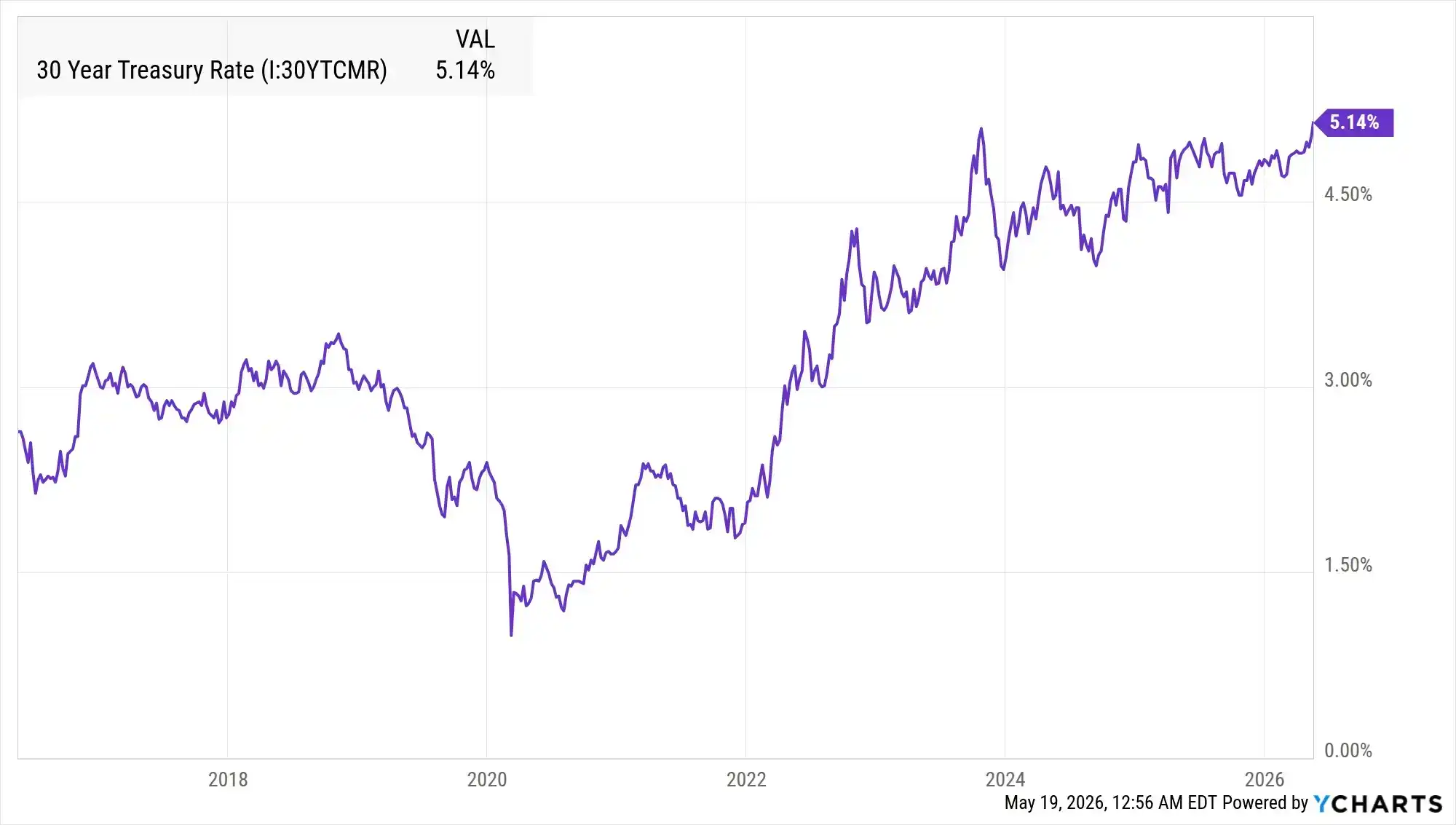
It's not just the United States. In a report on Sunday, May 17th, Apollo Global Management chief economist Torsten Slok stated that the yields on government bonds with maturities of 10 years or longer across G7 nations have collectively reached their highest levels since 2004, all approaching 5%.

Government fiscal deficits are expanding worldwide, necessitating more borrowing and bond issuance. The US fiscal deficit remains around 6% of GDP. Rising borrowing costs make it harder for governments to spend their way out of crises, precisely at a time when many countries face crises due to war.

In a report on May 18th, Deutsche Bank's Jim Reid noted that bond issues are likely to be on the agenda for the two-day G7 finance ministers' meeting opening that day in Paris. However, the structural problems in the bond market cannot be solved by any single ministerial meeting.

At a time of heightened geopolitical tension, global capital favors assets with more certain returns.

The outflow data from Bitcoin ETFs also corroborates this point.
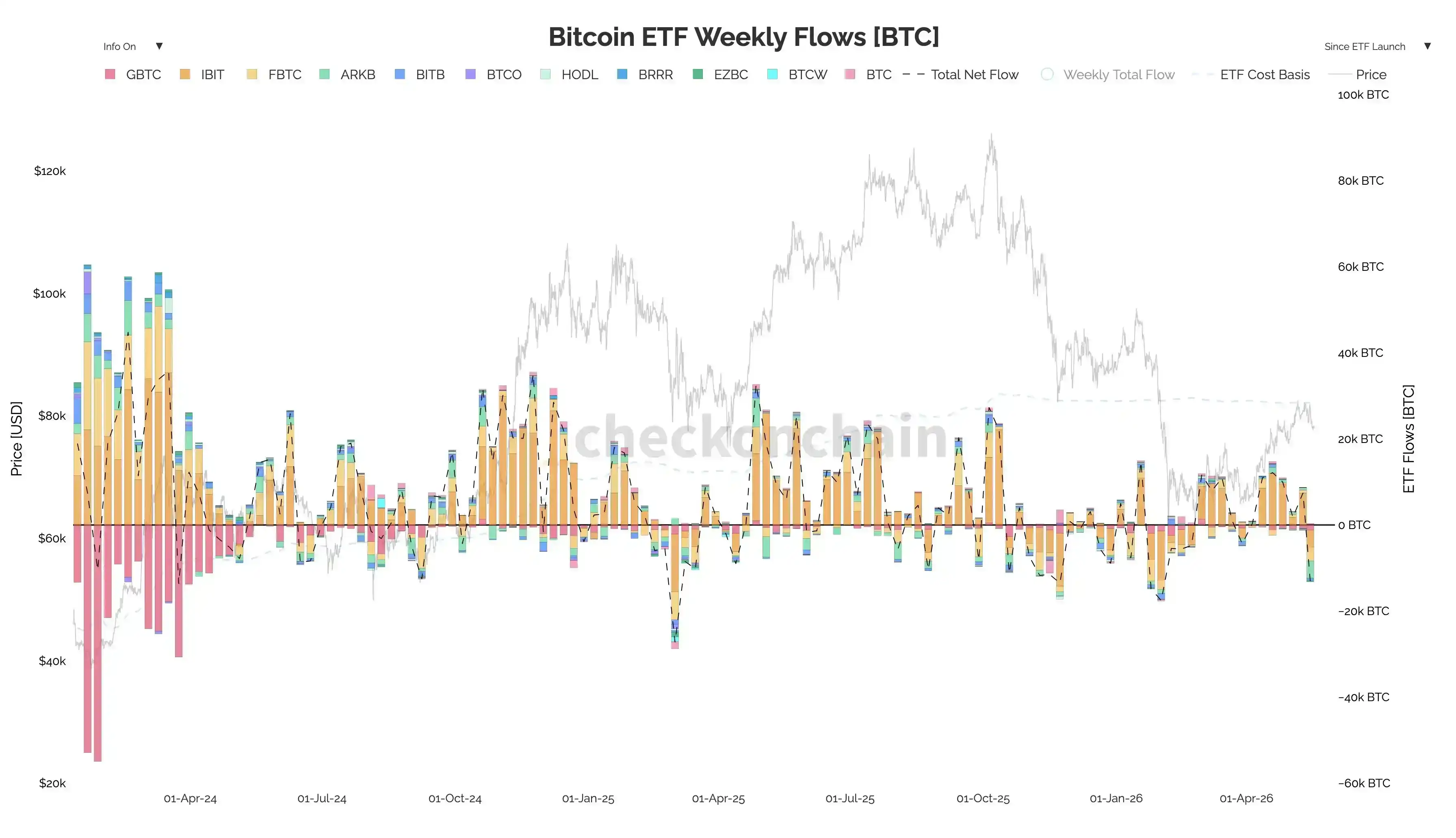
According to SoSoValue data, Bitcoin spot ETFs saw a net outflow of $1.039 billion for the week of May 11th to May 15th, ending six consecutive weeks of net inflows. This was also the largest weekly outflow since the end of January.

Drilling down to specific products, ARKB had a weekly net outflow of $324 million, and IBIT saw a net outflow of $317 million, with both leading products bleeding simultaneously. The intraday data paints an even sharper picture. There was a net outflow of $233 million on May 12th, a single-day withdrawal of $635 million on May 13th, and on Friday, May 15th, the 11 Bitcoin ETFs collectively experienced another outflow of $290 million. This indicates institutional funds are exiting in an orderly fashion.

Comparing with data from previous weeks highlights the force of this reversal. The week of April 17th saw nearly $1 billion in net inflows, the week of April 24th had $824 million in net inflows, and the week of May 8th still recorded $623 million in net inflows. The funding situation reversed from "sustained inflows" to "a $1 billion weekly outflow" within a single week.

Concurrently, Ethereum ETFs also saw a net outflow of $255 million, marking five consecutive days of negative outflows. The funding landscape for the entire crypto ETF asset class collectively turned downward in mid-May.

As the bond market's attractiveness grows, crypto's relative appeal naturally diminishes passively.

$4 Trillion in IPOs: How Can Crypto Compete?

Bonds are siphoning off funds with little risk appetite. IPOs are capturing risk capital, which constitutes the most direct liquidity drain for crypto.

There are $4 trillion worth of IPOs queued up for 2026, waiting to compete for capital. This is a figure substantial enough to reshape the map of global capital allocation.

SpaceX has become the next concentrated market focus. In this environment, Pre-IPO and new listing strategies offer an attraction that bonds cannot provide—non-linear wealth effects.

Meanwhile, the AI narrative remains the dominant theme of 2026. In a report on May 15th, Evercore analysts pointed out that US economic data shows demand remains strong, especially with a surge in AI-related capital expenditures. The flip side of this AI capital spending boom is the life-changing wealth effects created by AI leaders in the secondary market.

The return efficiency of names like Nvidia and Cerebras makes any crypto narrative seem less appealing by comparison.

More glaringly, even on-chain activity is helping traditional markets pull in money.

On the night SpaceX debuted on Trade.xyz, the Pre-IPO contracts on Hyperliquid saw $40 million in turnover on the first day. The HIP-3 platform is using perpetuals to facilitate price discovery for traditional stocks. Hyperliquid itself rose 10% to $45 for the week, becoming the only major crypto asset to buck the downtrend. Related reading: The Biggest Winner of the SpaceX IPO Might Be Trade.xyz.

In the short term, this is not exactly good news for crypto-native assets.

On-chain liquidity is being directed to price discovery for traditional stock targets like SpaceX, rather than flowing back to Bitcoin, ETH, or Solana. Even Hyperliquid's gains are not fundamentally driven by crypto narratives, but rather by the dividends of traditional asset narratives.

Warsh Takes Over, But Rate Cuts May Be Off the Table

While the bond and IPO markets are draining liquidity from the crypto space, looking at the Federal Reserve, the anticipated new liquidity injection might not materialize either.

Powell's term ended on May 15th. Warsh was confirmed by the Senate as the new Federal Reserve Chair last week and is currently awaiting formal appointment committee approval from the President and completion of asset clearance to comply with ethics regulations.

And even before officially taking the oath, Warsh already faces some tough problems.

Trump nominated Warsh partly because he hoped Warsh would be more cooperative than Powell with the White House's cost-cutting agenda. Treasury Secretary Bessent has consistently included lowering the government's borrowing costs as a core part of the White House's cost-cutting promises over the past few months. He laid it out clearly in his speech at the New York Fed last autumn: lowering government borrowing costs means lower corporate borrowing costs, lower mortgage rates, lower car loan payments—improving affordability for all Americans.

But as mentioned earlier, today's reality is that the bond market has pushed five-year inflation expectations to 2.7%, the highest since 2023. Yardeni Research directly pointed out in a report on May 17th that a two-year Treasury yield of 4.08% is the market using price to signal to the Fed that the current target range of 3.50%-3.75% is set too low.

By Warsh's own logic, he should continue raising rates, or at least not cut them. But the White House, especially Trump himself, has made its political desire for rate cuts almost public.

On the other hand, those who heard Warsh's pre-confirmation hearing remarks know he spent considerable time discussing AI. He believes AI will boost productivity, suppress inflation, and thus supports rate cuts. The problem is, short-term data shows no signs of this happening.

The view of José Torres, a senior economist at Interactive Brokers, already represents a large segment of opinion. In a report on May 15th, he wrote the assessment that, due to lack of progress in geopolitical conflicts, the market has abandoned bets on room for further rate hikes.

If Warsh chooses to succumb to Trump's political pressure and forces a rate cut, the bond market will respond with even higher long-end yields, making all duration-sensitive assets even more uncomfortable. If Warsh chooses a hawkish stance, then rate cut expectations for this year are directly off the table, and the market's bets on liquidity easing all need to be repriced.

This means the bets placed over the past few months on Warsh cutting rates upon taking office may be completely overturned.

HYPE Leads Crypto Gains

After October 10th, the recovery period following the crypto market's deleveraging should have been fueled by the return of new capital.

With $4 trillion in IPOs queued for 2026 and AI names continuing to generate wealth effects, the appeal of altcoin trades is being persistently diluted in this environment. Even Bitcoin, the most institutionally-favored crypto asset, is beginning to cede ground to traditional markets. The $1 billion weekly outflow from ETFs is the most direct evidence.

High bond yields, Bitcoin ETF outflows. The recovery period is being drawn out indefinitely, and crypto consistently fails to catch up with the overall upward pace of risk assets.

However, it's worth noting that some differentiation trends are already emerging within the broader crypto market.
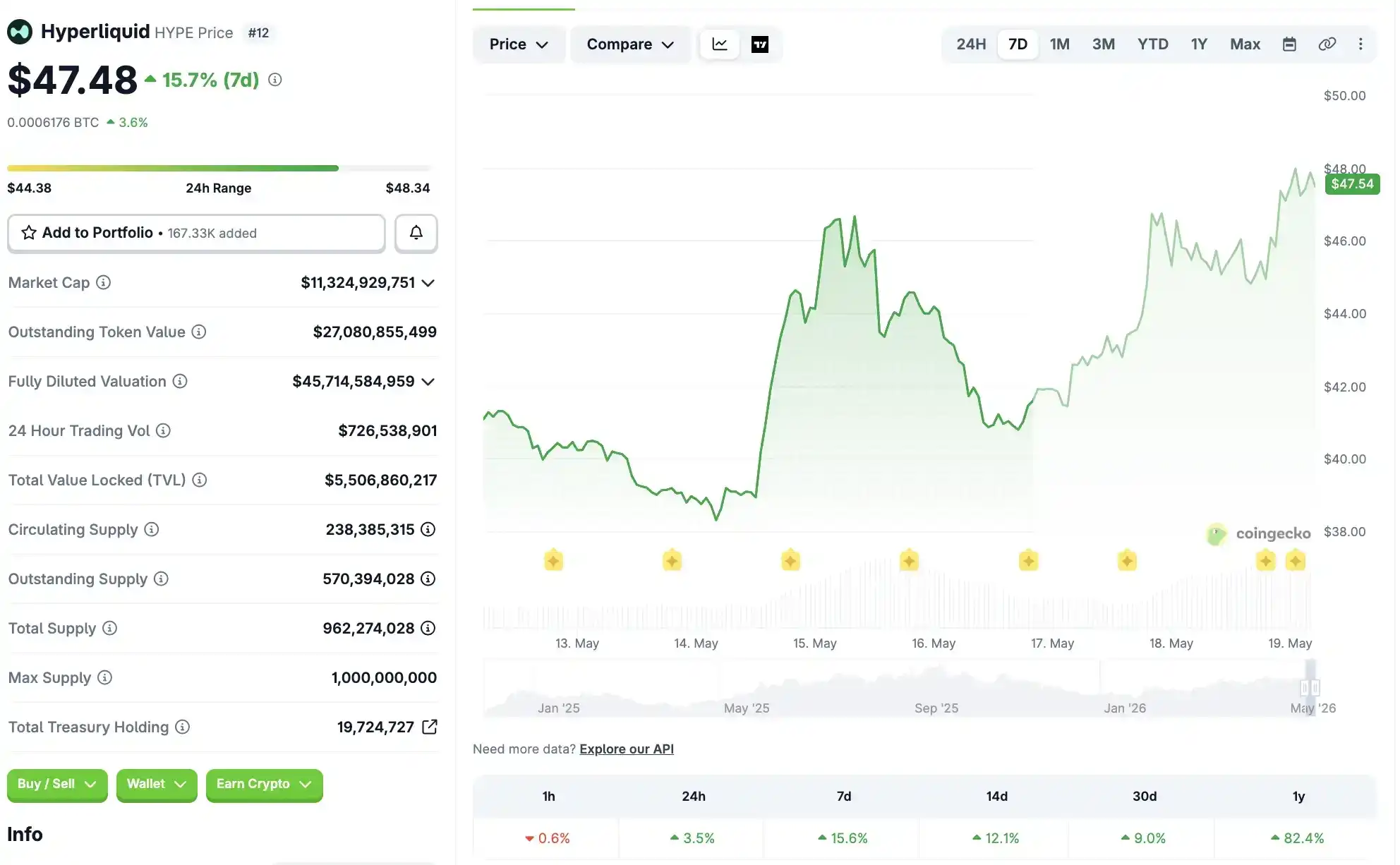
Hyperliquid rose 15% weekly to $48, with a year-to-date gain of 69%, precisely riding on the Pre-IPO price discovery narrative enabled by HIP-3. Assets that can tell new stories and capture entry points into traditional markets are still rising, while assets relying purely on beta are being compressed in pricing. Even Bitcoin has to take a back seat.

Zooming out to view the broader financial market reveals three forces simultaneously draining liquidity from the crypto space over the past few weeks. The bond market is pulling risk-averse money back with 5% yields, IPOs are capturing incremental risk budgets with a $4 trillion queue, and the new Fed Chair Warsh, upon taking office, may be unable to deliver on this year's rate cut expectations.

However, there are still potential catalysts for Bitcoin's next phase.

The upside catalyst is the enactment of the CLARITY Act in August. This is the biggest policy tailwind window for crypto this year, and increased regulatory certainty could directly release some pent-up institutional demand.

The downside risk is that before this catalyst materializes, we may need to retest the $70,000 level. If the current $77,000 level fails to hold, the next effective support is likely around $70,000.


İlgili Sorular

QWhat is the main point of the article regarding the current state of the crypto market?

AThe main point is that capital is being diverted away from the crypto market towards traditional assets. Specifically, it highlights that money is flowing into high-yield bonds (like the 30-year US Treasury) and into traditional IPOs (with a $4 trillion pipeline), leaving the crypto market behind and causing major assets like Bitcoin and Ethereum to decline. The only crypto asset seeing gains is HYPE, which benefits from a narrative tied to traditional finance.

QAccording to the article, what are the three forces currently draining liquidity from the cryptocurrency circle?

AThe three forces draining liquidity from the crypto market are: 1) The bond market, offering high yields (e.g., 5.12% for 30-year US Treasuries), pulling away risk-averse capital. 2) The traditional IPO market, with a $4 trillion pipeline of upcoming listings, competing for and absorbing risk capital. 3) The uncertainty around the Federal Reserve's future interest rate policy under the new Chairman Warsh, which threatens the expected liquidity injection from potential rate cuts.

QWhat does the article say about the performance of Bitcoin ETFs and what does this indicate?

AThe article states that Bitcoin spot ETFs experienced a net outflow of $1.039 billion for the week of May 11-15. This ended six consecutive weeks of inflows and was the largest weekly outflow since late January. It indicates that institutional money is making an organized retreat from the crypto market, likely due to the increased attractiveness of yields in traditional bonds.

QHow does the article describe the situation with the new Federal Reserve Chairman, Kevin Warsh?

AThe article describes a dilemma for the new Fed Chairman, Kevin Warsh. On one hand, there is significant political pressure from the Trump administration for him to cut interest rates to lower government borrowing costs. On the other hand, the bond market's high yields signal that inflation expectations are elevated, suggesting that current rates might be too low and that a rate hike or hold would be more appropriate. The article suggests his earlier dovish stance based on AI productivity gains may be challenged by short-term data, and markets may have to revise their expectations for rate cuts in 2026.

QWhat is one potential upcoming positive catalyst for Bitcoin mentioned in the article, and what is a key downside risk?

AOne potential positive catalyst for Bitcoin is the August enactment of the 'CLARITY Act', which is described as the biggest policy tailwind for crypto this year, as it would provide greater regulatory clarity and potentially unlock institutional demand. A key downside risk mentioned is that Bitcoin may need to retest the $70,000 support level if it fails to hold above $77,000 before that catalyst materializes.

İlgili Okumalar

Why is the RWA Boom Failing to Benefit DeFi?

The rapid growth of the tokenized real-world assets (RWA) market, now nearing $30 billion on-chain, has largely bypassed the DeFi ecosystem. Only about $2.47 billion is actively locked in DeFi protocols, indicating a penetration rate of just 9%. A major barrier is the "permissioned" architecture of most RWA products, like BlackRock's BUIDL fund, which are designed for institutional compliance. They require whitelisting, off-chain settlement, and strict investor accreditation, making them incompatible with open, permissionless DeFi applications like Aave or Uniswap. This is evident in categories like bonds/money market funds ($16.6B on-chain, $920M in DeFi) and tokenized equities ($2.7B on-chain, $78M in DeFi). Notable exceptions are private credit protocols (e.g., Maple Finance, Centrifuge) and assets like Ondo's USDY, which were designed from inception for DeFi composability, allowing them to be used freely as collateral. Morpho and Aave Horizon also demonstrate successful RWA lending integrations. However, industry reports (IOSCO, ECB) warn that growth may remain confined within traditional financial systems due to fragmented regulations, lack of unified standards, and inherent conflicts between DeFi's open logic and compliance requirements like minimum investments and fixed redemption windows. The RWA sector is effectively split into two markets: a compliant, permissioned on-chain finance market and a smaller DeFi-native market focused on composability. For DeFi penetration to rise significantly, asset issuers must prioritize designs that enable permissionless circulation from the start, moving away from models centered solely on institutional compliance.

marsbit9 dk önce

Why is the RWA Boom Failing to Benefit DeFi?

marsbit9 dk önce

Clarity Act Outlook: No Yield, No Payment

"Clear Act Outlook: No Yield, No Payment" analyzes the evolving U.S. regulatory landscape for stablecoins, focusing on the interplay between the proposed "Clarity Act" and the existing "Genius Act." The article argues that the Genius Act successfully fostered "payment stablecoins" by permitting tokenized assets like U.S. Treasuries as reserves. This created a structured market where stablecoin issuers (like USDC) must hold these reserves, often purchased as Tokenized Money Market Funds (TMMFs) from giants like BlackRock. These TMMFs are primarily B2B products, ensuring user-facing stablecoins remain non-interest-bearing and used primarily for payments. The upcoming Clarity Act is seen as the next phase, aiming to restrict passive yield on stablecoins. Its goal is to dismantle the arbitrage advantage of offshore stablecoins like USDT by redirecting Treasury demand towards compliant, U.S.-sanctioned TMMFs. For on-chain and compliant offshore dollars, this creates new pressure: they must spur adoption and utility to generate yield, as simple Treasury staking may be restricted. This indirectly promotes dollar circulation and sustained Treasury purchases. Ultimately, the analysis posits that U.S. regulation seeks to create a new dollar distribution model. By separating payment function from yield generation and anchoring both to U.S. debt instruments, it aims to embed the dollar and Treasury demand into the global crypto economy, managing yields through sanctioned intermediaries while leaving room for DeFi and cross-border arbitrage.

marsbit37 dk önce

Clarity Act Outlook: No Yield, No Payment

marsbit37 dk önce

Agents Capital Markets: How Will Autonomous Agents Secure Financing?

Agents Capital Markets: How Will Autonomous Agents Raise Capital? Within a decade, autonomous software agents—legal entities capable of signing contracts, holding bank accounts, and generating revenue—will create their own capital markets. These markets will feature rating agencies, underwriters, indices, and brokers, mirroring traditional public equity markets. Agents will perform routine services like marketing, logistics, and customer support at a fraction of human-operated costs, creating massive economic pressure for adoption. Four converging forces ensure this outcome: 1) Overwhelming cost advantages, with AI inference costs plummeting; 2) Existing, revenue-generating agent companies (e.g., Sierra, Harvey) proving market demand; 3) Established legal frameworks (e.g., Wyoming's memberless LLCs) enabling algorithmic management; and 4) A vast pool of yield-seeking private credit capital ready to fund new asset classes. The capital stack for agent companies will be multi-layered, evolving through stages: venture equity for early infrastructure, programmatic working capital advances (similar to Shopify Capital), revenue-based financing (RBF), and finally, institutional slate financing—pooling many agents to diversify risk, attracting large firms like Apollo. Tokenization will act as a settlement layer, enhancing liquidity, not an origination model. Objections regarding regulation, human oversight, or comparisons to SaaS are addressed: regulation will adapt, full autonomy will dominate for efficiency, and agents are distinct as legal entities that own their cash flows and liabilities. Due diligence shifts from founder assessment to analyzing code, contracts, and auditable operational history. The current bottleneck is not capital supply or demand but the intermediate institutional layer—standardized contracts, rating methodologies, and audit frameworks. The final constraint—reliance on human capital allocation—will be severed when agents can algorithmically access funding based on their performance. This transforms agents from software curiosities into fundable blocks of the real economy, unleashing their full productive potential. The rope is loosening.

marsbit2 saat önce

Agents Capital Markets: How Will Autonomous Agents Secure Financing?

marsbit2 saat önce

İşlemler

Spot
Futures

Popüler Makaleler

$S$ Nedir

SPERO'yu Anlamak: Kapsamlı Bir Genel Bakış SPERO'ya Giriş İnovasyonun manzarası gelişmeye devam ederken, web3 teknolojilerinin ve kripto para projelerinin ortaya çıkışı dijital geleceği şekillendirmede önemli bir rol oynamaktadır. Bu dinamik alanda dikkat çeken projelerden biri SPERO, $$s$$ olarak adlandırılmaktadır. Bu makale, SPERO hakkında ayrıntılı bilgi toplamak ve sunmak amacıyla, meraklılar ve yatırımcıların web3 ve kripto alanlarındaki temellerini, hedeflerini ve yeniliklerini anlamalarına yardımcı olmayı amaçlamaktadır. SPERO,$$s$$ Nedir? SPERO,$$s$$, kripto alanında merkeziyetsizlik ve blok zinciri teknolojisi ilkelerini kullanarak etkileşimi, faydayı ve finansal kapsayıcılığı teşvik eden bir ekosistem yaratmayı amaçlayan benzersiz bir projedir. Proje, kullanıcıların yenilikçi finansal çözümler ve hizmetler sunarak eşler arası etkileşimleri yeni yollarla kolaylaştırmayı hedeflemektedir. SPERO,$$s$$'nin temel amacı, bireyleri güçlendirmek ve kripto para alanındaki kullanıcı deneyimini artıran araçlar ve platformlar sağlamaktır. Bu, daha esnek işlem yöntemlerini mümkün kılmayı, topluluk odaklı girişimleri teşvik etmeyi ve merkeziyetsiz uygulamalar (dApp'ler) aracılığıyla finansal fırsatlar yaratmayı içermektedir. SPERO,$$s$$'nin temel vizyonu kapsayıcılık etrafında dönmekte olup, geleneksel finansal sistemlerdeki boşlukları kapatmayı ve blok zinciri teknolojisinin faydalarından yararlanmayı hedeflemektedir. SPERO,$$s$$'nin Yaratıcısı Kimdir? SPERO,$$s$$'nin yaratıcısının kimliği bir miktar belirsizdir, çünkü kurucusu(ları) hakkında ayrıntılı arka plan bilgisi sağlayan sınırlı kamuya açık kaynaklar bulunmaktadır. Bu şeffaflık eksikliği, projenin merkeziyetsizlik taahhüdünden kaynaklanabilir—birçok web3 projesinin paylaştığı bir etik anlayışı, bireysel tanınmanın yerine kolektif katkıları önceliklendirmektedir. Topluluk ve onun kolektif hedefleri etrafında tartışmaları merkezileştirerek, SPERO,$$s$$, belirli bireyleri öne çıkarmadan güçlendirme özünü taşımaktadır. Bu nedenle, SPERO'nun etik anlayışını ve misyonunu anlamak, tek bir yaratıcının kimliğini belirlemekten daha önemlidir. SPERO,$$s$$'nin Yatırımcıları Kimlerdir? SPERO,$$s$$, kripto sektöründe yeniliği teşvik etmeye adanmış girişim sermayedarlarından melek yatırımcılara kadar çeşitli yatırımcılar tarafından desteklenmektedir. Bu yatırımcıların odak noktası genellikle SPERO'nun misyonuyla uyumlu olup, toplumsal teknolojik ilerlemeyi, finansal kapsayıcılığı ve merkeziyetsiz yönetimi vaat eden projeleri önceliklendirmektedir. Bu yatırımcı temelleri, yalnızca yenilikçi ürünler sunan projelere değil, aynı zamanda blok zinciri topluluğuna ve ekosistemlerine olumlu katkılarda bulunan projelere de ilgi duymaktadır. Bu yatırımcıların desteği, SPERO,$$s$$'yi hızla gelişen kripto projeleri alanında dikkate değer bir rakip haline getirmektedir. SPERO,$$s$$ Nasıl Çalışır? SPERO,$$s$$, onu geleneksel kripto para projelerinden ayıran çok yönlü bir çerçeve kullanmaktadır. İşte benzersizliğini ve yeniliğini vurgulayan bazı temel özellikler: Merkeziyetsiz Yönetim: SPERO,$$s$$, kullanıcıların projenin geleceğiyle ilgili karar alma süreçlerine aktif olarak katılmalarını sağlayan merkeziyetsiz yönetim modellerini entegre etmektedir. Bu yaklaşım, topluluk üyeleri arasında sahiplik ve hesap verebilirlik duygusunu teşvik etmektedir. Token Kullanımı: SPERO,$$s$$, ekosistem içinde çeşitli işlevler sunmak üzere tasarlanmış kendi kripto para token'ını kullanmaktadır. Bu token'lar, işlemleri, ödülleri ve platformda sunulan hizmetlerin kolaylaştırılmasını sağlayarak genel etkileşimi ve faydayı artırmaktadır. Katmanlı Mimari: SPERO,$$s$$'nin teknik mimarisi, modülerlik ve ölçeklenebilirliği destekleyerek projenin evrimi sırasında ek özelliklerin ve uygulamaların sorunsuz bir şekilde entegrasyonuna olanak tanımaktadır. Bu uyum sağlama yeteneği, sürekli değişen kripto manzarasında geçerliliği sürdürmek için hayati öneme sahiptir. Topluluk Katılımı: Proje, işbirliği ve geri bildirim teşvik eden mekanizmalar kullanarak topluluk odaklı girişimlere vurgu yapmaktadır. Güçlü bir topluluk oluşturarak, SPERO,$$s$$, kullanıcı ihtiyaçlarını daha iyi karşılayabilir ve piyasa trendlerine uyum sağlayabilir. Kapsayıcılığa Odaklanma: Düşük işlem ücretleri ve kullanıcı dostu arayüzler sunarak, SPERO,$$s$$, daha önce kripto alanında yer almamış bireyler de dahil olmak üzere çeşitli bir kullanıcı tabanını çekmeyi hedeflemektedir. Bu kapsayıcılık taahhüdü, erişilebilirlik yoluyla güçlendirme misyonuyla uyumludur. SPERO,$$s$$ Zaman Çizelgesi Bir projenin tarihini anlamak, gelişim yolculuğu ve kilometre taşları hakkında kritik bilgiler sağlar. Aşağıda, SPERO,$$s$$'nin evriminde önemli olayları haritalayan önerilen bir zaman çizelgesi bulunmaktadır: Kavram Geliştirme ve Fikir Aşaması: SPERO,$$s$$'nin temelini oluşturan ilk fikirler, blok zinciri endüstrisindeki merkeziyetsizlik ve topluluk odaklılık ilkeleriyle yakından uyumlu olarak geliştirildi. Proje Beyaz Kağıdının Yayınlanması: Kavramsal aşamayı takiben, SPERO,$$s$$'nin vizyonunu, hedeflerini ve teknolojik altyapısını ayrıntılı bir şekilde açıklayan kapsamlı bir beyaz kağıt yayımlandı ve topluluk ilgisini ve geri bildirimini toplamak amacıyla sunuldu. Topluluk Oluşturma ve Erken Katılımlar: Projenin hedefleri etrafında tartışmalar yürüterek destek toplamak ve erken benimseyenler ile potansiyel yatırımcılar için bir topluluk oluşturmak amacıyla aktif iletişim çabaları gerçekleştirildi. Token Üretim Etkinliği: SPERO,$$s$$, yerel token'larını erken destekçilere dağıtmak ve ekosistem içinde başlangıç likiditesini sağlamak amacıyla bir token üretim etkinliği (TGE) gerçekleştirdi. İlk dApp'in Yayınlanması: SPERO,$$s$$ ile ilişkili ilk merkeziyetsiz uygulama (dApp) faaliyete geçti ve kullanıcıların platformun temel işlevleriyle etkileşimde bulunmalarını sağladı. Sürekli Gelişim ve Ortaklıklar: Projenin tekliflerine sürekli güncellemeler ve iyileştirmeler yapılmakta olup, blok zinciri alanındaki diğer oyuncularla stratejik ortaklıklar, SPERO,$$s$$'yi rekabetçi ve gelişen bir oyuncu haline getirmiştir. Sonuç SPERO,$$s$$, web3 ve kripto paranın finansal sistemleri devrim niteliğinde dönüştürme ve bireyleri güçlendirme potansiyelinin bir kanıtıdır. Merkeziyetsiz yönetime, topluluk katılımına ve yenilikçi tasarlanmış işlevselliğe olan bağlılığıyla, daha kapsayıcı bir finansal manzaraya doğru bir yol açmaktadır. Hızla gelişen kripto alanındaki herhangi bir yatırımda olduğu gibi, potansiyel yatırımcılar ve kullanıcılar, SPERO,$$s$$ içindeki devam eden gelişmelerle ilgili olarak kapsamlı bir araştırma yapmaları ve düşünceli bir şekilde katılmaları teşvik edilmektedir. Proje, kripto endüstrisinin yenilikçi ruhunu sergileyerek, sayısız olasılığını keşfetmeye davet etmektedir. SPERO,$$s$$'nin yolculuğu hala devam ederken, temel ilkeleri, teknoloji, finans ve birbirimizle etkileşim biçimimizi etkileyebilir.

89 Toplam GörüntülenmeYayınlanma 2024.12.17Güncellenme 2024.12.17

$S$ Nedir

AGENT S Nedir

Agent S: Web3'te Otonom Etkileşimin Geleceği Giriş Web3 ve kripto para dünyasında sürekli gelişen manzarada, yenilikler bireylerin dijital platformlarla etkileşim biçimlerini sürekli olarak yeniden tanımlıyor. Bu tür öncü projelerden biri olan Agent S, açık ajans çerçevesi aracılığıyla insan-bilgisayar etkileşimini devrim niteliğinde değiştirmeyi vaat ediyor. Otonom etkileşimlerin yolunu açarak, Agent S karmaşık görevleri basitleştirmeyi ve yapay zeka (AI) alanında dönüştürücü uygulamalar sunmayı hedefliyor. Bu detaylı inceleme, projenin karmaşıklıklarına, benzersiz özelliklerine ve kripto para alanındaki etkilerine dalacaktır. Agent S Nedir? Agent S, bilgisayar görevlerinin otomasyonunda üç temel zorluğu ele almak üzere özel olarak tasarlanmış çığır açıcı bir açık ajans çerçevesidir: Alan Spesifik Bilgi Edinimi: Çerçeve, çeşitli dış bilgi kaynaklarından ve iç deneyimlerden akıllıca öğrenir. Bu çift yönlü yaklaşım, alan spesifik bilgi açısından zengin bir veri havuzu oluşturmasını sağlar ve görev yürütmedeki performansını artırır. Uzun Görev Ufukları Üzerinde Planlama: Agent S, karmaşık görevlerin verimli bir şekilde parçalanmasını ve yürütülmesini kolaylaştıran deneyim artırımlı hiyerarşik planlama kullanır. Bu özellik, çoklu alt görevleri etkili ve verimli bir şekilde yönetme yeteneğini önemli ölçüde artırır. Dinamik, Homojen Olmayan Arayüzlerle Başlama: Proje, ajanlar ve kullanıcılar arasındaki etkileşimi geliştiren yenilikçi bir çözüm olan Ajan-Bilgisayar Arayüzü'ni (ACI) tanıtmaktadır. Çok Modlu Büyük Dil Modellerini (MLLM'ler) kullanarak, Agent S çeşitli grafik kullanıcı arayüzlerini sorunsuz bir şekilde gezinebilir ve manipüle edebilir. Bu öncü özellikler aracılığıyla, Agent S, makinelerle insan etkileşimini otomatikleştirmede karşılaşılan karmaşıklıkları ele alan sağlam bir çerçeve sunarak, AI ve ötesinde birçok uygulama için zemin hazırlıyor. Agent S'nin Yaratıcısı Kimdir? Agent S'nin kavramı temelde yenilikçi olsa da, yaratıcısı hakkında spesifik bilgiler belirsizliğini koruyor. Yaratıcı şu anda bilinmiyor, bu da projenin yeni aşamasını veya kurucu üyeleri gizli tutma stratejik tercihini vurguluyor. Anonimlikten bağımsız olarak, odak çerçevenin yetenekleri ve potansiyeli üzerinde kalıyor. Agent S'nin Yatırımcıları Kimlerdir? Agent S, kriptografik ekosistemde oldukça yeni olduğundan, yatırımcıları ve finansal destekçileri hakkında ayrıntılı bilgiler açıkça belgelenmemiştir. Projeyi destekleyen yatırım temelleri veya organizasyonları hakkında kamuya açık bilgilerdeki eksiklik, finansman yapısı ve gelişim yol haritası hakkında sorular doğuruyor. Destekleyicilerin anlaşılması, projenin sürdürülebilirliğini ve potansiyel pazar etkisini değerlendirmek için kritik öneme sahiptir. Agent S Nasıl Çalışır? Agent S'nin temelinde, çeşitli ortamlarda etkili bir şekilde çalışmasını sağlayan son teknoloji bir sistem yatmaktadır. İşleyiş modeli birkaç ana özellik etrafında inşa edilmiştir: İnsan Benzeri Bilgisayar Etkileşimi: Çerçeve, bilgisayarlarla etkileşimleri daha sezgisel hale getirmeyi amaçlayan gelişmiş AI planlaması sunar. Görev yürütmedeki insan davranışını taklit ederek, kullanıcı deneyimlerini yükseltmeyi vaat eder. Anlatı Belleği: Yüksek düzeyde deneyimlerden yararlanmak için kullanılan Agent S, görev geçmişlerini takip etmek amacıyla anlatı belleğini kullanarak karar verme süreçlerini geliştirir. Episodik Bellek: Bu özellik, kullanıcılara adım adım rehberlik sağlayarak, çerçevenin görevler gelişirken bağlamsal destek sunmasına olanak tanır. OpenACI Desteği: Yerel olarak çalışabilme yeteneği ile Agent S, kullanıcıların etkileşimleri ve iş akışları üzerinde kontrol sağlamasına olanak tanır ve Web3'ün merkeziyetsiz felsefesiyle uyumlu hale gelir. Dış API'lerle Kolay Entegrasyon: Çeşitli AI platformlarıyla uyumluluğu ve çok yönlülüğü, Agent S'nin mevcut teknolojik ekosistemlere sorunsuz bir şekilde entegre olmasını sağlar ve geliştiriciler ile organizasyonlar için cazip bir seçenek haline getirir. Bu işlevsellikler, Agent S'nin kripto alanındaki benzersiz konumuna katkıda bulunarak, karmaşık, çok aşamalı görevleri minimum insan müdahalesi ile otomatikleştirir. Proje geliştikçe, Web3'teki potansiyel uygulamaları dijital etkileşimlerin nasıl gelişeceğini yeniden tanımlayabilir. Agent S'nin Zaman Çizelgesi Agent S'nin gelişimi ve kilometre taşları, önemli olaylarını vurgulayan bir zaman çizelgesinde özetlenebilir: 27 Eylül 2024: Agent S'nin kavramı, “Bilgisayarları İnsan Gibi Kullanan Açık Bir Ajans Çerçevesi” başlıklı kapsamlı bir araştırma makalesi ile tanıtıldı ve projenin temelini sergiledi. 10 Ekim 2024: Araştırma makalesi arXiv'de kamuya açık olarak yayınlandı ve çerçevenin derinlemesine bir incelemesini ve OSWorld benchmark'ına dayalı performans değerlendirmesini sundu. 12 Ekim 2024: Agent S'nin yetenekleri ve özellikleri hakkında görsel bir içgörü sağlayan bir video sunumu yayımlandı ve potansiyel kullanıcılar ve yatırımcılarla daha fazla etkileşim sağlandı. Bu zaman çizelgesindeki işaretler, sadece Agent S'nin ilerlemesini değil, aynı zamanda şeffaflık ve topluluk katılımına olan bağlılığını da göstermektedir. Agent S Hakkında Ana Noktalar Agent S çerçevesi gelişmeye devam ederken, birkaç ana özellik öne çıkmakta ve yenilikçi doğasını ve potansiyelini vurgulamaktadır: Yenilikçi Çerçeve: İnsan etkileşimine benzer bir bilgisayar kullanımı sağlamak üzere tasarlanan Agent S, görev otomasyonuna yeni bir yaklaşım getiriyor. Otonom Etkileşim: GUI aracılığıyla bilgisayarlarla otonom olarak etkileşim kurabilme yeteneği, daha akıllı ve verimli hesaplama çözümlerine doğru bir sıçrama anlamına geliyor. Karmaşık Görev Otomasyonu: Sağlam metodolojisi ile karmaşık, çok aşamalı görevleri otomatikleştirerek süreçleri daha hızlı ve daha az hata payı ile gerçekleştirebilir. Sürekli İyileştirme: Öğrenme mekanizmaları, Agent S'nin geçmiş deneyimlerden öğrenmesini sağlar ve sürekli olarak performansını ve etkinliğini artırır. Çok Yönlülük: OSWorld ve WindowsAgentArena gibi farklı işletim ortamlarında uyumlu olması, geniş bir uygulama yelpazesine hizmet edebilmesini sağlar. Agent S, Web3 ve kripto alanında kendini konumlandırırken, etkileşim yeteneklerini artırma ve süreçleri otomatikleştirme potansiyeli, AI teknolojilerinde önemli bir ilerlemeyi temsil etmektedir. Yenilikçi çerçevesi aracılığıyla, Agent S dijital etkileşimlerin geleceğini örneklemekte ve çeşitli sektörlerde kullanıcılar için daha sorunsuz ve verimli bir deneyim vaat etmektedir. Sonuç Agent S, AI ve Web3'ün birleşiminde cesur bir sıçramayı temsil ediyor ve teknoloji ile etkileşim biçimimizi yeniden tanımlama kapasitesine sahip. Henüz erken aşamalarında olmasına rağmen, uygulama olanakları geniş ve çekici. Kritik zorlukları ele alan kapsamlı çerçevesi ile Agent S, otonom etkileşimleri dijital deneyimin ön plana çıkmasına taşımayı hedefliyor. Kripto para ve merkeziyetsizlik alanlarına daha derinlemesine girdikçe, Agent S gibi projelerin teknoloji ve insan-bilgisayar işbirliğinin geleceğini şekillendirmede önemli bir rol oynayacağı kesin.

489 Toplam GörüntülenmeYayınlanma 2025.01.14Güncellenme 2025.01.14

AGENT S Nedir

S Nasıl Satın Alınır

HTX.com’a hoş geldiniz! Sonic (S) satın alma işlemlerini basit ve kullanışlı bir hâle getirdik. Adım adım açıkladığımız rehberimizi takip ederek kripto yolculuğunuza başlayın. 1. Adım: HTX Hesabınızı OluşturunHTX'te ücretsiz bir hesap açmak için e-posta adresinizi veya telefon numaranızı kullanın. Sorunsuzca kaydolun ve tüm özelliklerin kilidini açın. Hesabımı Aç2. Adım: Kripto Satın Al Bölümüne Gidin ve Ödeme Yönteminizi SeçinKredi/Banka Kartı: Visa veya Mastercard'ınızı kullanarak anında Sonic (S) satın alın.Bakiye: Sorunsuz bir şekilde işlem yapmak için HTX hesap bakiyenizdeki fonları kullanın.Üçüncü Taraflar: Kullanımı kolaylaştırmak için Google Pay ve Apple Pay gibi popüler ödeme yöntemlerini ekledik.P2P: HTX'teki diğer kullanıcılarla doğrudan işlem yapın.Borsa Dışı (OTC): Yatırımcılar için kişiye özel hizmetler ve rekabetçi döviz kurları sunuyoruz.3. Adım: Sonic (S) Varlıklarınızı SaklayınSonic (S) satın aldıktan sonra HTX hesabınızda saklayın. Alternatif olarak, blok zinciri transferi yoluyla başka bir yere gönderebilir veya diğer kripto para birimlerini takas etmek için kullanabilirsiniz.4. Adım: Sonic (S) Varlıklarınızla İşlem YapınHTX'in spot piyasasında Sonic (S) ile kolayca işlemler yapın.Hesabınıza erişin, işlem çiftinizi seçin, işlemlerinizi gerçekleştirin ve gerçek zamanlı olarak izleyin. Hem yeni başlayanlar hem de deneyimli yatırımcılar için kullanıcı dostu bir deneyim sunuyoruz.

1.4k Toplam GörüntülenmeYayınlanma 2025.01.15Güncellenme 2025.03.21

S Nasıl Satın Alınır

Tartışmalar

HTX Topluluğuna hoş geldiniz. Burada, en son platform gelişmeleri hakkında bilgi sahibi olabilir ve profesyonel piyasa görüşlerine erişebilirsiniz. Kullanıcıların S (S) fiyatı hakkındaki görüşleri aşağıda sunulmaktadır.

活动图片