MrBeast, the Most Generous KOL, Sets His Sights on Teenagers' Digital Wallets

marsbit2026-02-10 tarihinde yayınlandı2026-02-10 tarihinde güncellendi

Özet

MrBeast, the renowned YouTube creator with over 466 million subscribers, has expanded into fintech through his company Beast Industries by acquiring Step, a mobile banking app designed for teenagers. Step offers FDIC-insured banking services via Evolve Bank & Trust, including savings accounts and Visa cards. This move follows a $200 million equity investment from Ethereum treasury firm BitMine in January 2026, with plans to integrate DeFi into future financial services. Previously, MrBeast faced allegations of profiting over $10 million through alleged pump-and-dump schemes involving low-market-cap cryptocurrencies like SUPER and PMON, where he promoted tokens before selling them during price surges. Despite these controversies, MrBeast aims to create financial educational content and provide youth with financial tools he lacked. His company has also filed a trademark for "MrBeast Financial," indicating intentions to offer crypto trading and payment processing services.

Original Author: ChandlerZ, Foresight News

On February 9, Beast Industries, owned by renowned YouTube creator MrBeast, announced its acquisition of Step, a mobile banking app for teenagers, marking its entry into the fintech sector. This move follows the company's recent announcement of a $200 million equity investment from Ethereum treasury firm BitMine, representing its first concrete action since the funding round.

Step is an all-in-one financial management application designed to help young people begin their financial journey through a digital banking platform. The company has long offered a range of services tailored for teenagers and young adults, including savings accounts, credit-building Visa cards that function like debit cards, and cash advances. Step itself is not a bank but provides banking services through a partnership with Evolve Bank & Trust, a member of the FDIC.

Neither company disclosed the terms of the transaction. In 2022, Step reported raising $500 million in equity and debt financing from institutional investors such as General Catalyst, companies like Stripe, and individual investors including TikTok influencer Charli D'Amelio.

Expanding Beyond YouTube

MrBeast, whose real name is Jimmy Donaldson, has evolved from a single creator into the core of a commercial organization spanning content, consumer goods, and offline experiences. Public data shows he has over 466 million YouTube subscribers, with his main channel and multi-language matrix covering an extensive audience, placing his communication efficiency and user mobilization capabilities at the top of global internet platforms.

The influencer began planning his entry into the fintech sector several months ago. In October 2025, Beast Holdings, LLC filed a trademark application for "MrBeast Financial" with the U.S. Patent and Trademark Office. The company plans to offer cryptocurrency trading services, crypto payment processing, and crypto trading via DEXs, among other services.

Although a trademark application only represents a预设的业务边界 and does not directly equate to product launch, with regulatory approvals and business implementation still requiring time, it nonetheless marks the first time MrBeast's intentions in finance and crypto have been formally documented.
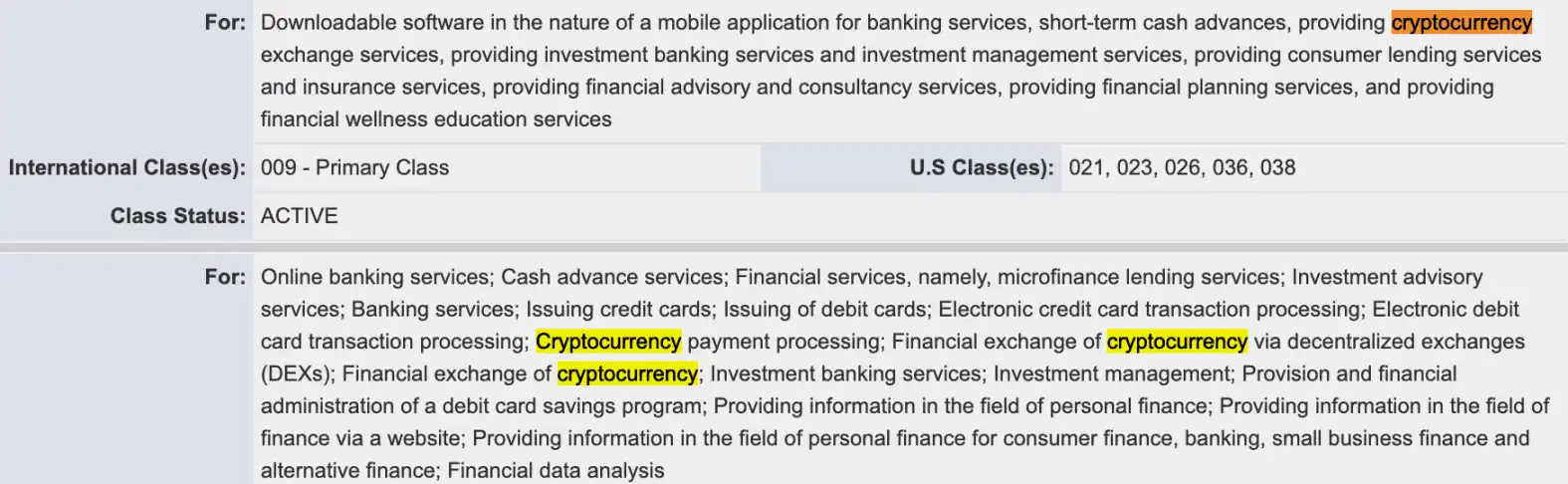
Going back a month earlier, in January 2026, Ethereum treasury company BitMine announced a $200 million equity investment in Beast Industries, with the transaction expected to be completed around January 19, 2026. Beast Industries CEO Jeff Housenbold stated that future collaborations would explore introducing DeFi into their financial services platform. The two parties plan to explore integrating DeFi into the upcoming financial services platform. Beast Industries is an entertainment and consumer goods company founded by renowned YouTube creator MrBeast.

MrBeast has frequently discussed his personal financial situation, viewing the acquisition of Step as an opportunity to "provide millions of young people with the financial foundation I never had." As the company prepares to enter the financial industry, MrBeast expressed his desire to create videos about finance, such as "educating people on how to invest and showing them what a Roth IRA is."

Previously Accused of Profiting Over $10 Million Through Crypto Pump-and-Dump Schemes

This is not MrBeast's first foray into the crypto space. On October 11, 2024, on-chain detective SomaXBT publicly released a chain investigation. The investigation alleged that MrBeast participated in several Initial DEX Offerings (IDOs) and token promotion activities, profiting significantly from代言后 token price surges.

The projects involved included SuperFarm (SUPER), Polychain Monsters (PMON), SPLYT (SHOPX), and others. Some tokens experienced price drops of over 90% after MrBeast sold his holdings.
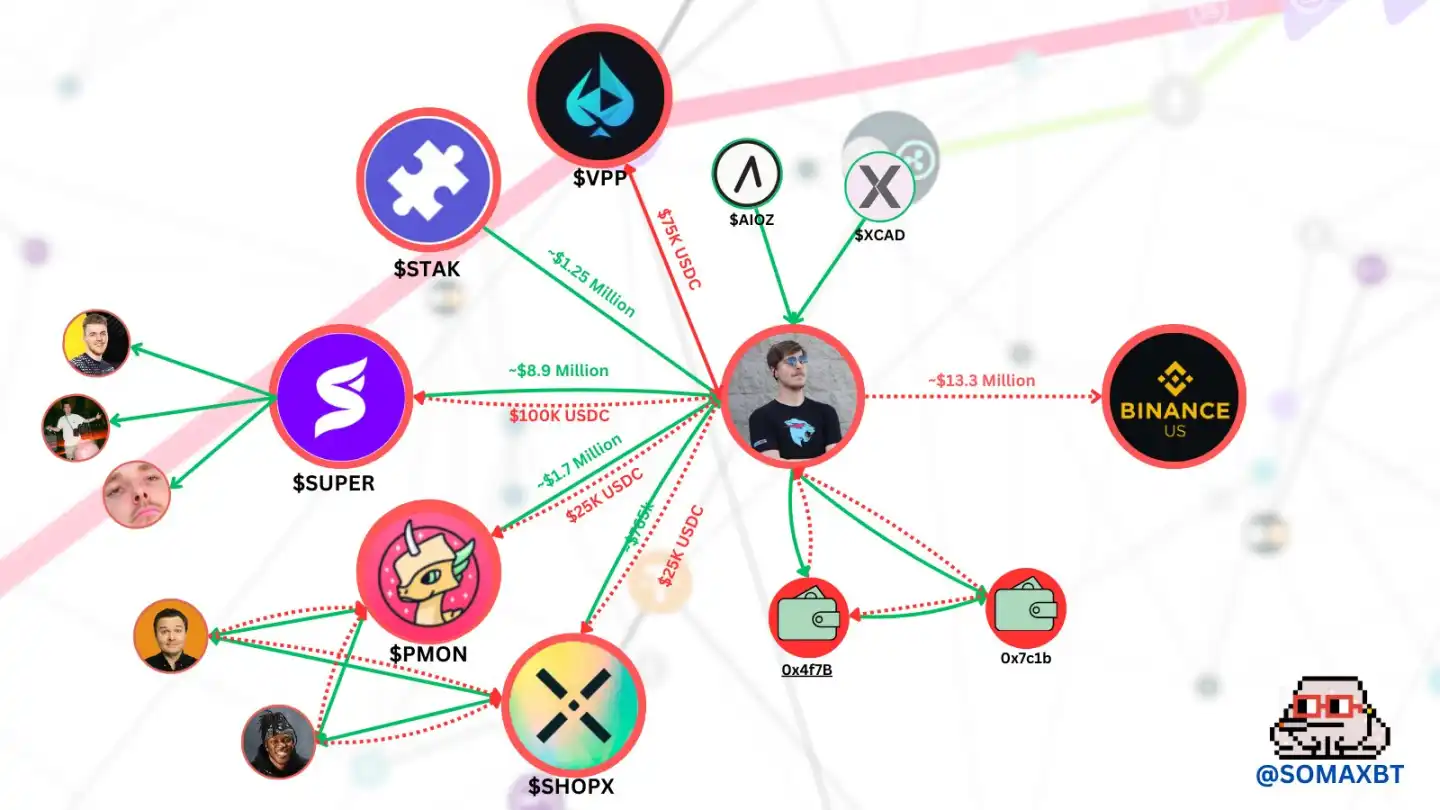
SomaXBT detailed multiple cases. Using the SUPER token, a project backed by Elliot Trades, as an example:

According to SomaXBT, MrBeast invested $100,000 in the project and received 1 million SUPER tokens in return. After his investment, the token price surged. MrBeast transferred his SUPER tokens to an alternate wallet on March 30, 2021, where they were sold through a series of transactions totaling 1,900 ETH (approximately $3.7 million at the time). MrBeast received additional SUPER tokens based on a vesting contract, which he later sold for $5.5 million, bringing his total revenue from the project to approximately $9 million.

SomaXBT's investigation also highlighted MrBeast's involvement with Polychain Monsters (PMON), another low-market-cap token project. In this case, MrBeast invested $25,000 and received 25,000 PMON tokens. On March 31, 2021, his wallet transferred these tokens to another wallet, where they were sold through a series of transactions, netting a profit of 685 ETH (approximately $1.3 million).

The investigation also discussed projects like SHOPX, STAK, and VPP under the same pattern, alleging that after MrBeast completed the accused sell-offs, these tokens experienced significant price corrections, with some falling over 90% from their peaks. It characterized this as a "pump-and-dump" scheme, emphasizing that influencer promotions combined with low-liquidity tokens amplify volatility and transfer risk to retail investors.
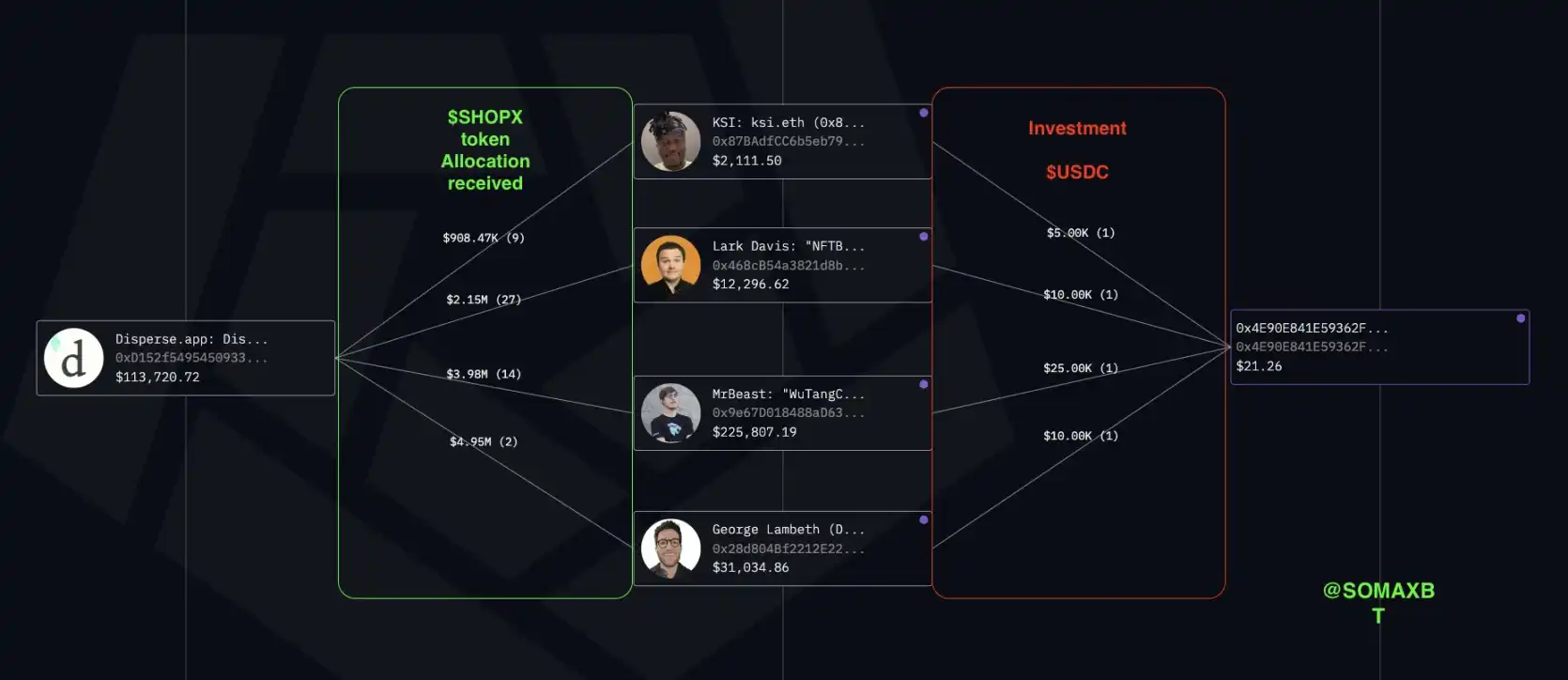
Additionally, in September 2025, MrBeast accumulated 705,821 ASTER tokens, worth approximately $1.28 million at the time.

In summary, Beast Industries has made a key move in establishing its financial entry point. Crypto-related capabilities are still in the planning and exploration stages, and historical on-chain controversies may continue to affect the trust threshold for its financial and crypto businesses.


İlgili Sorular

QWhat is the main business move announced by MrBeast's Beast Industries on February 9th?

ABeast Industries announced it has acquired Step, a mobile banking app for teenagers, marking its entry into the fintech sector.

QWhat specific financial services does the Step app provide to its young audience?

AStep provides a suite of services including savings accounts, a credit-building card that functions like a debit card, and cash advances. It offers these banking services through a partnership with the FDIC-insured Evolve Bank & Trust.

QWhat was the significant investment that preceded the acquisition of Step, and which company made it?

APrior to the acquisition, Beast Industries received a $200 million equity investment from BitMine, an Ethereum treasury company.

QAccording to the on-chain investigation by SomaXBT, what controversial practice was MrBeast accused of in the crypto space?

AMrBeast was accused of participating in 'pump and dump' schemes, where he promoted low-market-cap tokens and sold his allocated tokens after their prices surged, allegedly profiting over $10 million and leaving retail investors with significant losses.

QWhat future financial content does MrBeast express an interest in creating for his audience?

AMrBeast expressed an interest in creating videos that educate people on how to invest and explain financial concepts like a Roth IRA.

İlgili Okumalar

STAR 50 Soars 10.73%, Why Did A-Shares Stage a "V-Shaped Reversal"?

After a prolonged decline, the Chinese A-share market staged a strong rally on July 21. The STAR 50 index surged 10.73%, its largest single-day gain in nearly a year, leading a broad-based "V-shaped" reversal. The Shanghai Composite Index rose 1.79%, the Shenzhen Component Index gained 4.81%, and the ChiNext Index jumped 7.05%. Total market turnover reached 2.97 trillion yuan, an increase of 256.1 billion yuan from the previous session, with over 3,100 stocks advancing. The semiconductor sector spearheaded the rebound, with related ETFs posting significant gains. Analysts attribute the surge to three converging factors. First, coordinated capital inflows from "national team" institutions, insurance funds, listed company buybacks, and fund house self-purchases have bolstered market liquidity and confidence. Second, supportive policy signals, including commitments from regulators to ensure stable market operations, provided a favorable backdrop. Third, a stabilization and recovery in overseas markets, notably South Korea, created a positive external environment. Institutions suggest the most severe panic selling phase for the tech sector has likely passed, following a significant digestion of crowded positions and leveraged funds. While short-term volatility may persist, the medium to long-term outlook remains underpinned by enduring trends like AI computing demand expansion and semiconductor localization. The market's focus now shifts to the sustainability of supportive fund flows, earnings reports, and upcoming catalysts from the global AI industry chain.

marsbit30 dk önce

STAR 50 Soars 10.73%, Why Did A-Shares Stage a "V-Shaped Reversal"?

marsbit30 dk önce

U.S. Tech Momentum Stocks Post Largest Single-Day Gain Ever, But Is the Plunge Over?

US tech momentum stocks staged a sharp rebound on Tuesday (July 21st). Morgan Stanley's TMT Momentum Factor surged over 12%, marking its largest single-day gain on record, exceeding even peaks from the 2000 dot-com bubble. Key momentum indices from Goldman Sachs also posted their strongest daily performances in years. The rally was led by semiconductors, with the Philadelphia Semiconductor Index jumping 4.6%. This rebound followed three consecutive down days and a cumulative 33% plunge in momentum stocks, one of the steepest drawdowns since the dot-com era. Analysts attribute the surge largely to a short squeeze. Heavy selling had pushed high-beta momentum stocks into deeply oversold territory, forcing many short sellers, particularly in Asia, to cover their positions, creating a self-reinforcing buying spiral. However, the rebound's internals appear weak. Trading volume was notably low, and advancing stocks still lagged decliners on the S&P 500, indicating a narrow, concentrated rally rather than broad market participation. Diverging views emerge on the outlook. BTIG warns the bounce has hit key resistance and recommends selling into strength, citing extreme volatility and historical parallels to past market tops. Conversely, Goldman Sachs and UBS believe the momentum unwind is nearing its end, suggesting it may be time to gradually add exposure, as positioning has been significantly reduced. They caution, however, that high volatility warrants a measured approach, potentially using defined-risk strategies. The upcoming earnings season, particularly reports from major tech firms like Alphabet, is seen as a critical test for the rally's sustainability. Simultaneously, bond markets flashed a warning, with yields rising partly due to spiking oil prices. Analysts note that if long-term Treasury yields break decisively higher, it could pose a significant headwind for equities, especially growth stocks.

marsbit37 dk önce

U.S. Tech Momentum Stocks Post Largest Single-Day Gain Ever, But Is the Plunge Over?

marsbit37 dk önce

U.S. Tech Momentum Stocks Record Largest Single-Day Gain Ever, but Has the Rout Ended?

U.S. tech momentum stocks staged a dramatic rebound on Tuesday, July 21st. Key momentum indices like the Morgan Stanley TMT Momentum Factor and Goldman Sachs' High Beta Momentum Long Index posted historic or near-historic single-day gains, fueled largely by semiconductor stocks. This sharp rally followed a severe three-day sell-off that saw momentum stocks plunge 33%, marking one of the steepest pullbacks since the dot-com bubble. Analysts attribute the bounce primarily to a short squeeze, as forced covering from over-leveraged traders, particularly in Asia, created a buying spiral. However, the rally's health is questioned due to weak market breadth—overall trading volume was low, and decliners outnumbered advancers in the S&P 500 despite the index's gain—suggesting a narrow, concentrated surge rather than broad recovery. Opinions on the sustainability diverge. BTIG strategists warn the rebound has hit key resistance levels, citing extreme volatility and historic stock dispersion as signs of an ongoing broader correction, and recommend selling into strength. Conversely, Goldman Sachs and UBS view the aggressive momentum unwinding as nearing its end, noting reduced positioning and a lack of new fundamental catalysts. They suggest the sell-off presents a selective opportunity to add exposure, albeit cautiously and gradually using defined-risk strategies. The immediate trajectory hinges on the ongoing earnings season, with market focus on Alphabet's capital expenditure guidance for AI investment clarity. Meanwhile, bond markets present a risk, with rising Treasury yields—potentially heading toward 5.5%—and widening credit spreads for mega-cap tech companies posing a threat to equity valuations. The combination of technical factors, earnings results, and macro conditions leaves the durability of the rebound in doubt.

链捕手39 dk önce

U.S. Tech Momentum Stocks Record Largest Single-Day Gain Ever, but Has the Rout Ended?

链捕手39 dk önce

Long-Divided Must Unite, Long-United Must Divide: When L1 Becomes Its Own Rollup, What Is Ethereum's Endgame?

"The Inevitable Cycle: When L1 Becomes Its Own Rollup – What is Ethereum's Endgame?" For years, the Ethereum community grappled with concerns that L2s were fragmenting the ecosystem and eroding L1's value. While L2s provided cheaper execution, they also splintered liquidity and the unified user experience of a single chain. This has prompted a fundamental reassessment of the relationship between L1 and L2. Ethereum's roadmap is evolving. The "Scale" initiative merges L1 and L2 expansion into a holistic framework. L1 itself is advancing with higher gas limits, statelessness, and zkEVM verification, no longer content to be just a low-throughput settlement layer. Consequently, the primary value proposition of L2s is shifting from merely providing cheap blockspace to offering L1 cannot easily provide: application-specific optimizations, privacy features, and flexible governance models. L2s are becoming a spectrum of execution environments with varying degrees of security inheritance from Ethereum. A critical challenge in this multi-chain future is interoperability. The vision is to make Ethereum "feel like one chain again." This relies on advancements in native account abstraction (like EIP-7702) and intent-based architectures (Open Intents Framework), where users declare desired outcomes, and solvers handle the complex cross-chain execution. Furthermore, shortening Ethereum's finality time from minutes to seconds is crucial, as it underpins trust between chains for bridges, stablecoins, and cross-chain applications. Perhaps the most provocative idea is that Ethereum L1 itself could become a form of "its own Rollup." As zkEVM and proof systems mature, high-performance nodes could execute transactions and generate validity proofs. Regular validators would then verify these proofs instead of re-executing all transactions. This blurs the traditional L1/L2 hierarchy, making "Rollup" more of a general execution-verification architecture. Native Rollup aims to integrate L2 validation more directly into the Ethereum protocol, allowing L2s to inherit L1's security more fully and move away from reliance on security councils. In the end, L2s are not destined to replace L1 or be made obsolete by it. The likely future is a unified system where diverse execution environments—each optimized for specific use cases like DeFi, gaming, or privacy—coexist. They will share a common foundation of security, liquidity, and verifiable state, seamlessly connected to restore a cohesive user experience. The next phase for Ethereum is not just about scaling through separation, but about intelligently reintegrating what was separated back into a coherent whole.

链捕手55 dk önce

Long-Divided Must Unite, Long-United Must Divide: When L1 Becomes Its Own Rollup, What Is Ethereum's Endgame?

链捕手55 dk önce

İşlemler

Spot
活动图片




