More Accurate Than Polls, More Dangerous Than Imagined: Prediction Markets in the Eyes of the Fed

比推2026-02-24 tarihinde yayınlandı2026-02-24 tarihinde güncellendi

Özet

The Federal Reserve is exploring the use of prediction markets, particularly Kalshi, as a real-time tool for policy insights. A Fed-affiliated working paper found that Kalshi’s predictions for core CPI and unemployment are statistically comparable to—and sometimes more accurate than—Bloomberg consensus estimates. Prediction markets aggregate real-money, belief-backed trading, offering frequent updates and capturing nuanced shifts that traditional surveys miss. For instance, Kalshi priced inflation uncertainty in real time during a trade policy scare—a dynamic monthly surveys couldn’t reflect. While these markets provide valuable signals, they also carry risks. Prices reflect both expectations and risk preferences, and heavy reliance on sports betting for liquidity makes macroeconomic markets vulnerable to regulatory changes. If sports betting is restricted, liquidity could dry up, increasing manipulation risks. Moreover, if the Fed openly uses prediction markets, it could create a feedback loop where traders manipulate smaller markets like Kalshi to influence broader policy communication and traditional financial instruments. Despite these concerns, prediction markets offer a uniquely timely and distributed form of expectation aggregation—especially for events like FOMC meetings, where informed participants trade with real stakes. The Fed should require open data transparency to mitigate manipulation and carefully weigh the signal against the noise.

Source: The Token Dispatch

Author: Prathik Desai

Original Title: The Signal and the Noise


“Forecasts usually tell us more of the forecaster than of the future.”

— Warren Buffett

Money filters out empty talk. Supporters believe this is precisely why prediction markets are reliable. We saw people accurately predict the outcome of the 2024 U.S. presidential election on Polymarket and Kalshi. However, prediction markets themselves are not new, and their success in predicting political outcomes is not the first of its kind.

In October 1988, a group of economists at the University of Iowa supported their academic curiosity with a small, real-money prediction market. They launched a presidential election futures market where participants could buy contracts: if George H. W. Bush won, the contract paid $1; if Michael Dukakis won, it paid $0. On the eve of the election, Bush's contracts traded at 53 cents, while traditional polls suggested a close race. Ultimately, Bush won with 53.4% of the vote and a solid 8-point margin.

Since that academic experiment, these real-money futures markets have outperformed traditional polls in every election predicted more than 100 days in advance. In U.S. presidential elections since 1988, prediction markets have been closer to the final result than polls 74% of the time.

This success stems from a mechanism that forces people to express genuine beliefs backed by real money, something surveys can never achieve. Those who truly believed Bush would win bought and held contracts. For random participants, there is no incentive to spend $50 to support a claim they themselves do not believe. When this behavior aggregates thousands of traders, information converges into a price that reflects the true beliefs of a broad group, rather than a small, disproportionate sample.

That small academic experiment in Iowa, run on a shoestring budget, has now evolved into an institutionalized infrastructure.

Last week, a working paper authored by economists affiliated with the Federal Reserve noted that Kalshi, the largest regulated prediction market in the U.S., could serve as a valuable real-time benchmark for policymakers. The same week, New York Stock Exchange (NYSE) President Lynn Martin stated that Polymarket, the world's highest-volume prediction market, moved S&P index futures on election night by pricing Donald Trump's victory earlier than any news organization. Subsequently, Kalshi announced a partnership with a trading platform that handles $2.6 trillion in daily institutional volume.

In today's in-depth analysis, I will explore whether prediction markets can serve as reliable barometers for policymaking and what risks they bring.

Prediction Markets as Policymaking Tools

The paper found that Kalshi's predictions are statistically similar to Bloomberg's consensus expectations, with nearly identical prediction errors for core CPI and unemployment rates. In fact, the paper also found that Kalshi's predictions for core CPI were significantly better than Bloomberg's estimates.
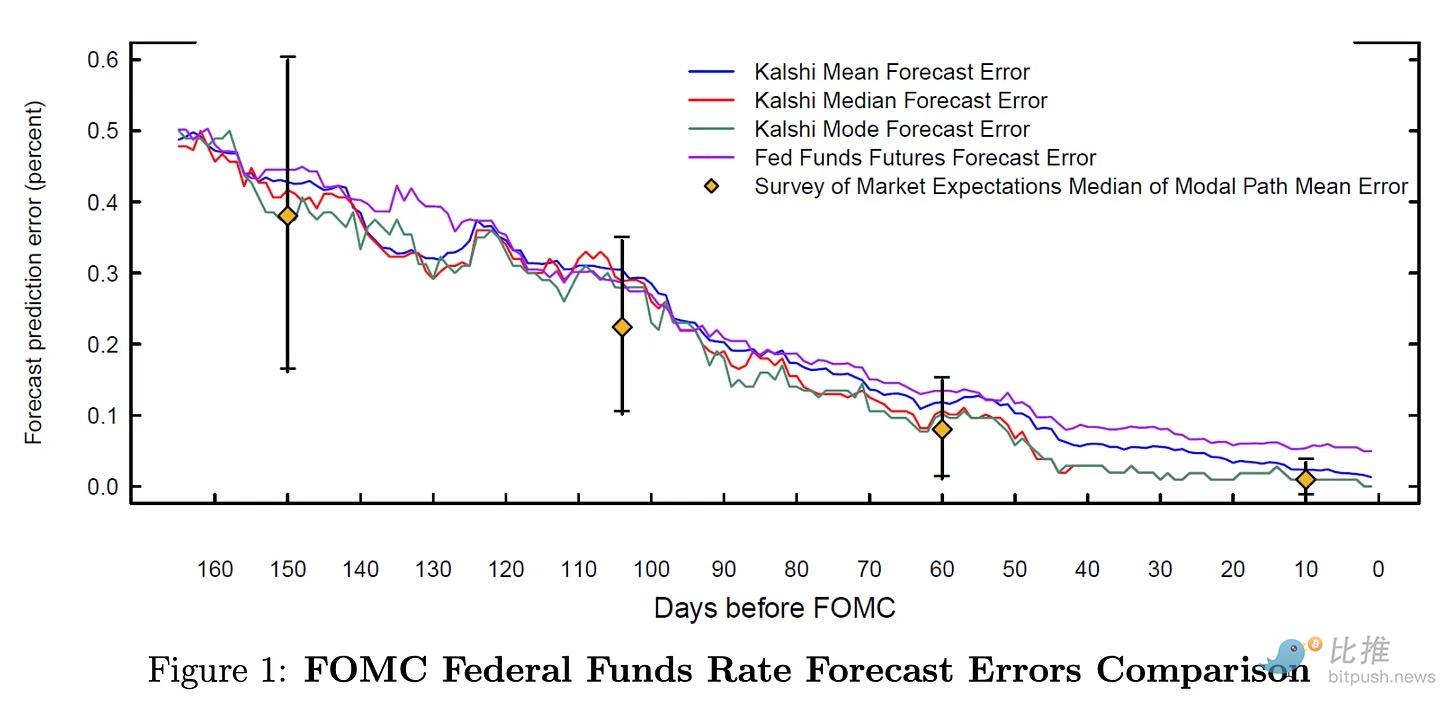
@FederalReserve

Despite similar statistical performance, Kalshi's uniqueness lies in its ability to provide more frequent, real-time probability curve updates for macroeconomic indicators such as GDP growth, core CPI, and unemployment rates. For estimates like inflation, the Bloomberg consensus is only available in the months leading up to the data release. This makes traditional estimates less frequent, with longer gaps that fail to reflect real-time expectation updates.

Kalshi not only provides predictions of outcomes but also real-time uncertainty ranges and tail risks. In early April 2025, uncertainty about trade policy temporarily raised inflation expectations. Although this uncertainty did not materialize, Kalshi priced this dynamic in real time. Monthly Bloomberg estimates could never capture this nuance.
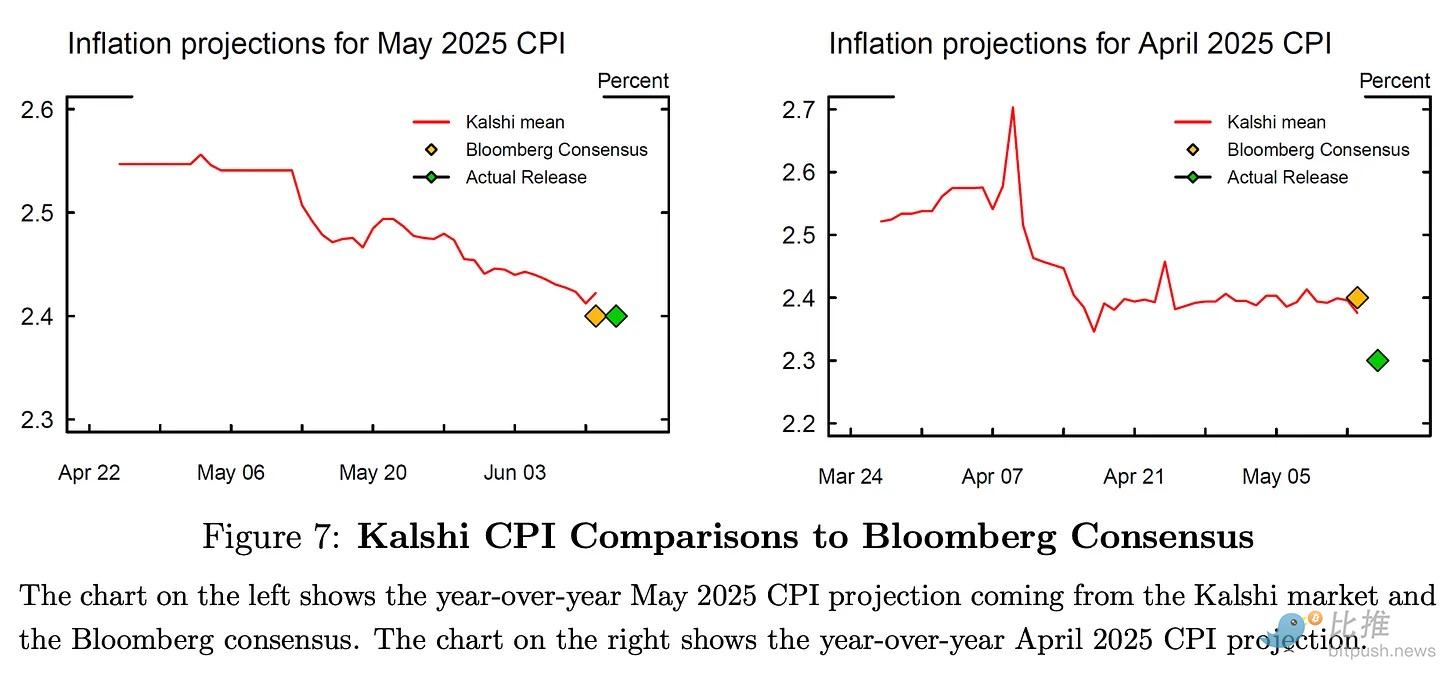
@FederalReserve

Today, when Federal Reserve governors speak at Federal Open Market Committee (FOMC) meetings, Kalshi's market odds move in real time. They price every word from the governors, providing policymakers with a perspective on how traders interpret the expected information.

For example, when Christopher J. Waller made dovish remarks ahead of the July 2025 FOMC meeting, the probability of no rate cut fell to 75%. After the stronger-than-expected June jobs report, this probability quickly rebounded to over 90%. The entire expectation of traders, backed by real money, is presented to policymakers in a way no other tool can currently achieve.

Who Trades on These Markets?

Before deciding how much to trust prediction markets, it is important to examine who is trading and what the volume represents.

Between September 2024 and January 2026, volume on Polymarket for FOMC meetings grew 11-fold, from $59 million to $660 million. In total, Polymarket's FOMC markets processed $2.6 billion, surpassing the combined total of the platform's culture, economy, geopolitics, and science categories.

So, who is trading such large amounts on FOMC meetings? While it is difficult to pinpoint on anonymous prediction platforms like Polymarket, we can speculate: it is hard not to think of macro hedge fund analysts involved in drafting labor statistics reports, or money market fund managers who stand to gain if rates are not cut.

Why them? The Iowa market worked because the number of people who put their money where their mouth is, with reliable information, outweighed those who merely gambling without it. While acknowledging the risk of over-assumption, I believe that when real stakes and funds of this scale are involved, those with reliable information converge on the market, leading to more accurate price discovery.

What to Be Wary Of

All this does not mean prediction markets can be perfect measuring tools for policymakers.

Probabilities in prediction markets also reflect traders' risk preferences. They are not a raw reflection of outcome expectations. For example, when Kalshi prices the probability of unfavorable CPI data at 15% while traditional surveys price it at 10%, this gap can be explained by two factors:

  1. Prediction markets may be pricing real-time information missed by the Bloomberg consensus.

  2. Traders may be paying a premium on prediction markets to hedge against unfavorable outcomes.

Policymakers must understand what this gap reflects before treating this information as a signal for policymaking.

While Kalshi's macroeconomic signals to policymakers seem reliable, over 85% of its total nominal volume comes from the sports category.
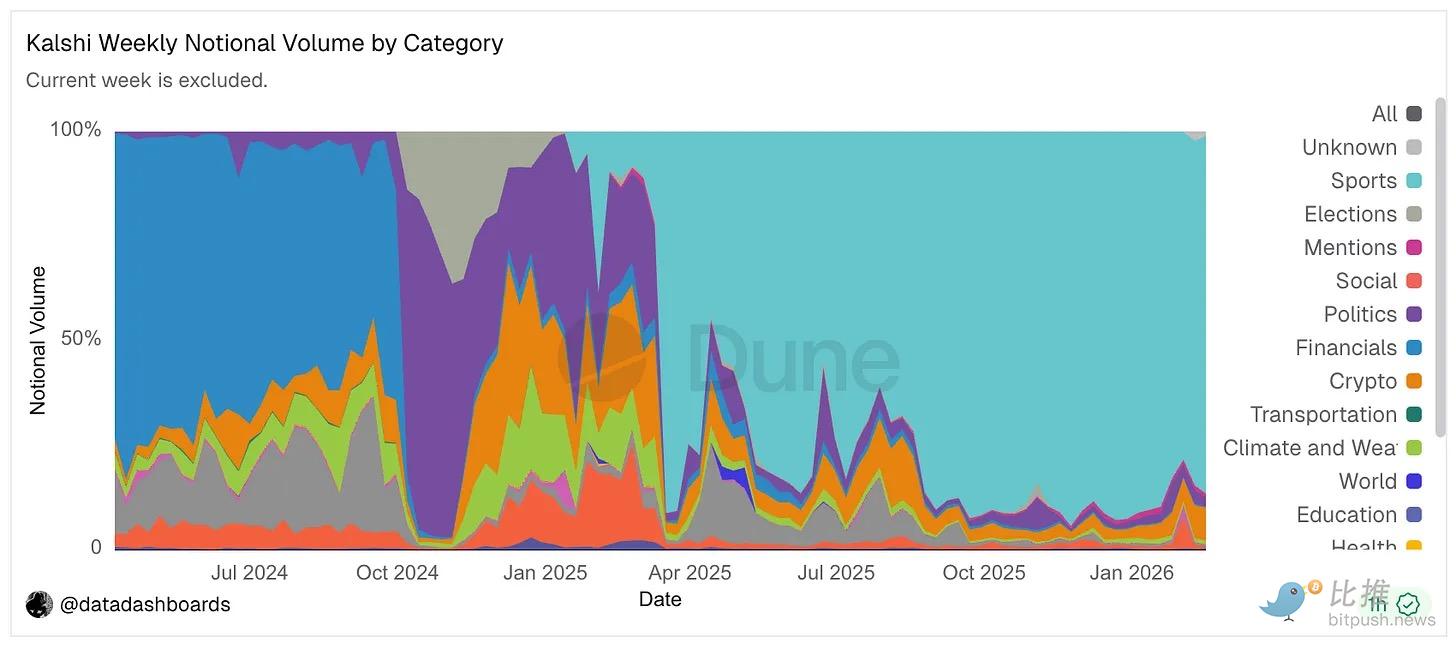
@Dune

Currently, at least 20 federal lawsuits are challenging the regulatory arbitrage achieved through nationwide sports betting for prediction markets.

The reliability of Kalshi's FOMC markets is partly due to sports betting providing the platform with foundational liquidity through active traders, narrow bid-ask spreads, and market-making infrastructure, which sustains all Kalshi markets. Although macro markets operate independently, they benefit from this foundation. If sports betting disappears under regulatory pressure, the platform will lose the liquidity engine that keeps spreads tight and prices continuous. Thinner macro markets become easier to move with less capital, making them more susceptible to manipulation.

The Fed's paper recommends using Kalshi as a monitoring tool, not a decision-making input. But making this intention public is itself problematic.

The authors suggest greater use of Kalshi to interpret incoming data and check real-time interpretations of Fed communications. However, because the intention to reference prediction markets is public, it could create a feedback loop.

For example, a policymaker at the Fed might see Kalshi pricing a 15% probability of a rate cut, lower than the expectation they wish to convey through their actions. In response, they might soften their rhetoric in the next speech, which could then cause fluctuations in global traditional interest rate markets. The problem here is that while Kalshi's FOMC market size is $660 million, the federal funds futures market is worth hundreds of billions of dollars. The former requires relatively small positions to change the odds. A well-funded participant, aware that moving Kalshi could influence subsequent Fed remarks (if not decisions), could use relatively small positions to move a much larger market. Policymakers' communications could become targets for manipulation.

This scenario highlights the difference between the 1988 Iowa futures market and the 2026 prediction markets. The Iowa economists back then simply wanted to determine if a market with real stakes could produce better predictions than surveys. At that time, policymaking was not under such close scrutiny to deter manipulators.

Back then, prices reflected true beliefs because those prices did not influence the world. They merely allowed those with insights to monetize them. Once the Fed publicly announces (if it does so) its intention to use prediction markets as a policy input, this attribute disappears. It also introduces a "performative" element to trading.

However, incorporating prediction market odds into the policy toolbox is not a misstep. Financial commitment still filters out empty talk. Informed participants continue to dominate price discovery. The result is a signal unmatched by surveys in terms of speed and distribution richness. For FOMC markets, this is more pronounced than any other application: there are participants on both sides with genuine hedging capabilities, and the market, by pricing real-time events frequently, better reflects real-time expectations.

Policymakers should mandate open-source data transparency as a prerequisite for formal adoption. If the data is not auditable, manipulation may go undetected. They should understand that both signal and noise come from the same place. People with real money and real beliefs can tell you what they think in real time.

For those powerful enough to game the system, this window of opportunity did not exist when the Iowa economists were conducting their academic experiment decades ago. Today, this window is wider than ever.


Twitter:https://twitter.com/BitpushNewsCN

Bitpush TG Discussion Group:https://t.me/BitPushCommunity

Bitpush TG Subscription: https://t.me/bitpush

Original link:https://www.bitpush.news/articles/7614191

İlgili Sorular

QAccording to the Federal Reserve working paper, how does the predictive accuracy of Kalshi compare to Bloomberg's consensus forecasts for core CPI and unemployment?

AThe paper found that Kalshi's predictions were statistically similar to Bloomberg's consensus expectations, with nearly identical prediction errors for core CPI and unemployment. In fact, Kalshi's forecasts for core CPI were significantly better than Bloomberg's estimates.

QWhat key advantage does the article highlight for Kalshi over traditional survey-based forecasts like Bloomberg's?

AKalshi provides more frequent, real-time updates to its probability curves for macroeconomic indicators, offering real-time uncertainty ranges and tail risk assessments that traditional surveys, which are only available months before data releases, cannot capture.

QWhat is the primary risk identified if the Federal Reserve were to publicly state its intention to use prediction markets like Kalshi as a policy input?

AIt could create a feedback loop and make policy communication a target for manipulation. A well-funded participant could use a relatively small position to move the odds on Kalshi, potentially influencing subsequent Fed communication and causing volatility in the much larger traditional interest rate markets.

QWhat does the article identify as the main reason for the historical success of prediction markets over traditional polls in forecasting election outcomes?

AThe mechanism forces people to express true beliefs backed by real money, which a survey questionnaire can never do. This aggregates information from a large crowd into a price that reflects genuine collective belief rather than a small, disproportionate sample.

QWhat major category currently provides the vast majority of the nominal trading volume on the Kalshi platform, and why is this a potential concern?

ASports betting accounts for over 85% of Kalshi's total nominal volume. This is a concern because the liquidity from sports trading supports the platform's infrastructure. If sports betting faces regulatory pressure and declines, the macro markets could lose liquidity, becoming thinner and more susceptible to manipulation.

İlgili Okumalar

STAR 50 Soars 10.73%, Why Did A-Shares Stage a "V-Shaped Reversal"?

After a prolonged decline, the Chinese A-share market staged a strong rally on July 21. The STAR 50 index surged 10.73%, its largest single-day gain in nearly a year, leading a broad-based "V-shaped" reversal. The Shanghai Composite Index rose 1.79%, the Shenzhen Component Index gained 4.81%, and the ChiNext Index jumped 7.05%. Total market turnover reached 2.97 trillion yuan, an increase of 256.1 billion yuan from the previous session, with over 3,100 stocks advancing. The semiconductor sector spearheaded the rebound, with related ETFs posting significant gains. Analysts attribute the surge to three converging factors. First, coordinated capital inflows from "national team" institutions, insurance funds, listed company buybacks, and fund house self-purchases have bolstered market liquidity and confidence. Second, supportive policy signals, including commitments from regulators to ensure stable market operations, provided a favorable backdrop. Third, a stabilization and recovery in overseas markets, notably South Korea, created a positive external environment. Institutions suggest the most severe panic selling phase for the tech sector has likely passed, following a significant digestion of crowded positions and leveraged funds. While short-term volatility may persist, the medium to long-term outlook remains underpinned by enduring trends like AI computing demand expansion and semiconductor localization. The market's focus now shifts to the sustainability of supportive fund flows, earnings reports, and upcoming catalysts from the global AI industry chain.

marsbit37 dk önce

STAR 50 Soars 10.73%, Why Did A-Shares Stage a "V-Shaped Reversal"?

marsbit37 dk önce

U.S. Tech Momentum Stocks Post Largest Single-Day Gain Ever, But Is the Plunge Over?

US tech momentum stocks staged a sharp rebound on Tuesday (July 21st). Morgan Stanley's TMT Momentum Factor surged over 12%, marking its largest single-day gain on record, exceeding even peaks from the 2000 dot-com bubble. Key momentum indices from Goldman Sachs also posted their strongest daily performances in years. The rally was led by semiconductors, with the Philadelphia Semiconductor Index jumping 4.6%. This rebound followed three consecutive down days and a cumulative 33% plunge in momentum stocks, one of the steepest drawdowns since the dot-com era. Analysts attribute the surge largely to a short squeeze. Heavy selling had pushed high-beta momentum stocks into deeply oversold territory, forcing many short sellers, particularly in Asia, to cover their positions, creating a self-reinforcing buying spiral. However, the rebound's internals appear weak. Trading volume was notably low, and advancing stocks still lagged decliners on the S&P 500, indicating a narrow, concentrated rally rather than broad market participation. Diverging views emerge on the outlook. BTIG warns the bounce has hit key resistance and recommends selling into strength, citing extreme volatility and historical parallels to past market tops. Conversely, Goldman Sachs and UBS believe the momentum unwind is nearing its end, suggesting it may be time to gradually add exposure, as positioning has been significantly reduced. They caution, however, that high volatility warrants a measured approach, potentially using defined-risk strategies. The upcoming earnings season, particularly reports from major tech firms like Alphabet, is seen as a critical test for the rally's sustainability. Simultaneously, bond markets flashed a warning, with yields rising partly due to spiking oil prices. Analysts note that if long-term Treasury yields break decisively higher, it could pose a significant headwind for equities, especially growth stocks.

marsbit44 dk önce

U.S. Tech Momentum Stocks Post Largest Single-Day Gain Ever, But Is the Plunge Over?

marsbit44 dk önce

U.S. Tech Momentum Stocks Record Largest Single-Day Gain Ever, but Has the Rout Ended?

U.S. tech momentum stocks staged a dramatic rebound on Tuesday, July 21st. Key momentum indices like the Morgan Stanley TMT Momentum Factor and Goldman Sachs' High Beta Momentum Long Index posted historic or near-historic single-day gains, fueled largely by semiconductor stocks. This sharp rally followed a severe three-day sell-off that saw momentum stocks plunge 33%, marking one of the steepest pullbacks since the dot-com bubble. Analysts attribute the bounce primarily to a short squeeze, as forced covering from over-leveraged traders, particularly in Asia, created a buying spiral. However, the rally's health is questioned due to weak market breadth—overall trading volume was low, and decliners outnumbered advancers in the S&P 500 despite the index's gain—suggesting a narrow, concentrated surge rather than broad recovery. Opinions on the sustainability diverge. BTIG strategists warn the rebound has hit key resistance levels, citing extreme volatility and historic stock dispersion as signs of an ongoing broader correction, and recommend selling into strength. Conversely, Goldman Sachs and UBS view the aggressive momentum unwinding as nearing its end, noting reduced positioning and a lack of new fundamental catalysts. They suggest the sell-off presents a selective opportunity to add exposure, albeit cautiously and gradually using defined-risk strategies. The immediate trajectory hinges on the ongoing earnings season, with market focus on Alphabet's capital expenditure guidance for AI investment clarity. Meanwhile, bond markets present a risk, with rising Treasury yields—potentially heading toward 5.5%—and widening credit spreads for mega-cap tech companies posing a threat to equity valuations. The combination of technical factors, earnings results, and macro conditions leaves the durability of the rebound in doubt.

链捕手47 dk önce

U.S. Tech Momentum Stocks Record Largest Single-Day Gain Ever, but Has the Rout Ended?

链捕手47 dk önce

Long-Divided Must Unite, Long-United Must Divide: When L1 Becomes Its Own Rollup, What Is Ethereum's Endgame?

"The Inevitable Cycle: When L1 Becomes Its Own Rollup – What is Ethereum's Endgame?" For years, the Ethereum community grappled with concerns that L2s were fragmenting the ecosystem and eroding L1's value. While L2s provided cheaper execution, they also splintered liquidity and the unified user experience of a single chain. This has prompted a fundamental reassessment of the relationship between L1 and L2. Ethereum's roadmap is evolving. The "Scale" initiative merges L1 and L2 expansion into a holistic framework. L1 itself is advancing with higher gas limits, statelessness, and zkEVM verification, no longer content to be just a low-throughput settlement layer. Consequently, the primary value proposition of L2s is shifting from merely providing cheap blockspace to offering L1 cannot easily provide: application-specific optimizations, privacy features, and flexible governance models. L2s are becoming a spectrum of execution environments with varying degrees of security inheritance from Ethereum. A critical challenge in this multi-chain future is interoperability. The vision is to make Ethereum "feel like one chain again." This relies on advancements in native account abstraction (like EIP-7702) and intent-based architectures (Open Intents Framework), where users declare desired outcomes, and solvers handle the complex cross-chain execution. Furthermore, shortening Ethereum's finality time from minutes to seconds is crucial, as it underpins trust between chains for bridges, stablecoins, and cross-chain applications. Perhaps the most provocative idea is that Ethereum L1 itself could become a form of "its own Rollup." As zkEVM and proof systems mature, high-performance nodes could execute transactions and generate validity proofs. Regular validators would then verify these proofs instead of re-executing all transactions. This blurs the traditional L1/L2 hierarchy, making "Rollup" more of a general execution-verification architecture. Native Rollup aims to integrate L2 validation more directly into the Ethereum protocol, allowing L2s to inherit L1's security more fully and move away from reliance on security councils. In the end, L2s are not destined to replace L1 or be made obsolete by it. The likely future is a unified system where diverse execution environments—each optimized for specific use cases like DeFi, gaming, or privacy—coexist. They will share a common foundation of security, liquidity, and verifiable state, seamlessly connected to restore a cohesive user experience. The next phase for Ethereum is not just about scaling through separation, but about intelligently reintegrating what was separated back into a coherent whole.

链捕手1 saat önce

Long-Divided Must Unite, Long-United Must Divide: When L1 Becomes Its Own Rollup, What Is Ethereum's Endgame?

链捕手1 saat önce

İşlemler

Spot
活动图片





