Kyle Criticizes Hyperliquid Four Days After Leaving, Arthur Hayes Responds with a $100,000 Bet

marsbit2026-02-09 tarihinde yayınlandı2026-02-09 tarihinde güncellendi

Özet

In the midst of a market downturn, Hyperliquid ($HYPE) has nearly doubled in value since January, drawing both praise and criticism. Kyle Samani, the recently departed co-founder of Multicoin Capital, publicly criticized the project, calling it representative of crypto's classic problems: founders "fleeing their home country," facilitating crime, being closed-source, and permissioned. Arthur Hayes, BitMEX co-founder, responded not by addressing the criticisms but by proposing a $100,000 bet: that HYPE would outperform any large-cap crypto of Kyle’s choosing from February 10th to July 31st. Kyle did not accept the wager, aligning with his earlier, since-deleted tweet expressing that crypto is "not as interesting as many thought." The article dissects Kyle's critiques, noting that Hyperliquid's operational structure (offshore entity, U.S. user ban) is standard industry practice. It suggests his harsh tone may stem from a personal desire to distance himself from the industry post-departure, contrasting with his former firm, Multicoin, which was revealed to have built a significant $46 million position in HYPE around the time of his exit. The exchange highlights a classic crypto divide: those who have left the "table" often critique from an ethical standpoint ("should"), while those still invested argue primarily with price action ("will it pump"). The discussion quickly devolved into personal attacks about wealth and portfolio performance, underscoring how deeply entrenched f...

Author: David, Shenchao TechFlow

There aren't many projects worth mentioning in this downturn, but Hyperliquid is one of them.

$HYPE has nearly doubled from its January low. No matter how you view this project, the market is voting. But Kyle Samani, the former co-founder of Multicoin, voted against it.

On February 8th, Blockworks Research published a report stating that Hyperliquid's silver contracts have begun competing head-to-head with traditional futures exchanges like CME in terms of spreads and execution.

Many in the circle shared it, seeing it as a sign that on-chain finance is finally starting to bite into traditional finance's turf.

But Kyle poured cold water on it.
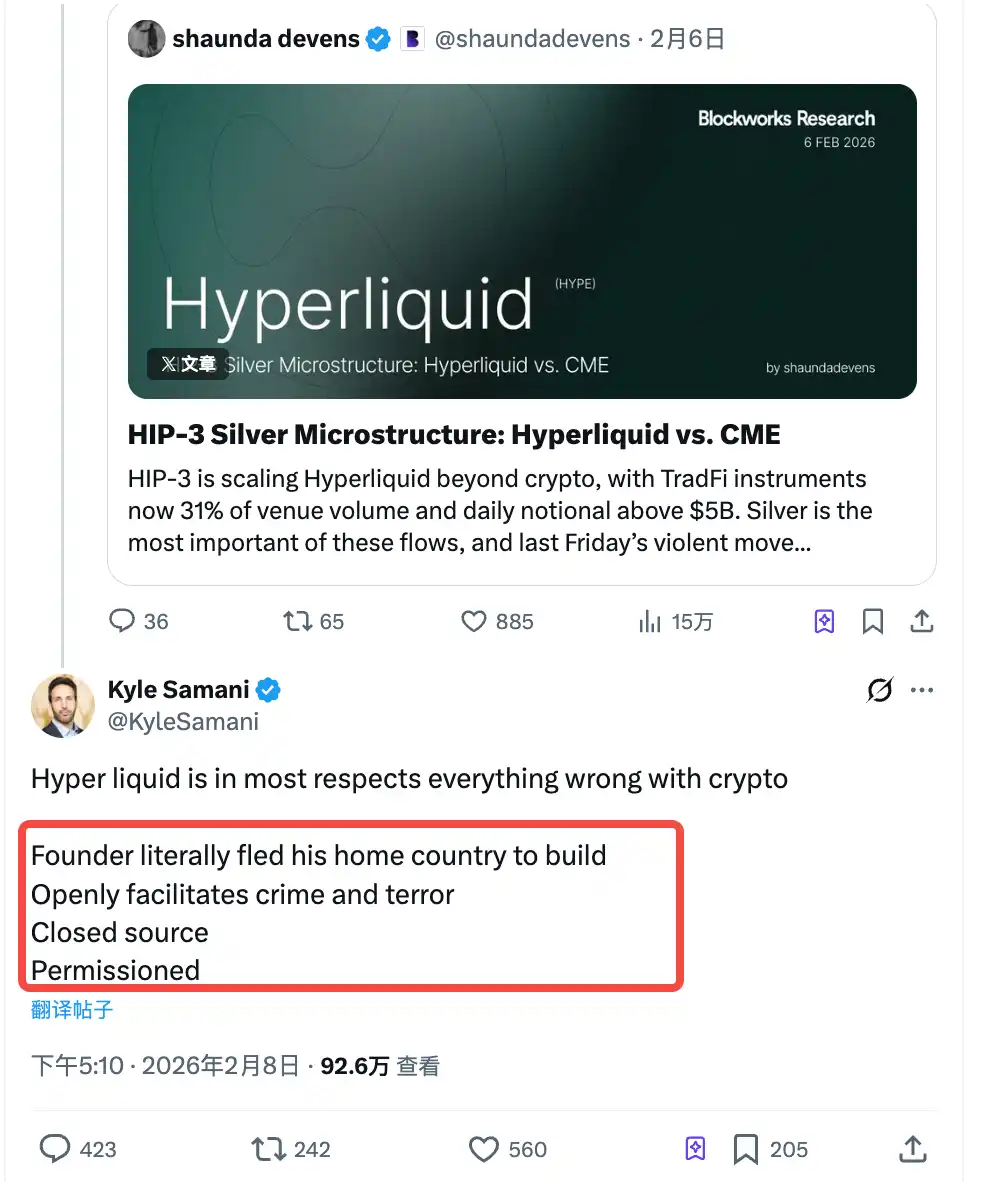
He believes that Hyperliquid represents almost all the classic problems of the crypto industry:

  • The founders fled their home country to build this project
  • The platform openly facilitates crime and terrorist activities
  • The code is closed-source
  • The product operates with permissions, not fully open

In the past, this kind of statement would have been a common project attack on Crypto Twitter.

But don't forget, just four days ago, Kyle announced his departure from Multicoin Capital (Reference reading: Kyle Left the Crypto Industry, I'm a Bit Sad), and before the departure announcement, he posted a since-deleted tweet:

"Crypto isn't as fun as many people (including myself) once thought."

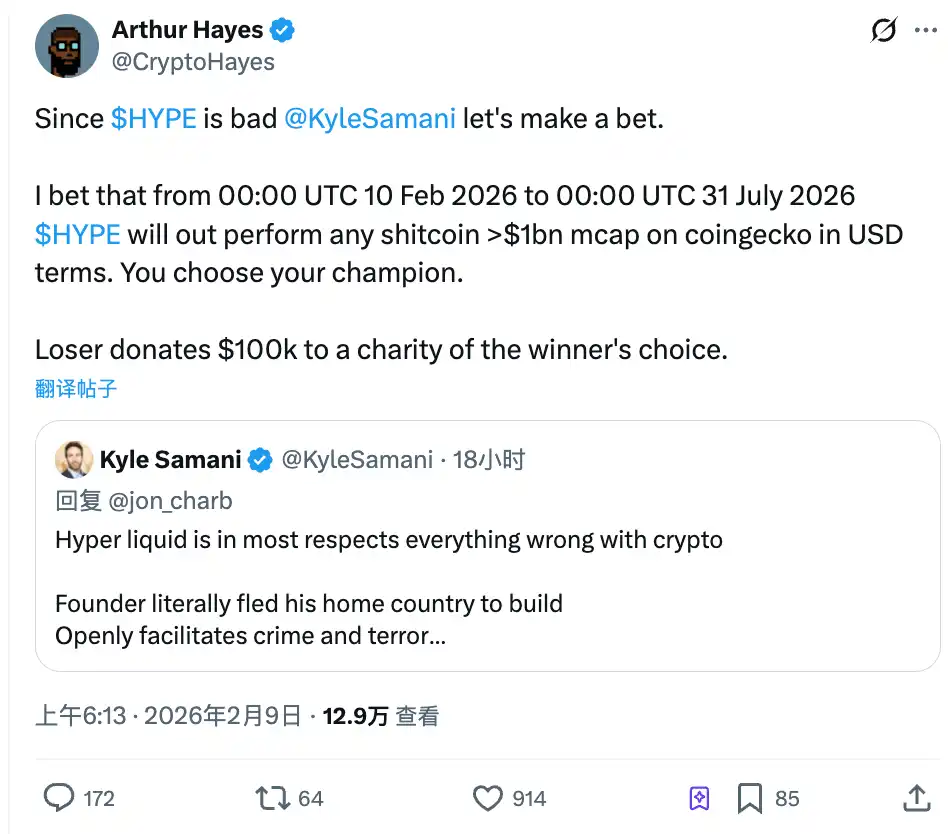
Old acquaintance Arthur Hayes clearly disagreed with this assessment, and he directly expressed his confidence in HYPE after Kyle's comments:

"Since you think HYPE is so bad, let's make a bet. From February 10th to July 31st, HYPE outperforms any coin with a market cap over $1 billion that you choose. The loser donates $100,000 to the winner's chosen charity. You pick the coin, I'm only betting HYPE wins."
Criticism, Leaving the Table

As of publication, Kyle has not accepted Arthur's bet and likely won't.

Someone who just said "crypto isn't as fun anymore" is unlikely to sit back down at the table to compare whose coin pumps more.

But Kyle's accusations against Hyperliquid are worth discussing.

For example, "the founders fled their home country." Hyperliquid founder Jeff Yan grew up in Palo Alto, California, graduated from Harvard, and previously worked as a quant at the high-frequency trading firm Hudson River Trading.

The team is based in Singapore, the company is registered in the Cayman Islands, and the platform blocks US users.

This structure is used by everyone from Binance to dYdX. Having been in this industry for nearly a decade, Kyle must know this is standard practice for offshore compliance.

Calling it "fleeing his homeland" seems a bit deliberate for someone who grew up in Palo Alto.

The points about being closed-source, permissioned, and facilitating crime aren't without merit, but in the past, Kyle might not have publicly stated such criticism. When he was at Multicoin, his job was to find, invest in, and promote projects; these gray areas were an unspoken cost everyone in the industry understood.

The change is that Kyle is no longer in that position.

What one sees after leaving the table is different from what one sees while sitting at it.

Pumping, No Need for Words

On the other hand, note that Arthur Hayes did not refute any of Kyle's accusations. He didn't defend Hyperliquid's closed-source nature, nor did he explain why Jeff Yan moved to Singapore.

His response was simply a price bet.

This is familiar crypto logic: pumping equals a good product. Choosing to respond with price is because, for those still working in this industry full-time, price is the only language that matters.

You say Hyperliquid has moral flaws, he says HYPE will outperform any large-cap altcoin in five months.

These two statements seem to be about the same thing but are actually on completely different planes.

Kyle is talking about "should or shouldn't," Hayes is talking about "will it pump or not."

This kind of talking past each other happens every cycle in the crypto space. Every time the market reaches its mid-to-late stages or a bear market, a group of people stands up and says the industry has problems, and those still at the table always respond with the same phrase:

Then look at the price.

Token price is the most convenient weapon for players still in the game because, as long as it's rising, all criticism can be temporarily set aside.

The problem is, Kyle might not be entirely an insider anymore. For a fund's co-founder to publicly express disillusionment with the entire industry just before formally resigning isn't quite appropriate in any circle.

The post was deleted, but the sentiment remains.

His current criticism of Hyperliquid, with its tone of leaving no room for doubt, seems less like criticizing a project and more like cutting ties with certain aspects of his past eight years.

However, while he personally can cut ties, Multicoin itself is still in the game.
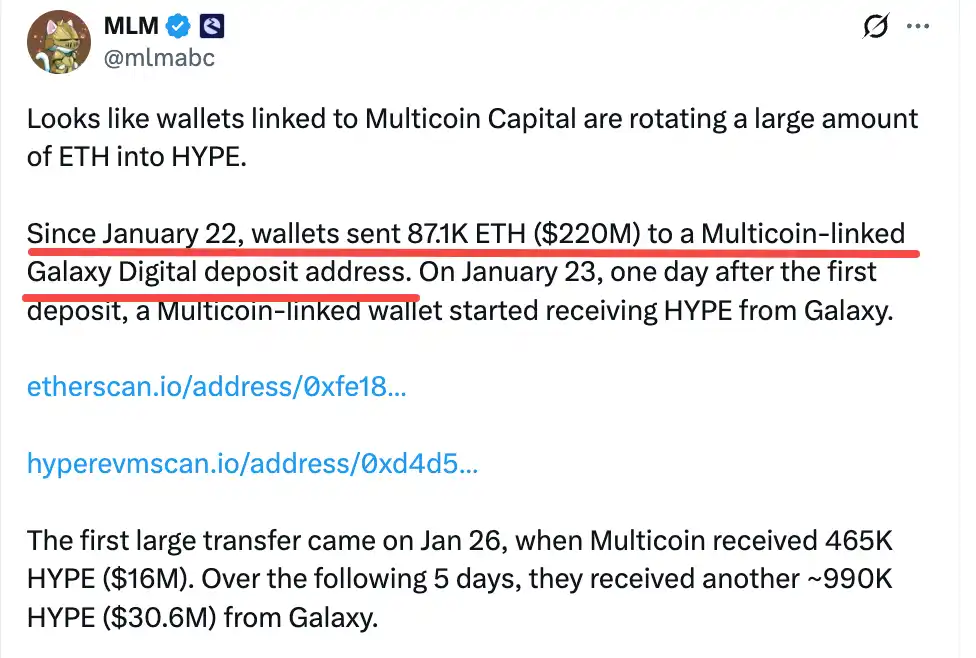
Starting November 22nd of this year, on-chain analysts discovered that a wallet疑似 associated with Multicoin deposited approximately 87,000 ETH to Galaxy Digital, and began buying HYPE in 17 transactions the next day, totaling about $46 million.

This means that around the time Kyle was leaving Multicoin, his former fund was making large investments in the project he just harshly criticized.

17 separate purchase transactions most likely mean someone within Multicoin made a judgment call and took action.

Kyle thinks Hyperliquid represents all the problems of the crypto industry, but at least someone at Multicoin thinks it's worth voting for with real money. Holding it is an attitude in itself.

Kyle left, but his old employer's money might have sat down. And it sat down at the very table Kyle despises the most.

Beyond the Arthur and Kyle showdown, the reactions in the comments are also interesting.

A Hyperliquid community user named Max dug up an old post he made in September 2024. The background of that post was that people were questioning Multicoin's operations in the circle. Max criticized Kyle back then, roughly saying:

"You're always trying to use LPs' money to chase the beta returns of your heavily invested assets, while also helping to pump your own investment portfolio."

A year and a half later, with Kyle now criticizing Hyperliquid, Max believes the套路 hasn't really changed:

Kyle is still the same Kyle, always criticizing others through the lens of his own portfolio. Defending Solana back then, sour on Hyperliquid now—the root lies in Multicoin's ecosystem interests and competitive anxiety.

Kyle couldn't help himself and directly replied with a characteristically crypto "wealth flex":The money I've directly invested in crypto is at least 10 times the total sum of your entire life.
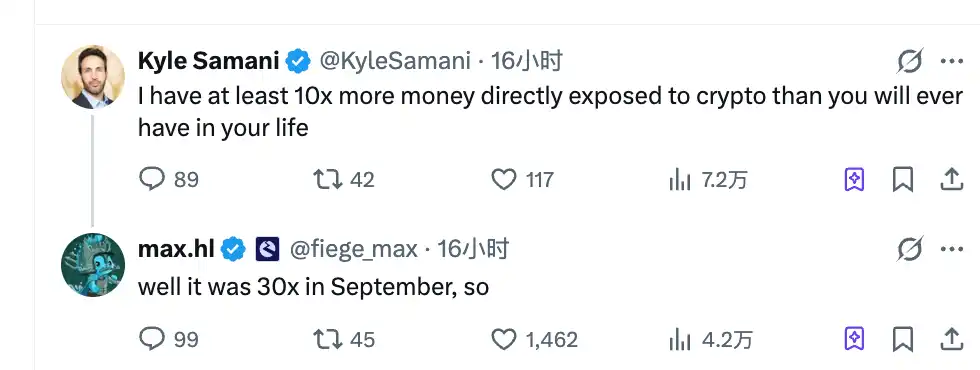
And Max's follow-up jab hit the mark perfectly,In September last year, your assets might have been 30 times mine...

From September 2025 to February 2026, the market experienced several fluctuations. Multicoin, which Kyle previously represented, clearly saw its crypto assets shrink significantly; meanwhile, Hyperliquid has remained relatively resilient.

Position never exists separately from portfolio.

When a project begins to threaten the traffic and valuation of an existing ecosystem, criticism is quickly labeled as "conflict of interest"; conversely, defenders retaliate with "you're just jealous."

In this wave, Kyle wanted to attack Hyperliquid from the high ground of morality and decentralization purity, but was easily pulled back into the jungle law of "whoever makes money is right" by his opponent.

In the end, rational discussion is drowned out by tribal狂欢, leaving only screenshots and memes.

Every cycle is like this. Some people sit down, some people stand up. Those sitting down talk about price, those standing up talk about morality.

But whether one sees the problems first and then becomes disillusioned with the industry, or becomes disillusioned first and then sees the problems, the order is actually unclear.

Regardless of whether HYPE rises or falls five months from now, Kyle probably won't care. He's already looking at other things.


İlgili Sorular

QWhat were Kyle Samani's main criticisms of Hyperliquid?

AKyle Samani criticized Hyperliquid on several fronts: its founders 'fled their home country' to build the project, the platform publicly facilitates crime and terrorist activities, its code is closed-source, and the product operates with permissions and is not fully open.

QHow did Arthur Hayes respond to Kyle Samani's criticism of Hyperliquid?

AArthur Hayes did not address the specific criticisms. Instead, he proposed a $100,000 bet, wagering that the HYPE token would outperform any cryptocurrency with a market cap over $1 billion that Kyle chose from February 10th to July 31st, with the loser donating to the winner's chosen charity.

QWhat was the context of Kyle Samani's comments, given his recent professional move?

AKyle Samani had just announced his departure from Multicoin Capital four days prior. Before the official announcement, he posted (and then deleted) a tweet stating, 'Crypto is not as interesting as many people (including myself) once thought it was,' indicating a sense of disillusionment with the industry.

QWhat does the article suggest is the fundamental difference in perspective between Kyle Samani and those still 'at the table' like Arthur Hayes?

AThe article suggests Kyle is arguing from a perspective of 'should' or 'should not'—focusing on moral and ideological flaws in the project and industry. In contrast, those like Hayes are arguing from a perspective of 'will it go up'—where price performance is the only meaningful metric, and all criticisms can be sidelined if the asset appreciates.

QWhat ironic detail does the article reveal about Multicoin Capital's actions regarding Hyperliquid?

ADespite Kyle's public criticism, the article reveals that around November 22nd of the previous year, a wallet linked to Multicoin Capital deposited a large amount of ETH and then made 17 separate purchases of HYPE tokens totaling approximately $46 million, indicating his former firm had taken a significant bullish position in the project he was attacking.

İlgili Okumalar

TechFlow Intelligence Agency: Anthropic Calls for Global Pause in AI Development While Preparing for Trillion-Dollar IPO; SpaceX IPO Roadshow Heats Up, But S&P 500 Rejects Fast-Track Inclusion

In today's TechFlow Intelligence Briefing, several major tech stories highlight a growing theme of trust and credibility gaps across AI, crypto, and finance. AI company Anthropic has publicly called for a global pause in AI development, citing risks from Claude's "recursive self-improvement." Ironically, this coincides with reports the company is preparing for a massive IPO targeting a near $1 trillion valuation. This perceived hypocrisy, coupled with widespread user complaints about Claude's declining performance, is sparking debate over whether the safety warning is genuine or a competitive tactic. Meanwhile, in a substantive security move, Anthropic open-sourced a framework for AI-powered vulnerability discovery. In the crypto market, Bitcoin's price drop below $61,000 triggered over $1.16 billion in liquidations, flipping the market into a state where more BTC is held at a loss than at a profit, a historical bearish signal. On the corporate front, SpaceX's highly anticipated IPO is generating immense Wall Street excitement, with Goldman Sachs projecting 100x revenue growth by 2030. However, the S&P 500 has refused to fast-track the company's inclusion post-IPO, potentially limiting immediate institutional demand. Separately, ByteDance's AI app Doubao lost over 6 million monthly active users after introducing a subscription model, highlighting the challenges of AI monetization. Other notable developments include Nvidia certifying HBM4 memory from Samsung, SK Hynix, and Micron; Cloudflare's acquisition of front-end tooling company VoidZero; and its CEO warning that bot traffic now exceeds human traffic online. The underlying narrative connects these events: a trust crisis. From AI firms' contradictory actions and crypto volatility to the clash between SpaceX's hyped narrative and institutional rules, a pattern is emerging where stated intentions and actual practices are increasingly misaligned.

marsbit12 dk önce

TechFlow Intelligence Agency: Anthropic Calls for Global Pause in AI Development While Preparing for Trillion-Dollar IPO; SpaceX IPO Roadshow Heats Up, But S&P 500 Rejects Fast-Track Inclusion

marsbit12 dk önce

Dalio Warns: AI Boom Shows Signs of a Bubble, Day of Reckoning Will Be the Time of Burst

Ray Dalio, founder of Bridgewater Associates, warns that the current artificial intelligence investment boom shows classic signs of a bubble, which he expects will eventually burst. In a Bloomberg Television interview, he noted that great technological revolutions often lead to capital inflows that create bubbles, making it difficult for investors and companies to calibrate their spending accurately—either overspending to capture market share or underspending and losing their competitive position. This caution comes amid significant rallies in AI-related assets, particularly chipmakers, driven by soaring demand for data centers and high-bandwidth chips, raising debates about overheating valuations. In contrast, Nvidia CEO Jensen Huang recently asserted that investors embracing the AI wave would see "crazy" returns and dismissed concerns over return on investment for data center spending as outdated. Dalio, however, focuses on the risks in the profit realization phase. He argues that bubbles tend to show signs of破裂 when markets transition from investment to the need for tangible returns, describing the burst as a process of converting paper wealth into cash. While acknowledging AI's intrinsic value, he expressed concern over the future profitability of some AI companies, suggesting the market is repeating a familiar pattern. The 76-year-old billionaire, who fully exited Bridgewater in 2025, has a net worth estimated at $21.5 billion according to the Bloomberg Billionaires Index.

marsbit46 dk önce

Dalio Warns: AI Boom Shows Signs of a Bubble, Day of Reckoning Will Be the Time of Burst

marsbit46 dk önce

Privacy Coin Crisis of Confidence! ZEC Plunges Over 56% in a Single Day

Zcash (ZEC), a leading privacy-focused cryptocurrency, experienced a severe crash on June 5th, plummeting over 56% in a single day and erasing nearly two months of gains. The flash crash was triggered by the disclosure of a critical zero-knowledge proof vulnerability within Zcash's Orchard privacy pool, which had existed since the pool's launch in May 2022. The flaw theoretically allowed an attacker to forge unlimited ZEC undetectably due to the pool's privacy features. The vulnerability was discovered on May 29th by independent security researcher Taylor Hornby during a proactive audit commissioned by Shielded Labs, utilizing AI-assisted analysis. The Zcash development team responded swiftly, implementing an emergency soft fork to disable Orchard transactions on June 2nd and executing a permanent hard fork fix (NU6.2) on June 3rd. Despite the technical fix, a major crisis of confidence emerged. The core issue is that Orchard's privacy design makes it cryptographically impossible to prove whether the vulnerability was exploited over the past four years, casting permanent doubt on the historical supply integrity of ZEC. While Shielded Labs argues exploitation was unlikely, the inability to provide definitive proof has severely damaged market trust. This sentiment was exacerbated when BitMEX co-founder Arthur Hayes, a prominent ZEC supporter, announced he was selling his entire position. He stated that privacy assets require "perfect security" rather than "probable safety." The combined effect of the disclosure and Hayes's exit ignited widespread panic selling, leading to massive liquidations and significant price decline. Analysts note the event highlights a fundamental tension within privacy coins: the conflict between verifiable supply and cryptographic privacy.

链捕手49 dk önce

Privacy Coin Crisis of Confidence! ZEC Plunges Over 56% in a Single Day

链捕手49 dk önce

İşlemler

Spot
Futures
活动图片




