Interactive Tutorial | Perle Labs, Which Raised $17.5 Million, Launches Season 1 Points Campaign

Odaily星球日报2026-01-22 tarihinde yayınlandı2026-01-22 tarihinde güncellendi

Özet

Perle Labs, an AI training data platform backed by $17.5 million in funding, has launched its Season 1 points campaign. The platform, which uses human experts to perform verifiable, on-chain data labeling on Solana, allows users to earn points by completing tasks. The interactive tasks, available on their app, include: a legal contract classification quest (1,000 points), social media account bindings (500 points), a product tagging quest from complaint emails (1,000 points), a meeting caption quest requiring audio recordings (1,000 points, pending manual review), and a medical specialty classification quest (1,000 points). Each task requires connecting a Solana wallet with some SOL for transaction fees. Users can also earn a 10% referral bonus from invited friends. Points and badges can be tracked in the "Earnings" section.

Original | Odaily Planet Daily (@OdailyChina)

Author | Asher (@Asher_ 0210)

On January 19, Perle Labs, an AI training data platform driven by human experts, announced on platform X that the beta version ended on January 6. The Season 1 campaign is now officially launched. Users can earn points by completing various tasks.

Below, Odaily Planet Daily will give you a quick overview of Perle Labs and a step-by-step guide to participating in the Season 1 campaign to earn points and potentially qualify for a future token airdrop.

Perle Labs: An AI Training Data Platform Driven by Human Experts

Project Introduction

Perle Labs is an AI training data platform driven by human experts, focused on providing high-quality datasets to support decentralized AI development. According to ROOTDATA, Perle Labs has raised a total of $17.5 million in funding to date.

On the Perle Labs platform, experts (such as doctors, financial analysts) perform data annotation. Each step is recorded on the Solana blockchain, making it tamper-proof and fully traceable. Clients (such as pharmaceutical companies, banks) can directly access this "certified" data via API.

Step-by-Step Interaction Tutorial

Interaction Link: https://app.perle.xyz/

STEP 1. Click "Connect Wallet" to connect a wallet supporting the Solana network (you will get a personal referral link; inviting friends earns you 10% of the points they earn). Ensure the connected wallet has a small amount of SOL, as each task requires on-chain confirmation.
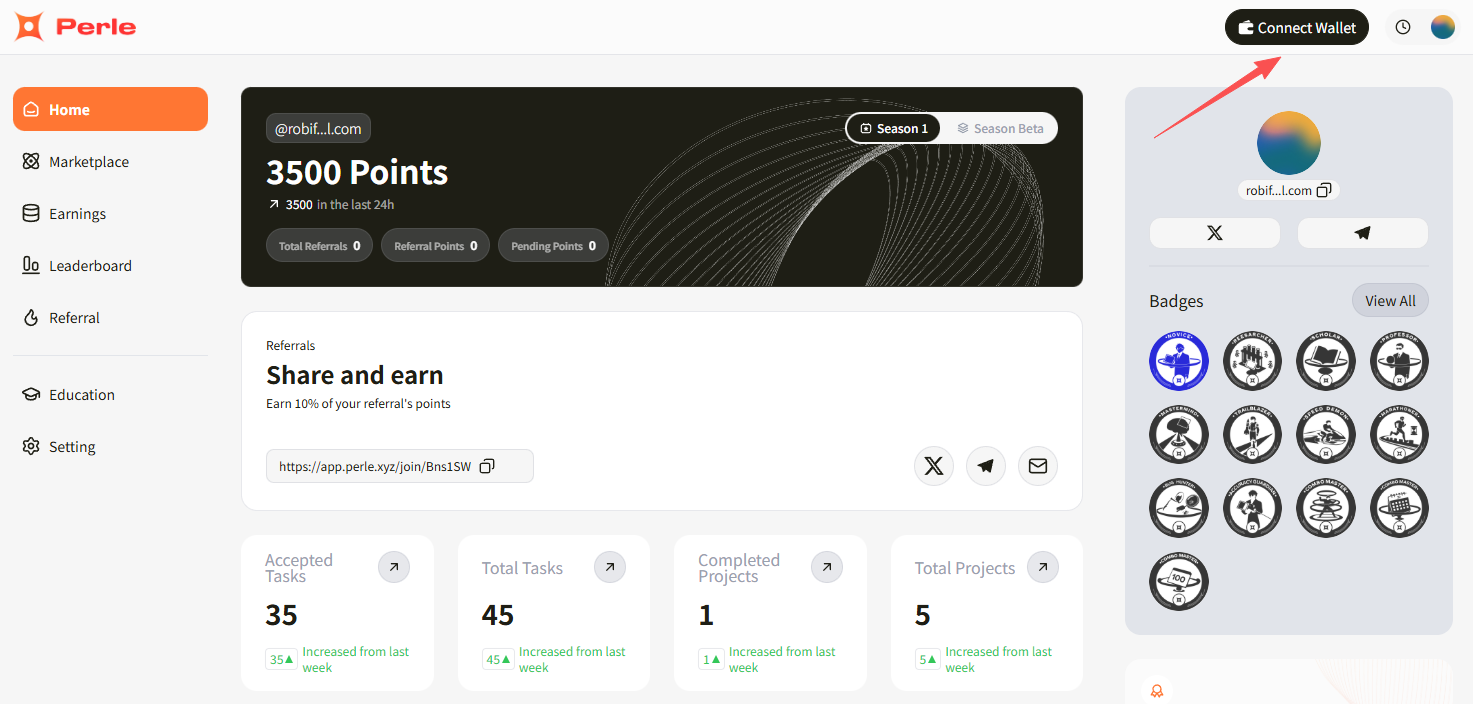
STEP 2. Click "Marketplace". There will be 5 tasks available to participate in.
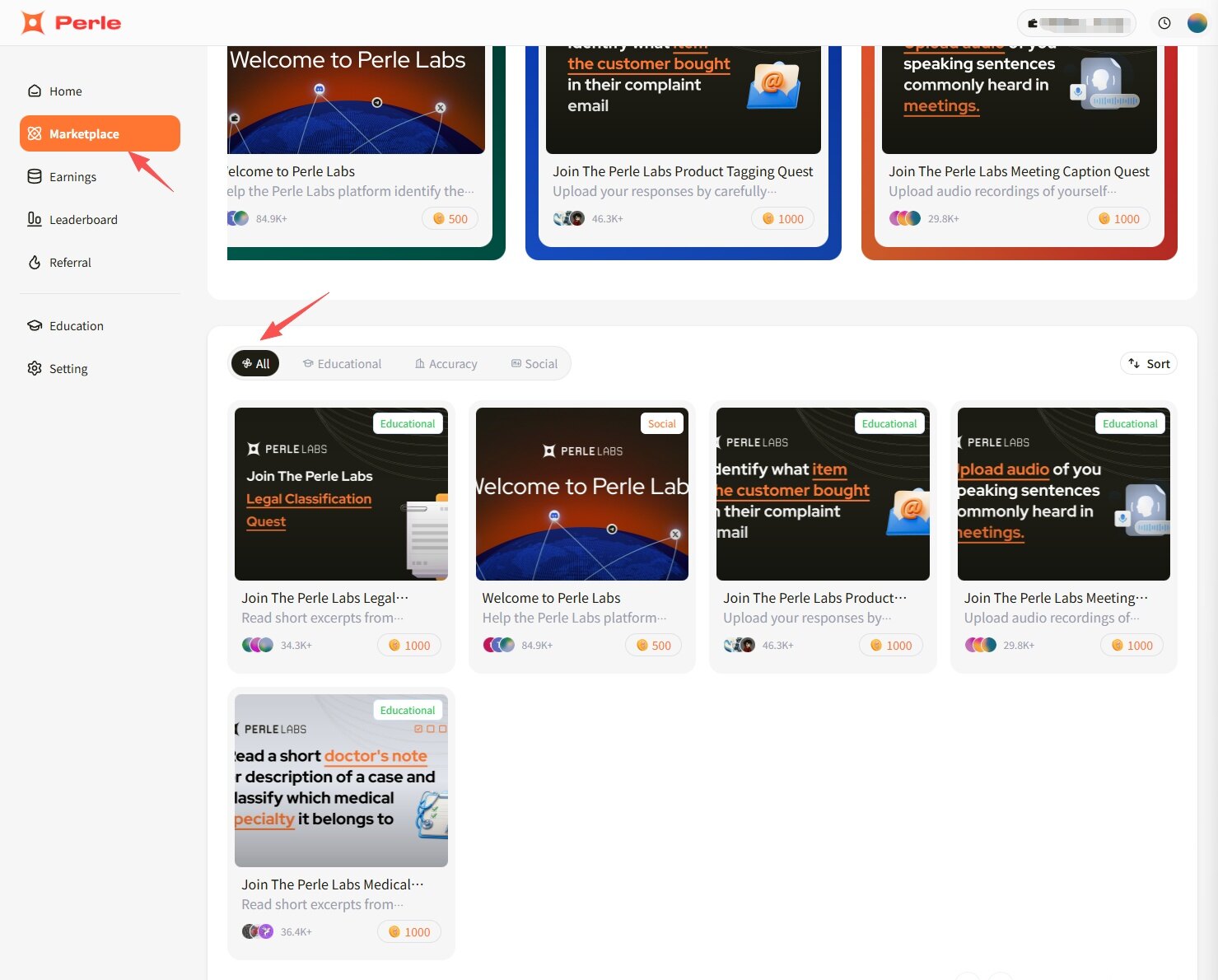
Except for the social binding task, for each other task, you need to fully watch the instructions to unlock it.

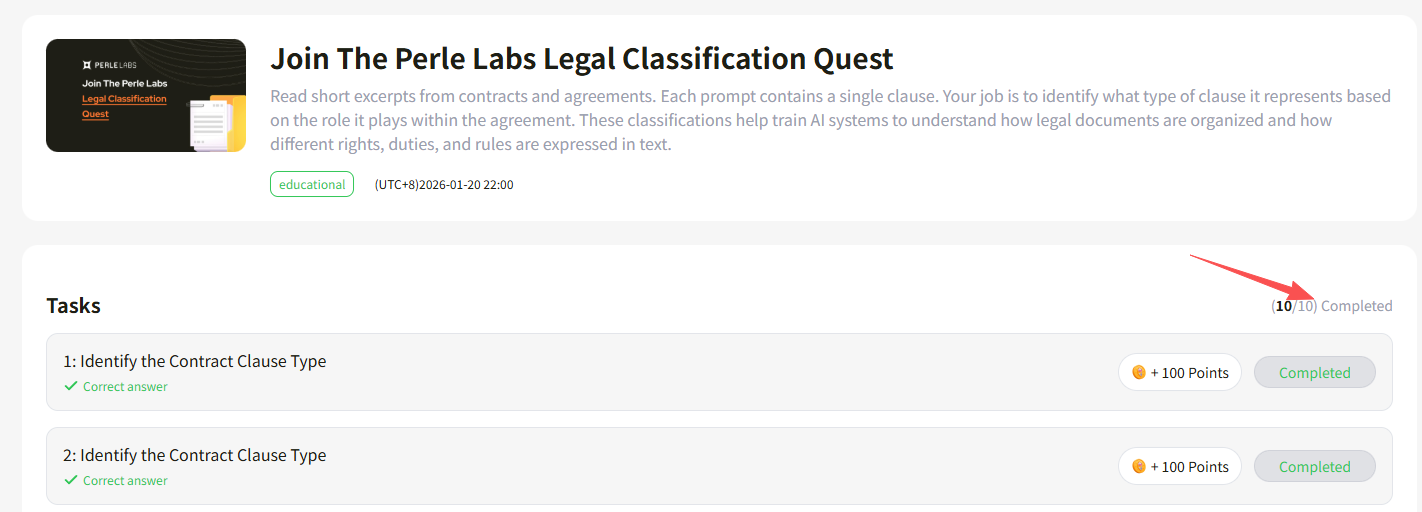
Task 1. Join The Perle Labs Legal Classification Quest: Read excerpts from legal contracts and select the corresponding clause (the questions are highly specialized; using AI tools for assistance is recommended). 10 questions, 100 points each, 1000 points total.
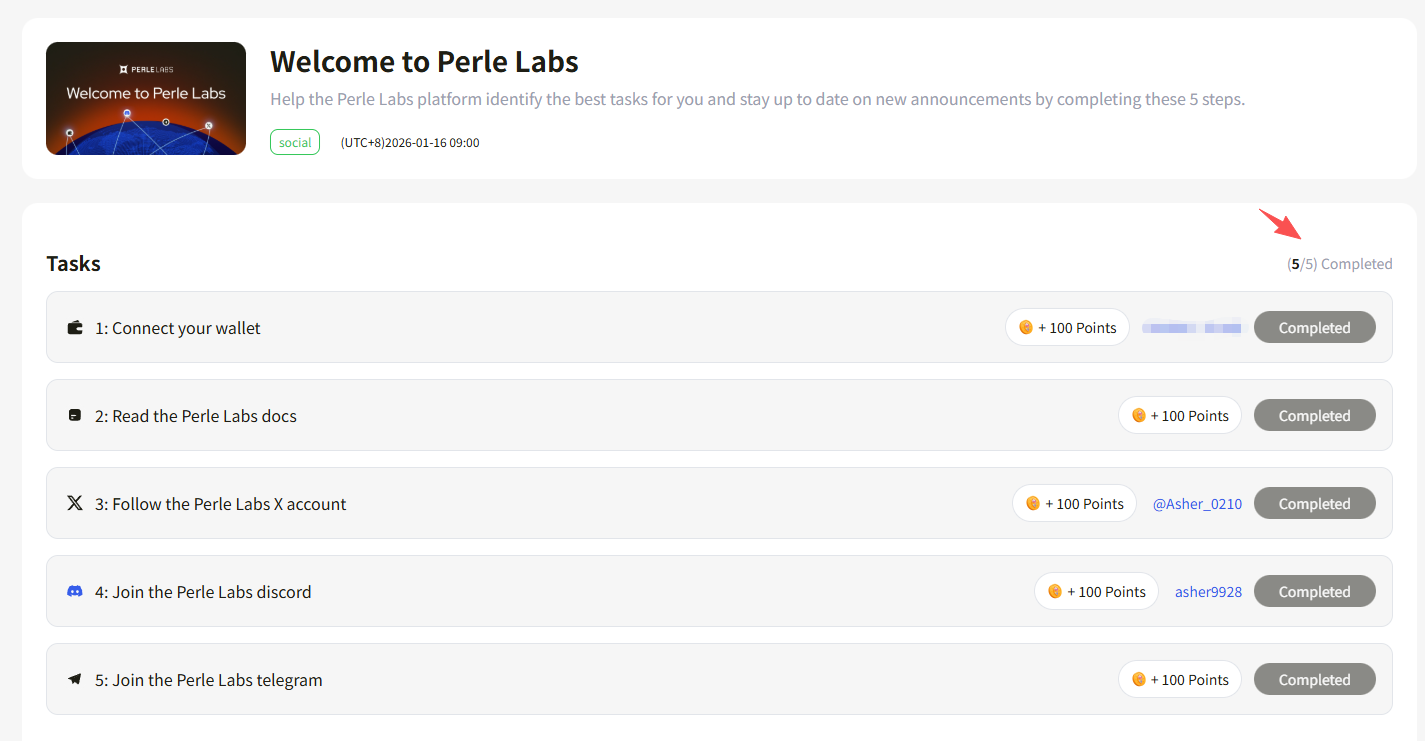
Task 2. Welcome to Perle Labs: Bind your personal X, Discord, Telegram, etc. 5 tasks total, 100 points each, 500 points total.
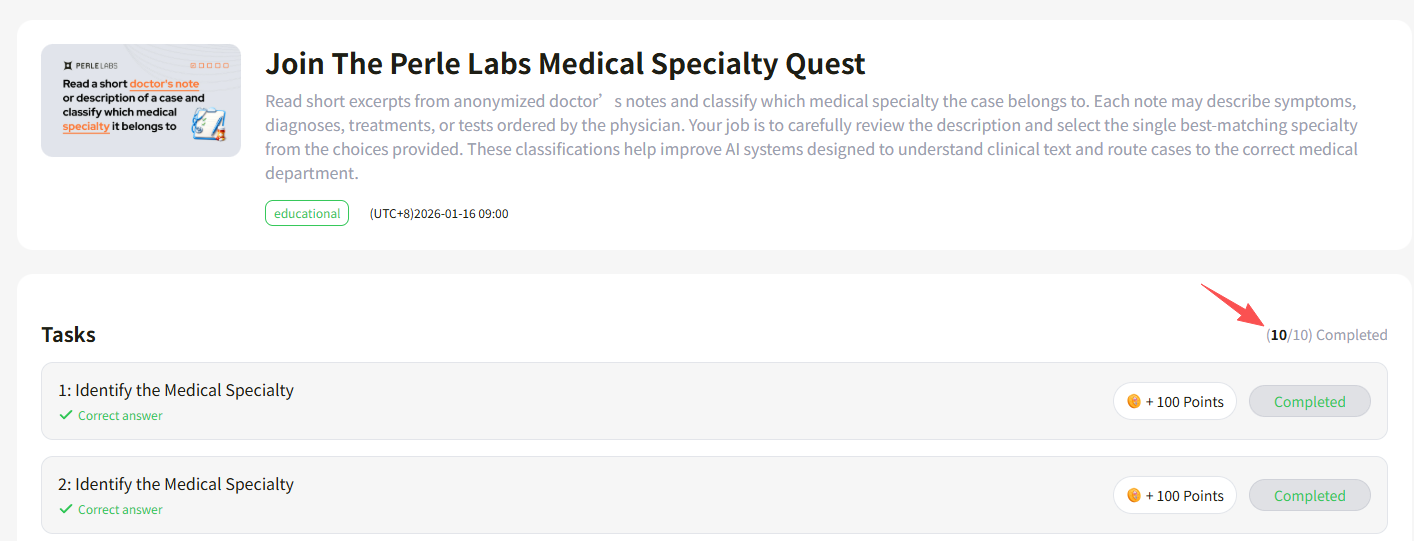
Task 3. Join The Perle Labs Product Tagging Quest: Find the mentioned product in complaint email messages. 10 questions, 100 points each, 1000 points total.
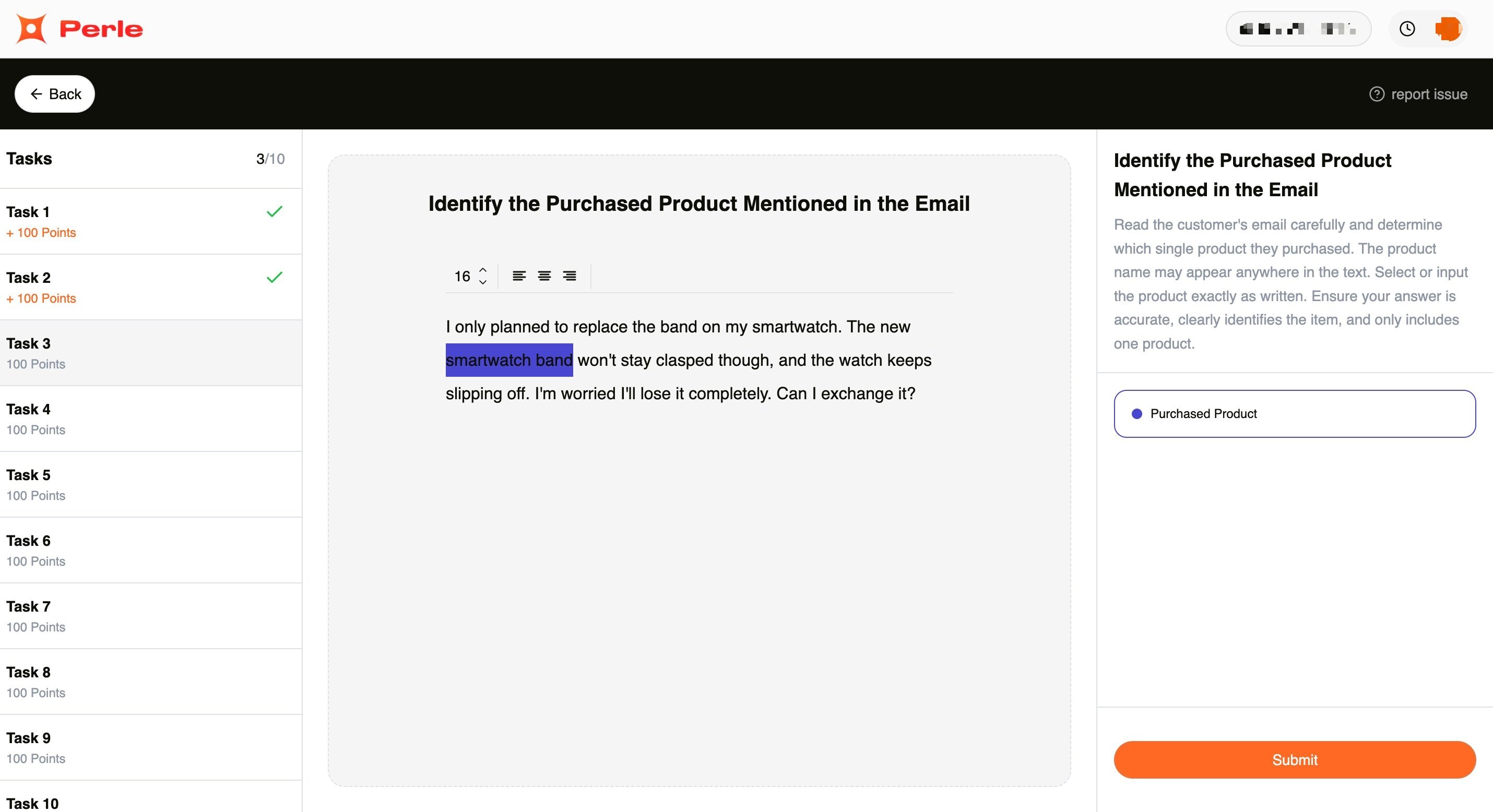
Task 4. Join The Perle Labs Meeting Caption Quest: Read sentences aloud (in English). 10 questions, 100 points each, 1000 points total. The audio part requires manual review and won't show as completed immediately; just submit the voice content on-chain.
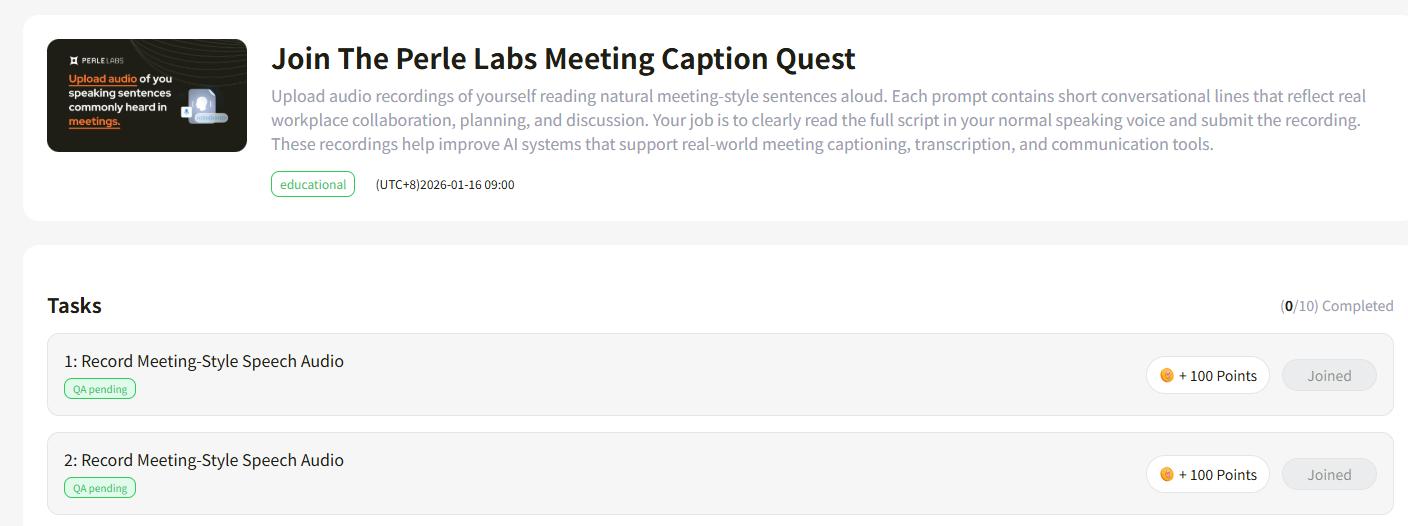
Task 5. Join The Perle Labs Medical Specialty Quest: Read the content of doctor's notes to determine the medical specialty of the case (the questions are highly specialized; using AI tools for assistance is recommended). 10 questions, 100 points each, 1000 points total.
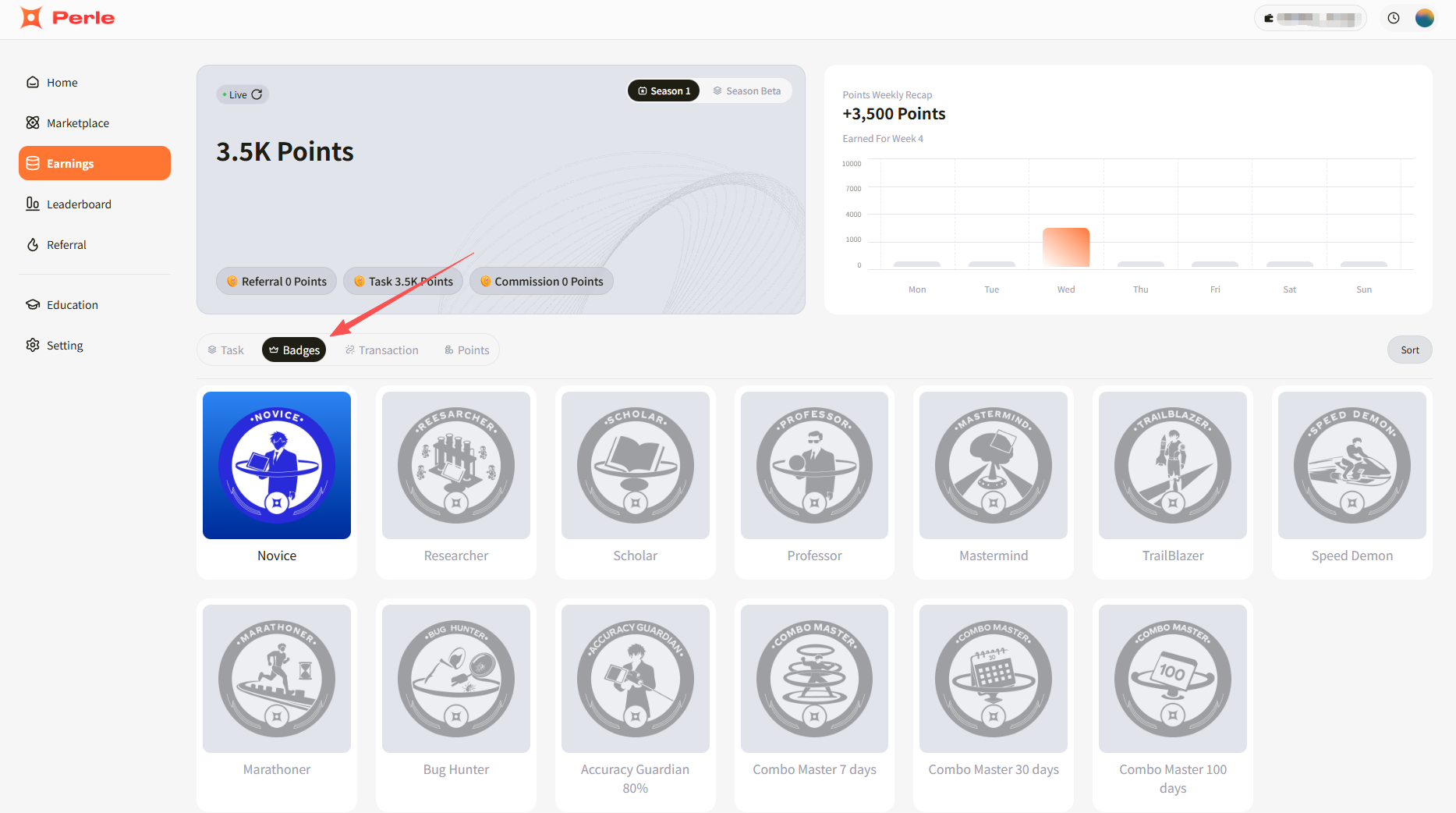
STEP 3. Click "Earnings" to view your points and badge acquisition status.
İlgili Sorular

QWhat is Perle Labs and what is its primary focus?

APerle Labs is a human expert-driven AI training data platform that focuses on providing high-quality datasets to support decentralized AI development.

QHow much total funding has Perle Labs raised according to the article?

APerle Labs has raised a total of $17.5 million in funding.

QWhat is the purpose of the Season 1 campaign launched by Perle Labs?

AThe purpose of the Season 1 campaign is for users to complete various tasks to earn points, potentially for future token airdrops.

QWhich blockchain does Perle Labs use to record data annotation steps?

APerle Labs records every step of expert data annotation on the Solana blockchain.

QWhat are the five main quests available in the Marketplace for users to earn points?

AThe five main quests are: 1. Legal Classification Quest, 2. Social Account Binding, 3. Product Tagging Quest, 4. Meeting Caption Quest, and 5. Medical Specialty Quest.

İlgili Okumalar

Global Stock Market's Storm Center: South Korea's Stock Market De-leveraging Is Largely Complete

Storm's Eye: South Korean Market De-leveraging Nears Completion The recent sharp correction in South Korean equities, with the KOSPI index dropping 32% from its June high, has been a key trigger for global tech stock volatility. The core driver was not a fundamental shift but a forced de-leveraging process within the market's unique structure, which is now largely complete. Two main leverage channels amplified the sell-off: 1. **Leveraged ETFs:** Their size, proportionally four times larger than in the U.S., peaked near $50 billion. Their mandatory daily rebalancing mechanism created a vicious cycle of "price drop → forced selling → further drop." Approximately 75% of this excess has been unwound, shrinking to $26 billion, with regulatory curbs now blocking new inflows. 2. **Hedge Fund Leverage:** Using swaps to magnify exposure, hedge funds saw their net long positioning fall by over 50% from peak levels. The most intense phase of this institutional de-leveraging is over. In contrast, **retail margin debt** poses minimal systemic risk. At 0.5% of market cap, it is far lower than in the U.S. or China, lacks automatic triggers, and is concentrated in smaller stocks. The conclusion: the high-leverage structures most prone to "chain-reaction selling" have been substantially cleared. The market is transitioning from a liquidity-driven crash to one priced more on fundamentals. The article argues that the AI trend—centered on Korean memory chips—remains intact. This episode represents a painful but necessary clearing of crowded trades, not the end of the AI revolution. For investors, the key question is conviction in the long-term AI direction; if the trend is real, current volatility is a cost of entry, not a terminal risk.

链捕手1 saat önce

Global Stock Market's Storm Center: South Korea's Stock Market De-leveraging Is Largely Complete

链捕手1 saat önce

The Eternal Fragments of Money: Third-Party Payment Has No First Principle

"The Enduring Fragments of Money: Third-Party Payments Lack a First Principle" Stripe is reportedly attempting to acquire PayPal, marking a significant shift reminiscent of PayPal's merger with the original X.com 30 years ago. The article analyzes Stripe's strategic challenges and the broader payments industry landscape. Despite its initial success with a developer-friendly API model, Stripe missed its optimal IPO window during the pandemic and has since seen its valuation decline. Its attempts to expand through acquisitions and new ventures, particularly in stablecoins (like its OUSD project) and Agent-focused payments (ACP/MPP protocols), have faced headwinds. The author argues that the payment industry remains highly fragmented and is ultimately an adjunct to the traditional banking system. This structure limits the potential for any single player, including Stripe, to achieve complete dominance. While stablecoins and the future rise of autonomous Agent economies present potential growth avenues, they are not yet mainstream and still require integration with the existing financial system. For now, Agent-based transactions are largely used for speculative "volume boosting" rather than substantive business applications. Stripe's current move to acquire PayPal is seen as an attempt to bolster its weak consumer-facing (C-side) business after its stablecoin-focused strategies faltered. Meanwhile, PayPal is described as structurally outdated, unable to revive itself through new products like Venmo or PYUSD. The future of payments may lie not in payments themselves but in value-added services like more efficient settlement networks. The author suggests that companies like Stripe and Circle, which are building their own blockchains (Tempo, Arc) and stablecoins, are positioning themselves to eventually profit from high-efficiency settlement systems. These new networks could potentially bypass some traditional banking layers. In conclusion, the article posits that third-party payment is a perpetually fragmented battlefield where scale alone cannot ensure victory. Players must find new models, focusing on efficiency to compete with the entrenched banking system. Stripe's acquisition of PayPal represents a bet on this uncertain future.

链捕手1 saat önce

The Eternal Fragments of Money: Third-Party Payment Has No First Principle

链捕手1 saat önce

İşlemler

Spot
活动图片