Illicit Crypto Flows Hit Record $158 Billion In 2025, TRM Says

bitcoinist2026-01-30 tarihinde yayınlandı2026-01-30 tarihinde güncellendi

Özet

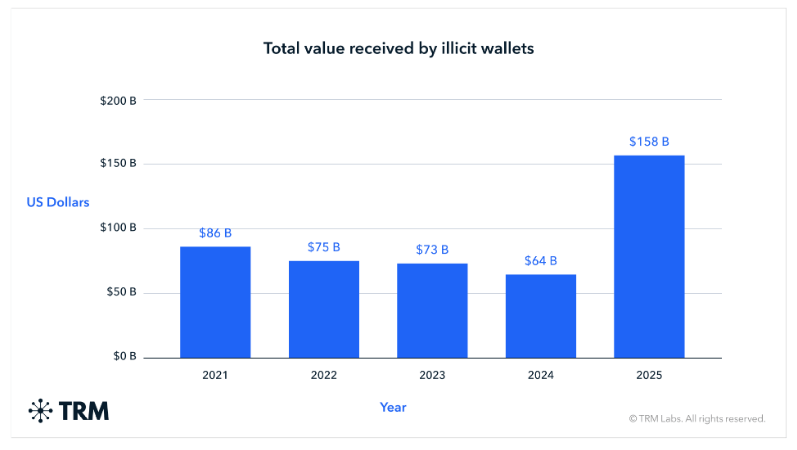
According to TRM Labs, illicit crypto flows reached a record $158 billion in 2025, driven by increasingly sophisticated scams using AI tools. Large language models, deepfakes, and voice cloning were employed to create believable messages and fake personas, helping fraudsters build trust before soliciting money through fake investments or false emergencies. These operations often function like small companies, using phishing kits and AI services to scale their efforts. While scam proceeds slightly decreased to $35 billion, the overall volume of criminal activity rose significantly. Despite improvements in scam-detection technology, the use of AI makes scams harder to identify and more convincing.

Scammers used new tools to widen their reach and to seem more real. According to TRM Labs, the use of large language models in scams jumped fivefold in 2025, helping fraudsters write believable messages, run many conversations at once, and trick people in different languages.

AI Tools Helping Con Artists Build Trust

Reports say AI images, voice cloning, and deepfakes are cutting the cost of making fake people who look and sound legit. These tricks have fed a pattern where criminals first make a target feel safe and then ask for money.

In some cases, a romance angle is used to win trust, and that trust is later turned into fake investment offers or bogus tax demands. This staged approach has let scams run longer and capture bigger sums from fewer victims.
A Rise In Industrial-Scale Fraud

Behind many of these schemes are groups that act like small companies. They hire people, sell tools, and reuse scripts to run campaigns in many places.

Some providers now sell phishing kits or offer AI-as-a-service to automate messages and replies, lowering the bar for new fraudsters and making scams easier to copy and spread.

Deepfake Calls And Targeted Hacks

Reports note that attackers have even used fake video calls to trick crypto workers into installing malware. In several incidents, victims were invited to what looked like normal Zoom meetings, only to find AI-generated faces on the screen.

When the meeting “needed a patch,” victims were urged to install what was actually malicious software. These methods have been linked to North Korea–connected groups and were flagged by security researchers last year.

BTCUSD now trading at $87,971. Chart: TradingView

Crypto Price Action Enters The Story

While the scams became more sophisticated, the market evolved too. Bitcoin was trading in the range of $88,000 to $90,000 in late January 2026 as investors considered macro news and policy developments.

This market context is important: as prices increase, the urgency and authenticity of crypto scams may seem more plausible, and the risks for both victims and law enforcement may be higher.

Scam Proceeds Compared To Illicit Flows Overall

Illicit inflows to crypto assets reached a record high of $158 billion, a substantial increase due to improved monitoring that brought more illicit activity to light.

Meanwhile, scam-related wallets saw a slight decrease in proceeds to around $35 billion in 2025, from $38 billion in the previous year.

However, the total volume of criminal activity increased substantially, even as the portion attributed to scams increased marginally.

It appears that scam-detecting technology is improving, but scams are evolving rapidly. The increasing use of AI-based tools makes generic advice less helpful, as the scams now sound more authentic.

Featured image from Unsplash, chart from TradingView

İlgili Sorular

QWhat was the total value of illicit crypto flows in 2025 according to TRM Labs?

AIllicit crypto flows reached a record high of $158 billion in 2025.

QHow did the use of large language models in scams change in 2025?

AThe use of large language models in scams jumped fivefold in 2025.

QWhat was the approximate trading range of Bitcoin in late January 2026?

ABitcoin was trading in the range of $88,000 to $90,000 in late January 2026.

QHow much did scam-related wallet proceeds amount to in 2025?

AScam-related wallets saw proceeds of around $35 billion in 2025, down from $38 billion the previous year.

QWhat are some specific AI tools mentioned that are being used by scammers to build trust?

AScammers are using AI images, voice cloning, and deepfakes to create fake people who look and sound legitimate to build trust.

İlgili Okumalar

Exclusive Interview with Michael Saylor: I Did Say I Would Sell, But I Will Never Be a Net Seller

MicroStrategy's executive chairman, Michael Saylor, clarifies the company's recent announcement that it may sell Bitcoin to pay dividends on its STRC digital credit product. He emphasizes this does not make MicroStrategy a net seller of Bitcoin. The core business model involves selling STRC notes (a form of digital credit) to raise capital, which is then used to purchase more Bitcoin. Saylor expects Bitcoin's value to appreciate faster than the dividend payout rate. Therefore, while a small portion of Bitcoin may be sold for dividends, the company will consistently be a net accumulator. For example, in April, the company raised $3.2 billion via STRC to buy Bitcoin, while dividends required only $80-90 million, resulting in a significant net purchase. Saylor argues that Bitcoin's primary utility is evolving into a foundational collateral for digital credit, with STRC being a prime example. He notes that STRC now constitutes a majority of the U.S. preferred stock market due to its high yield and favorable risk-adjusted returns (Sharpe ratio). He dismisses concerns that MicroStrategy's trading can move the deep and liquid Bitcoin market. Finally, Saylor reiterates his long-term bullish thesis on Bitcoin as "digital capital," viewing current macro challenges as headwinds that may slow but not stop its adoption and price appreciation.

Odaily星球日报4 dk önce

Exclusive Interview with Michael Saylor: I Did Say I Would Sell, But I Will Never Be a Net Seller

Odaily星球日报4 dk önce

Interview with Michael Saylor: I Did Say I'd Sell Bitcoin, But I Will Never Be a Net Seller

**Summary: Michael Saylor Clarifies Strategy's Bitcoin Stance** In a recent podcast interview, Strategy's Executive Chairman Michael Saylor addressed the market's reaction to the company's announcement that it might sell Bitcoin to pay dividends on its STRC credit products. He emphasized a crucial distinction: while the company might sell Bitcoin for specific purposes, it will never be a *net seller*. Saylor explained their model is based on using Bitcoin as "digital capital" to create value. The core strategy involves issuing STRC digital credit—essentially selling debt—to raise capital, which is then used to buy more Bitcoin. He estimates Bitcoin appreciates at roughly 40% annually. A small portion of these capital gains (e.g., ~2.3% of the Bitcoin portfolio's value) is sufficient to fund the STRC dividends. Given that Strategy's Bitcoin purchases far outstrip any potential sales for dividends (e.g., buying $3.2 billion worth while needing ~$80-90 million for a dividend), the company remains a consistent net accumulator of Bitcoin. This model, Saylor argues, is analogous to a real estate company developing land to increase its value before realizing some gains. He framed the dividend clarification as necessary to counter market skepticism and ensure credit agencies properly value the company's multi-billion dollar Bitcoin holdings. Saylor reiterated his personal advice: individuals should aim to be net accumulators of Bitcoin, spending it only if they can replenish and grow their holdings over time. Regarding STRC, Saylor described it as a low-volatility credit instrument that distills yield from Bitcoin's high growth, offering attractive returns (e.g., ~11-12% yield) for risk-averse investors. He noted that Strategy's STRC issuance now constitutes about 60% of the U.S. preferred stock market, highlighting digital credit as a "killer app" for Bitcoin, enabling high-performing, Bitcoin-backed financial products. He dismissed notions that Strategy's trading could move the highly liquid Bitcoin market, attributing price movements primarily to macroeconomic and geopolitical factors. Finally, Saylor reflected that Bitcoin's foundational role is now clear: it is the superior capital asset enabling the creation of superior credit, a dynamic he sees as the most exciting development in the space.

marsbit11 dk önce

Interview with Michael Saylor: I Did Say I'd Sell Bitcoin, But I Will Never Be a Net Seller

marsbit11 dk önce

380,000 Apps Exposed, 2,000+ Apps Leaked Secrets: AI Programming Turns 'Intranet' into Public Internet

Israeli cybersecurity firm RedAccess uncovered a severe data exposure trend linked to "vibe coding" or AI-powered software development tools. Their research found approximately 38,000 publicly accessible web applications built with platforms like Lovable, Base44, Netlify, and Replit. Of these, an estimated 2,000 apps exposed sensitive corporate and personal data, including medical records, financial information, internal strategic documents, and customer chat logs. In some cases, access even granted administrative privileges. The core issue stems from default privacy settings that make applications public by default, combined with a lack of built-in security controls (like authentication) in the AI-generated code. This allows employees without security expertise—"citizen developers"—to easily create and deploy applications that bypass standard corporate security reviews. The exposed apps, often indexed by search engines, are trivially discoverable. While some platform providers (Replit, Lovable, Wix/Base44) argue that security configuration is the user's responsibility and question the validity of some findings, security researchers confirm the widespread reality of such exposures. This pattern, also noted in prior studies, highlights a critical security gap as AI democratizes app creation, potentially leading to massive, unintentional data leaks.

marsbit1 saat önce

380,000 Apps Exposed, 2,000+ Apps Leaked Secrets: AI Programming Turns 'Intranet' into Public Internet

marsbit1 saat önce

Attracting Global Capital, Asia's New 'Super Cycle' Is Unfolding

Investors are turning to Asia as the next frontier for global equity growth, with a new "super cycle" unfolding across the region. Driven by the AI revolution, Asian markets, particularly South Korea, have seen significant rallies. According to Morgan Stanley analysis, the underlying drivers of Asia's industrial cycle are shifting from traditional sectors like real estate and manufacturing to massive investments in AI infrastructure, energy security and transition, and supply chain resilience. Fixed asset investment in Asia is projected to grow from around $11 trillion in 2025 to $16 trillion by 2030, with a 7% annual growth rate from 2026-2030. The AI wave is a primary catalyst, driving immense capital expenditure for chips, servers, data centers, and power systems. Asia is central to this hardware supply chain. In China, AI investment is focused on building a full-system domestic capability, with the local AI chip market potentially reaching $86 billion by 2030. Beyond AI, China's export story is expanding from EVs and batteries to robotics. The country already captures about half of new global industrial robot demand and over 90% of humanoid robot shipments. This growth phase mirrors the early stages of China's EV export boom. Simultaneously, energy security investments, spurred by AI's massive power needs, are rising, with China benefiting from its leadership in solar, batteries, and EVs. Regional defense spending is also increasing structurally, supporting demand for advanced manufacturing. The main beneficiaries are China, South Korea, and Japan, positioned in core supply chain areas. However, risks remain, including potential overcapacity, profit margin pressures from competition, persistent technological restrictions, geopolitical friction, and workforce displacement due to AI-driven automation. Market volatility is also expected to increase as investor expectations diverge on the realization of these capital investment and export themes.

marsbit1 saat önce

Attracting Global Capital, Asia's New 'Super Cycle' Is Unfolding

marsbit1 saat önce

İşlemler

Spot
Futures
活动图片





