How Difficult is Chip Making? A Division Error Costs 475 Million Dollars

marsbit2026-06-15 tarihinde yayınlandı2026-06-15 tarihinde güncellendi

Özet

How Hard Is It to Make a Chip? A Division Error Cost $475 Million Chip expert Shi Kan, a researcher at the Chinese Academy of Sciences and a popular tech creator, explains the immense challenges of chip development. Chips are foundational to modern technology, but their creation is extraordinarily difficult. The journey from sand to a functional chip involves complex design and manufacturing, but a critical bottleneck is verification—ensuring the design works flawlessly before costly production. A single, undetected bug can have catastrophic consequences, as illustrated by the infamous 1994 Intel Pentium FDIV bug. A flaw in the floating-point division unit forced a recall costing $475 million. Unlike software, chips cannot be easily patched after manufacture, making "first-time success" paramount. However, industry surveys show only 24% of chip projects achieve this; over three-quarters require at least one costly re-spin due to design flaws. Verification has thus become the dominant phase, consuming up to 70% of the design cycle. The core challenge is a "verification impossible triangle" between high performance, good debuggability, and low cost. Exhaustively verifying a modern CPU core could take 15,000 years with software simulation, or 30 years with advanced hardware emulation—timeframes utterly impractical for development. Despite being essential, verification is often seen as unglamorous "dirty work," receiving less academic attention than fields like AI. Shi and hi...

Hello everyone, I'm Shi Kan from the Institute of Computing Technology at the Chinese Academy of Sciences, a 'slash technology worker'. I have over a decade of experience in the chip industry, and currently, I conduct academic research related to chips at the Chinese Academy of Sciences; at the same time, I am also a science and technology Bilibili UP host 'Lao Shi Tan Xin', and my viewers call me 'Lao Shi'.

Chips: The Cornerstone of Modern Society

When it comes to chips, everyone surely knows their importance.
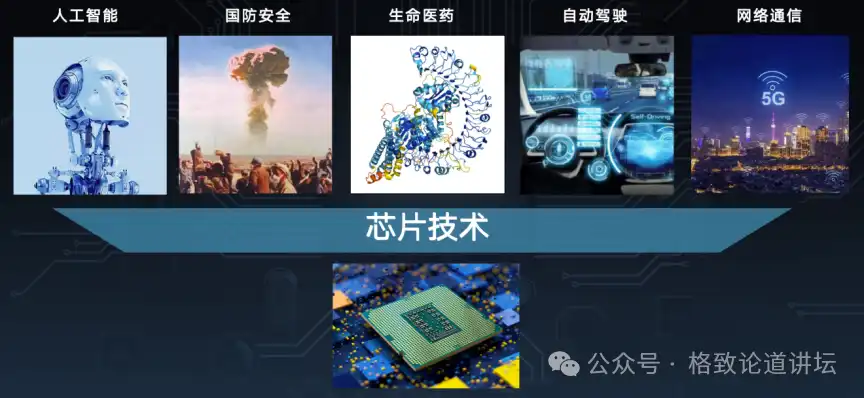
Whether it's the currently hot artificial intelligence, life sciences and medicine, autonomous driving, network communications, and so on, almost all the technologies of modern society you can imagine are inseparable from chips—this foundational technology of the information age.

I have been involved in chip work for a long time, and the chip development process is actually a very interesting one, mainly due to two aspects.

Firstly, the applications of chips are extremely wide-ranging. Once you enter this industry, you probably don't have to worry about unemployment because many industries require chip technology.

The second reason might be more important: chip development is a very difficult endeavor. As chip engineers, we need to constantly learn and enrich ourselves to face and embrace this era full of opportunities and challenges.

So the question arises: what exactly makes chip technology so difficult?

Why Are Chips So Difficult?

Completed: 10%//////////

Everyone might know that the manufacturing process of a chip is essentially an evolution journey of a grain of sand. Sand might be something inexhaustible and abundant on this planet; but turning low-value sand into high-value chips adds up to nothing but human intelligence.
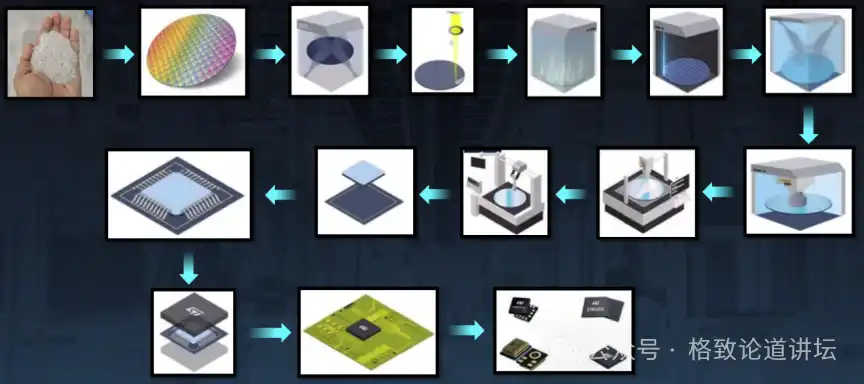
Starting from sand, we need to purify it to obtain wafers. Then, through a series of steps such as photolithography, ion implantation, etching, packaging, and so on, the abundant, inexhaustible sand is transformed into the final tiny chip.

So, having said all that, with so many steps, chip manufacturing is actually only part of the entire chip development process; it does not equal chip development itself.
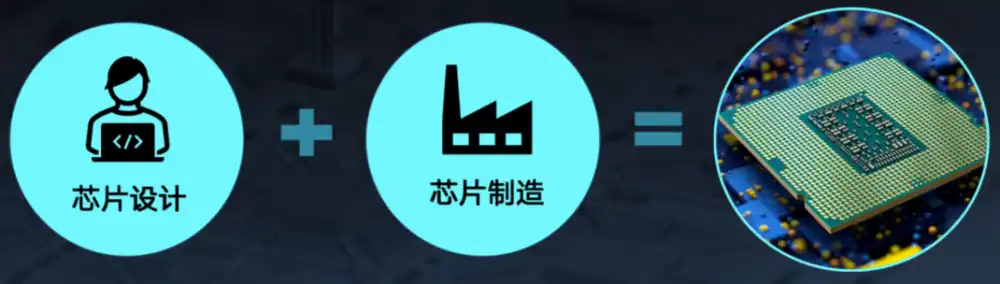
There is another crucial step, which is chip design. It refers to completing the circuit design according to requirements and making the circuit function properly. Then, we hand over the designed circuit to chip manufacturers for the later stages of manufacturing, ultimately obtaining the physical chip.

But there is another question here: how do you ensure that the chip's functionality matches your initial design?
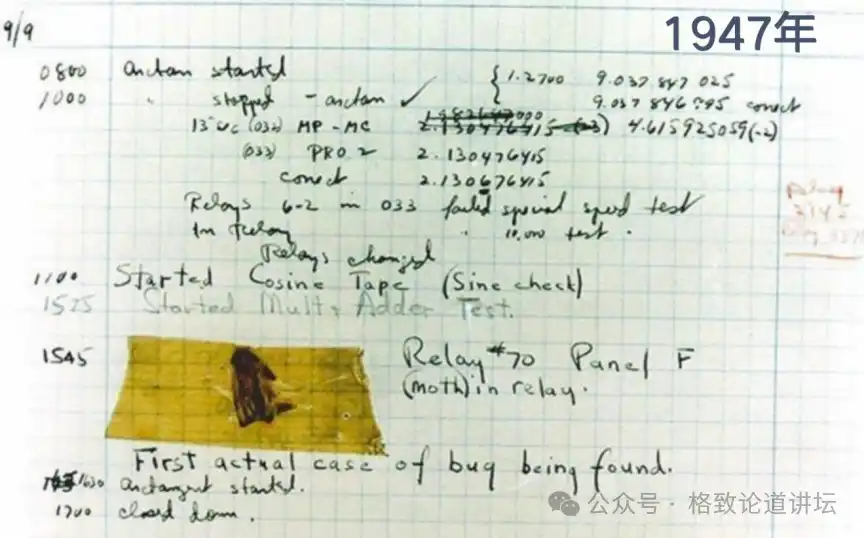
There is an interesting little story here. In 1947, a very famous female programmer named Grace Hopper found her computer wasn't working. After careful investigation and exploration, she discovered that a moth had flown into a relay of the computer. So, she carefully used tweezers to remove this moth and taped it onto a piece of paper.

This might be the first 'bug' discovered in the entire history of computer development, meaning a vulnerability.

If the previous example seems too distant, we actually have more examples. Here's a math problem for everyone: What is the final result of this expression? Actually, this problem is simple because the numerator and denominator in the later part are the same and can cancel out; then the numbers before and after the minus sign are also the same, so subtracting the same number should result in 0. However, in actual computers and chips, the result might not be this.
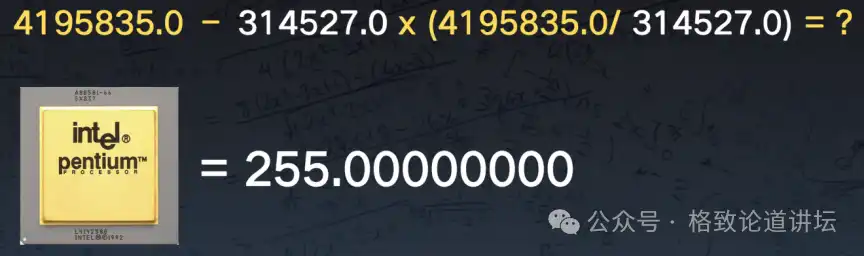
For example, in an Intel Pentium chip, the result was 255.00000000. What happened? It turned out that when an American scientist was conducting scientific research, he kept getting incorrect calculations when running this expression. Finally, he discovered that there was an undetected design flaw in a floating-point division unit of this chip.

Don't underestimate this design flaw; its consequences were actually very serious. In the 1990s, Intel spent $475 million to recall all problematic Pentium chips worldwide.

So, returning to the earlier question: what exactly makes chip technology so difficult?

In my view, the difficulty of chips lies in the need to succeed on the first try. Making chips is not like software, where you can patch and fix various problems later. In contrast, once a chip completes the evolution journey from sand to chip, you may have already spent tens of thousands, millions, or even hundreds of millions to complete the tape-out and manufacturing, making it very difficult to modify afterwards.

Then, the next question is: how many chip projects today can achieve success on the first try?

The 'Bottleneck' of Chip Verification

Completed: 40%//////////

According to survey data, only 24% of chip projects can achieve success on the first try. That is to say, 3/4 of chip projects, due to various major and minor undetected design flaws, require at least one more tape-out, which consumes a lot of time and money.
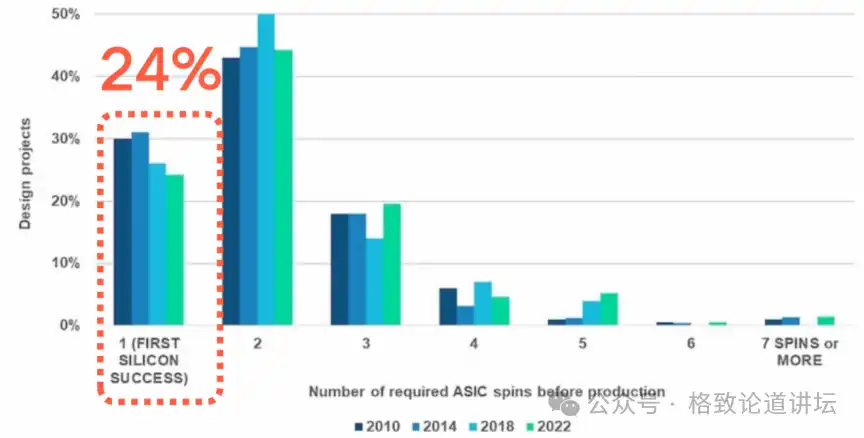
Therefore, the key question is: how can we ensure, as much as possible, that chips have as few or no bugs/design flaws as possible before tape-out and manufacturing? This is the direction I have been dedicated to researching over the past few years.
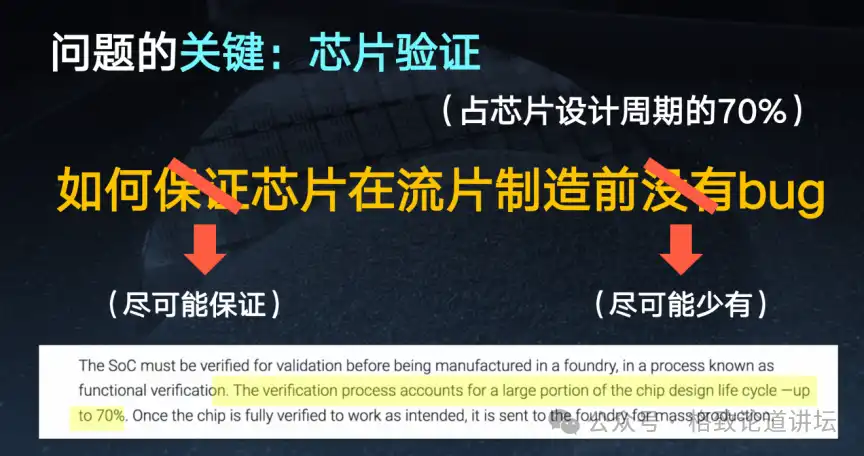
Also according to this research data, throughout the entire chip development process, especially with the current development of AI and various high-tech fields, chips are becoming increasingly complex. As a result, chip verification has become a very high proportion of the entire chip development cycle, even exceeding half, reaching 70% of the entire chip design cycle.

But unfortunately, chip verification is also a difficult task. I list some astronomical numbers here, such as the Earth's circumference, the possible number of stars in the Milky Way, or the length of a light-year.

In chip verification, there is also an astronomical number, which is the number of cycles needed to fully verify a CPU core. What exactly does this astronomical number represent?

If we use the most advanced software simulation technology available today to fully verify a CPU core, it would take at least 15,000 years. Using the most advanced hardware emulation technology can slightly reduce this time to 30 years. But we all know that developing a chip cannot wait 15,000 years, nor can it wait 30 years.
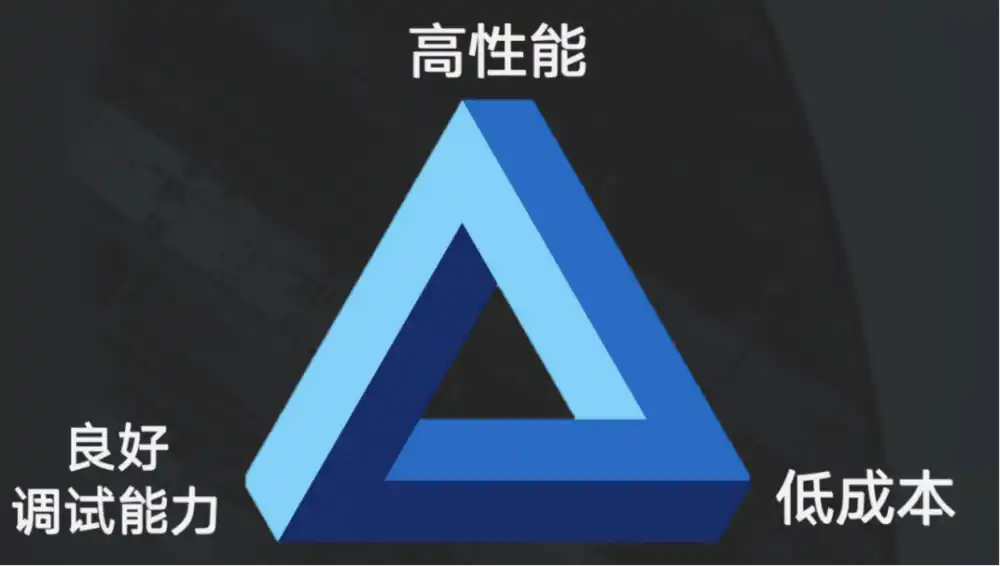
So, what is the essence of the problem? We have actually been researching this over the past few years. We found that in chip verification, there exists a so-called 'impossible triangle', namely the high performance of chip verification, good debugging capability, and low cost; these three factors crucial to chip verification cannot be satisfied simultaneously. For current mainstream research or methods, at most, two out of the three can be achieved, and this is the fundamental reason for the low efficiency of chip verification.

Someone Must Do Something Different

Completed: 60%//////////

Due to these reasons, chip verification has not seen significant development over the past period.

In chip companies, chip engineers may spend more time writing test cases and running regression verification. Essentially, it's dirty and tiring work. The same goes for academia; very few scholars are devoted to chip verification research, especially compared to current hot fields like artificial intelligence, research related to chip verification is very scarce.

So, an academic leader once told me that in the same amount of time, they could publish three or even more papers in the field of artificial intelligence, but in chip verification, they might not even publish one.

Unfortunately, what they said is true.

However, someone must do something different.

Therefore, over the past few years, I have led a team in conducting research related to chip verification and have built an agile verification research system from scratch. The core of this research system is a verification platform called ENCORE, which is based on a special chip—the Field-Programmable Gate Array (FPGA). ENCORE can significantly improve verification efficiency while achieving good verification debuggability.
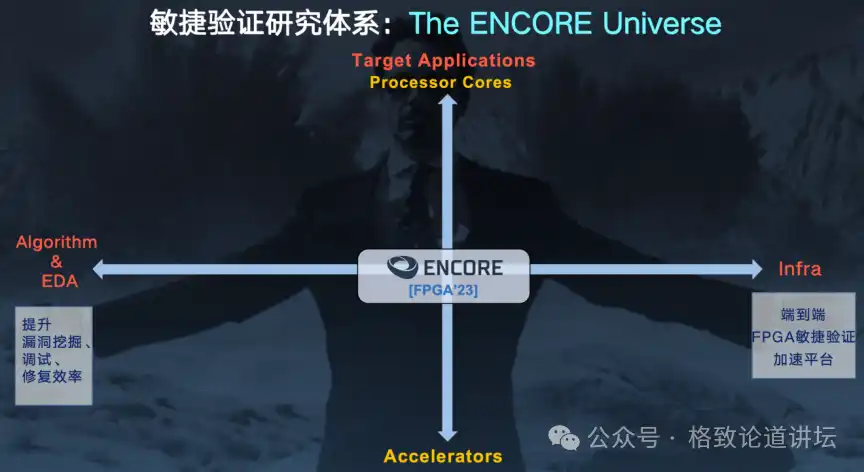
To build this agile verification research system, on one hand, we need to continuously optimize the efficiency of vulnerability mining, debugging, and repair at the algorithmic level; on the other hand, we also hope to build an end-to-end agile verification acceleration platform based on programmable logic chips (FPGAs). At the application level, we hope this platform can be suitable for both general-purpose processor verification, such as CPUs or GPUs, and specialized chip verification, such as the currently very popular AI accelerators.
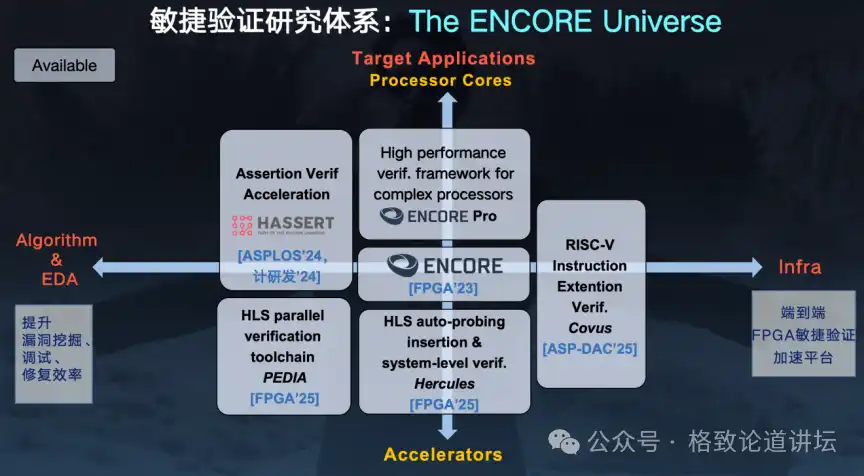
Over the past period, we have done a lot of cutting-edge exploratory work in this field, including the aforementioned ENCORE and many new research projects. We have also published these research results at many internationally renowned academic conferences.
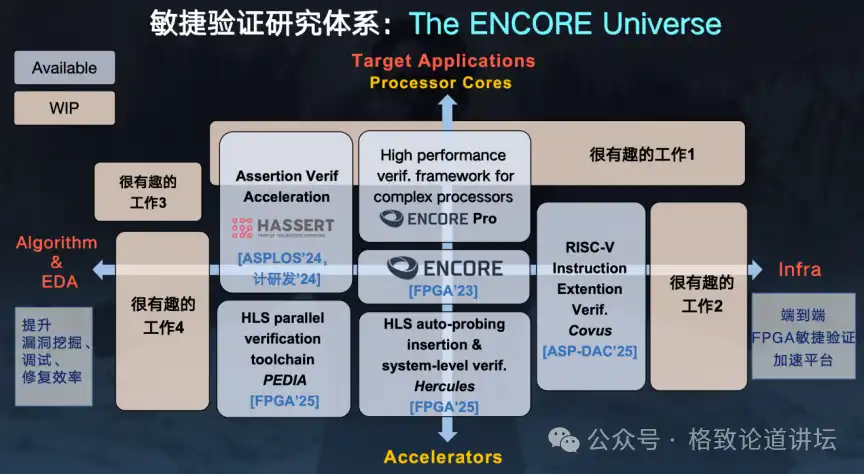
We are actually working on some interesting projects afterwards, but since these works have not been published yet, I won't show them to you one by one for now.

Letting More People Understand Chips

Completed: 80%//////////

However, during the research process, I gradually realized that these scientific or academic achievements are mainly for people within our small circle who only understand chip verification and related fields. So, how can we let more people see our work, understand our research, and even participate in our endeavors?

Naturally, I thought of chip science popularization, which also feels very interesting to me. I have been engaged in science popularization for four or five years, starting from text initially to later making videos on Bilibili. Chip science popularization has not only brought me many gains but also helped me meet many like-minded friends, as well as viewers who like and support me.
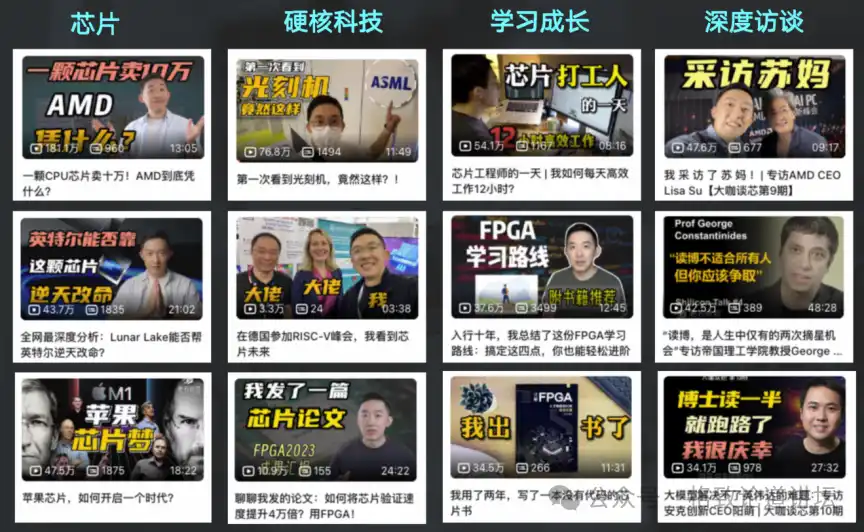
However, making chip science popularization videos is not a simple task, especially in today's era of short video proliferation. A fellow science popularization blogger and leader told me that in the same amount of time it takes me to produce one long, hardcore chip science popularization video, they could make 10 or even more short videos related to hot topics, and the traffic could be many times greater than mine.

Unfortunately, what they said is also true.

But based on this, I think there still needs to be people who persist in doing difficult things. I hope to combine chip science popularization and chip verification—two equally difficult but equally interesting things—and use video and text formats to show everyone what we have done, the papers we have published, and the open-source chip projects our entire large team is researching.

Besides chips, I will also share hardcore technologies like artificial intelligence and computers with everyone, as well as share my growth experiences, the books I have read, and the knowledge I have acquired. I know that I am not a genius myself, nor am I a so-called all-around expert or guru. I would rather be a 'guide' for everyone, sharing the path I have walked.

So, returning to the question I wanted to share with everyone today: chip research and chip science popularization, which one is more interesting? Of course, for me, both are equally interesting. The reason is simple: because they are equally difficult. At the same time, they both require me to persist very long-term and enduringly.

Many people say we need to do difficult and right things. But the problem actually is: how do you judge if something is right before you do it? If something is seen as sitting on a cold bench in others' eyes, or seen as doing dirty, tiring work, would you still persist in doing it?

Therefore, I prefer to do difficult and long-term things, such as academic research in chip verification, or making long hardcore chip science popularization videos. Because if something is difficult and requires long-term persistence, then it is probably right.

That's all I wanted to share with you today. I am Lao Shi, thank you, everyone!

This article comes from the WeChat public account: Gezhi Lundaotan , Author: Shi Kan, Original Title: 'How Difficult is Chip Making? A Division Error Costs 475 Million Dollars | Shi Kan'


Trend Kriptolar

İlgili Sorular

QWhat was the main point of the story about the Intel Pentium chip flaw mentioned in the article?

AThe story illustrated a critical design bug in the Pentium chip's floating-point division unit. A calculation that should have resulted in '0' instead produced '255.00000000'. This seemingly minor error forced Intel to spend $475 million on a global recall of the faulty chips in the 1990s, highlighting the high cost of failure in chip development.

QAccording to the article, why is chip development so difficult, especially compared to software development?

AChip development is exceptionally difficult because it requires 'first-time success'. Unlike software, which can be patched and updated after release, a physical chip cannot be easily modified once manufactured (or 'taped out'). The entire expensive process, from sand to finished silicon, costing potentially hundreds of millions, must be redone to fix design flaws.

QWhat percentage of chip projects achieve first-time success according to the survey data cited by the author?

AAccording to the survey data presented by the author, only 24% of chip projects achieve first-time success. This means approximately three-quarters (76%) of projects require at least one re-spin or re-fabrication due to various undetected design bugs, leading to significant extra time and cost.

QWhat is the 'impossible triangle' in chip verification, as explained in the article?

AIn chip verification, the 'impossible triangle' refers to the three crucial factors—high performance, good debuggability, and low cost. The article states that these three factors cannot be satisfied simultaneously with current mainstream methods. Engineers and researchers can only achieve a maximum of two out of these three, which fundamentally limits verification efficiency.

QWhat are the two 'hard but long-term' pursuits that the author, Shi Kan ('Lao Shi'), is committed to?

AThe author is committed to two challenging, long-term endeavors. First, he leads academic research in chip verification, specifically developing an agile verification framework called ENCORE based on FPGAs. Second, he creates hardcore, long-form chip and technology popular science content (like his Bilibili channel videos), aiming to make complex topics accessible to a wider audience beyond academic circles.

İlgili Okumalar

From Gold to Bitcoin: Fixed Supply + Institutional Frenzy, Might It Repeat the 'Explosive' Price Trend?

"From Gold to Bitcoin: Fixed Supply and Institutional Frenzy May Lead to 'Explosive' Price Rally Analysts suggest Bitcoin's price action could mirror gold's over the past two decades, following the launch of spot Bitcoin ETFs. Gold ETFs, introduced in 2004, drove gold's price surge to a current market cap near $28 trillion. Both gold and Bitcoin are non-yielding stores of value, with prices driven purely by investor sentiment rather than cash flows or credit. Gold ETFs experienced dramatic cycles: explosive growth, painful drawdowns, and slow recoveries, with each cycle reaching higher peaks. Bitcoin ETFs, approved in early 2024, saw rapid institutional adoption but are now facing similar volatility. Recent warnings highlight the risk of significant ETF outflows disrupting the current rebound. BlackRock's IBIT, a leading Bitcoin ETF, has sold nearly 100,000 BTC to meet redemptions while still holding over 733,000. The core parallel is fixed supply: when demand surges, prices explode, but demand is often volatile and wave-like, not steady. Institutional interest, through ETFs and corporate adoption, remains a key support pillar, helping to cushion sell-offs. If Bitcoin captures even a fraction of gold's role as a store of value, its upside potential is immense, though the path will be marked by high volatility. For investors, focusing on long-term trends and managing risk is crucial as this 'price explosion' narrative unfolds."

Foresight News4 dk önce

From Gold to Bitcoin: Fixed Supply + Institutional Frenzy, Might It Repeat the 'Explosive' Price Trend?

Foresight News4 dk önce

Why Is AI Agent Shopping Hard to Popularize?

The article argues that the popular narrative of "AI agent shopping" – equipping AI with a wallet to autonomously handle purchases – is fundamentally flawed and oversimplifies the complexity of shopping. It deconstructs shopping into two core actions: **information retrieval** (standardized, easily automated) and **value judgment** (deeply subjective and human-centric). The narrative mistakenly assumes AI can fully handle both. Value judgment itself has two layers: **evaluation** (assessing options against criteria) and **demand definition** (setting the criteria, weights, and values). The latter is inherently human and dynamic, as preferences are not fixed but constructed during the decision-making process ("constructive preferences"). The real dividing line for automation is not product standardization, but whether the **act of choosing** itself holds experiential value. For mundane purchases (e.g., printer paper), full AI delegation works. For experiential goods (e.g., wine, furniture), the joy of selection is core to consumption, so AI should act as an assistant that narrows options, leaving the final choice to humans. The "AI wallet" concept confuses three separate elements: decision-making, execution, and fund custody. Current payment industry solutions (e.g., from Stripe, Mastercard, Google, Visa) show that limited, scoped payment authorization tokens are sufficient for most consumer scenarios, not full fund custody. The true use case for autonomous AI wallets is in **B2B procurement** and **machine-to-machine (M2M) settlements** for standardized, high-frequency, low-value transactions. The real bottlenecks for AI shopping are not payment technology, but **1) the lack of trusted data sources** (e.g., fake reviews, counterfeit goods) and **2) the impossibility of automating human demand definition**. The conclusion is that the focus should be on safely automating the assessment and filtering process while reserving for humans the rights to define their criteria and enjoy the final act of choice. For experiential goods, the platform's competitive advantage shifts to providing a superior selection experience.

Foresight News1 saat önce

Why Is AI Agent Shopping Hard to Popularize?

Foresight News1 saat önce

After Nine Months of Shorting, a Full Turn to Long: Renowned Trader Opens Bitcoin Positions Around 64K, Crypto Market Long-Short Divergence Intensifies

After nine months of being short, prominent crypto trader Doctor Profit has closed all his bearish positions and started buying Bitcoin near $64,000, signaling a complete bullish reversal. He argues that structural market changes—such as impending U.S. regulation (CLARITY Act) and institutional adoption via securities tokenization—are rewriting the traditional four-year cycle script, potentially bringing the market bottom forward from the widely expected September/October timeframe. This view finds some technical support from on-chain analyst gumsays, who notes a bullish divergence on Bitcoin's weekly chart has persisted for 147 days, nearing the 161-day duration seen before the 2022 cycle low. However, cycle researcher Jake Pahor presents a counter-argument based on historical data. Analyzing patterns since 2014, he identifies three common features of past bear market bottoms: a ~12-month duration from peak to trough, a sustained period of extreme fear (with a proprietary risk score below 20), and the price falling below Bitcoin's realized price (~$53,000 currently). The current cycle, only nine months from its October 2025 peak, meets none of these conditions. The debate highlights a market torn between "front-running" a potential early bottom driven by new fundamentals and waiting for confirmation through traditional on-chain and sentiment metrics. While Doctor Profit opts for aggressive buying, Pahor maintains a disciplined, tiered accumulation strategy, continuing weekly buys at current risk levels but reserving larger orders for if more extreme fear emerges.

marsbit1 saat önce

After Nine Months of Shorting, a Full Turn to Long: Renowned Trader Opens Bitcoin Positions Around 64K, Crypto Market Long-Short Divergence Intensifies

marsbit1 saat önce

Senior Trader's Confession: How to Trade Market's False Expectations?

Veteran trader's case study: trading the market's "wrong expectations". This trade centered on a textbook "expectation error" after a weak CPI report. While the market initially priced in broad monetary easing (sending Nasdaq to 30,060), the crucial 30-year real yield hit a 20-year high. This signaled a fractured transmission mechanism: short-term rates eased, but long-term funding costs (vital for tech valuations) refused to fall. The trader executed five short positions on the Nasdaq (NQ) as it fell from 30,060 to 28,768. The core methodology: don't just trade the data, but analyze the market's implied causal chain and identify where it breaks. In this case, the chain was: Weak CPI → Policy Easing → Lower Long-Term Funding Costs → NQ Valuation Expansion. The break occurred between policy easing and long-term rates. The "veto variable" – long-term real yields – refused to confirm the bullish narrative. Trades were structured around "fast variables" (price) temporarily repairing while "slow variables" (funding conditions) remained broken. The article outlines a repeatable framework: 1) Map the market's implied causal chain. 2) Identify the veto variable. 3) Observe if it rejects the narrative. 4) Enter when price still follows the old script. 5) Choose the cleanest asset expression (e.g., short NQ, not broad S&P). 6) Define both invalidation and fulfillment exit conditions. The key insight: Alpha often comes not from an information edge, but from a "reaction function edge" – recognizing when the market is applying an outdated causal logic to new data. The critical question: What causal chain is the market's first reaction relying on, and is that chain still valid today?

marsbit1 saat önce

Senior Trader's Confession: How to Trade Market's False Expectations?

marsbit1 saat önce

İşlemler

Spot

Popüler Makaleler

CHIP Nasıl Satın Alınır

HTX.com’a hoş geldiniz! USD.AI (CHIP) satın alma işlemlerini basit ve kullanışlı bir hâle getirdik. Adım adım açıkladığımız rehberimizi takip ederek kripto yolculuğunuza başlayın. 1. Adım: HTX Hesabınızı OluşturunHTX'te ücretsiz bir hesap açmak için e-posta adresinizi veya telefon numaranızı kullanın. Sorunsuzca kaydolun ve tüm özelliklerin kilidini açın. Hesabımı Aç2. Adım: Kripto Satın Al Bölümüne Gidin ve Ödeme Yönteminizi SeçinKredi/Banka Kartı: Visa veya Mastercard'ınızı kullanarak anında USD.AI (CHIP) satın alın.Bakiye: Sorunsuz bir şekilde işlem yapmak için HTX hesap bakiyenizdeki fonları kullanın.Üçüncü Taraflar: Kullanımı kolaylaştırmak için Google Pay ve Apple Pay gibi popüler ödeme yöntemlerini ekledik.P2P: HTX'teki diğer kullanıcılarla doğrudan işlem yapın.Borsa Dışı (OTC): Yatırımcılar için kişiye özel hizmetler ve rekabetçi döviz kurları sunuyoruz.3. Adım: USD.AI (CHIP) Varlıklarınızı SaklayınUSD.AI (CHIP) satın aldıktan sonra HTX hesabınızda saklayın. Alternatif olarak, blok zinciri transferi yoluyla başka bir yere gönderebilir veya diğer kripto para birimlerini takas etmek için kullanabilirsiniz.4. Adım: USD.AI (CHIP) Varlıklarınızla İşlem YapınHTX'in spot piyasasında USD.AI (CHIP) ile kolayca işlemler yapın.Hesabınıza erişin, işlem çiftinizi seçin, işlemlerinizi gerçekleştirin ve gerçek zamanlı olarak izleyin. Hem yeni başlayanlar hem de deneyimli yatırımcılar için kullanıcı dostu bir deneyim sunuyoruz.

450 Toplam GörüntülenmeYayınlanma 2026.04.21Güncellenme 2026.06.02

CHIP Nasıl Satın Alınır

Tartışmalar

HTX Topluluğuna hoş geldiniz. Burada, en son platform gelişmeleri hakkında bilgi sahibi olabilir ve profesyonel piyasa görüşlerine erişebilirsiniz. Kullanıcıların CHIP (CHIP) fiyatı hakkındaki görüşleri aşağıda sunulmaktadır.

活动图片