Has the Crypto Talent Market Saturated with an 80% Plunge in Job Openings?

marsbit2026-01-19 tarihinde yayınlandı2026-01-19 tarihinde güncellendi

Özet

Has the crypto job market reached saturation? The data from early 2026 suggests a sharp slowdown. In the first two weeks of January 2026, only 85–90 new unique job postings were recorded across major crypto-focused job boards—an 80% drop compared to the same period in 2025, which saw around 38 postings per day. Despite the decline, certain trends stand out: 60% of roles are technical/engineering positions, while 40% are non-technical or business development roles. About 65% of openings are mid-to-senior level, indicating that companies are prioritizing experienced talent to lead core projects. Most roles require 5+ years of experience, with management positions demanding 7+ years. Hiring remains strongest among growth-stage companies that have completed Series A funding or beyond. Key areas attracting talent include infrastructure, stablecoins, and payment/fintech startups. Prediction markets like Kalshi and Polymarket are also actively competing for talent. A notable shift is the rising influence of the Solana ecosystem. For the first time since 2016, Solana attracted a larger share of new developers (22%) than Ethereum (16%) in 2024. With a 70% year-over-year increase in ecosystem funding in Q3 2025, Solana is challenging Ethereum’s long-standing dominance in developer and hiring markets. Looking ahead, the author suggests that the crypto job market will continue to evolve. Projects with strong fundamentals, real users, and sustainable revenue models are likely to succe...

Written by: willthetrill

Compiled by: Chopper, Foresight News

Has the recruitment market in the cryptocurrency industry become saturated? The answer is both yes and no. Although there were layoffs sporadically in December, overall, the momentum of hiring in the fourth quarter remained strong.

To uncover the truth, I specifically extracted data from major vertical recruitment websites in the crypto industry for the first two weeks of January 2026 (this data does not include official recruitment pages of companies). The results showed that only 85-90 new independent positions were added during this period.

This year's start has been quite quiet. In contrast, the data for January 2025 was quite impressive, with a total of 1,192 positions posted in that month alone, making it the highest month for recruitment in all of 2025.
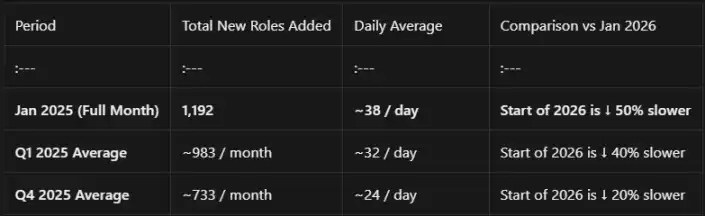
Data as of January 12, 2026

In the first two weeks of January 2025, the average daily number of positions posted was about 38; in the same period of 2026, the average daily number of positions posted was only about 6.5.

Recruitment activity in early January decreased by approximately 80% compared to the same period last year. This data confirms the widespread speculation: the industry's start this year is far less heated than last year.

Analyzing the details of the above job data, the main characteristics of the current recruitment market are as follows:

  • Distribution of job types: Technical/engineering positions account for 60%, while non-technical/business development positions account for 40%.
  • Distribution of job levels: Mid-to-senior positions such as specialists/senior specialists/supervisors/department heads account for about 65%. This signal indicates that companies are prioritizing the recruitment of experienced talent to lead key projects related to core product development and business growth.
  • Experience requirements: Most positions require candidates to have more than 5 years of relevant experience; management positions require more than 7 years of experience.

When conducting screening interviews with candidates, I often ask them: What currently attracts you to the crypto industry? The answers are invariably two: prediction markets and stablecoins. Therefore, it is no surprise that the data shows about 60% of recruitment demand is concentrated in infrastructure teams, stablecoin projects, and payment/fintech infrastructure startups. Additionally, the talent war between Kalshi and Polymarket continues, and this competition is expected to persist.

The most aggressive recruiters at the moment are those growth-stage enterprises (i.e., companies that have completed Series A funding or above). A quick glance at the recruitment pages of several companies and information on the Ashby platform can also confirm this conclusion.

  • Series A companies: Lifi Protocol has 13 open positions, Privy IO (acquired) has 10 open positions, Crossmint has 10 open positions, Coinflow Labs has 14 open positions;
  • Series B companies: TurnkeyHQ has 12 open positions;
  • Series C companies: Raincards has 49 open positions;
  • Series D companies: Anchorage has 66 open positions.

However, perhaps more intriguing is the change in talent flow.

Having worked full-time in crypto recruitment for 5 years, I can't help but reflect: "Has there ever been a public chain ecosystem, like Solana, that challenged Ethereum's dominance in the recruitment and developer growth arena?" The answer is: no, at least not on such a scale.

Looking back, other public chains like Polkadot and Cosmos have all experienced phases of rapid growth in developer numbers, but they have never been able to pose a challenge to Ethereum of the same magnitude in terms of market share and sustained recruitment scale.

Solana is the first ecosystem truly capable of competing with Ethereum. In 2024, it set a historic record: for the first time since 2016, the proportion of new contributing developers exceeded that of Ethereum. Solana attracted over 22% of the new developers in the crypto industry, while Ethereum's proportion was about 16%. This phenomenon is quite rare, especially considering that in the past, Ethereum almost monopolized the vast majority of new talent.
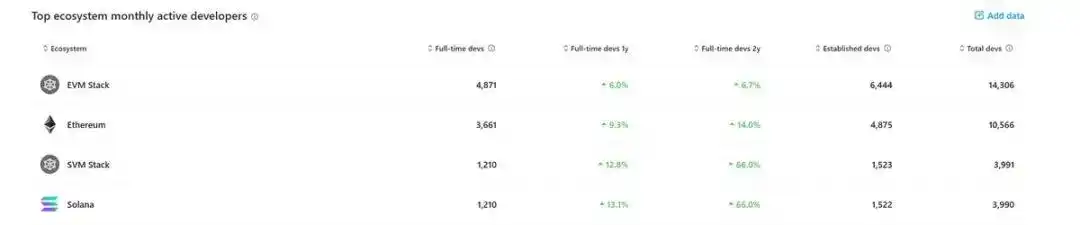
Data source: Electric Capital "Developer Report," as of January 14, 2026

In the third quarter of 2025 alone, 23 Solana ecosystem projects completed financing, raising a total of $211 million, representing a 70% year-on-year growth in ecosystem financing scale.

For example: When a project completes a $13.5 million financing round (such as Raikucom's financing in the third quarter of 2025), its first priority is to recruit 5-10 senior engineers to build the core engineering team and business development team. Such positions often do not appear on public recruitment websites but are instead filled through investor/angel investor networks, hackathon events, and targeted headhunting.

The crypto industry is constantly evolving, and the landscape of the recruitment market will change accordingly. Through token issuance, crypto technology has been able to drive the maximization of development in internet capital markets. However, the reality is that the vast majority of tokens issued in the past two years have seen their prices decline.

I believe that in 2026, the ripple effects of this phenomenon will gradually emerge, impacting companies' risk financing methods, market expansion strategies, and, of course, talent recruitment strategies.

The projects that will stand out this year will undoubtedly be those with solid business fundamentals, a real user base, solving actual needs, and most importantly, those capable of generating revenue.


İlgili Sorular

QAccording to the data, what was the percentage decline in daily job postings in the crypto industry in early January 2026 compared to the same period in 2025?

AThe daily job postings in early January 2026 declined by approximately 80% compared to the same period in 2025.

QWhat are the two main areas that candidates are most attracted to in the crypto industry, as mentioned in the article?

AThe two main areas that attract candidates are prediction markets and stablecoins.

QWhich blockchain ecosystem is highlighted as the first to seriously challenge Ethereum's dominance in terms of developer recruitment and growth?

AThe Solana ecosystem is highlighted as the first to seriously challenge Ethereum's dominance in developer recruitment and growth.

QWhat type of companies are currently the most aggressive in their hiring efforts within the crypto space?

AGrowth-stage companies (those that have completed Series A funding or later) are currently the most aggressive in their hiring efforts.

QWhat key characteristic is mentioned for projects that are expected to stand out in 2026?

AProjects that are expected to stand out in 2026 are those with solid business fundamentals, a real user base, solving actual needs, and, most importantly, the ability to generate revenue.

İlgili Okumalar

Understanding Hash in One Article: The "Browser Miner" on Ethereum

Hash is an Ethereum-based ERC-20 token described as a "browser-minable post-quantum token." Its key features include enabling browser-based GPU mining without specialized hardware, a fixed supply cap of 21 million tokens, immutable and permissionless smart contracts with no team allocation or pre-mining, and an emphasis on post-quantum security using Keccak256 hashing. The mining mechanism is a simplified on-chain proof-of-work where miners solve unique challenges tied to their wallet address. Key design elements prevent answer theft, with epochs resetting every 100 blocks (~20 minutes) and a per-block minting limit. Emission follows a Bitcoin-like halving schedule every 100,000 mints, starting at 100 tokens per mint. Projections suggest all tokens could be mined within approximately 294 days if a target rate of one mint per minute is sustained. Hash emphasizes "post-quantum" security by leveraging hash-based primitives like Keccak256, which are considered more resistant to quantum attacks compared to elliptic-curve cryptography. While not a fully post-quantum asset, it aligns with Ethereum's broader post-quantum research narrative. The project completed its Genesis sale at $0.03 and began trading on Uniswap, with its price reaching around $0.19. The initial circulating supply is small, with 5% sold in Genesis and 5% allocated to liquidity. The majority (47.6% of total supply) is allocated to early-stage mining, leading to a front-loaded emission schedule. This structure, combined with low initial liquidity, makes Hash a high-volatility, high-risk project dependent on sustained miner participation and market demand to absorb new supply.

marsbit6 dk önce

Understanding Hash in One Article: The "Browser Miner" on Ethereum

marsbit6 dk önce

OpenAI's Largest Internal Wealth Creation: 600 People Cash Out a Total of $6.6 Billion, 75 Take Home the Maximum $30 Million Each

A Wall Street Journal report reveals OpenAI's unprecedented pre-IPO wealth creation. In a single employee stock sale last October, over 600 current and former employees sold shares, collectively cashing out approximately $6.6 billion. Due to high investor demand, the company tripled the individual sale cap to $30 million, with about 75 employees selling the maximum amount. This event represents the largest such transaction in tech industry history for a private company. OpenAI's valuation was $500 billion for this tender offer. Employees with over two years of tenure were eligible, allowing many post-ChatGPT hires their first liquidity event. The company's stock has reportedly grown over 100-fold in seven years. Following a restructuring, employees collectively hold about 26% of OpenAI. The scale of executive wealth is also staggering. In court testimony related to Elon Musk's lawsuit, President and co-founder Greg Brockman confirmed his OpenAI stake is worth around $30 billion. Analysis indicates about 165 current and former employees hold a combined ~$164.9 billion in equity, averaging nearly $1 billion per person in paper wealth. OpenAI's per-employee stock-based compensation is estimated to be 34 times the average of major tech firms before their IPOs. OpenAI continues its rapid ascent, closing a $122 billion funding round at an $852 billion valuation in March. With monthly revenue hitting $2 billion, over 900 million weekly ChatGPT users, and plans for a potential trillion-dollar IPO in late 2026, this wealth-creation engine shows no signs of stopping.

链捕手28 dk önce

OpenAI's Largest Internal Wealth Creation: 600 People Cash Out a Total of $6.6 Billion, 75 Take Home the Maximum $30 Million Each

链捕手28 dk önce

İşlemler

Spot
Futures
活动图片