From Hyperliquid to Solana: How an ICO Promise of 'Chain Switching' Shakes Investor Trust?

比推2026-01-19 tarihinde yayınlandı2026-01-19 tarihinde güncellendi

Özet

In a controversial move, the digital collectibles platform Trove announced its sudden migration from Hyperliquid to Solana on January 19, citing a liquidity partner’s decision to liquidate a significant HYPE position. This shift contradicts earlier ICO promises that emphasized Hyperliquid integration and HYPE token backing, triggering backlash from investors who now demand refunds. The ICO, which initially raised over $11.5 million, faced scrutiny after the team briefly prolonged the fundraising period, causing speculative spikes on prediction market Polymarket. Investigations revealed that Trove had transferred $45,000 from its angel round directly into prediction markets, and allegations emerged that the team offered paid promotions to influencers. Community trust eroded further as Trove proceeded with token generation and distribution plans without addressing refund requests, despite the fundamental change in platform and tokenomics. The incident highlights risks in crypto investing, especially around anonymous teams, opaque fund management, and unilateral post-ICO changes.

Author: Sanqing, Foresight News

Original Title: Trove Raises Tens of Millions Then 'Switcheroo', Suspected of Misusing Funds and Manipulating Prediction Markets


On January 19, unwise, a team member of the digital collectibles contract platform Trove, tweeted that Trove would migrate to Solana. The member stated that this was because the liquidity partner supporting its Hyperliquid path chose to liquidate its 500,000 HYPE position. Subsequently, the HYPE purchase address disclosed on its ICO page began selling.
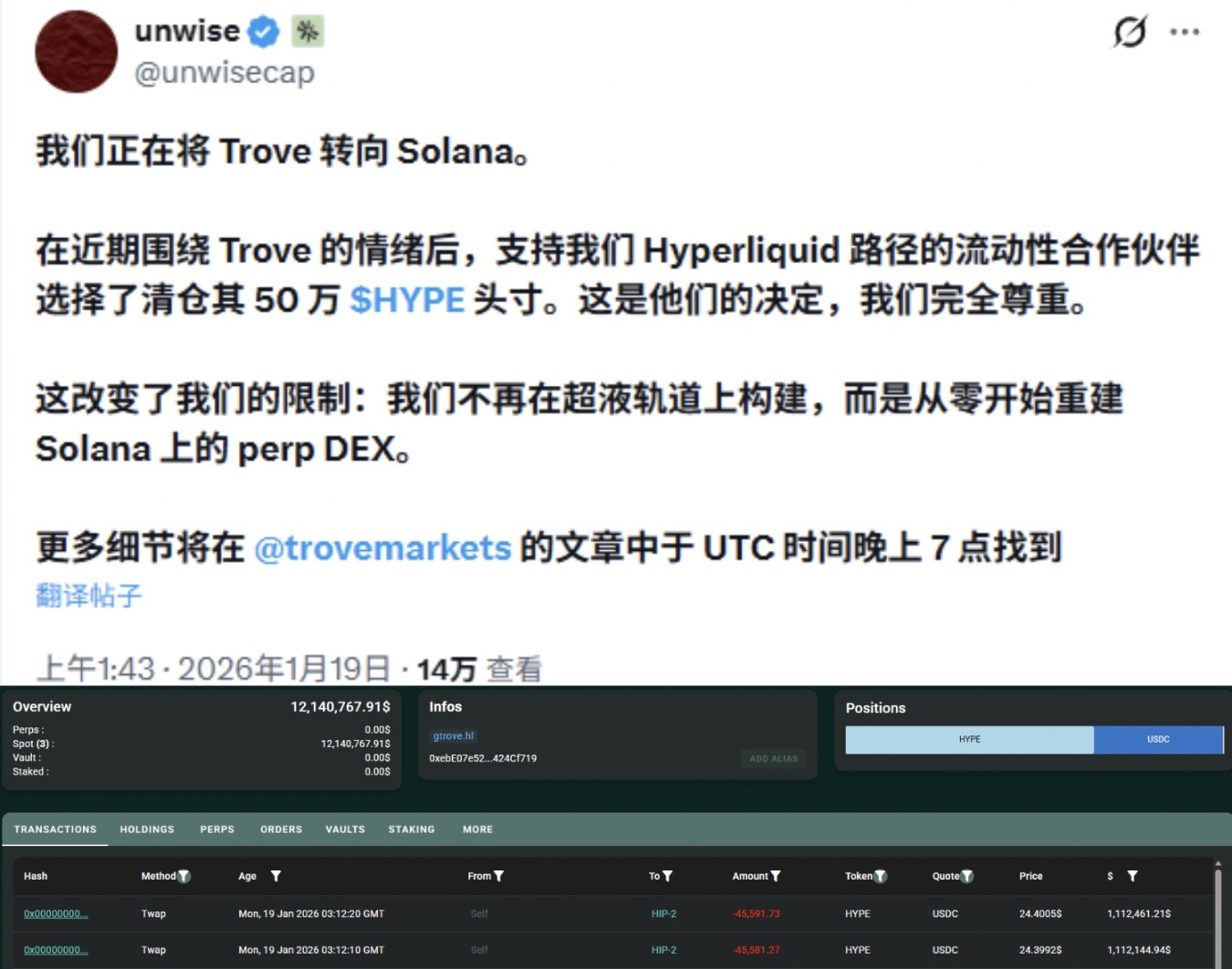
unwise's tweet (top), Trove-associated address HYPE transaction record (bottom) | Source: X (top, translated), HypurrScan (bottom)

Previously, Trove repeatedly mentioned that it had raised $20 million, would launch a token on Hyperliquid, and would build its digital collectibles contract platform based on HIP-3. Based on this public information, it completed an ICO with a $20 million FDV, selling 12.5% of the total supply.

ICO Flip-Flopping, Transferring Raised Funds to Prediction Markets

The Trove ICO was originally scheduled to start on January 9 at 1:00 and end on January 12 at 1:00.

On January 12, the project team announced it had raised over $11.5 million and extended the ICO by 5 days until January 16 at 1:00. 42 minutes later, they posted again revoking this decision and stated the ICO would end as originally scheduled.

Affected by this, the probabilities on Polymarket for the Trove ICO total raising over 15M, 20M, 25M, and 30M all sharply increased from near zero to 40% – 80% within a short time.

On January 17, on-chain detective ZachXBT tweeted that Trove had directly moved $45,000 from its Trove angel round financing into prediction markets on January 11. Trove team member unwise replied, attributing the operation to TJR (an English crypto KOL).
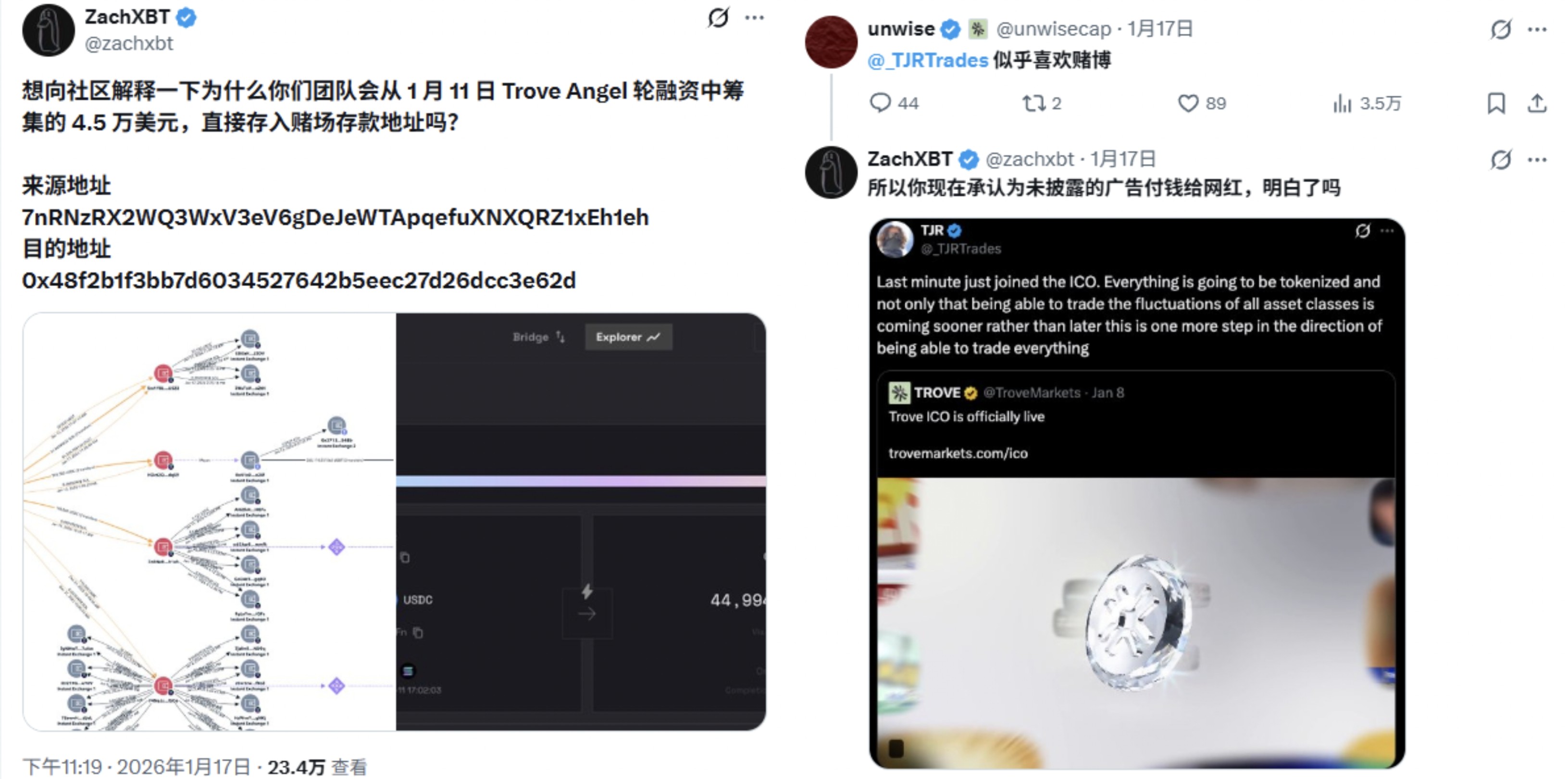
Source: ZachXBT and uniwise tweets (translated)

Furthermore, according to crypto KOL hrithik, they received multiple messages from the Trove team promising additional compensation for promoting their ICO bids and posts.
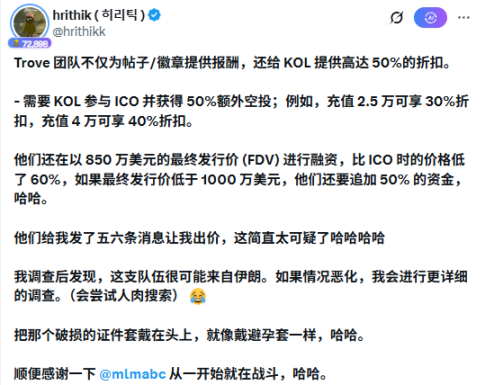
Source: hrithik tweet (translated)

Community feedback on the ICO changes and Polymarket activities included criticism that the extension decision increased uncertainty and damaged trust.

Source: xero tweet (translated)

Regarding Polymarket, users accused the team of manipulation and non-disclosure, turning a previously promising ICO into demands for refunds, with some calling it insider trading, leading to a shift in sentiment from excitement to caution.
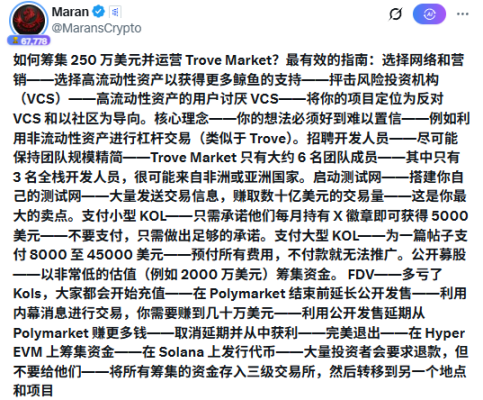
Source: Maran tweet (translated)

Violating ICO Public Information, Temporarily Migrating to Solana

Previously, Trove repeatedly stated on its official Twitter that it had purchased HYPE tokens, would build its digital collectibles contract platform based on HIP-3, and had launched a test website.

Source: TROVE tweet (translated)

During its ICO, it did not make any changes to this related information.
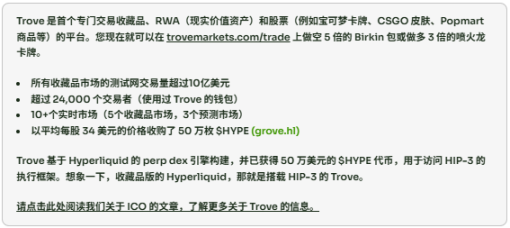
Trove related information | Source: Trove ICO page (translated)

The community strongly opposed the migration to Solana, viewing the shift as a deviation from the initial Hyperliquid promise. Some participants demanded full refunds, stating it no longer aligned with the investment logic.
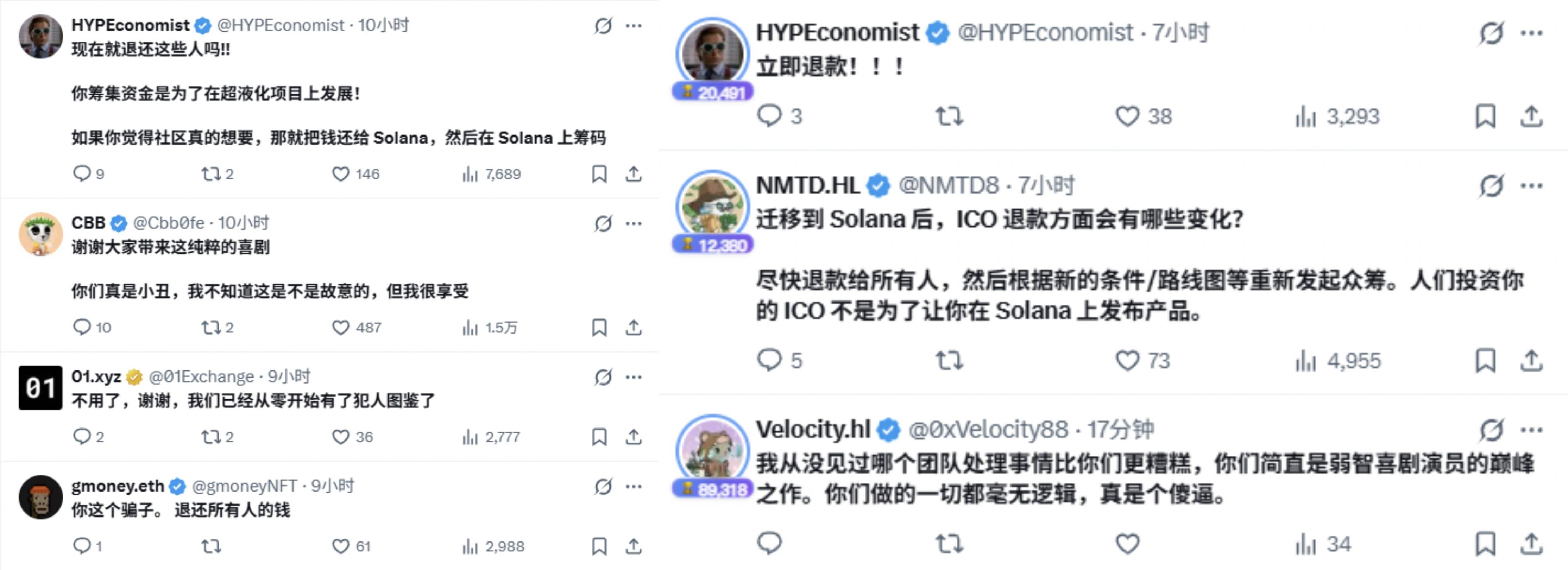
Source: unwise (left) and Trove official Twitter reply (right), translated
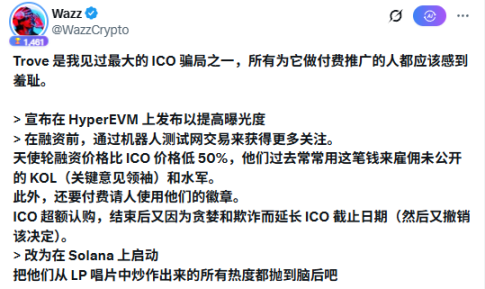
Source: Wazz tweet (translated)

As of now, Trove has not responded to related refund requests. It stated that TGE will occur on January 20 at 00:00, followed by ICO token distribution and oversubscription refunds.
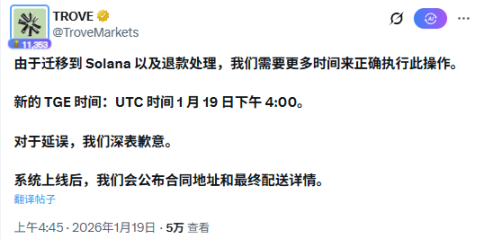
Source: Trove official Twitter (translated)

The Boundary Between ICO Promises and Investor Protection

The changes in Trove's actual execution have deviated from the core path, technical dependencies, and liquidity promises publicly during the ICO. These are major substantive changes, not mere technical optimizations or iterations.
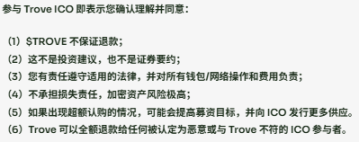
Source: Trove ICO page (translated)

This behavior of诱导 (inducing) first and switching later changes the essence of the investment target; the initial investment logic should be invalidated. Investors'诉求 (demands) for refunds to protect their rights should receive broad support.

The crypto investment environment is highly speculative and uncertain. Participants must carefully review project whitepapers, on-chain fund flows, team track records, etc., before deciding, and specifically evaluate the project team's communication transparency, timeliness, and compensation mechanisms for any major changes.

Investors need to be especially vigilant towards project parties with non-public team information, high anonymity, or those with delayed communication after changes.


Twitter:https://twitter.com/BitpushNewsCN

Bitpush TG Discussion Group:https://t.me/BitPushCommunity

Bitpush TG Subscription: https://t.me/bitpush

Original link:https://www.bitpush.news/articles/7604143

İlgili Sorular

QWhat was the main reason given by the Trove team for migrating from Hyperliquid to Solana?

AThe Trove team member unwise stated that the migration was due to their liquidity partner liquidating its 500,000 HYPE position, which was a key support for their Hyperliquid path.

QHow much funding did Trove claim to have raised during its ICO, and what percentage of the total token supply was sold?

ATrove claimed to have raised $20 million at a $200 million fully diluted valuation (FDV) and sold 12.5% of the total token supply in its ICO.

QWhat controversial action did Trove take regarding the ICO timeline, and how did it affect the Polymarket prediction market?

ATrove initially extended the ICO by 5 days on January 12 but reversed the decision 42 minutes later. This caused short-term spikes in probabilities on Polymarket for various fundraising milestones (15M, 20M, 25M, 30M) from near zero to 40-80%.

QWhat allegation did ZachXBT make about Trove's use of funds, and how did the team respond?

AZachXBT alleged that Trove transferred $45,000 from its angel funding round directly into a prediction market on January 11. The Trove team member unwise responded by attributing the action to TJR, an English crypto KOL.

QHow did the community react to Trove's decision to migrate to Solana, and what did many investors demand?

AThe community strongly opposed the migration, viewing it as a deviation from the initial Hyperliquid promise. Many investors demanded full refunds, arguing that the investment logic was no longer valid.

İlgili Okumalar

Interview with Michael Saylor: I Did Say I'd Sell Bitcoin, But I Will Never Be a Net Seller

**Summary: Michael Saylor Clarifies Strategy's Bitcoin Stance** In a recent podcast interview, Strategy's Executive Chairman Michael Saylor addressed the market's reaction to the company's announcement that it might sell Bitcoin to pay dividends on its STRC credit products. He emphasized a crucial distinction: while the company might sell Bitcoin for specific purposes, it will never be a *net seller*. Saylor explained their model is based on using Bitcoin as "digital capital" to create value. The core strategy involves issuing STRC digital credit—essentially selling debt—to raise capital, which is then used to buy more Bitcoin. He estimates Bitcoin appreciates at roughly 40% annually. A small portion of these capital gains (e.g., ~2.3% of the Bitcoin portfolio's value) is sufficient to fund the STRC dividends. Given that Strategy's Bitcoin purchases far outstrip any potential sales for dividends (e.g., buying $3.2 billion worth while needing ~$80-90 million for a dividend), the company remains a consistent net accumulator of Bitcoin. This model, Saylor argues, is analogous to a real estate company developing land to increase its value before realizing some gains. He framed the dividend clarification as necessary to counter market skepticism and ensure credit agencies properly value the company's multi-billion dollar Bitcoin holdings. Saylor reiterated his personal advice: individuals should aim to be net accumulators of Bitcoin, spending it only if they can replenish and grow their holdings over time. Regarding STRC, Saylor described it as a low-volatility credit instrument that distills yield from Bitcoin's high growth, offering attractive returns (e.g., ~11-12% yield) for risk-averse investors. He noted that Strategy's STRC issuance now constitutes about 60% of the U.S. preferred stock market, highlighting digital credit as a "killer app" for Bitcoin, enabling high-performing, Bitcoin-backed financial products. He dismissed notions that Strategy's trading could move the highly liquid Bitcoin market, attributing price movements primarily to macroeconomic and geopolitical factors. Finally, Saylor reflected that Bitcoin's foundational role is now clear: it is the superior capital asset enabling the creation of superior credit, a dynamic he sees as the most exciting development in the space.

marsbit4 dk önce

Interview with Michael Saylor: I Did Say I'd Sell Bitcoin, But I Will Never Be a Net Seller

marsbit4 dk önce

380,000 Apps Exposed, 2,000+ Apps Leaked Secrets: AI Programming Turns 'Intranet' into Public Internet

Israeli cybersecurity firm RedAccess uncovered a severe data exposure trend linked to "vibe coding" or AI-powered software development tools. Their research found approximately 38,000 publicly accessible web applications built with platforms like Lovable, Base44, Netlify, and Replit. Of these, an estimated 2,000 apps exposed sensitive corporate and personal data, including medical records, financial information, internal strategic documents, and customer chat logs. In some cases, access even granted administrative privileges. The core issue stems from default privacy settings that make applications public by default, combined with a lack of built-in security controls (like authentication) in the AI-generated code. This allows employees without security expertise—"citizen developers"—to easily create and deploy applications that bypass standard corporate security reviews. The exposed apps, often indexed by search engines, are trivially discoverable. While some platform providers (Replit, Lovable, Wix/Base44) argue that security configuration is the user's responsibility and question the validity of some findings, security researchers confirm the widespread reality of such exposures. This pattern, also noted in prior studies, highlights a critical security gap as AI democratizes app creation, potentially leading to massive, unintentional data leaks.

marsbit1 saat önce

380,000 Apps Exposed, 2,000+ Apps Leaked Secrets: AI Programming Turns 'Intranet' into Public Internet

marsbit1 saat önce

Attracting Global Capital, Asia's New 'Super Cycle' Is Unfolding

Investors are turning to Asia as the next frontier for global equity growth, with a new "super cycle" unfolding across the region. Driven by the AI revolution, Asian markets, particularly South Korea, have seen significant rallies. According to Morgan Stanley analysis, the underlying drivers of Asia's industrial cycle are shifting from traditional sectors like real estate and manufacturing to massive investments in AI infrastructure, energy security and transition, and supply chain resilience. Fixed asset investment in Asia is projected to grow from around $11 trillion in 2025 to $16 trillion by 2030, with a 7% annual growth rate from 2026-2030. The AI wave is a primary catalyst, driving immense capital expenditure for chips, servers, data centers, and power systems. Asia is central to this hardware supply chain. In China, AI investment is focused on building a full-system domestic capability, with the local AI chip market potentially reaching $86 billion by 2030. Beyond AI, China's export story is expanding from EVs and batteries to robotics. The country already captures about half of new global industrial robot demand and over 90% of humanoid robot shipments. This growth phase mirrors the early stages of China's EV export boom. Simultaneously, energy security investments, spurred by AI's massive power needs, are rising, with China benefiting from its leadership in solar, batteries, and EVs. Regional defense spending is also increasing structurally, supporting demand for advanced manufacturing. The main beneficiaries are China, South Korea, and Japan, positioned in core supply chain areas. However, risks remain, including potential overcapacity, profit margin pressures from competition, persistent technological restrictions, geopolitical friction, and workforce displacement due to AI-driven automation. Market volatility is also expected to increase as investor expectations diverge on the realization of these capital investment and export themes.

marsbit1 saat önce

Attracting Global Capital, Asia's New 'Super Cycle' Is Unfolding

marsbit1 saat önce

İşlemler

Spot
Futures
活动图片