From Ethereum to AI's 'CROPS': What Exactly Is This 'Slow Variable' That Vitalik Has Repeatedly Emphasized?

marsbit2026-06-06 tarihinde yayınlandı2026-06-06 tarihinde güncellendi

Özet

Recently, Vitalik Buterin has frequently emphasized the concept of "CROPS," first outlined in the Ethereum Foundation's March mandate as core principles guiding its focus: Censorship Resistance, Capture Resistance, Open Source, Privacy, and Security. CROPS represents Ethereum's commitment to providing foundational capabilities for user sovereignty—enabling asset ownership, identity expression, and coordination without reliance on centralized platforms or surrendering ultimate control. This framework is gaining new urgency with the rise of AI, particularly AI agents managing digital assets and automating transactions. While AI offers convenience, it risks centralizing user data, intent, and control if dependent on opaque, centralized services. Vitalik argues for "CROPS AI"—AI that is open, privacy-preserving, secure, and capable of local execution to maintain user agency. He highlights convergence between "CROPS Ethereum access layers" and "CROPS AI," such as using zero-knowledge proofs for private remote LLM calls and Ethereum RPC reads, ensuring users can access services without exposing sensitive information. Ultimately, CROPS is not just an abstract ideal but a practical guide for Ethereum's development and AI integration. It addresses the critical long-term question: as digital systems grow more powerful, how can users retain control over their privacy, assets, and autonomy? In an AI-driven era, these principles may define Ethereum's enduring value—prioritizing verifiab...

Over the past period, Vitalik has repeatedly mentioned a somewhat unfamiliar term: CROPS.

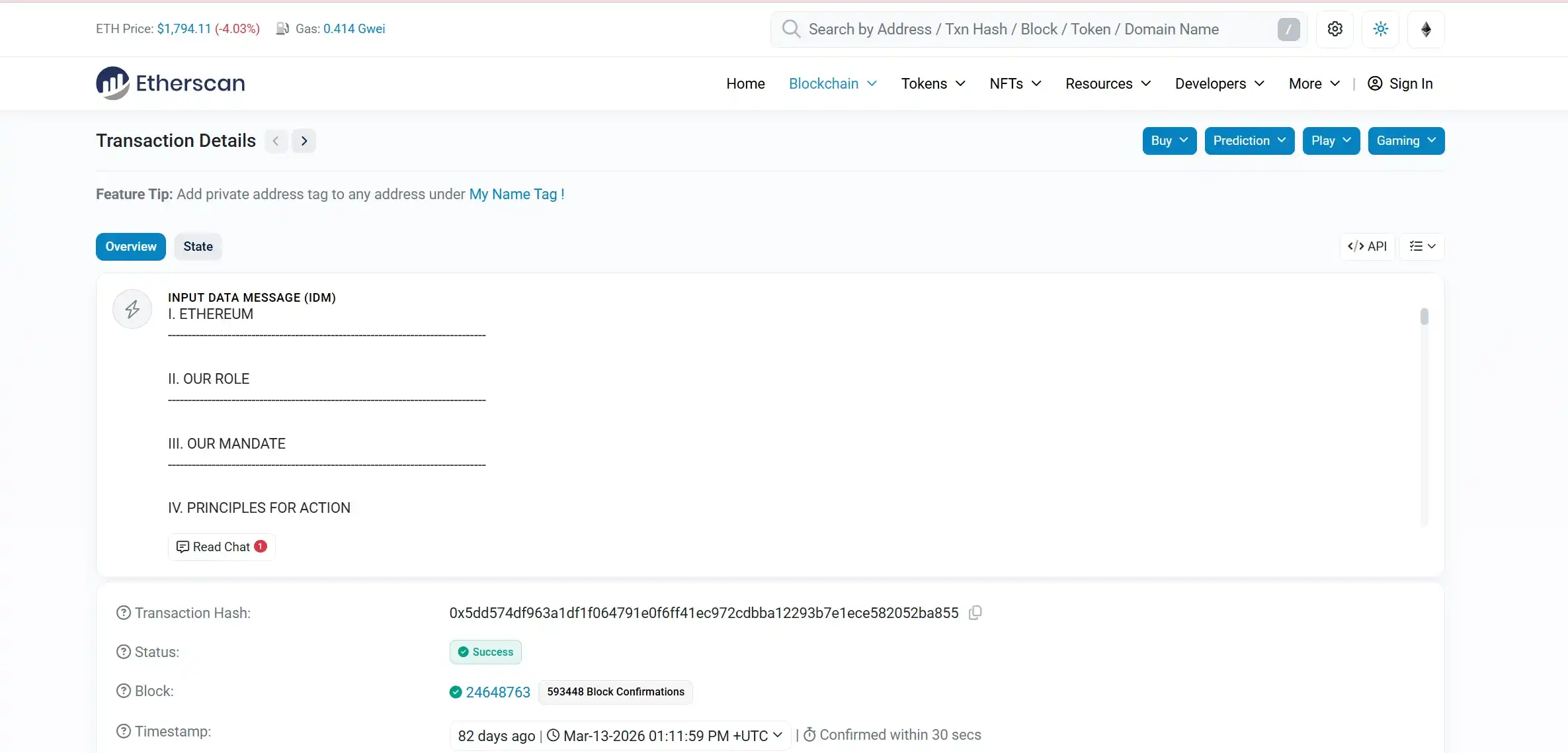
The systematic emergence of this concept can be traced back to March 13th. The Ethereum Foundation's Board of Directors released the 'EF Mandate' document, clearly stating that the primary focus will be on Ethereum's censorship resistance, open source, privacy, and security—namely, CROPS—and using this to serve user self-sovereignty while maintaining capture resistance and a more seamless user experience.

This statement is actually very important, especially as AI begins to enter wallet and automated execution scenarios, CROPS is no longer confined to Ethereum's value proposition but could become an issue of whether users can continue to control their digital lives in the AI era.
I. What Exactly is CROPS?

To understand CROPS, one must first break free from a common misconception: Ethereum certainly needs to improve performance and reduce costs, but it's not just competing with other blockchains to see who is faster or has lower fees.

While speed and cost are indeed the most intuitive factors for short-term user experience, if you zoom out and look at the longer term, Ethereum's stance has become increasingly clear over the past two years: what it truly aims to provide is a set of more fundamental capabilities: users can hold assets, express identity, sign transactions, and participate in coordination without relying on a single platform, without surrendering ultimate control, and without being arbitrarily blocked by a centralized service.

This is the significance of CROPS.

In the context of the EF Mandate, CROPS primarily points to five directions, which are also the acronym for their keywords: Censorship Resistance, Capture Resistance (this was actually added later by Vitalik), Open Source, Privacy, Security.

  • C - Censorship Resistance: Ensuring transactions and smart contracts are immutable and cannot be halted due to any external political or centralized entity pressure.
  • R - Capture Resistance: Preventing Ethereum's governance, development roadmap, and critical entry points from being controlled long-term by a minority of interested parties.
  • O - Open Source / Openness: Adhering to completely open-source code and maintaining absolute freedom of access for the ecosystem.
  • P - Privacy: Preserving users' right not to be scrutinized through cryptographic technologies on a transparent ledger.
  • S - Security: Upholding the bottom line, providing unbreakable ultimate settlement security.

Looking at these items together, they actually constitute a set of selection and guiding principles with a clear orientation, which is also very much in line with Ethereum's consistent value-driven path.

For example, at the protocol layer, it means Ethereum needs to continuously improve censorship resistance, client diversity, validator decentralization, formal verification, etc. At the application layer, wallets, RPCs, browsers, signature interfaces, and account systems also need to reduce dependence on centralized entry points. At the user experience layer, security cannot rely solely on users understanding complex transactions; it must be preemptively integrated through clearer signature displays, more verifiable interactions, and more comprehensive risk warnings before actions occur.

This is also why EF has recently advanced some more specific directions around security, privacy, protocol resilience, and ecosystem public goods, such as the Ethereum Audit Subsidy program, which attempts to lower the barrier for Ethereum ecosystem developers to obtain high-quality security audits. Viewed more broadly, this is not just about subsidizing costs, but about pushing 'security' further from a high-cost service affordable only to a few large projects towards more small and medium-sized developers.

In late May, Vitalik also reiterated his views on EF's future direction, emphasizing that EF should become a smaller, more distinct, and more focused organization dedicated to long-term sustainability, rather than trying to cover every need in the ecosystem. The reason is pragmatic: after all, EF does not possess infinite resources nor a continuous revenue stream from staking or transaction fees. Therefore, it should direct its limited resources towards tasks that are crucial for Ethereum to achieve CROPS values and that other entities find difficult to reliably undertake.

In other words, at this transformative historical stage Ethereum is currently in, CROPS is not an abstract slogan of 'principle over reality,' but rather more like an external definition and constraint on what EF should and should not do.

II. When CROPS Meets AI: The Convergence of Two Parallel Universes

Vitalik Buterin recently brought CROPS into a larger discussion by placing it in the context of AI.

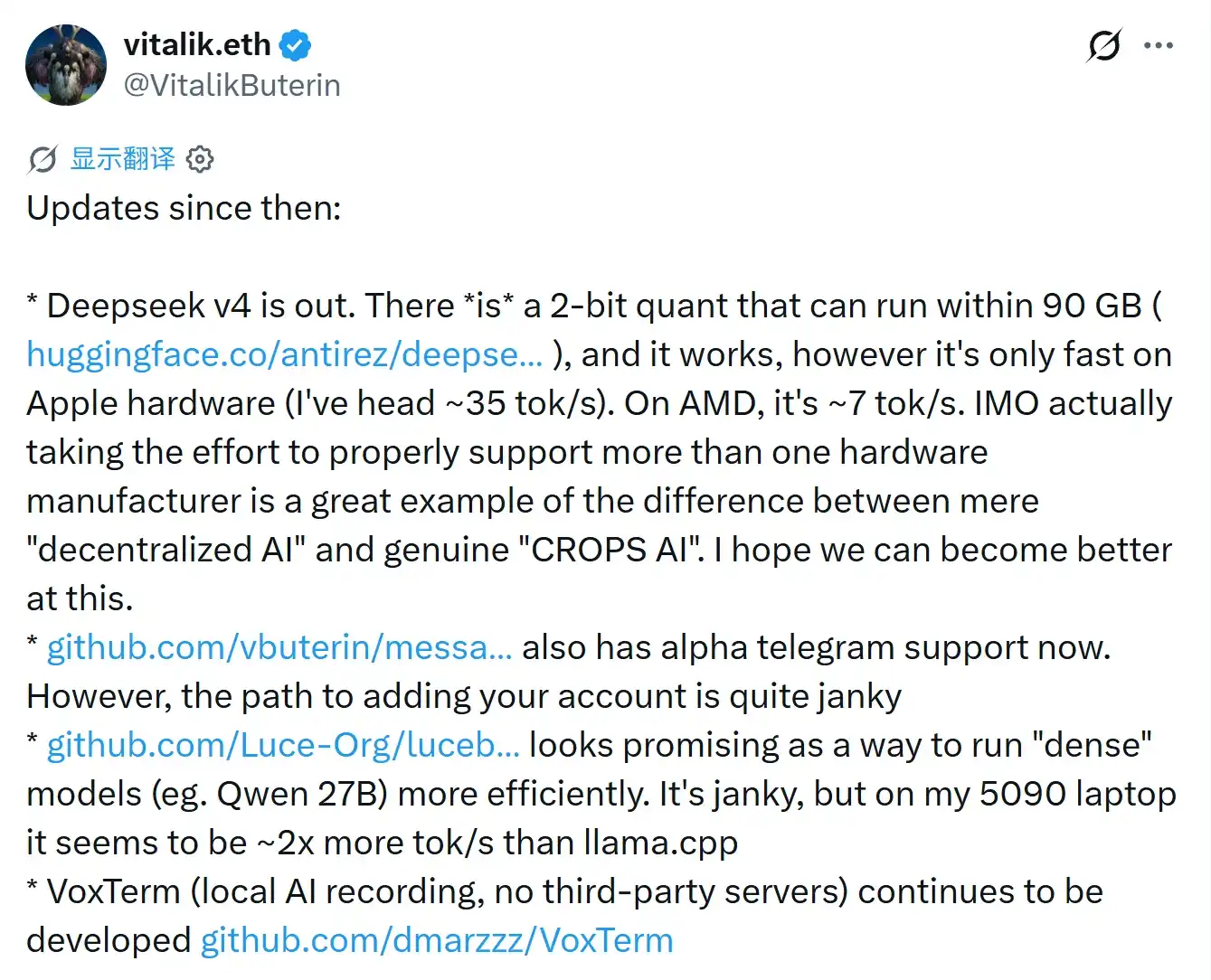
On May 28th, Vitalik Buterin posted an update on his progress with local AI, stating that DeepSeek V4 had released a 2-bit quantized version that could run within about 90 GB of VRAM, achieving speeds of around 35 tokens/second on Apple hardware and about 7 tokens/second on AMD hardware. He noted that a true 'CROPS AI' should support multiple hardware platforms, not just be 'decentralized AI.'

Simultaneously, he pointed out significant overlap between the CROPS Ethereum access layer and CROPS AI, for example, using zero-knowledge proofs for paid remote LLM calls and private Ethereum RPC reads. He suggested there should also be more AI models fine-tuned for Ethereum scenarios in the future, aimed at improving smart contracts, protocol code, and ecosystem security.

This essentially places Ethereum and AI within the same problem framework.
Previously, discussions about AI often focused on model capabilities—whether they can write code, and especially whether they can perform complex tasks as human substitutes. However, from a user safety perspective, the real change brought by AI is not just 'increased capability,' but that it is altering the entry points for digital operations.

To reiterate an old point: in the past, applications were relatively clear, separate interfaces. We opened wallets to transfer funds, opened DApps to trade, opened browsers to search, opened social products to post. Each application had relatively clear boundaries. But with the emergence of AI Agents, these boundaries are becoming increasingly blurred. Users no longer click functions one by one; instead, they express intent in natural language:

Help me find the optimal cross-chain route, help me make a swap, help me organize my assets, help me execute a certain DeFi strategy, help me generate and send a transaction...

This sounds convenient, but it also implies a more critical question: when AI becomes your digital agent, what transactions is it signing on your behalf, and what privacy is it exposing?

If AI runs entirely on centralized cloud services, users' asset information, transaction intent, address relationships, identity preferences, and operational habits could be concentrated in the hands of a few service providers. Especially when executing on-chain operations relying on opaque APIs, centralized RPCs, black-box plugins, and unverifiable inference processes, users might become more convenient but also less aware of what they are actually surrendering.

This is the question CROPS AI must answer.

A CROPS-compliant AI is not just about being capable; it should also be as censorship-resistant, open, privacy-preserving, and secure as possible. It should ideally run locally, or at least minimize reliance on centralized cloud services for sensitive scenarios, minimize information leakage, and allow users to understand, confirm, and retain ultimate control.

In other words, AI cannot just be a smarter black box. Especially in Web3 scenarios, AI in the future may not only help you summarize articles, write code, or provide customer service, but directly participate in asset management and automated execution.

The closer it gets to user assets, the more important CROPS becomes.

This is also why there is overlap between the CROPS Ethereum access layer and CROPS AI.

III. What Web3 Incremental Opportunities Lie in This Intersection?

From this perspective, Vitalik's recent mention of the overlap between CROPS Ethereum Access Layer and CROPS AI is very natural.

Because whether it's Ethereum or AI, the core problem users face is becoming the same: how can I use AI assistance without completely handing over my privacy, identity, assets, and right to choose to centralized intermediaries?

  • On the Ethereum side, this manifests as: How do users access on-chain data? How do they connect to RPCs? How do they sign transactions? How do they confirm if a DApp interaction is safe? How do they avoid having all wallet queries, balance reads, and transaction broadcasts pass through a few centralized services?
  • On the AI side, this manifests as: How do users call models? How can they ensure prompts and personal data are not misused? How can local models handle sensitive tasks? How, when needing remote large model capabilities, can they minimize exposure of their identity and intent?

These two sets of problems seem different, but are fundamentally similar.

For example, when Ethereum users query balances, read transaction history, or simulate transaction outcomes, they often need to go through RPC services. While RPCs appear to be mere technical interfaces, they can know your IP, addresses, query habits, asset structure, and interaction paths. If such data is centrally collected, users' on-chain privacy can be gradually pieced together.

But AI users calling remote models may also expose their preferences, financial information, or even identity clues. If users employ AI for wallet operations in the future, the risks would be further amplified.

Therefore, the ZK-paid remote LLM calls and private Ethereum RPC reads Vitalik mentioned essentially attempt to solve the same problem: how can we obtain services while invoking remote capabilities without exposing all our information?

This is where CROPS Ethereum and CROPS AI intersect. On one side is a more private, verifiable, and lower-trust-assumption on-chain access layer; on the other is a more open, localized, and secure AI execution environment. Combined, they may form a new entry point for users into the digital world in the future.

Extending outward along the underlying logic of CROPS, the entire Web3 ecosystem (especially the wallet layer as a traffic entry point) will undoubtedly take on more roles.

As users begin to express on-chain needs in natural language, a wallet is no longer just a signing tool but the control console for a user's digital actions. It needs to help users determine: Can this DApp connect? What exactly will this transaction do? Is this AI Agent calling unnecessary data?

From this perspective, CROPS is not an abstract value but will directly influence the design direction of wallet products and drive the development shift for the next decade in integrated Web3 interaction experiences and the wallet sector.

Conclusion

Although, in the current market sentiment, many people might not pay as much attention to purely conceptual topics anymore.

But the colder the market, the easier it is to overlook those technical variables that may not be 'sexy' in the short term but truly determine the direction in the long run.

CROPS is worth paying attention to, not because it creates a new hype cycle, but because it reframes the long-term problems of Ethereum and AI within a single framework: as digital systems become increasingly powerful, can users continue to retain their own control?

After all, security and privacy cannot just be patches applied after the fact.

From this perspective, in an era where AI is accelerating its takeover of the digital world, these factors may be the truly positive variables that make Ethereum worth continued building and usage.

In an era where AI is accelerating its takeover of the digital world, being more understandable, more verifiable, more private, and more secure may be the real reasons Ethereum continues to be worth building and using.


İlgili Sorular

QAccording to the article, what does the acronym CROPS stand for in the context of the Ethereum Foundation's mandate?

ACROPS stands for Censorship Resistance, Capture Resistance, Open Source / Openness, Privacy, and Security. It represents a set of core guiding principles for Ethereum.

QWhy does the article argue that CROPS is becoming critically important in the age of AI, particularly for Web3?

AThe article argues that as AI Agents begin to automate wallet operations and execute complex tasks on-chain, they gain proximity to user assets and sensitive data. CROPS principles are vital to ensure that AI does not become a 'black box' that compromises user sovereignty, privacy, and security, preventing users from losing control to centralized AI service providers.

QWhat is the common problem that both CROPS for Ethereum Access Layer and CROPS for AI are trying to solve, according to Vitalik Buterin's perspective mentioned in the article?

ABoth aim to solve the problem of how users can access remote services or capabilities (like RPCs or large language models) without fully exposing their personal information, identity, assets, or transaction intent. The goal is to obtain the service while preserving privacy and minimizing trust assumptions in centralized intermediaries.

QHow might the role of a wallet evolve in a future where CROPS principles guide interactions with both Ethereum and AI, as described in the article?

AThe wallet could evolve from a simple signing tool into a user's central digital action console or control panel. It would need to help users verify DApp safety, understand complex transaction implications, and monitor AI Agent behavior to prevent unnecessary data calls, thus becoming crucial for safeguarding user sovereignty in a world of automated, natural-language-driven interactions.

QWhat is the significance of the Ethereum Audit Subsidy program in relation to the CROPS framework, particularly the 'Security' aspect?

AThe Ethereum Audit Subsidy program is an example of applying the CROPS framework concretely. By lowering the cost barrier for high-quality security audits, it moves 'security' from being an expensive service only for large projects to a more accessible public good for smaller developers. This enhances the overall security and capture resistance of the ecosystem, aligning with CROPS's long-term, sustainability-focused goals.

İlgili Okumalar

Claude Opus 4.8 Finds a $4.5 Billion Bug: The AI Era is Mass-Producing Hackers

A researcher discovered a critical "infinite mint" vulnerability in the Zcash cryptocurrency's Orchard protocol using Claude Opus 4.8, leading to a swift fix but also a 50% market drop, erasing billions in value. This incident highlights a new era where powerful, accessible AI models are dramatically lowering the barrier to finding software vulnerabilities. Previously, the security community feared specialized models like Claude Mythos Preview, capable of finding decades-old zero-day exploits. The Zcash case, however, involved a publicly available, general-purpose model. This shift makes advanced security auditing—and attack capabilities—accessible to far more people, not just experts. The mass democratization of vulnerability discovery brings a dual challenge: a flood of low-quality, AI-generated false reports that overwhelm maintainers, and the real, rapid uncovering of deep, dangerous bugs. Open-source projects, often understaffed and unfunded, are particularly vulnerable to this "attention DDoS." The article cites examples like curl shutting down its bug bounty program due to the unsustainable workload. Our perceived digital safety has often been luck, relying on the high cost and effort required to find deeply hidden flaws in complex systems, as seen with historical vulnerabilities like Heartbleed or Baron Samedit. AI changes this cost structure, effectively "mass-producing flashlights" to illuminate every corner of our codebase. While large companies operate extensive security chains involving external white-hat hackers and massive defensive operations, the global cybersecurity workforce faces a severe shortage, especially of experienced personnel capable of analyzing complex threats and coordinating fixes. The core dilemma emerges: AI makes *finding* bugs cheap and scalable, but *fixing* them remains a slow, expensive, and human-intensive process. The article concludes that AI won't destroy the internet but acts as a bright light, revealing that our digital existence is not inherently secure but is precariously maintained by ongoing human effort. The true cost in the AI era may not be discovery, but whether there will be enough people left willing and able to do the hard work of repair.

marsbit6 dk önce

Claude Opus 4.8 Finds a $4.5 Billion Bug: The AI Era is Mass-Producing Hackers

marsbit6 dk önce

Codex Goal Mode Usage Guide: How to Make AI Continuously Pursue a Specific Objective

"Codex Goal Mode: How to Make AI Work Continuously Toward a Specific Goal" OpenAI's Codex "goal mode" (/goal) transforms the AI from a reactive code assistant into a proactive execution agent capable of working autonomously for hours or even days to achieve a defined objective. To maximize its effectiveness, follow these key principles: 1. **Define Clear, Verifiable Exit Criteria:** The goal prompt should be a concise, measurable success condition, not a lengthy specification. Use quantifiable metrics like "reduce build time by 30%" or "achieve 100% test parity." 2. **Provide Initial Guidance and Tools:** Direct Codex toward likely problem areas and specify available tools (e.g., browsers, testing environments) to prevent it from exploring unproductive paths. 3. **Enable Progress Measurement:** Equip Codex with ways to track advancement, such as creating comparison tools for visual tasks or evaluation sets, ensuring it can gauge its own progress. 4. **Use a Realistic Execution Environment:** For tasks like performance optimization, provide access to environments that closely mimic production (e.g., similar configs, databases) to yield valid results. 5. **Be Cautious with Visual Goals:** Avoid vague "pixel-perfect" instructions. Instead, supplement visual references with functional checklists or design system specifications to prevent Codex from obsessing over minor details. 6. **Implement Progress Tracking:** For long-running tasks, have Codex commit code to draft PRs, update progress documents, or send Slack updates to maintain visibility into its work. 7. **Review and Consolidate Results:** Once the goal is met, instruct Codex to review its work, clean up ineffective experimental code, and reflect on what strategies succeeded or failed. Ultimately, using goal mode shifts the developer's role from writing prompts to managing a persistent engineering agent—defining objectives, establishing metrics, configuring environments, and conducting final reviews.

marsbit1 saat önce

Codex Goal Mode Usage Guide: How to Make AI Continuously Pursue a Specific Objective

marsbit1 saat önce

İşlemler

Spot
Futures

Popüler Makaleler

ETH 2.0 Nedir

ETH 2.0: Ethereum için Yeni Bir Dönem Giriş ETH 2.0, Ethereum 2.0 olarak da bilinir, Ethereum blok zincirinde önemli bir yükseltmeyi işaret eder. Bu geçiş yalnızca bir yüz değiştirme değil; ağın ölçeklenebilirliğini, güvenliğini ve sürdürülebilirliğini temelinden geliştirmeyi hedeflemektedir. Enerji yoğun Proof of Work (PoW) konsensüs mekanizmasından daha verimli olan Proof of Stake (PoS) mekanizmasına geçişle birlikte, ETH 2.0 blok zinciri ekosistemine dönüştürücü bir yaklaşım vaat etmektedir. ETH 2.0 Nedir? ETH 2.0, Ethereum'un yeteneklerini ve performansını optimize etmeye odaklanmış özel, birbirine bağlı güncellemelerin bir derlemesidir. Yenileme, mevcut Ethereum mekanizmasının karşılaştığı kritik zorlukları, özellikle işlem hızı ve ağ tıkanıklığı ile ilgili sorunları ele almak üzere tasarlanmıştır. ETH 2.0'ın Amaçları ETH 2.0'ın ana amaçları, üç temel unsuru geliştirmeye odaklanmaktadır: Ölçeklenebilirlik: Ağın saniye başına işleyebileceği işlem sayısını önemli ölçüde artırmayı hedefleyen ETH 2.0, mevcut yaklaşık 15 işlem/saniye sınırlamasını aşmayı ve potansiyel olarak binlerce işleme ulaşmayı planlamaktadır. Güvenlik: Geliştirilmiş güvenlik önlemleri, özellikle siber saldırılara karşı daha iyi direnç sağlama ve Ethereum'un merkeziyetsiz görünümünü koruma açısından ETH 2.0 için hayati öneme sahiptir. Sürdürülebilirlik: Yeni PoS mekanizması, sadece verimliliği artırmakla kalmayıp aynı zamanda enerji tüketimini de önemli ölçüde azaltma hedefiyle tasarlanmış olup, Ethereum'un operasyonel çerçevesini çevresel kaygılarla uyumlu hale getirmektedir. ETH 2.0'ın Yaratıcısı Kimdir? ETH 2.0'ın yaratılması Ethereum Vakfı'na atfedilebilir. Ethereum'un gelişimini destekleme konusunda kritik bir rol oynayan bu kar amacı gütmeyen kuruluş, dikkat çekici kurucu ortağı Vitalik Buterin tarafından yönetilmektedir. Daha ölçeklenebilir ve sürdürülebilir bir Ethereum vizyonu, bu yükseltmenin arkasındaki itici güç olmuştur ve protokolü geliştirmek için kendini adamış küresel bir geliştici ve meraklı topluluğunun katkılarını içermektedir. ETH 2.0'ın Yatırımcıları Kimlerdir? ETH 2.0 yatırımcıları ile ilgili detaylar kamuoyuna açıklanmamış olsa da, Ethereum Vakfı'nın blok zinciri ve teknoloji alanında çeşitli kuruluşlar ve bireyler tarafından desteklendiği bilinmektedir. Bu ortaklar arasında merkeziyetsiz teknolojilerin ve blok zinciri altyapısının geliştirilmesine karşılıklı ilgi duyan girişim sermayesi şirketleri, teknoloji firmaları ve hayır kurumları yer almaktadır. ETH 2.0 Nasıl Çalışır? ETH 2.0, onu öncüsünden ayıran bir dizi önemli özelliği tanıtmasıyla dikkat çekmektedir. Proof of Stake (PoS) PoS konsensüs mekanizmasına geçiş, ETH 2.0'ın en belirgin değişikliklerinden biridir. İşlem doğrulama için enerji yoğun madenciliğe dayanmak yerine, PoS kullanıcıların ağa yatırdıkları ETH miktarına göre işlemleri doğrulayıp yeni bloklar oluşturmalarına olanak tanır. Bu, enerji verimliliğinin artırılmasına yol açarak tüketimi yaklaşık %99,95 oranında azaltmakta ve Ethereum 2.0'ı önemli ölçüde daha çevre dostu bir alternatif haline getirmektedir. Shard Zincirleri Shard zincirleri, ETH 2.0'ın diğer bir kritik yeniliğidir. Bu daha küçük zincirler, ana Ethereum zinciri ile paralel olarak çalışarak birden fazla işlemin aynı anda işlenmesine olanak tanır. Bu yaklaşım, ağın genel kapasitesini artırarak Ethereum'u rahatsız eden ölçeklenebilirlik sorunlarını ele alır. Beacon Zinciri ETH 2.0'ın temelinde, ağı koordine eden ve PoS protokolünü yöneten Beacon Zinciri yer almaktadır. Bu, bir tür organizatör olarak işlev görür: doğrulayıcıları denetler, shard'ların ağa bağlı kalmasını sağlar ve blok zinciri ekosisteminin genel sağlığını izler. ETH 2.0 Zaman Çizelgesi ETH 2.0'ın yolculuğu, bu önemli yükseltmenin evrimini gösteren birkaç önemli dönüm noktası ile tanımlanmıştır: Aralık 2020: Beacon Zinciri'nin başlatılması, PoS'un tanıtımını işaret etmiş ve ETH 2.0’a geçiş için sahneyi hazırlamıştır. Eylül 2022: "The Merge" tamamlanması, Ethereum ağının başarılı bir şekilde PoW'den PoS çerçevesine geçiş yaptığı kritik bir anı temsil etmekte ve Ethereum için yeni bir dönemi müjdelemektedir. 2023: Shard zincirlerinin beklenen dağıtımı, Ethereum ağının ölçeklenebilirliğini daha da artırmayı hedeflemekte ve ETH 2.0'ı merkeziyetsiz uygulamalar ve hizmetler için sağlam bir platform haline getirmeyi pekiştirmektedir. Ana Özellikler ve Faydalar Geliştirilmiş Ölçeklenebilirlik ETH 2.0'ın en önemli avantajlarından biri, geliştirilmiş ölçeklenebilirliğidir. PoS ve shard zincirlerinin kombinasyonu, ağın kapasitesini artırarak, eski sistemle kıyaslandığında çok daha fazla işlem hacmi karşılayabilmesini sağlamaktadır. Enerji Verimliliği PoS'un uygulanması, blok zinciri teknolojisinde enerji verimliliği yönünde büyük bir adım teşkil etmektedir. Enerji tüketimini ciddi şekilde azaltarak, ETH 2.0 yalnızca işletme maliyetlerini düşürmekle kalmaz, aynı zamanda küresel sürdürülebilirlik hedefleriyle daha yakın bir uyum sağlar. Geliştirilmiş Güvenlik ETH 2.0'ın güncellenmiş mekanizmaları, ağ genelinde güvenliğin artırılmasına katkıda bulunmaktadır. PoS'un uygulanması ve shard zincirleri ile Beacon Zinciri aracılığıyla geliştirilen yenilikçi kontrol önlemleri, potansiyel tehditlere karşı daha yüksek bir koruma sağlar. Kullanıcılar için Düşük Maliyetler Ölçeklenebilirlik geliştikçe, işlem maliyetleri üzerindeki etkiler de belirgin hale gelecektir. Artan kapasite ve azalan tıkanıklığın, kullanıcılar için düşük ücretler anlamına gelmesi beklenmekte ve Ethereum'u günlük işlemler için daha erişilebilir hale getirmektedir. Sonuç ETH 2.0, Ethereum blok zinciri ekosisteminde önemli bir evrimi işaret etmektedir. Ölçeklenebilirlik, enerji tüketimi, işlem verimliliği ve genel güvenlik gibi temel sorunları ele alırken, bu güncellemenin önemi abartılamaz. Proof of Stake'e geçiş, shard zincirlerinin tanıtımı ve Beacon Zinciri'nin altyapı çalışmaları, Ethereum'un merkeziyetsiz piyasalarının artan taleplerini karşılayabileceği bir geleceği göstermektedir. Yenilik ve ilerleme ile şekillenen bir sektörde, ETH 2.0, blok zinciri teknolojisinin daha sürdürülebilir ve verimli bir dijital ekonomi için yol açmadaki yeteneklerinin bir kanıtıdır.

170 Toplam GörüntülenmeYayınlanma 2024.04.04Güncellenme 2024.12.03

ETH 2.0 Nedir

ETH 3.0 Nedir

ETH3.0 ve $eth 3.0: Ethereum'un Geleceği Üzerine Derinlemesine Bir İnceleme Giriş Hızla evrilen kripto para ve blok zinciri teknolojisi ortamında, ETH3.0, sıklıkla $eth 3.0 olarak adlandırılmakta, önemli bir ilgi ve spekülasyon konusu haline gelmiştir. Bu terim, netleştirilmesi gereken iki temel kavramı kapsamaktadır: Ethereum 3.0: Bu, mevcut Ethereum blok zincirinin yeteneklerini artırmayı hedefleyen olası bir gelecekteki güncellemeyi temsil eder, özellikle ölçeklenebilirlik ve performansı iyileştirmeye odaklanmaktadır. ETH3.0 Meme Token: Bu ayrı kripto para projesi, Ethereum blok zincirini kullanarak meme merkezli bir ekosistem oluşturmayı amaçlamakta ve kripto para topluluğu içinde etkileşimi artırmaktadır. ETH3.0'ün bu yönlerini anlamak, yalnızca kripto meraklıları için değil, aynı zamanda dijital alandaki daha geniş teknolojik trendleri gözlemleyenler için de hayati öneme sahiptir. ETH3.0 Nedir? Ethereum 3.0 Ethereum 3.0, zaten kurulmuş olan Ethereum ağına önerilen bir güncelleme olarak duyurulmaktadır; bu ağ, kuruluşundan bu yana birçok merkeziyetsiz uygulamanın (dApp'ler) ve akıllı sözleşmelerin belkemiği olmuştur. Tasarlanan iyileştirmeler, esasen ölçeklenebilirlik üzerine yoğunlaşmakta – shardlama ve sıfır bilgi kanıtları (zk-proofs) gibi ileri teknolojileri entegre etmektedir. Bu teknolojik yenilikler, saniyede eşi benzeri görülmemiş sayıda işlem (TPS) gerçekleştirmeyi kolaylaştırmayı amaçlamakta olup, muhtemelen milyonlara ulaşarak mevcut blok zinciri teknolojisinin karşılaştığı en büyük sınırlamalardan birine çözüm getirmektedir. İyileştirme yalnızca teknik değil, aynı zamanda stratejiktir; Ethereum ağını, merkeziyetsiz çözümlere olan artan talep ile belirginleşen bir geleceğe hazırlamak için tasarlanmıştır. ETH3.0 Meme Token Ethereum 3.0'ın aksine, ETH3.0 Meme Token, internet meme kültürünü kripto para dinamikleriyle birleştirerek daha hafif ve eğlenceli bir alanda hareket etmektedir. Bu proje, kullanıcıların Ethereum blok zincirinde meme alım, satım ve ticaret yapmalarına izin vererek, yaratıcılık ve ortak ilgi alanları aracılığıyla topluluk etkileşimini teşvik eden bir platform sunmaktadır. ETH3.0 Meme Token, blok zinciri teknolojisinin dijital kültürle nasıl kesişebileceğini göstererek, hem eğlenceli hem de finansal olarak sürdürülebilir kullanım senaryoları oluşturmayı hedeflemektedir. ETH3.0'un Yaratıcısı Kimdir? Ethereum 3.0 Ethereum 3.0'a yönelik girişim, esas olarak Ethereum topluluğundaki bir geliştirici ve araştırmacı konsorsiyumu tarafından yönlendirilmektedir ve bunlar arasında Justin Drake de bulunmaktadır. Ethereum'un evrimine yönelik içgörüleri ve katkılarıyla tanınan Drake, Ethereum'u “Beam Chain” olarak adlandırılan yeni bir konsensüs katmanına geçirme konusundaki tartışmalarda öne çıkan bir figür olmuştur. Geliştirmeye yönelik bu iş birliği yaklaşımı, Ethereum 3.0'ın tek bir yaratıcının ürünü olmadığını, aksine blok zinciri teknolojisini ilerletmeye odaklanmış kolektif bir dehanın tezahürü olduğunu göstermektedir. ETH3.0 Meme Token ETH3.0 Meme Token'ın yaratıcısına dair detaylar şu anda izlenemez durumdadır. Meme tokenların doğası, genellikle daha merkeziyetsiz ve topluluk odaklı bir yapıya yol açmakta olup, bu da spesifik bir atıf eksikliğini açıklayabilir. Bu durum, yeniliğin genellikle iş birliği yerine bireysel çabalardan ortaya çıktığı kripto topluluğunun genel felsefesiyle uyumludur. ETH3.0 Yatırımcıları Kimlerdir? Ethereum 3.0 Ethereum 3.0'a olan destek, esasen Ethereum Vakfı ve hevesli bir geliştirici ve yatırımcı topluluğu tarafından sağlanmaktadır. Bu temel birliktelik, yıllar süren ağ operasyonlarıyla inşa edilen güven ve itibarından yararlanarak önemli bir meşruiyet sağlamaktadır. Kripto para dünyasının hızla değişen ikliminde, topluluk desteği, gelişim ve benimsemeyi yönlendirmede kritik bir rol oynamakta ve Ethereum 3.0'ı gelecekteki blok zinciri ilerlemeleri için ciddi bir rakip haline getirmektedir. ETH3.0 Meme Token Mevcut kaynaklar, ETH3.0 Meme Token'ı destekleyen yatırım temelleri veya kuruluşları hakkında net bilgiler sağlamasa da, bu durum meme tokenlar için tipik olan finansman modelini göstermektedir; bu model genellikle tabandan destek ve topluluk katılımına dayanır. Bu tür projelerdeki yatırımcılar genellikle toplum odaklı yenilik potansiyeli ve kripto topluluğunda bulunan iş birliği ruhuyla motive olmuş bireylerden oluşmaktadır. ETH3.0 Nasıl Çalışır? Ethereum 3.0 Ethereum 3.0'ın ayırt edici özellikleri, önerilen shardlama ve zk-proof teknolojisinin uygulanmasında yatmaktadır. Shardlama, blok zincirini daha küçük, yönetilebilir parçalara veya “parçalara” ayırma yöntemidir; bu parçalar işlemleri ardışık değil, eşzamanlı olarak işleyebilir. Bu işlem yükünün merkeziyetsizliği, tıkanıklığı önlemeye yardımcı olur ve ağın yoğun yük altında bile yanıt verebilir olmasını sağlar. Sıfır bilgi kanıtı (zk-proof) teknolojisi, işleme katılan temel verileri ifşa etmeden işlem doğrulaması sağlamasıyla başka bir sofistike katman ekler. Bu yön, sadece gizliliği artırmakla kalmaz, aynı zamanda ağın genel verimliliğini de artırır. Bu güncellemeye, ağın yeteneklerini ve faydasını daha da artırarak sıfır bilgi Ethereum Sanal Makinesi (zkEVM) entegrasyonunun da eklenmesi gündeme gelmektedir. ETH3.0 Meme Token ETH3.0 Meme Token, meme kültürünün popülaritesinden yararlanarak kendini farklılaştırmaktadır. Kullanıcıların sadece eğlence için değil, aynı zamanda potansiyel ekonomik kazançlar için meme ticareti yapmalarına olanak tanıyacak bir pazar yeri oluşturur. Stake etme, likidite sağlama ve yönetim mekanizmaları gibi özelliklerin entegrasyonu sayesinde, proje topluluk etkileşimini ve katılımını teşvik eden bir ortam oluşturur. Eğlence ve ekonomik fırsatların eşsiz bir karışımını sunarak, ETH3.0 Meme Token, kripto tutkunlarından gündelik meme meraklılarına kadar çeşitli bir kitleyi çekmeyi hedeflemektedir. ETH3.0 Zaman Çizelgesi Ethereum 3.0 11 Kasım 2024: Justin Drake, ölçeklenebilirlik iyileştirmeleri etrafında şekillenen yaklaşan ETH 3.0 güncellemesine işaret ediyor. Bu duyuru, Ethereum'un gelecekteki mimarisi hakkında resmi tartışmaların başlangıcını simgeliyor. 12 Kasım 2024: Ethereum 3.0'a yönelik beklenen önerinin, Bangkok'taki Devcon'da açıklanması planlanıyor ve bu, daha geniş topluluk geri bildirimi ve gelişim için olası sonraki adımların zeminini hazırlıyor. ETH3.0 Meme Token 21 Mart 2024: ETH3.0 Meme Token, CoinMarketCap'ta resmi olarak listeleniyor, bu da kamusal kripto alanına adım atarak meme merkezli ekosisteminin görünürlüğünü artırıyor. Ana Noktalar Sonuç olarak, Ethereum 3.0, gelişmiş teknolojiler aracılığıyla ölçeklenebilirlik ve performansla ilgili sınırlamaların üstesinden gelmeye odaklanan Ethereum ağındaki önemli bir evrimi temsil etmektedir. Önerilen güncellemeleri, gelecekteki talepler ve kullanılabilirlik için proaktif bir yaklaşımı yansıtmaktadır. Öte yandan, ETH3.0 Meme Token, kripto para alanındaki topluluk odaklı kültürün özünü kapsamakta, meme kültürünü kullanarak kullanıcı yaratıcılığını ve katılımını teşvik eden etkileşimli platformlar oluşturmayı hedeflemektedir. ETH3.0 ve $eth 3.0'un farklı amaçlarının ve işlevlerinin anlaşılması, kripto alanındaki gelişmeleri takip eden herkes için hayati öneme sahiptir. Her iki girişim de benzersiz yollar çizerek, blok zinciri yeniliğinin dinamik ve çok yönlü doğasını birlikte vurgulamaktadır.

171 Toplam GörüntülenmeYayınlanma 2024.04.04Güncellenme 2024.12.03

ETH 3.0 Nedir

ETH Nasıl Satın Alınır

HTX.com’a hoş geldiniz! Ethereum (ETH) satın alma işlemlerini basit ve kullanışlı bir hâle getirdik. Adım adım açıkladığımız rehberimizi takip ederek kripto yolculuğunuza başlayın. 1. Adım: HTX Hesabınızı OluşturunHTX'te ücretsiz bir hesap açmak için e-posta adresinizi veya telefon numaranızı kullanın. Sorunsuzca kaydolun ve tüm özelliklerin kilidini açın. Hesabımı Aç2. Adım: Kripto Satın Al Bölümüne Gidin ve Ödeme Yönteminizi SeçinKredi/Banka Kartı: Visa veya Mastercard'ınızı kullanarak anında Ethereum (ETH) satın alın.Bakiye: Sorunsuz bir şekilde işlem yapmak için HTX hesap bakiyenizdeki fonları kullanın.Üçüncü Taraflar: Kullanımı kolaylaştırmak için Google Pay ve Apple Pay gibi popüler ödeme yöntemlerini ekledik.P2P: HTX'teki diğer kullanıcılarla doğrudan işlem yapın.Borsa Dışı (OTC): Yatırımcılar için kişiye özel hizmetler ve rekabetçi döviz kurları sunuyoruz.3. Adım: Ethereum (ETH) Varlıklarınızı SaklayınEthereum (ETH) satın aldıktan sonra HTX hesabınızda saklayın. Alternatif olarak, blok zinciri transferi yoluyla başka bir yere gönderebilir veya diğer kripto para birimlerini takas etmek için kullanabilirsiniz.4. Adım: Ethereum (ETH) Varlıklarınızla İşlem YapınHTX'in spot piyasasında Ethereum (ETH) ile kolayca işlemler yapın.Hesabınıza erişin, işlem çiftinizi seçin, işlemlerinizi gerçekleştirin ve gerçek zamanlı olarak izleyin. Hem yeni başlayanlar hem de deneyimli yatırımcılar için kullanıcı dostu bir deneyim sunuyoruz.

3.5k Toplam GörüntülenmeYayınlanma 2024.12.10Güncellenme 2026.06.02

ETH Nasıl Satın Alınır

Tartışmalar

HTX Topluluğuna hoş geldiniz. Burada, en son platform gelişmeleri hakkında bilgi sahibi olabilir ve profesyonel piyasa görüşlerine erişebilirsiniz. Kullanıcıların ETH (ETH) fiyatı hakkındaki görüşleri aşağıda sunulmaktadır.

活动图片













