Fake Hong Kong Health Tech Company Absconds with 1.6 Billion USDT, On-Chain Tracking Reveals Full Picture of the Scam

marsbit2026-04-09 tarihinde yayınlandı2026-04-09 tarihinde güncellendi

Özet

BlockSec's on-chain investigation exposes VerilyHK, a fraudulent platform posing as a Hong Kong health-tech company, which processed approximately $1.6 billion USDT over 16 months via the TRON network. The scheme employed a sophisticated, multi-layered infrastructure: 8 generations of receiving hot wallets, 79 intermediate addresses, and 3 generations of paired withdrawal channels. Funds were systematically funneled through thousands of disposable addresses before converging into a single centralized exchange. The operation also revealed ties to the Cambodia-based Huione Group, sanctioned by FinCEN for money laundering. This industrial-scale routing structure highlights advanced evasion tactics, including timed wallet rotations and segregated transaction pathways, underscoring the need for enhanced compliance detection of structured crypto fraud.

Author: BlockSec

Compiled by: Deep Tide TechFlow

Deep Tide Introduction: Blockchain security company BlockSec conducted a complete on-chain fund tracking of VerilyHK, a Ponzi platform disguised as a Hong Kong health technology company. Over 16 months, the platform processed approximately $1.6 billion USDT cumulatively through the TRON network, using 8 generations of receiving hot wallets, 79 intermediate addresses, and 3 generations of paired withdrawal channels to build an industrial-grade fund routing infrastructure, ultimately funneling funds into the same centralized exchange. The fund flow chain also involves the Cambodia-based Huione Group, which is sanctioned by FinCEN.

Key Findings: A platform disguised as a Hong Kong health tech group cumulatively circulated approximately $1.6 billion USDT through the TRON network over 16 months. This is an upper-limit figure that includes potential internal fund recycling. On-chain analysis reveals an industrialized fund routing infrastructure: 8 generations of receiving hot wallets, 79 intermediate transit addresses, 3 generations of paired withdrawal channels (with second-level switching), and a shared exchange exit fed by tens of thousands of suspected deposit addresses. This article fully reconstructs the entire link topology from victim deposits to exchange withdrawals.

Background

VerilyHK presented itself externally as a legitimate Hong Kong health technology investment platform. The name itself is suspiciously similar to well-known entities: one is Verily Life Sciences, a precision health company under Alphabet, focusing on AI-driven healthcare and medical devices; the other is an A-share listed environmental engineering company (stock code: 300190), which has nothing to do with health tech or cryptocurrency. VerilyHK's website copy claimed expertise in AI health, big data analysis, and medical devices, almost directly copying the public positioning of the real Verily. Its marketing rhetoric also kept changing—from immune cell therapy and portable ECG devices to AI health, health credit systems, data asset tokenization, and even claiming to have obtained Hong Kong Securities and Futures Commission (SFC) Type 4 (securities advisory) and Type 9 (asset management) licenses.

Caption: A snapshot of verilyhk.com on Wayback Machine, showing the platform's "About Us" page, claiming to provide health management solutions through AI, big data, and medical devices

In April 2025, the Heshan District government issued a risk warning,明确指出该项目具有「明显的传销和非法集资特征」,并依赖「境外加密货币交易」 (clearly stating that the project had "obvious characteristics of pyramid selling and illegal fundraising" and relied on "overseas cryptocurrency transactions"). By the end of April 2025, multiple anti-fraud monitoring platforms issued crash warnings. The platform ceased operations in February 2026.

Based on the approximately $1.6 billion in on-chain transaction volume, VerilyHK's scale far exceeds other crypto Ponzi schemes that have been pursued by regulators, including Forsage ($300 million, sued by SEC) and NovaTech ($650 million, SEC lawsuit). But until now, there has been no public on-chain analysis dissecting this crypto criminal operation.

This article does not rely on the aforementioned public warnings to draw conclusions. All content below is based on on-chain data analysis of TRON USDT stablecoin flows related to this platform, layer by layer还原其内部基础设施的真实面貌 (restoring the true appearance of its internal infrastructure).

Starting Point

The investigation began with two TRON addresses provided by a victim: one deposit address and one withdrawal address. Tracing the connection between the two revealed not just a single path, but an entire multi-level, multi-generational fund routing network.

Receiving Layer: 8 Generations of Hot Wallets Rotated Over 16 Months

VerilyHK did not rely on fixed receiving addresses. It used at least 15 addresses, organized into 8 distinct generations, rotated in chronological order over a 16-month period from October 2024 to February 2026.

These addresses did not operate in parallel. They formed a relay chain: the end date of one generation precisely matched the start date of the next. This day-precise handover pattern recurred across all 8 transitions. Beyond the handover timing, adjacent generations also shared most of the deposit address network, with an overlap rate exceeding 65%, confirming they were operated by the same entity, just rotating new wallets.

The transaction volume processed by each generation grew sharply over time. Early generations handled tens of millions of dollars monthly, but by the sixth generation, volumes had reached the hundreds of millions level. The final generation processed over $900 million in less than 4 months. The cumulative transaction volume across all generations was approximately $1.6 billion.

But these figures should be considered upper-bound references, not net user deposits. They come from complete graph aggregation,包含潜在的内部转账 (including potential internal transfers). In a Ponzi structure, "returns" paid to users might be reinvested, causing the same funds to be counted multiple times in the receiving layer. The transaction volume explosion in later stages likely reflects both real growth and increasingly intense internal fund recycling.
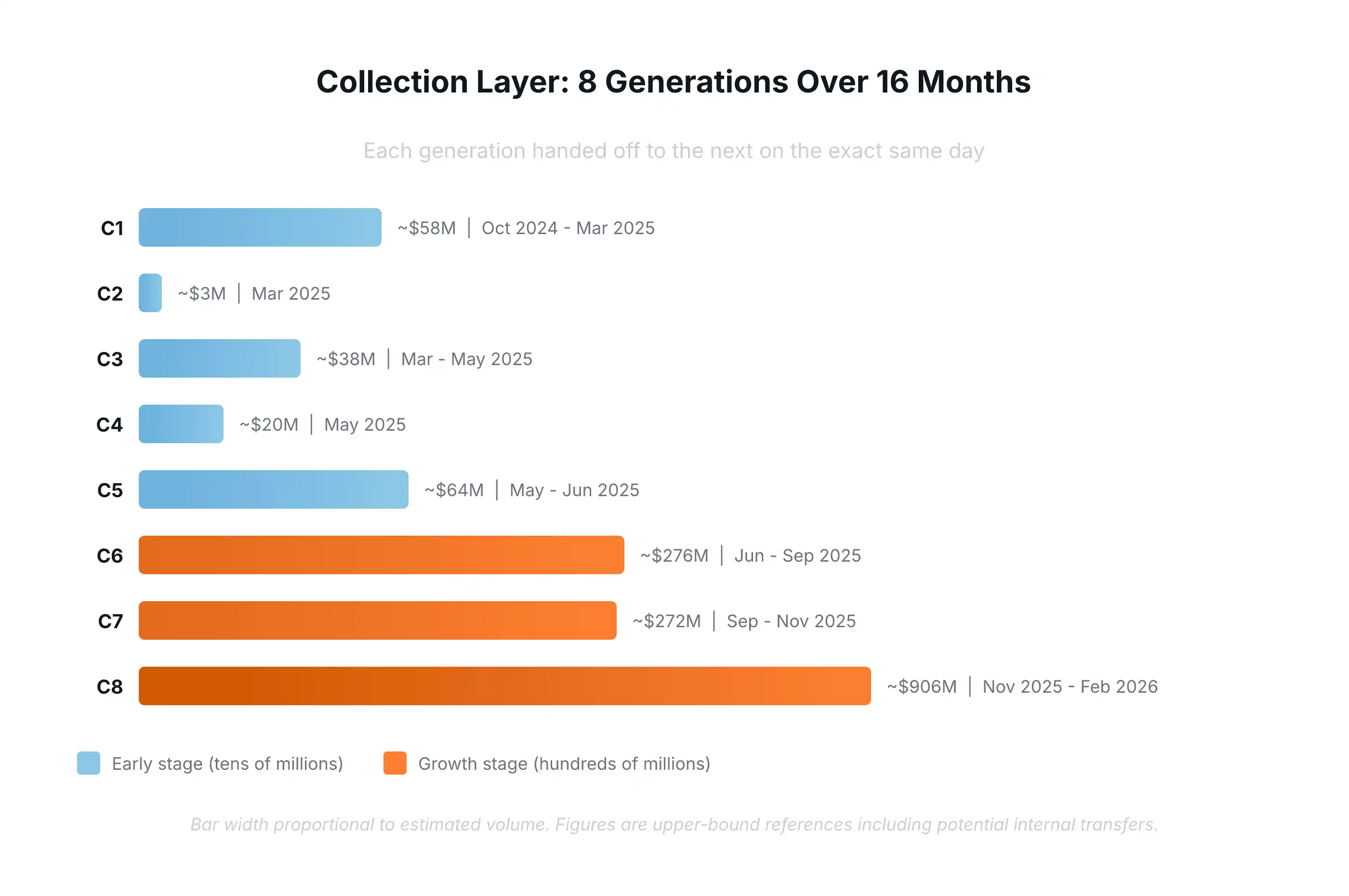
Caption: Receiving layer timeline, showing transaction volume climbing from $3 million to $906 million across 8 generations of hot wallets

Intermediate Layer: 79 Transit Addresses Converge to Known Hubs

Funds leaving the receiving hot wallets did not go directly to the withdrawal layer. They passed through 79 intermediate transit addresses, each with very few incoming sources, more outgoing targets, and a net retention close to zero. Over 80% of the transiting funds ultimately converged on a few identified withdrawal channel hubs.
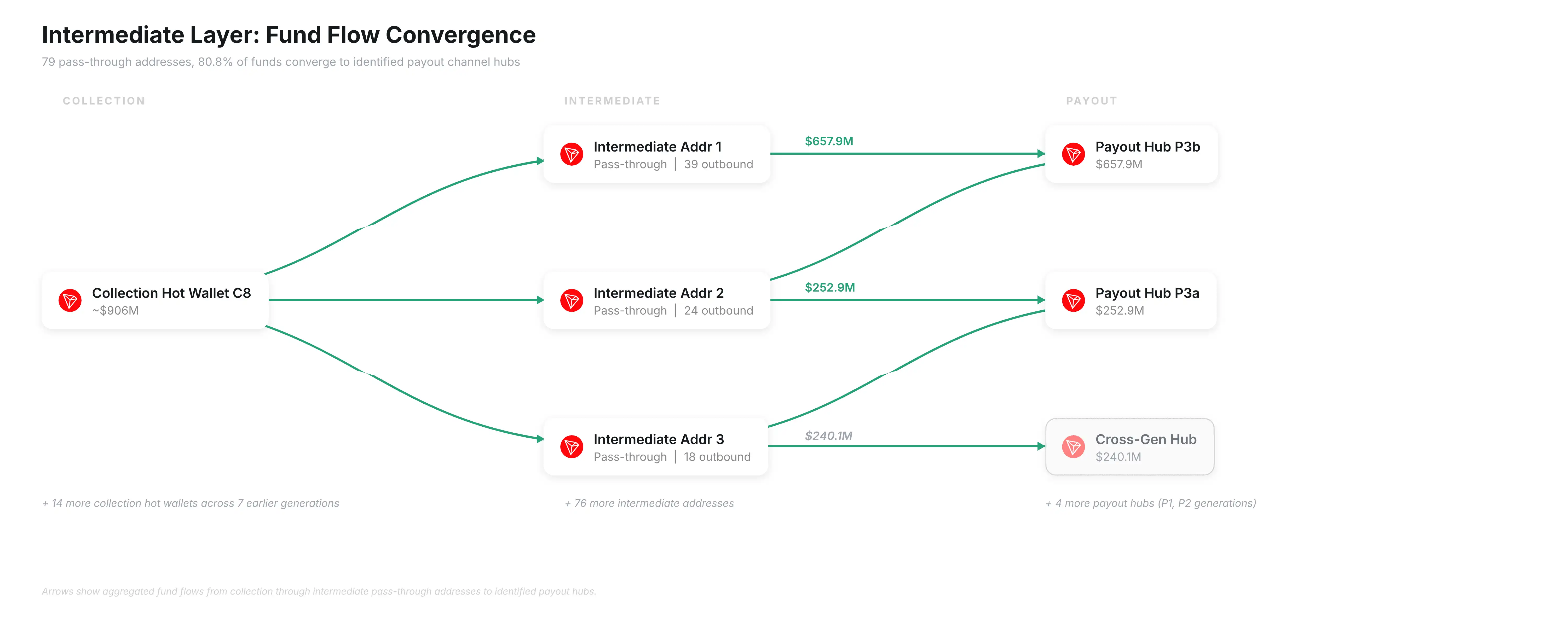
Caption: Intermediate layer fund flow: from receiving hot wallets through transit addresses converging to identified withdrawal hubs

Most of these funds flowed towards the withdrawal layer, but one node stood out. A cross-generational hub received funds from 75% of the intermediate addresses, spanning 6 of the 8 receiving generations, accumulating about $240 million. But its downstream structure was明显不同 (clearly different) from the identified withdrawal channels.

On-chain tracking revealed direct fund connections between this hub and multiple wallet addresses of the Huione Group. Huione is a Cambodian financial group placed on the US FinCEN list prohibiting access to the US financial system. On the incoming side, at least 4 Huione Group hot wallets transferred about $4.6 million to this hub through a chain of intermediate addresses (minimum 5 hops). On the outgoing side, the hub directly transferred funds to at least 2 Huione Group deposit addresses, amounting to $4,200 and $1.5 million respectively.

The fund flow between this cross-generational hub and Huione indicates that VerilyHK's fund routing infrastructure may have utilized Huione's network as a money laundering channel. This aligns with FinCEN's designation of Huione as a "key node for laundering money from virtual currency investment scams".
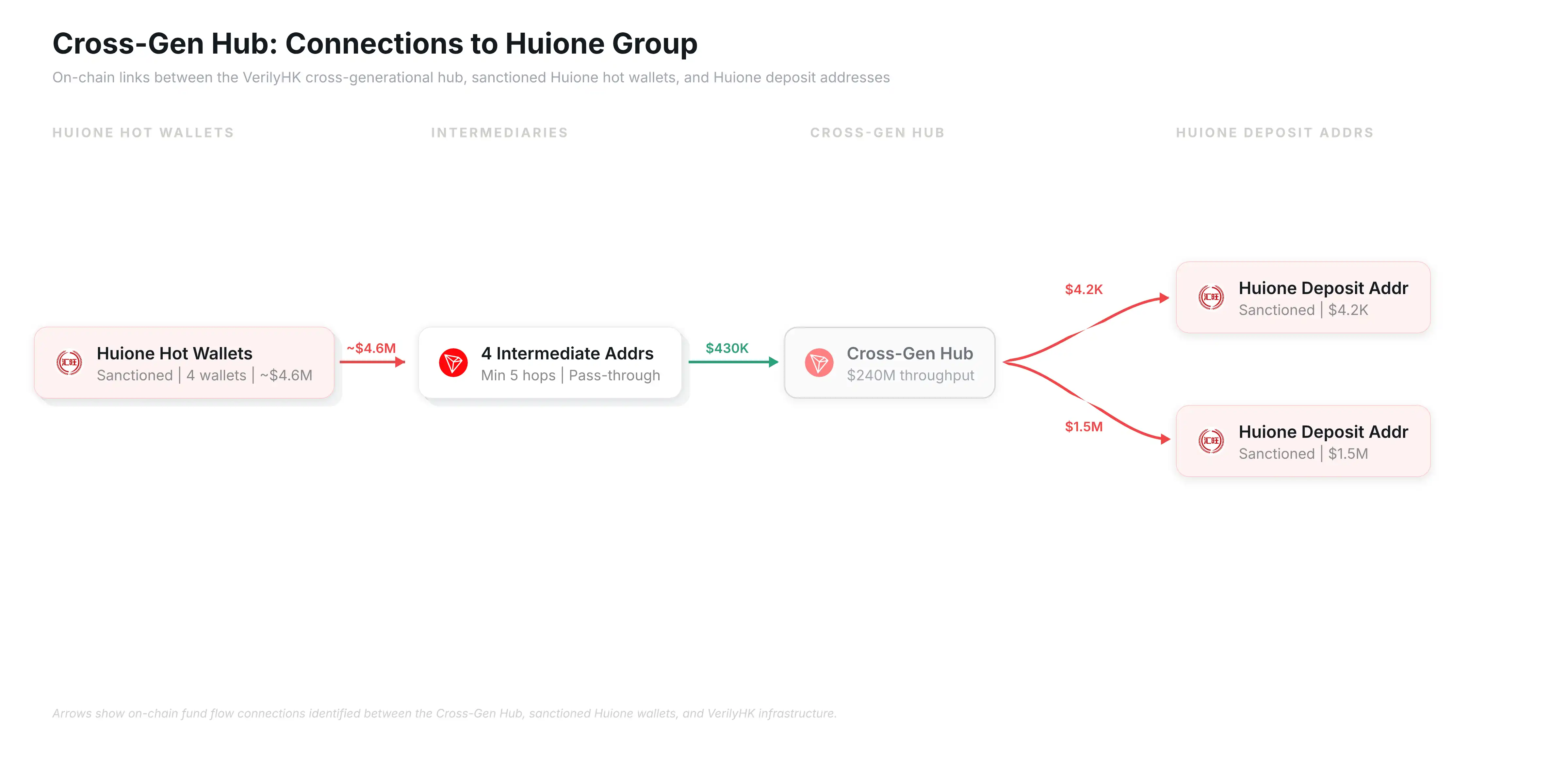
Caption: Fund flow between the cross-generational hub and the sanctioned Huione Group's hot wallets and deposit addresses

Withdrawal Layer: From Paired Channels to Shared Exchange Exit

The generational structure on the withdrawal side mirrored the receiving side exactly. Three generations of withdrawal addresses were identified, with a total withdrawal volume of approximately $1.1 billion. Like the receiving layer, the切换精确到秒 (switching between generations was precise to the second): on-chain timestamps show the second-generation channel stopping and the third-generation channel starting at the exact same moment. This pattern is difficult to explain by anything other than a preset switching plan by the same operating team.

Within each generation, the architecture followed a consistent pattern: dedicated bridge addresses first aggregated funds from the intermediate layer, then forwarded them to a pair of parallel withdrawal channels—one primary, one secondary. The start times for each pair differed by minutes, the stop times by seconds, but one channel's processing volume was always significantly higher than the other's. This "bridge → paired withdrawal" structure recurred across all three generations, proving it was a designed infrastructure, not temporarily created wallets.
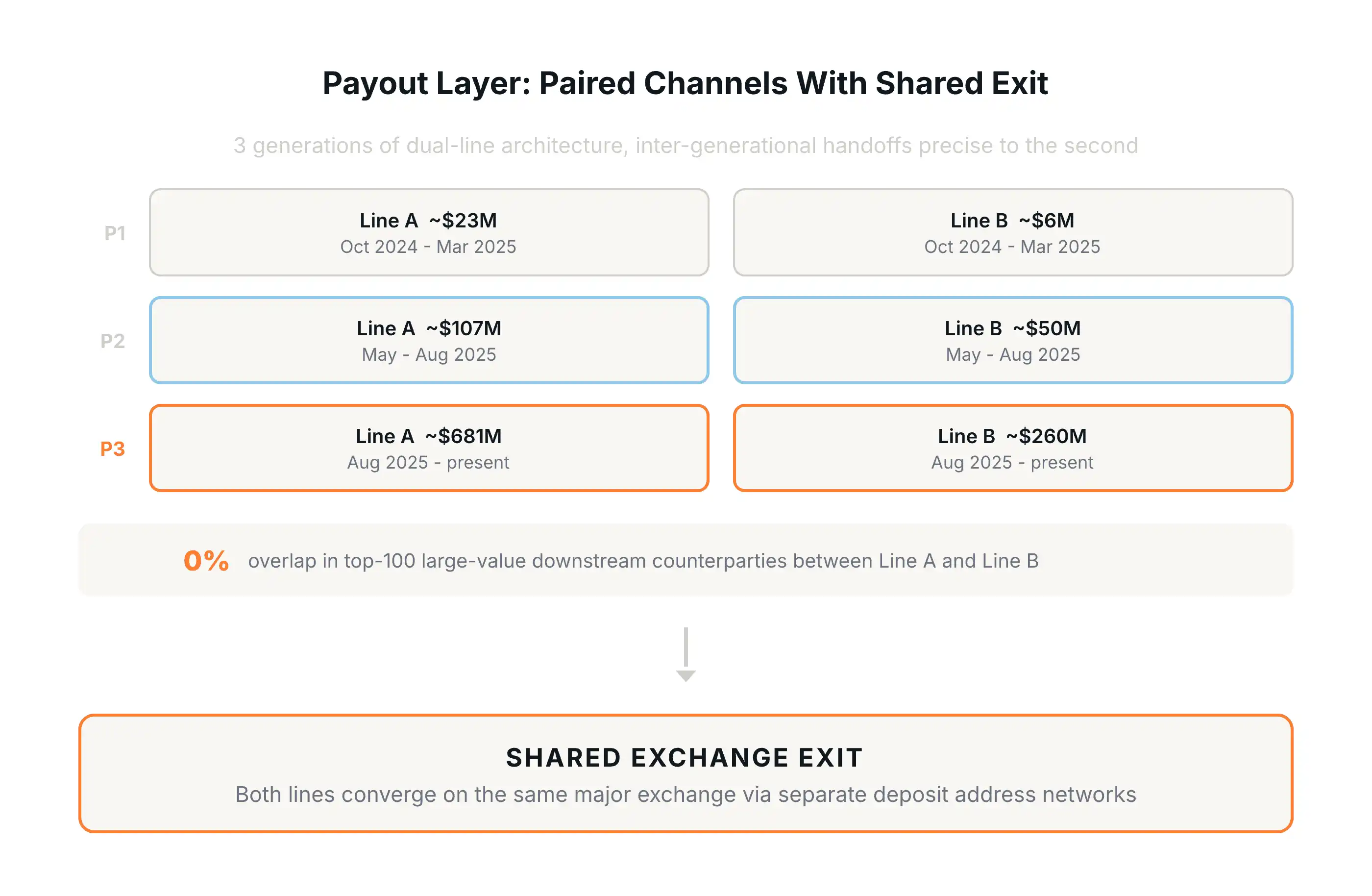
Caption: Withdrawal layer showing 3 generations of paired channels, each with largely independent downstream networks,最终汇聚于共享交易所出口 (ultimately converging on a shared exchange exit)

A closer look at the third-generation paired channels shows this separation more clearly. One channel's processing volume was about 2.6 times that of the other. Comparing the top 100 large downstream counterparts for both, the overlap rate was zero. Although supplied by the same upstream source and running concurrently, they operated completely independent downstream distribution networks.

What the two lines truly shared was the final exit. In their small downstream transfers, both lines showed the same pattern: funds flowed through tens of thousands of one-time addresses (each with almost only one incoming and one outgoing transaction),最终汇入同一个主要中心化交易所 (CEX) 的热钱包 (ultimately converging into the same primary centralized exchange (CEX) hot wallet). But even here, the two sets of deposit address intermediaries were almost completely independent—only 9 shared addresses out of approximately 60,000, like two separate pipelines feeding into the same exchange. On-chain data confirms the funds entered the exchange's processing pipeline, but cannot identify the specific user accounts behind these deposits.

Full Picture: Four-Layer Funnel

Summarizing all findings, VerilyHK's on-chain fund routing architecture formed a clear four-stage funnel: extremely dispersed at the front end, highly concentrated in the middle, dispersed again at the withdrawal layer, and finally exiting through the exchange.
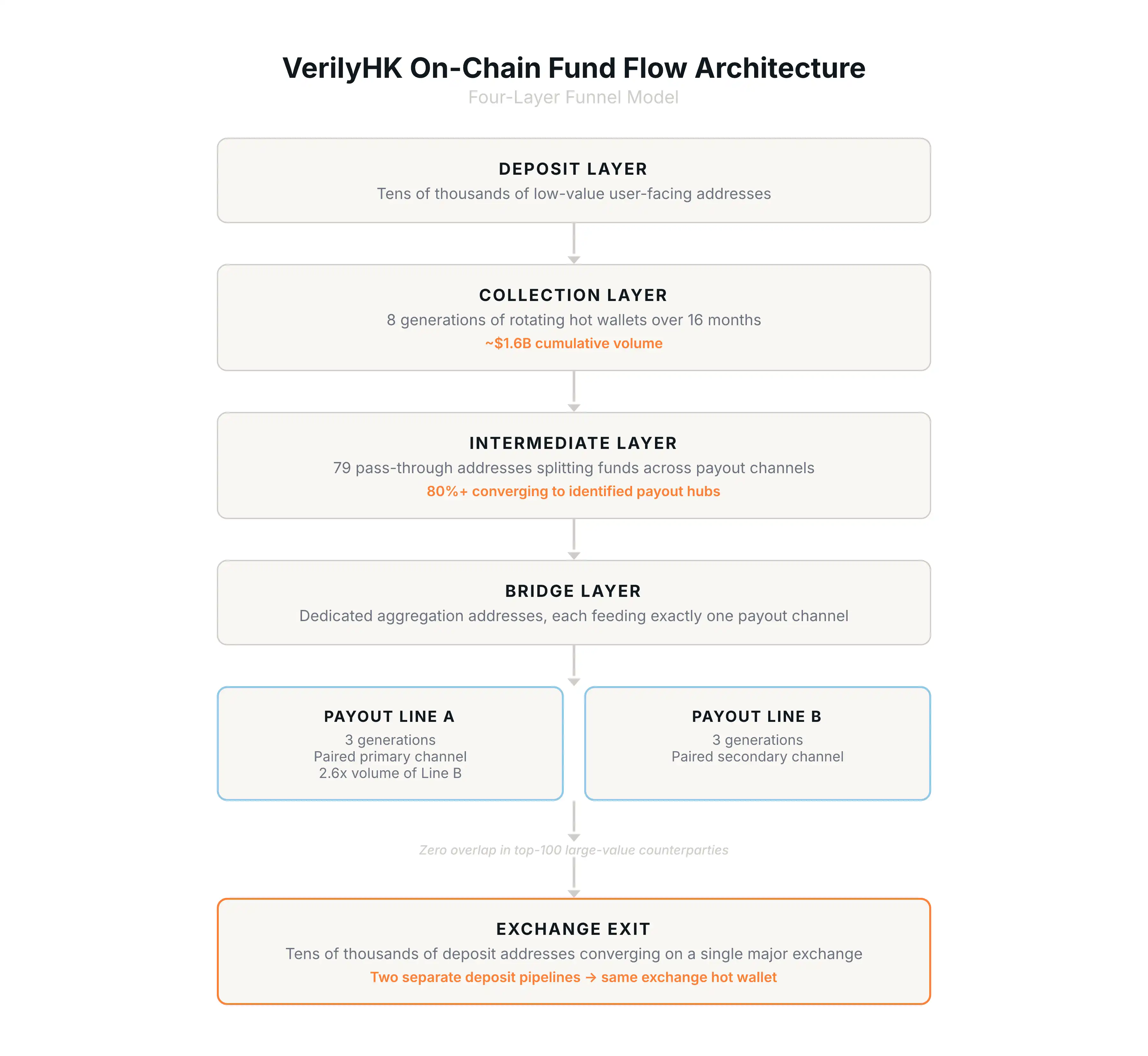
Caption: VerilyHK's four-layer funnel architecture—Deposit Layer, Receiving Layer, Intermediate Layer, Bridge Layer, Dual-Line Withdrawal, Exchange Exit

Most striking is the huge transaction volume (cumulative ~$1.6 billion on-chain fund flow) and the sophistication of the underlying infrastructure: day-precise generational handovers, paired withdrawal channels with基本独立的下游网络 (largely independent downstream networks), tens of thousands of one-time addresses converging into a shared exchange exit.

For exchange compliance teams, the structural features documented here constitute actionable detection heuristic indicators, especially the pattern of tens of thousands of one-time deposit addresses converging to the same hot wallet. For investigators and regulators, this layered architecture illustrates why tracking illicit funds requires going beyond single transactions to reconstruct the complete network topology.

All on-chain analysis in this article was completed using the MetaSleuth on-chain analysis tool, part of BlockSec's anti-money laundering and compliance suite. The analysis follows the Highest Value Path methodology, with all conclusions annotated for evidence strength and applicability boundaries.


İlgili Sorular

QWhat was the total amount of USDT processed by the VerilyHK platform over 16 months, and on which blockchain network?

AThe VerilyHK platform processed approximately 1.6 billion USDT over 16 months on the TRON network.

QHow many generations of hot wallets did VerilyHK use for receiving funds, and what was a key characteristic of their operation?

AVerilyHK used 8 generations of hot wallets for receiving funds, which were rotated in a strict, sequential order with precise day-level handover dates between generations.

QWhich sanctioned financial group was the VerilyHK platform's funds linked to through a cross-generational hub, and what was the nature of this link?

AFunds were linked to the Huione Group, a Cambodian financial group sanctioned by FinCEN. A cross-generational hub received funds from and sent funds to Huione Group wallets, indicating the platform's infrastructure potentially used Huione's network for money laundering.

QDescribe the structure of the withdrawal layer and its key feature for obfuscating the final destination of funds.

AThe withdrawal layer consisted of 3 generations of paired channels (a main and a secondary line). Each pair, fed by a dedicated bridge address, operated with largely independent downstream networks. However, both lines in a pair ultimately funneled funds through tens of thousands of one-time deposit addresses into the same centralised exchange (CEX) hot wallet, creating a shared final exit.

QWhat are the four main layers of VerilyHK's fund routing infrastructure as described in the 'Panorama: Four-Tier Funnel' section?

AThe four main layers are: 1) The充值层 (Deposit Layer) with numerous user addresses, 2) The收款层 (Receiving Layer) with generational hot wallets, 3) The中间层 (Middle Layer) with transit addresses, and 4) The桥接层/出金层 (Bridge/Withdrawal Layer) with paired channels leading to the shared CEX exit.

İlgili Okumalar

STAR 50 Soars 10.73%, Why Did A-Shares Stage a "V-Shaped Reversal"?

After a prolonged decline, the Chinese A-share market staged a strong rally on July 21. The STAR 50 index surged 10.73%, its largest single-day gain in nearly a year, leading a broad-based "V-shaped" reversal. The Shanghai Composite Index rose 1.79%, the Shenzhen Component Index gained 4.81%, and the ChiNext Index jumped 7.05%. Total market turnover reached 2.97 trillion yuan, an increase of 256.1 billion yuan from the previous session, with over 3,100 stocks advancing. The semiconductor sector spearheaded the rebound, with related ETFs posting significant gains. Analysts attribute the surge to three converging factors. First, coordinated capital inflows from "national team" institutions, insurance funds, listed company buybacks, and fund house self-purchases have bolstered market liquidity and confidence. Second, supportive policy signals, including commitments from regulators to ensure stable market operations, provided a favorable backdrop. Third, a stabilization and recovery in overseas markets, notably South Korea, created a positive external environment. Institutions suggest the most severe panic selling phase for the tech sector has likely passed, following a significant digestion of crowded positions and leveraged funds. While short-term volatility may persist, the medium to long-term outlook remains underpinned by enduring trends like AI computing demand expansion and semiconductor localization. The market's focus now shifts to the sustainability of supportive fund flows, earnings reports, and upcoming catalysts from the global AI industry chain.

marsbit39 dk önce

STAR 50 Soars 10.73%, Why Did A-Shares Stage a "V-Shaped Reversal"?

marsbit39 dk önce

U.S. Tech Momentum Stocks Post Largest Single-Day Gain Ever, But Is the Plunge Over?

US tech momentum stocks staged a sharp rebound on Tuesday (July 21st). Morgan Stanley's TMT Momentum Factor surged over 12%, marking its largest single-day gain on record, exceeding even peaks from the 2000 dot-com bubble. Key momentum indices from Goldman Sachs also posted their strongest daily performances in years. The rally was led by semiconductors, with the Philadelphia Semiconductor Index jumping 4.6%. This rebound followed three consecutive down days and a cumulative 33% plunge in momentum stocks, one of the steepest drawdowns since the dot-com era. Analysts attribute the surge largely to a short squeeze. Heavy selling had pushed high-beta momentum stocks into deeply oversold territory, forcing many short sellers, particularly in Asia, to cover their positions, creating a self-reinforcing buying spiral. However, the rebound's internals appear weak. Trading volume was notably low, and advancing stocks still lagged decliners on the S&P 500, indicating a narrow, concentrated rally rather than broad market participation. Diverging views emerge on the outlook. BTIG warns the bounce has hit key resistance and recommends selling into strength, citing extreme volatility and historical parallels to past market tops. Conversely, Goldman Sachs and UBS believe the momentum unwind is nearing its end, suggesting it may be time to gradually add exposure, as positioning has been significantly reduced. They caution, however, that high volatility warrants a measured approach, potentially using defined-risk strategies. The upcoming earnings season, particularly reports from major tech firms like Alphabet, is seen as a critical test for the rally's sustainability. Simultaneously, bond markets flashed a warning, with yields rising partly due to spiking oil prices. Analysts note that if long-term Treasury yields break decisively higher, it could pose a significant headwind for equities, especially growth stocks.

marsbit46 dk önce

U.S. Tech Momentum Stocks Post Largest Single-Day Gain Ever, But Is the Plunge Over?

marsbit46 dk önce

U.S. Tech Momentum Stocks Record Largest Single-Day Gain Ever, but Has the Rout Ended?

U.S. tech momentum stocks staged a dramatic rebound on Tuesday, July 21st. Key momentum indices like the Morgan Stanley TMT Momentum Factor and Goldman Sachs' High Beta Momentum Long Index posted historic or near-historic single-day gains, fueled largely by semiconductor stocks. This sharp rally followed a severe three-day sell-off that saw momentum stocks plunge 33%, marking one of the steepest pullbacks since the dot-com bubble. Analysts attribute the bounce primarily to a short squeeze, as forced covering from over-leveraged traders, particularly in Asia, created a buying spiral. However, the rally's health is questioned due to weak market breadth—overall trading volume was low, and decliners outnumbered advancers in the S&P 500 despite the index's gain—suggesting a narrow, concentrated surge rather than broad recovery. Opinions on the sustainability diverge. BTIG strategists warn the rebound has hit key resistance levels, citing extreme volatility and historic stock dispersion as signs of an ongoing broader correction, and recommend selling into strength. Conversely, Goldman Sachs and UBS view the aggressive momentum unwinding as nearing its end, noting reduced positioning and a lack of new fundamental catalysts. They suggest the sell-off presents a selective opportunity to add exposure, albeit cautiously and gradually using defined-risk strategies. The immediate trajectory hinges on the ongoing earnings season, with market focus on Alphabet's capital expenditure guidance for AI investment clarity. Meanwhile, bond markets present a risk, with rising Treasury yields—potentially heading toward 5.5%—and widening credit spreads for mega-cap tech companies posing a threat to equity valuations. The combination of technical factors, earnings results, and macro conditions leaves the durability of the rebound in doubt.

链捕手49 dk önce

U.S. Tech Momentum Stocks Record Largest Single-Day Gain Ever, but Has the Rout Ended?

链捕手49 dk önce

Long-Divided Must Unite, Long-United Must Divide: When L1 Becomes Its Own Rollup, What Is Ethereum's Endgame?

"The Inevitable Cycle: When L1 Becomes Its Own Rollup – What is Ethereum's Endgame?" For years, the Ethereum community grappled with concerns that L2s were fragmenting the ecosystem and eroding L1's value. While L2s provided cheaper execution, they also splintered liquidity and the unified user experience of a single chain. This has prompted a fundamental reassessment of the relationship between L1 and L2. Ethereum's roadmap is evolving. The "Scale" initiative merges L1 and L2 expansion into a holistic framework. L1 itself is advancing with higher gas limits, statelessness, and zkEVM verification, no longer content to be just a low-throughput settlement layer. Consequently, the primary value proposition of L2s is shifting from merely providing cheap blockspace to offering L1 cannot easily provide: application-specific optimizations, privacy features, and flexible governance models. L2s are becoming a spectrum of execution environments with varying degrees of security inheritance from Ethereum. A critical challenge in this multi-chain future is interoperability. The vision is to make Ethereum "feel like one chain again." This relies on advancements in native account abstraction (like EIP-7702) and intent-based architectures (Open Intents Framework), where users declare desired outcomes, and solvers handle the complex cross-chain execution. Furthermore, shortening Ethereum's finality time from minutes to seconds is crucial, as it underpins trust between chains for bridges, stablecoins, and cross-chain applications. Perhaps the most provocative idea is that Ethereum L1 itself could become a form of "its own Rollup." As zkEVM and proof systems mature, high-performance nodes could execute transactions and generate validity proofs. Regular validators would then verify these proofs instead of re-executing all transactions. This blurs the traditional L1/L2 hierarchy, making "Rollup" more of a general execution-verification architecture. Native Rollup aims to integrate L2 validation more directly into the Ethereum protocol, allowing L2s to inherit L1's security more fully and move away from reliance on security councils. In the end, L2s are not destined to replace L1 or be made obsolete by it. The likely future is a unified system where diverse execution environments—each optimized for specific use cases like DeFi, gaming, or privacy—coexist. They will share a common foundation of security, liquidity, and verifiable state, seamlessly connected to restore a cohesive user experience. The next phase for Ethereum is not just about scaling through separation, but about intelligently reintegrating what was separated back into a coherent whole.

链捕手1 saat önce

Long-Divided Must Unite, Long-United Must Divide: When L1 Becomes Its Own Rollup, What Is Ethereum's Endgame?

链捕手1 saat önce

İşlemler

Spot
活动图片




